Jagadevappa Patil
Dept of Pharmaceutics, SVERI’s College of Pharmacy, Gopalpur, Pandharpur-413 304, Maharashtra Mail id: [email protected]
Address for correspondence
Access this article online www.japer.in
Translation and Commercialization of Pharmaceutical scientific
Innovations: An Overview
INTRODUCTION
Technology transfer (TT) is a process, which includes mutual exchange of scientific findings from one
organization to another with the intention of
developing new products such as medicines,
educational tools, electronic devices, safety equipment
and health services for the better public use.[1,2]
Pharmaceutical TT is helpful, for example, to develop new drug delivery systems with improved efficiency,
maintains quality of product and helps to achieve
standardized process that facilitates cost effective
production.[3,4] Successful results of scientific
research are generally utilized to develop practical
applications with an intention to produce useful
products for society and this process is well
recognized as technology transfer (TT). Thus, TT is
anything that facilitates to yield economic and social
benefits to the people from scientific innovation. Due
to its complexity TT is an expensive and long term
process of R&D derived from basic research, applied
research and commercial development. TT process
generates new products, services, jobs and has impact on the economic well-being of a society either directly
or indirectly. It is almost proved and accepted that TT
affects the economic status of countries that already
have promoted it through their active innovative
systems. The success of TT in western countries such
as the United States is well attracting and influencing
to create interest from several other countries to
change or modify their laws/policies which can help
them in better management and transfer of successful
results of innovations. A key example is three tier R&D
process based on TT, which can be found in the
invention and development of drugs in
pharmaceutical industry. For them, TT helps for
successful progress from drug discovery through
product development, clinical trials and full-scale commercialization of a product. Thus, TT is a process
of making availability of advanced innovations from
one party to another commercial partner to exploit Re
ReRe
Reviewviewviewview ArticleArticleArticle Article
Economic and social transformation of a country depends on adopting advanced technology. The rightful usage of the later leads to a significant improvement in quality of production, export efficacy, and ultimately results in improving living standards of the people. Generally, scientific innovations are converted into technology helps in every area. The promise of technology transfer is recognized as a key consideration for the present globalized world irrespective of the countries with different income strata. The process of technology transfer in the field of medicine and pharmaceuticals helps to face the crucial challenges and leads phenomenal improvement in the field of global health. This can create necessary conditions for global economic growth and poverty reduction. Most of the research based pharmaceutical industries engaged in unique type of technology transfer which are the part of today’s business practice. For the authorities responsible for public health policy making, technology transfer in medicines and pharmaceuticals is of major importance in order to upgrade the public health. To contribute to these discussions and with a view to share the knowledge, we have attempted to narrate the various steps involved in pharmaceutical technology transfers.
Key words: Technology transfer, Economy, Research and development, Global health.
ABSTRACT ABSTRACT ABSTRACT ABSTRACT Jagadevappa Patil*1, Meghanath
Shete1, Vaibhav Chipade2, Prashant Gurav1, Ravindra Kulkarni2
1Department of Pharmaceutics, SVERI’s College of Pharmacy, Gopalpur-Ranjani Road, Gopalpur, Pandharpur-413 304, Maharashtra, India.
2Department of Pharmaceutical Chemistry, SVERI’s College of
Pharmacy, Gopalpur-Ranjani Road, Gopalpur, Pandharpur-413
304, Maharashtra, India.
J. Adv. Pharm. Edu. & Res.
the technology in enhancing the value of their product.
TT is a legal as well as an economic concept, follows an investment climate which is determined more by
economic considerations such as market nature,
business competitiveness and factors of production
parameters than anything else. To provide better
global health facilities, as health is a fundamental human right of the common public, there is an obvious need to intensify increase in the resources required
for health care R&D. However, TT has become a key
driver of health care R&D. The importance of
pharmaceutical TT for developing countries with
respect to health and economic improvement has
been recognized as the highest priority. This paper
was prepared with the aim to discuss trends or
advancements of TT since its historical conception. An
attempt was also made to initiate the awareness about
this novel policy which is considered most useful for
global health improvement.
Conceptual origin and historical milestones:
Concept of TT is not a new thing as per many
researchers. The conceptual origin of TT can be traced
back to the pre-history of human species where it
largely involved tacit knowledge which is evolutionary
prior to explicit knowledge.[5,6] Until 3000 BC there
were no written languages reported to be utilized in
the TT process. And during this period TT had mainly
occurred through languages, which were
supplemented by equations and, diagrams constituted
as the major means of explicit transfer of
technological knowledge. TT process was explicitly
done in friendly encounters mainly through the
spoken language and gestures without thesupport of
any written literatures. However, much of
pre-historic TT occurred between people when they
assimilated superior agricultural technologies and
eliminated those which could not reproduce as
rapidly.[7 It was traced from the Neolithic times to the
role that Arabs played in transferring technologies
from East to West and the transfer of English textile
expertise to the American textile industry in the
eighteenth and nineteenth centuries.[8] In the
eighteenth Century, France managed to import
English workers through industrial espionage, despite
the English law preventing knowledge migration.
American textile industry became successful in the
eighteenth and nineteenth centuries through transfer
of knowledge and expertise by the English textile
industry. [9,10] Few TT models were developed after
the World War II to govern the implementation of TT
activities and their application to market place.[11,12]
Four important TT models that developed over the
period can be named as the appropriability model,
dissemination model, knowledge utilization model,
and communication model. In studies carried out in
1970 “the economic international trade approach”
was adopted in developing a linear model.[13] In the
1980s research on TT emphasized on the
effectiveness of the specific technology being
transferred which in general was within a broader
context of economic development.[14] Strategic
management researchers have further contributed to
the development of TT frameworks based on
knowledge-based view (KBV) and organizational
learning (OL) perspectives, as these were found to
have quite similar dimensions such as outcomes,
processes, barriers and facilitators. These
perspectives have significantly contributed to the
expansion of TT models since literatures from both
KBV and OL perspectives appear to subsume most of
the contributions.[15] The development, transfer of
knowledge and technology has been and will continue
to be critical to the success of pharmaceutical
industry. World Health Organization (WHO) has
framed global strategy and plan of action on public
health, innovation and intellectual property rights, accordingly importance of TT for medicines is
recognized with an agreed action to promote TT in
developing countries.
Benefits of technology transfer:
TT is one means by which developing countries can
accelerate the acquisition of knowledge, experience
and equipment related to advanced, innovative
credited with the potential to develop improved
health care products, increase the reliability of supply
and decrease reliance on imports, raise the
competence of local workforce and reverse the “brain
drain” from developing counties, by increasing local
employment opportunities. Over and above the
beneficial impact on economic and social development
normally credited to technology transfer. TT is also
useful in improvement of the health of people of the
recipient country by increasing access to innovative
medicines. Thus, TT is essential for economic
development and can help the pharmaceutical
industries in the following ways.
• TT establishes innovative research and development activity. The needful information can be
elucidated from research and development activities.
That informationcan be further transferred to actual
production.[16] Ultimate goal for successful TT is to
have documented evidence that the manufacturing
process for drug substances/drug products is robust,
effective, complying with the registered specifications
and Good Manufacturing Practice requirements.[17]
• TT extends the benefits of R&D to the society especially in developing countries. Research is carried
out in laboratories on an experimental scale in small
batches before it could be produced for commercial
use at large batches. TT is important for such research
results to materialize on a larger scale for
commercialization especially in the case of products
which are being developed. TT includes not only the
patentable aspects of production but also includes the
business processes, such as knowledge and
skills.[18,19]
• TT provides an opportunity to reduce cost on drug discovery and development, thus major
pharmaceutical companies look for technology
transfer opportunities to reduce the risk, cost and rate
of failure.
• TT elucidates necessary information of existing product between various manufacturing places; to
develop new, more effective compounds, delivery
systems, and medical devices, to ensure safety, purity,
and effectiveness of drug products.
• TT helps in compliant and effective commercialization to bring new, more effective
products to market faster, to interpret the consistent
good manufacturing practice (GMP) regulations, to
adhere to all applicable regulations and guidelines, to
establish cost-effective production/ distribution and
achieve superior return on investment to
shareholders as well as stakeholders.
• TT provides safe and effective treatments to patients and achieves affordable healthcare cost.
Need for the technology transfer [20, 21] :
An organization develop the technology comes
forward to transfer it to the other organization instead
of self exploitation for numerous reasons. Technology
is transferred between two parties. Some of the
reasons why TT is done are as follows.
• To establish alliance with the partners for
clinical and regulatory studies.
The original inventor of technology have resources
only to conduct early-stage research activities such as
animal and toxicology study, but doesn’t have the
resources to take technology through its clinical and
regulatory phases must collaborate with another
organization to complete the entire phases which are
required to launch the product commercially.
• To establish alliance with partners having
manufacturing capability.
Here, the developer of technology has small scale
manufacturing equipments and does not have
extended facility for large scale manufacturing. Under
such circumstances the developer of the technology
must establish the alliance with a partner belonging to
another organization that does have that capability.
These kinds of alliances are some time also named by
the term ‘contract manufacturing’.
• To establish alliance with partners having
marketing and distribution capability.
Here, the organization is able to develop the
technology till getting regulatory approvals and
distribute its product successfully for marketing and
must collaborate with the organization that does have
that capability.
• To establish multiple exploitation partnership
If the technology is developed with multiple intentions
such as diagnostic and therapeutic applications, the
developer may like to establish partnerships with different organizations to exploit the technology for different applications so that he can create multiple
streams of income.
• To establish collaboration between research
institutes and commercial organizations.
Most of research organizations/universities develop
the technology, but do not have capability of
exploitation required to collaborate with commercial
organization have it. This kind of
industry-institutional collaborations can bring many better
pharmaceutical products in to the market.
Various stages of new drug development and TT
[16, 20]:
TT is not a single stage process; it involves the
transformation of a pharmaceutical prototype into a
successful product and requires the cooperation and
active involvement of many individuals. The classic
view of a flow from basic to applied technology is a
great over simplification sometimes, for instance,
problems or insights arising at the production level
give rise to new ideas that contribute to fundamental
basic advance. During development of a formulation,
care should be taken to understand operational
procedure used, critical and non-critical parameters of
each operation, production environment, equipment
and excipient availability, which should be taken into
account during the early phases of development of
formulation, so that successful scale up can be carried
out. Appropriate care during TT is important to
enhance drug quality as developed by R&D in final
formulation as well as to assure quality for
predetermined period of time. The various stages
involved in new drug development are depicted in the
below figure and stages of TT are given below:
Figure 1: Stages involved in the development of a new medicine
• Design of procedure and selection of
excipients
Prior to start with further steps, it is very essential
task to design the proper procedure and select the
right excipients. To begin, R & D does some exercise to
select the excipient materials required for the
proposed production and design the correct
procedure based on innovator product characteristics
by carrying out different tests and compatibility
studies.
• Identification of specification and quality
As innovator products should meet certain quality
specifications, R &D conducts stability studies for
innovator product and for product which is to be
manufactured.
• Technology transfer from R&D to production
R&D provides technology transfer dossier (TTD)
document to product development laboratory, which
contains all information of formulation processes and
drug product that include master formula record
(MFR) contains product name along with its strength,
generic name, MFR number, page number, shelf life
and intended market. Master packaging record gives
information about type of packaging, material used for
packaging, stability profile, and shelf life of packaging
materials. Specifications and standard test procedure
(STPs) helps to know active ingredients, excipients
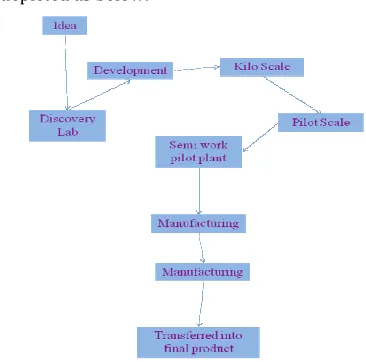
profiles, critical in-process parameters, specifications, and finished product details. The flow chart of TT can
be depicted as below:
Figure 2: The flow chart of technology transfer
Different ways of technology transfer:
Transfer of technology usually happens in different
ways between government laboratories to private
sectors, between the private sectors of the same
country, between academic and private sectors,
between academy, government and private sectors of
different country.
• Between government laboratories and private
sectors
Government laboratories usually avail plenty of
research grants under various heads from statutory
and other funding agencies. The technology developed
by government laboratories reach the private sectors
through TT. The main advantage of this type of TT is
that there is no added financial burden on government
laboratories, because they get additional financial
support and funds from government.
• Between private sectors of the same country
TT takes place between two private sector
organizations of the same country mainly in the
situations such as lack of commercialization ability,
financial constraints, inadequate knowledge of
regulatory requirements, and lack of sufficient human
resources. Here, the developer of technology gets
money against the transfer of technology.
• Between academia and private organizations
Such TT takes place between academic/research
institutes and private organizations. The
academic/research institutes develop the basic
technology that can be further developed and
commercialized. Many academic/research institutes
are actively involved in research and significantly
contribute to the development of technology. The
basic technology of drug discovery, developed by
research institutions, is absorbed for
commercialization by private organizations.
• Between private organizations of different
countries
TT takes place between private organizations of
different counties and it is particularly beneficial for
organizations that belong to developing countries in
strengthening of their economic status. The developed
country would get incentives for development and the
absorber county can commercialize the technology,
therebyit can build its economic status.
• Between government, academics and private
organizations
In this process, government can act as a facilitator in
developing the technology, the technology developed
by the academic institutions can then be transferred
to industry.
Types of Technology Transfer Models:
Traditional Models
• The Appropriability Model
This model was developed between 1945-1950s,
which suggests that no special efforts are being
infused for the sale of goods or quality technologies,
which sell themselves due to their better
attributes.[22] Also this model put light on the need of
quality research, highlights the importance of
competitive market pressure in gaining TT and
promoting the use of research findings.[11,12,22] As
per this model, TT happens only when a customer is
available as a user or market creates a new user. According to this model, once a technology has been
developed as an end product of research process, it is
made available as technical report through
professional journals which implicitly attract the user
to establish communication with technology
developers. Moreover, earlier reports have revealed
that technologies thus developed without being
reported or published have never gained importance
by the users.[23]
• The Dissemination Model
This model was developed in between 1960-1970s
and subsequently popularized.[24,25] The
dissemination approach describes about the
significance of technology and innovations to be
introduced to the customers by the experts[26] and
presumes that the expertise professionals share the
knowledge with the willing user. Once the
communications are established, the new technology
will move like water through a pipe line, once the
channel is opened to the user. The main drawback of
this model is its often unilateral communication
characteristics with non participation of users.
• The Knowledge Utilization Model
The knowledge utilization model was derived in late
1980s and has a significant influence on TT
literature.[27,28] This model stresses on the cardinal
role of interpersonal communication between the
technology developers/researchers and users, also on
the importance of organizational barriers or
facilitators of TT. This approach indicates an
evolutionary step which describes on how to organize
scientific knowledge for proper use in the technology
user’s setting.[29,30] The important assumption of
this model is that technology drivesdirectly from one
party to another in a single direction, unilaterally from
the experts to the users and tries to ease the
complexities involved in the TT process.[31] All the
aforementioned models still exhibit the linear bias and
show limitations in terms of their narrow applications
in TT.[12]
The Communication Model
This model has been consideredto be the alternative
model to previous three models [26,32,33]and works
on perceiving TT as communication and information
flow process with full exchange and sharing of
meanings. According to this model, the technology is
an on-going process, which consists either two-way or
nonlinear interaction by continuous and simultaneous
sharing of ideas among the participants. The
advantage of two way interactive communication is
that it overcomes the barriers existing between the
developers and the end users.[33,34] With all of its
appreciations as highlighted by this model it failed to
explain the intricacies with respect to the issues such
as knowledge transferred through collaborative
learning, the subjectivity of knowledge, the need for
contextual adaptation, assumption, and beliefs that
takes on more acute proportions with soft or
disembodied technologies.[12]
Advanced Models Developed After 1990s
A thorough review of literature reveals that apart
from the above traditional models many researchers
have attempted to develop new TT models
distinguishing from the traditional models. The later
models developed by researchers attempted to
address the limitations that arise from the traditional
models in terms of the application in contemporary
high-tech industries. [35] Several models developed
after 1990s have emphasized on the important
elements of communication between the technology
developer and the receiver or between different
organizations, the different levels and the factors
which influence TT process.
• Knowledge-Based View Related Models (KBV)
Kogut and Zander are among the first researchers who
established the foundation for knowledge based
theory of a firm when emphasizing the strategic
importance of knowledge as a source of competitive
advantage.[36] Their work is focused on the idea that
role of firms in creation and transfer of knowledge
within the organization is to do better than other
market leaders. This view was further articulated and
empirically testedto assert that the firms are efficient
means by which knowledge is created and transferred.
[37] A common understanding is developed by
individuals and groups in a firm through repeated
interaction to transfer knowledge from ideas into
production and markets. As firms provide a normative
territory to which members identify, costs of
coordination, communication, and learning within
firms are much lower which allow more knowledge to
be shared and created within firms.
• Organization Learning Related Models (OL)
This model explains the ability of an organization
about learning and focusing on the sources of
knowledge. The model describes that an organization
learns through hired individuals because of their
specific competencies or knowledge which may be
gained through on the job training or formal training.
Learning is an individual phenomenon, which benefits
the organization entirely through the individuals. OL
should involve systemizing knowledge into its
practices, processes, and procedures. When an
individual fails to use knowledge or resign, it will still
remain with the organization. If an organization
acquires or merges with other organization, OL occurs
when the acquiring organization absorbs the acquired
organization practices and procedures, or adds to its
personnel the knowledge embodied in the acquired
organization’s processes and personnel.[38] A
three-fold typology of organizational learning was
developed which contain single-loop, double-loop and
triple-loop learning.[39] Single-loop learning is
described as the error detection and their appropriate
corrections in order to allow an organization to
change its methods and rules to improve what is being
done within existing programs or policies. As a result,
the organization achieves its current objective more
efficiently. In addition to the error detection and
correction, double-loop learning involves change of
the value of existing theory-in-use of an organization.
Triple-loop learning is “learning how to learn” and
also a process how to execute single and double-loop
learning. A three stage model of OL was also proposed
based on the concept of knowledge acquisition,
knowledge sharing and knowledge utilization.
Knowledge acquisition refers to the development or
creation of skills, insights, and relationship, whereas,
knowledge sharing relates to the dissemination of
knowledge that has been learned and knowledge
utilization is the integration of learning to make it
widely available; where it can be generalized to new
environments. Knowledge and skill acquisition occur
not only through acquisition but also through
knowledge sharing and utilization.[40]
Anatomy/Channels of Pharmaceutical Technology
Transfer[41]:
The transfer of pharmaceuticals technology occurs
through many channels, all of which result in
improving the economic capabilities of the recipient
organization or an individual. What is transferred may
be a physical object or pure knowledge. Following one
definition, the following elements are identified:
• “Techno-ware”
This element comprises the transfer of some physical
objects such as equipments needed for use in research
laboratories or equipment required for manufacture
of pharmaceutical ingredients, or equipments
essential for packaging of the final products.
• “Human-ware”
This includes transfer of skills and expertise in the
form of human resources required for technology
management and learning. This can be exemplified
with conduct of a training course for researchers or
general practitioners across the world.
• “Info-ware”
TT can also create positive spillover effects into
associated industries and into the supporting public
sector research infrastructure; all techniques related
to knowledge, information and technology; in the form
of a technology license.[42]
• “Orga-ware”
This includes transfer of organizational and
procedural knowledge needed to operate a given
technology relating to a chemical or biological
compound, manufacturing of a particular drug
product, evaluation and optimization of the
procedures etc.
Role of Foreign Direct Investment (FDI) system on
TT:
Foreign Direct Investment (FDI) is by far the main
channel of TT, but other market mechanisms such as
licensing agreements, royalties and joint ventures are
necessary channels for transferring pharmaceutical
technologies. Through regulation and investment,
governments can help to create the right conditions
for technology markets to function. The
research-based pharmaceutical industry, like most other
industries, is seeing the newly industrialized countries
and other middle-income countries increasingly
relying on TT to access advanced foreign technologies
and grow their domestic capabilities. The
research-based pharmaceutical industry’s track record is proof
that in the public health arena, the historical
demarcation lines such as “North-South” are being
replaced by more complex networks of TT. The above
trend is not always shared by low income countries,
and is therefore sometimes characterized by an
exposure to foreign technologies and weak absorptive
capacity. This creates a particular challenge for
pharmaceutical TT and means that those parts of the
world least equipped to benefit today from TT are
among those who need its products the most.
The Favorable Conditions for Pharmaceutical TT:
Paramount commercial opportunities are available for
the private sector with respect to TT, but if the basic
conditions are right, non-commercial reasons may
also play a part. This is particularly true in advanced
technology sectors, especially when this might
provide an opportunity to open a market to a specific
technology. Many countries are already well
positioned in terms of pharmaceutical TTs. With
respect to potential TT ventures for pharmaceutical
and vaccine manufacturers a variety of factors are
considered. Many of these are influenced by
government policy decisions. However, the political
stability and rule of law are prerequisites for all the
investors. Research-based pharmaceutical companies
are looking for in prospective recipient countries. For
this purpose, eight critical factors are considered in
terms of creating favorable conditions for
pharmaceutical TTs, which are; a viable and
accessible promising local market, political stability
with good economic governance, clear development
priorities and effective regulation, availability of
skilled workforce and clear economic priorities,
adequate capital markets, innovation-friendly
environment with strong intellectual property rights
(IPR) with effective enforcement, quality of the
relationship between industry and government,
proper access to information, adherence to high
regulatory standards, and the extent they are able to
work together effectively for long periods of time. The
government has effective role in creating optimal
enabling conditions to attract TT based on overall
economic policy objectives of the country, and its
willingness in this respect is a strong determinant of
whether transfers will be directed towards their
domestic industrial sector. Indeed today, some
governments are taking an active role in encouraging
the TT. However, for low income countries, it is still
difficult for their domestic industry to meet the above
conditions and hence attract TT. In these cases, the
role of government and international development
institutions is greater and policy will play an
important role in determining the potential for TT in
the future.[43]
Role of Technology Transfer in the Improvement
of Global Health:
Low and middle income countries can accelerate the
acquisition of knowledge, experience and equipment
related to advanced, innovative industrial products
and processes. TT has been credited with the potential
to improve the health, increase reliability of supply,
decrease reliance on imports, and raise the
competence of local workforce. Over and above the
beneficial impact on economic and social development
normally credited to TT. In the field of
pharmaceuticals, TT can help to improve the health of
people belonging to recipient country by increasing
access to innovative medicines and vaccines.
Research-based pharmaceutical companies, members
of the International Federation of Pharmaceutical
Manufacturers Associations (IFPMA), can make a
unique contribution to improve global health through
the innovative medicines that they develop. In
addition, they have a strong track record of sustaining
programs to improve the health of patients in low and
middle income countries, by strengthening local
healthcare capacity, by educating patients and by
involving in R&D activities especially on the diseases
of developing world. Many research-based
pharmaceutical companies with their programs have
built up a credible track record using TT in
improvement of public health and country’s ability to
use innovative medicines, by strengthening the
expertise of the local scientific and medical
communities with the goal of improving the health
infrastructure. The rewards to companies transferring
pharmaceutical technology to emerging countries are
often reputational as well as commercial. Global
Strategy and Plan of Action on Public Health,
Innovation and Intellectual Property Rights of the
World Health Organization (WHO) has recognized the
importance of transferring technologies for medicines.
An agreed action is to promote transfer of technology
and creation of health products in developing
countries through identification of best practices,
investment and capacity building provided by
developed and developing countries where
appropriate44. While many newly industrialized
countries and other middle-income countries are
developing a strong experience and expecting the
benefits that access to advanced foreign technologies
and growing their domestic capabilities can bring; low
income countries may not always be able to offer the
preconditions required for successful uptake of TT. In
these circumstances, following are the conditions
based on IFPMA member companies’ experience of
TT: the governments can encourage TT by focusing on
attracting technology for which there is already a
demand from local companies, that which can help to
increase the local market and/or reduce regulatory
barriers. High income countries can help by giving
experts to low and middle income countries for
greater access to international standard setting
bodies, which will help to increase individuals’
technical expertise and familiarity with such
standards. Public sector institutions can also increase
technical and financial assistance to low and middle
income countries to strengthen local technical
competence.
CONCLUSION
Transformation of knowledge is in other words
extension of existing knowledge and the creation of
new knowledge. Thus, transformation is defined as
the integration, application and leveraging of
contributed knowledge, and the creation of new
knowledge as a result of R&D activities. The
cumulative commercialization of TT depends on the
success of creation, sharing and implementation. This
study contends that TT does not only require
transmission of knowledge but also knowledge
absorption and use. Effective adoption of the
technology, system, or management practices or all of
them to the local environment is the key factor for the
successful exploitation of an advantage of TT
internationally. In this view, a significant amount of
progress has been made towards achieving successful
pharmaceutical technology transfer that can
effectively help in improvement of global health. This
review significantly contributes to the existing
technology transfer literature by reviewing the
historical evolution and development in addition to
the comparative description on the traditional
technology transfer models with newly developed
models and could help to shape the direction of future
strategies on technology transfer specifically for low
and middle income countries.
REFERENCES
1. Ali S., Pandit V., Chander S. Technology Transfer in
Pharmaceuticals. Int. Res. J. Pharm. 2012; 3(6): 43-48.
2. Patel D.S. Nadiad. Technology Transfer an Overview of
Phamaceutical Industry. Int. Biopharm. Assoc. Publ.
2009; 2(4):2-8.
3. Reamer A., Icerman L., Youtie J. Technology Transfer
and Commercialization: Their Role in Economic
Development. EDA Public documents. 2003.
4. Patel D.S. An overview for pharmaceutical industry.
Int. Biopharm. Assoc. Publ. 2010; 1-10.
5. Donald M. Origins of Modern Mind: Three Stages in the
Evolution of Culture and Cognition, Cambridge; UK:
Harvard. 1991.
6. Mathews R. C., Roussel L. G. Abstractness of Implicit
Knowledge: A Cognitive Evolutionary Perspective, in:
D.C. Berry. Eds., How implicit is implicit learning?
Oxford: Oxford University Press, 1997: 13-47.
7. Diamond J. Guns, Germs and Steel, New York: W.W.
Norton & Company, 1997.
8. Segman R. Communication Technology: An Historical
View. J. Technol. Transf. 1989; 14(3, 4): 46-52.
9. Cameron E. H. Samuel Slater: Father of American
Manufacturer, Portland, MA: The Bond Wheel right
Company, 1960.
10.Irwin H., Moore E. Technology Transfer and
Communication: Lesson from Silicon Valley, Route
128, Carolina’s Research Triangle and Hi-tech Texas. J.
Informat. Sci. 1991;7: 273-80.
11.Devine M. D., James T.E., Adams T.I. Government
Support Industry-University Research Centers: Issues
for Successful Technology Transfer. J. Technol.
Transfer. 1987;12 (1): 27-37.
12.Tenkasi R. V., Mohrman S. A. Reviewing the Behavioral
Science Knowledge Based on Technology Transfer.
National Institute on Drug Abuse, Research
Monograph 155.1995: 147-68.
13.Bessant J., Francis D. Transferring Soft Technologies:
Exploring Adaptive Theory. Int. J. Technol. Manage
Sustain Dev. 2005; 4 (2):93-112.
14.Hope K. R. Basic Needs and Technology Transfer Issues
in the “New International Economic Order”. J. Econom.
Sociol.1983; 42(3): 393-404.
15.Daghfous A. An Empirical Investigation of the Roles of
Prior Knowledge and Learning Activities in
Technology Transfer. Technovation, 2004; 24: 939-53.
16.http://www.amuasi-paper-edited.pdf.
17.Patil R. P. Technology Transfer in Pharmaceutical
Industry: Objective, Issues and Policy Approaches. Int.
J. Pharm. Res. Dev. 2010; 2(10): 43-48.
18.Sanyang S.E., Kao T.C., Huang W.C. The Impact of
Agriculture Transfer to Women Vegetable Production
and Marketing Groups in the Gambia. World J. Agric.
Sci. 2009; 5(6):169-79.
19.Ortega A. J., Arce N. A., Sequeda F., Gribenchenko I.
Management of Innovation and Technology Transfer
Process Between University and Industry. The Mater
Res Cent Case 2009; 2: 7-8.
20.Biswajit D., Rao N. Transfer of Technology for
Successful Integration into the Global Economy: A Case
Study of the Pharmaceutical Industry in India.
UNCTAD 2002.
21.Bateni M. Selection of Appropriate Technology for
Developing Countries, Tadbir. 2000:108.
22.Gibson D.V., Smilor W. Key Variables in Technology
Transfer: A field – Study Based on Empirical Analysis.
J. Eng. Technol. Manage. 1991;8: 287-312.
23.Sazali A. W., Raduan C. R., Jegak U., Haslinda A. A
Review on the Technology Transfer Models,
Knowledge-Based and Organizational Learning Models
on Technology Transfer. Eur. J. Soc. Sci. 2009; 10(4):
550-64.
24.Rogers E.M. Diffusion of Innovations, New York: Free
Press.1983.
25.Rogers E. M., Kincaid D. L. Communication Networks: A
New Paradigm for Research, New York: The Free
Press.1982.
26.William F., Gibson D. V. Technology Transfer: A
Communication Perspective. Sage, Beverly Hills, CA,
1990.
27.Szakonyi R. 101 Tips for Managing R&D More
Effectively. Res. Technol. Manage. 1990; 33(4): 31-36.
28.Zacchea N. Technology Transfer: From Financial to
Performance Auditing. Manage Audit J. 1992; 7(1):
17-23.
29.Backer T. E. Drug Abuse Technology Transfer.
Rockville, MD. National Institute on Drug Abuse. 1991.
30.Dimancescu D., Botkin J. The New Alliance: America’s
R&D Consortia. Cambridge, MA: Ballinger Publishing.
1986.
31.Sung T. K., Gibson D. V. Knowledge and Technology
Transfer: Key Factors and Levels. Proceeding of 4th
International Conference on Technology Policy and
Innovation, 2000: 4.4.1-4.4.9.
32.Gibson D. V., Rogers E., Wohlert K. A
Communication-based Model of Technology Transfer. Paper presented
at the International Communication Association
Meeting, Dublin, Ireland, 1990.
33.Doheny-Farina S. Rhetoric, Innovation, Technology.
Cambridge, MA: MIT Press. 1992.
34.Dobrin D. Writing and Technique, Urbana, IL: National
Council of Teachers of English. 1989.
35.Rebentisch E. S., Ferretti M. A Knowledge-Based View
of Technology Transfer in International Joint Ventures.
J. Eng. Technol. Manage. 1995; 12:1-25.
36.Kogut B., Zander U. Knowledge of the Firm,
Combinative Capabilities, and the Replication of
Technology. Organiz. Sci. 1992; 3(3):383-97.
37.Kogut B., Zander U. Knowledge of the Firm and the
Evolutionary Theory of the Multinational Corporation.
J. Int. Busi. Stud. 1993; 24(4): 625-46.
38.Mills D. Q., Friesen B. The Learning Organization. Eur.
Manage. J.1992; 10(2):146-56.
39.Argyris C., Schön D. A. Organizational Learning: A
Theory of Action Perspective, Reading. MA:
Addison-Wesley. 1978.
40.Nevis E. C., Bella A. J. Di, Gould J. M. Understanding
Organizations as Learning Systems, Sloan Manage Rev.
1995; 36(2):75-85.
41.Technology Transfer: a Collaborative Approach to
Improve Global Health - © IFPMA 2011.
42.World Health Organization Commission on
Macroeconomics and Health Report of 2001.
43.World Health Assembly Resolution 61.21 which
includes the WHO Global Strategy and Plan of Action
on Public Health, Innovation, and Intellectual Property,
Element 4, Sub-Element 4.1 c.
How to cite this article: Jagadevappa Patil*1, Meghanath
Shete1, Vaibhav Chipade2, Prashant Gurav1, Ravindra Kulkarni2; Translation and Commercialization of Pharmaceutical scientific Innovations: An Overview; J. Adv. Pharm. Edu. & Res. 2013: 3(3): 125-135.
Source of Support: Nil, Conflict of Interest: Nil