Vaishali Kilor
Gurunanak College of Pharmacy, Nagpur E-mail: [email protected]
Address for correspondence
Access this article online www.japer.in
Development of effective extraction method for
Lepidium
sativum
seed mucilage with higher yield
INTRODUCTION
The plant derived gums and mucilages are hydrophilic and gel- forming in nature. They are normal product of metabolism formed within cell. [1] Recent trend towards the use of plant based and natural products demands the replacement of synthetic additives with natural ones [2].These plant based polymers have been studied for their application in different pharmaceutical dosage forms like matrix controlled systems, film coating agents, buccal films, microspheres, nanoparticles, viscous liquid formulations like ophthalmic solutions, suspensions, implants and their applicability and efficacy has been proven. [3-5] These have also been utilized as viscosity enhancers, stabilizers, disintegrants, [6] solubilisers, emulsifiers, [7] suspending agents, [8] gelling agents [9] and bio-adhesives and binders [10] in the above mentioned dosage forms. [11] The plant derived gums and mucilage comply with many requirements of pharmaceutical excipients as they are non-toxic, stable, easily available, associated with less regulatory issues as compared to their synthetic counterpart and inexpensive; also these can be easily modified to meet the specific need. [12]
Lepidium Sativum (Garden cress) is an annual herb, belonging to Brassicaceae family. In some regions garden cress is known as garden pepper cress, pepper grass or pepperwort. It is also known as Asalio or chandrasur in India and it is an important medicinal crop in India. It is a fast growing, edible plant botanically related to watercress and mustard and sharing their peppery, tangy flavor and aroma. The main character of Lepidium sativum is that it can grow in any type of climate and soil condition with few requirements. Seeds, leaves and roots are economically important, however, the crop is mainly cultivated for seeds. Garden cress is a perennial plant, and an important green vegetable consumed by human beings, most typically as a garnish or as a leafy vegetable. Generally fresh leaves are used as salads. [6] Seeds are small, oval- shaped about 2 to 3 mm long and 1 to 1.5 mm wide with reddish brown in color. Seeds when soaked in water swells and get covered with transparent, colorless mucilage. The Lepidium sativum plant have anti-asthmatic, anti scorbutic, aperients, diuretic, stimulant, chemo protective effects, anti-diabetic, anti-hypertensive, fracture healing property, hepatoprotective activity, pesticidal activity, antidiarrheal activity etc. [13, 14] Taxonomic classification of Lepidium sativum plant is
Kingdom= Plantae Division= Angisospermae
In the present study, we are reporting a novel extraction method for production of Lepidium sativum seed mucilage maximizing the yield of the product with good organoleptic property and swelling index. Extraction method developed was aimed at simplifying the process in which less amount of solvent will be used. The developed method was compared with the other methods reported in the literature. Mucilage extracted by precipitation of soaked and blended seed in acetone gave maximum yield of 12%w/w as compared to the other extraction methods where yield was 3-5% respectively. Mucilage was found to have excellent swelling index (351.5) and also exhibited good Organoleptic characteristic and flow properties.
Keywords: Extraction method, Lepidium sativum mucilage, % yield, organoleptic property,
swelling index, flow property. ABSTRACT
Vaishali Kilor1 Neeta Nandlal Bramhe1
Department of Pharmaceutics, Gurunanak College of Pharmacy,
Kamptee Road, Nagpur, Maharashtra, Nagpur- 440026.
Class= Dicotyeledonae Subclass= Polypetalae Series= Thalamiflorae Order= Parietales Family= Brassicaceae Genus= Lepidium Linn
Species= Lepidium sativum Linn sp.
Several procedures have been reported for the isolation and extraction of seed mucilage from Lepidium sativum using different methods. [15, 16, 17] Extraction of mucilage is mainly done on powered seed, crushed seed and whole seed by using various solvent like alcohol, acetone in suitable proportion. Archana, kumar et al [17] extracted mucilage by using aqueous extract of powder seed in water and chloroform and precipitate by acetone. Divekar et al [15] and Kenneth Bailey [18] extracted mucilage from the seeds of Lepidium sativum using 95% ethanol. Hasegawa et al. extracted mucilage from garden cress by changing various solvents. [16] H. Karazhiyan, S. Razavi et al [19] extracted mucilage by altering pH of seed and swollen mucilage was scraped by passing through an extractor with rotating plate. The method reported in literature are not cost effective as it give less yield and solvent required in extraction procedure increase the production cost. Lepidium sativum mucilage has multiple uses and has shown promising result as disintegrants, [20, 17] suspending agent. [21] Therefore there is need to developed the extraction procedure which give quality product with less cost of production and higher yield. The fig 1(a) shows the Lepidium sativum plant, fig 1(b) Lepidium sativum seed and fig 1(c) Lepidium sativum swollen seed in water with thin layer of mucilage.
Fig 1: 1(a) Lepidium sativum plant; 1(b) Lepidium sativum seeds; 1(C) Lepidium sativum swollen seeds.
In present research work a simplified and effective method was developed and compared with the methods reported in the literature. Comparative studies were done with respect to time for extraction, steps involved, utilization of suitable solvent, quality and purity of mucilage as well as yield of mucilage.
MATERIALS AND METHODS
Seeds of Lepidium sativum were collected from the local market, Nagpur, Maharashtra. The plant material (seeds) was authenticated with the help of herbarium sheet by Dr. N. M. Dongarwar, Department of Botany, R. T. M. Nagpur University, Nagpur. The specimen numbers given to the authenticated herbarium sheet was9890. Voucher specimen of the plant is deposited in the Department of Botany, R. T. M. Nagpur University, Nagpur. All the other solvents and reagents used in the study were of analytical grade. Extraction of seed mucilage:
Extraction of seed mucilage was carried out by the method developed in our laboratory (Method 1) and the properties and yield of the obtained mucilage was compared with mucilage obtained by extraction methods reported in the literature (Method 2 and Method 3).
Method 1:
Precipitation of soaked and blended seed in acetone:
hr. Dried mucilage easily separated in the form of flakes from glass slab by spraying acetone over dried mucilage. Mucilage flakes were further dried at 60°c for 5 min. Mucilage obtained was converted into powder by size reduction. Obtained powder was sieved using 80# sieve.
METHOD 2:
Precipitation of soaked seed in alcohol: [15, 18]
About 100 g of seeds were soaked in1000 ml distilled water and 5 ml of chloroform for 24 hr. The viscous solution obtained was filtered through muslin cloth. To the mucilaginous solution 1 L ethanol 95% was added to precipitate the mucilage, the precipitated Mucilage was collected and dried at temperature not exceeding 40 to 45°c till it was completely dried. The yield was calculated.
METHOD 3:
Precipitation of powdered seeds soaked and
blended in acetone: [17]
About 100 g of seed powder was soaked in 1000ml distilled water and 5 ml of chloroform for 48 hrs. The extract was forced to pass through sieve. To the filtrate collected add 1 L acetone and allow precipitating. The precipitated mucilage was collected and kept in freezer for 8 hr and then dried in a freeze dryer.
Evaluation of Organoleptic properties of extracted seed mucilage by various methods:
The isolated mucilage was characterized for organoleptic properties such as color, odor, taste and texture.
Evaluation of Flow properties of extracted seed mucilage [22, 23, 24]
Bulk and Tapped Densities: A weighed,
pre-sieved quantity of dried mucilage was poured into a graduated cylinder, and the volume recorded. The cylinder was tapped until the powder-bed volume reached a minimum value, and the tapped volume was recorded. The bulk and tapped densities were calculated.
Carr's Index and Hausner’s Ratio: [25] Carr's index and Hausner’s ratio were calculated from the bulk and tapped densities.
Angle of Repose: [26] The angle of repose was
determined by the fixed height funnel method. Determination of swelling index of seed mucilage: [27, 28] Swelling index of Lepidium sativum seed mucilage was determined by using modified method elsewhere reported. One gram of Lepidium sativum seed mucilage extracted was accurately weighed and transferred to a 100ml stopper measuring cylinder. The initial volume of the powder in the measuring cylinder was noted. The volume was made up to 100 ml mark with distilled water. The cylinder was shaken gently and set aside for 24 hr. The volume occupied by the gum sediment was noted after 24 hr. Swelling index (SI) was calculated according to the following equation:-
SI = xt - xo / xo
Where xo is the initial height of the powder in graduated cylinder and xt denotes the height occupied by swollen gum after 24 hr. The content from the measuring cylinder from the above test were filtered through a muslin cloth and the water was allowed to drain completely into a dry 100 ml graduated cylinder. The volume of water collected was noted and the difference between the original volume of the mucilage and the volume drained was taken as water retained by sample and was referred to as water retention capacity or water absorption capacity.
RESULT AND DISCUSSION Extraction of seed mucilage:
Precipitation of soaked and blended seeds in acetone:
sufficient for mucilage to swell completely and then swollen seeds were blended by using Phillips HR 1453 hand blander. The blades were designed in such a way that it scrapped out swollen mucilage layer without crushing the seed. Due to which pure mucilage filtrate can be obtained without affecting internal part of the seed and therefore yield of mucilage was also increased. The method developed was made cost effective by reusing distilled acetone from the filtrate which minimized the cost of solvent. Acetone increased the rate of precipitation and therefore less amount of solvent was required to precipitate the mucilage in larger quantity. Acetone being more volatile in nature was completely removed and no traces of solvent were found in dried the mucilage. The mucilage was dried at 60° c which reduced the time for extraction. The drying temperature did not affect the mucilage stability. [29] The total yield obtained was 12% w/w.
Precipitation of soaked and blended seed in alcohol:
In this method seeds were soaked for 24 hr in distilled water. Even after 24 hr time mucilage was not removed from the seeds completely which reduce the total yield of the mucilage. 95% Ethanol was used to precipitate mucilage which was required in larger quantity as compared to acetone. Mucilage was dried at temperature 45°C for 48 hours for complete drying to take place. The use of distilled water, quantity of alcohol required and drying time increased the extraction cost of mucilage. The total yield obtained was 5% w/w.
Precipitation of powdered seeds soaked and blended in acetone:
In this method seeds were powdered and soaked in 900 ml of water and 1 ml of chloroform for 24 hr. After total soaking time the filtrate become very viscous, with foul smell and foam was observed in filtrate. The viscous filtrate was unable to pass through the muslin cloth. It was therefore forcefully passed through sieve 80#. The filtrate obtained was not pure and contained traces of seed parts.
Precipitated mucilage obtained by using acetone was kept in freezer for 8 hr and then dried using lyophilizer. Thus increase the drying time of mucilage. The yield obtained was 3 % w/w.
In Method 1 soaking of seeds for 12 hr was sufficient to swell mucilage, where as Method 2 and Method 3 required 24 hour soaking time so that mucilage could dissolve in filtrate. The soaking time in other two methods increased the extraction time of mucilage. Also in Method 3 seeds were powdered and then soaked which increased steps of extraction process. In Method 1 seed were blended by Phillips HR 1453 blender which is important step in extraction which increases percentage yield of mucilage. Solvent used in Method 1 and Method 3 was acetone whereas in Method 2 mucilage was extracted by ethanol. Method 2 and Method 3 required more solvent as compared to other methods, moreover solvent cost in Method 1 was reduced by reusing distilled acetone from filtrate. Drying time for mucilage in Method 1 was 16 hours whereas in Method 2 and Method 3 was up to 24 hours. The drying time for other two methods was comparatively more than developed Method 1. Mucilage in Method 1 and Method 2 was dried in simple tray drier whereas Method 3 required freezing and lyophilizing extracted mucilage which made drying of mucilage complicated.
Evaluation of Organoleptic properties of seed mucilage.
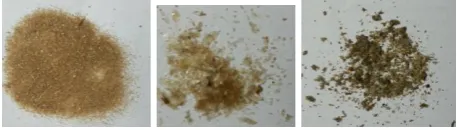
Fig 2: Images of extracted mucilage by method 1 (a), method 2 (b), and method 3 (c).
texture, odor and yield as compared to other two methods.
Table 1: Organoleptic characteristics of extracted mucilage
Properties Method 1 Method 2 Method 3
Appearance amorphous Lustrous powder
Small
flakes Amorphous powder
Color Brown Brown Almost black
Odor Odorless Odorless Foul smell
Taste Tasteless Tasteless Taste less
yield 12%w/w 5% w/w 3%w/w
Evaluation of Flow properties of extracted seed mucilage:
The flow properties of dried mucilage are shown in Table 2. Carr’s index, Hausner’s ratio and angle of repose were selected as flow indicating parameters. They reflect the particle size, surface characters and moisture content of the mucilage. [30] Flow properties of extracted mucilage are tabulated in Table 2. From the result it was observed that mucilage extracted from the Method 1 exhibited good flow properties as compared to the other extracted mucilage. Therefore mucilage extracted from Method 1 can be used in direct compression formulation. [31]
Table 2: Flow properties of extracted mucilage.
Flow properties Method 1 Method 2 Method 3
Carr’s index 11.5±0.2 17.34±0.22 14.63±0.06
Hausner ratio 1.16±0.01 1.27±0.21 1.28±0.02
Angle of repose 31.54±0.04 47.32±0.04 44.61±0.03
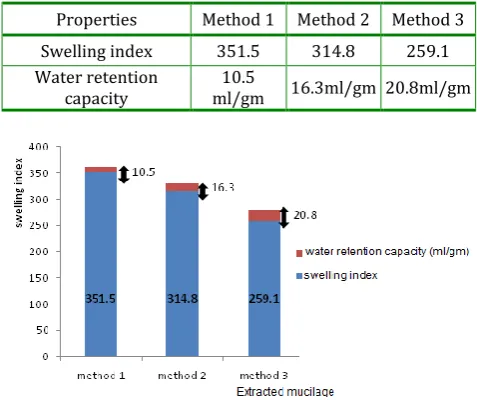
Determination of swelling index of seed mucilage: Mucilage on coming in contact with water hydrates and swells forming thick and viscous solution. [32] Swelling index of extracted mucilage from method 1, method 2 and method 3 were compared and results obtained are tabulated in Table 3. The particle size of mucilage obtained from method was reduced by passing it through 80# sieve. Due to its small particle size each particle swell to greater extent which results in higher swelling index. Also the water retention capacity was less which indicates that mucilage extracted from Method 1 swell to greater extent as
compared to mucilage extracted from other methods. The mucilage with higher swelling index swell to greater extend forming sticky and viscous solution and can be used as gelling, suspending, binding and disintegrating agent in different pharmaceutical formulations.
Table 3: swelling index and water retention capacity of extracted mucilage
Properties Method 1 Method 2 Method 3
Swelling index 351.5 314.8 259.1
Water retention
capacity ml/gm 10.5 16.3ml/gm 20.8ml/gm
Fig 2: Effect of extracted mucilage on swelling index of mucilage
CONCLUSION
ACKNOWLEDGEMENT
Authors are thankful to Principal, Dr, A. M. Ittadwar, Gurunanak College of pharmacy for providing necessary facilities to carry out the research work.
CONFLICT OF INTEREST
The authors declare that there is no conflict of interests regarding the publication of this paper.
REFERENCES
1. Evans W.C. Trease and Evans pharmacognosy. 16th
ed. Saunders Elsevier. Inc.: London, 1983.
2. Dharmendra S, Surendra J.K. Natural excipient – a review. IJPBA 2012; 3:1028-34.
3. Pandey R., Khuller G.K. Polymer based drug delivery
systems for mycobacterial infections. Curr drug deliv 2004; 1:195-201.
4. Chamarthy S.P, Pinal R. Plasticizer concentration and the performance of a diffusion-controlled polymeric drug delivery system. Elsevier 2008; 331: 25-30.
5. Alonso-Sande M, Teijeiro-OsorioD, Remunan-Lopez
C, Alonso M. Glucomannan, a promising
polysaccharide for biopharmaceutical purposes. Eur J Pharm Biopharm 2009; 72: 453-62.
6. Shrinivas K, Prakesh K, Kiran HR, Prasad PM. Study
of Ocimum basilicum and Plantago ovate as
disintegrants in the formulation of dispersible tablets. Indian J Pharm Sci 2003; 65:180-3.
7. Verma P.R.P., Razdan B. Studies on Leucaena
leucocephala seed gum: emulsifying properties. J Sci Ind Res 2003; 62:198-206.
8. Ibezim C., Khanna M, Sing S. A study of suspending properties of Anacardium accidentale gum. J Sci Ind Res 2000; 59:1038-43.
9. Guwthamarajan K, Kulkarni TG, Vijayakumar RS,
Suresh B. Evalution of Borassus flabellier mucilage as gelling agent. Indian drugs 2003; 40: 640-44. 10. Kulkarni, Gowthamarajan T. G., Brahmajirao B.G.
Evaluation of binding properties of selected natural mucilages. JSIR 2002; 61:529-532.
11. Tiwari PN, Kulmi GS. Performance of Chandrasur (Lepidium sativum) under different levels of nitrogen and phosphorus. J Med Aromatic Plant Sci 2004; 26: 479-81.
12. Avachat AM, Dash RR, Shrotriya SN. Recent
investigation of plant based gums, mucilages and
resins in novel drug delivery system. IJPR 2011; 45: 86-99.
13. Nandkarni KM. The Indian medica. 2 nded. Mumbai:
dhootapa – peshwarprakashan 1954.
14. Chopra R, Nayar L, Chopra L. Glossary of Indian medicinal plants. New Delhi: council of scientific and industrial research. 1986.
15. Divekar V.B., Kalaskar M. G., Chougule P.D., Redasani V.K., Baheti D.G. Isolation and characterization of mucilage from Lepidium sativum linn seeds. IJPRD 2010;2: 1–5.
16. Hasegawa K., Mizutani J., Kosemur S., Yamamura S. Isolation and identification of lepidimoide, a new allelopathic substance from mucilage of germinated cress seeds. Plant Physiol 1992; 100:1059–1061. 17. ] Archana, Kumar S., Mahalaxmi R., Shirwaikar A.,
Physio-chemical characterization and evalution of disintegrating property of Lepidium sativum seed mucilage. JPR 2012; 5:61–65.
18. Bailey K. ccxcvi. Cress seed mucilage. Biochem J. 1935; 29: 2477-2485.
19. Karazhiyan H, Razavi SMA, Phillips OG, Fang Y, Al-Assaf S, Nishinari K. Physiochemical aspect of hydrocolloid extract from the seeds of Lepidium sativum. Int. J. Food Sci Technol 2011; 46: 1066-72. 20. Patel H.H., Kardile D. Puvar A. N., Prajapati R.K., Patel
M. R. Lepidium sativum: natural superdisintegrants for fast dissolving technology. IJPAS 2011; 2:56-62. 21. Paratkar R., Patil S., Kamble S. Evalution of Lepidium
sativum mucilage as suspending agent in
paracetamol suspension. IAJPR 2011; 3:181-186.
22. Lachman L, Liberman H. The Theory and Practice of
Industrial Pharmacy. 3rd ed. Bombay: Varghese
Publishing House; 1991.
23. Aulton M. The Design and Manufacturing of
Medicine. 3rd ed. UK: An Imprint of Harcourt
Publisher; 2007.
24. Thube R, Gothoskar A, Shaikh S. Study of Potential of Natural Polymers as Formulation Component for the Development of Sustained Release Matrix Tablet. IJPRD 2011; 3:15-22.
25. Efentakis M, Koutlis A. Release of Furosemide from multiple unit and single unit preparations containing different viscosity grades of sodium alginate. Pharm Dev Tecnol 2001; 6:91-8.
of Fenugreek Seed Mucilage.Int J Pharm Tech Res 2009; 1: 982-96.
27. Kulkarni T.G., Gowthamarajan K., Kumar MN.S.,
Suresh B. Gums and mucilages therapeutic and pharmaceutical applications. IJNPR 2002; 1: 10-17. 28. Prakesh P., Kumar N. Design and development of
sustained release matrix tablet of diclofenac sodium using natural polymer. IRJP 2013; 4:169-176. 29. Kamble MS, Mendake SD, Dange SM, Bhalerao KK,
Aute PP, Chaudhari PD. Evalution of binding property of Ocimumtenuiflorumlinn. Seed isolated by defatting method. JBPR 2012; 1: 22-7
30. Fujio Y. Hayashi N, Hayakawa I. Effect of moisture content on flow behavior of molten soy-protein
isolated under an elevated temperature. Int J Food Sci Tech 2007; 26:45-51.
31. Banker G. The theory and practice of industrial pharmacy, 3rd ed; Mumbai: Varghese publishing
house; 1987.
32. Jani G.K., Shah D. P., Prajapati V.D., Jain V.C. Gums and mucilages: Versatile excipients for pharmaceutical formulations. AJPS 2009; 4: 308-322.
How to cite this article: Vaishali Kilor, Neeta Nandlal Bramhe; Development of effective extraction method for
Lepidium sativum seed mucilage with higher yield; J. Adv. Pharm. Edu. & Res. 2014: 4(3): 354-360.