Cite as
Wójcik T, Szymkiewicz P, Wiśniewski J, et al. Distribution of polymorphisms in the CYP2C19 and ABCB1 genes among patients with acute coronary syndrome in Lower Silesian population. Adv Clin Exp Med. 2019;28(12):1621–1626. doi:10.17219/acem/110322
DOI
10.17219/acem/110322
Copyright
© 2019 by Wroclaw Medical University This is an article distributed under the terms of the Creative Commons Attribution Non-Commercial License (http://creativecommons.org/licenses/by-nc-nd/4.0/)
Address for correspondence
Tomasz Wójcik
E-mail: [email protected]
Funding sources
None declared
Conflict of interest
None declared
Received on December 11, 2018 Reviewed on March 27, 2019 Accepted on June 27, 2019
Published online on November 28, 2019
Abstract
Background. Dual antiplatelet therapy (DAPT) with aspirin and clopidogrel administered to treat patients with acute coronary syndrome (ACS) is still being used. However, despite the proven efficacy of this treat-ment regimen, thromboembolic complications have been observed in some individuals. The reason for this phenomenon is linked to the so-called increased responsiveness of platelets despite high platelet resistance (HPR). A significant role in HPR is attributed to genetically determined differences in the absorption and activation of clopidogrel.
Objectives. The aim of the study was to assess the incidence of polymorphisms of the ABCB1 and CYPC19 genes that encode proteins involved in the absorption and metabolism of clopidogrel.
Material and methods. The analysis was performed in 199 consecutive patients from Lower Silesian voivodeship (Poland) who underwent coronary angioplasty with stenting for ACS. The single nucleotide polymorphism of the CYP2C19 and ABCB1 genes was performed using a mini sequencing or restriction fragment length polymorphism method.
Results. The results of this study revealed the high incidence of patients who may be unresponsive to anti-platelet treatment due to genetic causes. The CYPC19*2 allele in the form of homozygote or mutation hetero-zygote appeared in 26.1% of the study population. ABCB1 (C3435C> T) polymorphism was associated with 84% of patients. The total incidence of allelic disorders of low drug absorption and metabolism reached 14.6%. Conclusions. The data obtained should prompt clinicians to use more recent antiplatelet agents (ticagrelor or prasugrel) first, instead of clopidogrel.
Key words:ABCB1, clopidogrel, Lower Silesia, polymorphism, CYP2C9
Distribution of polymorphisms in the
CYP2C19
and
ABCB1
genes
among patients with acute coronary syndrome in Lower Silesian population
Tomasz Wójcik
1,A,D, Paweł Szymkiewicz
1,A,D, Jerzy Wiśniewski
2,B,C, Arleta Lebioda
3,B,C, Anna Jonkisz
3,B,C,
Andrzej Gamian
2,C,E, Wiktor Kuliczkowski
1,A,E, Krzysztof Ściborski
1,D, Andrzej Mysiak
1,A,E, Marcin Protasiewicz
1,A,D–F1 Department and Clinic of Cardiology, Wroclaw Medical University, Poland 2 Department and Section of Biochemistry, Wroclaw Medical University, Poland 3 Section of Molecular Techniques, Wroclaw Medical University, Poland
A – research concept and design; B – collection and/or assembly of data; C – data analysis and interpretation; D – writing the article; E – critical revision of the article; F – final approval of the article
Introduction
Dual antiplatel therapy (DAPT) with aspirin and clopido-grel has until recently been the gold standard for the treat-ment of acute coronary syndrome (ACS) patients. Nev-ertheless, despite the proven efficacy of this treatment regimen, thromboembolic complications continue to be observed in some patients.1,2 The reason for this
phenom-enon is associated with a so-called sustained increase in platelets activity, in spite of DAPT. This phenomenon may be due to an impaired aspirin response, but it is main-ly associated with an ineffective treatment with clopidogrel. A number of factors contribute to increased platelet reac-tivity. The lack of expected effects of DAPT is most likely due to non-compliance to treatment recommendations. How-ever, the complexity of genetically conditioned absorption and activation of clopidogrel is also important. The action of clopidogrel is conditioned by the efficacy of the pro-drug conversion into its active form. This process largely depends on intestinal absorption and complex hepatic metabolism. The first step of clopidogrel activation takes place in the gas-trointestinal tract. The ABCB1 gene expression product, P-GP (glycoprotein), plays a key role here. It is a membrane protein of the gastrointestinal tract, which acts to regulate xenobiotics concentrations in the human body, includ-ing clopidogrel. Spot mutations in the ABCB1 gene type C3435C> T, resulting in the emergence of mutation homozy-gotes (TT) or mutation heterozyhomozy-gotes (CT) in place of proper homozygotes (CC), imply (TT) increased P-GP activity. This activity causes an excessive rejection of clopidogrel, hin-dering its attainment of adequate plasma concentrations. The polymorphism of this gene has a negative influence on the clinical effects of clopidogrel treatment and may cause high platelet resistance (HPR). An even greater association with individual differences in response to clopidogrel treat-ment is attributed to cytochrome P450. Its proper function-ing allows for the final conversion of clopidogrel to its active metabolite.
Genetic studies are particularly difficult due to the nu-merous polymorphisms in the genes encoding CYP. CYP2C19, CYP3A4/5 and CYP1A2 are the most well-stud-ied genetic variants. CYP2C19 alleles of type *2–*8 are these that impair the metabolism of clopidogrel. It was observed that having even 1 allele of CYP2C19*2 was associated with worse prognosis in a long-term follow-up of myocar-dial infarction with respect to the incidence of subsequent myocardial infarction, stroke and death. There have also been more cases of stent thrombosis in these patients.3,4
The effect of the allele *17 in laboratory conditions is ex-pressed by lower values for maximum platelet aggregation, better platelet inhibition and higher plasma concentrations of the active metabolite.5 The clinical effect of increased
transcriptional activity of this polymorphism was associated with more bleeding. There have been no significant benefits noticed in terms of ischemic events and stent thrombosis.6
In our research work, we evaluated the prevalence
of polymorphism of major absorption genes (ABCB1) and clopidogrel metabolism (CYPC19 *2, *3, *17) in patients treated with coronary angioplasty with stent implantation due to ACS.
Material and method
A total of 199 patients (133 males and 63 females), mean age 65.2 ±11.9 years, randomized to the prospective study, were hospitalized for acute myocardial infarction, includ-ing unstable angina, with non ST-elevation myocardial infarction (NSTEMI), and ST-elevation myocardial infarc-tion (ST-elevainfarc-tion MI). All patients engaged in the research were treated according to European Society of Cardiology (ESC) recommendations using coronary angioplasty with stent implantation. The study was approved by the appro-priate research ethics committee, and all patients included in the study gave written informed consent. The basic
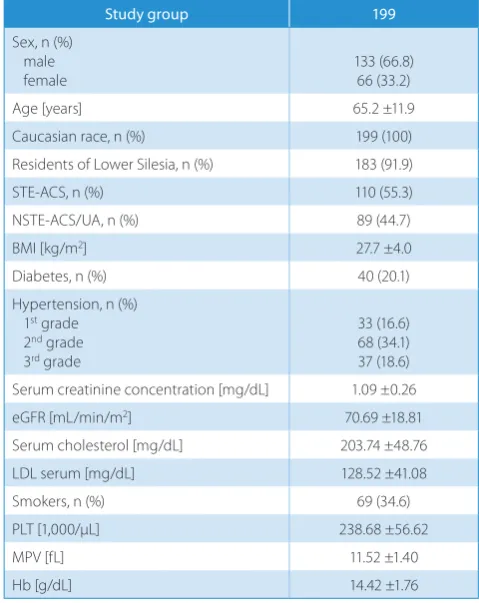
de-mographic data of patients are presented in Table 1.
Genetic research
In order to identify genetic polymorphism identification, genetic material was extracted from 200 μL of whole blood
Table 1. Demographics
Study group 199
Sex, n (%) male female
133 (66.8) 66 (33.2)
Age [years] 65.2 ±11.9
Caucasian race, n (%) 199 (100) Residents of Lower Silesia, n (%) 183 (91.9)
STE-ACS, n (%) 110 (55.3)
NSTE-ACS/UA, n (%) 89 (44.7)
BMI [kg/m2] 27.7 ±4.0
Diabetes, n (%) 40 (20.1)
Hypertension, n (%) 1st grade
2nd grade
3rd grade
33 (16.6) 68 (34.1) 37 (18.6) Serum creatinine concentration [mg/dL] 1.09 ±0.26 eGFR [mL/min/m2] 70.69 ±18.81
Serum cholesterol [mg/dL] 203.74 ±48.76 LDL serum [mg/dL] 128.52 ±41.08
Smokers, n (%) 69 (34.6)
PLT [1,000/μL] 238.68 ±56.62
MPV [fL] 11.52 ±1.40
Hb [g/dL] 14.42 ±1.76
samples of each patient using the High Pure PCR Template Preparation Kit (Roche Diagnostics, Warszawa, Poland). Using the ability of the DNA to bind under certain condi-tions with silica, centrifugation of the lysate was carried out in a mini column containing the silica membrane, which was then rinsed twice with washing buffer. Finally, the membrane was given a mini column elution buffer to re-cover the purified DNA. Amplified polymerase chain reac-tion (PCR) was the next step with the use of 4 pairs of spe-cific primers, respectively for: CYP2C19*17 (-3402C> T), CYP2C19*3, ABCB1 (C3435C> T) and CYP2C19 *2, as well as Multiplex PCR Kit (Qiagen, Hilden, Germany), accord-ing to the manufacturer’s instructions. Saccord-ingle-nucleotide (DNA) polymorphism of the CYP2C19*2, *3 and ABCB1
genes was performed using a mini-sequencing technique, a PCR modification. The SNaPshot Multiplex Kit (Applied Biosystems – Thermo Fisher Scientific, Gdańsk, Poland) was used for the analysis according to the manufacturer’s instructions. Purification of the duplicated genetic materi-al was carried out with materi-alkmateri-aline phosphatase digestion and exonuclease to eliminate primers and deoxynucleotides that were not consumed in PCR. The mini-sequencing reaction was performed with specific primers designed to hybridize to the template, ending before the desig-nated polymorphic site. Dideoxynucleotide triphosphates (ddNTP), or fluorescent labeled terminators, were involved in the reaction. Product detection was performed with cap-illary electrophoresis on a 3130 Genetic Analyzer (Applied Biosystems – Thermo Fisher Scientific). The results were analyzed with the use of the GeneMapper ID v. 3.2 program ( Applied Biosystems, Foster City, USA) against the internal GeneScan™ LIZ 120 standard. To assess the polymorphism
of CYP2C17*17 (locus -3402 C>T), a restriction fragment length polymorphism (RFLP) technique was used.
Division into absorption
and metabolic phenotypes
The study population was divided into the group of “good absorbers” (GA), which included the wild-type homozygote (CC), which lacked the C3435C> T spot mu-tation in the ABCB1 gene, and the “poor absorbers” group (PA), which included the mutation heterozygotes (CT) and mutation homozygotes (TT) of the ABCB1 gene.
Alleles that negatively affect clopidogrel metabolism (CYP2C *2, *3), and thus contribute to higher platelet re-activity in laboratory tests, have been assigned to the so-called loss-of-function (LoF) group. In contrast, alleles promoting the effects of clopidogrel (CYP2C *17), thus decreasing platelet aggregation, were given GoF (gain-of-function) name. For the purposes of the present work, pa-tients were eligible for 2 metabolic groups, due to the poly-morphism and the onset of the LoF or GoF allele:
– poor metabolizers (PM) – *2 or *3 carriers/non-*17 carriers – individuals with at least 1 LoF allele and no GoF allele;
– not poor metabolizers (NPM) – without the presence of any LoF allele (i.e., *2 and *3) and simultaneously having at least 1 GoF allele (i.e., *17) or patients without LoF (i.e., *2 and *3) and GoF (i.e., *17) or carriers simultaneously with both opposing alleles (*2 or *3 and simultaneously *17).
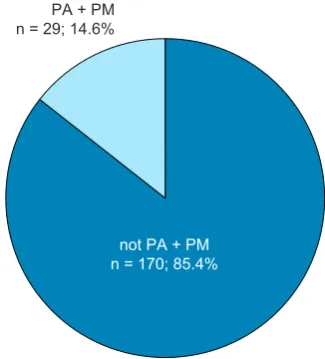
Patients with both PA and PM (PA + PM) phenotype were also isolated from the study group. The rest of the pa-tients were referred to as not PA + PM.
Results
The basic demographic data of the study population is presented in Table 1. The data is typical of the popula-tion with ischemic heart disease.
Genetic research
The incidence of ABCB1 polymorphism in the study group is shown in Fig. 1. The largest percentage of subjects were heterozygous (57.9%). The minority of the patients were identified as wild-type homozygotes (CC). The in-cidence of CYP2C19 *2 gene polymorphism is shown in Fig. 2. Most of the variants studied were patients with al-leles coding for normal protein activity, but 26.1% of them had at least 1 mutation. No CYP2C19 *3 allele was observed in the study population to reduce the activity of clopidogrel metabolism. A relatively high percentage of heterozygotes and wild-type homozygotes in the CYP2C19*17 allele were found in the study group (Fig. 3).
Division into absorption
and metabolic phenotypes
The incidence of clopidogrel GA and PA patients in the study population is shown in Fig. 4. The major-ity of the group were PA. Figure 5 shows the percentages
Fig. 1. Frequency of polymorphism of the ABCB1 gene
CC – wild-type homozygote; CT – mutation heterozygote; TT – mutation homozygote.
CC
n = 32; 16.0%
CT n = 115; 57.9% TT
of individual metabolic phenotype in the study population. The relatively high proportion of patients (18%) was found to be PM patients. The simutaneous incidence of PA and PM phenotypes is shown in Fig. 6. As many as 29 patients in the study group were members of this group.
Discussion
In this work, genetic testing was performed in a ho-mogeneous ethnic group of patients with ACS. An im-portant element of the study was the high homogeneity of the study group. Each of the 199 categorized patients was Caucasian, and 92% of the study group were residents of Lower Silesia.
Fig. 6. Incidence of poor phenotype absorption and poor metabolism
PA + PM – reduced absorption plus poor metabolism. Fig. 5. Division into metabolic phenotypes
PM – poor metabolizers; NPM – not poor metabolizers. Fig. 4. Division into absorption phenotypes
PA – reduced absorption of clopidogrel; GA – good absorption of clopidogrel.
Fig. 3. Frequency of CYPC19 *17 polymorphism
*1 – allele of the normal function of the CYP2C19 protein, *17 – allele improving the function of the CYP2C19 protein, *1/*1 – wild-type homozygote, *17 – mutation heterozygote.
Fig. 2. Frequency of CYPC19*2 polymorphism
*1 – allele of normal CYP2C19 protein function; * 2 – CYP2C19 protein allelic dysfunction; *1/*1 – wild-type homozygote; *1/2 – mutation heterozygote; *2 – mutation homozygote.
CYPC19 *1/*1 n = 147; 73.8% CYPC19 *1/*2
n = 49; 24.6%
CYPC19 *2/*2 n = 3; 1.5%
CYPC19 *1/*1 n = 110; 55.2% CYPC19 *1/*17
n = 81; 40.8%
CYPC19 *17/*17 n = 8; 4.0%
GA
n = 32; 16.0%
PA n = 167; 84.0%
PM
n = 36; 18.0%
NPM n = 163; 82.0%
PA + PM n = 29; 14.6%
The occurrence of ABCB1 homozygous mutation polymor-phism was demonstrated in 26.1% of the subjects (n = 52), which is comparable to the 27% of the carriers of the modi-fied gene present within the large TRITON-TIMI 38 study, based on a population of nearly 3,000 patients.7 Analyses
concerning the variability of polymorphisms in various eth-nic groups have revealed the prevalence of mutation ho-mozygotes in the indigenous population of South America (27%), among Caucasians (20%) and Africans (13%).8
The dis-tribution of polymorphisms in ABCB1 genes in the present study (CC 16.0%, CT 57.9%, TT 26.1%) is almost identical to that observed in large, randomized, multicenter studies. The obtained data correlates well with the analysis of geno-types of healthy volunteers in West Pomerania9 and are
slightly different with regards to wild-type homozygotes and heterozygotes among ACS patients in the population of Warszawa (CC 28%, CT 51%, TT 21%). However, the ho-mozygous mutations percentage is very alike in different groups, as demonstrated in the study by Śpiewak et al.10
The incidence of particular polymorphisms of the CYP2C19 variant depends on the ethnic group under consideration. The differences apply to each of the alleles being analyzed.
One of the dysfunctional alleles, CYP2C19*2, has been found in the East Asian population in the amount of up to 55%. Among Africans, this polymorphism was observed in 40% of the subjects, and in the Caucasian population in Europe, the prevalence of CYP2C19 *2 was reported in 30% of the subjects.11 In France, Collet et al. analyzed
259 patients with ACS episode. In their work, the wild-type homozygotes group of CYP2C19*1/*1 variant embraced 72% of the subjects, heterozygote *1/*2 25%, and mutation homozygote *2/*2 – only 2%.4 Almost identical results were
obtained in German and Portuguese populations, and only slightly different results – in Hungarian population.12–14
As far as we know, the research on the prevalence of this polymorphism in the Polish population was conducted only once in a study by Malek et al.15 The authors reported that
wild-type homozygotes appear in 80% of the population, heterozygotes in 18% and mutation homozygotes in 2%. Our study has shown 73.9% of wild-type homozygotes, 24,6% of heterozygotes and 1,5% of mutation homozygotes; therefore, the data confirms the predecessors’ observations.
The CYP2C19 *3 allele frequencies tend to vary across human populations. Most often this polymorphism is ob-served in East Asia. The incidence of *1/*3 genotype was reported by Jeong et al. at the level of 11%.16 In Africa
and Europe, this allele is much less frequent and sporadi-cally exceeds 1%. In the Italian population, this percent-age was reported at 1.6%17 and in Russian population
at 0.3%.18 In our group of 188 patients, there was no single
CYP2C19*3 mutation. To the best of our knowledge, our study is the first work which investigates the incidence of the CYP2C19*3 allele in the Polish population. The re-sults confirm poor inspection of the discussed allele in this part of Europe.
Recently, CYP2C19*17 allele has been the most frequently reported polymorphism. In Europe, the het-erozygous form of CYP2C19*17 allelic variant can be found in 31.7% of the population on average and the mu-tation homozygous – in 4.2%. Thus, the differences con-cern populations all over Europe. In Germany, the inci-dence of at least 1 allele *17 was reported at the frequency of 41%, in France 20% and in Sweden 18%.5,6,11 In Poland,
Kurzawski et al. analyzed the distribution of these poly-morphisms in a group of 125 patients and found allele *17 in 27.2% of patients.20 Widespread dissemination
of the allele polymorphism in Africa is rarely reported in literature, but some reports indicate a frequency simi-lar to that of the Caucasian population.21 The incidence
of the allele *17 in the Japanese population is estimated at 1.3%22 and Chinese at 4%.5 In our study on CYP2C19*17
polymorphisms, a higher incidence of this allele (40.8% heterozygous individuals and 4% homozygotes) was found, compared to the study by Kurzawski et al.9 Nevertheless,
when results obtained in this study are compared with those from a large group of over 1,500 German patients, one will find them to be very similar.6 They also
corre-spond to the results of studies conducted and published in Poland by Kubica et al.23
In the study, the prevalence of the phenotype absorp-tion and metabolism was assessed for the first time in the Polish population. As many as 14.6% of patients showed a cumulative occurrence of the polymorphism of the investigated genes which condition the malabsorp-tion of clopidogrel and its impaired metabolism. The use of clopidogrel in this group of patients may pose a particu-lar risk of achieving an inadequate effect of the drug and, hence, the risk of thromboembolic complications with all clinical implications.
The reported variability in polymorphism frequency, with confirmation of increased platelet reactivity despite clopidogrel administration, is a serious clinical problem. The presence of these polymorphisms is an independent and contributing factor to HPR and thromboembolic com-plications following ACS. This data, confirming a relatively high level of penetration in the area of clopidogrel poly-morphisms, should prompt Polish clinicians to recom-mend firstly the most recent antiplatelet drugs (ticagrelor or prasugrel), in spite of significantly higher costs of such pharmacotherapy for their patients.
ORCID iDs
Tomasz Wójcik https://orcid.org/0000-0001-9987-4872 Paweł Szymkiewicz https://orcid.org/0000-0002-8469-6871 Jerzy Wiśniewski https://orcid.org/0000-0003-2831-7643
Arleta Lebioda https://orcid.org/0000-0001-5802-2155 Anna Jonkisz https://orcid.org/0000-0001-6916-4212 Andrzej Gamian https://orcid.org/0000-0002-2206-6591 Wiktor Kuliczkowski https://orcid.org/0000-0001-6284-0820 Krzysztof Ściborski https://orcid.org/0000-0002-3922-2861
References
1. Schomig A, Neumann FJ, Kastrati A, et al. A randomized compari-son of antiplatelet and anticoagulant therapy after the placement of coronary-artery stents. N Engl J Med. 1996;334(17):1084–1089. 2. Claeys MJ. Antiplatelet therapy for elective coronary stenting:
A mov-ing target. Semin Vasc Med. 2003;3(4):415–418.
3. Mega JL, Close SL, Wiviott SD, et al. Cytochrome p-450 polymor-phisms and response to clopidogrel. N Engl J Med. 2009;360(4): 354–362.
4. Collet JP, Hulot JS, Pena A, et al. Cytochrome P450 2C19 polymor-phism in young patients treated with clopidogrel after myocardial infarction: A cohort study. Lancet. 2009;373(9660):309–317. 5. Sim SC, Risinger C, Dahl ML, et al. A common novel CYP2C19 gene
variant causes ultrarapid drug metabolism relevant for the drug response to proton pump inhibitors and antidepressants. Clin
Phar-macol Ther. 2006;79(1):103–113.
6. Sibbing D, Koch W, Gebhard D, et al. Cytochrome 2C19*17 allelic variant, platelet aggregation, bleeding events, and stent thrombo-sis in clopidogrel-treated patients with coronary stent placement.
Circulation. 2010;121(4):512–518.
7. Murphy SA, Antman EM, Wiviott SD, et al; TRITON-TIMI 38 Investi-gators. Reduction in recurrent cardiovascular events with prasu-grel compared with clopidoprasu-grel in patients with acute coronary syndromes from the TRITON-TIMI 38 trial. Eur Heart J. 2008;29(20): 2473–2479.
8. Santos PC, Soares RA, Santos DB, et al. CYP2C19 and ABCB1 gene polymorphisms are differently distributed according to ethnicity in the Brazilian general population. BMC Med Genet. 2011;12:13. 9. Kurzawski M, Pawlik A, Czerny B, Domański L, Rózański J, Droździk M.
Frequencies of the common promoter polymorphisms in cytokine genes in a Polish population. Int J Immunogenet. 2005;32(5):285–291. 10. Śpiewak M, Malek LA, Kostrzewa G, et al. Influence of C3435T multi-drug resistance gene-1 (MDR-1) polymorphism on platelet reactivity and prognosis in patients with acute coronary syndromes. Kardiol Pol. 2009;67(8):827–834.
11. Desta Z, Zhao X, Shin JG, Flockhart DA. Clinical significance of the cytochrome P450 2C19 genetic polymorphism. Clin Pharmacokinet. 2002;41(12):913–958.
12. Sibbing D, Stegherr J, Latz W, et al. Cytochrome P450 2C19 loss-of-function polymorphism and stent thrombosis following percutane-ous coronary intervention. Eur Heart J. 2009;30(8):916–922. 13. Teixeira R, Monteiro P, Marques G, et al. CYP2C19*2 and prognosis
after an acute coronary syndrome: Insights from a Portuguese center.
Rev Port Cardiol. 2012;31(4):265–273.
14. Rideg O, Haber A, Botz L, et al. Pilot study for the characterization of pharmacogenetically relevant CYP2D6, CYP2C19 and ABCB1 gene polymorphisms in the Hungarian population. Cell Biochem Funct. 2011;29(7):562–568.
15. Malek LA, Przyluski J, Spiewak M, et al. Cytochrome P450 2C19 poly-morphism, suboptimal reperfusion and all-cause mortality in patients with acute myocardial infarction. Cardiology. 2010;117(2):81–87. 16. Jeong YH, Tantry US, Kim IS, et al. Effect of CYP2C19*2 and *3
loss-of-function alleles on platelet reactivity and adverse clinical events in East Asian acute myocardial infarction survivors treated with clop-idogrel and aspirin. Circ Cardiovasc Interv. 2011;4(6):585–594. 17. Scordo MG, Caputi AP, D’Arrigo C, Fava G, Spina E.Allele and
geno-type frequencies of CYP2C9, CYP2C19 and CYP2D6 in an Italian pop-ulation. Pharmacol Res. 2004;50(2):195–200.
18. Gaikovitch EA, Cascorbi I, Mrozikiewicz PM, et al. Polymorphisms of drug metabolizing enzymes CYP2C9, CYP2C19, CYP2D6, CYP1A1, NAT2 and of P-glycoprotein in a Russian population. Eur J Clin
Phar-macol. 2003;59(4):303–312.
19. Frere C, Cuisset T, Gaborit B, Alessi MC, Hulot JS. The CYP2C19*17 allele is associated with better platelet response to clopidogrel in patients admitted for non-ST acute coronary syndrome. J Thromb
Haemost. 2009;7(8):1409–1411.
20. Kurzawski M, Gawrońska-Szklarz B, Wrześniewska J, Siuda A, Starzyńska T, Droździk M. Effect of CYP2C19*17 gene variant on Heli-cobacter pylori eradication in peptic ulcer patients. Eur J Clin Pharma-col. 2006;62(10):877–880.
21. Janha RE, Sisay-Joof F, Hamid-Adiamoh M, et al. Effects of genetic vari-ation at the CYP2C19/CYP2C9 locus on pharmacokinetics of chlorcyc-loguanil in adult Gambians. Pharmacogenomics. 2009;10(9):1423–1431. 22. Sugimoto K, Uno T, Yamazaki H, Tateishi T. Limited frequency of the CYP2C19*17 allele and its minor role in a Japanese population. Br J
Clin Pharmacol. 2008;65(3):437–439.
23. Kubica A, Kozinski M, Grzesk G, Fabiszak T, Navarese EP, Goch A. Genetic determinants of platelet response to clopidogrel. J Thromb