Volume 03, No. 06, June 2017
P
age
1
Microstructural and Mechanical Properties of Al-Zro
2Based
Alloy Manufactured By Stir Casting Method
P. S Ravichandra* & Vijay Kumar**
*Assistant Professor, Department of Mechanical Engineering , HMSIT, Tumkur, Karnataka **Associate Professor,Department of Mechanical Engineering , UBDT, Davangere. Karnataka
ABSTRACT
This paper describes the fabrication and testing of Aluminum alloy[LM4] reinforced with nano ZrO2
particle cast at (680OC), varying the dispersoid content by weight percentage in the range from 3 to 15 Wt% in steps of 3 Wt%. Microstructural study of the solidified composite fabricated indicates that there is a uniform distribution of the reinforcement in the matrix material and the mechanical properties reveal that presence of ZrO2 particles as despersoid up to 12 Wt% has significantly
improved tensile strength and hardness.
Keywords:
LM4, ZrO2, Microstructure, Tensile strength, Hardness, MMCs.INTRODUCTION
Composites materials are arguably, the most actively and extensive developing research area at the beginning of this century. As aero space technology continues to advance, there is a rapid demand for advanced materials like composite with high mechanical strength & thermal capabilities for such applications [1, 2]. Available literature indicates that, so far number of Al based MMCs including other MMCs [3, 4 & 5] are being developed but little work has been done in MMCs in this field. Hence the present research is taken to fill the void and to investigate integrated properties of Al alloy / ZrO2 MMCs. Among all the reinforcement used in Al based composites, only smaller sized particles has shown their potential superiority in improving mechanical properties (tensile & hardness) and microstructure with noticeable weight savings [1]. Stir casting technique has been chosen in this research work. Accordingly the primary aim of the present investigation is to develop Al alloy based composites. Particular emphasis is placed to study the effect and presence of particles size and increase in its amount on the microstructure and the mechanical response Al alloy [4].
EXPERIMENTAL METHOD
In this research ZrO2 particles were reinforced in Al alloy (LM4). The size of the ZrO2 particles size varies from 50 – 80 nm dispersed in the matrix from 3 to 15 Wt %. In steps of 3 Wt%.
Table 1 shows chemical composition of LM4
Alloy Cu Mg Si Fe Mn Ni Zn Pb Sn Ti Others Al
LM
4 2.0-4.0 0.2 0.4-0.6 0.8 0.2-0.6 0.3 0.5 0.1 0.1 0.2 0.2
Balanced
Table 2 shows chemical composition of ZrO2
Element Content (%)
Zirconium 74.03
Volume 03, No. 06, June 2017
P
age
2
FABRICATION OF THE COMPOSITE
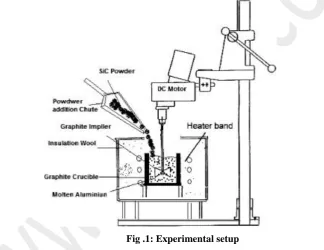
Stir casting technique as shown in fig.1 was used to melt Al alloy since it is simple and economical technique [6, 10]. The required amount of LM4 was placed in a graphite crucible and heated in a resistance furnace at around 700OC in a inert atmosphere for about 45 minutes for complete melting. Preheated (up to 310OC) ZrO2 particles of 3Wt% were introduced evenly into the molten metal (LM4) by using special feeding attachment, during which the molten metal was well agitated by a mechanical impeller specially fabricated to create vortex motion and degassing powder was added to avoid the formation of blow holes, the speed of the impeller was maintained at 460 rpm to get the uniform distribution of the reinforcement. This process was repeated for 6, 9, 12 & 15 Wt% of ZrO2. The molten composite material was next poured into a foundry sand mould prepared according to AFS standards, and the mould size is (125×50×35) mm. Before Pouring and during pouring of the molten mixture with 3 wt% of ZrO2, The above procedure was repeated for 6, 9, 12 and 15 Wt% reinforcement. The solidified metal matrix composites were compressed in a hydraulic press to remove blow holes (if any) and also for obtaining the perfect flatness on both sides of rectangular cast block.
Fig .1: Experimental setup
Micro structural examination:
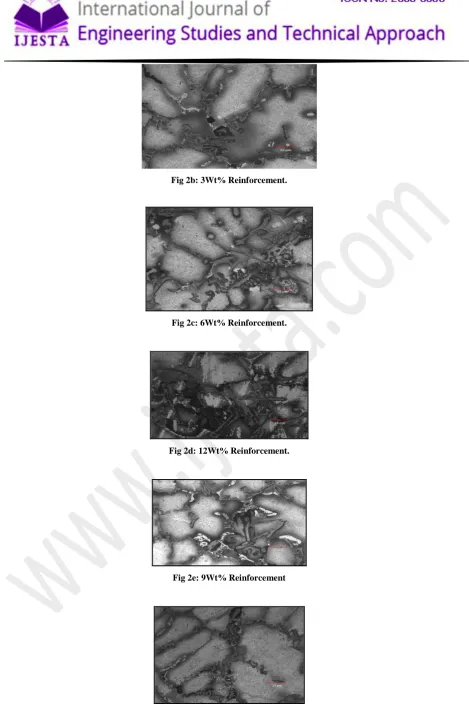
Microstructure characterization was conducted on all the polished specimens using OLYMPUS metallographic microscope to investigate morphological characteristics of grains, reinforcement distribution and interfacial integrity between matrix material and the reinforcement.
Volume 03, No. 06, June 2017
P
age
3
Fig 2b: 3Wt% Reinforcement.
Fig 2c: 6Wt% Reinforcement.
Fig 2d: 12Wt% Reinforcement.
Fig 2e: 9Wt% Reinforcement
Volume 03, No. 06, June 2017
P age
4
It is observed from the above set of photomicrograph that the molten material of solidified MMC suffers a severe super cooling [4]. This results in high rate of heat transfer during cooling of the hot melt in MMCs samples. Hence the critical size of the solidified melt is reduced and a greater number of nuclei are generated causing a finer microstructure. In addition to the super cooling of the melt, the stirring action of reinforcement segregated reinforcement particles do not have time to settle down due to the density difference between matrix material and the dispersoid and these results in more uniform distribution of ZrO2 particles in the matrix material. The effect during solidification causes stronger bonding between the matrix material and the reinforcement. This solidification shows the wettablity was good between the particles and the matrix material with the cryogenic cooling. These two factors lead to improved mechanical properties of the MMC’s. Thus the strong bonding between the dispersoid and the matrix material causes more effective load transfer. This in turn reduces the possibility of pullout of particulates from the matrix material [4].
Microstructure characteristics of hydraulically pressed MMCs are discussed in terms of distribution of reinforcement and matrix – reinforcement interfacial bonding (Fig 3a, 3b, 3c and 3d) revealed uniform distribution of the reinforcement with very limited clusters, good reinforcement – matrix material interfacial integrity, improved grain refinement with minimum porosity. At the same time, due to gravity of nano – ZrO2 associated with parameters such as good stirring action in the molten stage of LM4, good wetting of the preheated nano – ZrO2 by the melt of the material. Metallographic studies of the hydraulically pressed samples revealed that the matrix material is fully recrystallized. Fig 2 shows MMCs developed with various dispersoid content.
Hardness & Tensile Test:
Brinell micro hardness(strength) testing were conducted after the microscopic study on all the MMCs specimen using metsuzawa MXT50 digital hardness tester using 25 gf indentation load in accordance with ASTM E18-94 standards. The results of micro hardness test conducted on all hydraulically pressed MMCs samples revealed an increasing trend in matrix material with increase of reinforcement up to 12Wt%. Results of hardness measurement revealed that increase in the reinforcement content leads to a significant increase in the hardness. Because of the presence of nano - ZrO2 particles in the matrix material lead to higher resistance to the localized deformation during indentation effect. Table.3 and Fig.3 shows representation and tabulation of results for hardness and strength.
Table.5 and Fig.5 shows representation and tabulation of results for % elongation for different wt % of reinforcement. UTS are higher for all the MMCs as compared against the molten matrix material (LM4). When the reinforcement content ZrO2 increases from 3Wt% to 12Wt%, at the same time ductility reduces as the wt % reinforcement increases and significantly enhances the UTS values [1, 2, 4].
Table 3: BHN
%Despersoid BHN
0 62.86
3 57
6 62.6
9 57
12 57.5
Volume 03, No. 06, June 2017
P
age
5
Fig3: BHN v/s Dispersiod
Table 4: UTS
%Despersoid UTS(KN)
0 82.17
3 78.76
6 103.9
9 71.82
12 94.3
15 68.83
Fig4: UTS v/s Despersoid
Table 5: %Elongation
%Despersoid %Elongation
0 0.56
3 0.69
6 0.42
9 0.44
12 0.53
Volume 03, No. 06, June 2017
P
age
6
Fig5: %Elongation v/s Dispersiod
CONCLUSION:
Stir casting technique followed by compression used for the fabrication of ZrO2 composites reveals the following:
1. Microstructure analysis showed the grain refinement, fairly uniform distribution of the reinforcement with minimum porosities.
2. Mechanical property characterization of composite cast using 12Wt% reinforcement revealed that the presence of ZrO2 particulates in aluminum matrix significant improved hardness 43% and strength by 47%. Further addition of reinforcement in the metal matrix, mechanical properties reduces. When 15 wt% reinforcement was added non-uniform distribution was observed. Therefore it is concluded that dispersoid content has an effect on mechanical properties of composite developed along with the stir casting route of making the composite.
REFERENCES:
i. Braradeswaran A (2011), “Effect of Graphite Content on Tribological Behavior of Aluminum Alloy-Graphite Composites”, European J. of Scientific Research, Vol. 53, No. 2, pp. 163-170.
ii. Eustathopouloset al.(1999), “Wettability at High Temperatures”,Pregamon Materials Series Elsevier, Vol. 3, pp. 198, UK.
iii. Gilchrist J D (1989), Extraction Metallurgy, 3rdEdition, p. 148, Pregamon Press,UK.
iv. Hassan S F and Gupta M (2007), “Effectof Nano-ZrO2Reinforcement on Microstructure and Mechanical Behavior of Solidification Processed Elemental Mg”, Journal of Composite Materials, Vol. 41, No. 21, pp. 2533-2543.
v. Joel Hemanth (2009), “Quartz (SiO2p) Reinforced Chilled Metal Matrix
vi. Composite (CMMC) for Automotive Application”, Materials and Design, Vol. 30, No. 2, pp. 323-329.
vii. Kushal Kumar, Gnanendra Reddy G V and Balakumar G (2013), “Fracture Toughness and Wear Properties of Aluminum Alloy Based MMC Reinforced with ZrO2 Particulates”, International Journal of Mechanical and Production Engineering (IJMPE), Vol. 2, No. 1, pp. 2315- 4489.
Volume 03, No. 06, June 2017
P
age
7
ix. Mendoza D C et al.(2008), “Dispersion of Graphite Particles in A 6063AluminumAlloy by Mechanical Milling and Hot Extrusion”, J. Rev. Adv. Mater. Sc., Vol. 18, pp. 280-283.
x. Rasidhar L, Ramakrishna A and Srinavas Rao Ch (2013), “Fabrication and Investigation on Properties of Ilmenite (FeTiO3) Based Al-Nano Composite by Stir Casting Process”, I.J of Bio-Science and Bio-Technology, Vol.5, No. 4.
xi. Sajjadi S A, Ezatpour H R and Beigi H(2011), “Microstructure and Mechanical Properties of Al-Al2O3Micro and Nano Composites Fabricated by Stir Casting”, Material Science and Engg. A, Vol. 528, pp. 8765-8771.
xii. Seah K H W and Hemanth J (2007),“Cryogenic Effects During Casting on the Wear Behavior of Aluminum-Alloy/Glass MMCs”, Composites Part A, Vol. 38,pp. 1395-1402.