This is an open access journal, and articles are distributed under the terms of the Creative Commons Attribution-Non Commercial-ShareAlike 4.0 License, which allows others to remix, tweak, and build upon the work non-commercially, as long as appropriate credit is given and the new creations are licensed under the identical terms.
© 2018 Journal of Advanced Pharmacy Education & Research | Published by SPER Publication
1
Phenolic content, HPLC analysis and Antioxidant activity extract
from Tamarix Articulata
Amina Tabet*, Abbes Boukhari, Yassine Nouidjem
Laboratory of Organic Synthesis, Modeling and Optimization of Chemical Processes, Department of Chemistry Badji Mokhtar-Annaba University, B.O. 12, 23000, Annaba, Algeria.
Correspondence: Amina Tabet, Laboratory of Organic Synthesis, Modeling and Optimization of Chemical Processes, Department of Chemistry Badji Mokhtar-Annaba University, B.O. 12, 23000, Annaba, Algeria. E-mail: aminatabet @ gmail.com
ABSTRACT
Halophyte plants can easily adapt in saline habitats, salt marshes, mudflats, and inland deserts. This kind of plants can be utilized as new sources of natural antioxidants. The goal of the present investigation was to examine the antioxidant of methanolic extracts of the
Tamarix articulata in southern Algeria (ElOued). Colorimetric methods were applied to assess the total phenolic and flavonoid contents, HPLC analysis was used to identify the individual polyphenols, and the amount was also determined, while scavenging assays of DPPH, FRAP, ABTS, β- carotène and total antioxidant capacity of methanol leaves extract from Tamarix articulate were used to measure antioxidant capacities . The resulted findings showed that total phenolic contents and flavonoid from the extract of this plant were found to be 398.42 ± 5.21 mg GAE /g DW for phenolic content, and 120.55 ± 3.41 mg CE/g DW. The HPLC analysis showed that there were at least 8 remarkable phenolic compounds of leaves extract, and the most important ones included vanillic acid, naringin, and caffeic acid. The seeds of this natural plant can be a promising source for new drugs because they contain antioxidant properties and phenolic compounds.
Keywords:Tamarix articulata, antioxidant activity, HPLC analysis.
Introduction
Various saline habitats including coastal sand dunes, salt marshes and mudflats to inland deserts, salt flats and steppes can be suitable places for Halophytes to grow [1]. Because their salt
tolerance limits and their original climate zone, these plants have been attributed a high physiological plasticity. Considering its various genera, based on the studies conducted by different researchers, Tamarix (Tamaricaceae) covers between 65 and 90 species which originally grow in Asia, Africa and Europe [2]. A
lot of Tamarix species grow in salty areas such as deserts, sand dunes, salt marshes and ravines. Some species of Tamarix are grown as decorative plants in gardens or as wind breaks or shade trees [3-5]. Tamarix articulata belongs to this family
(Tamaricaceae) (Table 1), its generic name which is originated in Latin is believed to be Tarfagreen in Algeria. TamarixRiver in Spain is an annual plant, mostly seen in the Mediterranean region, Algeria, Tunisia, and Morocco. Its leaves have been used as traditional remedies for the treatment of various diseases such as antidiabetic agents [6], the stimuli of perspiration
and diuretic [7], anthelmintic, antihaemorrhoid hemostat and
gingivitis. The plant has been used to cure dromedary galls and antimicrobial agents [8]. The galls of this plant absorbs
hydrolyzable tannins up to 48% of their total weight [9, 10]. In
Algeria and surrounding regions, the plant has been medicinally applied to cure rheumatism, diarrhea, and other maladies [11].
There exist natural antioxidants in all parts of the plant, and phenolics, carotenoids and vitamins are the typical compounds representing antioxidant activities [12]. Considering all types of
natural antioxidants, polyphenols can be regarded as the major potent compound, because of being abundantly applied in the food industry, cosmetic, pharmaceutical and medicinal materials [13]. Structurally, phenolics form an aromatic ring,
including one or more hydroxyl substituent, and range from simple phenolic molecules to highly polymerized compounds
[14]. The phytochemical screening showed a conspicuous absence
of alkaloids in methanolic extract, then a remarkable presence
Access this article online
Website: www.japer.in E-ISSN: 2249-3379
How to cite this article:
Amina Tabet, Abess Boukhari, Yassine Nouidjem.
Phenolic content, HPLC analysis and Antioxidant activity extract from Tamarix Articulata. J Adv Pharm Edu Res 2018;8(4):1-8.2 Journal of Advanced Pharmacy Education & Research | Oct-Dec 2018 | Vol 8 | Issue4
of tannins in particular hydrolysable tannins. Other metabolites and bioactive compounds have been determined like flavonoids, cardiac glycosides, steroids and - terpenoids (Table 2) [15].
Considering all of these characteristics, the halophyte Tamarix articulata was selected to be examined in this study. In the current study, total phenolic content, flavonoid, antioxidant activities and HPLC profile of methanolic extract from Tamarix articulate which grows in southeast part of Algeria (ElOued) were investigated(Figure 01). Hence, the scavenging activities towards DPPH, ABTS, FRAP, β-carotène and total antioxidant activity were assessed for methanolic extract of Tamarix articulata.
Table 1. Classification of Tamarix articulata.
Division: Magnoliophyta
Class: Dicotyledons
Subphylum: angiosperms
Branching: spermaphytes
Genre: Tamarix
Subclass: Archichlamydes
Order: Parlétales
Species: Tamarix aphylla L. karst.
Table 2: Phytochemical compounds identified of methanolic extract.
Metabolite Methanolic extract
Steroids +
Terpenoids +
Alkaloids -
Flavonoids +
Tannins +
Cardiac glycosides +
Cyanogens glycosides -
Anthraquinones -
Saponins -
Reducing sugar -
Materials and Methods
Chemical
Methanol (99%) and Folin Ciocalteu reagent were obtained from biochem chemopharma Co (Canada). 1,1-Diphenyl-2-picryl hydrazyl (DPPH) (99%), ascorbic acid (99.7%), gallic acid (99%), sodium carbonate (99%), AlCl3 (99%), rutin (99%) were all bought from Merck Co, all other reagents used in the study were of analytical grade.
Plant material
All the samples were collected from mature, field-grown plants in the region of ElOued, Algeria. Green leaves were obtained during the growing season (Sep 2016). For each species of the plant,the samples were collected, placed in plastic bags, taken to the laboratory, and left to air dry. The species of the plant was determined by Dr. Youcef HALIS, Associate Professor,
Scientific and Technical Research Centre for Arid Areas (CRSTRA), Biophysical Station, Touggourt, Algeria.
Preparation of extract
Distilled water was used to wash the leaves of T. articulata, then, they were left at room temperature for 5 days in the dark, and dried in the oven for 1 h at 60 ̊ C. The dried leaves of the plant were crushed into small parts, and then were finely powdered. The extract was obtained by magnetic stirring of 10 g dry powder in 100 ml pure methanol. Furthermore, the extract was maintained for 24 h at room temperature, then filtered through a Whatman n° 4 filter paper. Finally, the filtrate was concentrated under vacuum. Then, it was kept at 4
˚ C [16].
Determination of total phenolic content
Singleton and Rossi (1965) used the Folin- Ciocalteu method with some modifications to determine the total phenolic content of the plant [17]. It was determined by the ultravioletand visible spectrometer at 760 nm. For this study, different concentrations (0.3-0.03 mg/ ml) of samples were added to 0.5 mL Folin– Ciocalteu phenol reagent (diluted 10 times with distilled water). After 5 min, the mixture was mixed with 2 ml of saturated sodium carbonate solution (20%). The mixture was stirred after staying 30 min in the dark; the absorbance was read at 760 nm. A standard curve of Gallic acid was used. The analysis was conducted in triplicate, and the total phenolic content of the organs was represented as mg Gallic acid equivalents per gram of dry weight (mg GAE/g DW).
Estimation of total flavonoid content
A colorimetric assay was used to identify the total flavonoids contents [18]. 1 ml of AlCl3 (2 %) solution was added to 1 ml of
methanolic extract and mixed well during 30 min to give pink color solution. At 430 nm, the absorbance of the mixture was identified. For calculating the standard curve, Rutin was utilized (0.1 and 0.02 g/L). The total flavonoid content was shown as mg of rutin equivalents (REs) per g of extract. The analysis of all the samples and the standards were done in triplicate.
HPLC analysis
The high-performance liquid chromatography (HPLC) was used to determine polyphenols of the extract [19]. The Shimadzu (LC
Journal of Advanced Pharmacy Education & Research | Oct-Dec 2018 | Vol 8 | Issue4 3
and naringin were dissolved in methanol used for the determination of polyphenols existing in the extract of Tamarix articulata. By comparing the retention time of the reference standards, the peak in HPLC was determined. Considering the peak area of the reference compounds, the concentration of each phenolic compounds in the extracts was identified and it was reported as mg/g of extract.
Antioxidant assays
Evaluation of total antioxidant capacity
The phosphomolybdenum method was based on the reduction of Mo (VI), to Mo (V) by the extract plant that produces the formation of a green phosphate Mo (V) complex at acid Ph [20].1 ml of reagent solution (0.6 M sulfuric acid, 0.28 M sodium phosphate and 0.04 mM ammonium molybdate) was added to 0.1 ml of methanolic extract.
The samples were put in a thermal block at 95 °C for 90 min. After that, the absorbance of each solution was assessed at 695 nm after the cooling of the mixture at room temperature. The analysis of all the samples were done in triplicate. The antioxidant capacity was represented as mg Gallic acid equivalent per gram dry weight (mg GAE/g DW).
DPPH assay
DPPH quenching ability of methanolic extract was calculated in order to scavenge the 2, 2-diphenyl-1-picrylhydrazil free radical
[21]. 1ml of the extract at known concentrations was added to
0.25 ml of methanolic solution DPPH. The mixture was placed at room temperature for 30 min in the dark, the ability of the extracts to decrease the stable radical DPPH to the yellow-colored was assessed before evaluating the absorbance at 517 nm, and the ability of extracts to decrease the stable radical DPPH to the yellow-colored DPPH was also measured. The ability to scavenge the DPPH radical was calculated using the following equation:
DPPH_scavenging effect % = [(𝐴𝐴0−𝐴𝐴1)/𝐴𝐴0] ×100
Where:
A0is the absorbance of the control at 30 min.
A1is the absorbance of the sample at 30 min.
The antioxidant capacity of the extract was represented as IC50. The IC50 was measured from the antioxidant activities (%) of the pure compound used at various concentrations. The analysis of all the samples were done in triplicate. A lower IC50 value showed the higher antioxidant activity of the plant extract.
FRAP assay
The ability of the extracts to reduce Fe3+ was determined by the method described by Benzie and Strain with some modifications [22]. FRAP reagent contained: 2.5 ml of TPTZ
(Tripyridyltriazine, 10 mM) mixed with 10 ml of HCl (40 mM) added to 2.5 ml of 20 mM FeCl3. After that, 25 ml of
0.3M acetate buffer (PH 3.6) was mixed with the above reaction. 1.8 ml of the freshly prepared was added to the volume of 0.2 ml of methanol extract (concentration of extract 0.9 mg/ml) or standardized (Ascorbic acid) was added to 1.8 ml of freshly prepared FRAP reagent. The absorbance of each sample solution was subsequently measured at 595 nm using a spectrophotometer (Shimadzu UV-1800, Japan). The results were represented as mg AAE/g dry weight, using the equation obtained from the calibration curve:
Y = 1.9249 X + 0.0039.
All the determinations were performed in triplicate.
ABTS assay
The antioxidant activity of methanolic extract of Tamarix articulata was evaluated by ABTS scavenging assay radical [23].
ABTS reacted with potassium per sulfate (K2S2O8) to form the cationic radical ABTS+ • blue-green color. The antioxidant
activity was determined by the discoloration of the solution, and was expressed by the percent inhibition (PI) of the absorbance at 734 nm and calculated using the following equation:
ABTS radical scavenging activity = [(Abscontrol-Abssample)/ Abscontrol] x100
Where:
Abs control: Is the absorbance of ABTS radical + ethanol. Abs sample: Is the absorbance of ABTS radical + ethanol extract or standard.
β
-Carotene linoleic acid bleaching assay
The free radicals’ scavenging is calculated by measuring the inhibition of the production of volatile organic compounds and the formation of conjugated diene hydroperoxides arising from linoleic acid oxidation [24]. β-Carotene was prepared; 10ml chloroform was added to 2 mg of this reagent, after that, 2 ml of β-Carotene solution was added. For removing the chloroform, the rotator evaporator was used at 40 °C. The resulted reaction was added to 100 ml of aerated distilled water under vigorous shaking in the dark. 0.2 ml of the extract was added to 4.8 ml of the above mixture. A control sample was prepared using 0.2 ml methanol and 4.8 ml of β-carotene reaction. The mixture was incubated at 50 °C for 2 h. The capacity of extract to inhibit β-Carotene radical was measured at 470 nm. The antioxidant capacity was estimated by (IC50 μg/ml) using the following equation:
% antioxidant activity = ((Aₒ̶ At)/ (Aₒ° ̶ At°)) x 100
Where:
4 Journal of Advanced Pharmacy Education & Research | Oct-Dec 2018 | Vol 8 | Issue4
respectively for simple extract and control. All measurements were prepared in triplicate.
Statistical Analysis
Experimental values are given as means ± standard deviation (SD) of the three replicates for antioxidant activity. One way analysis of variance (ANOVA), correspondence analysis and determination of the Pearson correlation coefficient (q) were used during this work to evaluate and correlate results between them. The statistical calculations were carried out by Origin Pro Version 9.1 software (Origin Lab Corporation). The significance level was set at p<0.05.
Results and Discussion
Total phenolic and flavonoids contents
Preliminary evaluation of the phytochemical composition of methanolic extract of Tamarix articulata gave results represented in the Table 2. From this table, the methanolic extract of the plant studied were compared with the methanolic extract ofTamarix articulata growth in Adrar [15] containing polyphenols
and flavonoids. The total polyphenol content of the methanolic leaves extract of Tamarix articulata obtained by maceration method was expressed as Gallic acid equivalent per gram of dry weight (Figure 1) using UV-Visible (Shimadzu UV-1800, Japan) and the equation of calibration curve: Y= 0.00778 x, R2 = 0.991, x was the absorbance and Y was the gallic acid equivalent. All the findings were shown as means (±SEM), and the analysis of them were done in three replications. The edible leaves of the plant and Tamarix articulata growth in Adrar were found to be rich in polyphenols, a high concentration of phenolic content was found in Tamarix articulata 398.42 ± 5.21 mg of GAE/g of dry weight and was found to be 262.26 ± 1.96 mg of GAE/g of dry weight in Tamarix articulata extract growth in Adrar. The difference existing in the results indicated that the quality, nature of the soil and the region were responsible for the obtained results.
The presented results were in agreement with those published earlier indicating Tamarix articulata was an accessible source of natural phenolic compounds [25, 26]. Previous studies have
reported the correlation between phenolic content with antioxidant activities, and some of the most important bioactive of phytochemical constituents such as flavonoids and tannins possess antioxidant [27]. The results showed that
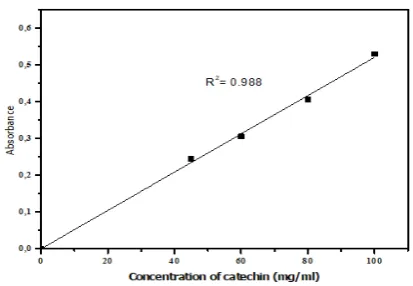
extracts from Tamarix articulata contained 120.55 ± 3.41 mg of catechin/g of dry weight (Figure 2) using the equation obtained from the calibration curve:
Y = 0.5617x, R2 = 0.985 where x is the absorbance and Y is the catechin equivalent.
Figure 1: Standard curve for determination of phenolic content expressed inmg GAE/g of dry weight
Figure 2: Standard curve for determination of flavonoid contentexpressed inmg CE/g of dry weight.
HPLC analysis:
The chromatographic profile of methanolic extract of Tamarix articulate has beenrepresented in Figure 3. The results of the quantitative analysis of phenolic compounds showed that in methanolic extracts, there were the standard compounds of gallic acid, chlorogenic acid, vanillic acid, caffeic acid, vanillin, p-Coumaric acid, rutin, and naringin. Figure 4 showed the chromatograms of the standard markers’ mixture. Peaks 1, 2, 3, 4, 5 and 6 were ascorbic acid, Gallic acid, chlorogenic acid, caffeic acid, vanillin and rutin; respectively.
The contents of these components in different extracts were determined according to the calibration curves of ascorbic acid y = 2260.81x (R2 = 0.998), Gallic acid (R2 = 0.991), chlorogenic acid y = 37492.06x (R2 = 0.999), caffeic acid y = 70429.77x (R2 = 0.999), vanillin y = 80555.42x (R2 = 0.989) and rutin y = 3118.94x (R2 = 0.988), where y was the peak area and x was the concentration of analytes (0–80 µg/ml). The contents of these components in different extracts were determined according to the calibration curves
[28].
The quantitative results have been specified in Table 3. For
Journal of Advanced Pharmacy Education & Research | Oct-Dec 2018 | Vol 8 | Issue4 5
profile of Tamarix articulata leaves extract. However, because of its strong polarity, some compounds were not concentrated by methanolic extract [29]. Tamarix articulata was identified for the
first time in this study. For a reliable characterization, the experimental data were compared with the literature [4, 30] and
with reference standards commercially available. Most of the polyphenols identified in this study were determined as
compounds previously recognized in other species belonging to the genus Tamarix, which included gallic acid, ellagic acid, flavones and flavonols [31]. The data provided above
demonstrated that the HPLC method developed in this study represented a reliable tool for the analysis of the major phenolic compounds in T. articulata.
Table 3: Quantification of identified individual phenolic compounds of Tamarix articuluta extract at 268 nm using HPLC system.
Identified compound Retention Time (min) Equation curve Area Area (%) in fraction Height (uV) (mg/g DW) Quantity
Gallic acid 5.29 y=54681x 136852 0.820 5449 2.574±0.01
Chlorogenic Acid
Vanillic Acid 13.39 15.53 y=21665x y=65077x 123706 266213 0.741 1.595 3883 5439 5.791±0.02 4.090±0.02
Caffeic Acid 16.27 y=84066x 461760 2.767 15150 5.492±0.01
Vanillin 21.46 y=58930x 134417 0.805 2599 2.280±0.01
p-Coumaric Acid Rutin Naringin Quercetin
23.81
28.37 34.78 45.05
y=49495x
y=28144x y=19377x y=55378x
282983
- 33723 254411
1.696
- 0.202 1.525
6903
- 1364 10985
5.717±0.02
ND 1.740±0.01 5.606±0.02 ND: Not detected
Figure 3:The HPLC chromatogram of leaves extract from
Tamarix articuluta at 268 nm.
1: Gallic acid; 2: Chlorogenic Acid; 3: Vanillic Acid; 4: Caffeic Acid; 5: Vanillin; 6: p-Coumaric Acid; 7: Naringin; 8:
Quercetin.
Figure 4. Chromatogramme Profil of mélange etalons 1: ascorbic Acid; 2: Gallic acid; 3: Chlorogenic Acid; 4: Caffeic
Acid 5: vanilline; 6: Rutin
Total antioxidant activity
Several tests and methods have been developed to evaluate the antioxidant capacity of plant extracts. Each assay represented the antioxidant activity of the test material from a different point of view. Applying a combination of two or more complementary test systems has been the most appropriate approach to identify the antioxidant activity of a plant extract
[32]. The phosphomolybdenum method has been based on the
decrease of Mo (VI) to Mo (V) by the antioxidant compounds, and the formation of green Mo (V) complexes with a maximal absorption at 695 nm. The total antioxidant activity of Tamarix articulate was shown to be 345.92 ± 8.45 mg AGE/ g DW (Table 3). In comparison with the Tunisian T. articulate, the leaves’ extract had interesting antioxidant capacity with the shown value of 262.26 ± 1.96 mg AGE/ g DW. This strong result confirmed high antioxidant activity of the eaves’ extract of the plant. This antiradical activity could be due to the phenolic compounds. In fact, it has been found that antioxidant molecules such as polyphenols, and flavonoids reduced the ability of free radicals [33]. The antiradical properties of
6 Journal of Advanced Pharmacy Education & Research | Oct-Dec 2018 | Vol 8 | Issue4 Table 4: Phenolic content, flavonoids content, Scavenging
activity of DPPH and AAT of Tamarix articulata leaves extracts. Antioxidant activity of DPPH expressed as %
inhibition IC50 values (mg/ml).
Tamarix articulata Phenolic content (mg GAE /g DW) 398.42 ± 5.21
Total flavonoids (mg CE/g DW) 120.55 ± 3.41 ATT (mg GAE/g DW) 345.92 ± 8.45 DPPH (IC50= µg/ml) 5.71± 0.22
DPPH scavenging radical activity
The DPPH free radical can be considered a stable organic free radical, and has been generally accepted as a method for the evaluation of free radical scavenging potential of antioxidants [34]
which has been a very simple and useful assay to detect the presence of antioxidant potential in the extracts [35].
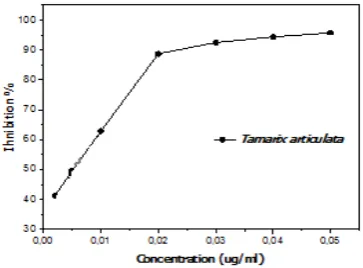
The inhibitory concentrations of leaves’ extract required 50% scavenging of the DPPH radical. The IC50 values of the antioxidant activity of the leaves’ extract has been presented in Table 3 (Figure 5). It shows that methanolic leaves extract of
Tamarix articulata exhibited the highest DPPH radicals with IC50= 5.71± 0.22 µg/ml. In comparison with the Algerian T. articulate, the leaves’ extracts had interesting antioxidant activities against DPPH radicals shown by IC50 values of 9.1 µg /ml [36]. The results showed that high polyphenol contents in
methanolic extract had the most potent radical scavenging capacity. Moreover, the concentrations of phenolic compounds were higher in the extract which could suggest that the high antioxidant capacity observed might be attributed mainly to the polyphenols. In a previous study, the high DPPH radical scavenging activity has been documented that could be due to the high content of phenolic compounds [37].
Figure 5: DPPH scavenging activity of methanolic leaves’ extract from Tamarix articulata.
ABTS assay
Figure 6showed the dose-response curves of ABTS scavenging activities of methanolic extracts from Tamarix articulata and
Tamarix gallica and reference antioxidant (BHT) on ABTS radicals. The ABTS radical scavenging activity of all extracts started with low values of 24.51 ± 0.66 % ; and 17.95 ± 0.52 % at a concentration of 125 µg/ml, respectively. After a rapid
growth, reached to stabilization of 75.81 ± 3.4 %, and 67.64 ± 3.55 at a concentration of 750 µg/mL, respectively. The abilities of scavenging ABTS radicals were in descending order: BHT >Tamarix articulata>Tamarix gallica.
Leaves’ extract of T. Gallica showed significant antioxidant activities against ABTS+. cation radicals illustrated by IC50 values of 316.7 µg/ml [38]. The compounds with antioxidant
activity were mainly phenolic acids, flavonoids and polyphenols
[39]. Phytochemical studies have shown that Tamarix articulata
extracts contain phenolic antioxidant compounds, such as flavonoids (luteolin, quercetin, apigenin, kaempferol, isorhamnetin, tamarixetin, quercetin dimethyl-ether, kaempferide and kaempferol-7,4’-dimethyl-ether) and phenolic acids (gallic acid, caffeic acid, p-coumaric acid and ellagic acid)
[40].
Figure 6: ABTS radical scavenging activity of Tamarix articulata
FRAP assay
This technique uses the direct reduction of hexacyanoferrate(III) anion [Fe(CN)6] 3- into hexacyanoferrate(II) anion [Fe(CN)6]
4-.On a structural point of view, this observation has been in agreement with the lipophilic properties of phenols with a high number of hydrogen and carbon atoms [22]. In this work, FRAP
antioxidant activity of methanolic extract from Tamarix articulata showed a wide range of the activity observed for
Tamarix articulata (74.44 ± 1.05 mg AAE/g). The antioxidant scavenging activities of the extract for FRAP assay were shown in Table 5. It has been the first time to investigate the FRAP antioxidant activity of methanolic extract from Tamarix articulata.
Table 5: The antioxidant scavenging activities of the two extracts for FRAP assay and ABTS assay
Antioxidant activity ABTS 50% (µg/ml) FRAP (mg/g) Tamarix articulata 385.76 ± 2.64 479.23 ± 6.74 The values have been expressed as means ± SD of the triplicate measurements.
β
-Carotene
-Journal of Advanced Pharmacy Education & Research | Oct-Dec 2018 | Vol 8 | Issue4 7
Carotene radical, resulting in a diminution of absorbance at 470 nm. The existence of antioxidants agent could retard the extent of β-Carotene blanching by the neutralization of the linoleate free radicals formed in the system. The results of inhibition activity (50 %) of the extract has been shown in Table 6, the value obtained in Tamarix articulate was (IC50= 43.52 ± 2.43
μg/ml). It has been the first time to investigate the β-Carotene model free radical scavenging of methanolic extract from
Tamarix articulata. The interaction of a potent antioxidant with
β-Carotene depended on the concentrations extracts. The results indicated and supported that the polyphenols can moderately prevent the degradation of β-Carotene caused by the radical reactions.
Table 6: β-Carotene bleaching activities of Tamarix articulata leave extracts. Antioxidant activity was
expressed as % inhibition IC50 values (μg/ml) Samples
concentrations (μg/ml)
Reaction time (min) Antioxidant activity
IC50= (μg/ml) 30 120
Tamarix articulata
Extract
20 40 60
35.37 ± 0.32 52.44 ± 1.31 83.42 ± 2.02
19.47 ± 0.59 41.08 ± 1.02 68.54 ± 1.85
43.52 ± 2.43
Data are expressed as means ± standard deviation of triplicate samples.
Conclusion
In this study, phytochemical investigation, HPLC analysis, in vitro antioxidant activities of methanolic leaves’ extract from
Tamarix articulata acquired by the maceration technique have been examined. The richness of the extracts with the phenolic and flavonoid content was remarkable, and might be considered as a source of these compounds. Furthermore, in vitro assays showed high antioxidant activity, sufficient ability to inhibit the DPPH radical and phosphomolybdate. Furthermore, with a powerful analytical HPLC technique, the identification and quantification of 8 phenolic compounds were achieved for Tamarix articulate whichcan be used as antiradical drugs. In this context, the data presented in this work suggested that Tamarix articulata could be a new source of polyphenols, antioxidant activity, which can be a dare for new medicament.
Conflicts of Interest
The authors declared no conflicts of interest.
Acknowledgements
The authors would like to thank Prof. BOUKHARI ABBES of Laboratory of Organic Synthesis, Modeling and Optimization of Chemical Processes (university of Annaba- Algeria), for the experimental help and fruitful discussions during this investigation.
References
1. El Shaer, Hassan M. In Cash Crop Halophytes: Recent Studies. Springer, p. 111-119 (2003).
2. Baum, B. R. The genus Tamarix. The Israel Academy of Sciences and Humanities, p. 209 (1978).
3. Orabi, M. A., Taniguchi, S., Terabayashi, S., & Hatano, T. Hydrolyzable tannins of tamaricaceous plants. IV: Micropropagation and ellagitannin production in shoot cultures of Tamarix tetrandra. Phytochemistry, 72(16), 1978-1989 (2011).
4. Saidana, D., Mahjoub, M. A., Boussaada, O., Chriaa, J., Chéraif, I., Daami, M.,& Helal, A. N. Chemical composition and antimicrobial activity of volatile compounds of Tamarix boveana (Tamaricaceae). Microbiological research, 163(4), 445-455 (2008).
5. Sharma, S.K., Parmar, V.S., Novel costitutes of Tamarix species. J. Sci. Ind. Res, 57, 873-890 (1998).
6. Gaston, B. The great flora in color. France, Switzerland, Belgium and neighboring countries, Volume 1. Editions Berlin Paris ; 373(1998).
7. Sultanova, N., T. Makhmoor, ZA. Abilov, Z. Parween, V.B. Omurkamzinova, A. Rahman. Antioxidant and antimicrobial activities of Tamarix Ramosissima. J Ethnopharmacol;78:201-205 (2001).
8. Sultanova NT, Makhmoor A, Yasin ZA. Abilov VB, Omurkamzinova Attaur Rahman MI. Choudhary. Isotamarixen-a new antioxidant & prolyl endopeptidase inhibiting triterpenoid from Tamarix hispida. Planta Med; 70(1): 65-67 (2004).
9. M. Ishak, H. El-Sissi, M. Nawwar, A. El-Sherbieny, Tannins and polyphenolics of the galls of Tamarix aphylla. Planta Med 21. 246–253 (1972).
10. M.S. Ishak, H.I. El-Sissi, A.E. el-Sherbieny, M.A. Nawwar. Tannins and polyphenolics of the galls of Tamarix aphylla. Part II. Planta Med 21, 374–381(1972). 11. Drabu S, Chaturvedi S, Sharma M, Tamarix gallica-An
overview. Asian J Pharm Clin Res; 5(3):17-19 (2012). 12. Chanwitheesuk, A., Teerawutgulrag, A., &
Rakariyatham, N. Screening of Antioxidant Activity and Antioxidant Compounds of Some Edible Plants of Thailand. Food chemistry, 92(3), 491-497 (2005).
13. Maisuthisakul, P., Suttajit, M., & Pongsawatmanit, R. Assessment of phenolic content and free radical-scavenging capacity of some Thai indigenous plants. Food chemistry, 100(4), 1409-1418 (2007).
14. Bravo, L. Polyphenols: chemistry, dietary sources, metabolism, and nutritional significance. Nutrition reviews, 56(11), 317-333 (1998).
8 Journal of Advanced Pharmacy Education & Research | Oct-Dec 2018 | Vol 8 | Issue4
16. Hmidene A B, Hanaki M, Murakami K, Irie K, Isoda H, & Shigemori, H, Inhibitory Activities of Antioxidant Flavonoids from Tamarix gallica on Amyloid Aggregation Related to Alzheimer's and Type 2 Diabetes Diseases. Biol Pharm Bull; 40(2): 238-241(2017).
17. Singleton, V. L., & Rossi, J. A. Colorimetry of Total Phenolics with Phosphomolybdic-Phosphotungstic Acid Reagents. American journal of Enology and Viticulture, 16(3), 144-158(1965).
18. Chang, C. C., Yang, M. H., Wen, H. M., & Chern, J. C. Estimation of Total Flavonoid Content in Propolis by Two Complementary Colorimetric Methods. Journal of food and drug analysis, 10(3) (2002).
19. Prieto, P., Pineda, M., & Aguilar, M. Spectrophotometric quantitation of antioxidant capacity through the formation of a phosphomolybdenum complex: specific application to the determination of vitamin E. Analytical biochemistry, 269(2), 337-341 (1999).
20. Hatano, T., Kagawa, H., Yasuhara, T., & Okuda, T. Two New Flavonoids and Other Constituents in Licorice Root: Their Relative Astringency and Radical Scavenging Effects. Chemical and Pharmaceutical Bulletin, 36(6), 2090-2097(1988).
21. Benzie, I. F., & Strain, J. J. The ferric reducing ability of plasma (FRAP) as a measure of "antioxidant power": the FRAP assay. Analytical biochemistry, 239(1), 70-76 (1996).
22. Özen, T. Antioxidant activity of wild edible plants in the Black Sea Region of Turkey. Grasas y aceites, 61(1), 86-94 (2010).
23. Raid A, Yazeed A, Ayesha M, Rabbani S, Janardhan K, Gupta VC. Evaluation of antibacterial activity of crude protein extracts from seeds of six different medical plants against standard bacterial strains, S J Biol Sci, 21:147– 51(2014).
24. Bettaib J, Talarmin H, Droguet M, Magné C, Boulaaba M, Giroux-metges MA, Ksouri R, Tamarix gallica phenolics protect IEC-6 cells against H2O2 induced stress by restricting oxidative injuries and MAPKs signaling pathways. Biomed Pharmacother; 89:490-498 (2017). 25. Cirillo G, Curcio M, Vittorio O, Iemma F, Restuccia D,
Spizzirri UG, Picci N, Polyphenol conjugates and human health: a perspective review. Crit Rev Food Sci Nutr; 56(2):326-337 (2016).
26. Ko G A, Son M, Cho S K. Comparative evaluation of free radical scavenging activities and cytotoxicity of various solvent fractions of Sandong Sageretia thea (Osbeck) M.C. Johnst. Branches. Food Sci Biotec; 25(6):1683-1691 (2016).
27. Zeng L B, Zhang Z R, Luo Z H, Zhu JX. Antioxidant activity and chemical constituents of essential oil and extracts of Rhizoma Homalomenae, Food Chemistry; 125:456–463 (2011).
28. J.-L. Wolfender, P. Waridel, K. Ndjoko, K.R. Hobby, H.J. Major, K.N Hostettmann, Evaluation of Q-TOF-MS/MS and multiple stage IT-MSn for the dereplication of flavonoids and related compounds in crude plant extracts. Analusis ; 895-906 (2000).
29. R.J. Robbins, Phenolic acids in foods : An Overview of Analytical Methodology. J. Agric. Food Chem; 2866-2887 (2003).
30. Prvulović, D., Malenčić, Đ., & Miladinović, Antioxidant Activity and Phenolic Content of Soybean Seeds Extracts. Agro-knowledge Journal, 17(2), 121-132 (2017). 31. Z. Mohammedi, F. Atik, “Impact of Solvent Extraction
Type on Total Polyphenols Content and Biological Activity from Tamarix Aphylla (L.) Karst,” International journal of pharma and bio sciences; 2(1), 609-615 (2011). 32. Msaada K, Jemia M B, Salem N, Bachrouch O, Sriti J,
Tammar S, Marzouk B. Antioxidant activity of methanolic extracts from three coriander (Coriandrum sativum L.) fruit varieties. Arab J Che, 10:3176-3183 (2017). 33. Upadhyay NK, Yogendra Kumar M.S, Gupta A.
Antioxidant, cytoprotective and antibacterial effects of Sea buckthorn (Hippophae rhamnoides L.) leaves. Food Chem Toxicol ; 48:3443–3448 (2010).
34. Kaur G, Arora DS. Antibacterial and phytochemical screening of Anethum graveolens, Foeniculum vulgare and Trachyspermum ammi. BMC Complement Alter Med; 9:30–39 (2006).
35. Kumari D, Madhujith T, Chandrasekara, Comparison of phenolic content and antioxidant activities of millet varieties grown in different locations in Sri Lanka. Food Sci Nutr; 5(3):474-485 (2017).
36. R. Ksouri, H. Falleh, W. Megdiche, N. Trabelsi, B. Mhamdi, K. Chaieb, A. Bakrouf, C. Magné, C. Abdelly, Antioxidant and antimicrobial activities of the edible medicinal halophyte Tamarix gallica L. and related polyphenolic constituents. Food Chem. Toxicol; 2083-2091 (2009).
37. C.J. Dillard, J.B. German. Phytochemicals: nutraceuticals and human health. J. Sci. Food Agric; 1744-1756 (2000). 38. A. Mahfoudhi, F. Pio Prencipe, Z. Mighri, F. Pellati.
Metabolite profiling of Polyphenols ion the Tunisian plant Tamarix aphyll(L.) karst. J. Pharm. Biomed. Anal; 97-105 (2014).
39. Monar, A., Medić-S_arić, M., Jasprica, I. ADME Data for polyphenols characterized by reversed-phase thinlayer chromatography. Journal of Planar Chromatography - Modern TLC 19 (112), 409-417.