http: // www.ijrtsm.com© International Journal of Recent Technology Science & Management 19
ISSN : 2455-9679
[Nitin et al. , 3(9), Sept 2018] Impact Factor : 2.865
IJRTSM
INTERNATIONAL JOURNAL OF RECENT TECHNOLOGY SCIENCE & MANAGEMENT
“
DESIGN AND ANALYSIS OF IC ENGINE PISTON DESIGN USING CATIA AND ANSYS
SOFTWARE
”
Nitin Kumar
1,
Ashish Kumar Sinha
2 1,PG, Scholar, Dept. of Mechanical Engineering, OIST, Bhopal, MP, India
2
Assistant Professor, Dept. of Mechanical Engineering, OIST, Bhopal, MP India
ABSTRACT
Piston is the part of engine which converts heat and pressure energy liberated by fuel combustion into mechanical works. Engine piston is the most complex component among the automotives. This thesis illustrate design procedure for a piston for 4 stroke petrol engine for hero splendor – pro bike and its analysis by its comparison with original piston dimensions used in bike. The design procedure involves determination of various piston dimensions using analytical method under maximum power condition. In this thesis the combined effect of mechanical and load is taken into consideration while determining various dimensions. The basic data of the engine are taken from a located engine type of hero splendor –pro bike. We have selected four materials of aluminium alloy- A2618, A 4032, AL-GHS 1300 and Ti-6Al-4v and we have used modeling through CATIA and simulation through ANSYS software.
KEYWORD: Piston, Bike, A2618, A 4032, AL-GHS 1300 and Ti-6Al-4v.
I.
I
NTRODUCTIONPiston is considered to be one of the most important parts in a reciprocating Engine, reciprocating Pumps, among other similar mechanisms in which it helps to convert the chemical energy obtained by the combustion of fuel into useful (work) mechanical power.
http: // www.ijrtsm.com© International Journal of Recent Technology Science & Management 20
ISSN : 2455-9679
[Nitin et al. , 3(9), Sept 2018] Impact Factor : 2.865
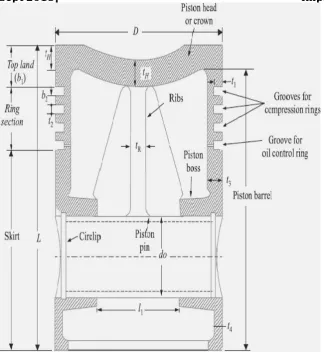
Figure.2
II.
MATERIALSTable 2 .1 A2618 Aluminium Alloy Mechanical properties
Material Field
Variable
Value Units
Density 2768 Kg/m3
Young’s
modulus
7.37E+10 Mpa
Poisson Ratio 0.33
Shear modulus 2.7707E+10 MPa
http: // www.ijrtsm.com© International Journal of Recent Technology Science & Management 21
ISSN : 2455-9679
[Nitin et al. , 3(9), Sept 2018] Impact Factor : 2.865
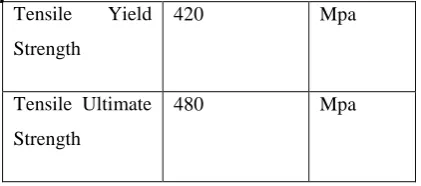
Tensile Yield
Strength
420 Mpa
Tensile Ultimate
Strength
480 Mpa
Table 2.2 A4032 Alloy Mechanical properties
Material Field
Variable
Value Units
Density 2685 Kg/m3
Young’s
modulus
7.97E+15 Mpa
Poisson Ratio 0.33
Shear modulus 2.9699E+10 Mpa
Bulk Modulus 7.7451E+10 Mpa
Tensile Yield
Strength
315 Mpa
Tensile Ultimate
Strength
380 Mpa
Table 2.3 AL-GHS 1300 Alloy Mechanical properties
Material Field
Variable Value Units
Density 2780 Kg/m3
Young’s modulus 9.8E+10 Mpa
Poisson Ratio 0.30
Shear Modulus 3.7692E+10 Mpa
http: // www.ijrtsm.com© International Journal of Recent Technology Science & Management 22
ISSN : 2455-9679
[Nitin et al. , 3(9), Sept 2018] Impact Factor : 2.865
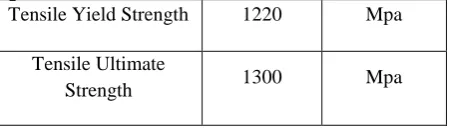
Tensile Yield Strength 1220 Mpa
Tensile Ultimate
Strength 1300 Mpa
Table 2.4 TI-6AL-4V Alloy Mechanical properties
Material Field Variable Value Units
Density 4430 Kg/m3
Young’s modulus 1.138E+10 Mpa
Poisson Ratio 0.33
Shear modulus 3.7692E+10 Mpa
Bulk Modulus 8.1667E+10 Mpa
Tensile Yield Strength 880 Mpa
Tensile Ultimate Strength 950 Mpa
III.
MODELING
&
SIMULATION
SPECIFICATIONS (Splendor-Pro)
Engine Type
Air-cooled, 4-stroke single
cylinder OHC
Displacement
97.2 cc
Max. Power
5.66 KW ,@ 5000 rpm
Max. Torque
7.130 N-m @ 2500 rpm
Compression
Ratio
9.9 : 1
Starting
Kick Start / Self Start
Ignition
DC - Digital CDI
http: // www.ijrtsm.com© International Journal of Recent Technology Science & Management 23
ISSN : 2455-9679
[Nitin et al. , 3(9), Sept 2018] Impact Factor : 2.865
Fig.3.1 2D Drafting
Fig.3.2 CATIA Model
http: // www.ijrtsm.com© International Journal of Recent Technology Science & Management 24
ISSN : 2455-9679
[Nitin et al. , 3(9), Sept 2018] Impact Factor : 2.865
Fig.3.4 Meshing
Fig.3.5 Fixed support A2618 Materials
http: // www.ijrtsm.com© International Journal of Recent Technology Science & Management 25
ISSN : 2455-9679
[Nitin et al. , 3(9), Sept 2018] Impact Factor : 2.865
Fig. 3.7 Total Deformation A2618 Materials
Fig.3.8 Equivalent Elastic Strain A2618 Materials
http: // www.ijrtsm.com© International Journal of Recent Technology Science & Management 26
ISSN : 2455-9679
[Nitin et al. , 3(9), Sept 2018] Impact Factor : 2.865
Fig.3.10 Pressure A4032 Materials
Fig.3.11 Total Deformation A4032 Materials
http: // www.ijrtsm.com© International Journal of Recent Technology Science & Management 27
ISSN : 2455-9679
[Nitin et al. , 3(9), Sept 2018] Impact Factor : 2.865
Fig.3.13 Equivalent Stresses A4032 Materials
Fig.3.14 Pressure AL-GHS 1300 Materials
http: // www.ijrtsm.com© International Journal of Recent Technology Science & Management 28
ISSN : 2455-9679
[Nitin et al. , 3(9), Sept 2018] Impact Factor : 2.865
Fig.3.16 Total Deformation AL-GHS 1300 Materials
Fig.3.17 Equivalent Strain AL-GHS 1300 Materials
http: // www.ijrtsm.com© International Journal of Recent Technology Science & Management 29
ISSN : 2455-9679
[Nitin et al. , 3(9), Sept 2018] Impact Factor : 2.865
Fig.3.19 Total Deformation TI-6AL-4v Materials
Fig.3.20 Equivalent Strain TI-6AL-4v Materials
http: // www.ijrtsm.com© International Journal of Recent Technology Science & Management 30
ISSN : 2455-9679
[Nitin et al. , 3(9), Sept 2018] Impact Factor : 2.865
IV.
RESULT
&
DISCUSSION
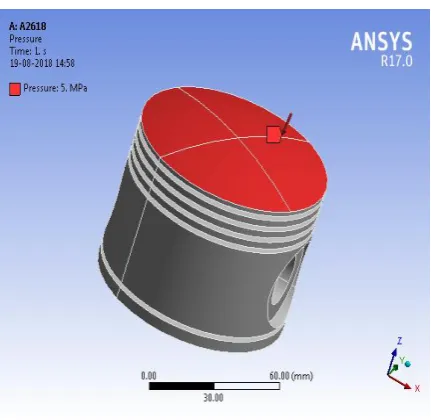
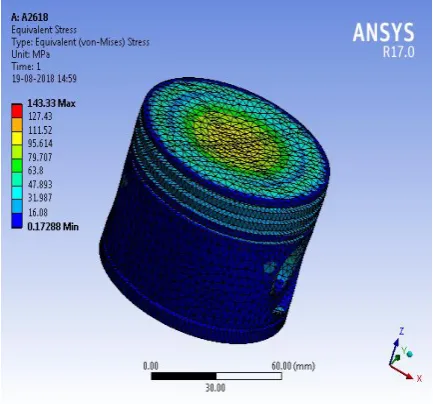
3D models of piston are created based on the dimensions obtained. CATIA V5R20 is used for creating the 3D model. These models are then imported into ANSYS WORKBENCH 17.0 for analysis. Static structural analysis of pistons is carried out. Meshing is done with an automatic which gives a fine mesh. For static structural analysis, gas pressure is applied on the top of the piston and frictionless support is applied across the surface of piston and also on the piston pin holes. Then results are obtained for von-misses stress and maximum elastic strain. A comparison is made between these results and the best suited aluminium alloy is selected based on the parameters.
The static structural analysis of A2618, A4032, Al-GHS1300, and Ti-6Al-4V are done and results are obtained
for Equivalent (Von-Mises) stress, equivalent elastic strain and deformation.
We can observe that in case of equivalent (von-mises) stress, piston made of A4032 is found to have Highest
stress of 143.33MPa is observed.
When piston made of Al-GHS 1300 then stress value maximum 151.03 MPa. Maximum equivalent stress on A2618 was found to be 143.33Mpa and that of Ti-6Al-4V was found to be 143.33 Mpa.
We can observe that in case of equivalent strain , piston made of A4032 is found to have maximum stress of
0.0019 mm/mm is observed. When piston made of Al-GHS 1300 then strain value was found to be 0.0013 mm/mm and that of Ti-6Al-4V was found to be 0.0016 mm/mm, equivalent strain on A2618 was found to be 0.0021 mm/mm. We can observe that in case of deformation , piston made of A4032 is found to have deformation of 0.148 mm is observed. When piston made of Al-GHS 1300 then deformation value was found to be 0.103 mm and that of Ti-6Al-4V was found to be 0.122 mm, deformation on A2618 was found to be 0.159 mm
http: // www.ijrtsm.com© International Journal of Recent Technology Science & Management 31
ISSN : 2455-9679
[Nitin et al. , 3(9), Sept 2018] Impact Factor : 2.865
Fig.4.2 Comparison Graph for Stress with different materials
Fig.4.3Comparison Graph for Deformation with different materials
http: // www.ijrtsm.com© International Journal of Recent Technology Science & Management 32
ISSN : 2455-9679
[Nitin et al. , 3(9), Sept 2018] Impact Factor : 2.865
V.
CONCLUSION
The fundamental concepts and design methods concerned with single cylinders petrol engine have been studied in this paper the results found by the use of this analytical method are nearly equal to the actual dimensions used now a days. Hence it provides a fast procedure to design a piston which can be further improved by the use of various software and methods. The most important part is that very less time is required to design the piston and only a few basic specification of the engine. Pistons made of different aluminum alloys like A2618, A4032, AL-GHS 1300, Ti-6Al-4V were designed and analyzed successfully. In static-structural analysis, the pistons were analyzed to find out the equivalent (von-mises) stress, equivalent elastic strain and deformation. It can be observed that maximum stress intensity is on the bottom surface of the piston crown in all the materials. Here we found Ti-6Al-4V this material has less deformation value compare to other materials of aluminum alloy. So we will be suggested this material for future work.
REFERENCES
1. Skopp a,1, N. Kelling a,1, M. Woydta,1, L.-M. Berger b,, Thermally sprayed titanium sub oxide coatings for
piston ring/cylinder liners under mixed lubrication and dry-running conditions, Wear 262 (2007) 1061–1070
2. A. V. Sreenath And N. Raman, Running-In Wear Of A Compression Ignition Engine: Factors Influencing The
Conformance Between Cylinder Liner And Piston Rings, Wear, 38 (1976) 271 – 289
3. B. Zhang, X. Peng , Z. He, Z. Xing, P. Shu, Development of a double acting free piston expander for power recovery in trans critical CO2 cycle, Applied Thermal Engineering 27 (2007) 1629–1636
4. C. Friedrich a,, G. Berg a, E. Broszeit a, F. Rick b, J. Holland b, PVD CrxN coatings for tribological application on piston rings, Surface and Coatings Technology 97 (1997) 661–668
5. C.W. Huanga,, C.H. Hsuehb,c, Piston-on-three-ball versus piston-on-ring in evaluating the biaxial strength of dental ceramics, Dental materials 2 7 ( 2 0 1 1 ) e117–e123
6. D. J. Picken; H. A. Hassaan, A Method for Estimating Overhaul Life of Internal Combustion Engines including Engines Operating, J. agric. Engng Res,28. (1983), 139-147
7. Dacheng Li a,, Haiqi Wub, Jinji Gao b, Experimental study on stepless capacity regulation for reciprocating compressor based on novel rotary control valve, International journal of refrigeration 36 (2013) 1701 e1715 8. Dhananjay Kumar Srivastava a, Avinash Kumar Agarwal a,, Jitendra Kumar b, Effect of liner surface
properties on wear and friction in a non-firing engine simulator, Materials and Design 28 (2007) 1632–1640 9. E.P. Becker a,, K.C Ludema b, A qualitative empirical model of cylinder bore wear, Wear, 225-229 (1999)
387-404
10. F.S. Silva , Fatigue on engine pistons – A compendium of case studies, Engineering Failure Analysis 13 (2006) 480– 492
11. G. Floweday a, S. Petrov b, R.B. Tait b,, J. Press c, Thermo-mechanical fatigue damage and failure of modern high performance diesel pistons, Engineering Failure Analysis 18 (2011) 1664–1674
12. H. Sunden and R. Schaub Ϯ , Piston rings for slow and speed diesel engines, Tribology International February 1979
13. J. E. Willn, Characterisation Of Cylinder Bore Surface Finish A Review Of Profile Analysis, Wear - Elsevier Sequoia S.A., Lausanne - Printed in the Netherlands
14. J. Galligan a, A.A. Torrance a,), G. Liraut b , A scuffing test for piston ring bore combinations: Pt. II. Formulated motor lubrication, Wear 236 (1999) 210–220
15. Jarosław Milewski, Łukasz Szabłowski, Jerzy Kuta, Control strategy for an Internal Combustion engine fuelled by Natural Gas operating in Distributed Generation, Energy Procedia 14 (2011) 1478 – 1483