70 Available online at www.ijiere.com
International Journal of Innovative and Emerging
Research in Engineering
e-ISSN: 2394 - 3343 e-ISSN: 2394 - 5494
Wi-Fi Module and Wireless Sensor
Network Based
Automated Irrigation System
Nirmit Patel
a,
Prof. Nilseh Desai
ba PG Scholar –Embedded System, b Professor - E&C Department
a,b G.H.Patel College of Engineering and Technology, V.V.Nagar, Anand, Gujarat-India
ABSTRACT:
Irrigation is the controlled application of water for agricultural purposes through manmade systems to supply water requirements not satisfied by rainfall. This paper reviews different monitoring systems and proposes an automatic monitoring system model using Wireless Sensor Network (WSN) which helps the farmer to improve the yield. Distributed in-field water level, temperature and Gas sensor network -based irrigation systems offer a potential solution to support site-specific irrigation management that allows producers to maximize their productivity while saving water. And using solar panel for power supply and charging battery for WSN so that there no worry about replace battery every time .Wi-Fi-Internet interface that allowed for data inspection and irrigation system and the monitored data displays the status directly to the predefined webpage. The mainly aims in design and implementation of automatic irrigation control system using ZigBee wireless network and the internet communication system based on Wi-Fi technology In addition, a gateway unit handles sensor information, triggers actuators, and transmits data to a web application. For such an environment, such as radiation, pollution, dangerous, distributed environment where the staff is not easy to reach, it is difficult to complete data collection and real-time monitoring through the traditional manual method.
Keywords: Water level and temperature Sensors, WSN, ZigBee, Wi-Fi Module, Web Application
I. INTRODUCTION
Water saving is the main aim of our work. Very small amount of water is useful for all living organisms and it’s the human being who is mainly responsible for wastage of water. One major reason of which is unnecessary wastage of water in agriculture field due to unawareness of farmers about sufficient supply of water [1]. There are many plants that are very sensitive to water levels and they required specific level of water supply for proper growth, if this not they may die or results in improper growth. It’s hardly possible that every farmer must possess the perfect knowledge about growing specifications of plants in case of water supply. Recent developments in integrating microelectromechanical systems and wireless technology have resulted in smaller and better performing wireless sensor nodes.
An interconnected network of such devices, with the capacity to sense, process and transmit information with limitations, is called a wireless sensor network (WSN). Due to their cost-effective nature and deployment flexibility, WSNs have been successfully used in many real-world applications [2]–[5]. The main advantage of WSN is it can remove hard wire connection in the soil area for sprinkler in the soil area. The WSN eliminates the need to hard wire sensor stations across the field and reduces installation and maintenance costs. A hard-wired system from in-field sensing stations to a base station takes extensive time and costs to install and maintain. It may not be feasible to hard wire the system for long distances, and it may not be acceptable to growers because it can interfere with normal farming operations. A wireless data communication system can provide dynamic mobility and cost free relocation. A data acquisition system was deployed for monitoring crop conditions by means of soil moisture and soil, air, and canopy temperature measurement in cropped fields.
ZigBee wireless technology is an example that has been adapted and used for sensing and control of agricultural systems [6]. I evaluated ZigBee radio for different agricultural environments, power consumption, and data transmission rates. I observed 1.4 m as an optimal radio height for a maximum 44-m radio range and reported limitations of significant signal loss after 8 h of continuous battery operation and 2–3 s of transmission latency with the increase of communication range. Application of ZigBee wireless data transmission of the moisture concentration of harvested silage and reported a limitation of a short 15-m range. However, the limitations can be solved or minimized by a system design optimization. For example, power shortages can be solved by using solar panels that recharge the battery, and the radio range can also be improved by upgrading the power class and antennas.
71
II. SYSTEM DESCRIPTION
The project mainly aims in design and implementation of automatic irrigation control system using ZigBee [7] wireless network and the internet communication system based on Wi-Fi technology [8]. For such an environment, such as radiation, pollution, dangerous, distributed environment where the staff is not easy to reach, it is difficult to complete data collection and real-time monitoring through the traditional manual method. The automated irrigation system hereby reported, consisted of two components wireless sensor units (WSUs) and a wireless information unit (WIU), linked by radio transceivers that allowed the transfer of soil moisture and temperature data, implementing a WSN that uses ZigBee technology. The WIU has also a Wi-Fi module to transmit the data to a web server via the public mobile network. The information can be remotely monitored online through a graphical application through Internet access devices.
1. Wireless Sensor Unit:
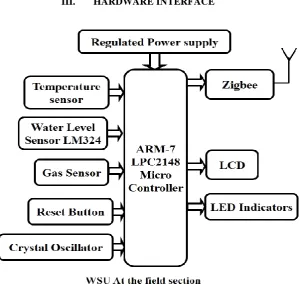
A WSU is comprised of a Zigbee transceiver, sensors, a microcontroller, and power sources. Several WSUs can be deployed in-field to configure a distributed sensor network for the automated irrigation system. Each unit is based on the ARM LPC2148 Micro Controller that controls the radio modem ZigBee and processes information from the soil-moisture sensor and the temperature sensor, Gas sensor. These components are powered by batteries with solar panel for charging battery so that there no worry about replace battery every time. These components were selected to minimize the power consumption for the proposed application. WSU consist following components.
1.1 ARM LPC2148 Micro Controller:
ARM LPC2148 is a 64 pin Micro Controller which comes under ARM 7 version of ARM processors. It comes under the processor core architecture ARM7TDMI.It is a 32 bit Micro Controller .This is intended for high end applications involving complex computations. It follows the enhanced RISC architecture. It has high performance and very low power consumption. It has serial communications interfaces ranging from a USB 2.0 Full Speed device, multiple UARTS, SPI, and I2Cs. Various 32-bit timers, dual 10-bit ADC(s), single 10-bit DAC, PWM channels and 45 fast GPIO lines with 9 interrupt pins [11].
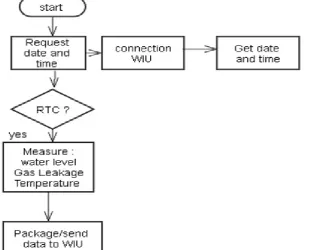
The microcontroller was programmed in C compiler with the appropriate algorithm shows in fig 1 for monitoring the soil-moisture probe through an analog-to-digital port and the soil-temperature probe through another digital port, implemented in 1-Wire communication protocol. A battery voltage monitor is included through a high-impedance voltage divider coupled to an analog-to-digital port. The data are packed with the corresponding identifier, date, and time to be transmitted via ZigBee radio modem using a RS-232 protocol through two digital ports configured as transmitter (TX) and receiver (RX), respectively. After sending data, the microcontroller is set in sleep mode for certain period according to the sensor sampling rate desired, whereas the internal RTC is running. This operation mode allows energy savings. When the WSU is launched for first time, the algorithm also inquires the WIU, the date and time to program the RTC, and periodically updates it for synchronization.
72 1.2 ZigBee Modules:
ZigBee (over IEEE 802.15.4) technology is based on short range WSN and it was selected for this battery-operated sensor network because of its low cost, low power consumption, and greater useful range in comparison with other wireless technologies like Bluetooth (over IEEE 802.15.1), UWB (over IEEE 802.15.3) [9]. The ZigBee devices operate in industrial, scientific, and medical 2.4-GHz radio band and allow the operation in a so-called mesh networking architecture[10].
1.3 Soil Sensor Array:
The sensor array consists of two soil sensors, including water level and temperature and Gas that are inserted in the root zone of the plants. The probe was selected to estimate the soil water level because of low power consumption (<7 mA) and low cost. The sensor was powered at 3.3 V and monitored by the microcontroller.
2. Wireless Information Unit :
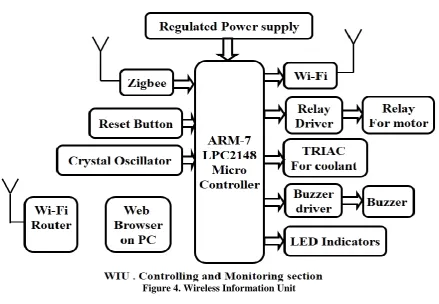
The soil water level, temperature and Gas leakage data from each WSU are received, identified, recorded, and analyzed in the WIU. The WIU consists of a master microcontroller, a ZigBee radio modem, a Wi-Fi module an RS-232 interface MAX3235E, one electronic relays for water motor of the tank, All the WIU electronic components were encapsulated in the control room. The WIU can be located up to 1500-m line-of-sight from the WSUs placed in the field. WIU consist following components.
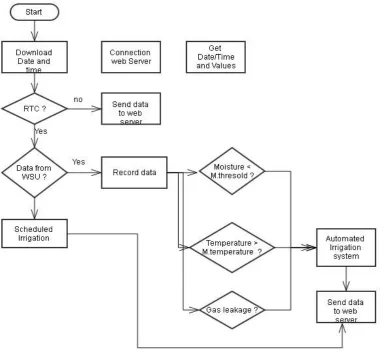
2.1 Main Microcontroller: The functionality of the WIU is based on the microcontroller, which is programmed to perform tasks, as is shown in figure 2.
Figure 2. Algorithm of the main microcontroller in the WIU for the automated irrigation system
73 the date, and time generated by the internal RTC. If irrigation is provided, the program also stores a register with the duration of irrigation, the date, and time. Finally, these data also transmitted at each predefined time to a web server through HTTP via the Wi-Fi module to be deployed on the Internet web application in real time. When the server receives a request for the web page, it inserts each data to the corresponding field in the database. This link is bidirectional and permits to change the threshold values through the website interface; scheduled watering or remote watering can be performed. The WIU has also a push button to perform manual irrigation for a programmed period and a LED to indicate when the information package is received. All the WIU processes can be monitored through the RS-232 port. The WIU includes a function that synchronizes the WSUs at noon for monitoring the status of each WSU.
2.2 Wi-Fi module: This Wi-Fi modem includes an embedded transmission control protocol/Internet protocol stack to bring Internet connectivity. The module is capable of transfer speeds up to 115.2 K b/s and can be interfaced directly to a UART or microcontroller [8]. It also includes an on-board LED to display network status.
2.3 Watering Module: The irrigation is performed by controlling the motor through electromagnetic relays connected with the microcontroller). The motor have a power consumption of 48 W each and were fed by a 5000-l water tank. Different irrigation actions (IA) are implemented in the WIU algorithm:
1) Fixed duration for manual irrigation with the push button; 2) automated irrigation with a fixed duration, if at least one soil moisture sensor value of the WSN drops below the programmed threshold level; 3) automated irrigation with a fixed duration, if at least one soil temperature sensor value of the WSN exceeds the programmed threshold level.
3. Web Application:
Graphical user interface software was developed for real-time monitoring and programming of irrigation based on soil moisture and temperature data. The software application permits the user to visualize graphically the data from each WSU online using any device with Internet Besides the soil-moisture and temperature graphs, the web application displays the total water consumption and the kind of the IA. The web application also enabled the user direct programming of scheduled irrigation schemes and adjusting the trigger values in the WIU according to the crop species and season management. All the information is stored in a database. The web application for monitoring and programming was coded in C# language of Microsoft Visual Studio 2010. The database was implemented in SQL Server 2005.
III. HARDWARE INTERFACE
74 Figure 4. Wireless Information Unit
IV. WORKING OF IRRIGATION SYSTEM
The purpose of system is to implement the remote wireless communication between WSU and WIU , we browse using ZigBee and Wi-Fi sensor network. The proposed project aims in designing an automatic operated system which is capable of controlling the electrical devices based on the sensors unit. This system creates a new era in the automation system. This system integrates human-machine interface.
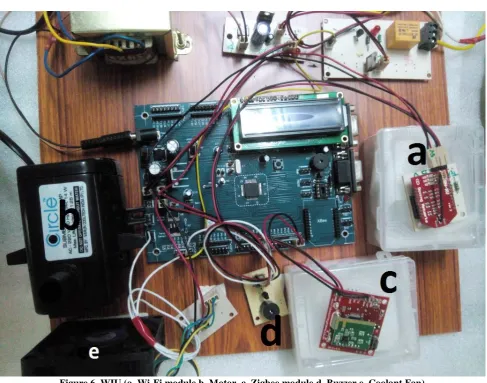
The entire system is divided in two parts one is WSU(wireless sensor unit) and another is WUI(wireless information unit). WSU contain all sensors and Zigbee transmitter which is located in the field section of the soil. WIU contain Zigbee receiver, Wi-Fi module and electrical devices coolant fan and motor pump and buzzer which is located in the monitoring section of control room.
Therefor the proposed system requires two arm-7 LPC2148 microcontroller mother boards. The system which is located at the fields is interfaced with sensors using ARM-7 Microcontroller. Whenever the sensors unit gets the input from respected sensors like temperature LM35 sensor, water level indicator sensor LM324 and Gas leakage detector these inputs are fed to the ARM 7 microcontroller and the controller takes the responsibility to transmit the monitored data to the monitoring section using ZigBee module. The Another ZigBee module which is located at monitoring section receives the data and fed as input to another ARM-7 Microcontroller performs appropriate task related to the data received like motor ON/OFF control, fan as coolant control system. The data is also transmitted directly to the predefined web page using router connected to Wi-Fi wireless network. The monitored data displays the status directly to the predefined webpage. The ARM-7 Microcontroller used in the project is programmed using Embedded C language.
75 Figure 5. WSU (a. GAS sensor, 2.zigbee module, c. water level sensor, d. temperature sensor)
Figure 6. WIU (a. Wi-Fi module b. Motor, c. Zigbee module d. Buzzer e. Coolant Fan)
CONCLUSION
76 Communication so that there will be no hard wire connection in crop field. Furthermore wireless sensor network’s nodes take power from solar panel so that there is no issue for power supply. The irrigation system can be adjusted to a variety of specific crop with different water level and requires minimum maintenance. In addition temperature monitoring in compost production can be easily implemented. Wi-Fi module allows transmitting water level and temperature information to web server. Furthermore, the Internet link allows the supervision through such as a smartphone and computers. So that we can monitor our crop related information from any place if we are far from crop area.
REFERENCES
[1] Ayars, J.E., Phene, C.J., Hutmacher, R.B., Davis, K.R., Schoneman, R.A., Vail,S.S. and Mead, R.M. (1999). Subsurface drip irrigation of row crops: a review of 15 years research at the Water Management Research Laboratory. Agricultural Water Management 42: 1-27.
[2] P. Bauer, M. Sichitiu, R. Istepanian, and K. Premaratne, “The mobile patient: Wireless distributed sensor networks for patient monitoring and care,” in Proc. IEEE EMBS Int. Conf. Inf. Technol. Appl. Biomed., 2000, pp. 17–21. [3] S. Ooi, I. Mareels, N. Cooley, G. Dunn, and G. Thomas, “A systems engineering approach to viticulture on-farm
irrigation,” in Proc. 17th IFAC World Congr., 2008, pp. 9569–9574.
[4] A. Mainwaring, D. Culler, J. Polastre, R. Szewczyk, and J. Anderson, “Wireless sensor networks for habitat monitoring,” in Proc. 1st ACM Int. Workshop Wireless Sensor Netw. Appl., 2002, pp. 88–97.
[5] J. Yick, B. Mukherjee, and D. Ghosal, “Wireless sensor network survey,” Comput. Netw., vol. 52, no. 12, pp. 2292–2330, 2008.
[6] T. Oksanen, M. Ohman, M. Miettinen, and A. Visala, “Open configurable control system for precision farming,” in Proc. ASAE Int. Conf. Autom. Technol. Off-Road Equipment, Kyoto, Japan, Aug. 1–4, 2004,vpp. 184–191. [7] Wireless Medium Access Control (MAC) and Physical Layer (PHY) Specifications for Low-Rate Wireless
Personal Area Networks (LR-WPANs), IEEE Standard 802.15.4, 2003.
[8] Wireless Medium Access Control (MAC) and Physical Layer (PHY) Specifications: Higher-Speed Physical Layer Extension in the 2.4 GHz Band, IEEE Standard 802.11b, 1999
[9] N. Baker, “ZigBee and Bluetooth strengths and weaknesses for industrial applications,” Comput. Control Eng. J., vol. 16, no. 2, pp. 20–25, Apr./May 2005.
[10]http://www.ti.com/product/cc2500 [11]http://www.arm.com/