61
_______________________________________________________________
_______________________________________________________________
AN OVERVIEW OF THE REGULATORY ENVIRONMENT IN ASEAN
COUNTRIES
Kiran Kumar B*, Umasankar K, Alagu Sundaram M, Jaya Chandra Reddy P
Krishna Teja Pharmacy College, Chadalawada Nagar, Tirupathi-517506, Andhra Pradesh, India.
ABSTRACT
This study aims is to analyze the ASEAN pharmaceutical regulatory landscape in terms of the ease of doing business, the impact of Harmonisation, and the key factors and dynamics influencing member countries and the outside world. It also provides strategic recommendations for market participants and conclusions. Drug product registration is a demanding task in regulated, semi regulated and rest of world countries. Although the requirements are harmonized in regulated countries by CTD (Common technical document) filing, yet others have giant diversity in requirements. ICH (International conference on Harmonization of Technical Requirements for Registration of Pharmaceuticals for Human Use) brought regulatory authorities and pharmaceutical industries of Europe, Japan and US together for numerous aspects of drug registration. Similarly, countries from Asia pacific are in process of harmonization with mutual concern as The Association of Southeast Asian Nations (ASEAN). The optimization in requirements is mandatory and can be judged by the incidence of higher cost involved in availability of drugs, research and development facilities. For better treatment safety and efficacy for the drugs must be justified and rationalize for public security. The quality, safety and efficacy data has its own importance in the registration dossier. The commercial significance of markets is increasing globally. It is vital for pharmaceutical industry to cope with the regulatory requirements for betterment of public and to ensure their place in the market. This Thesis lines the registration requirements in the form a dossier for market authorization. It also has drawn a comparative statement on various approaches for harmonization of registration requirement for pharmaceuticals in ASEAN Countries.
Key words: ASEAN, ICH, FDA, PS (Product Dossier) DMF, FP (Finished Product).
INTRODUCTION
Asia is expected to overtake Europe in pharmaceutical market within the next couple of decades and sales are driven by growth in key emerging markets. e.g., China is deemed to be the second largest pharmaceutical market after the United States by 2019. More than 80% population lives in the emerging market and so the real financial growth has come from these markets. This promotes many MNC‟s switched to these emerging countries particularly in ASEAN Countries.
The growing presence is increasingly moving beyond the use of CRO‟s (Contract Research Organisations) and marketing of well-established products to include early-stage research and technology aimed at specific medical needs of patients in these regions. One way to launch new drugs in a timely manner in emerging markets is to include majority of patients from relevant countries in clinical development programmes. This practice is routine for most pharmaceutical companies.
Regional assistance is required to ensure that the scientific capacity is developed. Apart from this, regional manufacturing capacity is the most expected way to enable economic feasibility, specified quality standards and meets international export requirements. Legislative and political factors are the most critical one, countries need to have support to develop effective national legislation, as well as cooperating regionally which helps to access to essential medicines.
At the end of 2015, the Association of Southeast Asian Nations (ASEAN) will launch an economic union in a region that has already seen a slew of device and drug companies contemplate, start or expand hubs in Singapore to sell into nearby markets.
But reaching into ASEAN nations such as Thailand, Myanmar and Vietnam will require "different speeds" for companies as they weigh the potential of a combined market of $2.6 trillion in GDP, according to a company that has unique insights--Swiss-based DKSH,
*Corresponding Author: Kiran Kumar B E mail: [email protected]
International Journal
of
Pharmacy Review & Research
www.ijprr.com
62 which has a 150-year history in Asia and that to date still
collects cash from pharmacies in many countries [1].
"ASEAN in general is a great opportunity," "But each country is different and there is no single recipe."
ASEAN countries require data as per ASEAN CTD which is same as ICH CTD for data requirements organized in Parts.
ACTD/ATR Drug Registration Requirements [2] ASEAN Common Technical Documents (ACTD) Part I
Glossary (ACTD-ACTR)
Organization of Dossier
Administrative Date Part II
Quality Part III
Non-Clinical Part IV
Clinical
Clinical Checklist
Drug Establishment Licensing Requirements
Guidelines on the Unified Licensing Requirements and Procedure of the Food and Drug Administration (FDA)
Checklists
Drug Manufacturers Drug Distributors Drugstores RONPD's
Self Assessment Toolkits Drug Manufacturers Drug Distributors Drugstores RONPDs
Sponsors and CROs SATKs
Reference Materials for Drug Establishments PICS GMP
Republic Acts and IRR
Risk Management Plan and Pharmacovigilance WHO GDP and GSP
PNDF 2008
NOTIFICATION LETTER CAPA Plan
FEES
The role of Pharmacist and Medical Tourism in ASEAN Countries
The role of the pharmacist
In this region, we also need to consider the role of the pharmacist in healthcare delivery.
Traditionally, the role of a pharmacist is focused on dispensing pharmaceuticals, with little contact with patients beyond this. A pharmacist, as a drug expert, is
rarely seen to engage with patients or provide consultation and feedback to physicians. However, in ASEAN this role is fast evolving, due to the increasingly challenging healthcare environment.
In Malaysia and Singapore, prescribing and dispensing are handled by physicians and patients largely fund their own treatment. While the separation of prescription and dispensing is legislated in other ASEAN markets, community pharmacies are neither formally integrated with the public health system nor reimbursed for their services by the government.
In countries such as Vietnam, it is common to seek medical advice from a pharmacy rather than a doctor due to limited government healthcare funding and limited public healthcare services. The distinction between ethical (POM) and over the counter (OTC) drugs is also unclear in markets such as Vietnam, Thailand and the Philippines, where ethical drugs can often be purchased without prescriptions, despite government efforts to regulate such practices. Hence, a pharmacist may carry increased influence in the sale of a particular drug. Despite a national government program in Vietnam to implement Good Pharmacy Practice (GPP), an international standard for implementing quality patient care, the size and lack of resources for implementing and enforcing the regulations has proved challenging.
The growth of medical tourism
Finally, ASEAN‟s growing market for medical tourism is providing a new dimension to the region‟s pharmaceutical industry. Low costs, quality treatment, and shorter waiting times are driving the region‟s pharma sector to new heights. Medical tourism is going through a transitional phase and has immense future growth and development potential. In the last 10 years, Malaysia‟s revenue from the healthcare tourism sector increased tenfold.
ASEAN nations are increasingly linked by the flow of people to high quality healthcare service hubs within the region, as the private sector in the region‟s more affluent countries captialiseon their comparative advantage. In countries where the healthcare infrastructure is more developed (such as Singapore, Malaysia and Thailand), there is an increased push to promote the region as a medical R&D hub and medical tourism hotspot. For example, Thailand welcomed nearly two million foreign patients in 2012, with medical tourism accounting for almost 0.4% of its GDP and seeing year on year increases. Singapore and Malaysia are also positioning themselves as destinations for high quality healthcare aimed at tourists both globally and within the region, notably the emerging Indonesian middle classes. In contrast, the Philippines‟ primary contribution to regional healthcare is its export of human resources for healthcare to generate income back home. Pharma marketers should consider the impact of medical tourism on their launch strategies in this region.
63 will help to increase the empowerment of regions and
ensure local market focus" [3].
Objectives
Many companies need Asean Data but due to lack of growth and minimum research work much literature is not available.
To better understand the ASEAN Technical guidelines.
To provide additional guidance to DRA and industries on technical difficulties encountered in the ACTD implementation
More export to Asean Countries
Assist applicants on the preparation of Product Dossiers (PDs) for multisource products by providing clear general guidance on the format of these dossiers.
Fully adopt the modular format of the ACTD and
Provide guidance on the location of regional information (Module 1) and other general data requirements.
These measures are intended to promote effective and efficient processes for the development of these PDs and the subsequent assessment procedures.
Summary
ASEAN is a model of a regional integration initiative undergoing dynamic development and changes. It has become one of the most successful regional groupings of developing nations, to promote cooperation, and trade in the face of wider international competition and economic upheavals. Since its inception four decades ago, ASEAN is now at a crucial stage in transforming itself from a regional Association into a dynamic, integrated economic Community.
ASEAN‟s drug regulatory authorities and industry have worked very close regionally but also increasingly with global organizations to develop a number of harmonized documents. These are the common submission dossier known as the ASEAN Common Technical Dossier and the ASEAN Common Technical Requirements, which are steadily evolving. Largely they have been realized already, the next step will be to focus on mutual recognition of pharmaceutical registrations and implementing a harmonized placement system. There is still much work to be carried out in the implementation.
The future will show if this can be achieved by the versioned end goal of economic community in 2015. Already now ASEAN can be regarded as an example of having developed a successful pharmaceutical harmonization scheme.
ASEAN is increasingly playing a major role in pharmaceutical industry.
Conclusion
The purpose of the study is to compare generic drug registration and requirements in ASEAN countries & to find out the differences in guidelines. The focus on countries like Indonesia and Thailand is because of high Population rate, maximum segment of ASEAN pharmaceutical market, low income. But these countries
are ranked after Vietnam and Philippines because of some restriction by countries government for foreign players. Singapore and Malaysia are the only countries in ASEAN, who have well established pharmaceutical regulations and more strict to quality & safety of drugs. These countries believe on innovation and give full fortification to them.
Hence there may not be many opportunities for small and medium scale generic companies in these countries unless their manufacturing processes are well to do with regulatory requirements This Thesis gives a basic overview of the Drug Regulatory Authority of 10 countries (ASEAN) and in detail registration requirements for filing a dossier for a generic drug product in the markets selected.
Format for Drug Registration in Asean countries ACTD - Common Technical Dossier
Common application format that will be submitted to ASEAN regulatory authorities for the registration of pharmaceutical products for human use, Even though some of the Individual ASEAN Countries have their own drug registration formats, all ASEAN countries accept the ACTD.
Countries like Brunei Darussalam, Cambodia,
Myanmar, Thailand, does not have any separate drug registration format but follow ACTD.
ASEAN Motto
“One Vision, One Identity, One Community”
Primary objectives of ASEAN Main goals
Accelerate economic growth, social progress and cultural development in the region
To promote regional peace and stability through long-lasting respect for justice and the rule of law in the relationship among countries of the region and adherence to the principles of the United Nations Charter
ASEAN Pharmaceutical Product [4]
At the first PPWG meeting the Terms of Reference were agreed and it was decided that the topics selected for harmonization would be divided into Safety, Quality and Efficacy to reflect the three criteria which are the basis for approving medicinal products. One of the PPWGs key topics is the idea of an „ASEAN pharmaceutical product‟. This means that same regulatory requirements apply for the registration of a medicinal product among the ASEAN member countries. The PPWG developed the ASEAN Glossary of terms, the ASEAN Common Technical Dossier (ACTD), the ASEAN common technical requirements (ACTR) and its guidelines.
64 compiled for a marketing authorization application. It does
not give any recommendations on the actual content of the dossier. The ACTD is similar to the European Notice to Applicants Volume 2B Presentation and Format of the dossier (EU-CTD).
The ACTR is as set of written material intended to guide applicants to prepare an application in a way that is consistent with the expectations of all ASEAN Drug Regulatory Authorities. It is guidance for the preparation of the ACTD
There are four ASEAN specific ACTR-quality guidelines and several other international guidelines that have been adopted as reference guideline to be followed when planning a submission.
The ACTD check-lists give recommendations to
which extend documentation has to be provided for the different product classifications. The different ASEAN product classifications are namely a New Chemical entity; Biotechnology derived products, Major/ Minor Variations or Generic Products. Until now these classifications are
not clearly defined. The applicant therefore has to apply the regulations of each national regulatory authority and consult them for advice, e.g. pre-submission meetings.
A Questions and Answers (Q&A) documents
for the ACTD quality has already been established and shall be up-dated on a regular basis by the relevant expert working group. Further Q&A documents are in planning also for the other parts of the dossier (e.g. for the ACTRs Quality guidelines on Stability, Process validation, Analytical validation guidelines).
The ACTD Glossary of terms is valid for ACTD and ACTR and helps to have a common understanding when working in different expert working groups. The PPWG agreed that the ASEAN - glossary is based on regional definitions and international guidelines. The different ASEAN member countries realized that different terms were used by different organizations, e.g. WHO, ICH, PPWG therefore created the ASEAN glossary, which was adopted in 2002.
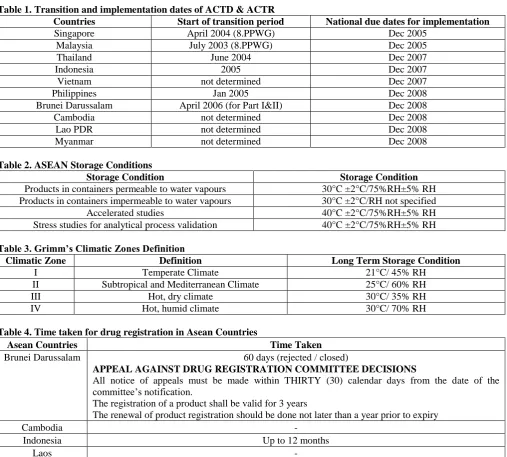
Table 1. Transition and implementation dates of ACTD & ACTR
Countries Start of transition period National due dates for implementation
Singapore April 2004 (8.PPWG) Dec 2005 Malaysia July 2003 (8.PPWG) Dec 2005
Thailand June 2004 Dec 2007
Indonesia 2005 Dec 2007
Vietnam not determined Dec 2007 Philippines Jan 2005 Dec 2008 Brunei Darussalam April 2006 (for Part I&II) Dec 2008 Cambodia not determined Dec 2008 Lao PDR not determined Dec 2008 Myanmar not determined Dec 2008
Table 2. ASEAN Storage Conditions
Storage Condition Storage Condition
Products in containers permeable to water vapours 30°C ±2°C/75%RH±5% RH Products in containers impermeable to water vapours 30°C ±2°C/RH not specified Accelerated studies 40°C ±2°C/75%RH±5% RH Stress studies for analytical process validation 40°C ±2°C/75%RH±5% RH
Table 3. Grimm’s Climatic Zones Definition
Climatic Zone Definition Long Term Storage Condition
I Temperate Climate 21°C/ 45% RH II Subtropical and Mediterranean Climate 25°C/ 60% RH III Hot, dry climate 30°C/ 35% RH IV Hot, humid climate 30°C/ 70% RH
Table 4. Time taken for drug registration in Asean Countries
Asean Countries Time Taken
Brunei Darussalam 60 days (rejected / closed)
APPEAL AGAINST DRUG REGISTRATION COMMITTEE DECISIONS
All notice of appeals must be made within THIRTY (30) calendar days from the date of the committee‟s notification.
The registration of a product shall be valid for 3 years
The renewal of product registration should be done not later than a year prior to expiry
Cambodia -
Indonesia Up to 12 months
65 Malaysia 210 t0 245 Working Days
Myanmar -
Philippines Not been approved previously - 8 – 12 Months Already Approved Product – 6 Months
Approved by one of the principle regulatory agencies – 6 Weeks Singapore If Already been approved by another country‟s (abridged evaluation) – 6 Months
If Approved by one of the principle regulatory agencies (verification evaluation), E.g.: US FDA, MHRA, TGA etc – 6 weeks
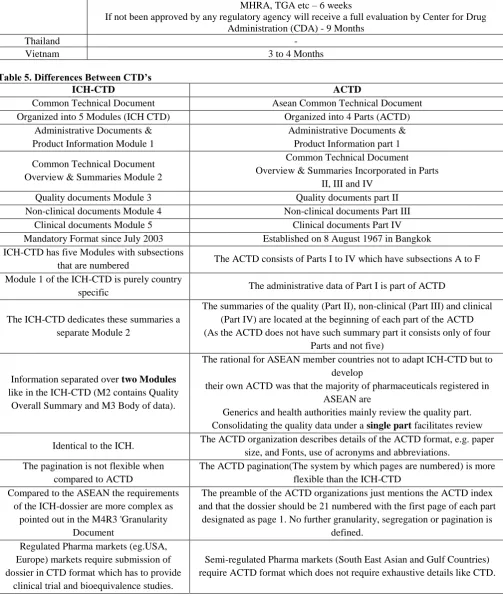
If not been approved by any regulatory agency will receive a full evaluation by Center for Drug Administration (CDA) - 9 Months
Thailand -
Vietnam 3 to 4 Months
Table 5. Differences Between CTD’s
ICH-CTD ACTD
Common Technical Document Asean Common Technical Document Organized into 5 Modules (ICH CTD) Organized into 4 Parts (ACTD)
Administrative Documents & Product Information Module 1
Administrative Documents & Product Information part 1
Common Technical Document Overview & Summaries Module 2
Common Technical Document Overview & Summaries Incorporated in Parts
II, III and IV Quality documents Module 3 Quality documents part II Non-clinical documents Module 4 Non-clinical documents Part III
Clinical documents Module 5 Clinical documents Part IV Mandatory Format since July 2003 Established on 8 August 1967 in Bangkok ICH-CTD has five Modules with subsections
that are numbered The ACTD consists of Parts I to IV which have subsections A to F Module 1 of the ICH-CTD is purely country
specific The administrative data of Part I is part of ACTD
The ICH-CTD dedicates these summaries a separate Module 2
The summaries of the quality (Part II), non-clinical (Part III) and clinical (Part IV) are located at the beginning of each part of the ACTD (As the ACTD does not have such summary part it consists only of four
Parts and not five)
Information separated over two Modules like in the ICH-CTD (M2 contains Quality
Overall Summary and M3 Body of data).
The rational for ASEAN member countries not to adapt ICH-CTD but to develop
their own ACTD was that the majority of pharmaceuticals registered in ASEAN are
Generics and health authorities mainly review the quality part. Consolidating the quality data under a single part facilitates review
Identical to the ICH. The ACTD organization describes details of the ACTD format, e.g. paper size, and Fonts, use of acronyms and abbreviations.
The pagination is not flexible when compared to ACTD
The ACTD pagination(The system by which pages are numbered) is more flexible than the ICH-CTD
Compared to the ASEAN the requirements of the ICH-dossier are more complex as
pointed out in the M4R3 'Granularity Document
The preamble of the ACTD organizations just mentions the ACTD index and that the dossier should be 21 numbered with the first page of each part
designated as page 1. No further granularity, segregation or pagination is defined.
Regulated Pharma markets (eg.USA, Europe) markets require submission of dossier in CTD format which has to provide
clinical trial and bioequivalence studies.
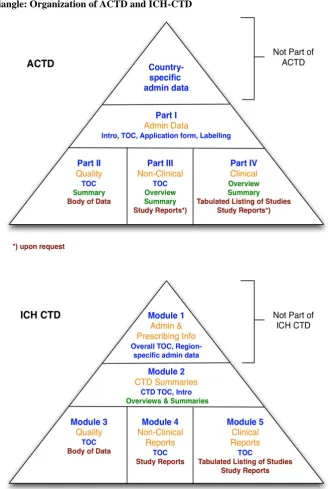
66 Figure 1. Dossier Triangle: Organization of ACTD and ICH-CTD
ACTD and ACTR Challenges
The newly development common ASEAN registration requirements with the emphasis on quality data required by the ACTD and ACTR are generally more extensive in details than most of the previous national requirements. Usually submission of a CPP that included a GMP statement was sufficient. With the new common ASEAN requirements it is required to mention the manufacturer for the final batch release in the in the application form. This information was previously not part of a submission and is also not indicated on CPPs. New requirement are the need to provide drug substance information, analytical validation, process validation data for the manufacture of the drug product and the new stability requirements. In the past most of the national
regulatory authorities even accepted stability data for zone I and II conditions. With the establishment of the new ASEAN Stability Guideline the region regards themselves belonging to zone IVb. Further MRA for GMP requirements, an ASEAN Post Marketing Alert System have been introduced. Accreditation of BA/BE centers will be harmonized soon.
67 of the pharmaceutical product. This will result in more
consequential changes (variations). It will also require more capacity building at national regulatory authorities‟ level.
Until now in a lot of ASEAN member states variations are free of charge, e.g. Thailand. There is a certain risk that fees for the different categories of applications will increase in order to compensate the additional work load. ASEAN currently seeks funding and training from international organizations, dialog partner countries as well as from industries. Therefore hopefully the pharmaceutical products will maintain affordable for the public.
One of the trade association‟s proposals to the regulators was to accept the mapping approach. This means that ICH-CTD is submitted accompanied with an ACTD index that is cross referring to the ICH-CTD sections and pages. The mapping approach is already commonly used during the transition period of the dossier formats.
Dossier Triangle: Organization of ACTD and ICH-CTD [5]
Main differences are the organization of data and the numbering of sections. Implementation of A-CTD in the ASEAN region is planned on 31 Dec 2008
Organization of the Dossier
Common format for the preparation of a well structured Common Technical Dossier (CTD) applications that will be submitted to ASEAN regulatory authorities for the registration of pharmaceuticals for human use. Guidelines reduce the time and resources needed to compile applications for registration and ease the preparation of electronic documental submissions. This guideline merely demonstrates an appropriate write-up format for acquired data.
Applicants can modify, if needed, to provide the best possible presentation of the technical information
Text and tables should be prepared using margins that allow the document to be printed on either A4 or 8.5 x 11 papers.
The left hand margin should be sufficiently large
Font and size, (Times New Roman, 12-point font)
Every page should be numbered
Common Technical Acronyms and abbreviations should be defined the first time they are used
References should be cited
The Common Technical Document is organized into four parts
Part I. Table of Contents (ToC), Administrative Data and Product Information
Part II. Quality Document Part III. Nonclinical Document Part IV Clinical Document
The overall organization of the Common Technical Dossier is presented on the following Parts
Part I: Table of Content Administrative Information and Prescribing Information
Section A: Introduction
Section B: Overall ASEAN Common Technical Dossier Table of Contents
Section C: Documents required for registration (for example, application forms, labeling, Product Data Sheet, and prescribing information)
Part II: Quality Document Section A: Table of Contents Section B: Quality Overall Summary Section C: Body of Data
Section D: Key Literature References
Part III: Nonclinical Document Section A: Table of Contents Section B: Nonclinical Overview
Section C: Nonclinical Written and Tabulated Summaries
Table of Contents
Pharmacology
Pharmacokinetics
Toxicology
Section D: Nonclinical Study Reports
Table of Contents
Pharmacology
Pharmacokinetics
Toxicology
Section E: List of Key Literature References
Part IV: Clinical Document Section A: Table of Contents Section B: Clinical Overview Section C: Clinical Summary
Summary of Biopharmaceutics and Associated Analytical Methods
Summary of Clinical Pharmacology Studies
Summary of Clinical Efficacy
Summary of Clinical Safety
Synopses of Individual Studies
Section D: Tabular Listing of All Clinical Studies Section E: Clinical Study Reports
Section F: List of Key Literature References
Countrieswise Deatils Brunei Darussalam [6]
There is separate cell for Pharmaceutical services and the Department of Pharmaceutical service (DPS) is mainly responsible for executing the control of drugs. More than 3500 Pharmaceutical products are registered. For the registration of Pharmaceutical products one has to submit the detailed monograph of the said product giving the details of the product pertaining to its Pharmacology, Pharmacokinetics, Toxicology, Biopharmaceutics, Clinical Pharmacology, Clinical efficacy, Safety etc. as required for CTD and any other supporting documents like Clinical trial and comparative studies.
68 All applications for provisional product
registration are to be made by submission of the required documents which are in line with the ASEAN Common Technical Dossier (ACTD) for the registration of pharmaceuticals for human use. The application dossier required will consist of 4 parts which are as follows:
Part I: Administrative Data And Product Information Section 1: Application Form (Form No: DPS/DRS/01) Section 2: Letter of Authorization
Section 3: Certifications Section 4: Labeling
Section 5: Product Information
Part II: Quality
Section 1: Application Form for Quality Requirements of the Drug Substance
(Form No: DPS/DRS/02/A)
Section 2: Application Form for Quality Requirements of the Drug Product
(Form No: DPS/DRS/02/B)
Part III: Non-Clinical (For a submission of New Chemical Entity, Biotechnological Products and some Major Variation Products only)
Section A: Table of Contents Section B: Nonclinical Overview
Section C: Nonclinical Summary (Written and Tabulated) Section D: Nonclinical Study Reports (As requested) Section E: List of Key Literature References
Part IV: Clinical Documents (For a submission of New Chemical Entity,
Biotechnological Products and some Major Variation Products only)
Section A: Table of Contents Section B: Clinical Overview Section C: Clinical Summary
Section D: Tabular Listing of All Clinical Studies Section E: Clinical Study Reports (If Applicable) Section F: List of Key Literature References
Cambodia [7]
Cambodia is also known formerly as Kampuchea. Much of the nation is covered by lush rain Forests. Forestry as well as mining is the primary sources of industry. The capital of Cambodia is located at Phnom Penh, which is the largest city, is rapidly growing with greater urbanization of the population.
It is situated in Southeast Asia, which occupies about 181,035 square kilometers including lakes and rivers. Cambodia shares its border with Thailand on the northwest, Laos on the northeast and Vietnam on the east and south. The local time is 7 hours ahead of GMT (Greenwich Mean Time).
Cambodia follows the common ASEAN CTD for registration of Pharmaceutical Product for Human use. There are more than 48 registered herbal medicines; however, none of them are included on National essential drug list. Herbal medicines in Cambodia are sold in
pharmacies as over-the-counter medicines, in special outlets, by licensed practitioners and without restriction.
Indonesia [8]
Time zone - various (UTC+7 to +9)
Registration for Completed Drug
Indonesia has its own drug registration format and also follows ASEAN CTD.
Registration for Completed Drug is divided to 3 groups:
New Drug
New Effect Substances
New Indication
New Supply Form
Biological Product
Copy Drug
Drug which has the same effect as the Registered Drug
Registration Procedure for Completed Drug
There are two steps for Drug Registration, which are:
Pre Registration
Consideration for evaluation path and completion of registration document
New Drug (Path I: 100 HK, Path II: 150 HK, Path III: 300 HK)
Copy Drug (Path I: 100 HK, Path III: 80 HK or 150 HK) Consultation for terms/criteria‟s and completeness of registration document
Registration
Submission of registration document has the following terms/criteria‟s:
Fill request form diskette according to the Pre Registration result or application form
Pay evaluation fee Fill diskette
Submit completed document according to the registration purpose
Administration Data for Drug Registration Local Product
Photocopy of pharmaceutical industry license
Photocopy of CPOB Certificate
Contract
Photocopy of pharmaceutical industry license from registrar and contract recipient
Photocopy of contract agreement
Photocopy of CPOB certificate from contract recipient and registrar
License
Terms/Criteria‟s are the same as local product with addition of:
69 Import
Photocopy of Pharmaceutical Industry license Selection Letter from abroad product owner
Certificate of Pharmaceutical Product /Free sale certificate (original) from manufacturer country Site master file : manufacturer which product that has
not owned distribution license in Indonesia or certain condition
Technical Data for Drug Registration
Technical Data
Form A
Form B
Form C1 (Quality and technology Data)
Form C2,C3,C4,C5,D2,D3,D4,D5 (Effective and Secured Data )
Packet
Completeness Technical Data which must be submitted
New Drug: A, B, C, D, E
Copy Drug and Biological Product: A, B, C, E
Changes:
Adding/changing packaging:
Different packaging type: A, C, E
Different packaging size: A, E
Changing packaging design / logo: A, E
Changing reductional brochure (without testing of preclinical/clinic)
Circulation License number which has expired: A, B, C, E
Circulation License number which has not expired: A, B (which has changed),E
Changing from Local to Import or the other way round: A, B, C, E
Changing manufacturer: A, B, C, E
Changing manufacturer name/ license authority: A, E
Changing Importer: A, E
Changing drug classification: A, B, C, E, supporting data
Changing formulae: A, B, C, E
Changing supply form (With Exception of new supply form): A, B, C, E
Laos [9]
Drug Registration
Lao PDR has its own has drug registration format and also follows ASEAN CTD.
All products which fall under the definition of drug and are found or deemed acceptable by the Food and Drug Department‟s (FDD) Drug Registration Committee are required to be registered before marketing and distribution following the procedure and requirements stated in this guideline.
If all the requirements for registration have been met, a Certificate of Drug Registration (CDR) is issued with a validity period of five years from the date of issue.
The applicant company must first seek the approval of the FDD‟s Drug Registration Committee
(DRC) as to the acceptability of the drug product for use in the Lao PDR before it can be accepted for registration.
Drug Evaluation
The evaluation of drug product is primarily a process to determine its safety, efficacy and quality.
All documents including the labeling materials submitted shall be evaluated in detail at the Drug Control Section of the FDD and by the Drug Registration Committee.
Drug product samples must also be submitted and shall be forwarded to the Food and Drug Quality Control Center of the Ministry of Health for analysis. This includes potency, identification and other test requirements. The results shall be forwarded to the FDD for final evaluation.
Filing of Application
Only licensed drug manufacturers and importers may file for registration of a pharmaceutical product. The duly licensed importer shall submit a Certificate of Agreement that the manufacturer in the exporting country authorizes the distribution of its product in Lao PDR. The agreement should also contain a stipulation that both the manufacturer and importer are jointly responsible for the quality of the product. Product applications will be accepted only on Friday.
Malaysia [10]
Procedure for the registration of Pharmaceutical products
Currently, only on-line submission is accepted for product's registration. This could be done by through
NPCB's National Pharmaceutical Control
Bureau (NPCB) website www.bpfk.gov.my
An applicant must buy a membership for Quest before the applicant can proceed with registration. There are several packages available to choose to become a member of Quest. Any assistance/advice shall be forwarded to Digicert Customer Service Department: 03-89928888. Once the applicant has received the user and password from BPFK (via email), he/she will be able to enter the registration site and proceed with online submission. This online registration system is also applicable for NCE and biotech products, traditional registration, re-registration of products and licensing.
The summary of the online registration procedure for products are as follows
1) Go to NPCB website (www.bpfk.gov.my)
2) Become Quest member (as First-time User)* Requirements:
I. Company Registration Form II. Company Authorization Letter III. Photocopy of I/C
70 4) With the login name and password, enter Quest, go
under registration, and register the product on-line. All forms are available in the form tray.
5) Submit data requested
6) Correspondences with NPCB officer if additional data is needed
7) Products tabled to DCA meeting
Myanmar [11]
The Myanmar (Burma) government enacted the National Drug Law („the ND Law‟) in 1992. The basic purpose of the ND Law is to control and systematically regulate the manufacture, import, export, storage, distribution and sale of drugs.
The ND Law is administered by the Ministry of Health („the MOH‟). The MOH is composed of a total of 14 departments and institutes.
Registration
Those who wish to manufacture, import, export, store, distribute and sell pharmaceutical raw materials or drugs must register the relevant these with the FDA.
An applicant must be a resident of Myanmar. If the producer is a foreign company, the applicant must be a resident representative of the foreign company.
An authorization letter must be given by the foreign manufacturer to the local party. If such a letter is granted to a local company, rather than an individual, an employee of the company who is authorized to serve as a contact person must also be designated in the letter of appointment.
Drug registration must be initiated by entering a list of drugs that the applicant wishes to register in a registry book at Drug Control Section 1 („DCS1‟), part of the FDA. The DCS1 will then issue a letter of intimation for remittance of assessment fees, which amount to US $100 plus fees in kyats for laboratory analysis, depending on the category of the drug.
After obtaining such letter, the applicant must remit the assessment fees to account No 91892 at Myanmar Foreign Trade Bank („MFTB‟).
Next step is Approval of the FDA for importation of samples of the items entered in the registry. This step must be followed within 6 months of the remittance of the assessment fees
To obtain this approval, one original and two photocopies of the credit advice issued by MFTB, a letter from the MFTB informing FDA that payment for the fees had been made and a list of samples in prescribed form must be submitted to DCS1
If the samples are already at the port of entry, in addition to the above requirements, the airway bill, a signed invoice and packing list of samples must be submitted.
The DCS1 will then issue an approval for importation of samples. The samples may then be imported in accordance with the regulations of Directorate of Trade („DOT‟) under the Ministry of Commerce („the MOC‟) and Customs Department under the Ministry
of Finance and Revenue („the MOFR‟) and the conditions as specified in the approval.
The samples are normally required for three purposes: clinical trial on sixty patients, for laboratory analysis and for retention. The total numbers of samples submitted must be in conformity with the FDA circular 1/97, which specifies the required quantities of samples. The samples must be submitted within two days of the date of clearance from the port of entry.
At the stage of submission of the samples, an original approval of importation and photocopied airway bill, signed invoice, packing list of the sample drug and the analytical report must accompany such samples. Thereafter, a receipt for the samples will be issued by the DCS1.
On the completion of the above steps, the applicant must type out an additional form and submit it to the DCS1. Such form must be accompanied with administrative documents, pharmaceutical documents and pharmacological and clinical documents. These documents must be submitted in person or by an authorized representative of the owner of the drug.
Two full sets of the above documents must be submitted to the DCS1 in files marked „Documents Required for Registration of Drugs‟. A list of documents submitted must also be shown on the first sheet of each file. Separate applications have to be made for pharmaceutical preparations of different strengths or dosages or package sizes.
The DCS1 may return non-conforming dossiers. When the DCS1 accepts conforming dossiers, it will issue an acknowledgement of receipt of the forms and registration files. After previewing the documentation, if the information provided is inadequate, the DCS1 will require further information. If all documentation is in order, the evaluation process of registration will proceed at the primary laboratory of the FDA.
When and if the primary laboratory analysis results are in favor of registration, the FDA announces its approval and the General Affairs Section („GAS‟) of the FDA issues a letter of intimation to remit registration fees of US$200 for each drug approved. The applicant must remit these registration fees through the MFTB as mentioned above within 90 days from the date of the intimation letter. If the applicant Fails to remit the registration fees within such period, the application is deemed to have been abandoned. In such case, neither will the registration assessment fees be refunded nor the registration documents and samples be returned
71
When the primary laboratory analysis results are not in favor of registration, the FDA will refuse registration. If the applicant is dissatisfied, he or she may file an appeal to the Board within 60 days from the date of the refusal. The Board will then require an appellate Laboratory to reanalyze the samples.
The holder of the registration certificate must guarantee the drug‟s quality, efficacy and safety. The manner in which it is manufactured, imported, exported, stored or distributed and sold must be set forth in the application.
If the holder of the registration certificate wishes to cancel the registration of a drug, an application must be lodged with the FDA stating the reasons. The drug registration certificate must be returned to the FDA within 7 days from the revocation or cancellation date.
The period of the registration is 5 years unless it is revoked temporarily or cancelled by the Board as a result of contravention of the rules and regulations of the ND Law.
Renewal of Registration
The registration must be renewed 90 days prior to its expiry.
Failure to apply for renewal of registration will result in invalidation of registration with effect from the date of expiry of the certificate.
The procedure for renewal is similar to that of the registration mentioned above
For renewal, samples for clinical trials are normally not required unless the situation warrants a repeat clinical trial.
The samples for laboratory analysis and for retention, however, are required for renewal for registration.
The information provided in the renewal application must be updated and any new findings have to be submitted.
Registration Assessment fees of US$100 plus additional small fees in kyats for laboratory analysis depending on the category of the drugs must have been remitted to account No 91892 mentioned above at the time of the application of renewal of registration.
When the FDA approves the renewal, US$200 in registration fees must be remitted. On the approval of renewal, a new registration number will be designated and the old one considered void.
Updating Changes to Registered Drugs
To do so, the holder must lodge an application for variation of registration with the FDA.
In the application, the reasons for the changes, relevant data or findings from studies on which the changes are based and the significant effects of the changes to the specifications of drug must be stated.
A photocopy of the original registration certificate of the drug and an attestation of the home country‟s drug regulatory authority approving such changes must accompany the application.
If the holder of the registration certificate cannot provide such an attestation, an explanatory letter must be provided.
When and if the FDA approves the changes, a US$100 variation fee will be levied on the applicant. The Drug Advisory Committee may waive this fee if it believes that the change is of benefit to the public quality, safety or the efficacy of the drug. The original registration certificate must then be submitted. The approved amendments are made on this certificate.
Registration of Active Pharmaceutical Raw Materials Application for registration of active pharmaceutical raw materials must be made in the same manner as that of finished products discussed above. Approval of the FDA for importation of sample raw material is also required. A sample weighing 20 gm must be submitted together with the files mentioned above. The sample must be packed and labeled properly. Assessment fees, registration fees and variation fees are the same as for finished products. The applicant for active raw materials must be a registered business representative. Only a person who has been granted registration under the Registration of Business Representatives Order No 2/89 issued by the MOC (Ministry of Commerce) can carry on business as a business representative in the country. The documentary requirements for registration of raw material can be categorized as administrative documents and pharmaceutical documents.
Administrative documents include a certificate issued by the regulatory authority of the home country to the effect that the product is authorized to be sold in the country of origin, a properly endorsed photo-copy of a valid manufacturing license, a GMP certificate of the manufacturing plant, a letter of authorization for legal representation of the manufacturer or owner of the product in Myanmar and a business registration certificate of the local representative.
Pharmaceutical documentation includes
generic name, chemical name, empirical and structural chemical formula, pharmacopoeia to which the product conforms, pharmaceutical specifications, method of analysis, manufacturing process, quality assurance system, certificate of analysis, stability test report of at least three different batches, recommended shelf-life, recommended storage conditions and packaging specifications.
Philippines [12]
72 Requirements for License to Operate
If Importer
A duly authenticated (by the Territorial Philippine Consulate), Foreign Agency Agreement FAA from each supplier.
Certificate of Registration of manufacturer and its conformity with Good Manufacturing Practices from Health Authority authenticated by Philippine Consulate.
If Wholesaler
A Valid current contract with BFAD licensed supplier/manufacturer
A certificate that the products supplied are registered with BFAD
Copy of (LTO) License to Operate from supplier/manufacturer
If Exporter
A Valid current contract with BFAD licensed supplier/manufacturer
A certificate that the product supplied are registered with BFAD
Copy of LTO from supplier/manufacturer
The products to be marketed or to be manufactured may be classified as one of the following:
FOODS
Category I
Category II
Food Supplement
DRUGS
Over-the-counter (OTC) Drug
Prescription Drug
Regulated Drug
Traditional Medicine
MEDICAL DEVICES
COSMETICS
HAZARDOUS SUBSTANCE
Furthermore, products are also classified according to origin:
Imported
Locally Manufactured
Processing a Product Registration
Product registration starts with the assessment and evaluation of the documents and technical requirements of your product to the Public Assistance Information & Compliance Section (PAICS) or to the Product Services Division (PSD), depending on the classification of the product applied for.
After the preliminary evaluation of the technical documents, the PAICS or the PSD will issue an assessment slip, wherein the amount to be paid for the application is also indicated.
After the payment, the applicant will proceed to the PAICS for the submission of requirements.
Upon submitting the documents, the applicant will be given a Routing Slip Number (RSN). The RSN will be written on the receiving copy, the RSN is used to verify the status of the application, to follow-up and inquire about the updates of the application.
On initial follow-up, you may be given a Certificate of Product Registration (CPR), a Letter of Denial (LOD) or a Notice of Deficiency (NOD). There are very few cases that FDA denies an application, or issues a CPR right away.
If the application has been approved, it will be forwarded to the Chief of the Product Services Division for signatory, then to the Office of the Director also for signatory.
Requirements for Product Registration with BFAD
Accomplished application form No.1 and No. 8 Duly Notarized.
Copy of valid contract between manufacturer and trader / distributor / seller / exporter / importer.
A copy of valid LTO‟s for manufacturer/trader/distributor/seller/exporter/importe r.
Unit Dose and Batch Formulation in Metric System.
Technical specification on all Raw Materials.
Certificate of Analysis on raw materials and finished product from manufacturer.
Technical Specification on finished Product.
Master manufacturing procedure, Production equipment, Sampling and In-process controls, and Master packaging procedure.
Assay on test procedures and data analysis if applicable.
Stability study in accordance with Philippines national guidelines and ASEAN guidelines.
Representative sample of packaging and labeling materials for commercial market.
Copy of ACB approval
For foreign manufactured products, a copy of the Original Product Registration in the manufacturing country.
Procedure for Product Registration with (BFAD) Bureau of Food and Drugs
Submission of application and all requirements to Public Assistance Information and Compliance Section of BFAD for assessment.
Accounting and billing department to assess registration fees to be paid at cashier.
Product services division of BFAD will evaluate all the requirements and prepare endorsement for Certificate of Registration.
Director signs Certificate of Registration and Product Registration documents can be picked up from BFAD.
Entire product registration process can be completed in 2-4 weeks* from submission of requirements
*Depending on type of Product: Cosmetic 2-4 weeks, Food 1-2 months, Pharmaceutical 8 months - 1 year
Initial Registration Application
73 accompanied by the requirements for CPR or PCIU as
listed in Checklist of Requirements
Review of Documents and Requirements
The BFAD shall evaluate the completeness of submitted documents based on the Checklist of Requirements.
Evaluation
The evaluation shall be done by the BFAD, and if necessary, with the BFAD consultant or the BFAD Advisory Committee on Biologic Products.
The same evaluation procedure shall apply to both CPR and PCIU applications.
Laboratory tests
The BFAD may require laboratory testing for the following reasons: a.) to provide information on the controls to be applied by the BFAD for lot or batch release certification, b.) as direct evidence of consistency of production, c.) as evidence of the stability of the product, and d.) to verify the submitted documents and data.
The applicant shall be informed about the specific laboratory test(s) that will be required at the time of issuance of the CPR or PCIU. The independent laboratory that will conduct the specific test must meet all the criteria of a biological laboratory
Action on Registration Application
The BFAD action on the application for CPR may consist of the following:
Issuance of a Certificate of Product Registration Approval of the product for general use shall be for a period of 5 years with a condition that all lots or batches, except UNICEF/WHO products, shall require BFAD lot or batch release certification
Notice of Deficiencies
A notice of deficiencies shall be sent to the applicant and a period of 30 days shall be given in order for the applicant to comply, and after which the applicant shall reapply for initial registration.
Denial of Application
The following, among others, are grounds for disapproval of product registration:
Failure to satisfy the standards and requirements for safety, efficacy, quality, and therapeutic/prophylactic value or rational use
Failure to settle unresolved problems regarding safety, efficacy and quality
Failure to respond to the letter of abeyance after 6 months
Failure to disclose other information relevant to the safety, efficacy, quality, and therapeutic/prophylactic value of the product
The label of the biologic product is false and misleading or does not conform with the labeling requirements
Action on PCIU Application
The BFAD action on the PCIU application may consist of the following:
Issuance of a Permit for Clinical Investigational Use. Approval of the product for investigational use for a specific period depending on the clinical trial protocol. All lots or batches shall require BFAD lot or batch release certification.
Notice of Deficiencies
A notice of deficiencies shall be sent to the applicant and a period of 30 days shall be given in order for the applicant to comply, and after which the applicant shall reapply for a PCIU.
Denial of Application
The same grounds for denial of application as enumerated in above Section shall apply.
Renewal of Registration
Application for the renewal of registration shall be made on a form promulgated by the BFAD. The application form shall be accompanied by the requirements for renewal of registration as specified in the Checklist of Requirements
Biologic products for renewal of registration shall be subjected to reevaluation. Determination of the following, among others, shall be the basis for renewal of registration
Evidence of consistency and reproducibility of production on a lot to lot basis.
Post Marketing Surveillance, Adverse Drug Reaction or Adverse Event, Following Immunization report in the country or other countries.
Maintenance of cGMP status of the manufacturer
Unresolved problems regarding the safety, efficacy and quality of the product in the country or other countries.
Failure to apply for lot or batch release certificates in the past.
Philippines Pharmaceutical Registration: An Overview Philippines have its own drug registration formats and also follow ASEAN CTD. In order to market a pharmaceutical product in the Philippines, the product must first be registered to the Philippine Bureau of Food and Drugs. The registration process is relatively straightforward (though as is often in the case in developing countries, having the right connections is also just as important). An application for registration should include:
Letter of application and Accomplish Form No. 8
Suggested Retail Price
Copy of valid agreement between manufacturer and trade, distributor / importer / exporter
Unit dose and batch formulation
74
Certificate of analysis of active raw materials
Certificate of analysis of finished product
Full description of methods used
Details of the assay and other test procedures for finished product including data analysis
Detailed report of stability studies to justify claimed shelf life
Representative sample in market or commercial presentation
Unattached generic labeling materials
Certificate of approval of PMS (Presidential Management Staff)
Bio-availability / bio-equivalence studies (for Rifampicin products)
Dissolution profile for drug product under List B (B prime)
Copy of latest Certificate of Product Registration Additional regulations apply for imported products, products in plastic containers, and for new drugs.
Singapore HSA
The Health Sciences Authority (HSA) was established in 2001 to regulate health products and oversee public health issues in Singapore. Under the HSA is the Health Products Regulation Group (HPRG), which is a body that ensures that drugs, medical devices and other health products are regulated to meet quality, safety and efficacy standards.
Singapore's pharmaceutical market is about $500 million. It is also the wealthiest country in the Association of Southeast Asian Nations (ASEAN).
In ASEAN as in many non-ICH countries registration procedures rely on the approval and assessment of reference countries. This is the reason why many developing countries ask for a Certificate of Pharmaceutical Product issued by the health authority of the reference country.
It enables countries with limited drug regulatory capacity to obtain partial assurance from exporting countries that the pharmaceutical products, which they plan to import, are safe, effective and of good quality. In countries where a CPP is mandatory for approval, usually just a relatively small dossier is required restricted to administrative parts and summaries.
There are different common practice about the amount and the timing of the CPP. In some developing up to three CPP are required for submission. This can be a trade barrier or lead to delayed access of pharmaceuticals to public.
In the case of Singapore the Health Authorities, have the knowledge and capacity to evaluate clinical data and therefore there exist registration procedures where a product can be submitted without a CPP. It can be seen as a kind of risk based approach. The more CPPs are provided the faster is the evaluation by Singapore‟s health authority as they can rely on reference or bench mark approvals.
If ASEAN would harmonize their registration systems, Singapore could be serving as a good model.
Pharmaceutical/Drug Registration in Singapore All pharmaceuticals/drugs require a product license before they can be imported or sold in Singapore. In applying for a product license, dossiers must be in either the International Conference on Harmonization (ICH) Common Technical Document (CTD) format or the ASEAN Common Technical Document (ACTD) format.
For new product licenses, Singapore has a new drug application (NDA) and a generic drug application (GDA). For products already approved by certain regulatory agencies (such as Australia's TGA, the US FDA, etc.), submitting an abridged dossier is possible. Applicants submit an online application through PRISM (Pharmaceutical Regulatory and Information System) and also submit a CTD dossier.
Regulatory Bodies
The Health Sciences Authority (HSA) was established in April 2001 to ensure the quality, safety and efficacy of drugs, medical devices, cosmetics, and other health-related products in Singapore. In January 2004, the Center for Drug Administration (CDA) was established under the HSA. The CDA was formed by merging two previously-existing agencies: the Center for Pharmaceutical Administration (CPA) and the Center for Drug Evaluation (CDE), which were both responsible for the regulation and evaluation of medical products in Singapore. The CDA‟s mission is to further simplify and streamline the evaluation and registration processes of pharmaceuticals in Singapore.
Pharmaceuticals
Singapore has its own drug registration format and follows common ASEAN CTD.
Overview
The Center for Drug Administration (CDA) regulates pharmaceuticals in Singapore under the following five regulatory guidelines:
1. Medicines Act, 2. Poisons Act, 3. Sale of Drugs Act,
4. Medicines (Advertisement and Sale) Act and 5. The Misuse of Drug Regulations.
The CDA‟s responsibilities include, but are not limited to, inspection and licensing of pharmaceutical manufacturers/importers/wholesalers, ensuring Good Manufacturing Practice (GMP) and Good Distribution Practice (GDP) standards, and post-marketing surveillance.
Product License Application Process
Pharmaceutical companies have the option of requesting a pre-submission consultation with the HSA. These requests should be made to the HSA in writing and a clear agenda and list of questions should be prepared by the company prior to the meeting. The information that the HSA provides is nonbinding and will not have a direct impact on the results of the application.
75 which have not been approved by any regulatory agency
will receive a full evaluation, which according to the CDA, takes approximately nine months to complete.
If a product has already been approved by another country‟s regulatory authority, an abridged evaluation process will be required, taking around six months to complete. Finally, if the product has already been approved by one of the principle regulatory agencies (US FDA, UK MHRA, Australia TGA, EU EMEA or Health Canada), only a verification evaluation will be necessary. This third evaluation process takes about six weeks to complete.
E-services and Forms [13] Health Products Regulation
Client Registration and Identification Service - cris@hsa
With cris@hsa, companies can authorize their employees or service providers to carry out electronic transactions with HSA on the companies' behalf.
Once authorization has been granted through CRIS, employees or service providers can then access MEDICS or PRISM using their SingPass or HSA PIN.
Apply for CRIS
To access CRIS, companies first have to appoint a company CRIS administrator. Company directors/sole proprietors whose names are listed with ACRA can submit an application form to HSA to nominate at least 2 company CRIS administrators.
Application for Client Registration and Identification Service (CRIS) Company Account
A CRIS Company Account is provided to enable our client to gain access to online PRISM / MEDICS systems on behalf of the company. To access CRIS, companies first have to appoint a CRIS Company Account Administrator.
Upon approval, the appointed CRIS Company Account administrator(s) will be able to:
Perform transactions on behalf of the company, and
Authorize the type of e-transactions for other employee / service provider to perform on behalf of the company via CRIS management module e-service (http://www.hsa.gov.sg/html/business/cris.html) Once authorization has been granted through CRIS, employee(s) or service provider(s) can then access MEDICS and/or PRISM using their SingPass or HSA PIN.
This E-form may take you 10 minutes to fill in.
You will need the following information to fill in the form: a) ACRA's Company Business Profile
b) Applicant's NRIC / Foreign Passport
c) CRIS Company Account Administrator's NRIC/ S-Pass/ Employment S-Pass/ Work Permit
Thailand [14]
Drug Registration Process
Thailand has its own drug registration format and also follows ASEAN CTD
Applicants: Only authorized licensees are qualified to apply for product registration.
Manufacturing plants: GMP compliance
According to the new Drug Act, a certificate of product registration is valid for five years as from the date of issuance. The process of drug registration will be carried out in 2 channels, which differ in degrees of control and dossier submission:
1. Registration of general medicines
2. Registration of Thai traditional medicines
Due to some differences in the requirements for dossiers to be submitted for product approvals, the general medicines will have to be further defined as:
Generics whose registrations require only dossiers on product manufacturing and quality control along with product information;
New medicines whose registrations require a complete set of product dossiers;
New generics whose registrations require dossiers of bioequivalence studies in addition to the required dossiers for generics submission.
Thai Drug Control Division
Procedure of Generic Drugs Registration
The procedure of generic drugs registration is divided into 2 main steps:
Step 1: Application for the permission to import or manufacture drug sample intended to be registered. The following documents are required:
1) Application form to be completely filled by authorized licensee
2) Drug formula [active ingredients(s) only] 3) Drug literature
4) Drug labeling and packaging
Step 2: Application for the approval of granted credential certificate.
1) Application form to be completely filled by authorized licensee
2) Permit to manufacture or import drug sample 3) Drug sample
4) Pharmacological and toxicological study (if any) 5) Clinical trials, safety and efficacy study (if any) 6) Complete drug formula
7) Drug literature
8) Labeling and packaging should consist of name of the drug, registration number, quantity of drug per packaging, formula which shows active ingredient (s) and quantity of strength, lot no. batch control number, name of manufacturer and address, manufacturing date, the words “ dangerous drug”/ “specially controlled”/ “for external use”/ “for topical use” written in Thai and in red color if the drug is considered to be of them, the word “household remedy drug” written in Thai if the drug is considered to be, the word “for veterinary use” written in Thai if the drug is considered to be, and the expire date
9) Certificate of Free sale (in case of imported drug) 10) Manufacturing method