Patient Experience Journal
Volume 6 | Issue 1
Article 12
2019
Comparing psychiatric care experiences shared
online with validated questionnaires; do they
include the same content?
Rebecca Baines
Collaboration for the Advancement of Medical Education Research and Assessment (CAMERA), University of Plymouth, [email protected]
John Donovan
Samantha Regan de Bere
Julian Archer
Ray Jones
University of Plymouth, [email protected]
Follow this and additional works at:
https://pxjournal.org/journal
Part of the
Health and Medical Administration Commons,
Health Policy Commons,
Health
Services Administration Commons,
Health Services Research Commons,
Psychiatric and Mental
Health Commons, and the
Psychiatry Commons
This Research is brought to you for free and open access by Patient Experience Journal. It has been accepted for inclusion in Patient Experience Journal by an authorized editor of Patient Experience Journal.
Recommended Citation
Baines, Rebecca; Donovan, John; Regan de Bere, Samantha; Archer, Julian; and Jones, Ray (2019) "Comparing psychiatric care experiences shared online with validated questionnaires; do they include the same content?,"Patient Experience Journal: Vol. 6 : Iss. 1 , Article 12.
questionnaires; do they include the same content?
Cover Page Footnote
Patient Experience Journal
Volume 6, Issue 1 – 2019, pp. 94-104
Patient Experience Journal, Volume 6, Issue 1 – 2019
© The Author(s), 2019. Published in association with The Beryl Institute and Patient Experience Institute
Downloaded from www.pxjournal.org 94
Research
Comparing psychiatric care experiences shared online with validated
questionnaires; do they include the same content?
Rebecca Baines,
University of Plymouth, [email protected]
John Donovan,
patient research partner, [email protected]
Samantha Regan de Bere,
[email protected]
Julian Archer,
[email protected]
Ray Jones,
[email protected]
Abstract
Patient feedback is considered integral to patient safety and quality of care. However, limited research has compared the content of validated questionnaires with subjective patient experiences shared online. The aim of this study was to therefore identify and compare the content of psychiatric care experiences shared online with validated questionnaires. All research was conducted in co-production with a volunteer mental-health-patient-research-partner. We analysed all
reviews published on the United Kingdom’s leading health and social care feedback platform Care Opinion, between 2005-2017 that discussed adult psychiatric care and compared findings with two validated questionnaires (ACP360 and General Medical Council patient feedback questionnaire). Our research findings show that patients describe some different measures of psychiatric care quality online and use different terminology to those used in validated questionnaires. Psychiatric care was also rarely discussed in relation to an individual psychiatrist alone. Multiple interactions affect patient experience and perceived care quality. Further work is needed to incorporate patient
perceptions and terminology of care quality into patient feedback questionnaires and surveys. This may best be achieved through co-design although exploration of this approach is required. The current focus of patient feedback in
revalidation is of limited value as patients do not typically disaggregate the care provided by an individual clinician from the wider healthcare team, system or environment. Although focused on psychiatry, research findings have clear implications for those looking to facilitate quality improvement and professional development.
Keywords
Patient feedback, patient experience, quality improvement, psychiatry, patient safety, Care Opinion
Introduction
Patient experience, defined as the specific experience of individuals,1 is considered integral to patient safety, quality
improvement and clinical effectiveness.2-4 Following the
increasing interest internationally in patient centred care,5
patient feedback, a method often used to explore individual experiences, is increasingly becoming a mandatory requirement in regulatory processes such as medical revalidation.6 However, questions have been
raised about the acceptability, value and relevance of existing feedback questionnaires.7 8 Unanswered questions
that remain fundamental to the development and evaluation of feedback tools include whether: (i) existing questionnaires ask the right questions in the right way, and (ii) whether their content covers care quality domains considered important from a patient perspective.9-11
Revalidation is a regulatory process in the United
Kingdom (UK) designed to ensure all doctors are both up to date and fit to practise.6 During the course of each
revalidation cycle (typically five years), doctors must collect six types of supporting information,12 including patient feedback collected through ‘validated’ questionnaires from
a pre-determined number of patient respondents to ensure a valid response.12 However, despite their growing use
internationally, 9 13 healthcare review websites such as
RateMDs and Care Opinion (UK) are not currently accepted by the General Medical Council (GMC) as a valid form of patient feedback. Only patient feedback that has been collected through a validated questionnaire is considered appropriate for revalidation purposes.12
However, a recent review led by Pearson questions the value and effectiveness of these validated questionnaires.14
For example, Sir Keith Pearson states that he remains
“unconvinced that a set of questionnaires, often collected on a single day…provides sufficient quality and breadth of information to enable a doctor to reflect properly on their patient interactions.”14 Similar
informing reflective practice, patient feedback was also one of the most problematic types of information to obtain.7 Furthermore, underpinned by this emerging body
of work, the Academy of Medical Royal Colleges acknowledges substantial “difficulties with the distribution, collection, analysis and reporting”15 of patient feedback, calling for opportunities provided by technology and “web based platforms that already collect patient feedback” to be harnessed.14 15
There is therefore increasing attention on the possibility of incorporating patient feedback shared online into
regulatory processes. It is important to ensure the tools used to collect patient feedback are effective, as patient feedback has been shown to have an effect on clinical effectiveness, patient safety, health outcomes, treatment adherence, and resource expenditure.2 16 There are
therefore strong policy and practical drivers to critically consider the tools currently used to collect patient feedback and any differences between them.
This research develops the existing understanding by comparing the content of healthcare experiences shared online, with the content used in two validated feedback questionnaires. Our study focuses on psychiatric care due to the acknowledged exclusion, or under-representation of mental health patients in patient feedback opportunities, research and reporting 18 and reported difficulties faced by psychiatrists including concerns that “patients with psychiatric or personality disorders could leave factually incorrect or malicious comments about them [practitioners] and harm their reputation”;17
Patient feedback tools have also typically been designed from a professional perspective only, with limited attention paid to what constitutes quality psychiatric care from a patient perspective.19 Critical exploration of the
belief that online feedback is only used by disgruntled patients is also severely limited.17
We ask the following three research questions: i) who do patients talk about when describing their psychiatric healthcare experiences online?; ii) what content do patients share online about their psychiatric healthcare experiences? And iii) how does this compare, if at all, to the content used in existing feedback questionnaires?
We compare the content shared on the UK’s leading
health and social care review website, Care Opinion, with two validated questionnaires provided by the GMC and Royal College of Psychiatrists. It is hoped that by exploring, and comparing healthcare experiences shared online with existing questionnaire content, a more nuanced understanding of how patients describe, and attribute value to their healthcare experiences can be developed.
Methods
We used a qualitative observational design, designed in co-production with a volunteer mental health patient research partner with personal experience of psychiatric care. We aimed to i) identify who patients describe in psychiatric healthcare experiences; ii) what patients share online about their psychiatric healthcare experiences and iii) this compares with the content of two validated questionnaires currently used in medical revalidation. Similar to previous research,5 Care Opinion was selected as the database for
this research as it is one of the largest non-profit health and social care review websites in England, publicly shares all moderated stories in near real time, and has facilities to support systematic searches for research purposes. The focus on a single website such as TripAdvisor, which Care Opinion shares some similar functions with, has been used in other published research studies.20 21 We do however
acknowledge the limitations of looking at a single, yet extensive database. Agreed principles of patient and public involvement were followed to ensure meaningful
involvement throughout the research process.22
Search strategy
All mental health related stories published on the website Care Opinion, from its inception in 2005 to the 12th June
2017, were identified using the search terms: “mental health” OR “mental illness” OR “mentally ill” OR mental
OR pnd OR psychiatric OR psychiatrist OR psychiatry OR depression OR depressed OR anorexia OR anxiety
OR “eating disorder” OR psychosis OR psychotic OR PTSD OR “self-harm” OR bipolar. To ensure relevance, searches were restricted to those tagged by Care Opinion moderators as related to: adult mental illness, addiction services, clinical psychology, eating disorders, forensic psychiatry, old age psychiatry, liaison psychiatry, psychiatric intensive care, primary care mental health, refugee and asylum seeker health, crisis resolution, perinatal psychiatry or Psychotherapy. To maximise sensitivity and specificity search terms were designed using the PRESS initiative,23 in collaboration with the CEO of
Care Opinion and volunteer mental health patient research partner.
Inclusion and exclusion criteria
Do care experiences shared online contain the same content as validated questionnaires?, Baines et al.
Patient Experience Journal, Volume 6, Issue 1 – 2019 96
psychiatrist in order to be included. Stories about child
psychiatric care or Alzheimer’s/Dementia were excluded
as quality of care is likely to differ in these contexts that go beyond the remit of this research. Examples of exclusion decisions made included being anxious about the removal of a tooth or hip operation that did not require psychiatric attention.
Dataselection
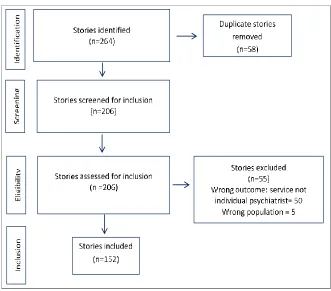
Stories were selected for inclusion using a two-stage process. Firstly, one reviewer screened all identified stories using a piloted inclusion criteria form to ensure story inclusion/exclusion standardisation. To enhance reliability, 20% (n=32) of identified stories were also screened by the patient research partner. Secondly, following their initial screening, potentially eligible stories were reviewed again for full inclusion. Figure 1 shows the inclusion and exclusion decisions made.
Data extraction
A piloted data extraction form was used to extract information about story submission and publication date, author status, name of organisation involved, story content, and other healthcare professionals, services or environments referred to. Based on their content, stories were also categorised as positive, negative or mixed.
Data analysis
Stories were analysed using the Framework analysis method.24 Firstly, the researcher and patient research
partner familiarised themselves with the stories through repeated readings and discussions. Secondly, the researcher and patient research partner outlined themes identified inductively from the data leading to a comprehensive coding framework. During this process suggested themes were regularly revised or combined. New codes were created when encountered data did not fit existing codes. The framework was then used to individually analyse all included stories with the researcher and patient partner meeting regularly to discuss developments. Themes were charted using NVIVO25 to facilitate retrieval enabling the
team to analyse similarities and differences across the data set. To address the final research question, the coding framework was mapped, and compared against the themes and questions used in the existing questionnaires
previously described.26 27
Results
Summary of included story characteristics
Based on their content, included stories were categorised as: 33% positive (n=50/152), 16% mixed (n=25/152) or 51% negative (n=77/152). The majority of story authors self-identified as a patient (n=104/152) with service users (n=18/152), relatives (n=9/152), carers (n=9/152) staff
members posting on behalf of a patient (n=5/152), parents/guardians (n=3/152), friends (n=3/152) and a staff member (n=1/152) also represented.
Self-reported conditions, experiences or diagnoses discussed included: schizophrenia, schizoaffective
disorder, dissociative identity disorder, multiple personality disorder, psychosis, bi-polar, Attention Deficit
Hyperactivity Disorder, depression, post-natal depression, post-traumatic stress disorder, anxiety, self-harm,
substance abuse and suicide attempts. On average, stories were 248 words in length (Range: 21-1818 words).
The results below are presented in order of the research questions asked: (i) who do patients discuss when sharing their psychiatric healthcare experience online? (ii) what do patients share about their psychiatric healthcare
experiences online? (iii) how does this compare to the content used in existing feedback questionnaires?
Who do patients discuss when sharing their psychiatric healthcare experience online?
Patients rarely discussed psychiatric care in relation to the care provided by a single psychiatrist alone. A number of other healthcare individuals, services, systems or processes were also described. For example:
“I am using the psychiatry service but I keep having problems with my appointments being cancelled… Recently I got two letters on the same day, one to give me an appointment and one to cancel it.”
(Unique Identifier (UID) 254339)
“My psychiatrist is amazing and understanding. I have never had any issues with her at all. She listens and she supports you… sign posts you to the right person when required … But the experience I had this week from the reception was very disappointing and quite stressing, because yes I have a mental health disease, but that does not mean I'm not a person… We are human, we are someone.” (UID 294950)
“I have been seeing Dr from around 2001 and was thinking about how good a service is provided… he is always wise, kind, caring and compassionate and always shakes my hand when he comes into the waiting room to collect me for my appointment…. My only very small criticism/request is for a better choice of magazines in the waiting room. A good magazine can help to calm nerves whilst you are waiting.” (UID 193188)
Forty-seven additional roles and/or services were
identified [See Appendix 1. Supplementary material]. Some of these additional roles can be seen in the example below:
“I was originally transferred to my local Community Mental Health Team from CAMHS services in another area. Initially the support I received was excellent. I was completely involved in my care. I had a skilled and compassionate Social Worker, a great Psychiatrist and a brilliant Support Worker… I also no care co-ordinator (which was
promised to me when my last one left)... A new Psychiatrist eventually said I could have a CPN who was my co-ordinator for 2 months…I was getting CBT from the Psychologist there… The mental health helpline have been very rude to me on occasions… The same goes for the Crisis teams… on one occasion the Consultant told me… On discharge from the Community team I was told I could self-refer myself back if I ever needed help, when I tried to do this a few weeks ago this was refused. Even my GP said I could do this.”(UID 57352)
What do patients share about their psychiatric care experiences online?
Patients described both positive and negative aspects of psychiatric care quality. Each is discussed in turn below.
Positive aspects of care quality
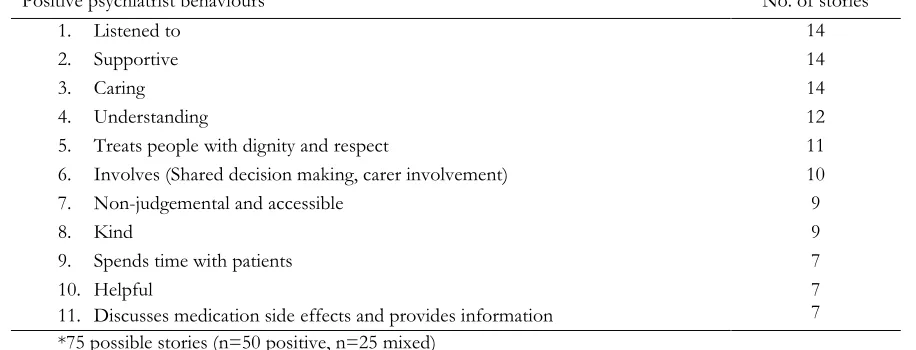
Patients described 49 positive aspects of psychiatric care at the individual practitioner level. Table 1 identifies those most frequently discussed. The words used by the story providers have been kept wherever possible to maintain authenticity.
Positive aspects of psychiatric care were often discussed in combination with one another. For example:
“I have received brilliant care from the psychiatrist, he really is fantastic, because he listens to me and he gives me options for my treatment, I feel that I’m really involved in my treatment and included in decisions.” (Unique Identifier, UID 295923)
“I wish to highlight the care from my Consultant Psychiatrist. At no point have I felt out of the loop regarding my care. Her thorough, learned, consistent understanding, compassion, encouragement, gentle and honest method of practice has allowed me to go from strength to strength. I have always been part of any decisions made both as an inpatient and outpatient. I feel so cared for, understood and supported” (UID 311614)
“I cannot praise him enough for his warmth, empathy and support… I know the importance of treating someone with respect, dignity and care and this I truly received in abundance.” (UID 150728)
More than one in four stories reviewed (n=45/152) wanted to thank those responsible for their psychiatric care. This was evident from both a patient and family/carer perspective:
“I was fortunate to be assigned to a wonderful Consultant Psychiatrist... she has given me the gift of 'mental-wellness'- and the confidence to go forward positively into the future. She herself is a gift to the Profession in which she practices and to all the patients who like myself have come under her care. I can never thank her enough.” (UID 171477)
Do care experiences shared online contain the same content as validated questionnaires?, Baines et al.
Patient Experience Journal, Volume 6, Issue 1 – 2019 98
attitude to how society treats people like me in general. That notwithstanding my psychiatrist has a reputation amongst patients and carers alike for his wonderful attitude and approach to those under his care. He is an exemplary professional and I feel sure my journey would have been far harder without his support. Thank you...” (UID 33340)
“As a family, we'd like to register our profound thanks to all those who were connected in the care of my nephew.” (UID 295558)
Negative aspects of care quality
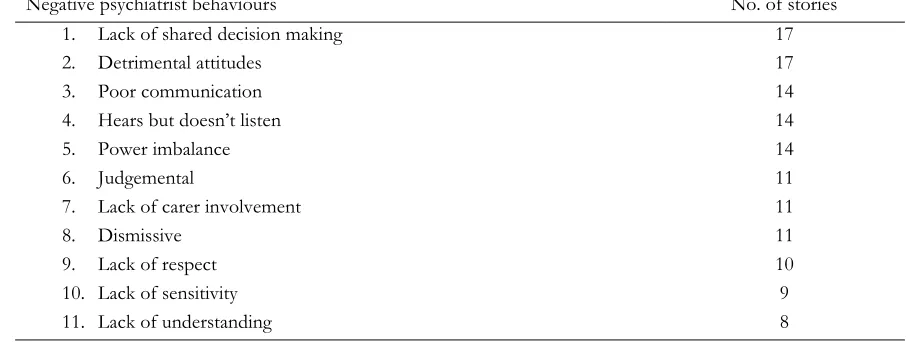
In contrast, story providers also identified a number of negative behaviours considered detrimental to psychiatric care quality (Table 2).
A lack of shared decision making was one of the most frequently discussed negative behaviours. This was aligned with other care domains including a lack of carer
involvement:
“I felt that decisions made about my treatment and care were completely out of my hands. I felt like the psychiatrist had made his mind up about what was going to happen before my
family/friends/advocate & I entered the room and all we were given was the opportunity to ultimately agree.” (UID 298009)
“There was a failure to understand the crisis when my daughter became a rushing door patient (1 day in hospital, 1 day out in a repeated sequence). The psychiatrist made all the decisions; I felt he paid no attention what so ever to my comments, hers or her friends. I feel there was a failure of duty of care.” (UID 19885)
“They never even ask. The fact that you have been a carer for a person for more than 4 years carries no weight at all.” (UID 21448)
Similar to the positive behaviours described above, negative behaviours were often described simultaneously. For example:
“We might be ill but we are not children, please respectfully talk to us as adults and be more open - give us the opportunity to understand what's what and let us make more informed choices when we are capable of making them.” (UID 48673)
“The way the psychiatrist treated me was degrading. It took a lot for me to go there and tell him how I felt and it felt like he was being dismissive, he treated me like a child. I felt worse when I left and ended up going home and attempting suicide… they still treat us as lesser human beings.” (UID 24139)
The pattern between negative psychiatric care experiences and reported outcomes such as those described above i.e.
“ended up going home and attempting suicide” was
discussed by a number of patients (n=25). Conversely, 29
stories described positive outcomes of recovery and “life
-saving” care received by individual psychiatrists:
“I feel like you have given me another chance at life and that's wonderful!” (UID 86975)
“The miserable depressed me has completely changed and I actually felt better than I ever had in my life! I hardly drink now - I had a period of abstinence that lasted about six years… I've even stopped smoking. I am working and expect that this will continue until retirement... I wonder where I would be now without them? Dead? On the streets? Who knows.” (UID 27812)
“With the help and support I have received I now have work as a volunteer, a house and a life.” (UID 206459)
“I'm more able to be the kind of mum that I want to be” (UID 365110)
Table 1. Positive aspects of psychiatric care at the individual practitioner level
Positive psychiatrist behaviours No. of stories
1. Listened to 14
2. Supportive 14
3. Caring 14
4. Understanding 12
5. Treats people with dignity and respect 11 6. Involves (Shared decision making, carer involvement) 10
7. Non-judgemental and accessible 9
8. Kind 9
9. Spends time with patients 7
10. Helpful
11. Discusses medication side effects and provides information
How does the content shared online compare with the content used in existing questionnaires?
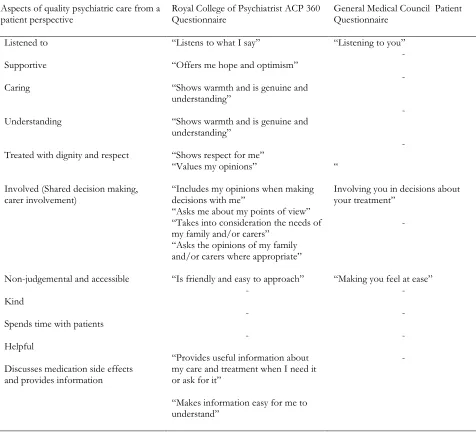
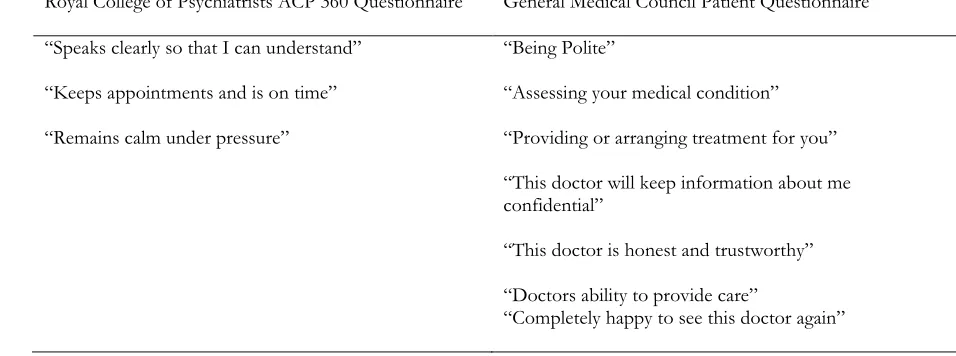
Finally, some of the content of psychiatric care experiences shared online differed to those used in validated questionnaires (Tables 3 and 4).
The GMC questionnaire did not include the majority of quality psychiatric care domains identified from a patient perspective (n=2/11 domains from a patient perspective) (Table 4). The specialty specific Royal College of Psychiatrists ACP 360 tool included more care quality domains from a patient perspective (n=9/11), with several questions repeatedly addressing shared decision making and carer involvement.
However, the language and categorisation used to describe these aspects often differed. For example, being caring and understanding was repeatedly discussed as two separate yet connected behaviours online. In existing questionnaires, these were often amalgamated.
Discussion
This research contributes to our existing understanding by uniquely identifying who patients describe in their psychiatric healthcare experiences, what patients share about their psychiatric healthcare experiences online, and how this compares to the content used in existing questionnaires. In contrast to the policy driven focus of individual practitioner feedback, our findings suggest patients do not typically disaggregate the care provided by a single healthcare professional from the wider team, or healthcare services and processes. At times, patients also share and describe aspects of psychiatric care quality that differs to the content and terminilogy used in existing feedback tools. Although focused on psychiatry, our
research findings have four clear practical and theoretical implications for those looking to facilitate quality improvement, patient feedback and professional development.
Firstly, our research findings suggest that the current GMC revalidation requirement for patients to disaggregate the care provided by an individual practitioner from the wider healthcare team, service or environment is unhelpful. Interactions external to an individual psychiatrist appear to influence, both positively and
negatively, the quality of an individual’s experience. The
current approach is therefore unfavorable and introduces possible bias,28 with the risk of patients providing patient
feedback scores that reflect external frustrations as opposed to the performance of the individual healthcare professional. However, this highlights several issues at the heart of patient feedback in a regulatory context. Firstly, there is an issue of feedback opportunity. The current requirement to collect patient feedback so infrequently (once every five years) sends the message, whether intentional or not, that patient feedback
is unimportant. Secondly, the purpose of patient feedback in a regulatory context is also unclear. Why is it collected and collected in the way that it is? Do we collect patient feedback to encourage learning, reflection and
development, , or do we collect it to compare and contrast healthcare professionals against one another or a set standard? This issue needs to carefully be resolved. assessment? If it is the former, than less rigid forms of feedback collection i.e. healthcare experiences shared online, or tools that allow sufficient space for narrative or free text comments to be more beneficial. The personal, subjective and human nature of patient experience is not a barrier to use but its strength. Narrative comments have been shown to help contextualise and explain the patient
Table 2. Negative aspects of quality psychiatric care at the individual practitioner level
Negative psychiatrist behaviours No. of stories
1. Lack of shared decision making 17
2. Detrimental attitudes 17
3. Poor communication 14
4. Hears but doesn’t listen 14
5. Power imbalance 14
6. Judgemental 11
7. Lack of carer involvement 11
8. Dismissive 11
9. Lack of respect 10
10. Lack of sensitivity 9
11. Lack of understanding 8
Do care experiences shared online contain the same content as validated questionnaires?, Baines et al.
Patient Experience Journal, Volume 6, Issue 1 – 2019 100
journey undertaken,29 avoiding the restrictive approach of
only asking, and therefore valuing prescriptive elements required for regulatory processes. Until the issue of its intended purpose is resolved,30 the methods used to
understand and explore patient feedback may be severely undermined.
The second implication of this research is that patients describe some different domains of psychiatric care quality that are not covered in existing questionnaires. Current methods may not therefore adequately reflect the patient experience, or aspects of care quality considered important from a patient perspective. This may reflect the
acknowledged exclusion of patients and the public in the
design, administration and evaluation of patient feedback questionnaires,19 accentuating the importance of
co-production. Research findings also highlight the potential benefits of including online feedback in regulatory or service improvement processes. For example, as described by Greaves et al., online forums could enable the patient voice to be heard with greater clarity and immediacy than ever before with the potential to transform relationships between care providers and receipients.3 In our research,
some patients described a cyclical pattern between poor psychiatric care and detrimental health care outcomes. The early detection of such patterns could help enhance patient safety and clinical performance. Equally, patients also described a number of lifesaving outcomes as a result of
Table 3. Comparison of patients’ subjective assessment of the quality of psychiatric care as shared online with two
existing validated questionnaires.
Aspects of quality psychiatric care from a
patient perspective Royal College of Psychiatrist ACP 360 Questionnaire General Medical Council Patient Questionnaire
Listened to “Listens to what I say” “Listening to you”
Supportive “Offers me hope and optimism” -
Caring “Shows warmth and is genuine and understanding”
-
Understanding “Shows warmth and is genuine and
understanding”
-
Treated with dignity and respect “Shows respect for me” -
Involved (Shared decision making, carer involvement)
“Values my opinions”
“Includes my opinions when making decisions with me”
“Asks me about my points of view” “
Involving you in decisions about
your treatment”
“Takes into consideration the needs of my family and/or carers”
“Asks the opinions of my family and/or carers where appropriate”
-
Non-judgemental and accessible “Is friendly and easy to approach” “Making you feel at ease”
Kind - -
Spends time with patients - -
Helpful - -
Discusses medication side effects and provides information
“Provides useful information about
my care and treatment when I need it
or ask for it”
“Makes information easy for me to understand”
high quality care. The ability of online forums to detect care excellence that can then be celebrated and supported helping to boost staff morale should not be
underestimated. The inclusion of online patient feedback in regulatory processes requires a necessary shift in our
thinking and definitions of what constitutes as ‘valid’
patient feedback.
Thirdly, the language and categorisation of care domains used in patient feedback shared online differed to that used in existing questionnaires. While the specialtyspecific ACP 360 questionnaire covered the majority of identified domains, the more generic GMC questionnaire failed to address half of the care domains identified as important from a patient perspective, highlighting the importance of tailoring feedback questionnaires to the population it seeks to serve.
Finally, our research goes some way to exploring the belief that online feedback platforms such as Care Opinion are a mere channel for disgruntled patients, particularly those
with “psychiatric or personality disorders”.17 While
negative experiences were encountered, our research also showed that one in four stories reviewed wanted to directly thank those involved in delivering their psychiatric care. This disrupts existing thinking and provides an alternative perspective to the protective discourse often used to deter acceptance and of feedback from the mental health community more generally.17
It is however important to consider the potential limitations of online feedback. Patients who share their experiences online are unlikely to be representative of the entire patient population.3 9 31 However, the same
arguments could be made about the requirement to collect a pre-defined number of patient responses (often 20-30) for revalidation purposes, with evidence to suggest some healthcare practitioners select which patients can respond.7
Furthermore, when viewed in relation to the total number of stories available on Care Opinion at the time of analysis, stories about the care of an individual psychiatrist
represented less than 1% of all available stories. This low representation may reflect the targeted focus of this research, i.e. care provided in part, or in full by an individual psychiatrist, or the moderation process used by Care Opinion where individual names are removed, but it may also be indicative of a wider cultural need to encourage, promote and accept the sharing of psychiatric care and mental health experiences more broadly. Previous research acknowledges the therapeutic benefits of
providing patient feedback and significant associations between patient care ratings, clinical outcomes and care quality.9 32 33 34-36 Critical exploration of ways to increase
the provision and accessibility of patient feedback in the context of psychiatry is therefore required.
Strengths and limitations
Strengths of this research include its application of a rigorous search process, generation of new knowledge that addresses identified limitations of existing research and its co-production with a volunteer mental health patient partner. However, its limitations must also be
acknowledged. Although extensive in scope, this research used one data source. Exploration of other online
feedback websites and international comparisons would be helpful to identify any cultural differences in aspects of psychiatric care quality and any difference between private and state funded healthcare. Patient and carer perceptions of quality psychiatric care were also amalgamated in this research. Future research should explore whether feedback websites are suitable in practice for patients, healthcare providers and regulators to help assess care quality provided from both individual professionals and healthcare services more broadly.9
Table 4. Items not discussed in patient stories but listed in existing patient feedback tools
Royal College of Psychiatrists ACP 360 Questionnaire General Medical Council Patient Questionnaire
“Speaks clearly so that I can understand” “Being Polite”
“Keeps appointments and is on time” “Assessing your medical condition”
“Remains calm under pressure” “Providing or arranging treatment for you” “This doctor will keep information about me confidential”
“This doctor is honest and trustworthy”
“Doctors ability to provide care”
Do care experiences shared online contain the same content as validated questionnaires?, Baines et al.
Patient Experience Journal, Volume 6, Issue 1 – 2019 102
Conclusion
Patients discuss a number of healthcare professionals and services in regards to their psychiatric care experience and describe some domains of psychiatric care quality that differ to those asked in existing questionnaires, Further work is needed to incorporate patient perceptions of care quality and their terminology in existing questionnaires. This may best be achieved through co-design. The current focus of patient feedback in revalidation is of limited value as patients do not typically disaggregate the care provided by an individual clinician from the wider healthcare team or environment. A patients experience is not perceived as individualistic contributions, but rather a collective effort between clinical and non-clinical staff, services and environments. The sharing of healthcare experiences online could help create desirable and dynamic transparency to the benefit of both current and future patients
References
1. Gill SD, Dolley PJ, Dunning TL, et al. Evaluating health services with point of service feedback: perspectives and experiences of patients, staff and community volunteers in an inpatient rehabilitation facility. Disability and Rehabilitation
2015;37(21):1997-2005. doi: 10.3109/09638288.2014.996298
2. Doyle C, Lennox L, Bell D. A systematic review of evidence on the links between patient experience and clinical safety and effectiveness. BMJ Open 2013;3(1) 3. Greaves F, Ramirez-Cano D, Millett C, et al.
Harnessing the cloud of patient experience: using social media to detect poor quality healthcare. BMJ quality & safety 2013:bmjqs-2012-001527.
4. Altmiller G. The role of constructive feedback in patient safety and continuous quality improvement. The Nursing Clinics Of North America
2012;47(3):365-74. doi: 10.1016/j.cnur.2012.05.002 5. Griffiths A, Leaver MP. Wisdom of patients:
predicting the quality of care using aggregated patient feedback. BMJ Quality & Safety 2018;27(2):110-18. doi: 10.1136/bmjqs-2017-006847
6. General Medical Council. The General Medical Council (Licence to Practise and Revalidation) Regulations Order of Council 2012. 2012 [Available from:
http://www.gmc-uk.org/LtP_and_Reval_Regs_2012.pdf_50435434.pdf .
7. Archer J, Cameron N, Lewis M, et al. Evaluating the regulatory impact of medical revalidation., 2018:1-75. 8. Edwards A, Evans R, White P, et al. Experiencing
patient-experience surveys: a qualitative study of the accounts of GPs. The British Journal of General Practice 2011;61(585):e157-e66. doi:
10.3399/bjgp11X567072
9. Verhoef LM, Van de Belt TH, Engelen LJ, et al. Social media and rating sites as tools to understanding quality of care: a scoping review. J Med Internet Res 2014;16(2):e56. doi: 10.2196/jmir.3024 [published Online First: 2014/02/26]
10. Emmert M, Meier F, Pisch F, et al. Physician Choice Making and Characteristics Associated With Using Physician-Rating Websites: Cross-Sectional Study. Journal of Medical Internet Research 2013;15(8):e187. doi: 10.2196/jmir.2702
11. Emmert M, Meier F. An analysis of online evaluations on a physician rating website: evidence from a German public reporting instrument. Journal of medical Internet research 2013;15(8):e157.
12. General Medical Council. Guidance on colleague and patient questionnaires. General Medical Council 2012 13. Patel S, Cain R, Neailey K, et al. Exploring Patients’
Views Toward Giving Web-Based Feedback and Ratings to General Practitioners in England: A Qualitative Descriptive Study. Journal of Medical Internet Research 2016;18(8)
14. Sir Keith Pearson. Taking revalidation forward: improving the process of relicensing for doctors, 2017:80.
15. Colleges. AoMR. Improving patient feedback for doctors., 2018.
16. Armstrong N, Herbert G, Aveling EL, et al. Optimizing patient involvement in quality
improvement. Health Expect 2013;16(3):e36-47. doi: 10.1111/hex.12039
17. Patel S, Cain R, Neailey K, et al. General Practitioners' Concerns About Online Patient Feedback: Findings From a Descriptive Exploratory Qualitative Study in England. Journal Of Medical Internet Research 2015;17(12):e276. doi: 10.2196/jmir.4989 [published Online First: 2015/12/19]
18. Gayet-Ageron A, Agoritsas T, Schiesari L, et al. Barriers to Participation in a Patient Satisfaction Survey: Who Are We Missing? PLoS ONE 2011;6(10) doi: 10.1371/journal.pone.0026852
19. Baines R, Donovan J, Regan de Bere S, et al. Patient and public involvement in the design, administration and evaluation of patient feedback tools, an example in psychiatry: a systematic review and critical interpretative synthesis. Journal of Health Services Research & Policy 2018(In press):1-13.
20. Vásquez C. Complaints online: The case of
TripAdvisor. Journal of Pragmatics 2011;43(6):1707-17.
21. Baines R, Donovan J, Bere SRd, et al. Responding effectively to adult mental health patient feedback in an online environment: A coproduced framework. Health Expectations;0(0) doi: doi:10.1111/hex.12682 22. Baines RL, Regan de Bere S. Optimizing patient and
public involvement (PPI): Identifying its “essential” and “desirable” principles using a systematic review
Expectations 2018;21(1):327-35. doi: 10.1111/hex.12618
23. Sampson M, McGowan J, Cogo E, et al. An evidence-based practice guideline for the peer review of electronic search strategies. Journal of clinical epidemiology 2009;62(9):944-52.
24. Ritchie J, Spencer L. Qualitative data analysis for applied policy research. In: Bryma A, Burgess RG, eds. Analyzing Qualitative Data. London: Routledge 1994:173-94.
25. NVivo 11. NVivo qualitative data analysis Software: QSR International Pty Ltd, 2012.
26. General Medical Council. Patient questionnaire. 27. Royal College of Psychiatrists. What is ACP 360?
2017 [Available from:
http://www.rcpsych.ac.uk/workinpsychiatry/qualityi mprovement/acp360/whatisACP360.aspx accessed 07.07.2017.
28. Downing SM. Validity: on the meaningful
interpretation of assessment data. Medical education 2003;37(9):830-37.
29. Baines R, de Bere SR, Stevens S, et al. The impact of patient feedback on the medical performance of qualified doctors: a systematic review. BMC medical education 2018;18(1):173.
30. Archer J, de Bere SR, Nunn S, et al. “No One Has
Yet Properly Articulated What We Are Trying to
Achieve”: A Discourse Analysis of Interviews With
Revalidation Policy Leaders in the United Kingdom. Academic Medicine 2015;90(1):88-93.
31. Rozenblum R, Bates DW. Patient-centred healthcare, social media and the internet: the perfect storm?: BMJ Publishing Group Ltd, 2013.
32. Greaves F, Pape UJ, King D, et al. Associations between internet-based patient ratings and conventional surveys of patient experience in the English NHS: an observational study. BMJ quality & safety 2012;21(7):600-05.
33. Bardach NS, Asteria-Peñaloza R, Boscardin WJ, et al. The relationship between commercial website ratings and traditional hospital performance measures in the USA. BMJ quality & safety 2012:bmjqs-2012-001360. 34. Kleintjes S, Lund C, Swartz L. South African mental
health care service user views on priorities for supporting recovery: implications for policy and service development. Disability and Rehabilitation 2012;34(26):2272-80. doi:
doi:10.3109/09638288.2012.681005
35. Thornicroft G, Brohan E, Kassam A, et al. Reducing stigma and discrimination: Candidate interventions. International Journal of Mental Health Systems 2008;2(1):3.
Do care experiences shared online contain the same content as validated questionnaires?, Baines et al.
Patient Experience Journal, Volume 6, Issue 1 – 2019 104
Appendix 1. Supplementary material identified roles in addition to psychiatrist, consultant psychiatrist, locum psychiatrist, duty psychiatrist and assistant psychiatrist
GP (n=37)
Community psychiatric nurse (n=27) Community mental health team (n=19) Crisis team (n=16)
Nurse (n=15) Psychologist (n=12) Secretary (n=10) Administrator (n=10) Social worker (n=7) Support worker (n=5) Occupational therapist (n=5) Clinical care co-ordinator (n=4) Care co-ordinator (n=4) Complaints manager (n=2) PALS (n=2)
Psychiatric liaison team (n=2) Counsellor (n=2)
Student (n=2) Paramedics (n=2) Mental health team (n=1) Community link worker (n=1)
Social inclusion and wellbeing service (n=1) Peer support worker (n=1)
Community nurse (n=1) Sister (n=1)
District nurse (n=1) IAPT (n=1) Trainee (n=1) A&E staff (n=1) Police (n=1) 111 (n=1) CRT (n=1) Neurologist (n=1)
Mental health service management (n=1) House officer (n=1)