Copyright © 2007-2008, Usability Professionals’ Association and the authors. Permission to make digital or hard copies of all or part of this work for personal or classroom use is granted without fee provided that copies are not
A Study of the Effect of Thumb
Sizes on Mobile Phone Texting
Satisfaction
Vimala Balakrishnan
Faculty of Information Science and Technology,
Multimedia University Jln. Ayer Keroh Lama 75450 Ayer Keroh, Melaka Malaysia
[email protected] Paul, H.P. Yeow
Faculty of Business and Law, Multimedia University Jln. Ayer Keroh Lama 75450 Ayer Keroh, Melaka Malaysia
Abstract
This paper investigates the effect of participants’ varying thumb sizes in relation to the experience of using mobile phone keypads for sending text messages. The keypad design factors considered in the study were key size, shape, texture, space between keys, layout, and simplicity. One hundred and ten people participated in the study. Their age ranged between 17 to 25 years old. The researchers
recorded the participants’ thumb lengths and circumferences. Participants’ positive or negative satisfaction with using mobile phone keypads correlates to their thumb length and circumference. For example, if a participant’s thumb circumference was large, he or she tended to be dissatisfied with the key size and space between keys. Results confirm that varying thumb sizes affect users’ text messaging satisfaction. Mobile phone manufacturers and designers can use the findings in this study to design customized mobile phones that cater to users with large thumbs. This may increase their customer’s text messaging satisfaction.
Keywords
Introduction
Text messaging or texting is the common term for sending short (maximum of 160 characters and spaces) text messages using the Short Message Service (SMS) from mobile phones. The individual messages are called text messages and more colloquially SMS. Text messaging has been a tremendous success in many countries, including Asian countries like Singapore, Philippines, and Malaysia. Malaysians, for example, were found to have sent 11.7 billion messages in the first three months of 2007, compared to only 7.4 billion in 2006 (The Star, 2007). Texting is a quick, easy, and cheap way to communicate with anyone, anywhere, and at anytime.
The popularity of SMS has heightened the interest in mobile phone research. A lot of studies have occurred on the use of mobile phones and the SMS in certain countries (Faulkner and Culwin, 2005; Hőflich and Rőssler, 2002; Ling, 2005). Social and psychological effects of SMS were also studied to examine the underlying motivations of using SMS (Reid and Reid, 2004). Some researchers have done usability studies of mobile phones (Balakrishnan et al., 2005; Soriano et al., 2005) and some have compared the performance of the text entry methods (Friedman et al., 2001; James and Reischel, 2001). Although numerous studies have been conducted related to SMS, very few studies were related to SMS users’ subjective satisfaction (Han et al., 2004; Ling et al., 2007; Yun et al., 2003).
User satisfaction is a main priority for many product designers. For example, in Japan, product designers employ Kansei engineering techniques to design products (such as cars, houses, and costumes) considering the end user’s perceived desirable features. (Kashiwagi et al., 1994; Miyazaki et al., 1993; Nagamachi, 2002). Mobile phone designers considered user satisfaction when evaluating the look-and-feel of mobile phone. (Yun et al., 2003). The success or failure of any product is heavily dependent on the end users’ satisfaction. Literature reviews revealed that no studies investigated the effect of users’ varying thumb sizes on texting satisfaction. Some users with large fingers have commented about the difficulty of using mobile phones to send text messages (Axup et al., 2005; Faulkner and Culwin, 2005; Soriano et al., 2005); however, the researchers did not take any finger measurements into consideration.
Studies related to keypad designs are numerous; however, most studies attempt to tackle keypad design problems by focusing on the text input mechanism (Mackenzie, 2002; Silfverberg et al., 2000). The Fastap keypad was designed by placing 52 independent keys onto an area the same size as the standard ISO keypad. Though the Fastap keypad offers an increased
performance over an ISO keypad, it remains to be seen how mobile phone users will assess the trade-off between the increased performance of advanced input technologies and the additional cost (Cockburn and Siresena, 2003). Several studies identified tiny key sizes as one of the problems related to mobile phone use (Kurniawan et al., 2006; Soriano et al., 2005). A study conducted with a group of older people revealed that keys placed too close to one another cause problems while handling a mobile phone (Ornella and Stephanie, 2006). Though many studies identified potential problems related to keypads, no study took any physical
measurements of the thumbs or fingers into consideration.
Keypad Design
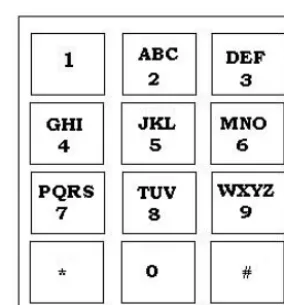
Figure 1. Standard ISO 12-key keypad design
The standard keypad design on many mobile phones consists between 12 to 15 keys. Each key contains multiple letters (see Figure 1). These keys are used to enter text, symbols, numbers, and punctuations. Users repetitively press keys for text input because each key is mapped to between one to five characters. The most popular forms of text input on a standard 12-key mobile phone are multitap or predictive text entry.
In a multitap system the user presses the key multiple times to make a letter selection. For example, the key 2 is loaded with the letters A, B, and C, thus if a user wants to enter a C, then he or she has to press the key three times (222) successively as C is the third letter placed on the key. The process of texting becomes more complicated when the intended letters are placed on the same key. For example, to text the word cab the user must press the 2 key using the following pattern: 222 (pause) 2 (pause) 22. To select the correct letter on the key, the user must pause to determine the correct letter. Most of the mobile phones employ a time-out process in which the user waits for a specified time (typically one to two seconds) before attempting to enter the next letter, which is why multitap is often criticized for being slow (Mackenzie, 2002).
On the other hand, predictive text entry uses a dictionary to disambiguate user’s input. Just like multitap, multiple keys correspond to the same key. However, keys are pressed only once. Possible words are continuously guessed as letters are entered and users can cycle through these words via a next key. Though this method is faster than multitap (James and Reischel, 2001), it can be quite frustrating and slow when the phone doesn’t recognize the words that are entered (Starner, 2004). Predictive text entry is a particular problem when using an English keypad to enter non-English text. Moreover, it is also impossible to enter numerals, acronyms, or any combinations of letters and numerals (e.g., l8r for later). Users also have to visually monitor the display to resolve ambiguities, unlike multitap that can be operated “eyes free” by experts (Mackenzie et al., 2001).
Theoretical Framework
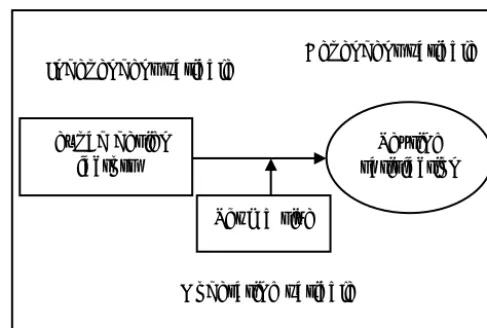
Figure 2. Standard ISO 12-key keypad design The keypad design factors identified are listed below:
• Size: size of the keys for texting and navigating
• Simplicity: the overall simplicity of the keypad design
• Shape: shape of the keys (square, rectangle, oval, etc.)
• Space: existing space between the keys
• Layout: arrangement of keys (4 x 3, QWERTY, etc.)
• Texture: tactual satisfaction related to key texture and material (soft, hard, coarse, etc.)
These factors were obtained from studies conducted to identify mobile phone design features that are critical to users’ satisfaction (Ling et al., 2007; Han et al., 2004; Yun et al., 2003). Other studies that have reported on issues related to some of these features are problems related to tiny keys (Kurniawan et al., 2006; Soriano et al., 2005) and problems related to key size and space between the keys (Balakrishnan et al., 2005; Ornella and Stephanie, 2006). None of these studies took finger or thumb size measurements into consideration.
Methods
The following sections present the subjects, thumb measurements, interview questionnaires, and interviews.
Subjects
Text messaging is popular among young adults (Ling, 2001; Reid and Reid, 2004). Therefore, researchers recruited 110 adults between 17 to 25 years old (mean = 21.5 years, SD = 1.64) for the study. There were an equal number of males and females (55 for each gender). The subjects were Malaysians comprised of the three major ethnicities (Malays, Chinese, and Indians). The majority of the subjects (84/110) were students from a local university with diverse origins (representing different states in Malaysia). The rest of the subjects were recruited from public places such as local malls and libraries. All the subjects were familiar with SMS, with an average of 3.8 years of experience and SD = 1.19. All the subjects composed messages single-handedly using their thumb. For text entry, 80.9% (89/110) of the subjects used multitap, 11.8% (13/110) used both multitap and predictive interchangeably, and 7.3% (8/110) used predictive. The subjects responded to the interview questions based on their own mobile phones; therefore, the data collected captured the user’s real feelings towards their own mobile phones. Table 1 shows the mobile phones used by the subjects in the study, the
dimensions (range given based on the minimum and maximum width of the mobile phone), and also the weight of the phones (range between the lightest and heaviest mobile phone). The dimensions and the weight of the mobile phones reflect the current trend towards mobile phone
Keypad design factors
Texting satisfaction
Thumb size
Independent variable Dependent variable
miniaturization (the heaviest phone is merely 114g). All the mobile phones had a 4 x 3 keypad layout. The following is a list of some of the models used in the study:
• Nokia: 6100, 3310, 8250, 6610, etc.
• Samsung: X430, E700, X460c, etc.
• Motorola: C300, C261, E100, etc.
• Sony Ericsson: K700i, T630, T68i, etc.
• Siemens: C65
• Alcatel: 331 and 565
Table 1. Mobile phone characteristics
Brand Ownership Dimension (mm) (length x width x thickness)
Weight (gram)
Nokia 73 102 x 42.6 x 19.4 – 113 x 48 x 16 76–114 Samsung 14 80 x 40 x 22 – 111 x 45 x 17 72–85 Motorola 10 106 x 44 x 16 – 110 x 48 x 15 82–108 Sony Ericsson 9 102 x 43 x 17 – 101 x 48 x 19.5 84–93
Siemens 2 105 x 45 x 16 86
Alcatel 2 98 x 42 x 20 – 98 x 45 x 20 77–80
Thumb measurements
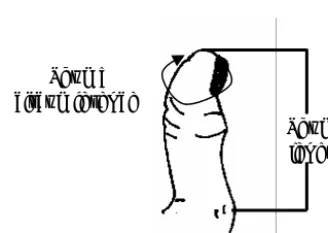
Researchers recorded the subjects thumb length and circumference. Thumb length might affect users’ reachability of the keys whereas users with large thumbs might find it cumbersome keying in messages via the tiny keys. Thumb length was measured from the second joint of the thumb to the tip of the thumb. The thumb circumference was measured above the second joint of the thumb at the narrowest point (see Figure 3). The measurements were taken twice using a measurement tape, then the two measurements were averaged together to maintain
consistency.
Figure 3. Thumb measurements
Table 2 shows the summary statistics for these anatomical measurements based on genders. These measurements depict the readings for the dominant thumbs that are used to text.
Thumb length Thumb
Table 2. Thumb length and circumference statistics
Measurements (cm)
Male (N=55)
Mean ± SD (min.–max.)
Female (N=55)
Mean ± SD (min.–max.)
Thumb length 6.4 ± 0.8 (4.8 – 8.0) 5.4 ± 0.65 (4.2 – 7.5) Thumb circumference 5.8 ± 0.75 (4.5 – 7.8) 5.4 ± 0.58 (4.5 – 7.2)
Interview questionnaires
An interview questionnaire was designed based on Sinclair’s (1995) guidelines, and then tested on five subjects and revised before finalizing it. The questionnaire was developed in English and had two major sections. Section A was to obtain the demographic profile of the subjects and the mobile phone characteristics. This section consisted of questions addressing issues such as dominant hands, finger(s) used when composing messages, and experience in using SMS. Section B is for the subjects to rate their satisfaction or dissatisfaction levels of SMS usage based on the keypad design factors using Likert’s five-point scale (1 means “Strongly dissatisfied,” 2 means “Dissatisfied,” 3 means “Neutral,” 4 means “Satisfied,” and 5 means “Strongly Satisfied”).
Interviews
Face-to-face interviews were conducted using the questionnaire beginning with the subjects’ background information, which included their age, gender, years of experience in sending SMS, the finger(s) used in composing SMS, and so forth. The interviewer recorded the subject’s thumb measurements. Then the interviewer recorded mobile phone characteristics such as brands, dimensions, and support of predictive text entry. Subjects were encouraged to give comments, opinions, and suggestions. All verbal comments were recorded by the interviewers. Each interview session lasted for about 30 minutes. It took two interviewers approximately six to seven weeks to question the subjects. The interviewers were knowledgeable of mobile phone features and SMS application so that they could easily interact with the subjects during the interview sessions.
Results
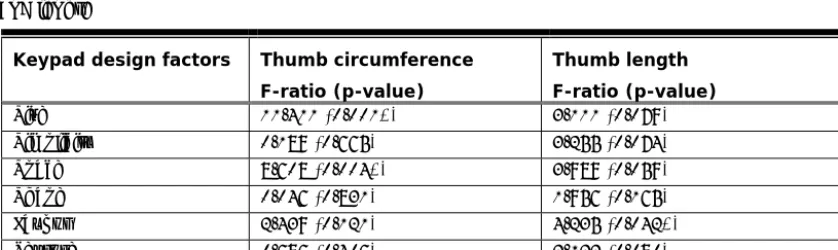
Statistical Package for the Social Sciences (SPSS) 13.0 software was used to test the statistical effect of thumb length and circumferences on users’ texting satisfaction based on keypad design factors. Analysis of covariance (ANCOVA) and Pearson correlations were used to analyze the collected data. All results are considered significant at p < 0.05 level.
Table 3. ANCOVA test for keypad design factors satisfaction, based on thumb circumference and length
Keypad design factors Thumb circumference F-ratio (p-value)
Thumb length F-ratio (p-value)
Size 11.411 (0.001*) 3.111 (0.079) Simplicity 0.189 (0.665) 3.255 (0.074) Space 8.608 (0.004*) 3.989 (0.059)
Shape 0.046 (0.831) 1.956 (0.165)
Layout 2.439 (0.121) 4.235 (0.042*) Texture 0.696 (0.406) 3.123 (0.080)
*: significant at
p
< 0.05
Table 4. Pearson correlations between thumb measurements and texting satisfaction
Thumb measurements p-value r
Thumb circumference <0.001* -0.628
Thumb length 0.057 -0.201
*: significant at p < 0.05
Table 4 shows the correlations between the thumb measurements and the dependent variable, texting satisfaction. A significant negative correlation was observed between thumb
circumference and users’ texting satisfaction (p = 0.003). No significant correlation was found between thumb length and users’ texting satisfaction.
Discussion
The following sections present thumb length and keypad layout, thumb circumference and key size, thumb circumference and space between keys, and thumb circumference and users’ texting satisfaction.
Thumb length and keypad layout
A significant negative correlation was found between thumb length and users’ satisfaction towards keypad layout. This could be due to the 4 x 3 layout used by the mobile phones in this study and in most of the mobile phones in the market. It was found that subjects with longer thumbs find it difficult to reach keys 3, 6, 9, and pound (#), which are all placed at the right-most column of the keypad (see Figure 1). Eleven subjects (thumb length ranged between 6.0 to 7.0 cm) commented that they have to practically bend their thumbs or readjust the
placement of the phone on their palms in order to press these keys, especially for the pound key (#) which is at the bottom corner of the phone. The motion of adjusting their hands and thumbs to accommodate the keypad layout causes dissatisfaction among these users. When prodded further, four of them stated that continuously bending their thumbs has caused discomfort at the first joint of their thumb (from the tip), especially after continuously texting. An increase in texting may contribute to a rise in repetitive strain injury (RSI) in thumbs, especially among the young users. Bronwyn Clifford, of the Association of Chartered
Physiotherapists in Occupational Health and Ergonomics (ACPOHE), mentioned that too much texting can result in pain and swelling of the thumbs and wrists as the thumb is good at grasping but not good for repetitive movement (Cannon, 2005). Balakrishnan et al. (2005) and Yeow and Balakrishnan (2007) have also reported that some of their subjects have experienced pain in their thumbs after prolonged texting; however, their study was based on a small sample size and disregarded thumb measurements.
Thumb circumference and key size
Thumb circumference and space between keys
A similar correlation was found between thumb circumference and space between keys, with both significantly correlating negatively to each other. This showed that subjects’ satisfaction decreased as their thumb circumference increased. Miniaturization of mobile phones causes the keys to be placed closely together. This results in a very limited space or no space at all
between the keys. Large thumbed users found texting a tedious task due to the close placement of the keys, which was further aggravated by the tiny key size. Twenty-two subjects (thumb circumference ranged between 6.5 to 7.5 cm) commented that they tended to hit the
neighbouring keys accidentally while texting, especially when done in a hurry or while in motion (e.g., walking or talking). It can be a frustrating task as they had to waste their time correcting the errors instead of texting efficiently. Moreover, they mentioned that they needed to
constantly focus on the screen to make sure they had pressed the correct key, which eliminated the possibility of eyes-free input among the large thumbed users. Frequently having to correct their errors hindered these users from adopting SMS at times or to use it only to send simple, short messages. Ornella and Stephanie (2006) also found limited spaces between the keys to be a problem among the older mobile phone users (60 to 80 years old); however, no thumb measurements were taken into consideration. Due to this dissatisfaction with texting, subjects tend to make phone calls that are faster instead of making slow key presses to send text messages.
Thumb circumference and users’ texting satisfaction
Finally, a significant negative correlation was found between thumb circumference and users’ texting satisfaction, indicating an increase in thumb circumference will significantly decrease texting satisfaction. This confirmed the previous findings whereby users’ satisfaction towards key size and space between keys decreased as the thumb circumference increased. It can be concluded that user’s dissatisfaction towards key size and space between keys affect user’s texting satisfaction. As stated previously, large thumb sized users found it difficult to make multiple key presses via the tiny keys that are placed close to one another, and thus results in an increased error and correction rates. This caused the users to be frustrated in using the keypad to text.
Recommendations
Results indicated that when thumb circumference increased, user’s satisfaction towards key size and space between keys decreased. Moreover, users’ texting satisfaction was found to decrease when thumb circumferences increased. Mobile phone manufacturers and designers should look into enlarging the keys and increasing the space between keys. This may result in a larger mobile phone and a change in the keypad layout; however, this will be eventually accepted as users’ texting speed increases. We also recommend an increase in the number of keys to reduce the key overloading problem. Extended keypads that consist of more keys could be designed and introduced for a more straight-forward way to enter text messages. For example, Nokia E70 comes with a foldable QWERTY keypad. This keypad requires mobile phone users to use both their hands for text entry. The increased number of keys results in a faster and easier text entry. Other mobile phone manufacturers should design similar keypads to be included in their respective mobile phones. Mobile phone users, especially those with larger thumb sizes, will benefit from such designs.
as accessibility to the commonly used keys are easier, which increases texting speed and eventually texting satisfaction.
Conclusion
The aim of the study was met as the findings confirm that varying thumb sizes have significant effects on users’ texting satisfaction, based on some of the keypad design factors (e.g., keypad layout, key size, and space between keys). With this knowledge, mobile phone manufacturers and designers can create customized mobile phones that suit users with larger thumb sizes by prioritizing key size, space between keys, and keypad layout.
Practitioner’s Take Away
The effect of thumb length and circumference on mobile phone texting satisfaction was studied against keypad design factors. The following results were drawn:
• The increase of thumb circumference decreases users’ satisfactions towards key size and space between keys as texting becomes tedious due to accidentally hitting the wrong keys.
• An increase in thumb circumference also decreases users’ texting satisfaction due to the inappropriate keypad design.
• The increase of thumb length decreases users’ satisfactions towards keypad layout as accessing keys 3, 6, 9 and the pound key (#) becomes difficult.
• Difficulty in reaching some of the keys sometimes causes discomfort in the first joint of the thumbs (from the tip).
• Keypad design awaits improvements to enhance users satisfaction in texting, especially among users with larger thumb measurements.
References
Anderson, J. (2005). Cell Phone Design Given A Failing Grade for Usability. Retrieved June 15, 2006, from www.ergoweb.com/news/detail.cfm?print=on&id=117
Axup, J., Viller, S., & Bidwell, N. (2005). Usability of a Mobile, Group Communication Prototype While Rendezvousing. CTS’05 International Symposium on Collaborative Technologies and Systems-Special Session on Mobile Collaborative Work, St. Louis, MO, USA.
Balakrishnan, V., Yeow, P.H.P., & Ngo, D.C.L. (2005, April). An Investigation on the Ergonomic Problems of Using Mobile Phones to Send SMS. In: P.D., & P.T., McCabe (Eds.)
Contemporary Ergonomics 2005 (pp.195-199). United Kingdom: Taylor & Francis. Cannon, D. (2005). Two Thumbs Down to Increased Texting Among Teens. Retrieved August
10, 2006, from www.ergoweb.com/news/detail.cfm?id=1188
Cockburn, A., & Siresena, A. (2003). Evaluating Mobile Text Entry with the Fastap Keypad. People and Computers XVII, Vol. 2: British Computer Society Conference on Human Computer Interaction, England.
Faulkner, X., & Culwin, F. (2005). When Fingers Do The Talking: A Study of Text Messaging, Interacting with Computers 17 (2), 167-185.
Friedman, Z., Mukherji, S., Roeum, G.K., & Ruchir, R. (2001). Data Input into Mobile Phones: T9 or Keypad?, Student Online HCI Research Experiments. Retrieved June 10, 2006, from http://www.otal.umd.edu./SHORE2001/mobilePhone/index.html
Han, S.H., Kim, K.J., Yun, M.H., Hong, S.W., & Kim, J. (2004). Identifying Mobile Phone Design Features Critical to User Satisfaction. Human Factors and Ergonomics in Manufacturing, 14 (1), 15-29.
James, C.L., & Reischel, K.M. (2001). Text Input for Mobile Devices: Comparing Model Prediction to Actual Performance. Computer Human Interaction 2001, 3 (1), 365-371. Kashiwagi, K., Matsubara, A., & Nagamachi, M. (1994). A Feature Detection Mechanism of
Design in Kansei Engineering. Human Interface, 9(1), 9-16.
Kurniawan, S., Murni, Mahmud, & Yanuar, Nugroho. (2006). A Study of the Use of Mobile Phones by Older Persons. Computer Human Interaction 2006, Canada.
Ling, R. (2001). “We Release Them Little by Little”: Maturation and Gender Identity as Seen in the Use of Mobile Telephony. Personal and Ubiquitous Computing, 5, 123-136.
Ling, R. (2005). The Socio-linguistic of SMS: An Analysis of SMS Use by a Random Sample of Norwegians. In R., Ling, & P., Pedersen (Eds.) Mobile Communications: Renegotiation of the Social Sphere (pp. 335 –349). London: Springer Verlag.
Ling, C., Hwang, W., & Salvendy, G. (2007). A survey of what customers want in a cell phone design. Behaviour and Information Technology, 26 (2), 149-163
Mackenzie, I.S., Kober, H., Smith, D., Jones, T., & Skepner, E. (2001). LetterWise: Prefix-based disambiguation for mobile text input. In Proceedings of the ACM Symposium on User Interface Software and Technology – UIST 2001. New York: ACM.
Mackenzie, S.I. (2002). Mobile Text Entry Using Three Keys. Proceedings of the Second Nordic Conference on Human-Computer Interaction- NordiCHI 2002 (pp. 27-34). New York: ACM. Miyazaki, K., Matsubara, Y., & Nagamachi, M. (2003). A Modeling of Design Recognition in
Kansei Engineering. Japanese Journal of Ergonomics, 29 (Special), 196-197.
Nagamachi, M. (2002). Kansei Engineering in Consumer Product Design. Ergonomics in Design, 10(2), 5-9.
Ornella, P., & Stephanie, B. (2006). Universal Designs for Mobile Phones: A Case Study. Computer Human Interaction 2006 (Work in Progress). Quebec, Canada.
Reid, F.J.M., & Reid, D.J. (2004). Text Appeal: The Psychology of SMS texting and its
implications for the design of mobile phone interfaces. Campus-Wide Information Systems, 21 (5), 196-200.
Silfverberg, M., Mackenzie, I.S., & Korhonen, P. (2000). Predicting Text Entry Speed on Mobile Phones. Computer Human Interaction 2000, 2 (1), 9-16.
Sinclair, A.M. (1995). Subjective Assessment. In: J.R., Wilson, & E.N., Corlett (Eds.). Evaluation of Human Work-A Practical Ergonomics Methodology. (pp. 69-100). London: Taylor & Francis.
Soriano, C., Raikundalia, G.K., & Szajman, J. (2005). A Usability Study of Short Message Service on Middle-Aged Users. Proceedings of OZCHI 2005, Canberra, Australia. Starner, T. E. (2004). Keyboards Redux: Fast mobile text entry. Pervasive Computing. The Star. (2007). 11.7 billion SMSes sent in first three months. Retrieved August 10, 2007,
from www.thestar.com.my/news/story.asp?file=/2007/8/8/nation/18525524&sec=nation Yeow, P.H.P., & Balakrishnan, V. (2007). Health Effects on Malaysian Youths Due To Mobile
Messaging. Proceedings of the International Conference on Ergonomics 2007, Kuala Lumpur, Malaysia.
About the Authors
Vimala Balakrishnan is a lecturer in Information Science and Technology at Multimedia University, Malaysia. She is also currently pursuing her doctoral study in the field of Ergonomics, specifically related to mobile phone design and users’ texting satisfaction.