ISSN: 2333-6021 (Print), 2333-603X (Online) Copyright © The Author(s). All Rights Reserved. Published by American Research Institute for Policy Development DOI: 10.15640/ijgws.v5n1p1 URL: https://doi.org/10.15640/ijgws.v5n1p1
He’s Smart and She’s Nice: Student Perceptions of Male and Female Faculty
Alison S. Burke
1, Ph.D., Whitney Head-Burgess
2, B.A. & Mark Siders
3, Ph.D.
Abstract
Women have advanced considerably in academia in the past several decades, however, even though the job duties for professors are the same, male and female professors are seen and treated differently. Many studies have examined student perceptions of faculty members only to find a clear existence of gender bias. The current study surveyed N=544 students from a small, Pacific Northwest liberal arts university. The results reveal that students assign very different attributes to their professors based on gender. Consequences of these biases are discussed.
Introduction
Women are well represented within the student body of university life and are attaining degrees at higher rates in the United States than ever before. However, in comparison to men, fewer women than men are making the transition from degree attainment into the higher ranks of academia, despite earning nearly half of the doctoral degrees awarded in this country (Renwick Monroe & Chiu, 2010). According to the US Department of Education (2016) larger shares of undergraduate degrees and certificates were conferred to female students than to male students in academic year 2012–13. Based on these numbers, there is no doubt that women are present in as far as degrees are concerned, but then the pipeline begins to leak. One explanation for this phenomenon could be that a majority of women in academia are employed in lower tier universities and are generally rated lower than their male counterparts within these same institutions; furthermore, women who are able to gain a positions in a top tier universities can expect to earn 12% less than male professors of the same rank (Renwick Monroe & Chiu, 2010). Renwick Monroe and Chiu (2010) argue that women in academia are consistently earning 3% to 8% less than men, and that wage gap increases as the institutional prestige rises.
Moreover, women are less likely to attain full professorship; with 10.9% becoming assistant professors, but only 7.2% rising to the rank of full professor in prestigious research universities (Basow, 1995; Renwick, Monroe & Chiu, 2010). Van den Brink and Benschop (2012) found that the number of women decreases at every stage of the appointment process. This could be due in large part to the lack of attention, encouragement and serious regard given to women in the classroom and the academy in general (Miller & Chamberlin, 2000, p. 287). The reality that women are under-represented in the academy brings forth another issue; that of differential work responsibilities. Male professors generally teach upper division classes whereas their female counterparts frequently teach introductory level classes. These distinctions are frequently based upon rank within the institution and create an aura of men as professors, but women as teachers. To illustrate the difference in work load, Pease (1993) examined the stereotype of “women’s work” (traditional roles of wives and mothers) and undergraduate teaching.
1 Criminology and Criminal Justice, Southern Oregon University, USA. 2
Department of Sociology, College of Liberal Arts and Sciences, Portland State University, USA.
Pease (1993) found that women’s work infiltrated academic positions in the form of student advising, mentoring, and general accessibility to students. Women’s work was considered nurturing and time intensive, and led to academic burnout as a result of the demand of students. Men’s work, on the other hand, involved solitude and intellectual work, and was considered “research.” As Pease (1993) noted, “The researcher works to satisfy self; the teacher works to serve others” (p. 135). Bernard (1964) called this phenomenon “academic momism” (p. 131), and it has been documented throughout academia. Astin and Bayer (1973) found that teaching responsibilities tended to be heavier for women than men. Women were more likely than men to carry heavy responsibilities for undergraduate teaching. Less than half of men teachers (48%) and more than two-thirds of women teachers (69%) indicated that their teaching was confined to undergraduates. These differences were only partly attributable to differences in job settings, the discrepancies being most marked in universities where proportionately twice as many women as men taught only undergraduate classes (p. 335). Relatedly, Hart and Cress (2008) found that in comparison with male faculty, female faculty actually bear more of the workload. Research shows that female faculty devote more time to teaching than male faculty (Allen 1998; Bellas and Toukoushian 1999), and that service assignments are a heavier burden on female faculty than on male faculty (Hart and Cress 2008).
Similarly, Monroe, Ozyurt, Wrigley and Alexander (2008) interviewed 80 female faculty at a Research One institution and found evidence of gender devaluation, or the “subtle process by which women’s work is devalued or minimized, so that work or positions once deemed powerful and conferring high status frequently become devalued as women increasingly take on these roles” (p. 230). Monroe et al.’s (2008) study supports the research that finds women have more service responsibilities than men. In addition to finding that service is considered women’s work, they also revealed that both service within the university and teaching are undervalued; “The status hierarchy rewards research” (p. 230). Perhaps the notable trends of publishing have something to do with the perceptions student have of female professors. In an empirical evaluation of student perceptions, Miller and Chamberlin (2000) found that students were more likely to attribute the status of “teacher” to women and “professor” to men, regardless of their credentials or academic position. It appears women’s role serves to inhibit their scholarly activities, which might be part of this “productivity puzzle.” The purpose of the current study is to explore student perceptions of professors and examine the effect, if any, that gender plays in their evaluative processes. Specifically, the research examines students’ word choices in relation to the gender of their professors. Moreover, it explores whether the students’ own gender colors their perceptions of their professors.
Literature Review
Student evaluations are subjective and oftentimes arbitrary, yet necessary for promotion and tenure requirements. However, the expectations students have of professors and their experiences they garner in class might be influenced by the gender of the professor rather than the actual merit of the instructional style. For example, Basow (1995), Anderson (2010) and Miller and Chamberlin (2000) assert that the subject being taught makes a great deal of difference when evaluating student perceptions of aptitude. Women who teach in fields which are seen as traditionally feminine subjects, such as composition, are largely evaluated as being more competent (Anderson, 2010). Whereas men who teach in Sociology, or Mathematics, traditionally male dominated fields, are seen as more capable and knowledgeable than female professors teaching the same subjects (Anderson, 2010; Miller & Chamberlin, 2000). Interestingly, Anderson’s (2010) study found that that male professors engaging in lectures about feminism and related women’s issues were viewed by students as being more knowledgeable and objective than their female counterparts who teach the same courses.
Even so, meeting the ideals for a female professor may not be enough in the eyes of student evaluators, which creates a double standard in which women can never truly measure up to their male counterparts. Additionally, those women who are evaluated negatively by their students in areas such as student accessibility may garner lower ratings simply because they did not conform to the gendered stereotypes of women as more accessible (Basow & Silberg, 1987). Gender stereotypes and schemas appear to color student evaluations of professors (Basow & Silberg, 1987; Anderson, 2010; Basow and Rubenfeld, 2003). These opinions can be tempered by several factors. Stereotypes based on the gender of female professors appear to play somewhat less of a role in evaluations when a student is more familiar with the female professor in question.; Miller and Chamberlin (2000) found that male and female students alike evaluated their professors differently if they were familiar with that professor’s teaching and grading style, relying less on gendered stereotypes in their assessments of instructor competence and personality. Similarly, it appears that student gender plays a part in how favorably a classroom instructor is rated- with female students overwhelmingly rating female professors highly in traditionally feminine attributes such as a caring or expressive teaching style, but also higher in traits like organization which are typically thought more masculine (Garcia, Bachen, & McLoughlin, 1999). Female and male students tend to perceive different qualities as being important; Basow (2000) suggests that caring qualities are more important for female students than for male students when evaluating faculty performance.
Student perceptions also carry over to respect of the professor. Macili, Fogliasso, and Baack (2011) found students were more likely to know the title of a male professor and were addressed as “Doctor” whereas female professors did not receive the same level or respect. Students were more likely to refer to the female professors as Mrs. Even though she had the same degree as the males. As the authors note, this implies continued stereotypes and gender roles. The current study seeks to explore whether students still have gendered perceptions of their professors. The first hypothesis is that students will use different word choices to characterize their male and female professors. The second hypothesis is that the gender of the respondent will impact the word choices used. Specifically, female respondents will associate more caring attributes with female instructors than will the males respondents. Methodology. In order to measure student perceptions of classroom instructors a survey instrument was required and utilized the framework provided by Tomkiewicz and Bass in their 2008 study on the difference between male and female student perception of managers. In their research to mkiewicz and Bass (2008) utilized a 92-item Descriptive Index originated by Schein (1973, 1975). This index has been used several times to define male, female, African-American, white, and Hispanic race stereotypes and the characteristics of managers, (Dodge, Gilroy, & Fenzel, 1995; Tomkiewicz 1999; To mkiewicz & Bello,1997; Tomkiewicz & Brenner, 1996; Tomkiewicz, Brenner & Adeyemi-Bello, 1998). Schein originally asked respondents to describe women in general, men in general, and middle managers. Similarly, respondents in Tomikiewicz and Bass’ (2008) study were as asked to describe their perceptions of managers in general and by gender identification, and used a five point rating scale beginning with “not characteristic” and ranging to “characteristic”.
The current study utilized eighteen positive and eighteen negative characteristics from Tomkiewcz and Bass’ (2008) study and Schein’s (1973,1975) index. A survey was constructed asking students to attribute positive and negative characteristics to both their female and male classroom instructors/professors and their assessment of characteristics of instructors/professors at the university in general. Students were asked to select which characteristics they thought their classroom instructors possessed; eighteen positive and negative traits were listed and students were allowed to choose a non-gendered ‘in general’ category as well as the gendered categories of female and male classroom instructors. A link to the survey was emailed to every student at small, Pacific Northwest liberal arts University, and of the approximately six thousand surveys sent, 544 responses were completed.
Results
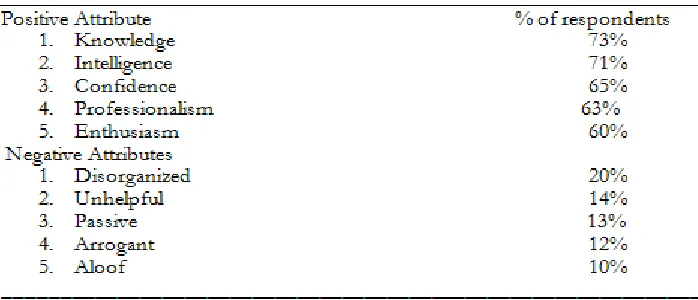
The negative attributes, which are not conducive to a supportive learning environment, were ranked much lower than the positive attributes. This denotes students generally have a favorable perception of faculty in general at their university.
Table 1: Rank Order for the Top 5 Attributes for Instructors in General
Table 2 presents the results for the top 5 attributes for male instructors and Table 3 presents the results for female instructors. As shown, a few of the attributes overlap for instructor in general (knowledge, confidence, intelligence, professionalism, enthusiasm, disorganized, unhelpful, arrogant, aloof, and passive), but only the negative attribute, disorganized, overlaps between the male and female instructors.
Table 2: Rank Order for the Top 5 Attributes for Male Instructors
More of the male attributes than the female attributes overlap with instructors in general.
Table 3: Rank Order for Top 5 Attributes for Female Instructors
Discussion
The results of this study indicate that professors in general have both positive and negative attributes that are traditionally considered more masculine. Professors in general are seen to have knowledge, intelligence, and confidence. These word choices are also found in the attributes associated with male instructors. Similarly, the negative word choice for instructors in general include disorganized, uncertain, passive, and arrogant. Except for passive, these words are associated with male instructors as well. Professional and enthusiasm are words used to describe instructors in general and female instructors.
As presented in the results, the characteristics used to describe male and female professors are very different. The women are seen as “accessible” whereas the men are defined by “leadership”. As Pease (1993) found, women’s work entails being accessible to students whereas men’s work entails solitude and intellectual work. Similarly, in support of Basow (1995), Basow (2000), and Anderson 2010, Bachen, McLoughlin& Garcia, (1999), the students in this study associated approachability, compassion (or kindness) with female instructors. The results of the current study support the hypothesis that students view male and female instructors differently. This also supports Miller and Chamberlin’s (2000) study which found men were viewed as professor while women were seen as teachers. Although they perform the same job (that of a university professor), men and women are seen by the students to bring different qualities to the job. This become highly problematic if a professor steps outside of the preconceived gender norms since promotion and tenure is based almost entirely on student evaluations. Students would be less likely to rate a female instructor as an effective teacher if she was not “kind” “professional” or did not take care of her appearance. The fact that students rate appearance for female professors is, by itself, extremely problematic.
Interestingly, the second hypothesis of the study, that female and male students would choose different attributes for female and male instructors was not supported. Basow (2000) found that caring qualities are more important for female students than for male students when evaluating faculty performance; however the current study failed to support this. The question is whether the attitudinal differences is likely to affect student evaluations of faculty and thereby affect their promotion and tenure status. The different attributes used does appear to speak to gender schemas and stereotypes when women instructors are rated for traditionally feminine characteristics like kindness or passive or more startling, rated on their appearance. While the results are interesting, there are several limitations to this study. Generalizability is a concern since the results are from a small liberal arts college on the west coast. Individuals in larger urban areas might have different perceptions. Additionally, the research only utilized 18 positive and negative characteristics. Perhaps a larger assortment of additives would yield different results.
Conclusion
.
The current study explored the perceptions students have of their university professors based on gender. It found that professors in general have both positive and negative attributes that are traditionally considered more masculine. The words associated with male instructors are likewise more masculine and those associated with female instructors are likewise more feminine. This suggests that we still have very socially contrived gender norms and perceptions of individuals and these perceptions are still very colored by gender expectations. Future research is encouraged.
References
Allen, H. L.1998. “Faculty workload and productivity: Gender comparisons”. In Almanac of higher education, 29–44. Washington, DC: National Education Association
Anderson, K.J. (2010). Students’ stereotypes of professors: an exploration of the double violations of ethnicity and gender. Social Psychology of Education.13(4) p 459-472.
Astin H. S., Bayer M.1973“Career profiles of women doctorates”, pp. 139–162 in Rossi A. S., Calderwood A. (eds.) Academic Women on the Move.New York: Russell Sage
Basow, S. A. (1995). Student evaluations of college professors: When gender matters. Journal of Educational Psychology, 87, 656-665.10.1037/0022-0663.87.4.656
Basow, S. A., & Silberg, N. T. (1987). Student evaluations of college professors: Are female and male professors rated differently? Journal of Educational Psychology, 79, 308-314.10.1037/0022-0663.79.3.308
Bellas, M. L. and Toutkoushian, R. K.1999. Faculty time allocations and research productivity: Gender, race and family effects.Review of Higher Education, 22(4): 367–390
Bernard, J. (1964).Academic Women. University Park, PA: Pennsylvania State University Press.
Brenner, O. C., Tomkiewicz, J., & Schein, V. E. (1989). The relationship between sex role stereotypes and requisite management characteristics revisited. Academy of Management Journal, 32 (3), 662-669.
Dodge, K. A., Gilroy, F.D., and Fenzel, L. M. (1995). Requisite Management Characteristics Revisited: Two decades later. Journal of Social Behavior and Personality, 10(6), 253- 264.
Garcia, S., Bachen, C. &McLoughlin M., (1999). Assessing the Role of Gender in College Students' Evaluation of Faculty, Journal of Communication Education, Volume 48, Issue 3.
Hart, J.L. and Cress, C.M. (2008) Are women faculty just “worrywarts?” Accounting for gender differences in self reported stress. Journal of Human Behavior in the Social Environment, 17(1-2), 175-193
Maceli, K. M., Fogliasso, C. E., Baack, D. E. (2011). Differences of Students' Satisfaction with
College Professors: The Impact of Student Gender on Satisfaction. Academy of Educational Leadership Journal, 15(4), 35-45.
Miller, J., & Chamberlin, M. (2000). Women Are Teachers, Men Are Professors: A Study of
Student Perceptions. Teaching Sociology,28(4), 283-298. Retrieved from http://www.jstor.org/stable/1318580 Monroe, K., Ozyurt, S., Wrigley, T. and Alexander, A. (2008) Gender Equality in Academia:
Bad News from the Trenches, and Some Possible Solutions. Perspectives on Politics, 6, 215-233.http://dx.doi.org/10.1017/S1537592708080572
Pease, J. (1993). Professor mom: Women’s work in a man’sworld.Sociological Forum(1993) 8 (1) p.133-139.doi:10.1007/BF01112334
Renwick Monroe, K. and Chiu, W.F. (2010). Gender equality in the academy: The pipeline problem. The Profession 43(2). Pp303-308. DOI: https://doi.org/10.1017/S104909651000017X
Schein, V. E. (1973). The relationship between sex role stereotypes and requisite management characteristics. Journal of Applied Psychology, 57, 95-100.
Schein, V. E. (1975). Relationships between sex role stereotypes and requisite management characteristics among female managers. Journal of Applied Psychology, 60, 340-344
Tomkiewicz, J. (1999). Comparing middle manager perceptions of white and African Americans: Thirty-eight to zero. International Journal of Management, 16, (3), 324-330.
Tomkiewicz, J. & Adeyemi-Bello, T. (1997). Perceptual differences in racial descriptions of Euro-American and Hispanic persons, Psychological Reports, 80, 1339-1343.
Tomkiewicz, J. and Bass, K. (2008). Attitudes of business students toward management generation cohorts. North American Journal of Psychology, 10(2). P 435.
Tomkiewicz, J., & Brenner, O.C. (1996). The relationship between race (hispanic) stereotypes and requisite management characteristics, Journal of Social Behavior and Personality, 11, (3), 511-520.
Tomkiewicz, J., Adeyemi-Bello, T., & Brenner, O.C. (1998). The impact of perceptions and stereotypes on the managerial mobility of African Americans. The Journal of Social Psychology, 138 (1), 88-92.
U.S. Department of Education, National Center for Education Statistics. (2016). Status and Trends in the Education of Racial and Ethnic Groups 2016 (NCES 2016-007),
Van den Brink, Marieke and Benschop (2012) Yvonne Slaying the Seven-Headed Dragon: The