ISSN: 2333-6080(Print), 2333-6099(Online) Copyright © The Author(s). 2014. All Rights Reserved. Published by American Research Institute for Policy Development DOI: 10.15640/jmm.v2n3-4a4 URL: http://dx.doi.org/10.15640/jmm.v2n3-4a4
Constructing a Consumption Model for Malaysian Consumers
Yaty Sulaiman1, Nik Kamariah Nik Mat2 & Noor Hasmini Abd Ghani3
Abstract
The objective of this research is to construct a consumption model for Malaysian consumers. The research is important for Malaysian national agenda, especially, in achieving a societal integrity, social cohesion, the vision of 2020, and developed country per capita income, with the slogan of “1 Malaysia, People First, Performance Now”. The consumption pattern of Malaysian consumers has changed markedly since 2005 as shown by several indicators such as consumer price index (CPI), per capita income and inflation rate. The per capita income for Malaysia has risen but at a very slow pace. It was USD5372 in 2005 and at the end of 2013 it has amplified to USD6765, a rise of 26 per cent. Therefore, Malaysia has to work harder by 121 percent to achieve the 2020 target of USD15,000 per capita income. Furthermore, as compared to per capita income of the consumers, the rise in consumer prices was incomparable. The consumer price index (CPI) increased from 95.4% in year 2000 to 122.8% in 2013. This implies that the consumer have to pay a higher price for purchase of consumer products nowadays. It has been a source of dissatisfaction among consumers. The price hike was triggered by a few factors such as the increase of the oil palm, rubber and fuel prices.
Keywords: Consumption pattern, consumer life style, consumer value, consumer
motive, and consumer preference
1.0 Introduction
The consumption pattern of Malaysian consumers is changing drastically in recent years. This can be observed from the consumer price index which indicates a steady rise from 95.4% in year 2000 to 122.8% in 2013. This implies that the consumer have to pay a higher price for purchase of consumer products.
1School of Business Management (SBM), College of Business (COB), Universiti Utara Malaysia, 06010 Sintok, Kedah, Malaysia.
Email: [email protected], Tel: (006) 0194496372
2Othman Yeop Abdullah Graduate School of Business (OYA GSB), Universiti Utara Malaysia, 06010 Sintok, Kedah, Malaysia. 3
Hence, the objective of this research is to construct a consumption model for Malaysian customers.Importance to National Agenda, societal integrity, social cohesion, achieved the vision of 2020, developed country per capita income, “1 Malaysia, People First, Performance Now”.
2.0 Problem Statement
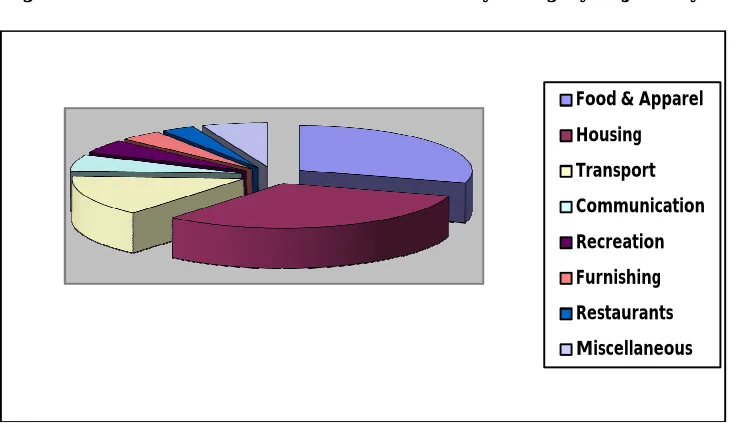
Table 1: The Consumer Price Index Increase by Category in January 2014
Categories Consumer Price Index
increase
Food and non-alcoholic beverages 30 Housing, water, electricity, gas and other
fuel
23
Transport 15
Communication 6
Recreation and culture
Furnishings, household equipment and routine household maintenance
Restaurants and hotels
Miscellaneous goods and services
5
4
3.2
6.3
Sources: Malaysia Inflation Rate.htm, retrieved on March 3, 2014
Figure 1: The Consumer Price Index Increase by Category in January 2014
Source: Malaysia Inflation Rate.htm, retrieved on March 3, 2014
3.0 Hypotheses
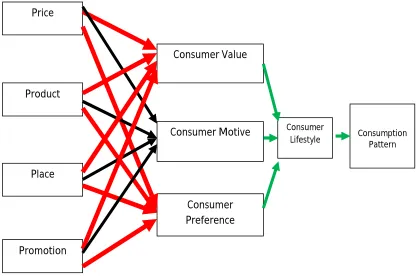
H1. Consumer life style is a direct predictor of consumption pattern. H2. Consumer value is a direct predictor of consumer life style. H3. Consumer motive is a direct predictor of consumer life style. H4. Consumer preference is a direct predictor of consumer life style. H5. Price is direct predictor of consumer value.
H6. Product is a direct predictor of consumer value. H7. Place is a direct predictor of consumer value. H8. Promotion is a direct predictor of consumer value. H9. Price is direct predictor of consumer motive. H10. Product is a direct predictor of consumer motive. H11. Place is a direct predictor of consumer motive. H12. Promotion is a direct predictor of consumer motive. H13. Price is direct predictor of consumer preference. H14. Product is a direct predictor of consumer preference. H15. Place is a direct predictor of consumer preference. H16. Promotion is a direct predictor of consumer preference.
H17. Consumer life style mediates the relationship between consumer value and consumption pattern.
H18. Consumer life style mediates the relationship between consumer motive and consumption pattern.
H19. Consumer life style mediates the relationship between consumer preference and consumption pattern.
H20. Consumer value mediates the relationship between price and consumer life style. H21. Consumer value mediates the relationship between product and consumer life
style.
H22. Consumer value mediates the relationship between place and consumer life style.
H23. Consumer value mediates the relationship between promotion and consumer life style.
H24. Consumer motive mediates the relationship between price and consumer life style.
H25. Consumer motive mediates the relationship between product and consumer life style.
H26. Consumer motive mediates the relationship between place and consumer life style.
H27. Consumer motive mediates the relationship between promotion and consumer life style.
H28. Consumer preference mediates the relationship between price and consumer life style.
H30. Consumer preference mediates the relationship between place and consumer life style.
H31. Consumer preference mediates the relationship between promotion and consumer life style.
4.0 Literature Reviews
4.1 Consumer Consumption Pattern
Consumption pattern is defined as the way of using, eating, or drinking something, or the amount that is used or the amount that is bought and used. Some examples are consumption of fuel/energy, consumption of fruit and vegetables, consumption of junk food, domestic/home consumption (Cambridge Business Dictionary
http: //dictionary.cambridge.org/dictionary/business-english/consumption, retrieved on March 12, 2014). Ironically, most marketing textbooks fail to define consumption pattern under the consumer behavior section. Alternatively, Alayew (2009) define consumption pattern as an estimate of consumption of household within one week period. Presumably, consumers are individuals who buy products or services for personal use and not for manufacture or resale. A consumer is someone who can make the decision whether or not to purchase an item at the store, and someone who can be influenced by marketing and advertisements. Any time someone goes to a store and purchases a toy, shirt, beverage, or anything else, they are making that decision as a consumer (http://www.investorwords.com, retrieved March 12, 2014).
On top of that, the government intends to impose Goods and Services Tax in 2015 as another burden on consumers. Hence, this study intends to solicit the perceptions of consumers on the price increased of important products and services.
4.1.1 Consumer Consumption Pattern Models
Past studies has shown scarcity in the development of a model in consumption pattern for Malaysian consumers (Munusamy & Hoo, 2008; Hawkins, Roupe and Coney, 1981; Veenma, Kistemaker, Lowik & Hulshof 1995). Only two studies have modelled a consumption pattern model which was conducted in United States and Holland (Hawkins, Roupe and Coney, 1981; Veenma et al., 1995). One of the models suggested that predominate consumption pattern is predicted by predominate consumer lifestyle, use situations consumers face, predominate value, motive and preference system, physical landscape and psychological landscape (Hawkins et al., 1981). Similarly, Veenma et al., (1995) proposed a consumption model for convenience food usage in Holland, which suggest the antecedents of food usage as lifestyle, degree of urbanization, personal and family situation, nutritional knowledge, quality conscious, weight conscious, health conscious, and socio-economic status. Alternatively, Munusamy and Hoo, (2008) only examine 4Ps as the direct antecedents (price, product, place and advertising) of consumer motive in three Tesco Stores in Klang Valley, Malaysia.
Based on the above discussion, this study integrates the three consumption pattern models to formulate a new conceptual framework for this study as in Figure 2 (Hawkins et al., 1981 and Munusamy and Hoo, 2008).
4.2 The Antecedents of Consumer Consumption Pattern
Finally, the antecedents of consumer motive are price, product, place and advertising (Munusamy & Hoo, 2008). For this study, the selected direct antecedents of consumption pattern is consumer lifestyle, indirect factors (mediators) are consumer value, consumer motive and consumer preference and four exogenous variables (price, product, place and advertising).
4.3 Consumer Lifestyle
Consumer life style is defined as entity that purchases and uses products and services for the purpose of individual or household consumption. In other words, consumer life style is referred to a way of living that influences and is reflected by one’s consumption behavior (Bin & Dowlatabadi, 2005).
4.4. Consumer Value
Consumer value is defined as a low price, whatever he or she wants in a product, the quality he or she gets for the price they pay, and what he or she gets for what they give (Zeithaml, 1988). Kahle (1996) recommends that consumer value is refer to people experiences and learning process.
4.5. Consumer Motive
Consumer motive is defined as internal impulses which simulated initiate some type of responses. In other words, consumer motive contribute to the drivers of behavior that bring consumers to the retail store (Duncan, 2005).
4.6 Consumer Preference
4.7. Marketing Mix (4Ps)
Kotler and Amstrong (2006) defined marketing mix as 4P’s namely the price, product, place, promotion. Marketing mix is designed to influence consumer decision-making and lead to profitable exchanges (Peter & Donnelly, 2007). In other words, the marketing mix is the set of marketing tools which used by organizations to pursue their marketing objectives in the target market (Munusamy & Hoo, 2008).
4.7.1 Price
According to Campbell (2009), the definition of price can be divided into two: from the marketing manager’s perspective and from the consumer’s perspective. From the marketing manager’s perspective, the price is what the consumer is willing to pay for the value of the bundle of attributes offered and is what produces the resources that cover all of the other activities of the firm. In contrast, from the consumer’s perspective, the price represents what the consumer must sacrifice to gain the value of the bundle of attributes in the product offering. In other words, price can mean more to consumers than just a monetary exchange of value.
4.7.2 Product
Kotler and Armstrong (2006) define a product as anything that can be offered to a market for attention, acquisition, use, or consumption that might satisfy a want or need. Ferrell (2005) defined the product as the core of the marketing mix strategy in which retailers can offer consumers symbolic and experiential attributes to differentiate products from the competitors. In addition, Borden (1984) identified product as a thing about quality, design, features, brand name and sizes.
4.7.3 Place
4.7.4 Promotion
Promotion is defined as sales promotion, advertising, personal selling, public relations and direct marketing (Borden, 1984). Meanwhile, Duncan (2005) defined promotion as the key to the market exchange process that communicates with present and potential stakeholders, and the general public. Hakansson (2005) stated that promotion appears as an issue of how to create an optimal mix of marketing communication tools in order to get a product’s message and brand from the producer to the consumer.
Figure 2: The Conceptual Framework
Price
Product
Place
Promotion
Consumer Value
Consumer Motive
Consumer Preference
Consumer
5.0 Research Methodology
Two research designs will be utilized: qualitative and quantitative approaches. The qualitative approach will interview 20-30 producers of main products/services: (Food: [sugar, rice, poultry, meat & vegetables] and Clothing; Housing: [water, electricity, and gas]; transport (fuel); communication; recreation, furnishing & household) restaurant and hotel; related government agencies (Ministry of Domestic Trade & Consumer Affair; Ministry of International Trade and Industry, Agriculture agencies; related non-government agencies (Consumer Associations, Institute of Marketing Malaysia, Association of Breeder Malaysia). For quantitative method, the unit of analysis is the consumer. This study approaches the respondents in two specific geographic segments i.e. rural and urban segments (Hawkins, Roupe, & Coney, 1981). The sampling frame is four states (Kedah, Kelantan, Selangor, and Kuala Lumpur) in Malaysia with the population of about 10.62 millions. The sample size from each state is 200 respondents, totaling sample size of 800 (200x4) (Table 2). We will take rural consumers from two states (Kelantan, and Kedah) and urban consumers in two states in urban areas (Selangor and Kuala Lumpur). The measurements of the variables are adapted from past instruments (price, product, place, advertising, consumer value, consumer motive, consumer preference, consumer lifestyle, and consumption pattern) (Table 3). The analysis methods for qualitative will be N-Vivo and quantitative will be Multiple Analysis of Variance (MANOVA, discriminant analysis) and structural equation modeling (SEM).
Table 2: The Sample Size
State Population (Millions) Sample Size
Kedah Kelantan Kuala Lumpur Selangor
1.95 1.54 1.67 5.46
200 200 200 200
5.1 Data Collection Method
5.2 Measurements
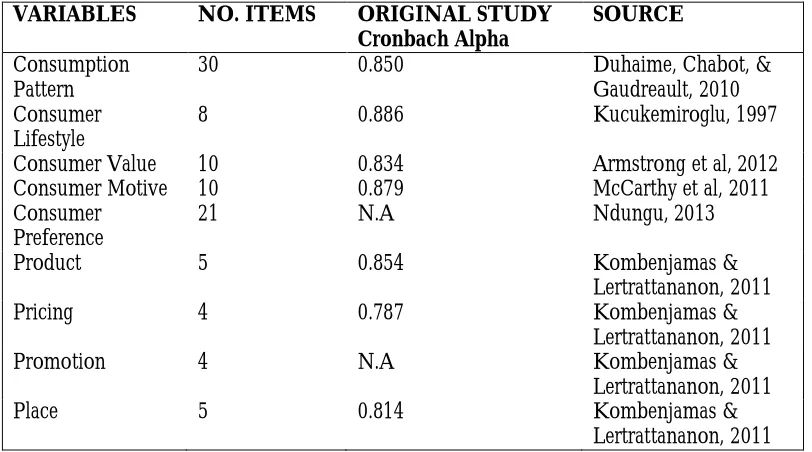
All measurement scales for variables are obtained from existing developed scales as summarized in Table 3. All variables will be measured using 7-point Likert scale from 1-strongly disagree to 7-strongly agree.
Table 3: Measurement (Instruments)
VARIABLES NO. ITEMS ORIGINAL STUDY
Cronbach Alpha
SOURCE
Consumption Pattern
30 0.850 Duhaime, Chabot, &
Gaudreault, 2010 Consumer
Lifestyle
8 0.886 Kucukemiroglu, 1997
Consumer Value 10 0.834 Armstrong et al, 2012
Consumer Motive 10 0.879 McCarthy et al, 2011
Consumer Preference
21 N.A Ndungu, 2013
Product 5 0.854 Kombenjamas &
Lertrattananon, 2011
Pricing 4 0.787 Kombenjamas &
Lertrattananon, 2011
Promotion 4 N.A Kombenjamas &
Lertrattananon, 2011
Place 5 0.814 Kombenjamas &
Lertrattananon, 2011
6.0 Significance of the Study
1. Consumption pattern is a very important issue for consumers because it benefits National Agenda in caring for public consumer needs.
2. The output of this study could assist policy makers to formulate new consumption pattern model to enhance consumption pattern among the consumers from rural areas and urban areas in Malaysia.
7.0 Conclusion
The focus of this study is in the food and non-alcoholic beverages, housing, utilities and transportation. In Malaysia, the most important categories in the increase of consumer price index are food and non-alcoholic beverages (30 percent of total weight) and housing, water, electricity, gas and other fuels (23 percent of total weight) and transport (15 percent).
References
Armstrong, R., Vaal, N. D., Reynolds, J., Taylor, S., Wilson, J., Boggs, M., McLeod, B., &Ketcheson, L. (2012).Measuring customer value and satisfaction for parks and recreation: A manual. Parks and Recreation Ontario, 1-26.
Berman, B. (1996). Marketing channels. United States: John Wiley & Sons.
Bin, S., &Dowlatabadi, H. (2005). Consumer lifestyle approach to US energy use and the related CO2 emissions.Energy Policy, 33, 197-208.
Borden, N. H. (1984). The concept of marketing mix.Journal of Advertising Research, 1(9), 2-7.
Cambridge Business Dictionary, http://dictionary.cambridge.org/dictionary/business-english/consumption, retrieved on March 12, 2014.
Campbell, M. C. (1999). Pricing strategy & practice: “Why did you do that?” The important role of inferred motive in perceptions of price fairness. Journal of Product & Brand Management, 3 (2), 145-152.ternational Energy Conference, 1-8.
Duncan, T. (2005).Principle of advertising & IMC (2nd Ed.). New York: McGraw-Hill.
Ferrell, O. C., & Michael, H. D. (2005).Marketing strategy (3rd Ed.).Ohio:South-Western
Thomson.
Hakansson, H. ,&Waluszewski. (2005). Developing a new understanding of markets: Reinterpreting the 4Ps. Journal of Business & Industrial Marketing, 20 (3), 110-117. Hawkins, D. I., Roupe, D., & Coney, K. A. (1981).The influence of geographic subcultures in
the United States. NA-Advances in Consumer Research, 8, 713-717. http://www.investorwords.com, retrieved March 12, 2014.
Kahle, L. R. (1996). Social values and consumer behaviour: Research from the list of values, in Vigaray, M., D. J., &Hota, M. Schwartz values, consumer values and segmentation: The Spanish fashion apparel case. Lille Economie& Management, 1-31.
Malaysia Inflation Rate.htm, retrieved on March 3, 2014.
Munisamy, J., &Hoo, W. C. (2008). Relationship between marketing mix strategy and consumer motive: An empirical study in major Tesco stores. Unitar E-Journal, 4 (2), 41-55.
Veenma, K. S., Kistemaker,, C., Lowik, M. T. H., & Hulshof, K. F. A. M. (1995). Socio-demographic, psycho-social and lifestyle factors affecting consumption of convenience food. E-European Advances in Consumer Research, 2, 149-156. www.tradingeconomics.com, retrieved March 12, 2014.