Iran University of Medical Sciences
____________________________________________________________________________________________________________________
1. MSc, Department of Biostatistics, School of Public Health, Hamadan University of Medical Sciences, Hamadan, Iran.
2. PhD, Department of Biostatistics, School of Public Health, Modeling of Noncommunicable Disease Research Canter, Hamadan University of
Medical Sciences, Hamadan, Iran. [email protected]
3. (Corresponding author) PhD, Department of Biostatistics, School of Public Health, Modeling of Noncommunicable Disease Research
Can-ter, Hamadan University of Medical Sciences, Hamadan, Iran. [email protected]
4. MD, Department of Gynecology, Hamadan University of Medical Sciences, Hamadan, Iran. [email protected]
A two-component Bayesian mixture model to identify implausible
gestational age
Maryam Mohammadian-Khoshnoud1, Abbas Moghimbeigi2, Javad Faradmal*3
Mahnaz Yavangi4
Received:25 November 2015 Accepted:2 July 2016 Published:7 November 2016
Abstract
Background:Birth weight and gestational age are two important variables in obstetric research. The primary measure of gestational age is based on a mother’s recall of her last menstrual period. This recall may cause ran-dom or systematic errors. Therefore, the objective of this study is to utilize Bayesian mixture model in order to identify implausible gestational age.
Methods: In this cross-sectional study, medical documents of 502 preterm infants born and hospitalized in Hamadan Fatemieh Hospital from 2009 to 2013 were gathered. Preterm infants were classified to less than 28 weeks and 28 to 31 weeks. A two-component Bayesian mixture model was utilized to identify implausible ges-tational age; the first component shows the probability of correct and the second one shows the probability of incorrect classification of gestational ages. The data were analyzed through OpenBUGS 3.2.2 and 'coda' pack-age of R 3.1.1.
Results: The mean (SD) of the second component of less than 28 weeks and 28 to 31 weeks were 1179 (0.0123) and 1620 (0.0074), respectively. These values were larger than the mean of the first component for both groups which were 815.9 (0.0123) and 1061 (0.0074), respectively.
Conclusion:Errors occurred in recording the gestational ages of these two groups of preterm infants included recording the gestational age less than the actual value at birth. Therefore, developing scientific methods to cor-rect these errors is essential to providing desirable health services and adjusting accurate health indicators.
Keywords:Gestational age, Birth weight, Bayesian, Mixture model.
Cite this article as:Mohammadian-Khoshnoud M, Moghimbeigi A, Faradmal J, Yavangi M. A two-component Bayesian mixture model to identify implausible gestational age.Med J Islam Repub Iran2016 (7 November). Vol. 30:440.
Introduction
Birth weight and gestational age are two important features in prenatal research. These factors have an important role in computing health indicators and adopting health policies. We can almost always trust the accuracy of birth weight, but the accu-racy of gestational age, especially if report-ed basreport-ed on the last menstrual period (LMP) can be doubted (1-7). Premature birth or preterm birth refers to birth before the 37th week of pregnancy (8). The
preva-lence of this phenomenon is different in
various regions and is reported between 5% to 10% (9,10). According to studies per-formed in Iran, the prevalence of premature is reported to be 5.6% in Qom, 7% in Zan-jan and 14.7% in Shiraz’s high risk group and 3.1% in its low risk group (11-13). In-fants born based on their gestational age require different treatments. Therefore, de-termining the gestational age of infants is the best health indicator in this critical pe-riod of their life (14). Hertz et al reported that LMP can be trusted only in 18% of women (15). Some reasons for this
tainty include oligomenorrhea, intrauterine hemorrhage etc. (16). Furthermore, illit-erate women cannot record their LMP date and cannot calculate the gestational age of their fetus (17). According to the men-tioned reasons, using LMP can lead to ran-dom and systematic errors (18-21). In addi-tion to LMP, ultrasound, uterine evaluaaddi-tion, fetus movement and uterine height meas-urement are used to determine the gesta-tional age (22). The error of gestagesta-tional age determination using bimanual examination of uterine height is ±2 weeks (23). Uterine height measurement in the second and third trimester show 8 weeks of change in gesta-tional age (24). The ultrasound error for determining gestational age in the first and second trimester is about 3 to 5 days (22). While this method is more accurate in measuring the gestational age in the first and second trimester of pregnancy, the ac-curacy of ultrasound is not reliable in the third trimester (25). Accurate estimation of gestational age is important and essential to women’s health in all conditions. For in-stance, the antenatal test interpretation may depend on the gestational age. Especially, the rate of ɑ-fetoprotein in the amniotic flu-id and the maternal serum depend on the gestational age (26). Also, the wrong classi-fication of term delivery as preterm deliv-ery increases the rate of infant survival un-realistically in low gestational ages (27).
If the recorded birth weight is not con-sistent with gestational age, cut-off points, a simple method for identifying gestational ages, is utilized (3,7). Utilizing cut-off points is administratively easy, but this method does not accurately control the er-rors since it is based on clinical information and judgment and depends on the clinical characteristics of society which may not be applicable to all societies (28). On the other hand, removing weights that are far from cut-off points leads to truncated distribution of birth weight and data loss (29).
The mixture model is a new method for identifying implausible gestational ages which does not result in data loss (28,30-32). Since in earlier reported gestational
ages, the distribution of birth weight in-stead of being curved or symmetrical is of-ten skewed to the right or bimodal. There are techniques such as numerical methods, EM algorithm and Bayesian approach for parameter estimation in the normal mixture model. According to studies, compared to the others, Bayesian technique results are more acceptable (34). Therefore, Bayesian mixture models are plausible candidates for identifying implausible gestational ages. Oja et al., provided a three-component mix-ture model in order to model the distribu-tion of birth weight (30). Their method was able to diagnose the errors in one menstrual cycle. Platt et al used a two-component mixture model in order to study deliveries with misreported gestational ages (28). Tentoni et al. also used a two-component mixture model for identifying implausible gestational ages (32). While there are many studies considering identification of im-plausible gestational ages, a search in pub-lished literature shows that there are no studies in Iran considering this issue. Con-sequently, the objective of this study is to identify implausible gestational ages in pre-term infants using Bayesian mixture model.
Methods
This study was a cross-sectional research, the study population was all the preterm infants (based on LMP) born in Hamadan Fatemieh Hospital from 2009 to 2013. Hamadan Fatemieh Hospital is the most important center for gynecology and deliv-ery in Hamadan province, west of Iran. Pre-term infants refer to those born before the end of 37th week of pregnancy which
ac-cording to Cunningham et al include infants with the following gestational ages: ex-tremely preterm (less than 28 weeks), very preterm (between 28 to 32 weeks), moder-ately preterm (between 32 to 34 weeks), late preterm (between 34 to 36 weeks) (8). Data were collected from hospital files of all preterm infants during the above men-tioned years.
The inclusion criteria were identifying the infant as preterm (37 weeks or less
tional age) and not being a twin. All twin infants (192 infants) and multiple births (48 infants) and infants who did not have a rec-orded gestational age (17 infants) were ex-cluded from the study. As a result, from 759 preterm infants, only 502 were includ-ed in the study.
In order to extract the necessary infor-mation from infant records, a checklist was designed with the following variables: du-ration of infant hospitalization, reason of hospitalization, mother’s age, gestational age, weight, height, head circumference, the first and the fifth minutes Apgar score, gender, number of infants, type of delivery, fatality reasons (if the infant dies), blood type, mother’s number of deliveries, num-ber of stillborn and previous abortions.
Data analysis
In this study, two-component Bayesian mixture model was used to identify implau-sible gestational age. According to previous research, a combination of gestational age and birth weight information was used to identify implausible gestational age (29). Therefore, infants were classified into 4 groups of less than 28 weeks, 28 to 32 weeks, 32 to 34 weeks and 34 to 36 weeks based on their gestational ages. Then in each group, a Bayesian mixture model was fitted on birth weight. In a homogenous population, it is assumed that the distribu-tion of birth weight is normal, but because of recording/recalling error, a two compo-nents mixture of normal distribution was assumed for birth weight. So, the probabil-ity densprobabil-ity function (PDF) of birth weight can be written as
f(y) = ∏ π . f yμ , σ ( )
wheref y μ , σ shows the normal PDF of each birth weight component, Z=1 or 2, a latent variable following binary distribu-tion with Pr(Z = j) = π and π j=1, 2 is the component weight or mixing proportion so that ∑ π = 1. It is assumed that one component indicate infants with correctly
recorded gestational age and the other one, infants with erroneously reported gestation-al age.
Parameters estimation of birth weight dis-tribution were carried out using Baysian method. Normal and inverse gamma were used as prior distributions for the mean and variance of each component of birth weight distribution, respectively. Also, Beta distri-bution, the conjugate of binary distridistri-bution, was used as the prior of Z. The posterior distribution of the unknown parameters were sampled using Markov chain Monte Carlo (MCMC) algorithm. The conver-gence of MCMC algorithm was evaluated by Geweke, Gelman-rubin and Raftery and Lewis convergence diagnostics (33). In or-der to produce almost independent samples from prior distribution of parameters, one of the methods is to execute the Markov chain Monte Carlo algorithm for a long time and then we can reduce the effect of the convergence between samples. The Bayesian mixture model with introduced priors is converged to posterior distribution with 20000 repetitions (10000 burn-ins and with lag of 20). The data were analyzed through OpenBUGS software 3.2.2 and 'coda' package of R software 3.1.1.
Results
From among the five years considered in this study, the largest number of births be-longed to 2012 with 131 infants (26.1%) and the smallest number of births belonged to 2010 with 62 infants (12.4%). According to Table 1, the number of preterm boys is more than the preterm girls. The largest number of preterm girls belonged to 2012 and the smallest number of preterm girls belonged to 2010. The preterm infants born during the studied period included 243 girls (48.4%) and 259 boys (51.6%).
Forty two percent of the infants were the first born to their mothers. From all the pre-term infants, 47.2% died in the hospital, 49.6% were discharged from the hospital after successful treatment and the rest were transferred to other hospitals or discharged with personal content. The age of mothers
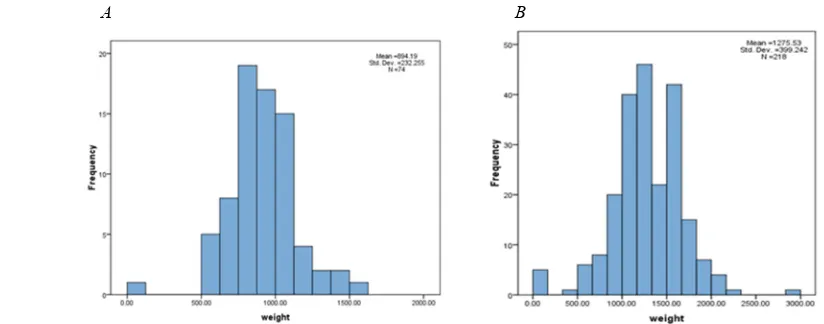
at delivery was 14 to 50 years with mean (SD) of 27.09 (7.68) and 13% of mothers were under 20 years. According to Table 2, the largest number of preterm infants be-longed to 28 to 31 weeks gestational age and the smallest number belonged to 21 to 27 weeks gestational age. The smallest birth weight was 450 gr and with increasing in gestational age, there was an increase in the average birth weight (Table 2).
In this study, the identifiability of all ges-tational age was considered for the estima-tion of parameters and since this capability was not present in the third and fourth groups, 32 weeks gestational age and high-er whigh-ere removed from the study. Thhigh-erefore, the probability of implausible gestational age was considered for two groups of 21 to 27 weeks and 28 to 31 weeks. For both groups, the Bayesian mixture model gesta-tional age converged to a posterior
distribu-tion.
From PDF plot and histogram of birth weight in the pre-specified gestational ages, it is clearly observable that in each group of gestational age, two components are detect-able (Figs. 1 and 2). The mean of the first component has very small difference from the mean of the second one for infants with 21-27 gestational age (Fig. 2a) but this dif-ference is relatively of bigger size for in-fants with 28-31 gestational age (Fig. 2b). Table 3 reports the parameter estimates of Bayesian mixture model and confirm these findings.
Table 3 reveals that about three fourth of the recorded gestational ages between 21 to 27 weeks are plausible and in the second group, 28-31 weeks gestational age, only about 56% of the gestational ages are plau-sible. These results indicate that accuracy decrease with increasing of gestational ages.
Table 1. Frequency of infants' gender by the year Gender
Year Male
N (%) FemaleN (%) N (%)Total
2009 66 (51.6) 62 (48.4) 128 (100)
2010 30 (48.4) 32 (51.6) 62 (100)
2011 34 (49.2) 35 (50.8) 69 (100)
2012 71 (54.4) 60 (45.6) 131 (100)
2013 58 (51.8) 54 (48.2) 112 (100)
total 259 (51.6) 243 (48.4) 502 (100)
Table 2. Infants' birth weight (gr) in different gestational age groups SD Mean
Maximum Minimum
N (%) Gestational age group
232.25 894.19
1600 500
74 (15) 21 to 27 weeks
399.24 1275.5
2950 450
218 (43) 28 to 31 weeks
442.32 1700.3
2500 600
118 (24) 32 to 33 weeks
506.39 2256.1
3800 1000
92 (18) 34 to 36 weeks
A B
Fig. 1. The histogram of birth weight (gr) for (a) 21-27 and (b) 28-31 weeks gestational age of infants born in Fatemieh Hospital of Hamedan during 2008 to 2013.
Discussion
Erroneous recording of gestational age may be the result of unknowing the correct date or wrong recall of LMP. Several stud-ies consider the identification of implausi-ble gestational ages using mixture models. In this study, which is inspired by the work of Zhang et al, the Bayesian mixture model was used to identify the proportion of im-plausible gestational ages. This method was used for two groups introduced in the mate-rials and methods section.
Joseph et al considered four different cut-off point methods to remove the implausi-ble gestational ages (35). These methods cause to different proportion of implausible gestational ages detection from about 0.09% using ±4 standard deviation method to about 40% using Tukey’s rule. Also, ac-cording to the experts’ opinion method, no gestational age was implausible regarding to related weight. These four method detect a smaller proportion of gestational as im-plausible compared to the Bayesian mixture model that was used in the current study. This finding is consistent with other studies that were used mixture models (29). Ac-cording to the Joseph’s study, in all four different cut-off point methods, the number of implausible gestational age increases with increase in recorded gestational age. This finding is in concordance with the
cur-rent study's result. Also, in the study by Zhang et.al, the percentage of correctly recorded age for infants with 23 to 27 weeks of gestational age is more than 80% and this percentage reduced for infants with 28-31 weeks gestational age (29). These findings are close to that achieved in this study where the percentage of correctly recorded age in the first group is about 74% and this percentage is more than the second group. Overall, the model shows that the misspecification of the gestational age less than the true value occurred for relatively vast majority of infants.
Although a two-component Bayesian mixture model was fit in the current study, a method with more components (if neces-sary) can be used to identify implausible gestational ages. On the other hand, each component of the model has a normal dis-tribution, this restriction may be questiona-ble, especially in lower gestational ages. As a solution, one may use distribution-free models. These models present a flexible distribution for erroneously reported gesta-tional ages. Wilcox and Russell suggest a two-component mixture distribution (36). One component includes “predominant dis-tribution” which has normal distribution. The second component includes a “residual distribution” which has no specified form. Ultimately, the objective of this study was
A B
Fig. 2. The estimated PDF of birth weight (gr) for (a) 21-27 and (b) 28-31 weeks gestational age of infants born in Fatemieh Hospital of Hamedan during 2008 to 2013.
Table 3. The estimated mean of birth weight (gr), standard deviation and mixing proportion for the Bayesian mixture model Gestational age group Component Mean Standard deviation Mixing Proportion Credible interval
21 to 27 weeks First
Second 815.91179 0.01230.0123 0.740.26 1039 - 1171766 - 846
28 to 31 weeks First
Second 10611620 0.00740.0074 0.560.44 1030 - 10911583 - 1656
only to identify implausible gestational ag-es and correcting the probably misreported gestational ages can be the subject of the future studies.
Conclusion
This study demonstrate that the errors oc-curred in specification/recording the gesta-tional ages of preterm infants less than the true values include a vast majority of gesta-tional ages. Therefore, correcting the sys-tem of recording and developing scientific methods to correct these gestational ages is essential to providing suitable health ser-vices and adjusting accurate health indica-tors.
Acknowledgments
This article was extracted from the MSc dissertation of the second author and sup-ported by Hamadan University of Medical Sciences. We are grateful to personnel of Fatemieh Hospital of Hamadan for their corporation.
Conflict of interest
All authors declare that they have no sig-nificant competing interests.
Funding
This study was funded by the Vice-chancellor of Research and Technology of Hamadan University of Medical Sciences (grant number 9304242121).
References
1. Alexander G, Wingate M, Bader D, Kogan M. The increasing racial disparity in infant mortality rates: composition and contributors to recent US trends. Am J Obstet Gynecol 2008;198(1):51-e1.
2. Ananth C, Joseph K, Oyelese Y, Demissie K, Vintzileos A. Trends in Preterm Birth and Perinatal Mortality Among Singletons: United States, 1989 Through 2000. Obstet Gynecol 2005;105(5, Part 1):1084-91.
3. Butler AS, Behrman RE. Preterm Birth: Causes, Consequences, and Prevention: National Academies Press; 2007.33.
4. Schempf AH, Branum AM, Lukacs SL, Scho-endorf KC. The Contribution of Preterm Birth to the Black–White Infant Mortality Gap, 1990 and 2000. Am J Public Health 2007;97(7):1255-60.
5. Swamy GK, Stbye T, Skjærven R. Association of Preterm Birth With Long-term Survival, Repro-duction, and Next-Generation Preterm Birth. JAMA 2008;299(12):1429-36.
6. Tolson GC, Barnes JM, Gay GA, Kowaleski JL. The 1989 revision of the U.S. standard certificates and reports. National Center for Health Statistics. Vital Health Stat 1991;4(28):1-34.
7. Zwicker JG, Harris SR. Quality of Life of For-merly Preterm and Very Low Birth Weight Infants From Preschool Age to Adulthood: A Systematic Review. Pediatrics 2008;121(2):e366-e76.
8. Cunningham F, Gant N, Leveno K, Gilstrap L, Hauth J, W K. Williams obstetrics. 21st ed: New York: McGraw-Hill Companies; 2001.13.
9. Eliyahu S, Weiner E, Nachum Z, Shalev E. Ep-idemiologic risk factors for preterm delivery. Isr Med Assoc J 2002;4(12):1115-7.
10. Kaufman JS, Alonso FT, Pino P. Multi-level modeling of social factors and preterm delivery in Santiago de Chile. BMC Pregnancy Childbirth 2008; 8(1):46.
11. Khalaji Nia Z. Prevalence and Maternal Risk Factors of Preterm Laboring in Qom, 2007. Qom Univ Med Sci J 2011;5(1):30-6.
12. Rajaee Fard A, Mohammad Beigi A, Moham-madi M, Jolaee H, Alipour H. Evaluation of risk factors in preterm delivery and impact of education in its prevention. Daneshvar med 2010;17(86):11-8.
13. Sohrabi D, Ghanbari Gorkani M. A survey on Risk factors and outcomes of women with preterm labor admitted to Valieasr hospital in Zanjan. J Ur-mia Nurs Midwifery Fac 2011;9(2).
14. Pishva N, Madani A, Movahedi P. Determina-tion of gestaDetermina-tional age with ballard and dubowitz clinical methods incomparison with last menstrual period and sonographic findings in 1000 newborns. JMR 2003;1(4):54-9.
15. Hertz RH, Sokol RJ, Knoke JD, Rosen MG, Chik L, Hirsch VJ. Clinical estimation of gestational age: rules for avoiding preterm delivery. Am J Ob-stet Gynecol 1978;131(4):395-402.
16. MacGregor S, Sabbagha R. Assessment of Gestational Age by Ultrasound. women's med [In-ternet] 2008.
17. Raymond EG, Tafari N, Troendle JF, Clemens JD. Development of a practical screening tool to identify preterm, low-birthweight neonates in Ethio-pia. The Lancet 1994;344(8921):524-7.
18. Alexander GR, Allen MC. Conceptualization, measurement, and use of gestational age. I. Clinical and public health practice. J Perinatol 1995; 16(1):53-9.
19. Alexander GR, Himes JH, Kaufman RB, Mor J, Kogan M. A United States national reference for fetal growth. Obstet Gynecol 1996;87(2):163-8.
20. Kramer MS, McLean FH, Boyd ME, Usher RH. The validity of gestational age estimation by menstrual dating in term, preterm, and postterm gestations. JAMA 1988;260(22):3306-8.
21. Savitz DA, Terry JW, Dole N, Thorp JM, Siega-Riz AM, Herring AH. Comparison of preg-nancy dating by last menstrual period, ultrasound scanning, and their combination. Am J Obstet Gy-necol 2002;187(6):1660-6.
22. Kalish RB, Chervenak FA. Sonographic de-termination of gestational age. Ultrasound Rev Ob-stet Gynecol 2005;5(4):254-8.
23. Robinson HP, Cherevenak FA, Isaacson GC SC. Gestational age determination: first trimester. Ultrasound in Obstetrics and Gynecology Boston: Little, Brown and Company 1993:295-304.
24. Beazley JM, Underhill RA. Fallacy of the fundal height. BMJ 1970;4(5732):404-6.
25. Doubilet PM, Benson CB. Improved predic-tion of gestapredic-tional age in the late third trimester. J Ultrasound Med 1993;12(11):647-53.
26. Cowchock FS. Use of alpha-fetoprotein in prenatal diagnosis. Clin Obstet Gynecol 1976; 19(4):871-92.
27. David RJ. The quality and completeness of birthweight and gestational age data in computer-ized birth files. Am J Public Health 1980;70(9):964-73.
28. Platt RW, Abrahamowicz M, Kramer MS, Jo-seph KS, Mery L, Blondel B, et al. Detecting and eliminating erroneous gestational ages: a normal mixture model. Stat Med 2001;20(23):3491-503.
29. Zhang G, Schenker N, Parker J, Liao D. Iden-tifying implausible gestational ages in preterm ba-bies with Bayesian mixture models. Stat Med 2013;32(12):2097-113.
30. Oja H, Koiranen M, Rantakallio P. Fitting mixture models to birth weight data: a case study. Biometrics 1991;47(3):883-97.
31. Parker JD, Schenker N. Multiple imputation for national public‐use datasets and its possible ap-plication for gestational age in United States Natali-ty files. Paediatr Perinat Epidemiol 2007;21(s2):97-105.
32. Tentoni S, Astolfi P, Pasquale A, Zonta LA. Birthweight by gestational age in preterm babies according to a Gaussian mixture model. BJOG 2004;111(1):31-7.
33. Ntzoufras I. Bayesian Modeling Using Win-BUGS. New Jersey: John Wiley & Sons; 2009.448-449.
34. McLachlan G, Peel D. Finite Mixture Models. New York: John Wiley & Sons; 2000.175-220.
35. Joseph KS, Kramer MS, Allen AC, Mery LS, Platt RW, Wen SW. Implausible birth weight for gestational age. Am J Epidemiol 2001;153(2):110-3. 36. Wilcox AJ, Russell TL. Birthweight and peri-natal mortality: I. On the frequency distribution of birthweight. Int J Epidemiol 1983;12(3):314-8.