Research Paper:
The Effect of Knowledge of Result Feedback
Timing on Speech Motor Learning in Healthy Adults
Fatemeh Karimi1 , Majid Soltani1* , Mohammad Jafar Shaterzadeh Yazdi1 , Negin Moradi1 , Saman Shariari2 , Seyed Mahmoud Latifi3
1. Musculoskeletal Rehabilitation Research Center, Ahvaz Jundishapur University of Medical Sciences, Ahvaz, Iran.
2. Department of Language and French Literature, Faculty of Letters and Humanities, Shahid Chamran University, Ahvaz, Iran.
3. Diabetes Research center, Health Research Institute, Ahvaz Jundishapur University of Medical Sciences, Ahvaz, Iran.
* Corresponding Author: Majid Soltani, PhD.
Address: Musculoskeletal Rehabilitation Research Center, Ahvaz Jundishapur University of Medical Sciences, Ahvaz, Iran. Tel: +98 (916) 6148862
Objectives: The current study mainly aimed at studying the effect of Knowledge of Result (KR) feedback timing and result-estimation opportunity before receiving delayed KR on learning a new speech motor skill in monolingual healthy adults.
Methods: Thirty-nine Persian healthy adults were randomly divided into three groups. Each group received immediate KR, delayed KR (after eight seconds), or delayed KR (after eight seconds) with self-estimation of the result in the delay interval. All three groups received verbal KR feedback. Participants were trained to produce a French phoneme (/ɪn/) in the context of words in four training sessions. The correct production of the target phoneme was judged by a bilingual Persian-French examiner holding an academic degree in French language teaching. Later, a transfer test and two retention tests were administered. The two retention tests were administered one day and two weeks after the last training session respectively.
Results: The effect of feedback timing on motor performance and motor learning was examined by repeated-measures ANOVA. Performance in both acquisition and retention phases was significantly different between groups (P=0.04 for both phases). One-way ANOVA was used to investigate the transfer of learning (P=0.001). Tukey test results indicated that the groups 1 and 2 were different in both acquisition and retention phases and all three groups were different in transfer test.
Discussion: The results showed that the immediate KR is beneficial for the acquisition phase, and delayed KR is more beneficial for the retention and transfer tests compared with immediate KR.
A B S T R A C T
Article info:
Received: 07 Oct 2018
Accepted:23 Feb 2019
Available Online: 01 June 2019
Keywords:
Motor learning, Knowledge of results, Result estimation, Delayed feedback, Motor speech, Immediate feedback
Citation Karimi F, Soltani M, Shaterzadeh Yazdi MJ, Moradi N, Shariari S, Latifi SM. The Effect of Knowledge of Result Feedback Timing on Speech Motor Learning in Healthy Adults. Iranian Rehabilitation Journal. 2019; 17(2):171-180. http:// dx.doi.org/10.32598/irj.17.2.171
: http://dx.doi.org/10.32598/irj.17.2.171 Use your device to scan
Highlights
● Gradually-reducing feedback does not degrade the retention of motor learning.
● Gradually-reducing and high-frequency feedback have almost similar results.
● Immediate feedback may increase the acquisition rate.
● Delayed feedback leads to better performance in retention and transfer tests.
Plain Language Summary
Providing feedback by other persons or devices can affect the learning (e.g., motor learning). The feedback can be during a task, immediately after the task, or after the task (delayed feedback). In this study, we investigate the effect of the time of external feedback on one of the motor aspects of speech, i.e., learning to produce a new sound. We used verbal feedback on the participant’s trials. To investigate the impact of the time of the feedback, the participants categorized into three groups: immediate feedback, 8-second delay feedback, and 8-second delay feedback but as a self-rated interval. We considered three phases for learning: the acquisition (learn to produce the target sound in the single words), the retention (the maintenance of the ability to produce the sound after a certain time), and the transfer phase (the ability to produce target sound in non-trained words). Our results show that immediate feedback leads to better performance at early learning, but the delayed feedback is much better for retention learning and generalization of learning to non-trained motor tasks.
1. Introduction
ovement and acquiring motor skills is a fundamental requirement in human life. Human curiosity for better under-standing of the fundamental processes of motor control led to an increasing number of studies in various disciplines, including reha-bilitation fields. Discussion in the field of motor learning requires a functional definition of motor learning. Motor learning is a collection of intrinsic processing as a result of practice, and causes relatively stable changes in the
person’s ability in movement [1, 2].
During the last decades, researchers tried to determine the optimal conditions for optimizing motor learning and focusing on motor learning through changes in the struc-ture and the amount of practice and feedback. The re-sults of these studies in the limb motor learning, known as the principles of motor learning, describe the optimal
conditions for motor learning [3]. Speech is a precise,
fast and complex motor skill performed by participation and coordination of a number of muscles from various articulators. In recent years, some researchers focus on speech motor learning to determine the effects of vari-ous variables (e.g. feedback) on speech motor learning/
relearning [4-6].
Studies focusing on speech motor learning tried to answer whether the principles of motor learning affect the speech motor control system in a similar way to the
limbs motor control system [7]. One of the most
im-portant variables affecting the learning of motor skill is
feedback [4,8]. Feedback is the second most important
variable affecting the acquisition of new motor skills [9].
Feedbacks are of two kinds; intrinsic feedback, which includes information provided by internal sources dur-ing or after the movement, and extrinsic feedback, which
provides information by an external source [10,11].
Ex-trinsic feedback can provide information about how the movement is performed and which motor patterns are used for doing it; this is called Knowledge of Perfor-mance (KP) feedback. Extrinsic feedback can also pro-vide information about the result of the motor action and
is called the Knowledge of Result (KR) feedback [4,11].
Several variables related to extrinsic feedback including the frequency and the timing of the feedback are of the researchers’ interests. Feedback can be presented imme-diately after the movement or with a delay [4]. Theoreti-cally, the delay interval before receiving the feedback by providing the opportunity for loss of the memory track-ing helps in forgetttrack-ing the motor memory. Therefore, it seems that prolongation of the time between movement
and feedback can degrade learning [12]. Salmon et al.
showed that the delay interval before receiving feedback
has no negative effects on learning, and even it can be
benefitial in this regard in some cases [13,14].
Swinnen et al. suggested that interfering in the process of other types of information, such as response-pro-duced intrinsic information, immediate feedback may reduce the individual’s ability to detect self-errors and block self-objective assessing of the trial, and then have
a negative effect on motor learning [13]. Therefore, it is
clinically recommended to consider an interval between the trial and the feedback to make the response-produced information processing possible. Since the 1970s, many researchers suggested that learners’ sensitivity to discov-er and correct their discov-errors is beneficial to motor pdiscov-erfor-
perfor-mance and motor learning [13].
Thereafter, several studies examined the effects of self-estimation on limb motor learning. Theoretically, when the learner did the motor action and even while doing it, the response-produced information from internal sourc-es associatsourc-es with extrinsic feedback information about the achievement/non-achievement of the environmental goal, and gradually the learner acquires the ability to discover her/his errors by matching these two types of information. Detecting the error can be useful in several ways. If the learner identifies the errors in the initial trials and tries to correct them, he/she can act more accurately in subsequent trials and have a better performance in
de-layed retention tests [15].
On the other hand, the ability to detect errors provides a situation to the learner to use response-produced intrin-sic information as well as extrinintrin-sic feedback information and thus, the learner is less dependent on extrinsic feed-back, which results in better performance in no feedback
situations [13,15].
Studies on the effects of feedback timing on limb mo-tor learning revealed that immediate feedback results in high rate of motor skill acquisition, but delayed feedback causes better results in the retention and the transfer tests; therefore, the degradation of performance from the acquisition phase to the retention phase are less. Hula et al. performed the first study to investigate the effect of feedback timing on speech motor learning. They used an experimental-single subject design on two subjects with apraxia of speech in order to compare the effect of im-mediate and delayed feedback (with five seconds delay).
The results were inconsistent for one of the partici-pants, but for the other participant, results indicated that immediate feedback increases the acquisition rate and delayed feedback results in more permanent outcomes.
They stated that the complexity of the stimuli may affect the results and makes them difficult to interpret; in addi-tion, the small sample makes it difficult to generalize the
results [2,7]. To the best of authors’ knowledge, no study
thus far reported the effect of feedback timing on speech motor learning.
Some studies focus on the interval between the
move-ment and the delayed extrinsic feedback [15-21]. This
interval may be spent simply without performing any specific activity or with a special activity such as
count-ing [19]. One interesting activity to fill this interval is the
estimation of results by the learner, so that the learner comments on reaching/not reaching the goal before re-ceiving the feedback. Few studies focused on the effect of the result estimation on limb motor learning and re-vealed that the chance of self-estimation can lead to im-proved performance at the retention phase and increase
the permanency of the results [13, 15,22]. Based on the
review of the literature, no study thus far reported the ef-fect of self-estimation on speech motor learning before receiving feedback.
As mentioned earlier, there is little evidence of the ef-fect of the feedback timing on speech motor learning and no study was conducted thus far on the effects of self-estimation on speech motor learning. Therefore, the current study investigated the effects of KR timing and self-estimation on learning a new speech motor skill be-fore receiving KR in healthy adults. Determining the im-portant variables and optimal conditions of speech mo-tor learning can have widespread clinical applications, because speech and language therapists can easily make changes in the condition of providing feedback and im-proving motor learning without additional costs.
2. Methods
Participants
the group 3 received delayed feedback after eight sec-onds with the opportunity of self-estimation.
Stimuli
The French /ɪn/ phoneme was used as a new speech motor task. This phoneme is a semivowel and has an oro-nasal production manner, which is not present in Per-sian. Twenty-three French words with syllabic structure similar to Persian language rules (i.e. the absence of the consonant clusters or the vowels in the initial position of words) or simplified to match the Persian language rules were selected. The target sound came only once in each word in the initial, middle, or final positions of the word. Fifteen words were randomly selected as training stimuli for the acquisition phase, and eight words remained un-trained for the transfer test. The 23 target words are in-cluded in Appendix A.
The criteria for judging the correctness of each attempt were as follows: 1. Production of the word without stut-tering, repetition, and correction; 2. Natural duration of the word; 3. Natural stress of the word; 4. The correct production of the target phoneme. The target words were typed in English with black pencil and in easily readable font and size, and the target sound was marked in red. At each training session, each word was practiced seven
times (a total of 105 trials) [5]. A random arrangement of
these 105 trials was made for each training session, and the same arrangements were used for all participants. All training sessions and retention/ transfer tests were recorded as audio files. Providing of KR was online and alive, but calculation of the scores was done later, ac-cording to audio files.
Procedures
The training sessions and retention/transfer tests were held in an acoustic room of a speech and language labo-ratory. Each participant sat on the chair in front of a mon-itor and beside the trainer. Target words were presented as a PowerPoint file. Number of sessions and number and type of practices were the same for all three groups. A Persian-French bilingual person with the experience of French language teaching produced the target sound and words clearly and intelligibly, and his voice was re-corded and used as a model of correct production of the target sounds and words.
All groups received random practice and had four ses-sions of approximately 40-50 minutes in one week. Ap-proximately, the first 10 minutes of each session was de-voted to pre-practice. In pre-practice, the phonetic place
of the target phoneme was introduced and the correct production of the phoneme and the training words were practiced until the learner produced correct /ɪn/ three times. The participants received KP as well as KR feed-back in pre-practice. Then 30-40 minutes were allocated to the practice. The practice included 105 trials in which the learner was not given any model for correct produc-tion or KP feedback.
The words were presented to participants randomly and the participants should produce them and receive feedback based on the group performance. Before train-ing, the subjects were informed that their performance (if received KR) is graded by the trainer as good, not bad, and bad. The provided verbal KR after each practice was scored 0 for bad, 0.5 for not bad, and 1 for good trials. At the end of each session, the final score for each ses-sion (maximum 105) was recorded. Maximum possible score for transfer test was 8 (for eight untrained words). The rater re-scored an audio file of 105 trials after four weeks and Pearson correlation test was used to assess the validity of the trainer’s judgments, and the correlation coefficient of his repeated judgments was 0.90.
Transfer and retention tests were used to examine the generalization as well as the permanency of learning outcomes. The transfer test was performed five minutes after the final training session and two retention tests were performed one day and two weeks after the final training session. All three tests were administered in no model and no feedback (KR or KP) situations. The Kol-mogorov-Smirnov test was used to evaluate the normal-ity of the data and the Leven test was employed to check the homogeneity of the variances. Repeated-measures ANOVA was used to investigate the effect of KR tim-ing on two acquisition and retention phases and one-way ANOVA was used to examine the effect of KR timing on the transfer of the results.
3. Results
To investigate the effect of KR timing on learning the new sound, repeated measures ANOVA was used. The results of ANOVA for the acquisition and retention
phases are summarized in Table 1. The results of the test
demonstrated significant differences between groups in both acquisition and retention phases.
The post hoc Tukey test showed significant difference between groups 1 and 2 at both acquisition and retention phases (P<0.05). The group 3 had no significant
Table 1. Results of ANOVA on the effect of feedback timing over time
Variables P F df
Acquisition phase 0.04 3.519 2
Retention phase 0.04 3.397 2
The significant level was 0.05; df: degree of freedom
The mean score difference (Dif 1) of the 1st and the 4th training sessions as well as Dif 2 and Dif 3 (the
4th training session, and the 1st and 2nd retention tests
mean scores) were calculated and examined to deter-mine which groups obtained better scores in each phas-es. As mentioned above, only groups 1 and 2 were
sig-nificantly different and according to Table 3, the group
2 had better scores in both acquisition and retention phase in comparison with group 1.
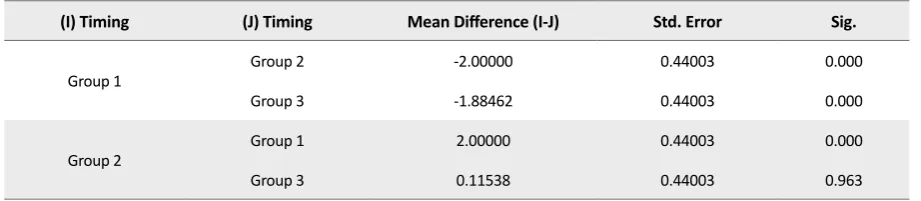
In addition, one-way ANOVA was performed for the mean scores of the transfer test and the result of the test showed a significant difference between at least two groups (P=0.001, F=13.024, df=2). Groups 2 and 3
were not significantly different. Table 3 shows that the
highest and the lowest mean scores in the transfer test belonged to groups 2 and 1, respectively. The post-hoc
test (Table 4) indicated that the mean score of transfer
test in group 1 was significantly different from those of the other two groups.
Table 2. Multiple comparisons between groups
(I) Timing (J) Timing Acquisition Phase Retention Phase
Mean Difference (I- J) Std. Error Sig. Mean Difference (I-J) Std. Error Sig.
Group 1 Group 2 -10.4058 3.92459 0.031 -11.6795 4.64194 0.043
Group 3 -5.5019 3.92459 0.351 -8.5769 4.64194 0.169
Group 2 Group 1 10.4058 3.92459 0.031 11.6795 4.64194 0.043
Group 3 4.9038 3.92459 0.433 3.1026 4.64194 0.783
Table 3. Difference of mean scores and mean scores of transfer test for each group
Group Dif 1 Dif 2 Dif 3 Transfer
G1 G2 G3 G1 G2 G3 G1 G2 G3 G1 G2 G3
Mean 23.73 20.23 21.00 -7.23 -1.00 0.07 -10.03 -8.96 -6.57 3.26 5.26 5.15
SD 12.23 110.6 18.62 6.04 6.71 2.36 2.39 2.08 3.74 1.28 0.97 1.08
Table 4. Multiple comparisons between the groups
(I) Timing (J) Timing Mean Difference (I-J) Std. Error Sig.
Group 1 Group 2 -2.00000 0.44003 0.000
Group 3 -1.88462 0.44003 0.000
Group 2 Group 1 2.00000 0.44003 0.000
4. Discussion
The main purpose of the current study was to deter-mine the effect of the KR timing on acquisition, reten-tion, and transfer of speech motor learning in healthy adults; moreover, the effect of estimating the result be-fore receiving KR feedback was investigated in other phases of the study. Regarding previous studies on limb and speech motor learning, it was expected that imme-diate feedback results in quicker acquiring speech task and providing delayed feedback, especially after self-es-timation, which lead to more permanent learning at the retention phase and facilitate the transfer of learning to untrained items.
The current study revealed that motor performance and motor learning in acquisition and retention phases were significantly different among the groups. Imme-diately received KR and delayed received KR (without self-estimation) differ significantly between various groups. Examination of the effect of KR timing on limb
and speech motor learning [2, 14,16,18,19] showed
that although the immediate KR promotes the rate of the acquisition, but the delayed KR is more effective for retention of new motor skill.
Consistent with the results of studies by Kim et al.,
Hula et al., Anderson et al. [23], Adams et al., Liu and
Wisberg, and Swinnen et al. the obtained mean scores at the acquisition phase indicated that receiving immedi-ate feedback resulted in better performance at acquisi-tion phase rather than the delayed feedback; moreover, delayed feedback (without self-estimation) resulted in better performance at retention phases. In addition, the mean scores in the transfer test indicated that delayed feedback-with/without the opportunity to estimate the result before receiving extrinsic feedback-was more ben-eficial for transfer of learning to untrained items relative to the immediate feedback. Thus, results of the present study indicated that although immediate feedback may increase the acquisition rate, delayed feedback is more beneficial for sustain ability and transfer of learning and causes less degradation of performance over time.
Theoretically, it seems that providing an opportunity for self-estimation helps learner to process intrinsic feed-back of the motor action for estimating the result and discovering errors in the first stages of training and it cor-rects errors in subsequent trials. However, in the absence of feedback, it has better performance and can use the recently acquired ability in untrained items. In contrast, providing immediate feedback by blocking the process of intrinsic feedback leads to learner’s dependence on
external information about the result and in conditions where extrinsic feedback is not available, the perfor-mance of the learner is significantly reduced over time.
Contrary to previous studies showing better performance at the retention phase for group with self-estimation
op-portunity (e.g. Chiviacowsky and Wulf [24], Guadangnoli
and Kohl, and Liu and Wisberg) the current study showed that delayed KR after self-estimation and empty delayed KR were equally at three acquisition, retention, and trans-fer phases and the diftrans-ferences between immediate KR and delayed KR after self-estimation was only at the transfer test. As described earlier, one of the groups received de-layed feedback without self-estimation opportunity.
In fact, the interval between the practice and receiving the feedback (eight seconds) was an empty interval and there was no specific activity for this. Individuals may spend this interval in different ways; actually learners may be silent spontaneous estimation at this interval. So, the differences between the two situations (delayed feedback with or without self-estimation) may actually be fewer. Therefore, it is suggested that future studies can minimize the impact of this factor by considering another group and providing an activity, which interferes with the silent re-sult estimation process, such as a reversal counting task.
The present study encountered some limitations. First, in each training session, there were 105 trials that were frustrating for some of the participants. Second, consid-ering one of the groups immediately received KR and all the feedbacks were verbal, practice exercises were judged by just one individual to provide immediate KR. Finally, judgments were made based on practice exer-cises with perceptual assessment methods. Although perceptual assessment is one of the most important and commonly used tools for speech therapy, it is always as-sociated with the probability of error.
5. Conclusion
The present study suggests that immediate KR is bene-ficial for speech motor acquisition and delayed feedback is more beneficial for retention and transfer of speech motor learning.
Ethical Considerations
Compliance with ethical guidelines
informa-tion confidential. The study protocol was approved by the Ethics Committee of Ahvaz Jundishapur University of Medical Sciences (code: PHT-9511).
Funding
This project was supported and founded with Muscu-loskeletal Rehabilitation Research Center, Ahvaz Jundis-hapur University of Medical Sciences through grant number pht-9511.
Authors' contributions
All authors contributed in designing, running, and writ-ing all parts of the research.
Conflict of interest
The authors declared no conflict of interest.
Acknowledgments
The authors thank Ahvaz Jundishapur University of Medical Sciences for financial support.
References
[1] Schmidt RA, Lee TD. Motor control and learning: A behav
-ioral approach. Champaign: Human Kinetics; 1999.
[2] Hula SNA, Robin DA, Maas E, Ballard KJ, Schmidt RA.
Effects of feedback frequency and timing on acquisition, re
-tention, and transfer of speech skills in acquired apraxia of speech. Journal of Speech, Language, and Hearing Research.
2008; 51(5):1088-113. [DOI:10.1044/1092-4388(2008/06-0042)]
[3] Magill RA, Anderson D. Motor learning and control: Con
-cepts and applications. New York: McGraw-Hill; 2007.
[4] Maas E, Robin DA, Hula SNA, Freedman SE, Wulf G, Bal
-lard KJ, et al. Principles of motor learning in treatment of
motor speech disorders. American Journal of Speech-Lan
-guage Pathology. 2008; 17(3):277-98.
[DOI:10.1044/1058-0360(2008/025)]
[5] Ballard KJ, Smith HD, Paramatmuni D, McCabe P, Theo
-doros DG, Murdoch BE. Amount of kinematic feedback af
-fects learning of speech motor skills. Motor Control. 2012;
16(1):106-19. [DOI:10.1123/mcj.16.1.106] [PMID]
[6] Bislick LP, Weir PC, Spencer KA. Effect of feedback frequen
-cy on motor learning in individuals with apraxia of speech
and healthy adults. Paper presented at: Clinical Aphasiol
-ogy Conference Clinical Aphasiol-ogy Conference. 20-25 May 2012; California, United States.
[7] Bislick LP, Weir PC, Spencer K, Kendall D, Yorkston KM.
Do principles of motor learning enhance retention and
trans-fer of speech skills? A systematic review. Aphasiology. 2012;
26(5):709-28. [DOI:10.1080/02687038.2012.676888]
[8] Maas E, Butalla CE, Farinella KA. Feedback frequency
in treatment for childhood apraxia of speech. American Journal of Speech-Language Pathology. 2012; 21(3):239-57.
[DOI:10.1044/1058-0360(2012/11-0119)]
[9] Steinhauer K, Grayhack JP. The role of knowledge of results
in performance and learning of a voice motor task. Journal of
Voice. 2000; 14(2):137-45.
[DOI:10.1016/S0892-1997(00)80020-X]
[10] Fujii S, Lulic T, Chen JL. More feedback is better than less:
Learning a novel upper limb joint coordination pattern with augmented auditory feedback. Frontiers in Neuroscience.
2016; 10:251. [DOI:10.3389/fnins.2016.00251] [PMID] [PM
-CID]
[11] Sigrist R, Rauter G, Riener R, Wolf P. Augmented visual, auditory, haptic, and multimodal feedback in motor learning: A review. Psychonomic Bulletin & Review. 2013; 20(1):21-53.
[DOI:10.3758/s13423-012-0333-8] [PMID]
[12] Winstein CJ. Knowledge of results and motor learning-implications for physical therapy. Physical Therapy. 1991;
71(2):140-9. [DOI:10.1093/ptj/71.2.140] [PMID]
[13] Swinnen SP, Schmidt RA, Nicholson DE, Shapiro DC.
Information feedback for skill acquisition: Instantaneous
knowledge of results degrades learning. Journal of Experi
-mental Psychology: Learning, Memory, and Cognition. 1990;
16(4):706. [DOI:10.1037//0278-7393.16.4.706]
[14] Kim IS, LaPointe LL, Stierwalt JA. The effect of feedback
and practice on the acquisition of novel speech behaviors. American Journal of Speech-Language Pathology. 2012;
21(2):89-100. [DOI:10.1044/1058-0360(2011/09-0082)]
[15] Guadagnoli MA, Kohl RM. Knowledge of results for motor
learning: Relationship between error estimation and knowl
-edge of results frequency. Journal of Motor Behavior. 2001;
33(2):217-24. [DOI:10.1080/00222890109603152] [PMID]
[16] Swinnen SP. Interpolated activities during the
knowledge-of-results delay and post-knowledge-knowledge-of-results interval: Ef
-fects on performance and learning. Journal of Experimen
-tal Psychology: Learning, Memory, and Cognition. 1990;
16(4):692-705. [DOI:10.1037/0278-7393.16.4.692]
[17] Shea JB, Upton G. The effects on skill acquisition of an interpolated motor short-term memory task during the KR-delay interval. Journal of Motor Behavior. 1976; 8(4):277-81.
[DOI:10.1080/00222895.1976.10735082] [PMID]
[18] Liu J, Wrisberg CA. The effect of knowledge of results de
-lay and the subjective estimation of movement form on the acquisition and retention of a motor skill. Research Quarterly
for Exercise and Sport. 1997; 68(2):145-51. [DOI:10.1080/0270
1367.1997.10607990] [PMID]
[19] Travlos AK, Pratt J. Temporal locus of knowledge of re
-sults: A meta-analytic review. Perceptual and Motor Skills.
1995; 80(1):3-14. [DOI:10.2466/pms.1995.80.1.3] [PMID]
[20] Swinnen S. Post-performance activities and skill learn
-ing. Advances in Psychology. 1988; 50:315-38. [DOI:10.1016/
S0166-4115(08)62563-7]
[21] Carter MJ, Ste-Marie DM. An interpolated activity during
-ing advantages of self-controlled feedback schedules. Psycho
-logical Research. 2017; 81(2):399-406.
[DOI:10.1007/s00426-016-0757-2] [PMID]
[22] Van Vliet PM, Wulf G. Extrinsic feedback for mo
-tor learning after stroke: What is the evidence? Dis
-ability and Rehabilitation. 2006; 28(13-14):831-40.
[DOI:10.1080/09638280500534937] [PMID]
[23] Anderson DI, Magill RA, Sekiya H, Ryan G. Support for
an explanation of the guidance effect in motor skill learning.
Journal of Motor Behavior. 2005; 37(3):231-8. [DOI:10.3200/
JMBR.37.3.231-238] [PMID] [PMCID]
[24] Chiviacowsky S, Wulf G. Self-controlled feedback is effec
-tive if it is based on the learner’s performance. Research Quar
-terly for Exercise and Sport. 2005; 76(1):42-8. [DOI:10.1080/02
Appendix A. French words stimulus used in the study and the description of their syllable structure
Word Syllable Structure
Ateqesan CV CV CV CVC
Akapabl CV CV CVCC
Ateqioq CV CV CV CVC
Aseqtan CV CVC CVC
Ateqvio CV CVC CV CV
Azhenioq CV CV CV CVC
Adigo CV CV CV
peqAs CV CVC
sAtuq CV CVC
lAzhqi CVC CV
dAdon CV CVC
lAguistik CV CV CVC CVC
sudA CV CV
peqA CV CV
maqA CV CV
kuzA CV CV
kontqA CVCC CV
mAsiq CV CVC
tAtamaq CV CV CVC
vAdikt CV CVCC
moA CV CV
seqtA CVC CV