Research Article
Operating Room Scheduling in
Teaching Hospitals: A Novel Stochastic
Optimization Model
Background and Objectives
Operating rooms (ORs) are simultaneously the largest cost center and the greatest source of revenue for most hospitals. OR planning is a key to achieving high OR productivity. Efficient OR planning is a challenging task due to the combinatorial complexity of the problem and the uncertainties associated with surgical care delivery.1
The last 60 years witness constant evolution of methods for improving the OR scheduling. Operational research techniques have gained an established role in such a progress. In particular, stochastic
*Corresponding Author: Arezoo Atighehchian, Department of Manage-ment, Faculty of Administrative Sciences and Economics, University of Is-fahan, IsIs-fahan, Iran, P.O.Box: 73441-81746, Tel: +98 31 37935204, Fax: +98 31 37935204, Email: [email protected]
Arezoo Atighehchian
1*, Mohammad Mehdi Sepehri
2,3, Pejman Shadpour
31 Department of Management, Faculty of Administrative Sciences and Economics, University of Isfahan, Isfahan, Iran. 2 Department of Industrial Engineering, Tarbiat Modares University, Tehran, Iran. 3 Hasheminejad Kidney Center, Hospital Management Research Center, Iran University of Medical Sciences, Tehran, Iran
Background and Objectives: Operating room (OR) scheduling is key to optimal OR productivity. The significant uncertainty associated with surgery duration renders scheduling of surgical operation a challenging task. This paper proposes a novel computational stochastic model to optimize scheduling of surgeries with uncertain durations. The model considers various surgical operation constraints in teaching hospitals, including optimal of assigning surgeons, residents, and assistant surgeons to each surgery, infection prevention constraints, availability of surgeons, and balanced distribution of operations between various groups of surgeons.
Methods: A two-stage stochastic operating room scheduling (SORS) framework was developed to minimize idle time and over time of ORs under practical constraints. The optimization model was solved using L-shaped algorithm. The performance of the SORS in proposing optimal scheduling solutions was extensively compared with that of deterministic models, as well as the performance of manual scheduling obtained from clinical data.
Findings: Results from implication of model on sample real-life OR scheduling problems showed that SORS offers more efficient scheduling solutions as compared with the corresponding deterministic model. Furthermore, comparison of the SORS-proposed schedules with the practical schedules indicated that SORS can remarkably reduce the OR idle times (96%) and overtimes (87%), suggesting the utility of this model in clinical practice.
Conclusions: A novel validated computational OR scheduling model was developed, which can potentially be employed to achieve higher OR performance.
Keywords: Operating room scheduling, Stochastic modeling, Operations research, Hospital performance
Abstract
programming has proven powerful in yielding solutions
for optimal management of ORs.2-4 Denton et al
developed a series of stochastic models for optimal
assignment of surgeries to multiple ORs.1 Mancilla
and Storer developed a number of algorithms for appointment sequencing and scheduling of a single OR with waiting time, idle time, and overtime costs as
decision variables.2 Min and Yih developed a surgery
schedule for elective patients undergoing surgery operations, which took into account the uncertainty in surgery durations and the availability of downstream resources such as surgical intensive care unit.3 Batun et al presented a two-stage stochastic mixed-integer model to minimize the total expected operating cost under uncertain surgery duration condition. They highlighted the benefit of pooling ORs as a shared
IJHR
Open Access
Abstract
Background and Objectives: Endometrial hyperplasia (EH) is an abnormal overgrowth of endometrium that may lead to endometrial cancer, especially when accompanied by atypia. The treatment of EH is challenging, and previous studies report conflicting results. Metformin (dimethyl biguanide) is an anti-diabetic and insulin sensitizer agent, which is supposed to have antiproliferative and anticancer effects and the potential to decrease cell growth in endometrium. While some studies have evaluated the anticancer effect of metformin, studies on its potential effect on endometrial hyperplasia are rare. To address this gap, in this comparative trial study, we evaluate the effect of additive metformin to progesterone in patients with EH.
Methods: In this clinical trial, 64 women with EH were randomized in two groups. The progesterone-alone group received progesterone 20 mg daily (14 days/month, from the 14th menstrual day) based on the type of hyperplasia,
and the progesterone-metformin group received metformin 1000 mg/day for 3 months in addition to progesterone. Duration of bleeding, hyperplasia, body mass index (BMI), and blood sugar (BS) of the patients were then com-pared between the two groups.
Findings: NA mean age of 44.5 years, mean BMI of 29 kg/m2 and mean duration of bleeding of 8 days were calcu
-lated for the study sample. There was no significant difference in age, BMI, gravidity, bleeding duration, and duration of disease at baseline between the two groups. While all patients in the progesterone-metformin group showed bleeding and hyperplasia improvement, only 69% of the progesterone-alone patients showed such an improvement, with the difference between the two groups being significant (P = 0.001). Although the difference between two groups in the post treatment endometrial thickness was not significant (P = 0.55), post treatment BMI in the progesterone-metformin group was significantly lower than in the progesterone-alone group (P = 0.01). In addition, the BS reduction in the progesterone-metformin group was significantly larger than that in the progesterone-alone group (P = 0.001).
Conclusions: Our results indicated that administration of progesterone 20 mg/day plus metformin 1000 mg/day can significantly decrease bleeding duration, hyperplasia, BMI and BS in women with EH.
Keywords: Endometrial hyperplasia, Metformin, Progesterone
Background and Objectives
Endometrial hyperplasia (EH) is an abnormal over
-growth of endometrium that may lead to endometrial cancer, especially when accompanied by atypia [1].
Although the effect appears only in 5% of asymptom-atic patients, its prevalence in patients with PCOS
and oligomenorrhea is about 20% [2]. Body mass index (BMI) and nulliparity are two main risk factors for EH. Other risk factors include chronic
anovula-tion, early menarche, late onset of menopause and
diabetes [3], which are related to increased
circulat-ing estrogen [4]. The treatment of EH is challengcirculat-ing and previous studies report conflicting results [5]. Age, fertility, and severity of EH in histology are the most important factors determining the treatment op -tion [5]. Most studies have addressed hysterectomy
in patients with atypical EH [5], particularly those
with PCOS, and have led to conflicting results [5-11].
Evaluation of the Effect of Additive
Metformin to Progesterone on Patients
with Endometrial Hyperplasia
Afsaneh Tehranian 1, Nasim Zarifi 1*, Akram Sayfolahi 2, Sara Payami 2, Faezeh Aghajani 2
1 Department of Gynecology and Obstetrics, Arash Women's Hospital, Tehran University of Medical Sciences, Tehran, Iran 2 School of Medicine, Tehran University of Medical Sciences, Tehran, Iran
*Corresponding author: Afsaneh Tehranian, Department of Gynecology and Ob-stetrics, Arash Women's Hospital, Tehran University of Medical Sciences, Tehran, Iran, P.O.Box: 1653915981, Tel: +98 21 77719922, Fax: +98 21 2177883196, E-mail: [email protected]
resource and performing parallel surgeries.4 Zhiming proposed a two-stage scheduling approach of ORs
by a multi-agent system.5 Beaulieu et al proposed a
4-step approach to the problem. Firstly, the surgery cases are assigned to a given day. Secondly, they are scheduled based on different strategies, which are evaluated through a simulation tool in the third step. If needed, feedback and rescheduling occur in the fourth step. Uncertainty is taken into account implicitly twice: first, through the load level of the schedule built during the assignment problem, and second, in
the simulation step.6 Mancilla and Storer developed
a stochastic integer programing model using sample average approximation to optimally assign surgeries
to ORs and sequencing them.7 Erdogan and Denton
proposed two new stochastic linear programming models for appointment scheduling assuming that service durations and the number of patients to be served on a particular day are uncertain.8 Pulido et al introduced a mixed integer linear programming (MILP) model for the efficient scheduling of multiple ORs during a working day considering multiple surgeons multiple types of surgeries. Stochastic strategies were implemented to take into account the uncertainty in surgery durations (pre-incision, incision, and post-incision times). In addition, a heuristic-based method and a MILP decomposition approach were proposed for
solving large-scale OR scheduling problems.9
In teaching hospitals, where many operations are performed by residents and/or fellowships under the supervision of relevant attending surgeons, the surgeons typically do not have a list of their own surgeries in advance, thus the scheduling is carries out based on open strategy. In this paper, we present a stochastic operating room scheduling (SORS) model for daily scheduling of ORs based on open strategy. Built on the assumption that the complete set of surgeries is known in advance, the goal was set to construct a schedule that minimizes (1) the total idle times of ORs between surgeries and (2) the total overtimes across all ORs. Our model involves a comprehensive list of the real-life constraints, including optimality of assigning surgeons, residents, and assistant surgeons to each surgery, infection prevention constraints, availability of surgeons, and balanced distribution of operations between various groups of surgeons.
Methods
Two-Stage Stochastic Programming
The model is formulated as a two-stage stochastic
programming model with recourse.10 The details of
model parameters and formulation are provided in Additional File 1. Briefly, the two-stage stochastic programming model involves two sets of decision variables, including first-stage and second-stage variables. This decomposition allows solving certain large-scale optimization problems, where the objective of the first-stage problem is to optimize the cost of the first-stage decision plus the expected cost of the (optimal) second-stage decision. In our modeling, the first-stage decision is to optimally assign surgeries to ORs, surgeons and assistant surgeons, and to determine the optimal sequence of surgeries in each OR and for each surgeon. The second-stage decisions include determining the start and completion times of the surgery as well as the idle time and overtime associated with each OR. The model’s objective is to minimize the expected second-stage costs of OR’s overtime and idle time. The uncertainties associated with surgery duration are represented by a finite set of scenarios in the second-stage problem.
Data Collection
The developed model was validated by using it to identify optimal solutions for several real-life surgical scheduling problems. These problems were formulated by collecting the data of surgical operations performed in Hasheminejad Kidney Center (HKC) within 2012-2014. Most data were extracted from the hospital information system (HIS). The required data that were not available from HIS were collected using intelligent character recognition (ICR) form that was completed by OR staff. Time data were expressed in 15-minute units. The discrete probability distributions of the surgery durations were estimated based on the surgery duration history. The overtime cost per time slot was estimated to be 2.28 k. The ORs were planned to be open 8 hours/day. The OR idle cost per time slot was estimated to be 4.41 k.
Scenarios
Implementation
The SORS model was used to solve a series of 30 scenario instances, representative of 1-month activity of the ORs. The allowed computation time was limited to 3 hours. For large problems that required high computational costs to reach optimal solution, the best possible solution was recorded.
The advantage of capturing uncertainty in surgery duration was assessed by determining value of the stochastic solution (VSS). VSS is the percentage of
difference in the values of objective function between
the stochastic and mean-value problems.11 The
mean value problem is the deterministic version of the developed model which is formulated by using deterministic variables instead of the random ones.
System and Software
The SORS model was implemented in GAMS and solved using CPLEX 12.3.0. on a 2.50 GHz, Pentium® Dual-core CPU with the Windows XP
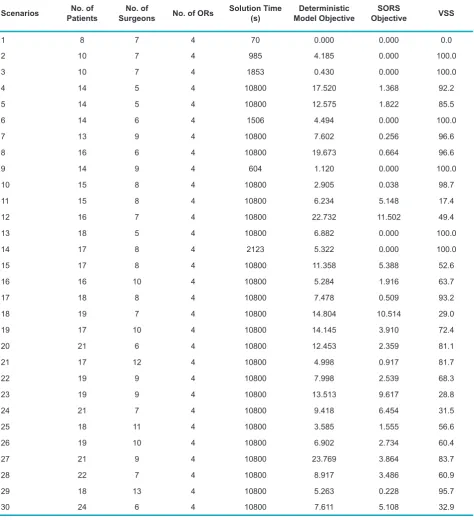
Table 1. Comparison of the Calculated Objective Value Between SORS and Deterministic Models
Scenarios PatientsNo. of SurgeonsNo. of No. of ORs Solution Time(s) Model ObjectiveDeterministic ObjectiveSORS VSS
1 8 7 4 70 0.000 0.000 0.0
2 10 7 4 985 4.185 0.000 100.0
3 10 7 4 1853 0.430 0.000 100.0
4 14 5 4 10800 17.520 1.368 92.2
5 14 5 4 10800 12.575 1.822 85.5
6 14 6 4 1506 4.494 0.000 100.0
7 13 9 4 10800 7.602 0.256 96.6
8 16 6 4 10800 19.673 0.664 96.6
9 14 9 4 604 1.120 0.000 100.0
10 15 8 4 10800 2.905 0.038 98.7
11 15 8 4 10800 6.234 5.148 17.4
12 16 7 4 10800 22.732 11.502 49.4
13 18 5 4 10800 6.882 0.000 100.0
14 17 8 4 2123 5.322 0.000 100.0
15 17 8 4 10800 11.358 5.388 52.6
16 16 10 4 10800 5.284 1.916 63.7
17 18 8 4 10800 7.478 0.509 93.2
18 19 7 4 10800 14.804 10.514 29.0
19 17 10 4 10800 14.145 3.910 72.4
20 21 6 4 10800 12.453 2.359 81.1
21 17 12 4 10800 4.998 0.917 81.7
22 19 9 4 10800 7.998 2.539 68.3
23 19 9 4 10800 13.513 9.617 28.8
24 21 7 4 10800 9.418 6.454 31.5
25 18 11 4 10800 3.585 1.555 56.6
26 19 10 4 10800 6.902 2.734 60.4
27 21 9 4 10800 23.769 3.864 83.7
28 22 7 4 10800 8.917 3.486 60.9
29 18 13 4 10800 5.263 0.228 95.7
operating system.
Results and Discussion
Numerical Results
Table 1 compares the objective value obtained from SORS that uses random variables and a deterministic version of this model that uses mean values of variables. The fact that in all scenario instances the stochastic solution objective is lower than (97%) or equal to (3%) the mean-value solution objective indicates the superiority of the SORS compared with deterministic models. The remarkably higher efficiency of the stochastic model is further confirmed by the observation that the VSS is higher than 80% in more than 50% of the instances and higher than 90% and in 40% of the cases.
Comparison With Practical Schedules
The practical schedules of HKC’s ORs were obtained from the HIS and/or ICR forms. The focus of the present study was on the training operations. Because in HKC the training operations are not performed on Thursdays and Fridays, the results of model could not be compared with practical schedules in these
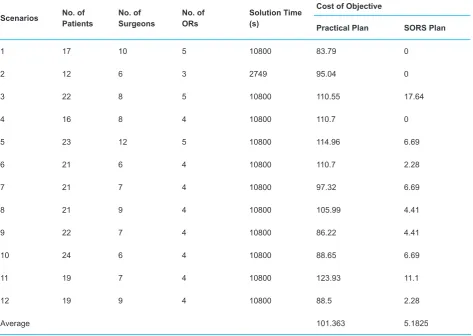
days. In addition, Sundays and Tuesdays are dedicated to transplant operations which are not considered training operations. By excluding the operations in these days, a series of 12 representative schedules remains for the purpose of comparison. Table 2 compares the results of such a comparison. As seen, the objective costs associated with daily schedules is largely lower for stochastic scheduling plans (average = 5.18 k) as compared with that of practical plans (average = 101 k).
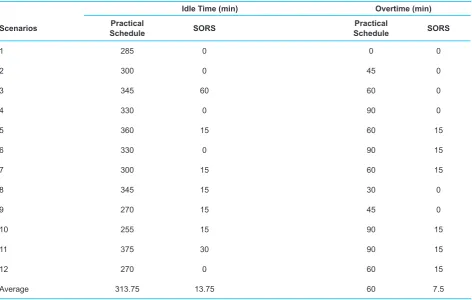
Table 3 compares the idle times and overtimes of ORs between associated with SORS-based schedules and practical schedules. As seen, idle times associated schedules are remarkably lower in SORS plans (average = 13.75 minutes) as compared with the practical plans (average = 313.75 minutes) (96% reduction). In addition, the ORs’ overtimes are significantly lower in SORS-proposed schedules (average = 7.7 minutes) as compared with the practical schedules (average = 60 minutes) (87% reduction).
Conclusions
In the present study a novel OR scheduling optimization model was developed. Results from implication of model on sample real-life OR scheduling problems showed that
Table 2. Comparison of the Calculated Cost of Objective Between SORS and Deterministic Models
Scenarios No. of Patients No. of Surgeons No. of ORs Solution Time (s)
Cost of Objective
Practical Plan SORS Plan
1 17 10 5 10800 83.79 0
2 12 6 3 2749 95.04 0
3 22 8 5 10800 110.55 17.64
4 16 8 4 10800 110.7 0
5 23 12 5 10800 114.96 6.69
6 21 6 4 10800 110.7 2.28
7 21 7 4 10800 97.32 6.69
8 21 9 4 10800 105.99 4.41
9 22 7 4 10800 86.22 4.41
10 24 6 4 10800 88.65 6.69
11 19 7 4 10800 123.93 11.1
12 19 9 4 10800 88.5 2.28
SORS offers more efficient scheduling solutions as compared with the corresponding deterministic model. Furthermore, comparison of the SORS-proposed schedules with the practical schedules indicated that SORS can remarkably reduce the OR idle times and overtimes, suggesting the utility of this model in clinical practice.
Abbreviations
(OR): operating room; (SORS): Stochastic operating room scheduling; (HKC): Hasheminejad Kidney Center; (HIS): hospital information system; (ICR): intelligent character recognition; (MILP): mixed-integer linear programming; (VSS): value of stochastic solution.
Competing Interests
The authors declare that there are no conflicts of interest.
Authors’ Contributions
MMS and PS jointly designed the study. AA has the major contribution to developing the SORS and the solution method, analyzing the data, and drafting and revising the manuscript. MMS contributed to preparing and revising the manuscript. PS determined the constraints of the model, the setting, and interpretation of the results. All authors read and approved the final manuscript.
Acknowledgments
The authors would like to thank Mr. Hamed Tarkesh from Tarbiat Modares University (Tehran, Iran) for his kind help for this paper. The contributions of HKC’s ORs’ staff are also gratefully acknowledged.
Additional files
Additional File 1 contains the details of the two-stage stochastic programming model.
References
1. Denton BT, Miller AJ, Balasubramanian HJ, Huschka TR. Optimal allocation of surgery blocks to operating rooms under uncertainty. Oper Res. 2009;58(4):802-816. 2. Mancilla C, Storer RH. (2009) Stochastic Sequencing and
Scheduling of an Operating Room. Paper presented at: the MOPTA; August 2009; Bethlehem, PA.
3. Min D, Yih Y. (2010) Scheduling elective surgery under uncertainty and downstream capacity constraints. Eur J Oper Res. 2010;206:642-652.
4. Batun S, Denton BT, Huschka TR, Schaefer AJ. Operating room pooling and parallel surgery processing under uncertainty. INFORMS J Comput. 2011;23(2):220-237. 5. Zhiming ZA. Two-stage scheduling approach of
operation rooms considering uncertain operation time. In: International Conference on Information Science and
Table 3. Comparison of idle Times and Overtimes Optimized by SORS With the Corresponding Practical Data
Idle Time (min) Overtime (min)
Scenarios SchedulePractical SORS SchedulePractical SORS
1 285 0 0 0
2 300 0 45 0
3 345 60 60 0
4 330 0 90 0
5 360 15 60 15
6 330 0 90 15
7 300 15 60 15
8 345 15 30 0
9 270 15 45 0
10 255 15 90 15
11 375 30 90 15
12 270 0 60 15
Please cite this article as:
Atighehchian A, Sepehri MM, Shadpour P. Operating room scheduling in teaching hospitals: a novel stochastic optimization model. Int J Hosp Res. 2015;4(4):171-176.
Technology (ICIST). Nanjing: IEEE; 26-28 March 2011: 1225-1228.
6. Beaulieu I, Gendreau M, Soriano P. Operating rooms scheduling under uncertainty. In: Tanfani E, Testi A, eds. Advanced Decision Making Methods Applied to Health Care. Springer; 2012:13-32.
7. Mancilla C, Storer RH. Stochastic sequencing of surgeries for a single surgeon operating in parallel operating rooms. IIE Transactions on Healthcare Systems Engineering. 2013;3(2):127-138.
8. Erdogan SA, Denton B. Dynamic appointment scheduling of a stochastic server with uncertain demand. INFORMS J Comput. 2013;25(1):116-132.
9. Pulido R, Aguirre AM, Ibáñez-Herrero N, Ortega-Mier M, García-Sánchez Á, Méndez CA. Optimization methods
for the operating room management under uncertainty: Stochastic programming vs. decomposition approach. J Appl Oper Res. 201;6(3):145-157.
10. Dantzig GB. (1955) Linear programming under uncertainty. Manage Sci. 1955;1:197-206.