DECENTRALIZED INFORMATION FLOW CONTROL IN CLOUD COMPUTING
Gangabhargava R.B*, Manjunath H.R* M.Tech Department of Computer Science Shridevi Institute of Engineering and Technology
Tumakuru, Karnataka, India.
Assistant Professor Department of Computer Science Shridevi Institute of Engineering and Technology Tumakuru, Karnataka, India.
KEYWORDS
:
Cloud, data security, information flow, information flow control (IFC).ABSTRACT
Security concerns are broadly seen as a snag to the appropriation of distributed computing arrangements. Data Flow Control (IFC) is a surely knew Mandatory Access Control strategy. The soonest IFC models focused on security in a brought together environment, yet decentralized types of IFC have been composed and executed, regularly inside of scholarly research ventures. Therefore, there is potential for decentralized IFC to accomplish preferred cloud security over is accessible today. In this paper we portray the properties of distributed computing—Platform-as-a-Service mists specifically—and audit a scope of IFC models and executions to recognize open doors for utilizing IFC inside of a distributed computing setting. Since IFC security is connected to the information that it ensures, both occupants and suppliers of cloud administrations can concede to security strategy, in a way that does not oblige them to comprehend and depend on the particulars of the cloud programming stack with a specific end goal to impact requirement.
INTRODUCTION
Distributed computing has developed into giving modest, pragmatic and on-interest access to figuring assets. It is acknowledging utility figuring—the vision of the Grid and other appropriated frameworks before it. One of the slightest tasteful parts of distributed computing is the absence of confirmations about security. Unless cloud occupants can trust cloud suppliers, the boundless utilization of distributed computing arrangements will be extremely shortened. The issue of cloud security is trying because of its extensive variety of lawful and specialized aspects.
The key technical challenge in cloud security stems from the certainty that cloud foundations combine heterogeneous software and administrations composed by different improvement groups with no common methodology for ensuring information security. For instance, a cloud supplier might depend on virtualisation to detach the calculations of various inhabitants yet share a solitary information store over every one of the occupants. So also, an information store might give offices to detach the confidential information of various clients of an application (e.g. through independent client accounts as bolstered by most database administration frameworks) however such usefulness is not normally presented to inhabitant applications. Conventional security practices, for example, access control [1], [2] Chinese Wall [3] and promising advances, for example, homomorphic encryption [4] are as of now being utilized or considered as a part of cloud situations, however can't accomplish the flexibility, all inclusive statement and efficiency expected by cloud suppliers and inhabitants. As an answer, we contend that information driven security systems, for example, Information Flow Control (IFC) — and Decentralized IFC (DIFC) specifically—can possibly improve significantly today's cloud security approaches. We imagine future secure distributed computing stages that backing the connection of security approaches to information and utilize these arrangements at runtime to control where client information flows.
Such information driven security components, which track or uphold data flow, can enhance cloud security from numerous points of view. In the first place, designers are given the capacity to organize with the cloud supplier and control how client information engenders in a cloud stage. This encourages consistence with administrative systems. Second, multi-tenancy,i.e. the act of sharing administrations between cloud inhabitants, turns out to be more secure in light of the fact that the cloud stage can force checks to authorize security arrangements regardless of flaws in the administrations themselves. Third, following information flows crosswise over various administrations offers the cloud supplier an approach to log touchy operations on occupant information thoroughly, in this way enhancing responsibility.
status in cloud security, and recommend cross-cutting legitimate and specialized concerns identifying with the assurance of client information
BACKGROUND
The overview of the three main categories of cloud service provision (IaaS, PaaS, SaaS) have been explained here. For each, the typical approach is used to secure them. Information Flow Control has been introduced and discusses crosscutting legal and security concerns.
Cloud Computing and Security
Cloud computing is the advancement of utility computing: the aim that computing services can be provided in a manner that is taken away from the computing resource itself. The important concept is the sharing of resources to increase their usage: the consequent economies of scale offered to cloud providers provide them to sell slices of resource on demand in a cost effective manner. Technology developments and tradeoffs often caused computing provision to transformation between centralised and decentralised computing in recent years. In the olden days, processing machinery was very big and expensive, so resources had to be shared in order to make them cost-effective. The Internet had always provided some remote access but increasing bandwidth made it necessary to consider computing beyond firewall-protected local administrative domains, giving rise to new security problems. Web-based, Service-Oriented Architectures took the provision of computing to a global scale. The Grid explicitly draws a model between performing computing and the electricity grid. Users should be able to plug in and they can do their computing work with less or no attention to how the distributed computing is actually structured.
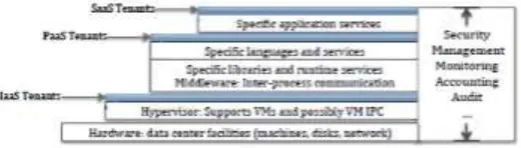
Fig. 1. Cloud service levels and the points of tenant interaction.
Infrastructure as a Service (IaaS) Clouds: IaaS customers
rent computing resources directly. This form of cloud computing allows tenants most flexibility over the software they use but requires most effort from them: they are responsible for the configuration and customisation of the resources. IaaS was the first widely available commercial cloud type, initiated by Amazon’s launch of their EC2 service, and made possible by the widespread availability of efficient open source hardware virtualisation [6]. Other notable providers include Rackspace Joyent, Google, and Microsoft. IaaS resources are usually provided to tenants in the form of Virtual Machines (VMs). There have been significant recent developments in the management of VM templates, which ease the deployment of new VMs. In terms of security, the operating systems and software running on the VMs generally need to be managed no differently than on physical, dedicated servers. The exception to this is “paravirtualised” device drivers that are installed into the VMs to increase efficiency. These drivers are necessarily aware of running in a VM. Instead of using expensive emulated device access they typically interact directly with the VM host via some agreed channel. However, there is little that an IaaS user can do other than trusting the paravirtualised device driver authors, or choosing to use much slower virtual hardware via native device drivers. [7], [8] discuss a possible scheme to create a cross-VM side-channel to extract information from a co-resident. As in most systems, an administrator may be a security risk [9]. The key trusted computing base is the hypervisor, or virtualization host. However, IaaS clouds seldom allow manipulation of the underlying hypervisor configuration. The correctness of the hypervisor has to be assumed, although Microsoft’s collaborative efforts to automatically verify a hypervisor [10] are providing significant advances in that area.
2) Platform as a Service (PaaS) Clouds:PaaS customers must develop their applications using languages and
3) Software as a Service (SaaS) Clouds: SaaS customers use applications and/or data hosted by the cloud provider. Often the data being manipulated will remain within the cloud, which avoids the comparatively slow Internet links between the tenant and the SaaS provider.
A. Information Flow Control
Models of secure data access are often divided into Mandatory Access Control or Discretionary Access Control (DAC) systems. Previous and common models such as Access Control Lists (ACLs), capability systems are DAC systems, meaning that the prior of the data can modify and access permissions. It achieves protection by controlling access to resources. Their implementations mainly based on where access control checks are performed in the code of an application. Data is secured as a function of access control checks in the APIs provided to interact with that data. Problems with DAC approaches are that it may be possible to bypass access control checks, especially in web-based application systems.
Fig. 2. Labels in Myers’ DIFC Model
The “Authorised Flow” group on the right-hand side of each row in the figure indicates the principals that can interact for data labeled with La and Lb. Now consider a function f(a, b) that combines data labeled with La and
Lb. The result of the function f(a, b) will be associated with the label Lf(a,b) = {o1 : r1, r2 ; o2 : r1, r3} and therefore will be authorised to flow only towards r1.
General Cloud Security Concerns
Individuals and organizations that use cloud services to store their sensitive data generally rely on the provider to maintain an correct level of security. However, it is often the problem that agreements (SLAs) between cloud providers and tenants are silent with respect to security guarantees, or even denial of many types of service responsibility. Moreover, the global nature of cloud services brings jurisdiction and regulation considerations, which can directly affect the way in which data is managed and governed, in addition to raising problem causing liability, enforcement, and compensation.
Fig. 3. IFC data isolation, data flow tracking and enforcement between two applications.
1) Regulatory Framework: Governments have shown concern about widespread application of cloud services. Here, we give a selection of recent recommendations by various nations.
2) Multi-Tenancy: Multi tenancy, where a number of tenants share the same architecture, may be used by any of the three forms of cloud discussed above. Note that a tenant may be hosting a multi- user service on cloud architecture. IFC supports isolation of single users’ data, not just inter-tenant isolation. 3) Access Control: A security challenge faced by companies and organization wishing to provide the hosting
interactions are safer before their deployment.
THREATS
TO
IFC
SYSTEMS
IFC is a secure access methodology, but not a security panacea—this section explores some threats that IFC does not typically secure against. For many IFC systems, though the environment is considered hostile, the application code is commonly considered not to be explicitly dangerous, even if the threats may be caused by implementation errors
DIFC SYSTEM IMPLEMENTATIONS
It summaries particular work on implemented DIFC systems that could contribute to adoption of DIFC within the cloud. Their characteristics relevant to cloud deployment are compared. We occupy IFC systems that operate in hardware then some implementations of IFC within OS. All share or have gained inspiration from IFC implementations at the middleware level and as language libraries are then described. It considers IFC provided at these system levels for possible integration.
Library-Level IFC
Library-level IFC systems track explicit flow of information within a web application by extending a given language with IFC related features. These characteristic include the ability to describe ―sandboxes‖ for containing labelled information, to associate labels with variables and describe policies to be applied to labelled information
1) Resin: Resin is a runtime taint monitoring system for PHP web applications, which enhanced server-side prevention and can be used to guarantee user-information privacy. Resin provides mechanisms to help programmers implement IFC assertions. Filter objects describe information flows boundaries that can be interposed at I/O connection or on a function call connection. Sticky policies can associate information with a policy that application programmers have described themselves. The programmers rely on the Resin label tracking system to propagate those policies throughout the application (however the programmer must pay particular attention to implicit flows.
2) PHP Aspis: The PHP Aspis tool uses a simpler approach than Resin: Aspis marks all user generated information with a ―taint‖ and propagates this taint across the application. Some critical methods are update (such as echo or print) to present specific behaviour when faced with tainted information. This is done by performing code-to-code translation of the source code of executed software. The trade-off against Resin is a reduction in expressiveness and control from the point-of-view .
3) DEFCON: In previous work, the exploration of data centric security mechanisms in several domains has been used. The DEFCON system adds strong object isolation to Java without impacting the efficiency of object sharing. In exact we introduced the notion of Decentralized Event Flow Control (DEFC), which focuses on the IFC requirements of event-based systems. DEFCON is implemented in Java, and runs on an unmodified JVM. It provides dynamic inter-isolate communication using a combination of static and runtime approach. As a middleware, DEFCON provides an API that applications can be developed against. However, to strongly accomplish isolation, the system goes further than providing middleware: additional runtime data flow containment instrumentation can be installed using appearance, an appearance-oriented weaver. A static analysis phase ensures that isolates cannot communicate using channels such as the many thousands of static variables maintained by the Java runtime programmer.
Cloud Benefit offerings are typically divided into three broad categories: Infrastructure as a Service (IaaS), Platform as a Service (PaaS), and Software as a Service (SaaS). Infrastructure as a Service (IaaS) Clouds: IaaS customers rent computing resources directly. This form of cloud computing allows resident most flexibilit y over the software they use but requires most effort from them: they are responsible for the configuration and customisation of the resources.
2) Software as a Service (SaaS) Clouds: SaaS customers use applications and/or data hosted by the cloud provider. Often the data being managed will remain within the cloud, which deflects the similarly slow Internet links between the resident and the SaaS provider.
Safe Web:
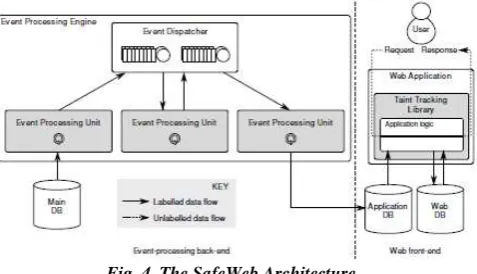
Safe Web is a middleware. It aims to tolerate against policy problem in multi-tier web applications. It uses IFC to monitor information flows through all tiers of the web application architecture, in order to ensure end-to-end information confidentiality and integrity. Safe Web has an event processing backend that can be deals directly with the processing of important information, and a web frontend that manage application (or client) requests. By enabling web requests from the processing of information, implementation problem in the logic handling web requests cannot result in inappropriate release of important information.
Fig. 4. The SafeWeb Architecture.
IFC Protection in Hardware
Some IFC method target custom hardware. RIFLE translates normal binary code to run on hardware that help IFC tracking. To overcome the pitfalls of implicit flow inherent to all dynamic systems, all implicit flows are translated to explicit flows. Suh et al. present a hardware method to monitor information flows. The authors change how standard instructions involved propagating tags and adding an additional cache to store those tags. CPU registers have an extra bit to denote tagged information.
IFC Enforced by Operating Systems
When IFC is enforced by OS, IFC monitoring is typically done at the process level. Processes and persistent information are labelled, and labels are propagated when persistent information is accessed and when inter-process communication occurs. While considering the Asbestos, it is a fully IFC-capable OS, albeit with a non-standard interface. Flume runs on top of a slightly changed Linux OS and intercepts system calls to enforce IFC. DStar enables IFC in distributed systems, by translating the protection labels between instances of IFC-enabled OSs. Aeolus runs Asbestos across a distributed system by providing different communication and IFC monitoring.
Authentication:
Resin is a runtime taint monitoring system for PHP web applications, which improves server side protection and can be used to achieve user information privacy .Resin gives mechanisms to support programmers implement IFC assertions. Filter objects define information flow boundaries that can be used at I/O interfaces or on a function call interface. Sticky policies can involve information with a policy that application programmers have described themselves. The programmers rely on the Resin label monitoring system to propagate those policies on entire the application (however the programmer must pay important attention to implicit flow.
CONCLUSION
REFERENCES
1. D. Denning, Cryptography and Information Security. Addison-Wesley Long- man, 1982.
2. Biba, ―Integrity considerations for secure computer systems,‖ MITRE Co., technical report ESD-TR 76- 372, 1977.
3. R. Wu, G.-J. Ahn, H. Hu, and M. Singhal, ―Information flow control in cloud computing,‖ in CollaborateCom, 2010.
4. H. Hacig¨um¨us¸, B. Iyer, et al., ―Executing SQL over encrypted information in the informationbaseservice-provider model,‖ in Proc. 2002 ACM SIGMOD, pp. 216–227.
5. J. Bacon, D. Evans, et al., ―Big ideas paper: enforcing end-to-end application security in the cloud,‖ in 2010 ACM/IFIP Middleware.
6. P. Barham, B. Dragovic, et al., “Xen and the art of virtualization,” in 2003 ACM SOSP
7. T. Ristenpart, E. Tromer, et al., “Hey, you, get off of my cloud: exploring information leakage in third-party compute clouds,” in Proc. 2009 ACM CCS, pp. 199–212.
8. Y. Zhang, A. Juels, et al., “Cross-VM side channels and their use to extract private keys,” in Proc. 2012 ACM CCS, pp. 305–316.
9. A. Ganjali and D. Lie, “Auditing cloud management using information flow tracking,” in Proc. 2012 ACM STC, pp. 79–84.