DEMOGRAPHIC RESEARCH
VOLUME 41, ARTICLE 36, PAGES 1047-1058
PUBLISHED 18 OCTOBER 2019
https://www.demographic-research.org/Volumes/Vol41/36/ DOI: 10.4054/DemRes.2019.41.36
Descriptive Finding
Mortality convergence of twins and singletons in
sub-Saharan Africa
Roland Pongou
David Shapiro
Michel Tenikue
© 2019 Roland Pongou, David Shapiro & Michel Tenikue.
This open-access work is published under the terms of the Creative Commons Attribution 3.0 Germany (CC BY 3.0 DE), which permits use, reproduction, and distribution in any medium, provided the original author(s) and source are given credit.
1 Introduction 1048
2 Data and methods 1050
2.1 Data 1050
2.2 Methodology 1050
3 Results: Mortality and survival of twins and singletons, by age 1050
4 Conclusion 1054
5 Acknowledgments 1055
Demographic Research: Volume 41, Article 36
Descriptive Finding
Mortality convergence of twins and singletons in sub-Saharan Africa
Roland Pongou1 David Shapiro2 Michel Tenikue3
Abstract
BACKGROUND
While there is a substantial amount of literature documenting that twins have higher mortality than singletons, that literature does not address the questions of whether this disadvantage of twins eventually disappears and if so, at what age.
OBJECTIVES
This paper seeks to determine if there is convergence of mortality of twins and singletons and if so, to determine the age at which convergence takes place. We also examine how twin–singleton mortality differences have changed across successive cohorts.
METHODS
We use data on more than 3 million live births from 99 Demographic and Health Surveys carried out between 1990 and 2013 in 34 different countries in sub-Saharan Africa to examine age-specific mortality of twins and singletons, by month for the first year of life and by year up to age 25.
RESULTS
We find that mortality of twins is considerably higher than that of singletons in the first year of life, and especially in the first month. As children age, a narrowing of the mortality difference occurs, with convergence taking place by age 6. Over time, mortality of both twins and singletons has declined, but the disadvantage of twins has persisted.
1 University of Ottawa, Canada, and Harvard University, USA.
CONCLUSIONS
The mortality disadvantage of twins compared to singletons eventually disappears as they age.
CONTRIBUTION
This study documents that in sub-Saharan Africa, there is convergence of mortality of twins and singletons and that this convergence takes place by the age of 6.
1. Introduction
Twin–singleton mortality differences in early ages are an important source of child inequality in all societies. Owing to the unfavorable fetal conditions of twins resulting in growth retardation and low birth weight, their risk of death within the first year of life is significantly higher than that of singletons by a factor ranging from 3.46 times greater in Gambia (Miyahara et al. 2016) to 5 in the United Kingdom (ONS 2012) and Sweden (Cheung, Yip, and Karlberg 2000), and 6 in the United States (Almond, Chay, and Lee 2005). This gap is also observed in all sub-Saharan African countries (Pongou 2013; Smits and Monden 2011).
These mortality inequalities mean that a large number of twins are missing. In 2006 there were about 125 million individuals in the world who had been born as twins (Oliver 2006). This figure represents about 1.6% of the world population, which is far below the proportion of twin births in most societies, which is around 3% (Pison, Monden, and Smits 2015; Smits and Monden 2011; Monden and Smits 2017). These figures indicate that at least 100 million twins – about half of the twin population – are missing; that is, if there were no differences in mortality rates between twins and singletons, there would be at least 100 million more twins than the world currently has.
Moreover, the inequality of mortality between twins and singletons also raises the possibility that surviving twins may experience important health and developmental problems that compromise their ability to accumulate human capital as they age (Black, Devereux, and Salvanes 2007; Almond and Currie 2011). This constitutes a fundamental equity problem in the areas of population and health.
Demographic Research: Volume 41, Article 36
We document twin–singleton mortality differences from birth to the age of 25. We can look at mortality only to the age of 25 because our data goes to only this age. However, being able to study mortality in this age interval already represents a significant advancement, especially given the paucity of good data on twins in most countries.
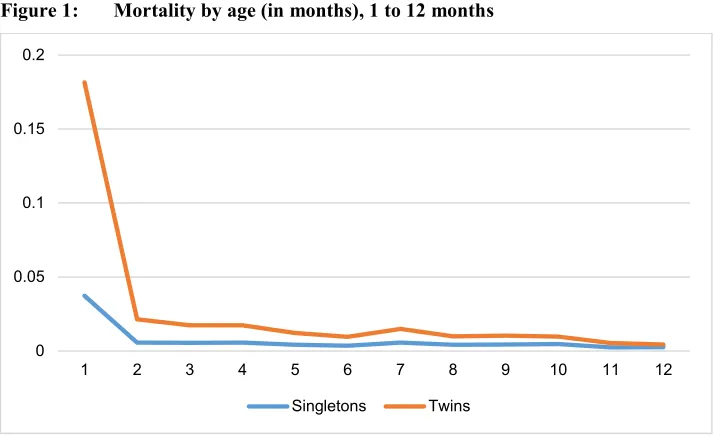
We show that twins are at a disadvantage in early ages, but this disadvantage gradually decreases and almost disappears after age 5. The twin–singleton difference in the probability of death falls from 210 per 1,000 in the first year of life to less than 2 per 1,000 after age 5. Further analyzing mortality differences within the first year of life, we find that these differences are mostly concentrated in the neonatal period. These results show that the ‘missing twins’ phenomenon originates very early in life.
We also examine twin–singleton differences across cohorts over time. Mortality has declined over time; our objective here is to determine how twin–singleton differences in mortality have changed among successive cohorts.
Our paper adds to the large literature on health and survival inequalities. Several studies note higher mortality in twins than in singletons in different contexts (Cheung, Yip, and Karlberg 2000; Almond, Chay, and Lee 2005; ONS 2012; Pongou 2013; Miyahara et al. 2016; Monden and Smits 2017). Researchers who focus on sub-Saharan African countries include Pongou (2013), Miyahara et al. (2016), and Monden and Smits (2017). In particular, focusing on the period from 1995 to 2014, Monden and Smits (2017) find that the decline in under–age 5 mortality and in neonatal mortality during said period was lower for twins compared to singletons. They also find that parental socioeconomic status, place of residence, and birth weight are significant predictors of mortality among twins and singletons.
Our paper differs significantly from all the abovementioned studies in that we focus on the timing of mortality convergence between twins and singletons. For this purpose, we follow children up to the age of 25, whereas all the abovementioned studies limit their investigation to children under the age of 1 or 5, and none of them study the twin–singleton mortality convergence. In addition, by covering a larger number of countries and a longer period of time, we are also able to study mortality convergence by birth cohort. Our study is indeed the first to document the timing of mortality convergence between twins and singletons and to show that the ‘missing twins’ phenomenon originates in very early ages.
2. Data and methods
2.1 Data
We use data on all live births recorded in 99 Demographic and Health Surveys collected in 34 sub-Saharan African countries between 1990 and 2013 (a supplementary table with data on the countries, surveys, and sample sizes is available from the corresponding author on request). For each birth, the survey provides information on the age of the child at the time of the survey if the child is alive, the age at death if the child is dead, sex of the child, and twinning status. The data is on 3,048,923 deliveries, of which 1.7% are twin deliveries. The corresponding number of children is 3,099,780, of which 3.2% are twins.
2.2 Methodology
We use survival analysis methods to document differences in mortality and survival rates of twins and singletons by age, measured both in months and years. We treat the very large sample of births as a random sample of births drawn from the 34 countries covered by this paper. Our estimates are based on unweighted data. However, we note that use of sample weights yields very similar results. The maximum age considered is 300 months (25 years). A child is included in the sample of month/year t if she has survived to month/year t. If a child dies in month/year t, she is not included in the sample in month/yeart+1. We consider that mortality converges when the difference between twin and singleton mortality rates falls below 2 per 1,000 and remains below this value as children age (the Millennium Development Goal target of child mortality for developed countries was 5 per 1,000).
3. Results: Mortality and survival of twins and singletons, by age
Demographic Research: Volume 41, Article 36
Figure 1: Mortality by age (in months), 1 to 12 months
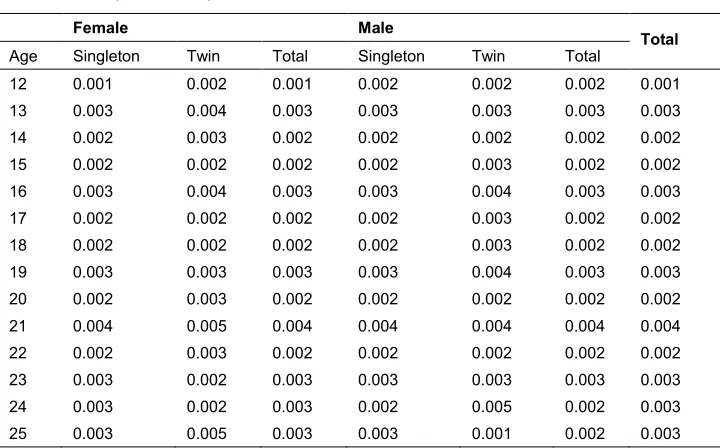
Mortality of twins and singletons by age in years is shown in Figure 2. The substantial difference in the first year, already noted, is apparent. The differences diminish as age increases. As shown in Table 1, which provides age-specific mortality rates of twins and singletons separately by sex, by age 5, the twin–singleton mortality difference has fallen to 2 per 1,000. Beginning with age 6, the difference falls to 1 or zero per 1,000 and remains that low up through the early 20s. Hence, we consider that convergence of mortality of twins and singletons occurs by age 6. Male mortality of both twins and singletons exceeds female mortality up through about age 10, and especially in the first year of life.
The data by age shows that mortality of twins is more than 3 times that of singletons during the first year of life, but this factor falls to 1.7 and 1.4 in ages 2 and 3, respectively. Beginning with age 6, twin mortality remains slightly higher at some ages, but by age 7 the overall mortality has dropped to an average of 4 per 1,000. Between ages 8 and 20, the overall mortality is below 4 per 1,000.
0 0.05 0.1 0.15 0.2
1 2 3 4 5 6 7 8 9 10 11 12
Figure 2: Mortality of twins and singletons by age (in years)
Table 1: Mortality rates by age, sex, and twin status
Female Male
Total
Age Singleton Twin Total Singleton Twin Total
1 0.075 0.260 0.081 0.088 0.299 0.095 0.088 2 0.028 0.048 0.028 0.029 0.051 0.030 0.029 3 0.023 0.034 0.023 0.024 0.034 0.024 0.024 4 0.015 0.018 0.015 0.016 0.022 0.016 0.015 5 0.008 0.010 0.008 0.009 0.011 0.009 0.008 6 0.006 0.007 0.006 0.007 0.008 0.007 0.006 7 0.004 0.005 0.004 0.005 0.006 0.005 0.004 8 0.004 0.004 0.004 0.005 0.006 0.005 0.004 9 0.003 0.003 0.003 0.003 0.004 0.003 0.003 10 0.002 0.002 0.002 0.002 0.003 0.002 0.002 11 0.003 0.003 0.003 0.003 0.004 0.003 0.003
0.000 0.050 0.100 0.150 0.200 0.250 0.300
1 2 3 4 5 6 7 8 9 10 11 12 13 14 15 16 17 18 19 20 21 22 23 24 25
Demographic Research: Volume 41, Article 36
Table 1: (Continued)
Female Male
Total
Age Singleton Twin Total Singleton Twin Total
12 0.001 0.002 0.001 0.002 0.002 0.002 0.001 13 0.003 0.004 0.003 0.003 0.003 0.003 0.003 14 0.002 0.003 0.002 0.002 0.002 0.002 0.002 15 0.002 0.002 0.002 0.002 0.003 0.002 0.002 16 0.003 0.004 0.003 0.003 0.004 0.003 0.003 17 0.002 0.002 0.002 0.002 0.003 0.002 0.002 18 0.002 0.002 0.002 0.002 0.003 0.002 0.002 19 0.003 0.003 0.003 0.003 0.004 0.003 0.003 20 0.002 0.003 0.002 0.002 0.002 0.002 0.002 21 0.004 0.005 0.004 0.004 0.004 0.004 0.004 22 0.002 0.003 0.002 0.002 0.002 0.002 0.002 23 0.003 0.002 0.003 0.003 0.003 0.003 0.003 24 0.003 0.002 0.003 0.002 0.005 0.002 0.003 25 0.003 0.005 0.003 0.003 0.001 0.002 0.003
When it comes to cohort trends in mortality and survival of twins and singletons, we now analyze time trends in the twin–singleton mortality difference. We use data collected since 1990 from women aged 15 to 49 at the time of the survey. The data therefore provides detailed information on births that date back more than 34 years prior to the survey, which allows us to monitor mortality over time.
It is well known that child survival in sub-Saharan Africa has markedly improved over the years, mainly due to important improvements in neonatal care and vaccination against infectious diseases. The annual rate of reduction of the infant mortality rate increased from 1.6% in the 1990s to 4.1% in 2000‒2015 (United Nations 2015).
Figure 3: Kaplan‒Meier survival rate of twins and singletons by birth cohort
4. Conclusion
This paper examines twin–singleton differences in mortality risk through the age of 25. We find an important difference in the first year of life, but the difference decreases with age and practically disappears after age 5. After the age of 6 all children are exposed to a very low annual mortality risk (less than 5 deaths per 1,000 children overall). This might be explained by both the selection effect, because most vulnerable children died before age 5, and the fact that by that age many children are already immunized for some infectious diseases and are less vulnerable to health problems.
Our finding that twins have much greater mortality risks than singletons in early ages is consistent with other studies (Cheung, Yip, and Karlberg 2000; Almond, Chay, and Lee 2005; ONS 2012; Pongou 2013; Miyahara et al. 2016; Monden and Smits 2017). These studies, however, limit their analysis to children under 1 or 5 and therefore do not study mortality convergence between twins and singletons. Our study
0. 00 0 .2 5 0 .5 0 0. 75 1. 00
0 36 84 132 180 228 276 Age(in months)
Singleton Twin
Birth cohort 1960-1969
0. 00 0 .2 5 0 .5 0 0. 75 1. 00
0 36 84 132 180 228 276 Age(in months)
Singleton Twin
Birth cohort 1970-1979
0. 00 0 .2 5 0 .5 0 0. 75 1. 00
0 36 84 132 180 228 276 Age(in months)
Singleton Twin
Birth cohort 1980-1989
0 .0 0 0.2 5 0.5 0 0.7 5 1 .0 0
0 36 84 132 180 228 276 Age(in months)
Singleton Twin
Birth cohort 1990-1999
0 .0 0 0.2 5 0.5 0 0.7 5 1 .0 0
0 36 84 132 180 228 276 Age(in months)
Singleton Twin
Birth cohort 2000-2009
0 .0 0 0.2 5 0.5 0 0.7 5 1 .0 0
0 36 84 132 180 228 276 Age(in months)
Singleton Twin
Demographic Research: Volume 41, Article 36
is the first to conduct this analysis, yielding new insights into how mortality inequalities change across ages.
5. Acknowledgments
References
Almond, D., Chay, K.Y., and Lee, D.S. (2005). The costs of low birth weight.
Quarterly Journal of Economics 120(3): 1031–1083. doi:10.1162/00335530 5774268228.
Almond, D. and Currie, J. (2011). Human capital development before age five. In: Ashenfelter, O. and Card, D. (eds.).Handbook of Labor Economics, Volume 4b. Amsterdam: Elsevier: Chapter 15, 1315–1486. doi:10.1016/S0169-7218(11) 02413-0.
Black, S.E., Devereux, P.J., and Salvanes., K.G. (2007). From the cradle to the labor market? The effect of birth weight on adult outcomes.The Quarterly Journal of Economics 122(1): 409–439,doi:10.1162/qjec.122.1.409.
Cheung Y.B., Yip, P., and Karlberg, J. (2000). Mortality of twins and singletons by gestational age: A varying-coefficient approach. American Journal of Epidemiology 152(12): 1107‒1116.doi:10.1093/aje/152.12.1107.
Miyahara R., Jasseh, M., Mackenzie, G.A., Bottomley, C., Hossain, M.J., Greenwood, B.M., D’Alessandro, U., and Roca, A. (2016). The large contribution of twins to neonatal and post-neonatal mortality in The Gambia, a 5-year prospective study. BMC Pediatrics 16: 39.doi:10.1186/s12887-016-0573-2.
Monden, C. and Smits, J. (2017). Mortality among twins and singletons in sub-Saharan Africa between 1995 and 2014: A pooled analysis of data from 90 Demographic and Health Surveys in 30 countries. Lancet Global Health 5(7): PE673‒E679. doi:10.1016/S2214-109X(17)30197-3.
Office for National Statistics (ONS) (2012). Live births, stillbirths and infant deaths, Babies Born in 2009 in England and Wales Statistical Bulletin. http://webarchive.nationalarchives.gov.uk/20160105160709/http://www.ons.gov
.uk/ons/rel/vsob1/birth-cohort-tables--england-and-wales/2009/stb-bct-2009.html.
Oliver, J. (2006).Twin resources. Swindon: Economic and Social Research Council. Pison, G., Monden, C., and Smits, J. (2015). Twinning rates in developed countries:
Trends and explanations.Population and Development Review 41(4): 629–649. doi:10.1111/j.1728-4457.2015.00088.x.
Demographic Research: Volume 41, Article 36
Smits, J. and Monden, C. (2011). Twinning across the developing world. PLoS ONE 6(9): e25239.doi:10.1371/journal.pone.0025239.