VOLUME 40, ARTICLE 7, PAGES 155
,
184
PUBLISHED 24 JANUARY 2019
http://www.demographic-research.org/Volumes/Vol40/7/ DOI: 10.4054/DemRes.2019.40.7
Research Article
Does moving for family nest-building inhibit
mothers’ labour force (re-)entry?
Stefanie Kley
Sonja Drobnič
This publication is part of the Special Collection on “Spatial Mobility, Family Dynamics and Gender Relations,” organized by Guest Editors Sergi Vidal and Johannes Huinink.
© 2019 Stefanie Kley & Sonja Drobnič.
This open-access work is published under the terms of the Creative Commons Attribution 3.0 Germany (CC BY 3.0 DE), which permits use, reproduction, and distribution in any medium, provided the original author(s) and source are given credit.
1 Introduction 156
2 Study background 158
2.1 Family migration 158
2.2 Residential mobility and the work-family nexus 159
3 Method 161
3.1 Data 161
3.2 Method of analysis and variables 162
4 Findings 165
4.1 Employment characteristics of movers and stayers 165 4.2 Housing characteristics before and after moving 166 4.3 Timing of the labour market entry after first childbirth 167 4.4 Full-time or part-time employment after childbirth 170
5 Discussion 172
References 175
Does moving for family nest-building inhibit mothers’
labour force (re-)entry?
Stefanie Kley1
Sonja Drobnič2
Abstract
BACKGROUND
Couples tend to move house around first childbirth and often into suburban or rural neighbourhoods, conforming to the normative belief that children should grow up in a ‘proper family home.’ Such moves are likely to increase housing costs and both partners might need to contribute to the household income. But the move might also necessitate long commutes, inhibiting mothers’ labour force participation. If the family sphere is more salient for (prospective) mothers, they might accept a remote location for its family-friendly environment but also because they are not planning a rapid return to work.
OBJECTIVE
This article analyses the influence of moving around first childbirth on the timing of mothers’ transitions into employment after childbirth.
METHODS
Event history methods are used on longitudinal data from the German Socio-Economic Panel 1999–2014 (N = 1334 first-time mothers).
RESULTS
Limited evidence was found for the hypothesis that moving around first childbirth accelerates mothers’ labour market (re-)entry: moving for homeownership increased the entry rate into full-time employment for mothers with low earnings potential. Strong evidence was found for the hypothesis that moving around first childbirth impedes mothers’ employment, particularly hampering entering part-time jobs, the domain of working mothers in Germany and other countries.
CONCLUSION
Moving for family nest-building seems to place mothers in unfavourable structural positions for employment.
CONTRIBUTION
This article shows that social inequalities among women and within households as well as the persistence of gendered life courses can be reinforced through processes of family migration.
1. Introduction
A number of influential factors for mothers’ labour force re-entry at various levels of inquiry have been identified, but it is rarely questioned in what ways the birth of a child impacts the multiple life domains of family members. There is a vast body of research demonstrating that motherhood is associated with women reducing their working hours, interrupting their employment, and dropping out of the labour force, although individual characteristics such as age at childbirth, marital status, educational level, previous labour market participation, occupational position, and earnings potential play an important role in (re-)employment decisions (e.g., Desai and Waite 1991; Drobnič 2000; Drasch 2013). In general, the findings are consistent with the human capital approach (Becker 1985), with women who invested more in education and training being more likely to return to the labour market and to return earlier after the birth of a child. On the macro level, comparative research has documented large cross-national differences in mothers’ labour force participation, thus pointing to the importance of normative beliefs and structural opportunities and constraints (Sayer and Gornick 2012; Drasch 2013; Janus 2013; Ziefle and Gangl 2014). Besides the individual and societal level, it has been recognized that decisions about balancing family and work roles and the timing of re-employment after childbirth are decisively driven by household constellations and partners’ characteristics (Blossfeld and Drobnič 2001; Kanji 2011; Begall and Grunow 2015). Nevertheless, research on female employment around childbirth has not recognized that family migration may contribute to mothers’ employment decisions.
Having children goes hand in hand with increased housing needs, not only in terms of the size of the dwelling. Like other social needs, housing is a normative concept. There is a widespread belief that children should grow up in a ‘proper family home,’ preferably a detached or semi-detached house in a suburban or rural area with its own garden (Lauster 2010). The need for additional space or the desire for a more pleasant environment in which to raise children are major determinants for families deciding to change their residence. Therefore, moves around first childbirth are common, and they normally lead families to the outskirts of cities (Rossi 1980 [1955]; Stockdale and Catney 2014), which often increases the distance between home and the workplace considerably or constrains job searching and accessibility in the case of a job change (MacDonald 1999). On the one hand, improved housing is likely associated with increased costs and is often affordable only if both partners contribute to the household income. Therefore, it can be expected that increased housing costs after moving around first childbirth speed up mothers’ (re-)entry into employment. On the other hand, long commutes make employment and particularly part-time work – the domain of mothers with young children – unattractive. Increased commuting costs and accessibility constraints may therefore counteract the push factors of increased housing costs. This argument raises the question whether (prospective) mothers and their partners might not anticipate the likely consequences of moving on their employment prospects beforehand. The outcome might be the same – constrained employment participation of mothers – but the mechanisms would be different. In the latter case, the self-selection of families would be involved, with moving expected to show a stronger effect on women with lower labour market commitment and low earnings potential.
the introduction of new family policies. In this study, we analyse data from the German Socio-Economic Panel Study (SOEP) in the period 1999–2014.
2. Study background
2.1 Family migration
It has long been recognized that family ties and household context have an impact on the probability of migration and on consequent changes in employment and earnings of family members (Cooke 2008). The general consensus is that family migration is most likely to occur in support of the man’s career and that the woman’s employment and earnings are likely to suffer as a result of such moves (Mincer 1978; Shihadeh 1991; Bielby and Bielby 1992; Boyle et al. 2001; Boyle, Feng, and Gayle 2009; Cooke et al. 2009; Abraham, Auspurg, and Hinz 2010; Shauman 2010; Lersch 2016; Vidal et al. 2017), although there is evidence that couples’ migration for the sake of the female career has become more widespread (Nisic 2009, 2017). What these studies have in common is the focus on labour market position of individuals and couples. Essentially, family migration is seen as driven by career opportunities of individuals, and the research focuses on long-distance moves. Specific reasons for the move have not been considered. Exceptions are Boyle, Feng, and Gayle (2009); Abraham, Auspurg, and Hinz (2010); Lersch (2016); and Vidal, Perales, and Baxter (2016), but also these studies are predominantly concerned with employment-related reasons for family migration, distinguishing between migrants who moved for the man’s job, those who moved for either the woman’s or both partners’ jobs, and those who moved for other reasons. The study by Lersch and Uunk (2017) identified aspirations for moving into homeownership.
‘proper family home’ is for many a self-owned house with a private garden in a residential area (Feijten and Mulder 2002), reflecting a widespread belief that children should grow up in quiet surroundings and not within the hustle and bustle of city centres (Matthews et al. 2000; van Dam, Heins, and Elbersen 2002). Housing decisions and childbearing choices are thus interrelated and best modelled jointly when the interplay between both processes is analysed (Kulu and Steele 2013).
In our study the research question is different, focusing on (re-)employment of first-time mothers. Childbirth is the starting point for our analysis, and housing transitions close to this event are the main predictor. This outline of analysis fits well into a new strand of research analysing the consequences of couples’ residential relocations with regard to shifts in women’s employment situations (Nisic 2009, 2017; Lersch 2014b; Vidal, Perales, and Baxter 2016). In the following sections, the relationship between first childbirth and housing relocation will be first analysed descriptively. It will be shown that moves close to first childbirth are widespread. Comparing area and housing characteristics before and after the move indicates that on average moving leads to a more ‘child-friendly’ environment, larger dwellings, higher housing costs for tenants, and more homeownerships. An increase in costs might primarily motivate an increase in labour supply, as was found for women anticipating relocation into homeownership (Lersch and Uunk 2017). These findings let us hypothesize that:
Hypothesis 1: Moving around first childbirth is related to mothers’ increased
(re-)entry into employment after childbirth to accommodate higher costs associated with moving and better housing.
2.2 Residential mobility and the work-family nexus
Hypothesis 2: Moving around first childbirth hampers mothers’ (re-)employment chances, and this effect is particularly pronounced for entering part-time employment.
Predictions based on higher housing costs on the one hand and spatial constraints arguments on the other lead to conflicting outcomes. It thus remains an empirical question whether moving around first childbirth accelerates or delays mothers’ labour force (re-)entry in contemporary societies.
Furthermore, we would like to assess the underlying mechanisms behind the one or the other empirical finding, as our knowledge in this area is limited. The constraints mothers encounter with regard to combining work and family life can be considered to fall into one of two broad categories: structural and normative (McRae 2003). Important elements of structural constraints are job availability, childcare availability and costs, and opportunity costs of forgone earnings, as well as place of residence and the opportunities for affordable ‘family nest-building,’ as outlined above. The normative category includes beliefs about gender roles and the spouse’s/partner’s role and attitudes towards family life, mothering, and childcare, including beliefs about the ‘proper family home.’ The different categories of constraints are likely intertwined. In the context of our study, if increased costs and spatial constraints are independent mechanisms that, respectively, accelerate and delay mothers’ employment returns, the effect of moving should persist after controlling for human capital, labour market commitment, and normative views on the work-family sphere. But if the influence of moving is markedly reduced, moving is likely a mediator in a causal chain that links labour market commitment and family orientation, respectively, with re-employment behaviour of mothers. This would support the assumption that:
Hypothesis 3: Moving for family nest-building may be a path that facilitates
mothers’ self-selection into homemaking.
couples’ residential relocations (Vidal, Huinink, and Feldhaus 2017). Specific motives like buying a house, improving surroundings, or getting married may all contribute to achieving this goal; they reflect perceived needs and necessities that become particularly salient when having a child. To substantiate the general findings on the effects of moving, we will test whether specific reasons for moving around first childbirth trigger or hamper mothers’ (re-)employment, net of other influences. The reasons for moving taken into consideration in this study are (a) moving for homeownership, as buying a home is typically associated with high expenses; (b) moving for marriage, as for many couples’ marriage is normatively connected with starting a family and therefore a sign of increased salience of the family sphere; (c) moving for occupational reasons, which is expected to directly accelerate labour market (re-)entry; and (d) moving for other reasons, which include, among others, improved housing and surroundings as well as “other family reasons.” In the final step, we will examine if the findings hold for (re-)entry into both full-time and part-time work.
3. Method
3.1 Data
The present study draws on 1999–2014 German Socio-Economic Panel data (SOEP) (http://www.diw.de/en/soep), a nationwide study of individuals living in private households in Germany (Wagner, Frick, and Schupp 2007). Started in 1984 in former Federal Republic of Germany and extended to the former German Democratic Republic in 1990, the SOEP is a nationally representative panel survey that provides information on social and demographic backgrounds, education, fertility and marital histories, and job histories, as well as data on current employment and income for all household members aged 16 and older. The head of the household provides additional household-related information, e.g., about the size of the household and regional information. This data is well-suited for analysing the outcomes of residential mobility and internal migration as all participants in the study are followed if they relocate within the boundaries of Germany.
the number of respondents. We constructed a spell data set suitable for event history analysis. Each spell begins with the month of a couple’s first childbirth and ends either with the first month of gainful employment or is censored at the time of the last interview. Information on the partner was collected only if he lived in the household. In our sample, 8% of the first-time mothers did not live with a partner during the whole observation window. As housing and employment issues are fundamentally different for single mothers, they were excluded from the analysis. Retained in the sample are the 4% of women who first lived alone but then moved together with a partner. If one of the partners moved out of the household or died, the observation was treated as censored (applies to 8% of the women). The final sample consists of 1,334 mothers who lived with a partner in a joint household at least some months after first childbirth. The analysed time at risk is about 35,000 person-months in total, while the women are observed for 26 months on average (minimum: 1 month; maximum: 138 months). Within the observed time span, 48% of the mothers re-entered the labour market.
3.2 Method of analysis and variables
because it is considered more accurate than Breslow’s approximation (Cleves et al. 2010: 145 f.).
We performed the analysis in two steps, first estimating the hazard rate of entering employment in general, followed by competing risk models to assess whether there are differences in determinants of entering full-time and part-time jobs. These models estimate the risk of entering full-time employment after first childbirth whereas the histories of those who started part-time work are considered in the estimation until the occurrence of the competing event (a part-time job). At this point the episode gets censored. The risk of entering part-time employment is estimated analogously. For yielding correct results, this modelling approach must meet two additional assumptions (Cleves et al. 2010: 365). First, there must not be entirely different causes behind the two competing risks. Second, censoring must not affect potential failure times. This might be debatable, since women working full-time in high-level positions might find returning to work on a part-time basis practically impossible; as a reaction, these women could extend their leave period. We tested the Kaplan–Meier estimates for staying out of the labour force for different income groups and found no evidence for such differences.
The dependent variable is the transition rate into gainful employment after first childbirth, measured on a monthly basis. Employment refers to actually working; childcare leave is treated as currently not employed, whereas having been on maternity leave at first childbirth is controlled for as time-constant information. Childcare leave in Germany consists of two distinct programs: maternity leave that stipulates a 14-week period around expected delivery, with compulsory eight weeks after the childbirth, during which mothers continue to receive their full salary; and parental leave, which is optional and can be taken by either parent. The length of paid and unpaid part of parental leave has varied during the study period. During this time parents cannot be dismissed or their job contracts renegotiated, but they do not participate in the labour market, or they participate to a low extent, as long as they receive parental leave benefits.
We excluded marginal employment from the analysis because these so-called mini-jobs are not integrated into the social security system and are seldom a stable, long-term form of employment. Average volume of work is significantly lower compared to regular part-time employment.
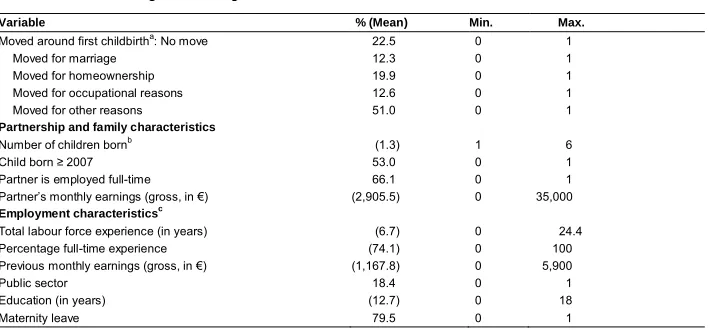
The most important predictors with regard to the research question are those related to household moves, which are coded on a monthly basis. Out of those surveyed, 77% of women moved during the two years before and the two years after first childbirth. This large time span was chosen because couples might move to a child-friendly environment well in advance of conception (Vidal, Huinink, and Feldhaus 2017) as well as after having the first child (Kulu 2008). Moves that occurred during the 24 months before first childbirth were modelled as time-constant information and moves that occurred during the 24 months after first childbirth as time-variant. After preliminary analyses both types of moves were combined because their effects on mothers’ labour market (re-)entry were similar (moved before first childbirth: hazard ratio (HR) = 0.76, p = 0.004; moved after: HR = 0.80, p = 0.024). Moves later than 24 months after childbirth were not considered (HR = 0.88, p = 0.80). There are 1,034 movers in the sample, of whom 28% moved before and after first childbirth. In the case of multiple moves the information on reasons for moving, housing, and area characteristics was updated with each move. Reasons for moving were asked with 15 categories, and multiple reasons were permitted. In Table 1 a sample description at t = 1, that is, the month of first childbirth, is depicted. A description and additional analyses of reasons for moving can be found in the Supplement.
Table 1: Sample description
Variable % (Mean) Min. Max.
Moved around first childbirtha: No move 22.5 0 1
Moved for marriage 12.3 0 1
Moved for homeownership 19.9 0 1
Moved for occupational reasons 12.6 0 1
Moved for other reasons 51.0 0 1
Partnership and family characteristics
Number of children bornb (1.3) 1 6
Child born ≥ 2007 53.0 0 1
Partner is employed full-time 66.1 0 1
Partner’s monthly earnings (gross, in €) (2,905.5) 0 35,000
Employment characteristicsc
Total labour force experience (in years) (6.7) 0 24.4
Percentage full-time experience (74.1) 0 100
Previous monthly earnings (gross, in €) (1,167.8) 0 5,900
Public sector 18.4 0 1
Education (in years) (12.7) 0 18
Maternity leave 79.5 0 1
Source: Own elaboration based on SOEP data, 1999–2014.
Note: N = 1,334 women and their partners. If not indicated otherwise, variables are measured at t = 1, that is, the month of first childbirth.a Moves are measured during the 24 months before and 24 months after first childbirth. Multiple reasons for moving were
permitted. The average number of reasons per mover is 2.3.b In the observation window.cEmployment characteristics are
measured during the 12 months before first childbirth.
4. Findings
Moving around first childbirth is common, as 77% of women did relocate during the 24 months before and 24 months after first childbirth (movers), whereas 23% did not (stayers). For stayers, the observation window is often shorter, comprising 19 months on average (max. 80 months), whereas it is 28 months on average for movers (max. 138 months); but the (re-)entry into the labour market is observed equally often, in 48% of stayers and 49% of movers (not displayed; results available on request). Nevertheless, it is important to account for right-censoring of the data in the analysis; otherwise the effects could be biased due to group-specific lengths of the observation window. This type of censoring typically occurs in panel studies at the time of the last panel wave but could also happen due to panel attrition. It can be easily handled with event history methods (Blossfeld, Golsch, and Rohwer 2007: 41), as will be applied here.
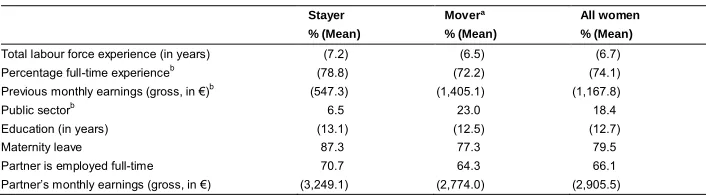
4.1 Employment characteristics of movers and stayers
more total labour force experience and more full-time experience compared to movers, but they had much lower average earnings; instead, their partners earned more. Additionally, the share of stayers working in the public sector was small compared to movers, but stayers were more often on maternity leave when the first child arrived. These figures suggest that stayers were more often secondary earners before the first child arrived compared to movers.
Table 2: Movers’ and stayers’ employment characteristics at first childbirth Stayer Moverª All women % (Mean) % (Mean) % (Mean)
Total labour force experience (in years) (7.2) (6.5) (6.7)
Percentage full-time experienceb (78.8) (72.2) (74.1)
Previous monthly earnings (gross, in €)b (547.3) (1,405.1) (1,167.8)
Public sectorb 6.5 23.0 18.4
Education (in years) (13.1) (12.5) (12.7)
Maternity leave 87.3 77.3 79.5
Partner is employed full-time 70.7 64.3 66.1
Partner’s monthly earnings (gross, in €) (3,249.1) (2,774.0) (2,905.5)
Source: Own elaboration based on SOEP data, 1999–2014.
Note: N = 1,334 women and their partners. Variables are measured at t = 1, that is, the month of first childbirth.a Moves are measured during the 24 months before first childbirth.bEmployment characteristics are measured during the 12 months before first
childbirth.
4.2 Housing characteristics before and after moving
Table 3: Housing and area characteristics of young families before and after movinga
Before After t-value
Size of home (in square metre; mean) 92.2 104.3 12.8***
Number of rooms (mean) 3.6 4.1 12.3***
Rent in € (if applicable; mean) 512.7 563.3 7.2***
Homeowner (%) 25.5 36.6 9.8***
Family homeb (%) 36.1 45.2 7.2***
Garden (%) 52.2 62.0 7.9***
Metropolitan areac (%) 46.8 43.1 –4.0***
Suburban/urbanized areac (%) 38.5 45.0 5.8***
Source: Own elaboration based on SOEP data, 1999–2014.
Note: N = 1,034 movers. ***p < 0.001, **p < 0.01, *p < 0.05.a Moves are measured during the 24 months before and 24 months after
first childbirth.b Detached or semi-detached house or terraced house for one or two families.c Areas are derived from the BIK
classification, which is based on municipal data of numbers of inhabitants and employees’ commuter flows. ‘Metropolitan area’ = centres of cities with at least 100,000 inhabitants, ‘Rural area’ = settlements and towns with up to 20,000 inhabitants, ‘Suburban/urbanized areas’ = city peripheries and small to medium sized municipalities (>20,000 – <100,000 inhabitants).
4.3 Timing of the labour market entry after first childbirth
To assess the impact of housing relocation on mothers’ employment while controlling for potential confounding factors, we turned to event history analysis, using stratified Cox regression, as described in the Methods section. Model 1 in Table 4 shows that moving around first childbirth was associated with a delayed (re-)entry into the labour market. When specific reasons for moving were included in Model 2, a more complex picture emerged. Moving for marriage deterred mothers’ (re-)entry into employment. The hazard of entering employment after first childbirth was reduced by 38% (1 – 0.62) compared to recent mothers who did not move house, whereas opposite effects of the same size were observed for mothers who moved for homeownership and occupational reasons. The remaining category that subsumed other reasons for moving showed a strong and highly significant negative effect on mothers’ (re-)employment.
reduced it. The coefficients for moving for homeownership and occupational reasons were markedly diminished and were no longer statistically significant when employment resources were controlled, such as previous labour market experience, earnings, and educational level. The employment-deterring effect of moving for marriage and other reasons around first childbirth remained strong and significantly negative.
Table 4: Hazard ratio of mothers’ labour market (re-)entry after first childbirth
Model 1 Model 2 Model 3 Model 4 Model 5 HR SE B HR SE B HR SE B HR SE B HR SE B Moved around first childbirtha
Moved (ref. = no move)
For all/other reasons 0.72 ** 0.10 0.68*** 0.11 0.79* 0.12 0.67** 0.13 0.67*** 0.12
For marriage 0.62*** 0.14 0.63** 0.14 0.69* 0.14
For homeownership 1.38** 0.10 1.41** 0.11 1.00 0.11
For occupational reasons 1.35** 0.12 1.32* 0.12 1.10 0.12
Partnership and family characteristics
Number of children 0.48*** 0.12 0.47*** 0.12 0.47*** 0.12
Child born ≥ 2007 1.36** 0.09 1.30** 0.10 1.31** 0.10
Partner is employed full-time 0.75* 0.13 0.77* 0.13 0.76* 0.13
Partner’s earnings (gross, in €100) 1.00 0.00 0.99* 0.00 0.99* 0.00
Employment characteristicsb
Total labour force experience (years) 1.01 0.01 1.01 0.01
Percentage full-time experience 1.73*** 0.14 1.71*** 0.14
Previous earnings (gross, in €100) 1.02*** 0.00 1.02*** 0.00
Public sector 1.44*** 0.10 1.44*** 0.10
Education (in years) 1.10*** 0.02 1.11*** 0.02
Maternity leave at first childbirth 2.04*** 0.19 2.06*** 0.19
Person-months 35,259 35,259 35,259 35,259 35,259
No. of persons 1,334 1,334 1,334 1,334 1,334
No. of events 638 638 638 638 638
LR χ2 10.6*** 37.7*** 101.6*** 278.0*** 270.4***
df 1 4 9 15 12
Source: Own elaboration based on SOEP data, 1999–2014.
Note: Cox regressions, stratified by East Germans, West Germans, and immigrants. Controls are: partner information missing (omitted from the table). HR = eB = Hazard Ratio. ***p < 0.001, **p < 0.01, *p < 0.05.a Moves are measured during the 24 months
before and 24 months after first childbirth.bEmployment characteristics are measured during the 12 months before first childbirth.
association between moving for homeownership and employment (not displayed). These factors are also important when applying for the mortgage. However, the negative impact on employment of moving for marriage, a sign of adherence to the normative image of the family and an increasing salience of the family sphere, supports the assumption of self-selection into homemaking, largely independent of labour force commitment and human capital. Furthermore, the strong negative effect of other reasons for moving, which include factors such as having more space and a child-friendly environment, support the view that spatial constraints may play an important role. As Model 5 shows, the negative effect of moving around first childbirth on mothers’ (re-)employment – reasons not specified – persisted, compared to Model 1, when all covariates were included in the estimation.
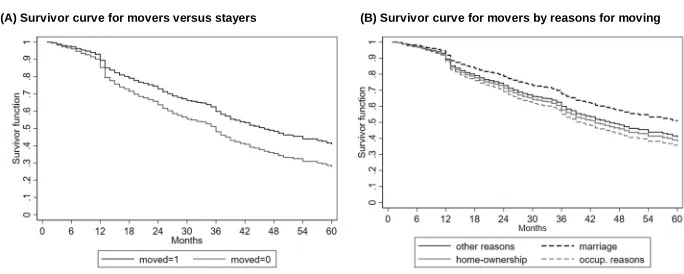
Figure 1 illustrates that the survivor function of staying out of the labour force for the first five years after childbirth was affected by moving around first childbirth generally (A, left-hand side) and by moving for particular reasons (B, right-hand side). The graphs are based on the estimates of the full Models 4 and 5 in Table 4. In the first 12 months after childbirth the curves of both graphs are rather similar, after 12 months the difference between movers and stayers as well as between those who moved for particular reasons becomes clearly visible. Graph A reveals that mothers who moved around first childbirth (re-)entered the labour market later than their counterparts, who did not move. Graph B shows that mothers who moved for occupational reasons (re-)entered employment the fastest, followed by those who moved for homeownership and other reasons. Women who moved for marriage had the longest employment interruptions.
Figure 1: Estimated survivor curve for duration of absence from the labour market after first childbirth
(A) Survivor curve for movers versus stayers (B) Survivor curve for movers by reasons for moving
4.4 Full-time or part-time employment after childbirth
The results in Table 4 suggest that moving around first childbirth delayed mothers’ labour market (re-)entry in general, and there is some evidence for self-selection of women with a stronger family orientation, little work experience, and low earnings potential into homemaking. As these women are particularly responsive to the convenience of work settings (Desai and Waite 1991), we estimated Cox regressions for two competing outcomes: full-time or part-time jobs. Self-selection into homemaking via moving around first childbirth can be expected to delay entering part-time work more strongly than entering full-time work because working part-time might be an expression of a mother’s relatively low commitment to the world of work (Hakim 2000), and living in the city outskirts normally comes at the cost of relatively high commuting distance, which makes part-time work unattractive (MacDonald 1999; Lee and McDonald 2003).
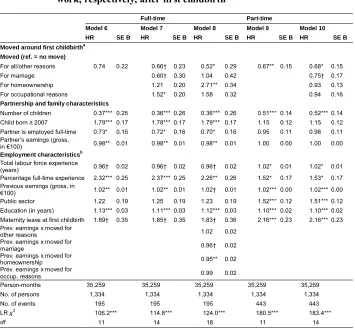
Models 6 to 8 in Table 5 present hazard ratio estimates of entering full-time employment after first childbirth whereas the histories of those who started part-time work were considered in the estimation until the occurrence of the competing event (part-time job). At this point the episodes were censored. The hazard of entering the labour market on a part-time basis was estimated analogously and is presented in Models 9 and 10. Again, Cox regression was applied, stratified for East Germans, West Germans, and immigrants to account for stratified samples.
Table 5: Hazard ratio of mothers’ (re-)entry into full-time and part-time work, respectively, after first childbirth
Source: Own elaboration based on SOEP data, 1999–2014.Note: Cox regression, stratified by East Germans, West Germans, and immigrants. ***p < 0.001, **p < 0.01, *p < 0.05, †p < 0.1. HR = eB = Hazard Ratio.a Moves are measured during the 24 months
before and 24 months after first childbirth.bEmployment characteristics are measured during the 12 months before first childbirth.
In further model specifications it became evident that mothers who moved for occupational reasons or homeownership were more likely to (re-)enter the labour market on a full-time basis than stayers (Model 7). The influence of moving for homeownership interacted with women’s labour market potential (Model 8). The accelerating effect of moving for homeownership was especially pronounced for mothers with low previous earnings, as the effect size decreased with rising earnings potential. We can conclude that for a share of mothers who purchased a new home
Full-time Part-time
Model 6 Model 7 Model 8 Model 9 Model 10 HR SE B HR SE B HR SE B HR SE B HR SE B Moved around first childbirtha
Moved (ref. = no move)
For all/other reasons 0.74 0.22 0.66† 0.23 0.52* 0.29 0.67** 0.15 0.68* 0.15
For marriage 0.60† 0.30 1.04 0.42 0.75† 0.17
For homeownership 1.21 0.20 2.71** 0.34 0.93 0.13
For occupational reasons 1.52* 0.20 1.58 0.32 0.94 0.16
Partnership and family characteristics
Number of children 0.37*** 0.25 0.36*** 0.26 0.36*** 0.26 0.51*** 0.14 0.52*** 0.14
Child born ≥ 2007 1.79*** 0.17 1.78*** 0.17 1.79*** 0.17 1.15 0.12 1.15 0.12
Partner is employed full-time 0.73* 0.15 0.72* 0.16 0.70* 0.16 0.95 0.11 0.98 0.11
Partner’s earnings (gross,
in €100) 0.98** 0.01 0.98** 0.01 0.98** 0.01 1.00 0.00 1.00 0.00
Employment characteristicsb
Total labour force experience
(years) 0.96† 0.02 0.96† 0.02 0.96† 0.02 1.02* 0.01 1.02* 0.01
Percentage full-time experience 2.32*** 0.25 2.37*** 0.25 2.26** 0.26 1.52* 0.17 1.53* 0.17
Previous earnings (gross, in
€100) 1.02** 0.01 1.02** 0.01 1.02† 0.01 1.02*** 0.00 1.02*** 0.00
Public sector 1.22 0.19 1.25 0.19 1.23 0.19 1.52*** 0.12 1.51*** 0.12
Education (in years) 1.13*** 0.03 1.11*** 0.03 1.12*** 0.03 1.10*** 0.02 1.10*** 0.02
Maternity leave at first childbirth 1.89† 0.35 1.85† 0.35 1.83† 0.36 2.16*** 0.23 2.16*** 0.23
Prev. earnings x moved for
other reasons 1.02 0.02
Prev. earnings x moved for
marriage 0.96† 0.02
Prev. earnings x moved for
homeownership 0.95** 0.02
Prev. earnings x moved for
occup. reasons 0.99 0.02
Person-months 35,259 35,259 35,259 35,259 35,259
No. of persons 1,334 1,334 1,334 1,334 1,334
No. of events 195 195 195 443 443
LR χ2
106.2*** 114.8*** 124.0*** 180.5*** 183.4***
around the birth of the first child, the likely high costs associated with moving and housing had an accelerating effect on entering full-time employment. Moving for other reasons, such as a small dwelling, bad facilities, location, and surroundings, deterred mothers from entering full-time employment.
The determinants of the hazard rate were rather different for part-time employment (Models 9 and 10). There was a significant negative impact of moving around first childbirth on women’s part-time employment, as expected. The relative hazard for movers was 67% of the hazard of those who did not move around childbirth. Mothers’ human capital indicators were again influential, but partners’ employment characteristics were of minor importance when it came to part-time employment. Having additional children again hindered employment, while extensive rights to part-time work for public-sector employees were reflected in their significantly increased hazard of entering part-time employment. Having the first child under the new parental leave regulations after 2007 was not significant.
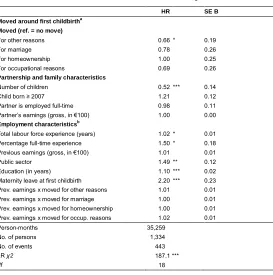
When reasons for moving were differentiated, it became obvious that the negative impact of moving around first childbirth on mothers’ part-time (re-)employment was related to moving for marriage or other reasons, whereas moving for homeownership or occupational reasons had no effect. There were no significant interactions between moving for particular reasons and a mother’s earnings potential on part-time (re-)entry (see Table A-3 in the Supplement).
5. Discussion
childrearing and the way such needs are met reflect normative ideals on family nest-building involving a ‘proper family home’ and a child-friendly environment.
Empirical results in the present longitudinal study contribute to the body of literature about interrelated processes in different life domains over the family life course. Decisions on family formation, housing relocation, and women’s employment conditions are closely intertwined; these processes constrain or reinforce each other, also depending on the household’s and women’s resources. First, housing relocation around first childbirth was found to be related to an increased employment rate after childbirth for those women who undertook their moves for homeownership, but this effect was largely explained by mothers’ human capital and labour market commitment. Therefore, only limited evidence was found for the hypothesis that moving around first childbirth accelerates mothers’ labour market (re-)entry due to high costs for housing and moving. In general, it seems that couples who buy a family home around first childbirth do so if they anticipate that they can afford it without significant consequences for their labour supply. An exception were mothers with low earnings potential. Moving for homeownership significantly increased their (re-)entry rate into full-time employment. This result is consistent with the findings that some women expand their labour force participation to meet increased financial demands after childbirth (Estes and Glass 1996), and that women with low work commitment are especially responsive to financial pressures (Desai and Waite 1991). These women might perceive a necessity to participate in the labour force although this might not necessarily reflect the preferences of the women and/or their partners (Gash 2008).
Second, the analysis lends stronger support for the hypothesis that moving around first childbirth impedes mothers’ employment. An overall deterring effect of residential mobility on mothers’ (re-)entry in paid work was found, over and above that of human capital, previous employment, and family characteristics. The finding that moving around first childbirth particularly hampers entering part-time jobs is consistent with the view that working part-time becomes unattractive with long commutes. Although we were not able to test whether moving in fact increased the distance to the (former) workplace, this assumption is plausible in the light of our descriptive analysis of housing and area characteristics before and after moving, and it is plausible in the light of previous findings and the arguments on spatial constraints for mothers (MacDonald 1999; Lee and McDonald 2003). Future research might want to test our argumentation.
References
Abraham, M., Auspurg, K., and Hinz, T. (2010). Migration decisions within dual-earner partnerships: A test of bargaining theory.Journal of Marriage and Family 72(4): 876–892.doi:10.1111/j.1741-3737.2010.00736.x.
Bauernschuster, S. and Rainer, H. (2012). Political regimes and the family: How sex-role attitudes continue to differ in reunified Germany. Journal of Population
Economics 25(1): 5–27.doi:10.1007/s00148-011-0370-z.
Becker, G.S. (1985). Human capital, effort and the sexual division of labour.Journal of
Labour Economics 3(1): 33–58.doi:10.1086/298075.
Begall, K. and Grunow, D. (2015). Labour force transitions around first childbirth in the Netherlands. European Sociological Review 31(6): 697–712. doi:10.1093/ esr/jcv068.
Bielby, W.T. and Bielby, D.D. (1992). I will follow him: Family ties, gender-role beliefs, and reluctance to relocate for a better job. American Journal of
Sociology 97(5): 1241–1267.doi:10.1086/229901.
Blossfeld, H.-P. and Drobnič, S. (2001).Careers of couples in contemporary society:
From male breadwinner to dual-earner families. Oxford: University Press.
Blossfeld, H.-P., Golsch, K., and Rohwer, G. (2007). Techniques of event history
modeling using Stata: New approaches to causal analysis. Mahwah: Erlbaum.
Boyle, P., Cooke, T.J., Halfacree, K., and Smith, D. (2001). A cross-national comparison of the impact of family migration on women’s employment status.
Demography 38(2): 201–213.doi:10.1353/dem.2001.0012.
Boyle, P., Feng, Z., and Gayle, V. (2009). A new look at family migration and women’s employment status. Journal of Marriage and Family 71(2): 417–431.
doi:10.1111/j.1741-3737.2009.00608.x.
Clark, W.A.V., Deurloo, M.C., and Dieleman, F.M. (1994). Tenure changes in the context of micro-level family and macro-level economic shifts. Urban Studies
31(1): 137–154.doi:10.1080/00420989420080081.
Clark, W.A.V. and Maas, R. (2015). Interpreting migration through the prism of reasons for moves. Population, Space and Place 21(1): 54–67. doi:10.1002/ psp.1844.
Cleves, M.A., Gould, W.W., Gutierrez, R.G., and Marchenko, Y.V. (2010). An
Cooke, T.J. (2008). Migration in a family way. Population, Space and Place 14(4): 255–265.doi:10.1002/psp.500.
Cooke, T.J., Boyle, P., Couch, K., and Feijten, P. (2009). A longitudinal analysis of family migration and the gender gap in earnings in the United States and Great Britain.Demography 46(1): 147–167.doi:10.1353/dem.0.0036.
Cox, D.R. (1972). Regression models and life-tables. Journal of the Royal Statistical
Society Series B 34(2): 187–220.doi:10.1111/j.2517-6161.1972.tb00899.x.
De Jong, G.F. and Fawcett, J.T. (1981). Motivations for migration: An assessment and a value expectancy research model. In: De Jong, G.F. and Gardner, R.W. (eds.).
Migration decision making. New York: Pergamon Press: 13–58. doi:10.1016/
B978-0-08-026305-2.50008-5.
Desai, S. and Waite, L.J. (1991). Women’s employment during pregnancy and after the first birth: Occupational characteristics and work commitment. American
Sociological Association 56(4): 551–566.doi:10.2307/2096274.
Drasch, K. (2013). Educational attainment and family-related employment interruptions in Germany: Do changing institutional settings matter? European Sociological
Review29(5): 981–995.doi:10.1093/esr/jcs076.
Drobnič, S., Blossfeld, H.-P., and Rohwer, G. (1999). Dynamics of women’s employment patterns over the family life course: A comparison of the United States and Germany. Journal of Marriage and the Family 61(1): 133–146.
doi:10.2307/353889.
Drobnič, S. (2000). The effects of children on married and lone mothers’ employment in the United States and (West) Germany.European Sociological Review 16(2): 137–157.doi:10.1093/esr/16.2.137.
Estes, S.B. and Glass, J.L. (1996). Job changes following childbirth: Are women trading compensation for family-responsive work conditions? Work and
Occupations 23(4): 405–436.doi:10.1177/0730888496023004005.
Fagan, C. and Warren, T. (2001).Gender, employment and working time preferences in
Europe. Dublin: European Foundation for the Improvement of Living
Conditions.
Fishbein, M. and Ajzen, I. (2010). Predicting and changing behavior: The reasoned
action approach. New York: Taylor and Francis.
Gangl, M. and Ziefle, A. (2015). The making of a good woman: Extended parental leave entitlements and mothers’ work commitment in Germany. American
Journal of Sociology 121(2): 511–563.doi:10.1086/682419.
Gash, V. (2008). Preference or constraint? Part-time workers’ transitions in Denmark, France and the United Kingdom. Work, Employment and Society 22(4): 655– 674.doi:10.1177/0950017008096741.
Hakim, C. (2000).Work-lifestyle choices in the 21st century: Preference theory. Oxford:
University Press.
Huinink, J. and Kohli, M. (2014). A life course approach to fertility. Demographic
Research 30(45): 1293–1326.doi:10.4054/DemRes.2014.30.45.
Janus, A.L. (2013). The gap between mothers’ work-family orientations and employment trajectories in 18 OECD countries. European Sociological Review
29(4): 752–766.doi:10.1093/esr/jcs055.
Kanji, S. (2011). What keeps mothers in full-time employment?European Sociological
Review27(4): 509–525.doi:10.1093/esr/jcq022.
Kley, S. (2011). Explaining the stages of migration within a life-course framework.
European Sociological Review 27(4): 469–486.doi:10.1093/esr/jcq020.
Kulu, H. (2008). Fertility and spatial mobility in the life course: Evidence from Austria.
Environment and Planning A 40(3): 632–652.doi:10.1068/a3914.
Kulu, H., Boyle, P.J., and Andersson, G. (2009). High suburban fertility: Evidence from four northern European countries. Demographic Research 21(31): 915–944.
doi:10.4054/DemRes.2009.21.31.
Kulu, H. and Steele, F. (2013). Interrelationships between childbearing and housing transitions in the family life course. Demography 50(5): 1687–1714.
doi:10.1007/s13524-013-0216-2.
Lauster, N. (2010). Housing and the proper performance of American motherhood, 1940–2005.Housing Studies 25(4): 543–557.doi:10.1080/02673031003711485.
Lee, B.S. and McDonald, J. (2003). Determinants of commuting time and distance for Seoul residents: The impact of family status on the commuting of women.
Lersch, P. (2014a). Geburten und die Wohnraumversorgung von Familien: Anpassungen der Wohnung im zeitlichen Verlauf [Childbirth and room stress among families: Housing adjustments over time]. Zeitschrift für Soziologie
43(2): 131–149.doi:10.1515/zfsoz-2014-0205.
Lersch, P. (2014b).Residential relocations and their consequences: Life course effects
in England and Germany. Wiesbaden: Springer. doi:10.1007/978-3-658-042
57-8.
Lersch, P. (2016). Family migration and subsequent employment: The effect of gender ideology. Journal of Marriage and Family 78(1): 230–245. doi:10.1111/jomf. 12251.
Lersch, P. and Uunk, W. (2017). The shadow of future homeownership: The association of wanting to move into homeownership with labour supply.Work, Employment
and Society 31(3): 522–541.doi:10.1177/0950017016631443.
MacDonald, H. (1999). Women’s employment and commuting: Explaining the links.
Journal of Planning Literature 13(3): 267–283. doi:10.1177/0885412992209
2397.
Matthews, H., Taylor, M., Sherwood, K., Tucker, F., and Limb, M. (2000). Growing-up in the countryside: Children and the rural idyll. Journal of Rural Studies 16(2): 141–153.doi:10.1016/S0743-0167(99)00059-5.
Matysiak, A. and Steinmetz, S. (2008). Finding their way? Female employment patterns in West Germany, East Germany, and Poland. European Sociological Review
24(3): 331–345.doi:10.1093/esr/jcn007.
McRae, S. (2003). Constraints and choices in mothers’ employment careers: A consideration of Hakim’s Preference Theory.British Journal of Sociology 54(3): 317–338.doi:10.1080/0007131032000111848.
Mincer, J. (1978). Family migration decisions. Journal of Political Economy 86(5): 749–773.doi:10.1086/260710.
Mulder, C.H. and Wagner, M. (1993). Migration and marriage in the life course: A method for studying synchronized events.European Journal of Population 9(1): 55–76.doi:10.1007/BF01267901.
Mulder, C.H. and Wagner, M. (2001). The connections between family formation and first-time home ownership in the context of West Germany and the Netherlands.
European Journal of Population 17(2): 137–164. doi:10.1023/A:10107063088
Nisic, N. (2009). Labour market outcomes of spatially mobile coupled women: Why is the locational context important? Schmollers Jahrbuch 129(2): 203–215.
doi:10.3790/schm.129.2.203.
Nisic, N. (2017). Smaller differences in bigger cities? Assessing the regional dimension of the gender wage gap. European Sociological Review 33(2): 292–304.
doi:10.1093/esr/jcx037.
Rosenfeld, R.A., Trappe, H., and Gornick, J.C. (2004). Gender and work in Germany: Before and after reunification. Annual Review of Sociology 30(1): 103–124.
doi:10.1146/annurev.soc.30.012703.110531.
Rossi, P.H. (1980 [1955]).Why families move. Beverly Hills: Sage.
Sandor, E. (2011). European Company Survey 2009: Part-time work in Europe. Luxembourg: Publications Office of the European Union.
Sayer, L.C. and Gornick, J.C. (2012). Cross-national variation in the influence of employment hours on child care time. European Sociological Review 28(4): 421–442.doi:10.1093/esr/jcr008.
Shauman, K.A. (2010). Gender asymmetry in family migration: Occupational inequality or interspousal comparative advantage? Journal of Marriage and
Family 72(2): 375–392.doi:10.1111/j.1741-3737.2010.00706.x.
Shihadeh, E.S. (1991). The prevalence of husband-centred migration: Employment consequences for married mothers. Journal of Marriage and the Family 53(2): 432–444.doi:10.2307/352910.
SOEP (2016). Socio-Economic Panel data for years 1984–2014, version 31.1 [electronic resource]. Berlin: German Institute for Economic Research.
https://www.diw.de/en/diw_01.c.519355.en/soep_v31.html.
Stockdale, A. and Catney, G. (2014). A life course perspective on urban–rural migration: The importance of the local context. Population, Space and Place
20(1): 83–98.doi:10.1002/psp.1758.
Trappe, H., Pollmann-Schult, M., and Schmitt, C. (2015). The rise and decline of the male breadwinner model: Institutional underpinnings and future expectations.
European Sociological Review31(2): 230–242.doi:10.1093/esr/jcv015.
van Dam, F., Heins, S., and Elbersen, B.S. (2002). Lay discourses of the rural and stated and revealed preferences for rural living: Some evidence of the existence of a rural idyll in the Netherlands. Journal of Rural Studies 18(4): 461–476.
Vidal, S., Huinink, J., and Feldhaus, M. (2017). Fertility intentions and residential relocations.Demography 54(4): 1305–1330.doi:10.1007/s13524-017-0592-0.
Vidal, S., Perales, F., and Baxter, J. (2016). Dynamics in domestic labor across short-and long-distance family relocations. Journal of Marriage and Family 78(2): 364–382.doi:10.1111/jomf.12269.
Vidal, S., Perales, F., Lersch, P., and Brandén, M. (2017). Family migration in a cross-national perspective: The importance of institutional and cultural context.
Demographic Research 36(10): 307–338.doi:10.4054/DemRes.2017.36.10.
Wagner, G., Frick, J., and Schupp, J. (2007). The German Socio-Economic Panel Study (SOEP): Scope, evolution and enhancements. Berlin: German Institute for Economic Research (SOEPpapers on Multidisciplinary Panel Data Research 1). Willekens, F. (1987). Migration and development: A micro-perspective. Journal of
Institute of Economic Research22(2): 51−68.
Winship, C. and Radbill, L. (1994). Sampling weights and regression analysis.
Sociological Methods and Research 23(2): 230–257.doi:10.1177/00491241940
23002004.
Supplement
Description and additional analysis of reasons for moving
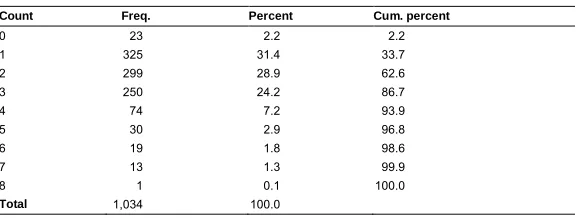
Reasons for moving were reported by the household head. These may not reflect the reasons of other household members, which may be conflicting. Respondents could choose multiple reasons from a list of 15. The distribution of reasons for moving and their effect on mothers’ re-entry to the labour market are described in Table A-1. The most frequent reasons for the (last) move were “dwelling too small” (49%), “family, other” (32%), and “buying a dwelling” (referred to as “homeownership,” 25%); “childbirth” was not included in the list of reasons for moving. Most movers reported one or two reasons for moving, 2% reported no reason, and 1% reported seven to eight reasons (Table A-2). The reasons “dwelling too small,” “bad facilities,” “bad surroundings,” and “bad location” were found to be significantly correlated. These reasons for moving reflect changing needs with regard to the dwelling and its location that are interpreted as being associated with childbirth.
Table A-1: Distribution of reasons for moving among movers1 and partial effects
of moves for particular reasons before or after first childbirth regressed on mothers’ (re-)employment2
Moved Moved Moved
Reasons for moving before or after before childbirth after childbirth
% HR SE B HR SE B HR SE B
Reference: no move
Notice of termination 3.0 0.72 0.24 0.77 0.26 0.75 0.35
Homeownership 25.3 1.35 ** 0.14 1.38 ** 0.15 1.31 0.25
Inheritance 1.5 1.77 † 0.52 1.82 * 0.54
Occupational reasons 16.1 1.33 * 0.16 1.31 * 0.16 1.45† 0.28
Marriage 15.9 0.63 ** 0.09 0.65 ** 0.10 0.77 0.19
Separation 4.9 1.16 0.29 1.23 0.31 0.94 0.38
Leaving parental home 15.7 0.92 0.12 0.93 0.12 1.07 0.22
Family, other 32.3 1.01 0.10 1.02 0.10 1.16 0.20
Dwelling too small 49.2 1.03 0.10 1.04 0.10 1.15 0.20
Dwelling too large 1.5 0.79 0.34 0.78 0.33 0.61 0.46
Dwelling cost too high 9.4 0.85 0.15 0.89 0.15 0.79 0.23
Bad facilities 10.1 0.99 0.16 0.98 0.16 0.91 0.23
Bad location 7.8 1.03 0.18 1.04 0.20 0.81 0.23
Bad surrounding 14.4 1.07 0.16 1.05 0.16 1.42† 0.30
Other 18.2 1.02 0.12 1.07 0.13 1.07 0.21
Total 225.3
Source: Own elaboration based on SOEP data, 1999–2014.
Note: ***p < 0.001, **p < 0.01, *p< 0.05, †p< 0.1.1 Moves are measured during the 24 months before and 24 months after first
childbirth. Multiple reasons for moving were permitted. In the case of multiple moves, the reasons for the last move are displayed. N = 1,034 movers.2 Cox regressions, stratified by East Germans, West Germans, and immigrants. N = 35,259 person-months. The
number of persons is 1,334. Controls are: reason for moving missing (omitted from the table). HR = eB = Hazard Ratio. = not
enough cases.
Table A-2: Number of statements about reasons for moving Count Freq. Percent Cum. percent
0 23 2.2 2.2
1 325 31.4 33.7
2 299 28.9 62.6
3 250 24.2 86.7
4 74 7.2 93.9
5 30 2.9 96.8
6 19 1.8 98.6
7 13 1.3 99.9
8 1 0.1 100.0
Total 1,034 100.0
Source: Own elaboration based on SOEP data, 1999–2014.
Table A-3: Hazard ratio of mothers’ (re-)entry into part-time job after first childbirth, and interactions with previous income
HR SE B
Moved around first childbirtha Moved (ref. = no move)
For other reasons 0.66 * 0.19
For marriage 0.78 0.26
For homeownership 1.00 0.25
For occupational reasons 0.69 0.26
Partnership and family characteristics
Number of children 0.52 *** 0.14
Child born ≥ 2007 1.21 0.12
Partner is employed full-time 0.98 0.11
Partner’s earnings (gross, in €100) 1.00 0.00
Employment characteristicsb
Total labour force experience (years) 1.02 * 0.01
Percentage full-time experience 1.50 * 0.18
Previous earnings (gross, in €100) 1.01 0.01
Public sector 1.49 ** 0.12
Education (in years) 1.10 *** 0.02
Maternity leave at first childbirth 2.20 *** 0.23
Prev. earnings x moved for other reasons 1.01 0.01
Prev. earnings x moved for marriage 1.00 0.01
Prev. earnings x moved for homeownership 1.00 0.01
Prev. earnings x moved for occup. reasons 1.02 0.01
Person-months 35,259
No. of persons 1,334
No. of events 443
LRχ2 187.1 ***
df 18
Source: Own elaboration based on SOEP data, 1999–2014.
Note: Cox regression, stratified by East Germans, West Germans, and immigrants. HR = eB = Hazard Ratio. ***p < 0.001, **p < 0.01,
*p < 0.05, †p < 0.1.a Moves are measured during the 24 months before and 24 months after first childbirth.bEmployment