1: Immunology Research Center, Bu-Ali Research Institute, University of Medical Sciences, Mashhad, Iran.
The Influence of Gamma Radiation Processing
on the Allergenicity of Main Pistachio Allergens
Vahid Yaghoubi Naei
1, Mojtaba Sankian
1, Malihe Moghadam
1, Narges Farshidi
1,
Seyed Hasan Ayati
1, Fatemeh Hamid
2, Abdol-Reza Varasteh*
1Abstract
Background:Gamma irradiation is a form of processing with an array of applications in medical sciences such
as microbial decontamination, viruses inactivation, cervical carcinoma and breast cancer treatment. One of the ways in which gamma irradiation has the potential to be used is in reducing the allergenicity of food allergens.
Methods:In the present study, pistachios were irradiated with either a 1, 10, or 100 kGy dose of gamma irradiation. The binding rate of mice and human antibodies to the allergens of the pistachio extracts were examined via Western blot analysis.
Results:Our findings show an inverse dose-response relationship between the binding rate of antibodies to the
pistachio allergens and the gamma irradiation dose. Despite these promising findings, the results of our sensory evaluation indicate that gamma irradiation causes undesirable changes to the sensory characteristics of pistachios, especially at the dose of 100 kGy.
Conclusions:Gamma irradiation appears to be an effective method in reducing the allergenicity of pistachios.
Thus, this form of processing has the potential to prevent adverse allergic reactions to the major pistachio allergens in sensitized subjects. However, further research must be dedicated to examining the dose sufficient in reducing allergencity, while maintaining adequate sensory quality for satisfactory consumption.
Keywords:Allergenicity, Gamma irradiation, Pistachio.
Introduction
Atopic allergic disease is a consequence of the body inappropriately engaging an immune response towards innocus substances. This type of immune
response, termed hypersensitivity reactions,
manifests through a variety of different symptoms. This broad category of immune hypersensitivity reactions includes food allergies (1). Food allergy is most prevalent in developed countries such as the United States (US) where approximately 6-8% of young children and 3.5% of adults suffer from some form of food allergy (2, 3).
The incidence of food allergy is multifactorial and has been linked to a number of factors including: genetic background, route of exposure, allergen dose, and the molecular properties of the
allergen which are all pivotal in determining the clinical presentation of symptoms (4, 5).
Allergens are non-pathogenic proteins, or antigens, found in several different types of substances including pollen, dust, peanuts, eggs, and milk that have the capacity to induce an excessive and unwarranted immune response in some individuals. When an allergen adheres to the surface of an immune cell, it causes the secretion of IgE which binds to high-affinity receptors are located on mast cells. Crosslinking of these
transmembrane receptors by antibodies
subsequently triggers a cell signaling cascade that leads to an allergic response involving the release of chemicals and pro-inflammatory factors. During
an allergic response, one substance released in particular, histamine, underlies the majority of allergic symptoms such as wheezing, pruritus, and asthma (3).
As reported by David et al.1997, peanuts are the third most common allergen responsible for allergic reactions among Asian children. In addition to peanuts, several other tree nuts including pistachios, cashews, walnuts, almonds, hazelnuts, and pecans have been considered as significant allergens within the United States and Europe. Pistachios (Pistacia vera) are one of the most commonly used tree nuts belonging to the Anacardiacea family of plants. Pistachios contain a high nutritional value, are easily accessible and can undergo diverse methods of processing which has led to a high rate of pistachio consumption. The increased rate of allergic reactions to pistachios is proportional to its increased consumption (6, 7). Given the wide prevalence of pistachios, introducing an effective method capable of reducing the allergenicity of this tree nut could result in a significant decrease in the number or severity of allergic reactions occurring in the population.
Forms of ionizing radiation including, X-rays, alpha/beta particles and gamma rays have recently been used to reduce the allergenicity of different foods. Gamma irradiation has provided significant contributions to the food industry, for example to reduce allergenicity of albumin (8-10). The breakdown of cobalt-60 results in water radiolysis which causes both physical and chemical modifications to the basic structure of the food and its allergens. These changes have the potential to alter the allergen epitopes and consequently reduce their IgE binding (11). In this study, we aimed to assess the effect of different doses of gamma irradiation on pistachio allergenicity.
Materials and methods
Iran is one of the key pistachio cultivators in the world, producing a considerable amount of different pistachio types such as, Akbari, Kalleh-Ghuchi, Ahmad Aghai and Fandoghi. Among the major commercial varieties the use and consumption of the Akbari pistachio is particularly wide spread among industries and
households (6). Thus, this was the type of pistachio examined in our study.
To investigate the effectiveness of gamma irradiation on pistachio allergenicity, 200 g- samples of raw pistachios from the main pistachio producer province in Iran (Kerman city), were divided into four groups. Group 1 was the control in which the pistachios received no gamma irradiation treatment. Groups 2, 3 and 4 were the test groups in which the pistachios were treated with 1, 10 or 100 kGy doses of gamma irradiation (determined by the Atomic Energy Organization, Iran), respectively (12). Proteins from 10 g of pistachios from each group were extracted following gamma irradiation. The remaining pistachios were tested by a set of 40 random individuals (18-22-year-old students). The quality of the pistachios was examined based on the taste, odor, color, chew ability, and overall acceptability of the product. During this sensory evaluation process, 3 pistachios from each group were distributed to each subject at random. Individuals were then asked to report their experience in the questionnaire provided. The choices for the questionnaire Reponses ranged from very good, good, average, bad and very bad. The volunteers were asked to wash their mouth to prevent contaminating tastes.
The allergic potency was examined from the extracts of the treated and non-treated pistachios. For this purpose, the two major pistachio allergens (7, 13, 14), mouse antiserum against recombinant profilin and manganese superoxide dismutase, were produced and examined as described below. The resulting mouse antiserum, was utilized for western blot analyses to determine the antibody reactivity of the pistachio extracts. Additionally, serum collected and pooled together from individuals allergic to pistachios were utilized in the western blots to examine IgE reactivity.
Mouse antiserum production: Profilin and
manganese superoxide dismutase were
expressed as histidine-tagged recombinant
proteins in Escherichia coli. After purification of
recombinant proteins by Ni-IDA column
(Parstous biotechnology, Mashhad, Iran),
BALB/c mouse polyclonal antibodies against the
pistachio allergens were produced via
intramuscular and intraperitoneal injections of 8-10 μg of antigen in complete Freundʹs adjuvant. Phlebotomy was carried out following three booster doses of the proteins in incomplete Freundʹs adjuvant administered at 7 day intervals.
Pistachio protein extraction: A 10 g sample of each group was grinded for 30-40 s using a kitchen grinder (Moulinex, France). The fat in the samples was removed (dissolving extracts in hexane (1/15 w/v), shaking for 18 hours at 4 ˚C, hexane was then removed via a vacuum pump (Millipore, Germany). Acetone was added to wash any lingering hexane from the samples. The dry extracts were then reconstituted in Phosphate-buffered saline (PBS, pH: 7.4, 1:10 w/v) including complete protease inhibitor cocktail (Roche, Mannheim, Germany). The solution was kept on a shaker for 18 hours at 4 ˚C. Following centrifugation for 30 min at 9000 g, the supernatant was removed and dialyzed (MW cut off 12000, Sigma, USA) in PBS for 24 hours at 4 ˚C. Afterwards, the Bradford protein assay was used to measure protein concentration against a BSA solution as the standard (15).
Western blot analysis: Total extracts from each group were run in a 12.5% (w/v) SDS-PAGE (16) in duplicates, one for assessing IgE reactivity (blot A) and the other for general antibody reactivity (blot B). Protein bands, were
transferred from the SDS-PAGE to
polyvinylidene difluoride (PVDF) membranes (Millipore, Bedford, MA) which were then blocked (incubation in 2% BSA overnight at 4 ˚C). The blots were washed 3 times, for 5 min each with PBS. Blot A was incubated with the pooled serum from 15 allergic patients (1:5 dilution in PBS) overnight at 4 ˚C. To remove any unbound antibodies, the PVDF sheets were washed with PBS, 5 times for 5 min each time. The blots were then incubated with biotinylated anti-human IgE (KPL, USA) (1: 1000 diluted with 1% BSA). After another washing step, the membranes were incubated in horseradish
peroxidase-linked Streptavidin (BD,
Biosciences, MD) (1:25000 diluted in 1% BSA). The blots were washed again and incubated with
chemiluminescent substrate (Parstous
biotechnology, Mashhad, Iran) for 3 min. Bands
were detected using a G-Box gel documentation system (Syngene, Cambridge, UK).
For blot B, after blocking with 2.5% skimmed milk (overnight in room temperature), the membranes were incubated with the
previously described mouse antiserum in (1:250
dilution in 5% skimmed milk), for 2 hours at room temperature. Wash steps were the same as blot A. The membranes were then incubated for 1 hour with HRP-labelled goat anti-mouse antibody (diluted 1/1000 in 2.5% skim milk) at room temperature. The rest of the procedure was the same as described for blot A.
Results
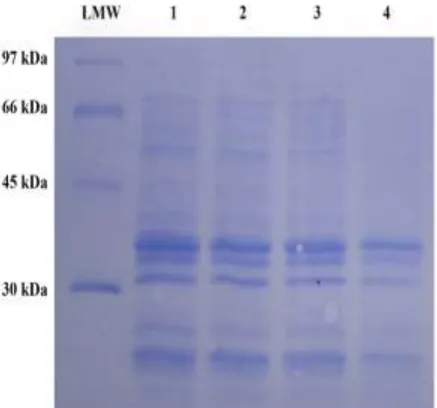
Proteins from the gamma irradiated (1, 10 and 100 kGy) and non-irradiated (control) pistachio extracts were compared via SDS-PAGE. Equal amounts (8 mg total protein for each extract) of samples were loaded in each lane. The extraction protein profiles for the different groups are shown in (Fig 1).
According to SDS-PAGE analysis, irradiation caused major changes in the pattern and intensity of the protein extracts. In the 100 kGy gamma irradiated sample, the intensity of the protein bands was significantly decreased, while some disappeared entirely. Figure 2 shows the comparison of IgE binding between the control and treatment extracts.
Fig. 1. SDS-PAGE analysis with the coomassie blue staining. LMW: low molecular weight marker. The numbers 1-4 are referring to the different groups (1-4), beginning with control, 1, 10 and 100 kGy, respectively.
Similar results were obtained with mouse antibodies. In comparison to the control group,
the binding rate of the mouseantibodies to the
Fig. 2. Western blot of the extracts with human patient serum. LMW: low molecular weight marker. Number 1 is the negative control, while 2-4 are referring to the specific groups (positive control, 1, 10 and 100 kGy, respectively). Immunoblotting of the protein extracts was performed via biotinylated anti-human IgE. The arrows indicate immune reactions of anti-human IgE to the protein extracts on a PVDF membrane.
pistachio extracts decreased in the treatment groups when examined on the Kodak 1 D analysis software. As the irradiation dose increased, the binding rate of the mouse antibodies to the pistachio extracts decreased. The 100 kGy treatment dose resulted in the most significant reduction of antibody binding. As seen in Figure 3 and 4, there is a clear reduction in the serum reactivity with
profilin and Pis v 4 in the treatment groups.
The effect of gamma irradiation on the sensory attributes of pistachio were evaluated via descriptive sensory analysis. The results showed gamma irradiation to cause a number of undesirable sensory characteristics in pistachios, especially at the dose of 100 kGy. All of the sensory factors evaluated were compared between the control group and the 3 treated groups. The scores of group 1 (control), 2 (1 kGy irradiated) and 3 (10 kGy irradiated) were similar. However, the scores
attributed with the 100 kGy group were much lower indicating a lower overall quality of pistachio.
Fig. 3. Western blot of recombinant profilin with mouse polyclonal antibodies. LMW: low molecular weight marker. The numbers 1-5 are referring to the different control and treatment groups, negative control, positive control, and the 1, 10 and 100 kGy treated groups, respectively.
Fig. 4. Western blot of recombinant Pis v 4 with mouse polyclonal antibodies. LMW: low molecular weight marker. 1 is referring to the negative control (with negative serum). 2, 3, 4 and 5 are the positive controls and the irradiated samples with a dose of either 1, 10 or 100 kGy, respectively.
Fig. 5. Sensory evolution test. Pistachios were randomly allocated into control (no gamma irradiation) or treatment groups 1, 2, and 3 (irradiated with 1, 10, and 100 kGy of gamma irradiation, respectively). The sensory evaluation (color, odor, taste, chewability, and overall acceptability) of the pistachios was performed by a group of volunteers consisting of 40 students ages 18-22.
Discussion
Gamma irradiation appears to be an effective method for reducing the allergic potential of pistachios and preventing the develop of harmful allergic reactions in hypersensitive individuals. The present study is the first to apply gamma irradiation to reduce pistachio allergenicity. Our results show that there is an inverse correlation between gamma irradiation dose and pistachio allergenicity. We hypothesized that this relationship is due to the ability of higher doses of gamma irradiation to result in the generation of more free radicals, and thus more changes in the allergen epitopes.
Previous studies were totally different from that of ours, which they have limitations in time, costs and temperature spectrum and varied effects based on samples location in the chamber. While lower time and cost are some benefits of gamma irradiation. Previous work has examined the ability of gamma irradiation to reduce the allergenic potency of ovalbumin, a significant allergen found in eggs. According to Ji-Hyun Seo et al, gamma irradiation at 10 and 20 kGy resulted in a reduction in the allergenicity of ovalbumin (17).
A separate study showed that gamma irradiation alone was unable to alter the allergenicity of food. However, when used in combination with other methods like thermal
processing, it had a significant influence of the allergenic potency of food (18). It should be noted that due to the variation in the basic composition of different foods, the influence of gamma irradiation will likely be diverse. Thus, the specific irradiation dose should be determined for each product individually.
Reducing the allergenicity of pistachios via gamma irradiation can be explained through various hypotheses. As claimed by Kim et al. the denaturation of proteins caused by gamma irradiation can destroy the conformational epitopes. Additionally, as gamma irradiation results in the aggregation, fragmentation and modification of amino acids this can lead to a change in the linear epitopes. According to the study by J-H seo et al. changes to the allergen structure caused by gamma irradiation can reduce IgE binding in patient samples.
Moreover, the results of our sensory evaluation survey showed a decline in the overall quality of the gamma irradiated pistachios. This is likely due to the alterations in the sensory characteristics as a result of the irradiation. A study by Noorbakhsh et al. examined the sensory experience of steam roasting pistachios including color, odor, taste, chew ability and overall acceptability. Their results showed steam roasting to have a significant
alteration in the taste of pistachios, diminishing theoverall sensory experience. However, this study did not evaluate changes in the allergenicity of the steam roasted pistachios (6). Further investigation needs to be dedicated to determining the optimal dose, exposure time, or method combination in order to achieve low allergenicity while maintaining a high nutrition value and sensory quality.
Acknowledgment
This research was supported by the Mashhad University of Medical Sciences. We would like to thank our colleagues Ali Ganji, Abbas Pishdadian, Ali Toloue Ostad Gavahi, Mohsen Karamati, Seyede Elahe Shariati Bafghi, Hasan Mansouri Torghabeh and Fereshteh Varaei who provided expertise that greatly assisted the research.
References
1. Jiménez-Saiz R, Benedé S, Molina E, López-Expósito I. Effect of Processing Technologies on the Allergenicity of Food Products. Critical reviews in food science and nutrition. 2014(just-accepted). 2. Allen KJ, Koplin JJ. The epidemiology of
IgE-mediated food allergy and anaphylaxis.
Immunology and allergy clinics of North America. 2012;32(1):35-50.
3. Chung S-Y, Reed S. Reducing food allergy: is there promise for food applications? Current pharmaceutical design. 2014;20(6):924-30.
4. Kay A. Allergy and allergic diseases. New England Journal of Medicine. 2001;344(1):30-7. 5. Ferreira F, Wolf M, Wallner M. Molecular approach to allergy diagnosis and therapy. Yonsei medical journal. 2014;55(4):839-52.
6. Noorbakhsh R, Mortazavi SA, Sankian M, Shahidi F, Maleki SJ, Nasiraii LR, et al. Influence of processing on the allergenic properties of pistachio nut assessed in vitro. Journal of agricultural and food chemistry. 2010;58(18):10231-5.
7. Noorbakhsh R, Mortazavi SA, Shahidi F. Pistachio allergy-prevalence and in vitro cross-reactivity with other nuts. Allergology International. 2011;60.
8. Vaz A, Souza M, Medeiros P, Melo A, Silva-Lucca R, Santana L, et al. Low-dose gamma irradiation of food protein increases its allergenicity in a chronic oral challenge. Food and Chemical Toxicology. 2013; 51:46-52.
9. Lee J-W, Seo J-H, Kim J-H, Lee S-Y, Kim K-S, Byun M-W. Changes of the antigenic and allergenic properties of a hen’s egg albumin in a cake with gamma-irradiated egg white. Radiation Physics and Chemistry. 2005;72(5):645-50.
10. Seo J-H, Lee J-W, Kim J-H, Byun E-B, Lee S-Y, Kang I-J, et al. Reduction of allergenicity of irradiated ovalbumin in ovalbumin-allergic mice. Radiation Physics and Chemistry. 2007;76(11):1855-7.
11. Luo C, Hu C, Gao J, Li X, Wu Z, Yang A, et al. A potential practical approach to reduce Ara h 6 allergenicity by gamma irradiation. Food chemistry. 2013;136(3):1141-7.
12. Zhenxing L, Hong L, Limin C, Jamil K. The influence of gamma irradiation on the allergenicity of shrimp. Journal of food engineering. 2007;79(3):945-9.
13. Ahn K, Bardina L, Grishina G, Beyer K, Sampson HA. Identification of two pistachio allergens, Pis v 1 and Pis v 2, belonging to the 2S albumin and 11S globulin family. Clinical and experimental allergy: Journal of the British Society
for Allergy and Clinical Immunology.
2009;39(6):926-34.
14. Willison LN, Tawde P, Robotham JM, Penney RMt, Teuber SS, Sathe SK, et al. Pistachio vicilin, Pis v 3, is immunoglobulin E-reactive and cross-reacts with the homologous cashew allergen, Ana o 1. Clinical and experimental allergy: Journal of the British Society for Allergy and Clinical Immunology. 2008;38(7):1229-38.
15. Bradford MM. A rapid and sensitive method for the quantitation of microgram quantities of protein utilizing the principle of protein-dye binding. Analytical biochemistry. 1976;72:248-54.
16. Laemmli UK. Cleavage of structural proteins during the assembly of the head of bacteriophage T4. Nature. 1970;227(5259):680-5.
17. Seo J-H, Kim J-H, Lee J-W, Yoo Y-C, Kim MR, Park K-S, et al. Ovalbumin modified by gamma irradiation alters its immunological functions and
allergic responses. International
immunopharmacology. 2007;7(4):464-72.
18. Su M, Venkatachalam M, Teuber SS, Roux KH,
Sathe SK. Impact of γ‐irradiation and thermal
processing on the antigenicity of almond, cashew nut and walnut proteins. Journal of the Science of Food and Agriculture. 2004;84(10):1119-25.