International Journal of Epidemiologic Re
search
Copyright © 2017 The Author(s); Published by Shahrekord University of Medical Sciences. This is an open access article distributed under the terms of the Creative Commons Attribution-NonCommercial 4.0 International License (http://creativecommons.org/licenses/by-nc/4.0/) which
2017 Autumn;4(4):240-244 doi:10.15171/ijer.2017.10
The Effectiveness of a Behavioral Program on Severity of
Urinary Incontinence Among Iranian Women With Multiple
Sclerosis
Mohammad Sahebalzamani1, Sayedeh Zahra Hosseinigolafshani2, Farnoosh Rashvand2*
1Associate Professor of Educational Management, Tehran Medical Sciences Branch Islamic Azad University, Tehran, Iran 2Assistant Professor of Nursing, Faculty of Nursing and Midwifery, Qazvin University of Medical Sciences, Qazvin, Iran
http://ijer.skums.ac.ir
Original Article
Abstract
Background and aims: Urinary incontinence is common among multiple sclerosis (MS) patients, which affects their quality of life negatively. This study examined the effectiveness of a behavioral training program on severity of urinary incontinence among Iranian women with MS.
Methods: This is a quasi experimental study. The sample was selected using purposeful sampling
from all those who presented for routine follow-up care and treatment in an MS clinic in Tehran from March 2015 to September 2015. The training consisted of 2 sessions (each were 45 minutes) video, small group discussion and group lecture in which all aspects of the urinary incontinence were taught. Before the study initiation, patients were asked to complete the Incontinence Questionnaire-Urinary Incontinence Short Form (ICIQUI-SF) and a demographic questionnaire. Three month after the first educational intervention, MS patients were reassessed using the ICIQUI-SF. Data analyzed in SPSS 21.
Results: The mean total scores of ICIQ-SF were 12.4 ± 3.3 and 7.1 ± 3.2 before and after training, respectively. According to the results of paired t test, this difference before and after study was statistically significant (P < 0.001). The mean scores of “number of urine leak” were 2.7 ± 0.9 and 1.5 ± 0.8 before and after intervention, respectively (P < 0.001). The mean scores of “amount of urine leak” were 3.3 ± 1.4 and 2.1 ± 0.9 before and after intervention, respectively (P < 0.001). The mean scores of “effect of urine leak on everyday life” were 6.3 ± 2.1 and 3.6 ± 2.0 before and after intervention, respectively (P < 0.001).
Conclusion: Behavioral training could be effective strategy in management of bladder dysfunction in MS patients. Health-care providers should be aware of this and plan for use. Further study in this regard is strongly recommended.
Keywords: Bladder dysfunction, bladder disorder, urinary incontinence, multiple sclerosis, education
Received: 24 April 2017 Accepted: 6 June 2017 ePublished: 28 October 2017 *Corresponding Author:
Farnoosh Rashvand, Email:
Introduction
Multiple sclerosis (MS) is an autoimmune, inflammatory,
unpredictable, chronic progressive disease that results
in demyelinating lesions of the central nervous system
(CNS).1-4MS is one of the most common neurological
diseases especially in young individuals (typically manifests between second and fourth decades of life), which causes disability, severe burden on individuals, their families, and ultimately on societies.1,2,5-7
Although MS causes are not well known, previous studies showed that genetic and environmental factors (includes infections caused by especial viruses such as Epstein Barr, vitamin D deficiency and smoking) influence susceptibility to the disease.8-10 The rate of
MS disease varies considerably around the world.11 It
is estimated that 2 300 000 people around the world
have MS.12 According to the finding of previous study,
Iran has the highest prevalence of MS in the Middle
East and Asia.12
Generally, symptoms related to the MS disease have been categorized in 3 forms including primary, secondary and tertiary symptoms.14,15 Primary
as mood disorders or isolation from other peoples, caused by psychological reactions to the disease related
pressure.14,15 As a chronic and progressive disease,MS
can cause several symptoms including severe fatigue, psychological problem, gait disorder, spasticity, muscle weakness, blurred vision, sensory disturbances and bowel and bladder problems.3,16-19 Lower urinary tract
symptoms (including frequent urination, nocturia and urge incontinence) are very common among MS patients. In one study in this regards, Khalaf et al, examined the type and rate of symptoms related to the urinary tract system symptoms among 1047 patients with MS. Of the 1047 patients who participated in their study, 966 (92%) reported some type of lower urinary tract symptoms. Terminal dribble, need to empty the bladder immediately and feel to not enough emptying of bladder were the most common lower urinary tract symptoms reported by patients in the study done by Khalaf et al.20
Symptom management of bladder dysfunction in MS patients is an integral part of its care. However, identification and management of bladder dysfunction in this group of patients is inadequate. Although several treatments were developed in recent years for management of lower urinary tract symptoms in MS patients, the rate of this problem remain high. In present study, we examined the effectiveness of a behavioral program on severity of urinary incontinence among Iranian women with MS.
Methods
This is a quasi experimental study with pre and post test design. The study was conducted from March 2015 to September 2015 in Tehran, Iran. The sample was selected using purposeful sampling from all those who presented for routine follow-up care and treatment in an MS clinic. Inclusion criteria for participation in this study were as follows: being between 18 to 50 years of age, and getting a score lower than 6 on the Expanded Disability Status Scale in MS (EDSS). The exclusion criteria were as follows: not being pregnant, having no history of disease and disorders that affect the urinary tract such as heart and pulmonary diseases, diabetes mellitus, urinary tract infection, having no severe mental disorders, having no experience of MS attack over the last three months, having no history of gynecological surgery, and having no history of caesarian section and normal delivery. Informed consent was obtained from the respondents before they entered the study. All data obtained from our participants remained anonymous, stored safely and used only in line with our study aims.
Before the study initiation, patients were asked
to complete the International Consultation on
Incontinence Questionnaire-Urinary
Incontinence-Short Form (ICIQ-UI-SF) and a demographic
questionnaire. Three month after the first educational intervention, MS patients were reassessed using the
ICIQUI-SF. During this 3-month interval, no patient
received any clinical or surgical treatment for urinary incontinence. Patients education performed by researcher (MS) who had experience in MS patients caring and education. The training consisted of 2 sessions (each were 45 minutes) video, small group discussion and group lecture in which all aspects of the urinary incontinence were taught. Participants also received a booklet containing information about MS disease and urinary incontinence. All workshops in our study done in morning in a suitable classroom in the
MS clinic.
The ICIQUI-SF is a short and simple questionnaire developed by the International Consultation on Incontinence that examine the frequency, amount and duration of urine leakage and its effect on the quality of life.21 It consists of 6 questions that scored on a scale
from 0 to 21 (higher numbers indicate a worse urinary
incontinence). The ICIQUI-SF is a simple and robust
instrument for measuring the impact of symptoms related to urinary incontinence on patients quality of life outcome. In the previous study in Iran, the validity and reliability of the ICIQ-UI SF were determined to
be in good level.22
Data Analysis
The data analysed in SPSS 21. Descriptive statistics
(mean and standard deviation [SD]), Pearson
correlation coefficient, chi-square and paired t test
were used for data analysis. A P value of less than 0.05 was considered as statistically significant.
Results
The mean age of patients was 32.8 ± 6.7 years (range: 18–50 years). About 70% of the patients were married. The mean of the patient’s weight was 64.8 ± 13.6 kg (range: 39–95 kg). The mean body mass index (BMI) of patients was 25.3 ± 5.4 (range: 13–43). About 70% of the patients had a diploma or lower level of education. With regards to MS type, 81.4%, 8.6%, 8.6%, and 1.4% of patients had relapsing-remitting MS, primary progressive MS, secondary progressive MS, and progressive relapsing MS, respectively. The mean number of months that patients had been living with MS disease was 84.3 ± 54.6 (range: 9–252 month). The most commonly used therapy in this sample was CinoVex therapy (25.7%). Family history of MS was positive in 17.1% of patients.
and 7.1 ± 3.2 before and after training, respectively. According to the results of paired t test, this difference was statistically significant before and after training (P
< 0.001).
The mean scores of “number of urine leak” were 2.7 ± 0.9 and 1.5 ± 0.8 before and after the training, respectively. According to the results of paired t test, this difference before and after the training was statistically significant (P < 0.001) (Table 1). The mean
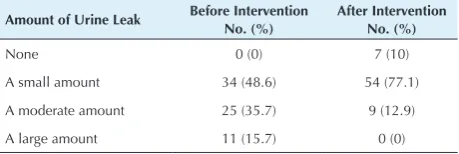
scores of “amount of urine leak” were 3.3 ± 1.4 and 2.1 ± 0.9 before and after the training, respectively. According to results of paired t test, this difference before and after the education were statistically significant (P < 0.001) (Table 2). The mean scores of “effect of urine leak on everyday life” were 6.3 ± 2.1 and 3.6 ± 2.0 before and after the training, respectively. According to the results of paired t test, this difference before and after the training was statistically significant
(P <0.001) (Table 3). Table 4 shows information about time of urine leak before and after training.
Discussion
Urinary incontinence affects MS patients’ quality of life negatively. Despite these negative consequences, the identification and management of this problem remain unsatisfactory, especially in developing countries. In the present study, we examined the effectiveness of a behavior program on severity of urinary incontinence in MS patients. According to the findings of the present study, behavioral training program were effective in decreasing the severity of urinary incontinence.
Table 1. Information About “Number of Urine Leak” Items Before and After Intervention
Number of Urine Leak Before InterventionNo. (%) After InterventionNo. (%)
Never 0 (0) 5 (7.1)
About once a week 3 (4.3) 36 (51.4)
Two or 3 time a week 34 (48.6) 22 (31.4)
About once a day 13 (18.6) 6 (8.6)
Several times a day 19 (27.1) 1 (1.4)
All the time 1 (1.4) 0 (0)
P = 0.001.
Table 4. Information About “Time of Urine Leak” Items Before and After Intervention
Time of Urine Leak Before InterventionNo. (%) After InterventionNo. (%)
Never 0 (0%) 7 (10%)
Before you can get to toilet 50 (71.4%) 47 (67.1%)
Leak when you cough or sneeze
7 (10%) 3 (4.3%)
Leak when you are asleep 1 (1.4%) 1 (1.4%)
Leak when you are physically active
3 (4.3%) 2 (2.9%)
Leak when you have finished
urination 4 (5.7%) 8 (11.4%)
Leak for no obvious reason 4 (5.7%) 2 (2.9%)
Leak all the time 1 (1.4%) 0 (0%)
P = 0.001.
Table 3. Information About “Effect of Urine Leak on Everyday Life” Items Before and After Intervention
Effect of Urine Leak on
Everyday Life Before InterventionNo. (%) After InterventionNo. (%)
Never 0 (0) 4 (5.7)
Mild 4 (5.7) 31 (44.3)
Moderate 35 (50) 27 (38.6)
High 23 (32.9) 8 (11.4)
Very high 8 (11.4) 0 (0)
P = 0.001.
Table 2. Information About “Amount of Urine Leak” Items Before and After Intervention
Amount of Urine Leak Before InterventionNo. (%) After InterventionNo. (%)
None 0 (0) 7 (10)
A small amount 34 (48.6) 54 (77.1)
A moderate amount 25 (35.7) 9 (12.9)
A large amount 11 (15.7) 0 (0)
P = 0.001.
Similar to finding of the present study, previous studies on MS patients showed that this group of patients needed specific education and training in many fields. In one study in this regard, Dehghani et al reported that 78% of the MS patients needed education and training about the nature of the disease, 82% needed education and training about treatment and care, 46% needed education and training about nutrition, and 32% needed education and training about physical activity.23 Knowledge improvement could
be effective in symptoms management in this group of patients. Bladder function controlled via complex routs by several parts of brain and spinal cord.24 This
complex routs in CNS of MS patients affected by MS
disease related lesions and cause some situation related
to urinary system such as urinary retention, need to empty the bladder urgency, and urinary incontinence.24
Although there is no definite cure for MS,25 symptom
management in this disease is very important. For reliving and management problems related to urinary system in MS disease, several strategy developed and tested in recent years such as strengthening the patients pelvic muscles, electrical stimulation of patients pelvic nerves, use of some drugs such as acetylcholine blockers and desmopressin drugs, patients nerve stimulation, cannabinoids, and use of some toxins
such as botulism.26 However, studies that investigated
lower urinary tract symptoms in MS patients are very limited. In one study in this regard, in 2017, Rafii et al examined the effect of pelvic floor muscle training and education on urinary incontinence and its resulting stress, anxiety and depression in 50 MS patients using pretest-posttest design. Participants in their study received training on pelvic floor muscle exercises and then practiced them for three consecutive months. They measured urinary incontinence using ICIQ-UI SF. Similar to the finding of the present study, Rafii et al reported significant differences between the frequency of urinary leakage, urine leakage and incontinence impact on quality of life before and after training.27
In other study in this regards, Lucio et al examined effect of pelvic floor muscle exercise programm on the control and relive of urinary tract symptoms in one group of MS patients. They randomly assigned 35 female patients with MS into 2 groups. The treatment group in their study received exercise program for pelvic muscle strengthening. Participants performed the exercises daily at home. The control group in their study not received any exercise program related to pelvic muscle strengthening. Results of the study by Lucio et al showed that pelvic floor muscle training improved patients’ symptoms significantly.28
Conclusion
Bladder dysfunction and associated negative consequences are well documented in MS patients. However identification and management of bladder dysfunction in this group of patients is inadequate. Results of the present study revealed that behavioral training could be an effective strategy in management of bladder dysfunction in this group of the patients. Further study in this regard is strongly recommended.
Ethical Approval
The present study was approved by the ethic committee of Tehran University of Medical Sciences.
Conflict of Interest Disclosures
None.
Funding/Support
None.
References
1. Massot C, Khenioui H, Agnani O, Guyot MA, Hautecoeur P, Donze C. Stress urinary incontinence in women with multiple sclerosis. Int Neurourol J. 2016;20(3):224-31. doi: 10.5213/ inj.1630490.245.
2. Shah P. Symptomatic management in multiple sclerosis. Ann Indian Acad Neurol. 2015;18(Suppl 1):S35-42. doi: 10.4103/0972-2327.164827.
3. Buhse M. Assessment of caregiver burden in families of persons
with multiple sclerosis. J Neurosci Nurs. 2008;40(1):25-31. 4. Masoudi R, Abedi H, Abedi P, Mohammadianinejad SE.
Experiences of Iranian multiple sclerosis patients’ and their caregivers’ regarding care and treatment outcomes. Jundishapur J Chronic Dis Care. 2014;3(1):21-31. 5. Uccelli MM. The impact of multiple sclerosis on family
members: a review of the literature. Neurodegener Dis Manag. 2014;4(2):177-85. doi: 10.2217/nmt.14.6.
6. Rintala A, Hakkinen A, Paltamaa J. Ten-year follow-up of health-related quality of life among ambulatory persons with multiple sclerosis at baseline. Qual Life Res. 2016;25(12):3119-27. doi: 10.1007/s11136-016-1347-x.
7. Leibach GG, Stern M, Arelis AA, Islas MA, Barajas BV. Mental Health and Health-Related Quality of Life in Multiple Sclerosis Caregivers in Mexico. Int J MS Care. 2016;18(1):19-26. doi: 10.7224/1537-2073.2014-094.
8. Wingerchuk DM. Environmental factors in multiple sclerosis: Epstein-Barr virus, vitamin D, and cigarette smoking. Mt Sinai J Med. 2011;78(2):221-30. doi: 10.1002/msj.20240.
9. Ascherio A. Environmental factors in multiple sclerosis. Expert Rev Neurother. 2013;13(12 Suppl):3-9. doi: 10.1586/14737175.2013.865866.
10. Disanto G, Morahan JM, Ramagopalan SV. Multiple sclerosis: risk factors and their interactions. CNS Neurol Disord Drug Targets. 2012;11(5):545-55.
11. Evans C, Beland SG, Kulaga S, Wolfson C, Kingwell E, Marriott J, et al. Incidence and prevalence of multiple sclerosis in the Americas: a systematic review. Neuroepidemiology. 2013;40(3):195-210. doi: 10.1159/000342779.
12. Browne P, Chandraratna D, Angood C, Tremlett H, Baker C, Taylor BV, et al. Atlas of Multiple Sclerosis 2013: A growing global problem with widespread inequity. Neurology. 2014;83(11):1022-4. doi: 10.1212/wnl.0000000000000768. 13. Nasr Z, Majed M, Rostami A, Sahraian MA, Minagar A, Amini
A, et al. Prevalence of multiple sclerosis in Iranian emigrants: review of the evidence. Neurol Sci. 2016;37(11):1759-63. doi: 10.1007/s10072-016-2641-7.
14. Ben-Zacharia AB. Therapeutics for multiple sclerosis symptoms. Mt Sinai J Med. 2011;78(2):176-91. doi: 10.1002/ msj.20245.
15. Schapiro RT. The symptomatic management of multiple sclerosis. Ann Indian Acad Neurol. 2009;12(4):291-5. doi: 10.4103/0972-2327.58278.
16. Cameron MH, Wagner JM. Gait abnormalities in multiple sclerosis: pathogenesis, evaluation, and advances in treatment. Curr Neurol Neurosci Rep. 2011;11(5):507-15. doi: 10.1007/ s11910-011-0214-y.
17. Chalah MA, Ayache SS. Psychiatric event in multiple sclerosis: could it be the tip of the iceberg? Rev Bras Psiquiatr. 2017. doi: 10.1590/1516-4446-2016-2105.
18. Nourbakhsh B, Azevedo C, Nunan-Saah J, Maghzi AH, Spain R, Pelletier D, et al. Longitudinal associations between brain structural changes and fatigue in early MS. Mult Scler Relat Disord. 2016;5:29-33. doi: 10.1016/j.msard.2015.10.006. 19. Sadiq A, Brucker BM. Management of neurogenic lower
urinary tract dysfunction in multiple sclerosis patients. Curr Urol Rep. 2015;16(7):44. doi: 10.1007/s11934-015-0519-5. 20. Khalaf KM, Coyne KS, Globe DR, Armstrong EP, Malone
DC, Burks J. Lower urinary tract symptom prevalence and management among patients with multiple sclerosis. Int J MS Care. 2015;17(1):14-25. doi: 10.7224/1537-2073.2013-040. 21. Rafii F, Shareinia H, Seyedalshohahadaee M, Sarraf P,
Mahmoodi F. The effect of Pelvic Floor Muscle Exercise Training on Urinary Incontinence in Patients with Multiple Sclerosis. Iran J Nurs. 2014;27(87):43-54.
Form and its correlation with urodynamic findings. Urol J. 2012;9(4):685-90.
23. Dehghani A, Mohammadkhan Kermanshahi S, Memarian R. Evaluation of the Needs of Patients with Multiple Sclerosis. Zahedan Journal of Research in Medical Sciences. 2012;14(9):104-6.
24. Burks JS, Bigley GK, Hill HH. Rehabilitation challenges in multiple sclerosis. Ann Indian Acad Neurol. 2009;12(4):296-306. doi: 10.4103/0972-2327.58273.
25. Rabiei L, Abedi H, Abedi P, Zarea K, Masoudi R. Perspectives and Experiences Related to Help-Seeking Behaviors: A Content Analysis Study of Iranian Patients With Multiple Sclerosis. J Nurs Res. 2017. doi: 10.1097/jnr.0000000000000216.
26. Sand PK, Sand RI. The diagnosis and management of lower urinary tract symptoms in multiple sclerosis patients. Dis Mon. 2013;59(7):261-8. doi: 10.1016/j.disamonth.2013.03.013. 27. Rafii F, Sajjadi M, Shareinia H , Sarraf P, Seyedalshohahadaee
M. Pelvic floor muscle training instruction to control urinary incontinence and its resulting stress, anxiety and depression in patients with Multiple Sclerosis. Jundishapur J Chronic Dis Care. 2017;6(1):e37333. doi: 10.17795/jjcdc-37333. 28. Lucio AC, Perissinoto MC, Natalin RA, Prudente A, Damasceno
BP, D’Ancona C A. A comparative study of pelvic floor muscle training in women with multiple sclerosis: its impact on lower urinary tract symptoms and quality of life. Clinics (Sao Paulo). 2011;66(9):1563-8.