COMPUTATION OF CONNECTIVITY INDICES OF KULLI PATH
WINDMILL GRAPH
V. R. KULLI1, B. CHALUVARAJU2, H. S. BOREGOWDA3, §
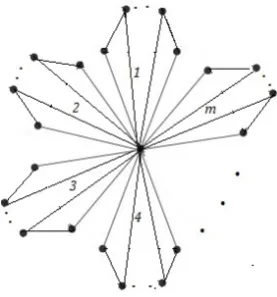
Abstract. The Kulli path windmill graphPn+1(m) is the graph obtained by takingm≥2
copies of the graph K1 +Pn for n ≥ 4 with a vertex K1 in common. In this paper, we determine Zagreb, hyper-Zagreb, sum connectivity, general sum connectivity, Randic connectivity, General Randic connectivity, atom-bond connectivity, geometric-arithmetic, harmonic and symmetric division deg indices of Kulli path windmill graph.
Keywords: Topological indices; Degree based connectivity indices; Windmill graph and Kulli path windmill graph.
AMS Subject Classification: 05C05, 05C07, 05C35.
1.
Introduction
Throughout this paper, we consider simple graphs which are finite, undirected without
loops and multiple edges. Let
G
= (
V, E
) be a connected graph with vertex set
V
=
V
(
G
)
and edge set
E
=
E
(
G
). The degree
d
G(
v
) of a vertex
v
is the number of vertices adjacent
to
v
. The edge connecting the vertices
u
and
v
will be denoted by
uv
. For other undefined
notations and terminologies from graph theory, the reader are referred to [7].
A molecular graph is a graph such that its vertices correspond to the atoms and the edges
to the bonds. Chemical graph theory is a branch of Mathematical chemistry which has an
important effect on the development of the chemical sciences. A single number that can
be used to characterize some property of the graph of a molecular is called a topological
index for that graph. There are numerous topological descriptors that have found some
applications in theoretical chemistry, especially in QSPR/QSAR research.
In [6], the first and second Zagreb indices were introduced to take account of the
con-tributions of pairs of adjacent vertices. The first and second Zagreb indices of a graph
G
are defined as
M
1(
G
) =
P
v∈V(G)d
G(
v
)
2or
M
1(
G
) =
P
uv∈E(G)[
d
G(
u
) +
d
G(
v
)] and
M
2(
G
) =
P
uv∈E(G)[
d
G(
u
)
d
G(
v
)].
In [11], Shirdel et al., introduced the first hyper Zagreb index
HM
1(
G
) of a graph
G
.
This index is defined as
HM
1(
G
) =
P
uv∈E(G)[
d
G(
u
) +
d
G(
v
)]
2. In [4], the second hyper
Zagreb index
HM
2(
G
) of a graph
G
is defined as
HM
2(
G
) =
P
uv∈E(G)[
d
G(
u
)
d
G(
v
)]
2.
1
Department of Mathematics, Gulbarga University, Gulbarga - 585 106, India. e-mail: [email protected]; ORCID: https://orcid.org/0000-0002-6881-5201.
2
Department of Mathematics, Bangalore University, J. B. Campus, Bangalore -560 056, India. e-mail: [email protected]; ORCID: https://orcid.org/0000-0002-4697-0059.
3
Department of Studies and Research in Mathematics, Tumkur University, Tumkur-571 103, India. e-mail: [email protected]; ORCID: https://orcid.org/0000-0002-8887-5156.
§ Manuscript received: November 11, 2016; accepted: December 21, 2016.
TWMS Journal of Applied and Engineering Mathematics, Vol.8, No.1a, cI¸sık University, Department of Mathematics, 2018; all rights reserved.
The Randic index or product connectivity index of a graph
G
is defined as
χ
(
G
) =
P
uv∈E(G)
√
d 1G(u)dG(v)
. This topological index was proposed by Randic in [10].
The sum connectivity index of a graph
G
is defined as
X
(
G
) =
P
uv∈E(G)
√
d 1G(u)+dG(v)
.
This topological index was proposed by Zhou and Trinajstic in [14].
The general Randic connectivity index or second
K
aindex of a graph
G
is defined as
χ
a(
G
) =
P
uv∈E(G)
[
d
G(
u
)
d
G(
v
)]
a. The general sum connectivity index or first
K
aindex of
a graph
G
is defined as
X
a(
G
) =
P
uv∈E(G)
[
d
G(
u
) +
d
G(
v
)]
a. The above two topological
indices were proposed in [1], [6] and [8].
In [2], Estrada et al. introduced the atom-bond connectivity index, which is defined as
ABC
(
G
) =
P
uv∈E(G)
q
dG(u)+dG(v)−2
dG(u)dG(v)
.
The geometric-arithmetic index of a graph
G
is defined as
GA
(
G
) =
P
uv∈E(G)
2
√
dG(u)dG(v)dG(u)+dG(v)
.
This index was proposed by Vukicevic and Furtula in [12].
The harmonic index of a graph
G
is defined on the arithmetic mean as
H
(
G
) =
P
uv∈E(G) 2 dG(u)+dG(v)
.
This index was first appeared in [3].
In [13], Vukicevic and Gasperov posed the symmetric division deg index of a graph
G
,
which is defined as
SDD
(
G
) =
X
uv∈E(G)
max
(
d
G(
u
)
, d
G(
v
))
min
(
d
G(
u
)
, d
G(
v
))
+
min
(
d
G(
u
)
, d
G(
v
))
max
(
d
G(
u
)
, d
G(
v
))
=
X
uv∈E(G)
d
G(
u
)
2+
d
G(
v
)
2d
G(
u
)
d
G(
v
)
.
The Kulli path windmill graph
P
n+1(m)is the graph obtained by taking
m
≥
2 copies of the
graph
K
1+
P
nfor
n
≥
4 with a vertex
K
1in common. This graph is shown in Figure-1.
The Kulli path windmill graph
P
2+1(m)is a friendship graph and it is denoted by
F
3(m). The
Kulli path windmill graph
P
3+1(m)is the first Kulli path windmill graph. For more details
on french windmill graph
F
n(m)and Kulli cycle windmill graph
C
n+1(m), refer to [5] and [9],
respectively. In this paper, we consider only the Kulli path windmill graphs
P
n+1(m)for
m
≥
2
and
n
≥
4.
2.
Results
Theorem 2.1.
The sum connectivity index of Kulli path windmill graph is
X
(
P
n+1(m))
=
2
√
5
−
3
√
6
+
2
√
mn
+ 2
−
2
√
mn
+ 3
m
+
1
√
6
+
1
√
mn
+ 3
mn.
Proof.
Let
G
=
P
n+1(m), where
P
n+1(m)is a Kulli path windmill graph. By algebraic method,
we have
|
V
(
G
)
|
=
mn
+ 1 and
|
E
(
G
)
|
= 2
mn
−
m
. We have three partitions of the vertex
set
V
(
G
) as follows:
V
2=
{
v
∈
V
(
G
) :
d
G(
v
) = 2
}
;
|
V
2|
= 2
m,
V
3=
{
v
∈
V
(
G
) :
d
G(
v
) = 3
}
;
|
V
3|
=
mn
−
2
m,
and
V
mn=
{
v
∈
V
(
G
) :
d
G(
v
) =
mn
}
,
|
V
mn|
= 1
.
Also we have four partitions of the edge set
E
(
G
) as follows:
E
5=
{
uv
∈
E
(
G
) :
d
G(
u
) = 2
, d
G(
v
) = 3
}
;
|
E
5|
= 2
m,
E
6=
{
uv
∈
E
(
G
) :
d
G(
u
) = 3
, d
G(
v
) = 3
}
;
|
E
6|
=
mn
−
3
m,
E
mn+2=
{
uv
∈
E
(
G
) :
d
G(
u
) =
mn, d
G(
v
) = 2
}
;
|
E
mn+2|
= 2
m,
and
E
mn+3=
{
uv
∈
E
(
G
) :
d
G(
u
) =
mn, d
G(
v
) = 3
}
;
|
E
mn+3|
=
mn
−
2
m
. Now
X
(
G
)
=
X
uv∈E(G)
1
p
d
G(
u
) +
d
G(
v
)
=
X
uv∈E5
1
√
2 + 3
+
X
uv∈E6
1
√
3 + 3
+
X
uv∈Emn+2
1
√
mn
+ 2
+
X
uv∈Emn+3
1
√
mn
+ 3
=
√
1
5
×
2
m
+
1
√
6
×
(
mn
−
3
m
) +
1
√
mn
+ 2
×
2
m
+
√
1
mn
+ 3
×
(
mn
−
2
m
)
=
2
√
5
−
3
√
6
+
2
√
mn
+ 2
−
2
√
mn
+ 3
m
+
1
√
6
+
1
√
mn
+ 3
mn.
Theorem 2.2.
The general sum connectivity index of Kulli path windmill graph is
X
a(
P
n+1(m))
=
[2(5
a)
−
3(6
a) + 2(
mn
+ 2)
a−
2(
mn
+ 3)
a]
m
Proof.
Let
G
=
P
n+1(m)be a Kulli path windmill graph. Now
X
a(
G
)
=
X
uv∈E(G)
[
d
G(
u
) +
d
G(
v
)]
a=
X
uv∈E5
[2 + 3]
a+
X
uv∈E6
[3 + 3]
a+
X
uv∈Emn+2
[
mn
+ 2]
a+
X
uv∈Emn+3
[
mn
+ 3]
a=
5
a×
2
m
+ 6
a×
(
mn
−
3
m
) + (
mn
+ 2)
a×
2
m
+
(
mn
+ 3)
a×
(
mn
−
2
m
)
=
[2(5
a)
−
3(6
a) + 2(
mn
+ 2)
a−
2(
mn
+ 3)
a]
m
+
[6
a+ (
mn
+ 3)
a]
mn.
From the above Theorem, the following results are immediate
Corollary 2.1.
The first Zagreb index of
P
n+1(m)is
M
1(
P
n+1m) = (
mn
)
2+ 9
mn
−
10
m.
Corollary 2.2.
The first hyper Zagreb index of
P
n+1(m)is
HM
1(
P
n+1m) = (
mn
)
3+ 6(
mn
)
2+ 41
mn
−
68
.
Theorem 2.3.
The Randic index of Kulli path windmill graph is
χ
(
P
n+1(m))
=
"
√
2
√
3
−
1 +
√
2
√
mn
−
2
√
3
mn
#
m
+
1
3
+
1
√
3
mn
mn.
Proof.
Let
G
=
P
n+1(m), where
P
n+1(m)is a Kulli path windmill graph. Now
χ
(
G
)
=
X
uv∈E(G)
1
p
d
G(
u
)
d
G(
v
)
=
X
uv∈E5
1
√
2
×
3
+
X
uv∈E6
1
√
3
×
3
+
X
uv∈Emn+2
1
√
mn
×
2
+
X
uv∈Emn+3
1
√
mn
×
3
=
√
1
6
×
2
m
+
1
√
9
×
(
mn
−
3
m
) +
1
√
2
mn
×
2
m
+
√
1
3
mn
×
(
mn
−
2
m
)
=
"
√
2
√
3
−
1 +
√
2
√
mn
−
2
√
3
mn
#
m
+
1
3
+
1
√
3
mn
mn.
Theorem 2.4.
The general Randic index of Kulli path windmill graph is
Proof.
Let
G
=
P
n+1(m)be a Kulli path windmill graph. Now
χ
a(
G
)
=
X
uv∈E(G)
[
d
G(
u
)
d
G(
v
)]
a=
X
uv∈E5
[2
×
3]
a+
X
uv∈E6
[3
×
3]
a+
X
uv∈Emn+2
[
mn
×
2]
a+
X
uv∈Emn+3
[
mn
×
3]
a=
6
a×
(2
m
) + 9
a×
(
mn
−
3
m
) + (2
mn
)
a×
(2
m
)
+
(3
mn
)
a(
mn
−
2
m
)
=
[2
×
6
a−
3
2a+1+ 2
a+1(
mn
)
a−
2(3
mn
)
a]
m
+
[9
a+ (3
mn
)
a]
mn.
From Theorem 2.4, we have the following results.
Corollary 2.3.
The second Zagreb index of
P
n+1(m)is
M
2(
P
n+1m) = 3(
mn
)
2+ 9
mn
−
2
m
2n
−
15
m.
Corollary 2.4.
The second hyper Zagreb index of
P
n+1(m)is
HM
2(
P
n+1m) = 9(
mn
)
3−
10
m
3n
+ 81
mn
−
171
m.
Theorem 2.5.
The atom-bond connectivity index of Kulli path windmill graph is
ABC
(
P
n+1(m)) = (
√
2
−
2)
m
+
2
3
mn
+
r
2
m
n
+
r
mn
(
mn
+ 1)
3
−
2
r
m
2n
+
m
3
n
.
Proof.
Let
G
=
P
n+1(m), where
P
n+1(m)is a Kulli path windmill graph. Now
ABC
(
G
)
=
X
uv∈E(G)
s
d
G(
u
) +
d
G(
v
)
−
2
d
G(
u
)
d
G(
v
)
=
X
uv∈E5
r
2 + 3
−
2
2
×
3
+
X
uv∈E6
r
3 + 3
−
2
3
×
3
+
X
uv∈Emn+2
r
mn
+ 2
−
2
mn
×
2
+
X
uv∈Emn+3
r
mn
+ 3
−
2
mn
×
3
=
√
1
2
2
m
+
2
3
(
mn
−
3
m
) +
1
√
mn
2
m
+
mn
+ 1
3
mn
(
mn
−
2
m
)
=
(
√
2
−
2)
m
+
2
3
mn
+
r
2
m
n
+
r
mn
(
mn
+ 1)
3
−
2
r
m
2n
+
m
3
n
.
Theorem 2.6.
The geometric-arithmetic index of Kulli path windmill graph is
GA
(
P
n+1(m))
=
4
√
6
5
−
3
!
m
+
mn
+
4
√
2
m
√
mn
mn
+ 2
+
2
√
3
√
mn
mn
+ 3
!
(
mn
−
2
m
)
.
Proof.
Let
G
=
P
n+1(m), where
P
n+1(m)is a Kulli path windmill graph. Now
GA
(
G
)
=
X
uv∈E(G)
2
p
d
G(
u
)
d
G(
v
)
d
G(
u
) +
d
G(
v
)
=
X
uv∈E5
2
√
2
×
3
2 + 3
+
X
uv∈E6
2
√
3
×
3
3 + 3
+
X
uv∈Emn+2
2
√
mn
×
2
mn
+ 2
+
X
uv∈Emn+3
2
√
mn
×
3
mn
+ 3
=
2
√
6
5
×
2
m
+ (1)
×
(
mn
−
3
m
) +
2
√
2
√
mn
mn
+ 2
!
2
m
+
2
√
3
√
mn
mn
+ 3
!
(
mn
−
2
m
)
=
4
√
6
5
−
3
!
m
+
mn
+
4
√
2
m
√
mn
mn
+ 2
+
2
√
3
√
mn
mn
+ 3
!
(
mn
−
2
m
)
.
Theorem 2.7.
The harmonic index of Kulli path windmill graph is
H
(
P
n+1(m)) =
1
3
+
2
mn
+ 3
mn
+
1
mn
+ 2
−
1
mn
+ 3
−
1
20
4
m.
Proof.
Let
G
=
P
n+1(m), where
P
n+1(m)is a Kulli path windmill graph. Now
H
(
G
)
=
X
uv∈E(G)
2
d
G(
u
) +
d
G(
v
)
=
X
uv∈E5
2
2 + 3
+
X
uv∈E6
2
3 + 3
+
X
uv∈Emn+2
2
mn
+ 2
+
X
uv∈Emn+3
2
mn
+ 3
=
2
5
×
2
m
+
1
3
×
(
mn
−
3
m
) +
2
mn
+ 2
×
2
m
+
2
mn
+ 3
×
(
mn
−
2
m
)
=
1
3
+
2
mn
+ 3
mn
+
1
mn
+ 2
−
1
mn
+ 3
−
1
20
4
m.
Corollary 2.5.
Let
P
n+1(m)be a Kulli path windmill graph with
n
≥
2
. Then
(i)
H
(
P
n+1(m)) = 2
X
(−1)(
P
n+1(m))
,
(ii)
H
(
P
n+1(m))
< χ
(
P
n+1(m))
.
Theorem 2.8.
The symmetric division deg index of Kulli path windmill graph is
SDD
(
P
n+1(m)) =
mn
3
+
m
3
+ 2
mn
−
5
3
m
−
2
n
+ 3
.
Proof.
Let
G
=
P
n+1(m)be a Kulli path windmill graph. Now
SDD
(
P
n+1(m))
=
X
uv∈E(G)
d
G(
u
)
2+
d
G(
v
)
2d
G(
u
)
d
G(
v
)
=
X
uv∈E5
2
2+ 3
22
×
3
+
X
uv∈E6
3
2+ 3
23
×
3
+
X
uv∈Emn+2
(
mn
)
2+ 2
2mn
×
2
+
X
uv∈Emn+3
(
mn
)
2+ 3
2mn
×
3
=
13
6
×
2
m
+ 2
×
(
mn
−
3
m
) +
(
mn
)
2+ 4
2
mn
×
2
m
+
(
mn
)
2+ 9
3
mn
×
(
mn
−
2
m
)
=
mn
3
+
m
3
+ 2
mn
−
5
3
m
−
2
n
+ 3
.
References
[1] Clark, L., and Gutman, I., (2008), The exponent in the general Randic index, J. Math. Chem. 43, pp. 32-44.
[2] Estrada, E., Torres, Rodriguez, L., and Gutman, I., (1998), An atom-bond connectivity index: Mod-elling the enthalphy of formation of alkanes, Indian J. Chem. 37A, pp. 849-855.
[3] Fajtlowicz, S.,(1987), On conjectures of Graffiti-II, Congr. Numer. 60, pp. 187-197.
[4] Farahani, M. R., Rajesh Kanna, M. R., and Pradeep Kumar, R., (2016), On the hyper-Zageb indices of some nanostructurs, Asian Academic Research J. Multidisciplinary, 3(1), pp. 115-123.
[5] Gallian, J. A., (2007), Dynamic Survey DS6: Graph Labeling, Electronic J. Combin., DS6, pp. 1-58. [6] Gutman, I., and Trinajstic, N., (1972), Graph Theory and molecular orbitals, Totalπ-electron energy
of alternant hydrocarbons, Chem. Phys. Lett. 17, pp. 535-538.
[7] Kulli, V. R., (2012), College Graph Theory, Vishwa International Publications, Gulbarga, India. [8] Kulli, V. R., (2016), The first and secondKaindices and coindices of graphs, International Journal of
Mathematical Archive, 7(5), pp. 71-77.
[9] Kulli, V. R., Chaluvaraju, B., and Boregowda, H. S., (2016), Some degree based connectivity indices Kulli cycle windmill graph, submitted.
[10] Randic, M., (1975), On characterization of molecular branching, J. Am. Chem. Soc., 97, pp. 6609 -6615.
[11] Shirdel, G. H., Rezapour, H., and Sayadi, A. M., (2013), The hyper-Zagreb index of graph operations, Iran J. Math. Chem. 4(2), pp. 213-220.
[12] Vukicvic., D. and Furtula, B., (2009), Topological index on the ratio of geometrical and arithmetical means of end vertex degrees of edges, J. Math. Chem, 46, pp. 1369-1376.
[13] Vukicevic., D., and Gasperov, M., (2010), Bond Additive Modeling 1. Adriatic Indices, Croatica chemica acta 83(3), pp. 243-260.
Dr. B. CHALUVARAJUis a former, Professor and Chairman for Department of Mathematics and Director of Distance Education, Tumkur University. Currently, he works as a Special Officer (Evaluation) and Faculty of Mathematics in Banga-lore University. Six students received their Ph.D. degree and four students received their M.Phil. degree under his guidance. He has published more than 74 research papers in Graph Theory. His area of interest is Combinatorics and Graph theory. He has presented many invited talks and research articles in National/International Conferences, Symposiums and Seminars in different parts of the world.
Dr. V. R. KULLI is a former Dean, Faculty of Science and Technology and a former Professor and Chairman, Department of Mathematics, Gulbarga University. He is a former UGC-Emeritus fellow. 14 students received their Ph.D. degree and 19 students received their M.Phil. degree under his guidance. He has published more than 200 research papers and introduced several new fundamental ideas, concepts in Graph Theory. The Kulli-Sigarkanti conjecture is well-known conjecture in Graph Theory. He has authored/edited many useful books for Colleges, Universities, M. Phil. and Ph. D. students of Mathematics. Apart from his academic work, he worked in various capacities for the development of Gulbarga University such as Syndicate, Senate, Academic Council Member.