[Subramani* 4(7): July, 2017] ISSN 2349-4506
Impact Factor: 2.785
G
lobal
J
ournal of
E
ngineering
S
cience and
R
esearch
M
anagement
IMPLEMENTATION OF NON-LINEAR MULTI OBJECTIVE OPTIMIZATION
FOR ENERGY MANAGEMENT SYSTEMS
R. Subramani*, C. Vijayalakshmi
*
Department of Mathematics, St. Joseph’s College of Engineering, Chennai
SAS, Mathematics Division, VIT University, Chennai
DOI: 10.5281/zenodo.824967
KEYWORDS
:
SCADA, Distribution Automation, Substation feeders, Transmission Capacity, Demand-Side Management, Distribution Control Cen-tre (DCC), Lagrangian Relaxation (LR).ABSTRACT
This paper mainly deals with the development of an energy management of the platform using a SCADA (Supervisory Control and Data Acquisition) system. A predictive controller is implemented above the centralized SCADA platform. The distribution net-works have been focused by a Monitor, Control and maintain equipment in the sub stations to reduce the operating cost. This re-search proposes a new energy management model is that enables a flexible and also efficient operation of various power plants. The Distribution Control Centre (DCC) is being monitored and controlled by SCADA systems and the DCC has become an important en-ergy efficient policy concept. Based on the numerical calculations and graphical representations the renewable energy sources in both configurations, is independent of the permanent or intermittent primary energy resource availability, which can lead to effective pro-duction.
INTRODUCTION
THE large increase of distributed energy resources, including dis-tributed generation, storage systems and demand response, espe-cially in distribution networks, makes the management of the available resources a more complex and crucial process. Many organization requires the advanced techniques for monitoring, control and supervising. SCADA systems are used to control envi-ronmental factors at a variety of physical sites. Data collection functions can be used at facilities and buildings to monitor vari-ables such as temperate, lighting, and entry systems. The control functions of these systems can be used to maintain specific envi-ronmental elements at these sites, keeping refrigeration units online, maintaining specific heating levels. Manufacturing com-panies use SCADA to monitor their inventory. They use their SCADA system to regulate production machinery and implement quality control tests. This can be very much useful for just-in-time manufacturers by an automating production so that the demand is met exactly, which reduces inventory costs. This arti-cle presents an optimization model to consider the available re-sources (generation resources including storage, demand re-sponse, and distribution network) and demand requirements in order to optimize operation costs.
SCADA is a term, which used in several industries fairly gen-erally to refer a centralized control and monitoring system. In the electric utility industry, SCADA usually refers to basic control and monitoring of field devices including breakers, switches, ca-pacitors and transformers. It can therefore be said that SCADA usually refers to a system for centralized control. Most opera-tions are automatically executed by the local equipment of data acquisition and control (RTU) or by the programmable logic con-trol unit (PLC). A SCADA system consists of remote terminal units (RTU), which collect the field data connected back to a master station via a communications system. Usually, to imple-ment a SCADA system the following components are necessary: Human Machine Interface (HMI), controllers, input-output de-vices, networking, software, etc.
[Subramani* 4(7): July, 2017] ISSN 2349-4506
Impact Factor: 2.785
G
lobal
J
ournal of
E
ngineering
S
cience and
R
esearch
M
anagement
Lagrangian Optimization Technique. This reveals the fact that the lower cost of operation compared to earlier non-automated systems is being obtained.
The main function of SCADA systems is the automatic genera-tion of commands, ensuring of the dialogue between operator and surveyed system by creating a database for the monitored system and the alarming of the operator in case of important events. Based on renewable energy sources, the SCADA system gathers information from the electrical equipment, transfers the information to the central system and generates an alert signaling the failure, displays the information. It should be noted in pass-ing that many operators judge a SCADA system not only by the smooth performance of the Remote Terminal Units (RTUs), communication links and the master station (all falling under the umbrella of SCADA system).
This system encompasses the transfer of data between a SCADA central host computer and a number of RTUs and/or Programmable Logic Controllers (PLCs), and the central host and the operator terminals. A SCADA system gathers information (such as where a leak on a pipeline has occurred), transfers the information back to a central site, then alerts the home station that a leak has occurred, carrying out necessary analysis and control, such as determining if the leak is critical, and displaying the information in a logical and organized fashion. These systems can be relatively simple, such as one that monitors environmental conditions of a small office building, or very complex, such as a system that monitors all the activity in a nuclear power plant or the activity of a municipal water system. Traditionally, SCADA systems have made use of the Public Switched Network (PSN) for monitoring purposes. Many systems are monitored using the infrastructure of the corporate Local Area Network (LAN)/Wide Area Network (WAN). Wireless technologies are now being widely deployed for purposes of monitoring.
Benefits of using PLCs in substation automation
Reliability: PLCs are extremely reliable. They have been developed for application in industrial environments. They are designed to operate correctly in wide temperature ranges and in very high electromagnetic noise and high vibration environments. They can operate in dusty or humid environments as well. The number of PLCs (in the millions) which have been applied in various environments has allowed the designers of PLCs to perfect the resistance to the negative effects of harsh environments.
A large installed base: The large installed base of PLCs offers the advantages of reduced costs, readily available and low cost spare parts and trained personnel to work on PLCs. The large installed base also allows the manufactures more opportunity to improve design and offer new products for more varied applications.
Extensive support resources: PLCs have extensive support throughout the United States and most of the world. PLC manufactures have extensive of field officers, distributors and authorized control system integrators. Most technical schools and colleges offer courses in PLC application, programming and maintenance.
Low cost: In many, if not all, applications PLCs offer lower cost solutions than traditional RTUs for SCADA systems. They offer lower cost solutions than traditional electromechanical control relay systems for automated substation applications. With the lower cost solutions PLC based systems offer in substation and distribution automation application along with the other benefits, it is no surprise that there is so much interest in the application of PLCs in substation
Energy Management
In this electricity forward world Energy management is the needed topic, this includes the following criteria
o High performance
o distributed
o mission critical
o control Capability to monitor
o control
o optimize the operation of geographically dispersed transmission and generation assets in real-time
[Subramani* 4(7): July, 2017] ISSN 2349-4506
Impact Factor: 2.785
G
lobal
J
ournal of
E
ngineering
S
cience and
R
esearch
M
anagement
network (assets in real-time).
Literature Review
In past research, Zita Vale (2013) et.al. Discussed a contextual energy resource management methodology, which is able to a model contracted by the third party resource use in Renewable Energy. Subramani (2015, 2016) et.al. Made an analysis in various optimization techniques. Vale (2011) et. al., provided computational intelligence applications for future power systems in different dimensions based on future power demand. Alicherry et al. (2005) and J. Yuan et al. (2006) investigate the joint scheduling, routing and flow-rate control problem that has been strongly developed. W. Yu et al. (2006) were first discovered the zero duality gap under the so-called time sharing condition. Subsequently, Z. Luo et al. (2008) rigorously proved some results for the continuous Lebesgue integral formulation.
M.Alicherry et al. (2005) and J.Yuan et al.(2006) investigate heavily in a joint scheduling, routing and flow-rate control problem. These works are employed in a conflict graph which is to bound mutual-interference when scheduling are concurrent transmissions. However, this model is not suitable for rate-adaptive wireless systems where the transceiver can adjust the link data rate to tolerate different levels of interference. Rate-adaptive wireless networks was taken by X.Lin, but the author focused on the minimum power allocation problem instead of that we are consider maximization problem here.
Based on the wireless network scheduling, we have problems in other network system and communication systems with the similar mathematical models. J.W. Lee et al.(2005) discuss the rate control problem and optimization for a multi-class service in the internet in order to maximize the utility function which may not be concave(i.e, non-convex minimization). They showed that the rate control algorithms based on the dual method by a pricing-based mechanism, developed for concave utility function, can be used for problems with non-concave utility function. Their problem is still simpler than the scheduling problem to be investigated. This is because their non-concave utility functions are chosen to be sigmoid-like which are not difficult to evaluate, compared to our non-concave objective function (for flow date rate under MUI).
Cristian and Adrian Gligor are gives the detailed theory on power management on Emerging markets queries in Finance and Business SCADA based software for renewable energy manage management system. The fast penetration of renewable energy sources (RES) have been generated increasing difficulties for reliable electric energy. Real-time dynamic monitoring, analysis, protection and control of energy management system (EMS) become necessary to combat the fluctuations caused by renewable power supply and fast load changes. State estimation (SE) technology, as a key energy management system functionality , provides a real-time database of the state of the power system. Efficient and accurate SE is a prerequisite for the reliable operation of the EMS. After Schweppe and Wildes introduced the concept of SE in the field of power system in the early 1970s. The various practical considerations in applying Data Acquisition Systems are summarized, and some feasible areas of advanced applications are investigated.
Real time Network Analysis
[Subramani* 4(7): July, 2017] ISSN 2349-4506
Impact Factor: 2.785
G
lobal
J
ournal of
E
ngineering
S
cience and
R
esearch
M
anagement
Fig –1 Real time Network Analysis
A list of contingencies is processed as applicable to current state. It is one of the security analysis application in power utility control centre that differentiates the energy management system from a less complex SCADA system. It is to analyze the power system in order to identify the overload and problem that can be occurred due to a contingency. A ranking method will be demonstrated to prioritize transmission planning. Contingency is a event that causes important component to be removed from service (eg: turbine-line, generator, transformer) and Contingency Analysis which impact of a set of contingencies to identify harmful ones.
MATHEMATICAL MODEL FORMULATION
Parameters
N − Set of connected nodes in wireless network Fk,i − Input of flow i in time slot k
Fimin − Minimum input of flow i
Vi − Voltage magnitude of flow i
Vimin & Vimax − Lower and Upper bounds of voltage magnitude
θi − Voltage phase angle of flow i
θimin & θimax − Lower and Upper bounds of voltage phase angle for each flow i
ei − per unit transmit power of flow i
Ci – Cost resource of the system in flow i
Csi – Startup cost of unit i at time slot k
Cvi – Cost of voltage unit i at time slot k
Cpvi – Production cost of photovoltaic unit i at time slot k
Pi(k) – Power output of unit i at time slot k (MV)
Ri(k) – Allocated reserve power of generation i at timeslot k
Pimin & Pimax – Minimum and Maximum power flow transmission line i at time slot k
PD(k) – System load demand at time slot k (MV)
Ii(k) – Commitment state of flow i at time slot k
Optimization Model
1 1
[
( )
( )
( )
( )]
N N
i i i i i i pvi i
k i
v s
Min
C I k
C I k
C I k
C I k
--- (1)1 1
,
iN N
k
k i
Max
F
---- (2)Subject to
[Subramani* 4(7): July, 2017] ISSN 2349-4506
Impact Factor: 2.785
G
lobal
J
ournal of
E
ngineering
S
cience and
R
esearch
M
anagement
min
,
1 1 1 1
i
k i
N N N N
i
k i k i
F
V
P
--- (4)P
imin(k) ≤ P
i(k) ≤ P
imax(k)
--- (5)
0 ≤ R
i(k) ≤ P
imax(k) - P
imin(k)
---(6)
V
imin≤ V
i≤ V
imax∀ i
--- (7)
θ
imin≤ θ
i≤ θ
imax∀ i --- (8)
V
i− e
iθ
i≥ 0,
∀ i --- (9)Lagrangian Decomposition Model Lagrangian Relaxation is a general solution strategy for solving mathematical programs which allows in decomposing problems to exploit their structure. This approach to solution leads to bounds on the optimal objective function value. The general application of Lagrangian relaxation can be found in Fisher (1985). An exposition of its use in location models is found in the text by Daskin (1995). Lagrangian Relaxation replaces the original problem with an associated Lagrangian problem, the optimal solution of which provides a bound on the objective function of the problem. This is achieved by eliminating (relaxing one or more) constraints of the original model and adding these constraints associated with a Lagrangian multiplier in the objective function. In Power Distribution, Optimal Power Flow (OPF) Problem minimizes the total generation cost with respect to active power and reactive power. Optimizing the reactive power distribution network is a sub problem of OPF which minimizes the active power losses in the transmission network. Transmission network losses can be minimized by installing Distributed Generation capacity (DG) units. These DG units increase the maximum load ability of the system by improving the system voltage profiles on the distribution system. Studies on computational results for the proposed optimization models indicate that the Lagrangian Relaxation technique is capable of solving large problems to the acceptable convergence. One of the most computationally useful ideas of the 1970s is the observation that many hard Integer Programming problems (IPP) can be solved by dualizing constraints produces a Lagrangian problem that is easy to solve and is a lower bound (for minimization problems) on the optimal value of the original problem. Therefore the Lagrangian problem can thus be used in place of a linear programming relaxation to provide bounds in a Branch and Bound algorithm. A Lagrangian relaxation approach is presented for the optimization problems in different areas of power system. Optimization models have been formulated with respect to various parameters and operating conditions of the power system. The solutions of the Optimization models are obtained from Lagrangian Decomposition (LD) models. These LD models are achieved by Lagrangian Relaxation (LR) technique. In this relax-and-cut scheme, the reformulation of the optimization problems which contains addition of the relaxed constraints is associated with the Lagrangian multipliers with respect to the additionally introduced variables which improve the convergence rate dramatically In order to obtain the ranges of the above objective function Lagrangian Relaxation technique has to be implemented (Fisher, 1981). Based on the objective function, the feasible solution is obtained. The difference between the bounds is defined as the “gap”. min , , 1 1 1 1
[ , ]
(
)
N N N N k i i k i i k i k iL U
Min Max
F
F
F
Subject to Pimin(k) ≤ Pi(k) ≤ Pimax(k) --- (11)0 ≤ Ri(k) ≤ Pimax(k) - Pimin(k) --- (12)
Vimin ≤ Vi ≤ Vimax ∀ i --- (13) θimin ≤ θi ≤ θimax ∀ i --- (14)
[Subramani* 4(7): July, 2017] ISSN 2349-4506
Impact Factor: 2.785
G
lobal
J
ournal of
E
ngineering
S
cience and
R
esearch
M
anagement
Lagrangian Relaxation method replaces the original problem with an associated Lagrangian problem whose optimal solution provides the range of the objective function of the problem. This is achieved by relaxing (eliminating) one or more constraints of the original model, and adding these constraints, multiplied by an associated Lagrangian multiplier (λ) in the objective function. The main objective of this method is to relax the constraints that will result in a relaxed problem. When it gives the values of multipliers, it is much easier to solve optimally. The role of these multipliers is to derive the Lagrangian problem towards a solution that satisfies the relaxed constraints. A major benefit of Lagrangian-based heuristics is that they generate bounds (i.e., lower bounds on minimization problems and upper bounds on maximization problems) on the value of the optimal solution of the original problem. For any set of values for the Lagrangian multipliers, the solution to the Lagrangian model is less than or equal to the solution to the original model. Therefore, the Lagrangian solution is a lower bound on the solution to the original problem.
The solution to the Lagrangian problem for any given values of the Lagrangian multipliers will generally violate one or more of the relaxed constraints. Many Lagrangian based algorithms incorporate additional heuristics to convert these infeasible solutions to feasible ones. In this way, the researchers can produce good solutions to the original model. The difference between the upper and lower bounds is referred to as the “gap”. If the gap reaches zero (or some minimum value based on the integer properties of the model) then the optimal solution should be found. Otherwise, when the gap gets sufficiently small (e.g. less than 1%), the analyst may stop the procedure and be satisfied that the current best solution is within 1% of optimality. In this paper, Non Linear Integer programming model is designed, the optimal scheduling decision for each power flow is obtained by Lagrangian dual which minimizes the power flow route losses.
NUMERICAL CALCULATIONS AND GRAPHICAL REPRESENTATIONS
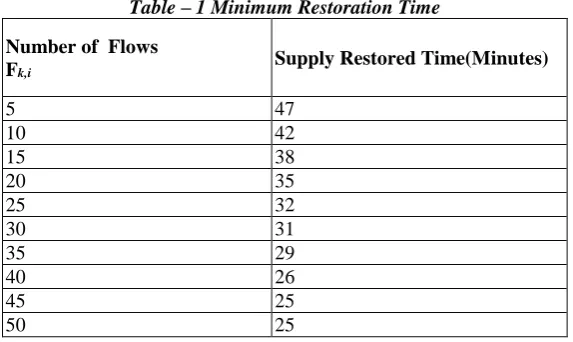
In the Lagrangian Decomposition approach, an optimization model is implemented for reducing cost, voltage, such a state variables. The tested results are presented in the following table – 1 tested in TNEB (Tamil Nadu Electricity Board)which gives the production of the electricity in a single power station. The testing data sets are summarized as follows
Table – 1 Minimum Restoration Time
Number of Flows
Fk,i Supply Restored Time(Minutes)
5 47
10 42
15 38
20 35
25 32
30 31
35 29
40 26
45 25
[Subramani* 4(7): July, 2017] ISSN 2349-4506
Impact Factor: 2.785
G
lobal
J
ournal of
E
ngineering
S
cience and
R
esearch
M
anagement
Fig –2 Supply restoration time
The generated units in the form of power flow in the corresponding time duration is in minutes. Based on the numerical calculation and graphical representation the feeder losses are minimized with respect to the minimum restoration time as twenty five minutes and is based on the input flow ‘i’ in the time slot ‘k’.
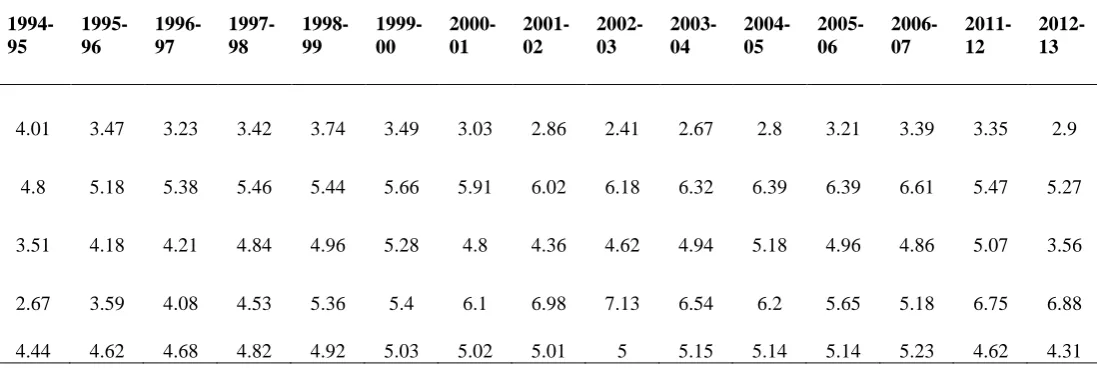
The following real time data are shows that the growth of electricity power production in plan wise. The plans are calculated according to the financial year plan (Five year plan). Based on this we have the tested data is shown in the following table
Table- 2 Year wise Growth Analysis (in Giga Watts)
1994-95
1995-96
1996-97
1997-98
1998-99
1999-00
2000-01
2001-02
2002-03
2003-04
2004-05
2005-06
2006-07
2011-12
2012-13
4.01 3.47 3.23 3.42 3.74 3.49 3.03 2.86 2.41 2.67 2.8 3.21 3.39 3.35 2.9
4.8 5.18 5.38 5.46 5.44 5.66 5.91 6.02 6.18 6.32 6.39 6.39 6.61 5.47 5.27
3.51 4.18 4.21 4.84 4.96 5.28 4.8 4.36 4.62 4.94 5.18 4.96 4.86 5.07 3.56
2.67 3.59 4.08 4.53 5.36 5.4 6.1 6.98 7.13 6.54 6.2 5.65 5.18 6.75 6.88
4.44 4.62 4.68 4.82 4.92 5.03 5.02 5.01 5 5.15 5.14 5.14 5.23 4.62 4.31
Generation Scheduling gives the cycles for generation of units. The Lagrangian Decomposition models are solved by MATLAB R2010a. The data sets used for the LD models are real time data sets. Fig – 3 depicts the modewise utility
0 5 10 15 20 25 30 35 40 45 50 55
10 15 20 25 30 35 40 45 50 55
Number of units Generated(Flows)
Su
pp
ly
Re
st
or
ed
ti
m
e
(M
inu
te
s)
[Subramani* 4(7): July, 2017] ISSN 2349-4506
Impact Factor: 2.785
G
lobal
J
ournal of
E
ngineering
S
cience and
R
esearch
M
anagement
Fig – 3 Modewise utilities
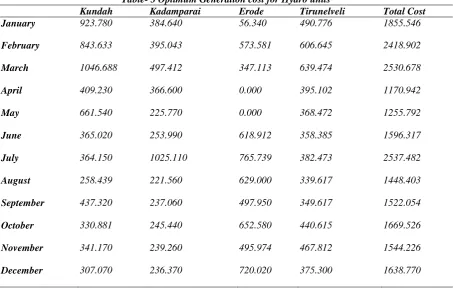
From the case study presented in table 3, we observed that the total generation cost for hydro units is minimized in april month whose generation cost is Rs. 1170.942 lakhs (hydro units) i.e., maximum power can be utilized in April with respect to the power cycle where the planning schedule period is January to December
Table- 3 Optimum Generation cost for Hydro units
Kundah Kadamparai Erode Tirunelveli Total Cost
January 923.780 384.640 56.340 490.776 1855.546
February 843.633 395.043 573.581 606.645 2418.902
March 1046.688 497.412 347.113 639.474 2530.678
April 409.230 366.600 0.000 395.102 1170.942
May 661.540 225.770 0.000 368.472 1255.792
June 365.020 253.990 618.912 358.385 1596.317
July 364.150 1025.110 765.739 382.473 2537.482
August 258.439 221.560 629.000 339.617 1448.403
September 437.320 237.060 497.950 349.617 1522.054
October 330.881 245.440 652.580 440.615 1669.526
November 341.170 239.260 495.974 467.812 1544.226
December 307.070 236.370 720.020 375.300 1638.770
SPECIFIC GENERATION BY ALL INDIA POWER STATIONS
MODE-WISE UTILITIES (1994-95 TO 2012-13)
HYDR O
COAL/ LIGNIT E
[Subramani* 4(7): July, 2017] ISSN 2349-4506
Impact Factor: 2.785
G
lobal
J
ournal of
E
ngineering
S
cience and
R
esearch
M
anagement
Fig – 3 Hydro Generation cost
CONCLUSION
This paper provides an optimal energy control efficient strategy for the electricity systems by power generation and optimal load management systems. A Lagrangian decomposition algorithm has been formulated as a Non-Linear Integer Programming (NLIP) problem with respect to various optimal constraints energy cost, etc. A novel SCADA-based decentralized approach is that proposes for power management in today’s electricity forwarded market. The capacity of transmission lines is optimally allocated to individual transactions for maximizing the social welfare. In the restructured power management systems, spot prices and reserved prices in the market that are the important parameters for solving the profit based unit commitment problems.
REFERENCES
1. M. Alicherry, R. Bhatia and ssaLi "Joint channel assignment and routing for throughput optimization in multi-radio wireless mesh networks" In Proceedings of ACM Mobicom' 05,(2005). pp 58 - 72.
2. Cristian and Adrian Gligor, SCADA based software for renewable energy management system ,
Procedia Economics and Finance, (2012), Vol. 3, pp. 262 – 26.
3. J.W Lee and R.R.Mazumdar and N.B. Shroff, "Non-convex optimization and rate control for multi-class services in the Internet", IEEE/ACM Transations on Networking, (2005), Vol. 13, No. 4, pp.827 – 840. 4. K.H. Liu, L. Cai, X.S. Shen, “Multi-class utility-based scheduling for UWB networks”, IEEE
Transactions on Vehicular Technology, (2008), Vol. 57, No. 2, pp. 1176−1187.
5. A. Rajeswaran, G. Kim and R. Negi, “A scheduling framework for UWB and cellular networks, Mobile Networks and Applications, (2006), Vol. 11, No. 1, pp. 9−20.
6. B. Radunvovic and J.Y. Le Bouder, "Optimal power control, scheduling and routing in UWB networks",
IEEE Journal on Selected Areas in Communications, (2004), Vol. 22, No. 7, pp.1252 – 1270.
7. R. Subramani and C. Vijayalakshmi, “Design and Analysis of Lagrangian Decomposition Model”,
Global Journal of Pure and Applied Mathematics, (2015), Vol. 11, No. 4, pp. 1859 – 1871.
8. R. Subramani and C. Vijayalakshmi, “A Review on Advanced Opti-mization Techniques”, ARPN Journal of Engineering and Applied Sciences, (2016), Vol. 11, No. 19, pp. 11675 – 11683.
9. Vale, ‘Distribution system operation supported by contextual energy resource management based on intelligent SCADA’, Renewable En-ergy, (2013), Vol. 52, pp.143 – 153.
10. Vale Z, Venayagamoorthy K, Ferreira J, Morais H. “Computational intelligence applications for future power systems”, Computational intelligence for engineering systems, (2011), Vol. 46, pp. 176 - 193. 11. S.J.Wang “Short-term generation scheduling with transmission and environmental constraints using an
augumented Lagrangian Relaxa-tion” IEEE Transactions on Power Systems, (1995), Vol. 10, No. 3, pp. 1294 – 1301
12. J. Yuan, Z. Li, W. Yu and B. Li, “A cross-layer optimization frame-work for multihop multicast in wireless mesh networks”, IEEE JSAC, Vol. 24, No. 11, pp. 2092, 2006.
P
la
ntw
is
e
G
ener
a
tio
n
Co
st
Period (Months)