42
Research note
Measurement and Correlation of Ibuprofen in Supercritical
Carbon Dioxide Using Stryjek and Vera EOS
M. Mirzajanzadeh1, F. Zabihi2∗, M. Ardjmand1
1- Islamic Azad University, Tehran South Branch, Faculty of Graduate Studies, Department of Chemical Engineering, Tehran-Iran.
2- Islamic Azad University, Ayatollah Amoli Branch,Department of Chemical Engineering, Amol-Iran.
Abstract
Ibuprofensolubility in supercritical carbon dioxide was measured using a dynamic apparatus at a pressure between 80 and 140 bars at three different temperatures, 308.15, 313.15 and 318.15 K. The mole fraction of Ibuprofen in fluid phase was in the range of 0.015 × 10⁻³ - 3.261 × 10⁻³ at the mentioned operational condition. Modified Mendez-Santiago and Teja equation were used to check the consistency of the experimental data. Results were correlated using the Stryjek and Vera equation of state with the van der Waals 1-parameter (vdW1) and 2-parameters (vdW2) mixing and combining rules. Interaction parameters along with the percentage of the average absolute relative deviation (%AARD) were displayed. Also, the Lydersen group contribution methods were used for predicting the physicochemical and critical properties of the Ibuprofen.
Keywords: Ibuprofen Solubility, Supercritical Carbon Dioxide, Stryjek and Vera EOS, Mendez-Santiago and Teja Equation
∗ Corresponding author: [email protected]
1- Introduction
Solubility data are essential for an accurate design of the operational conditions and to calculate the concentration of supercritical solution, in order to investigate the feasibility of SCF based processes. Supercritical fluids are useful in a variety of applications as food and pharmaceutical industries. Supercritical fluids have been established as powerful solvents for many non volatile and thermal labile compounds [1-2]. A fluid in the supercritical area has gas-like diffusivity,
Iranian Journal of Chemical Engineering, Vol.7, No. 4 43 Based on the supercritical fluids
characteristics, the solubility of a solid component in a supercritical solvent is influenced by the solution pressure and temperature sensitively [6-9].
To predict the solubility of a solute in supercritical fluids, EOS models are widely used. Cubic EOSs are the simplest equations capable of predicting and representing fluid phase equilibrium. Mixing rules are necessary when equations of state are applied to calculate the fluid mixtures thermodynamic properties. Although cubic EOS’s are the simplest mathematical models, capable of predicting fluid phase equilibrium, semi-empirical models are often utilized because of their relative ease of application compared to EOS’s. These models are commonly based on providing a correlation between solubility and density [10-12]. Current investigation has been organized to obtain Ibuprofen solubility data in supercritical CO2 in low pressure range
(80-140 bars). Results have been drawn as three isotherms ( in 308.15, 313.15 and 318.15K). Stryjek and Vera equation of state was used to correlate the experimental data within the 1-parameteric and 2-parameteric van der Waals mixing and combining rules. The Lydersen group contribution method was used in order to determine Ibuprofen physicochemical properties.
2- Experimental method
2.1- Materials
Ibuprofen (Sina Daru, 99.99% purity) was used as the original compound and CO2
(Roham Gaz, 99.95%) was also used as the solvent. Ethanol (99.8%, Sigma Aldrich) was used in analytical grade form.
2.2- Solubility measurements
The solubility of a solid component in supercritical CO2 was measured by a
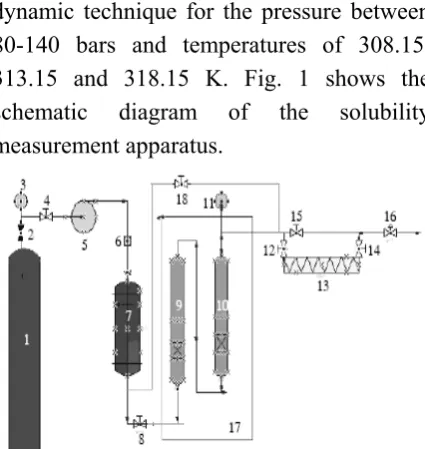
dynamic technique for the pressure between 80-140 bars and temperatures of 308.15, 313.15 and 318.15 K. Fig. 1 shows the schematic diagram of the solubility measurement apparatus.
Figure 1. Schematic diagram of the experimental
apparatus:1) gas tank, 2 ) ball valve, 3,11) pressure gauge indicator, 4,8,12,14,15,18) needle valve, 5) pump, 6) filter 7) pre-heater, 9,10) equilibrium-sell 16) throttling valve , 17) constant temperature bath
Condensed CO2 was fed to an HPLC pump
through a 0.5μm filter, to reach the desired pressure. The compressed fluid entered into a preheating coil contained in a temperature-controlled electronic oven to achieve thermal equilibrium and passed into a solubility cell that was packed with pure Ibuprofen powder. The solute laden purged to the atmosphere in order to ensure the operational condition
44 Iranian Journal of Chemical Engineering, Vol. 7, No. 4 sampling pass by closing the needle valves.
The sampling equipment (coil and valves) then separated from the system and marinated in the pure ethanol. The valves were then opened and the CO2 was vented
out and all the solute was washed out by ethanol. The ethanol-Ibuprofen solution was prepared for GC test to determine the solute amount. CO2 amount was calculated by
measuring the volume of the sampling equipment and the CO2 density in the
operational pressure and temperature in all runs. Solubility measuring run was performed in triplicate in each operational condition.
3- Results and discussion
3.1- Experimental results
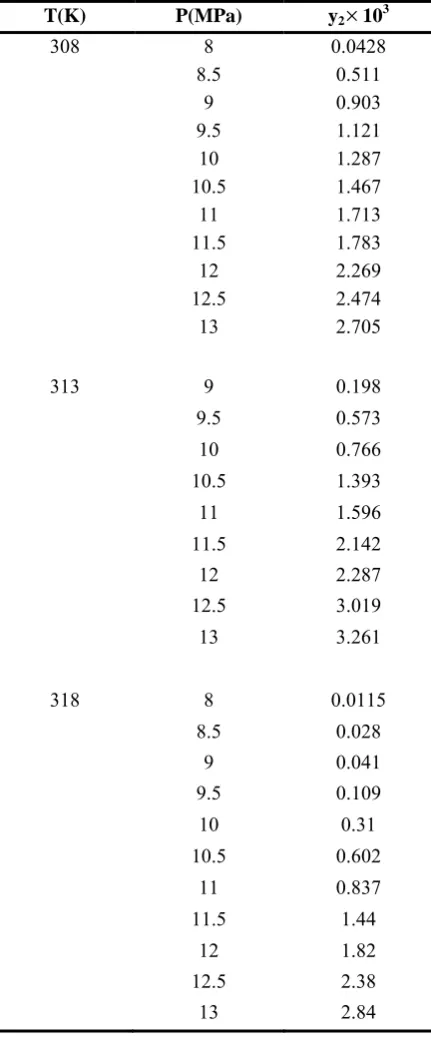
Solubility measuring results for an Ibuprofen-Supercritical CO2 system are
shown in Fig. 2 and are supported by data in Table 1.
-1 -0.5 0 0.5 1 1.5 2 2.5 3 3.5
7 7.5 8 8.5 9 9.5 10 10.5 11 11.5 12 12.5 13 13.5 14
308.15K
313.15K
318.15K
Figure 2. Experimental solubility data obtained in
308.15, 313.15 and 318.15 K and the pressure range of 80-140 bars
According to the experimental results, the mole fraction of ibuprofen in the fluid phase was in the range from 0.015 × 10⁻³ - 3.261 ×
10-3. As shown in Fig. 2, solubility is
affected by the supercritical solvent pressure and temperature intensively. Pressure increasing at a constant temperature consequently causes the density and the solvent power to increase. In addition, the
Table 1. Experimental molar fraction solubility of
Ibuprofen in supercritical CO2
T(K) P(MPa) y2×103
308 8 0.0428
8.5 0.511
9 0.903
9.5 1.121
10 1.287
10.5 1.467
11 1.713
11.5 1.783
12 2.269
12.5 2.474
13 2.705
313 9 0.198
9.5 0.573
10 0.766
10.5 1.393
11 1.596
11.5 2.142
12 2.287
12.5 3.019
13 3.261
318 8 0.0115
8.5 0.028
9 0.041
9.5 0.109
10 0.31
10.5 0.602
11 0.837
11.5 1.44
12 1.82
12.5 2.38
Iranian Journal of Chemical Engineering, Vol.7, No. 4 45 isotherms comparison shows that the
solubility power in a constant pressure, changes with the temperature increasingly in lower than 120 bar (~2Pc) and decreasingly
in the higher pressure ranges. This result can be interpreted by the iso-fugacity criteria [13]: SCF sub s sub RT P P v E E P P y 2 2 2 2 2 ) ( exp φ ⎟⎟ ⎠ ⎞ ⎜⎜ ⎝ ⎛ − ≡ = (1)
At a constant pressure, both the E and sub
P2
value affect the solubility. At pressures higher than the crossover point (about 120 bar), the effect of E is relative to the solid
component sublimation pressure intensively. In low pressure ranges, molecular interactions between Ibuprofen and carbon dioxide become severely weak by increasing the temperature. On the other hand, in higher pressure ranges, sublimation pressure is the
more effective factor. Because although the sublimation pressure increases with the temperature, the E factor impression by the
temperature becomes very weak at high pressures.
3.2- Correlation of solubility using Stryjek and Vera EOS
If the solid phase does not dissolve the SC-CO2, solute solubility in the CO2-riched fluid
phase at equilibrium can be calculated using the equation (1). The Stryjek and Vera EOS has been selected to calculate SCF
2
φ , as it has proved to combine the simplicity and accuracy in modeling of several solids solubility in SCFs. The van der Waals mixing rules may be used to calculate the mixture parameter 'a' and 'b' in SV-EOS.
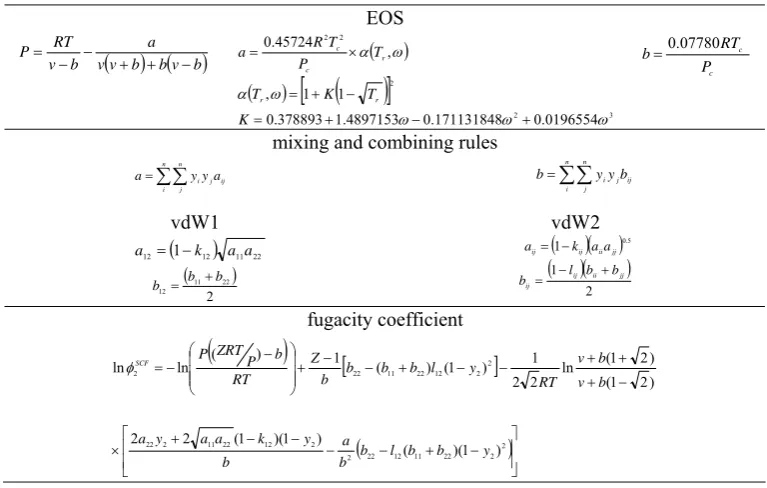
Table 2 summarizes the cubic EOS along with the mixing and combining rules and the fugacity coefficient ( SCF
2
φ ) used in this work [14].
Table 2. Summary of the cubic EOS, mixing and combining rules and fugacity coefficient
EOS
(v b) (bv b)
v a b v RT P − + + − − = ( ) ( )
[
(
)
]
3 2 2 2 2 0196554 . 0 171131848 . 0 4897153 . 1 378893 . 0 1 1 , , 45724 . 0 ω ω ω ω α ω α + − + = − + = × = K T K T T P T R a r r r c c c c P RT b=0.07780mixing and combining rules
∑∑ = n i n j ij j iya
y
a =∑∑
n i n j ij j iyb
y b
vdW1 vdW2 a12=(1−k12) a11a22
( ) 2 22 11 12 b b b = +
(1 )( )0.5
jj ii ij ij k aa
a = −
( )( )
2
1 ij ii jj
ij
46 Iranian Journal of Chemical Engineering, Vol. 7, No. 4 The Correlation is performed by minimizing
the objective function of Average Absolute Relative Deviation (AARD) defined by equation (2) [15]:
∑
= −=
= N
i i
i calc i
y y y
1 ,exp exp , ,
N 100 AARD(%) Function
Objective
(2)
A trial and error algorithm was provided and encoded for the interaction parameters optimized values computation. The loop was conditioned by 10-7 tolerance.
Lydersen group contribution method was also used to predict the physicochemical and critical properties of the Ibuprofen that are presented in Table 3 [16].
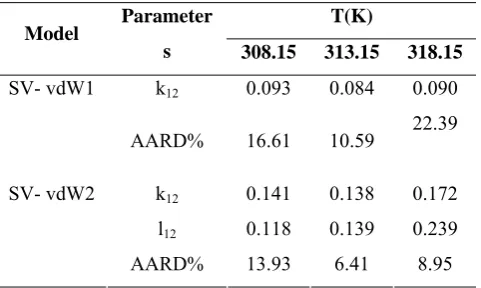
Under these conditions, the optimized interaction parameters (k12 and l12) showed
the best fitting between the experimental data and the calculated values (by SV-EOS and van der Waals mixing rules) (Table 4). A comparison between the correlation results for the SV- EOS at 318.15 K for the two different mixing rules is illustrated in Fig. 3.
Table 3. Physicochemical and critical properties of the ibuprofen and CO2
2
10 ) ( × −
Pa Psub
Substance Tc(K) Pc(MPa) ω ×106 3 −1
mol m vs
308.15K 313.15K 318.15K
Ibuprofen 749.7a 2.33a 0.819a 182.1b 4.95c 8.97c 16.0c
CO2 304.18 7.38 0.239
a Estimated by Lydersen method
b Estimated by Immirzi and Perini method c Estimated by Lyman et al. method
Table 4. Optimized interaction parameter for the modeling of Ibuprofen solubility in CO2
with the SV-EOS and the van der Waals mixing rules
T(K)
318.15 313.15
308.15 Parameter
s Model
0.090 0.084
0.093 k12
22.39 10.59
16.61 AARD%
SV- vdW1
0.172 0.138
0.141 k12
0.239 0.139
0.118 l12
8.95 6.41
13.93 AARD%
Iranian Journal of Chemical Engineering, Vol.7, No. 4 47 Figure 3. Experimental solubility of Ibuprofen in
SC-CO2 at 308.15(+), 313.15(o) and 318.15K(∗) and
correlation results obtained with SV EOS using the vdW1 and vdW2
3.3- Modeling with a density-based correlation
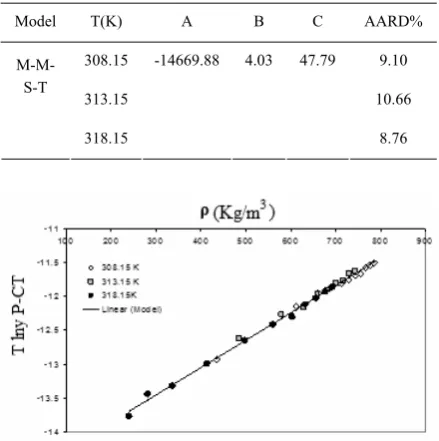
In order to check the consistency of experimental data for the solubility of Ibuprofen in SC carbon dioxide as a function of absolute temperature and solvent density, we used the semi-empirical Mendez-Santiago and Teja equation. The modified Mendez-Teja equation can be expressed by the equation (3) [16].
CT B
A yP
Tln = + ρ1+ (3)
The regression constants and AARD% values are presented in Table 5 in the three isotherms for the model.
The experimental results were plotted in the form of Tlny2P−CT against the supercritical
CO2 density, to test the M-S-T model
self-consistency (Fig. 4). The linear behavior shown in Fig. 4 confirms that the measured solid solubility data are consistent at all experimental conditions.
Table 5. Modified Mendez-Santiago-Teja modeling
results
Model T(K) A B C AARD%
308.15 -14669.88 4.03 47.79 9.10
313.15 10.66
M-M-S-T
318.15 8.76
Figure 4. Experimental solubility data for Ibuprofen
and values correlated by modified M-S-T model
4- Conclusions
48 Iranian Journal of Chemical Engineering, Vol. 7, No. 4 feasible for the application of data
extrapolation.
5- Nomenelature
A, B and C adjustable parameters
E enhancement factor
SCF 2
φ fugacity coefficient of the
solute in the fluid phase
1
ρ supercritical fluid density
(kg.m-3)
k12 and l12 interaction parameters
N number of experimental data
P equilibrium pressure
sub
P2 sublimation pressure of solute
component
T equilibrium temperature
s
v2 the saturated molar volume of
solid solute at the equilibrium temperature
y mole fraction of solid
component in supercritical solvent
References
[1] Fages, J., Luchard, H., Letorneau, J.J. and Sauceau M., "Particle generation for pharmaceutical applications using supercritical fluid technology", Powder Technol, 141, 219 (2004).
[2] Yildiz, N., Tuna, S., Duker, O. and Calimli, A., "Particle size design of digitoxin in supercritical fluids", J. of Supercritical Fluids, 41, 440 (2007).
[3] Chen, Y. and Koberstein J.T., "Fabrication of block copolymer monolayers by adsorption from supercritical fluids: A versatile concept for modification and functionalization of polymer surfaces", Langmuir, 24,
10488-10493, (2008).
[4] Hirunsit, P., Huang, Z., Srinophakon, T.,
Charoenchaitrakool, M. and Kawi, S., "Particle formation of Ibuprofen-supercritical CO2 system from rapid
expansion of supercritical solution", J. Powder Technology, 154, 83-94, (2005).
[5] Dashtizadeh, A., Pazuki, G.R., Taghikhani, V. and Ghotbi, C., "A new two-parameter cubic eq. of state for predicting phase behavior of pure compounds anf mixtures", J. of Fluid Phase Equilib., 242, 19, (2006).
[6] Madras, G. "Thermodynamic modeling of the solubilities of fatty acids in supercritical fluids", J. of Fluid Phase Equilibria, 220,
167, (2004).
[7] Zabihi, F., Akbarnejad, M.M., Vaziri, A., Arjomand, M. and Seyfkordi, A. A., "Drug nano-particles formation by supercritical rapid expansion method operational condition effects investigation", IJCCE, 28,
441, (2009).
[8] Chrastil, F. J. "Solubility of solids and liquids in supercritical gases", Phys. Chem 86,
3016, (1982).
[9] Fages, J., Lochard, H., Letourneau, J. J., Sauceau, M. and Rodier, E. "Particle generation for pharmaceutical applications using supercritical fluid technology",
Powder Technol.141, 219, (2004).
[10] Su, C. S., Chen, Y. P. "Measurement and correlation for the solubility of nonsterodial anti inflammatory drugs (NSAIDs) in supercritical carbon dioxide", J. Supercrit. Fluids43, 438, (2007).
[11] Güçlü-Üstünda˘g, Ö. and Temelli, F. "Correlating the solubility behavior of fatty acids, mono, di, and triglycerides, and fatty acid esters in supercritical carbon dioxide", Ind. Eng. Chem. Res. 39, 4756, (2000).
Iranian Journal of Chemical Engineering, Vol.7, No. 4 49
[13] Sparks, D. L., Hernandez, R. and Antonio Estevez, L. "Evaluation of density-based models for the solubility of solids in supercritical carbon dioxide and formulation of a new model", J. of Chemical Engineering Science, 63, 4292 (2008).
[14] Coimbra, P., Duarte, C.M.M. and Susa, H.C.de, "Cubic equation-of-state correlation of the solubility of some anti-inflammatory drugs in supercritical carbon dioxide", J. of Fluid Phase Equilibria, 239(5), 188 (2006).
[15] Housaindokht, M.R. and Bozorgmehr, M.R., "Calculation of solubility of methimazol, phenazopyridine and propanol in supercritical carbon dioxide", J. of Supercritical Fluids, 43(2), 390 (2008).
[16] Charoenchaitrakool, M., Dehghani, F. and Foster, N.R., "Micronization by rapid expansion of supercritical solutions to enhance the dissolution rates of poorly water-soluble pharmaceuticals", J. of Ind. Eng. Chem. Res., 39(8), 4794 (2000).
[17] Sparks, D. L., Hernandez, R. and Estevez, A., "Evaluation of density-based models for the solubility of solids in supercritical carbon dioxide and formulation of a new model", J. of Chemical Engineering Science,