OPEN A
CCE
SS
JZ
AR R
esearch article
OPEN A
CCE
SS
Reproduction, social behaviour and captive husbandry in the eastern
grass owl (
Tyto longimembris
)
Ric Dunlop1 and Philip Pain2
1Perth Zoo, 20 Labouchere Road, South Perth, Western Australia, 6151 Australia
2Eagles Heritage, 341 Boodjidup Road,Margaret River, Western Australia, 6285, Australia
Correspondence: Ric Dunlop; [email protected]
Keywords:
captive management, clutch size, cooperative breeding, fertility
Article history:
Received: 2 September 2015 Accepted: 24 August 2016 Published online: 3 November 2016
Abstract
The eastern grass owl (Tyto longimembris) has a wide distribution through the Indian sub-continent, southern China, Indonesia, Papua New Guinea and northern and eastern Australia. Despite this broad geographic range it has seldom been studied in the wild and little is known of its reproductive ecology and social behaviour. We studied three nestlings acquired from the wild in 1996, and successfully bred from those birds in the following two years. Breeding commenced at one year of age, with up to three clutches produced in a single breeding season. Clutch size ranged between seven and 10 eggs; incubation commenced after the second egg was laid and lasted 29–31 days. Fertility within clutches varied from 0 to 90% (n=3 clutches, across two years), with clutches laid late in the season having lower fertility. Fledging success varied from 50 to 75% (n=2 clutches, across two years). Evidence of cooperative breeding was observed, with female young of the previous year participating in incubation and chick rearing in the year following their birth.
Introduction
In Australia the eastern grass owl (Tyto longimembris Jerdon
1889) is found in the sub-coastal environments between northern New South Wales and Cape York Peninsula in Queensland, the northern parts of the Northern Territory and the Kimberley region of Western Australia. Grass owls have also been found as vagrants in inland areas on the Barkly Tableland in Queensland and through the catchments of Lake Eyre and upper Darling River, and there is a single record from south-western Western Australia (Johnstone and Storr 1998). There are 817 records for this species in the Atlas of Living Australia database (Atlas of Living Australia 2015), the majority of which have come from coastal areas of eastern Australia (Queensland, New South Wales and Victoria), and a scattering of inland locations in other parts. At nearly all of the locations where they have been recorded, grass owls have been at very low densities. Their presence at most sites is sporadic, with the owls dispersing when favourable breeding conditions deteriorate (Schodde and Mason 1980; Hobcroft and James 1997; Johnstone and Storr 1998). By virtue of its nocturnal habits and distribution in remote and sparsely populated regions of Australia, this species has received little detailed study.
With longer legs than other owls and reduced plumage on the upper legs, the eastern grass owl (EGO) is well suited to its habitat in tussock grasslands (Brooker 1976; Schodde and Mason 1980; Pizzey 2007). It has also been known to inhabit heaths, swamps, coastal dunes, tree-lined creeks, treeless plains, grassy gaps between trees, agricultural crops, mangroves and young pine plantations (del Hoyo et al. 1999).
Over the years, sightings of EGOs in Western Australia have been sporadic, with few observations recorded since the first report of a bird collected at Cranbrook in 1944 (Johnstone and Storr 1998; Olsen and Doran 2002). Since that time sightings in Western Australia have been confined to the Kimberley, where birds have been observed near Broome (seven records), Dunham River (six records) and Kununurra (Johnstone and Storr 1998; NatureMap 2015). Most breeding records in Australia are from the east coast, with the bulk of the records from Cairns south to near Rockhampton and single records from the Alligator River in the Northern Territory and Kununurra (Johnstone and Storr 1998; Higgins 1999). Breeding appears to occur in loose colonies, with 40–50 pairs recorded nesting in a 40 ha fallow rice field (Higgins 1999) and up to 30 birds nesting in an area of less than 100 ha (Hollands 2008).
1976; Beste 1982; Sedgwick 1984; Fitzgerald and Thorsten 1994; Maciejewski 1996; Hobcroft and James 1997; Olsen and Doran 2002; Hollands 2008). Published accounts from elsewhere in the species’ range in the Indian sub-continent, Indonesia and Papua New Guinea are for the most part limited to its inclusion in regional handbooks and species lists (del Hoyo et al. 1999).
Little is known of the social organization of EGOs, apart from those observations made during the breeding season. It has been suggested that EGOs often occur in loosely communal associations, roosting, nesting and hunting near each other, but this is matched by many records of pairs or single birds during drier times (Higgins 1999). Breeding pairs are thought to be monogamous, but possibly temporary in nature (Schodde and Mason 1977; Fry et al. 1988). We could find only one report describing the captive
behaviour of the EGO (Pettigrew et al.1986) that described the
incubation period (in June 1983) from a single captive pair held at Cairns Bird Park.
This paper describes the information recorded by staff at the Perth Zoo following the acquisition of three sibling nestling EGOs aged between 15 and 28 days from Kununurra in the east Kimberley in July 1996, and the subsequent successful husbandry and captive breeding of those birds over a two year period (1997– 1998).
While it is always necessary to consider observations of captive animals with caution, they can provide useful information that could otherwise not be collected on cryptic or naturally rare species in the wild, and can provide focus for particular field observations.
Methods
Eastern grass owls at Perth Zoo
The three EGO nestlings were obtained by a research associate of the Western Australian Museum (under Department of Parks and Wildlife licence) from a paddock near Kununurra after the nest they were occupying was run over by a tractor-drawn mower. At least two other siblings in the nest were killed and the nest was destroyed.
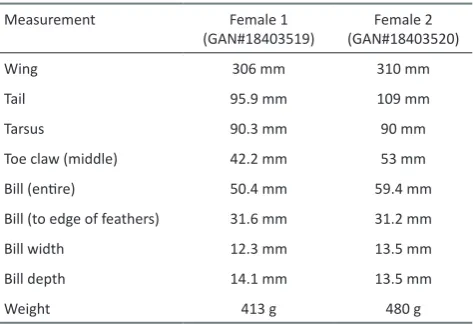
On arrival in Perth the measurements of the two youngest birds were taken (Table 1).
Housing and cleaning
The EGOs were maintained in an enclosure (15 x 2 x 2 m: L x W x H) with the walls made of 19 mm thick plywood with ventilation grills located at each end. The enclosure was meshed with 25 x 12 mm wire and had colour bond sheeting covering both ends
of the enclosure. Shade cloth was attached to the entire roof to provide shading during the summer months and to reduce lighting levels in the uncovered section of the enclosure. An overhead sprinkler system was provided to cool the enclosure during the hot dry summer months experienced in Perth. The substrate in the enclosure was crushed limestone with a top layer of coarse
river sand, into which large tussocks of Rhode’s grass (Chloris
gayana) were planted. In recognition of the terrestrial habits of this species only one perch was provided in the enclosure.
Staff entered the enclosure once a day to feed, clean and check the condition of birds. Uneaten food, faecal pellets and castings were removed from the enclosure daily and water dishes cleaned and refilled with fresh water. The enclosure was cleaned once a
week, removing dead vegetation and raking the substrate. After
egg laying and during the incubation and nestling growth periods, the frequency of cleaning was reduced to minimise disturbance to the breeding birds.
Feeding regime
The EGOs were routinely fed 4–5 adult mice (Mus musculus),
frozen then thawed at room temperature, each day with one starve day each week. With the onset of the breeding season, this was increased to 4–6 mice each a day with one starve day a week. During the period after hatching, feeding was increased for the maintenance and growth requirements of the young. The young birds were not starved until after they had fledged. All food was placed on the floor of the enclosure.
Body measurements
Other than for the wing and the tail, which were measured with a steel ruler (rounded to the nearest mm), all measurements were made using Vernier callipers (± 0.5 mm). All weights were determined using digital scales (± 0.1 g).
Results
Social observations
In 1997 the three EGOs (two females, GAN numbers 18403519 and 1843520, and one male, GAN number 8447327) were housed together and displayed a gregarious nature from the outset. There was no aggression shown towards siblings, either in the lead up to, or during the breeding season.
With the pairing of the breeding male and female, the unpaired female was observed to roost with the male, or on the edge of the nest area with the breeding female. This behaviour was observed throughout laying and nestling growth period. The male did not exhibit any mating behaviour towards the second female and only one female produced eggs.
Sexual maturity
Sexual maturity was reached after 12 months of age in both the male and the one female the male bonded with.
Egg laying and incubation
A single clutch of seven eggs was produced in April 1997, laid over an 11-day period from 2 to 13 April. The nest made to hold the eggs was a simple scrape on the ground located beneath a dense stand of Rhode’s grass. All nests were on bare sand and were unlined. The interval between successive eggs varied from 1 to 3 days, with a mean interval of two days. Incubation commenced after the laying of the second egg, and the mean duration of incubation for each egg was 29.8±1.0 days (mean ± s.d.; n=6; Table 2). Three of the six chicks that hatched survived to fledge.
Prior to the 1998 breeding season the original trio of wild-born birds were separated. One adult male and one adult female (hatched 1996) were retained at Perth Zoo and the other adult Table 1. Morphometric measurements from two of the three eastern grass
owl chicks received at Perth Zoo in 1996.
Measurement Female 1
(GAN#18403519) (GAN#18403520)Female 2
Wing 306 mm 310 mm
Tail 95.9 mm 109 mm
Tarsus 90.3 mm 90 mm
Toe claw (middle) 42.2 mm 53 mm
Bill (entire) 50.4 mm 59.4 mm
Bill (to edge of feathers) 31.6 mm 31.2 mm
Bill width 12.3 mm 13.5 mm
Bill depth 14.1 mm 13.5 mm
Table 2. Laying and hatching dates and incubation period for the first clutch of eggs produced by a grass owl at Perth Zoo in 1997, and the first of three clutches produced in 1998.
Egg number
1997 1 2 3 4 5 6 7
Lay date 2 April 1997 2 April 1997 4 April 1997 6 April 1997 8 April 1997 10 April 1997 13 April 1997 Hatch date 3 May 1997 3 May 1997 Infertile 6 May 1997 7 May 1997 9 May 1997 12 May 1997
Incubation period (d) 31 31 – 30 29 29 29
1998 1 2 3 4 5 6–9
Lay date 5 June 1998 6 June 1998 7 June 1998 13 June 1998 14 June 1998 17–23 June 1998 Hatch date 6 July 1998 7 July 1998 Infertile 12 July 1998 13 July 1998 Infertile
Incubation period (d) 31 31 – 29 29 –
female was sent to another facility along with two of the three surviving young from the 1997 breeding season. One young female from the 1997 breeding season was retained at Perth Zoo and was housed in the same enclosure with her parents during 1998. As had been observed the previous year, there was no aggressive behaviour noticed among the birds with the onset of breeding. The non-breeding female was observed to spend much of the day roosting at the nest with the breeding female. During 1998, three clutches of eggs were produced by the breeding pair.
Clutch 1
With the onset of the laying season the younger female moved into the nest with the breeding female. Incubation (though not egg laying) and the subsequent raising of the chicks were shared by the two females until the young fledged. Only six of the nine eggs from the first of two clutches laid in 1998 were fertile and the interval between egg-laying was 1–6 days (mean 2 days) for the first five eggs, followed by a three-day break, and the remaining three eggs were laid over a six-day period (Table 2). Incubation began after the second egg was laid and had a mean duration of 30.0 ± 1.2 days (mean ± s.d., n=4). Four fertile eggs hatched, but only three chicks lived to fledge.
Clutch 2
After the three chicks had fledged the adult pair moved from the original nest site and laid 10 eggs in a new nest over the period 26–30 August 1998. It was decided to remove these eggs and
incubate them artificially. The artificial incubator subsequently developed an electrical fault and all 10 eggs failed to hatch, though nine of the 10 were fertile. The eggs in this clutch were of a very consistent size and weight, despite the very short laying period (five days) for the entire clutch. Mean width was 29.3±1.33 mm, mean length was 40.7±1.45 mm, and mean weight 22.0±0.0 g.
Clutch 3
A third clutch of six eggs was laid after the second clutch had been removed by zoo staff, and these were left in the nest to be incubated by both females; however, none of these eggs hatched.
Plumage characteristics of chicks
At hatching the chicks were covered in the first (protoptile) natal down which dried to a cream white colour rather than the white
“powder puff” effect often observed in other Tyto species. The
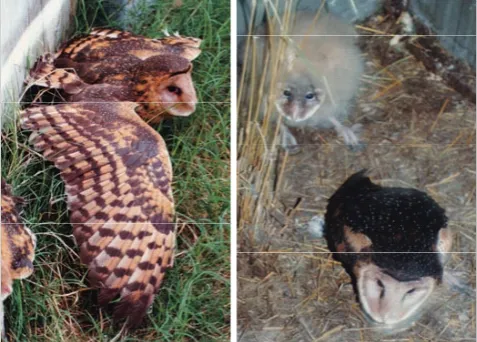
natal down was replaced with a second (mesoptile) down in a rich golden brown colour with the full “powder puff” effect from as early as 55 days of age, through to as late as 65 days of age (Figure 1).
The golden brown down was subsequently replaced with the first plumage, which was dark tawny brown in colour with white tips on the upper parts from crown to tail. The under parts were a soft mid-tawny brown colour with dark tips, a mid-tawny brown breast with white belly and thighs.
The facial disc, at the time of the loss of down, was a dark tawny colour with white tips at the bottom of the disc (Figure
Figure 1. Female eastern grass owl chick (GAN#18397771) at 55 days old (L) and 69 days old (R) showing golden brown down and emerging white feathers on the facial disk (Photos: Ric Dunlop).
2). During the first year of life the coloration of plumage became lighter, with light tawny brown on the nape and throat area and sporadic colouring through darker plumage on upper-parts. The adult plumage was dark black with white tips to some feathers on the back, and tawny brown feathers along the flanks and belly (Figure 2).
Growth measurements of chicks
Two chicks hatched in 1997 were weighed and measured on four occasions between days 1 and 69 after hatching. Mean values of measurements are provided in Table 3.
Longevity in captivity
The two founding female birds (GAN#s 18403519 and 1843520) lived in captivity for six and eight years respectively, and the male (GAN# 8447327) for 18 years.
Discussion
The data presented here provide additional detailed information on egg dimensions, and the first detailed data on egg-laying period
Measurement Definition Day 1 Day 46 Day 57 Day 69
Head/bill From the back of the skull to the furthermost point of the top mandible 15 59 71 81
Head width At the widest point of skull – 39 47.5 48
Bill/cere From the furthermost point of the top mandible to the edge of feathers – 24.5 28 28.5
Bill width At the widest point of the mandible 8 13 13 13
Bill depth From the cranio-facial hinge to the base of the bottom mandible 2.75 15.5 – 18
Cere From the cranio-facial hinge to the exposed bill – 9 n/a 16
Ulna/radius From the tip of the bone at joint of ulna/radius and carpals to the tip of the bone at
the joint at ulna/radius and humerus 15 60 96 115
Humerus From the tip of the bone at the ulna/radius and the humerus joint to the tip of the bone at the humero-clavicular joint
16 67 88 100
Tarsus From the tip of the bone at the inter-tarsal joint to the tip of the bone at the tarsal joint
31 53 74 83.5
Femur From the tip of the bone at the tibio-tarsal joint to the tip of the bone at the ischium 15 – – – Tibio-tarsus From the tip of the bone at the femoral joint to the tip of the bone at the
tarso-metatarsus 20.5 70 94 115
Digit From the tarsals to the tip of the talon – 19
Digit 1 – 9 – 30.5
Digit 2 – 23.5 – 30
Digit 3 – 22 – 23
Digit 4 – 16
Talon From the tip of the talon to the flesh of the digit – 13
Talon 1 – 6 – 16
Talon 2 – 10 – 13
Talon 3 – 9 – 12
Talon 4 – 7.5
Wing Longest feather measured with the wing straight and flat – 116 – 215
Tail Longest feather measured from under tail coverts – 35 – 67
Weight (g) 15 248 410 518
Table 3. Morphometric measurements collected from two unsexed chicks (GAN# 18403646 and # 18403647) hatched in 1997. All measurements are mean values in (mm), except weight (g).
and interval, nestling growth and reproductive behaviour in captive
EGOs. In captivity the EGOs in our study reached sexual maturity at
one year of age, which was a year earlier than recorded by Wallace (1983) and Pettigrew et al. (1986). However, as with many bird species inhabiting environments with unpredictable rainfall and food supplies, age at the onset of breeding may depend on an adequate food source to promote breeding. This observation is
consistent with published accounts for other species of Tyto owls
that have been kept in captivity (Marti 1997; Frey et al. 2011). Eggs laid in captivity were of a similar size to those encountered in the wild (Campbell 1920; Johnstone and Storr 1998), while the clutch sizes recorded in our study were typically larger than those reported from the wild in Australia (Stone 1917; Campbell 1920; Schodde and Mason 1977; Hollands 2008), and also larger than the 4–6 eggs recorded in India (del Hoya et al. 1999).
infertile, were laid three days after the fifth egg, and twelve days after the first egg. This may have been due to the male not mating with the female once incubation commenced after the second egg was laid, so no more viable sperm were available to fertilise the eggs produced in the second half of the clutch.
Egg fertility rates for the clutches produced by the captive birds ranged from 44 to 90 %, but this did not translate into a corresponding number of fledglings. Even in captivity, where food supply was assured in terms of quality and quantity, survival to fledging varied from 50 to 75 %.
Bearing in mind that the birds used in this study were three siblings from the same nest and their progeny, and that their relatedness may have resulted in some atypical behaviour, the social behaviour observed in captivity indicates a capacity for a gregarious nature and possible colony-style breeding. Of particular interest is the observation that young females of the previous season are tolerated at the nest after fledging and can participate in the incubation and rearing of subsequent clutches. While these observations could be isolated cases and not considered the normal behaviour in the wild, cooperative breeding has been recorded in
other species of owl (e.g. great grey owl Strix nebulosa and eagle
owl Bubo bubo) (Cramp 1985; Bull and Duncan 1993; Martinez et al. 2005) and diurnal raptors (29% of genera and 14% of species within Accipitridae and Falconidae; Kimball et al. 2003).
There are no data on longevity of EGOs in the wild, but sister species banded in the wild in Australia have lived for periods
ranging from 11 months (T. novaehollandiae) to four years and 15
days (T. tenebricosa), and seven years and eight months (T. alba)
(Australian Bird and Bat Banding Scheme database; accessed 7 July 2015). The recorded longevity for EGOs in captivity of 18 years reported in this study is comparable to that of wild birds
from other species in the genus Tyto, but at the lower end of the
range recorded in captive owls from a broader range of genera (Mikkola 2014).
Conclusion
The eastern grass owl is a striking bird that lends itself to display
in zoos and wildlife parks, more so than many of the other Tyto
species. Its largely terrestrial habits make an attractive alternative to other arboreal raptors for display purposes. While being simple to manage, the EGO retains an aggressive demeanour towards keeping staff, even in captive-bred birds. Based on the limited observations described here, it appears to engage in cooperative breeding, with daughters sharing incubation and chick rearing duties with their mothers.
The paucity of information on the captive management of grass owls indicates that there is still a need for ongoing studies within this group of owls. More research is required to confirm the role of juvenile birds (6–18 months old) in the rearing of subsequent young born within the same or subsequent breeding season, and the relationship between the mid-clutch delay in laying and the success of the clutch.
Acknowledgements
We thank Colin Hyde, Peter Mawson, Arthur Ferguson, Kaelene McKay and the Bird Staff at Perth Zoo for their assistance with data collection and their encouragement to progress this research, and Ron Johnstone (WA Museum) for his advice and information
regarding Tyto longimembris in Western Australia.
References
Atlas of Living Australia (2015) http://biocache.ala.org.au/occurrence/ search?q=lsid%3Aurn%3Alsid%3Abiodiversity.org.au%3Aafd. taxon%3A12d6e000-f7c5-457b-b8dd-9e0d57c2aa25#tab_mapView; accessed 8 May 2015.
Beste H. (1982) Observations at a nest of eastern grass owls. Australian Bird Watcher 9:154–157.
Brooker M.G. (1976) A record of the eastern grass owl from the Northern Territory. Emu 76: 154.
Bull E.L., Duncan J.R. (1993) Great gray owl (Strix nebulosa). In: A. Poole. (ed.) The Birds of North America. Vol. 41. Ithaca, NY: Cornell Lab of Ornithology.
Campbell A.J. (1920) Notes on additions to the ‘H.L. White Collection’. Emu
20: 49–66.
Cramp, S. (1985) (ed.) Handbook of the Birds of Europe, the Middle East and North Africa. Volume 4. Oxford: Oxford University Press. Del Hoyo J., Elliot A., Sargatal J. (1999) Handbook of Birds of the World.
Volume 5: Barn-owls to Hummingbirds. Arrington VA: BirdLife International and Lynx Edicions.
Fitzgerald M., Thorstensen C.R. (1994) A note on the eastern grass owl
Tyto longimembris: Diet from the northern coast of New South Wales.
Corella 18: 87–88.
Frey C., Sonnay C., Dreiss A., Roulin A. (2011) Habitat, breeding performance, diet and individual age in Swiss barn owls (Tyto alba).
Journal of Ornithology 152: 279–290.
Fry C.H., Keith S., Urban E.K. (1988) The Birds of Africa. Volume 3: Parrots to Woodpeckers. London: Academic Press.
Glauert L. (1945) A Western Australian grass owl. Emu 44: 229–230. Higgins P.J. (ed.) (1999). Handbook of Australian, New Zealand and
Antarctic Birds.Volume 4. Parrots to Dollarbird. Melbourne: Oxford University Press.
Hobcroft D., James D.J. (1997) Records of the grass owl from southern New South Wales. Australian Bird Watcher 17: 91–93.
Hollands D. (2008) Owls, Frogmouths and Nighthjars of Australia. Australia: Bloomings Books.
Johnstone R.E., Storr G.M. (1998) Handbook of Western Australian Birds. Volume I: Non-passerines (Emu to Dollarbird). Perth: Western Australian Museum.
Kimball R.T., Parker P.G., Bednarz J.C. (2003) Occurrence and evolution of cooperative breeding among the diurnal raptors (Acciptridae and Falconidae). The Auk 120: 717–729.
Maciejewski S.E. (1996) The grass owl (Tyto capensis) in north-eastern New South Wales. Australian Raptor Studies II, Birds Australia Monograph 3. Hawthorn East, Victoria: Birds Australia.
Marti C.D. (1997) Lifetime reproductive success in barn owls near the limit of the species’ range. The Auk 114: 581–592.
Martinez J.E., Gil F.G., Zuberogoitia I., Martinez J.A., Calva J.F. (2005) First record of coooperative nesting in the eagle owl Bubo bubo. Ardeola
52: 351–353.
Mikkola H. (2014) Owls of the World. London: Bloomsbury.
NatureMap (2015) http://naturemap.dpaw.wa.gov.au/default.aspx, accessed 5 January 2015.
Olsen P., Doran B. (2002) Climatic modelling for the Australian distribution of the grass owl (Tyto capensis): is there an inland population? Wildlife Research 29: 117–125.
Pettigrew J.D., Little L., Steginga T. (1986) Incubation period of the Australian grass owl Tyto capensis longimembris. Emu 86: 117–118. Pizzey G. (2007) The Field Guide to the Birds of Australia. Pymble, NSW:
Harper Collins.
Schodde R., Mason I.J. (1977) Zoological Catalogue of Australia. 37.2. Aves. Melbourne: CSIRO Publishing.
Schodde R., Mason I.J. (1980) Nocturnal Birds of Australia.
Melbourne:Landsdowne Press.
Sedgewick E.H. (1984) An eastern grass owl at Coen, Queensland.
Australian Bird Watcher 10: 236–237.
Stone A.C. (1917) Description of eggs and nesting-place of Strix candida
(Tickell) (Tyto longimembris walleri, Matthews), Australian grass owl.
Emu 17: 39–40.