Performance Assessment for Students using
Different Defuzzification Techniques
Anjana Pradeep Jeena Thomas
Department of Computer Science & Engineering Department of Computer Science & Engineering St. Joseph College of Engineering and Technology Palai,
Kerala, India
St. Joseph College of Engineering and Technology Palai, Kerala, India
Abstract
The aim of this study is to evaluate the performance of students using a fuzzy expert system. The fuzzy process is based solely on the principle of taking non-precise inputs on the factors affecting the performance of students and subjecting them to fuzzy arithmetic to obtain a crisp value of the performance. The system classifies each student's performance by considering various factors using fuzzy logic. Aimed at improving the performance of fuzzy system, several defuzzification methods other than the built methods in MATLAB have been devised in this system for producing more accurate and quantifiable result. This study provides comparison and in depth examination of various defuzzification techniques like Weighted Average Formula (WAF), WAF-max method and Quality Method (QM). A new defuzzification method named as Max-QM which is extended from Quality method that falls within the general framework is also given and commented upon in this study.
Keywords: Fuzzy logic, Fuzzy Expert System, Defuzzification, Weighted Average Formula, Quality Method
_______________________________________________________________________________________________________
I.
I
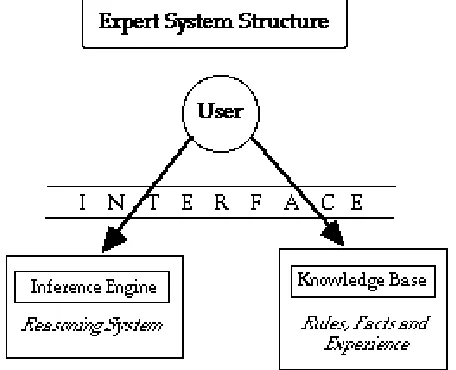
NTRODUCTIONAn expert system is a software program that can be used to solve complex reasoning tasks that usually require a (human) expert. In other words, an expert system should help a novice, or partly experienced, problem solver, to match acknowledged experts in the particular domain of problem solving that the system is designed to assist. To be more specific, expert systems are generally conceptualized as shown in Fig 1. The user makes an interaction through the interface system and the system questions the user through the same interface in order to obtain the vital information upon which a decision is to be made. Behind this interface, there are two other sub-systems viz. the knowledge base, which is made up of all the domain-specific knowledge that human experts use when solving that category of problems and the inference engine, a system that performs the necessary reasoning and uses knowledge from the knowledge base in order to come to a judgment with respect to the problem modelled [1].
Expert system has been playing a major role in many disciplines such as in medicines, assist physician in diagnosis of diseases, in agriculture for crop management, insect control, in space technology and in power systems for fault diagnosis[5]. Some expert systems have been developed to replace human experts and to aid humans. The use of an expert system is increasing day by day in today’s world [40]. Expert systems are becoming an integral part of engineering education and even other courses like accounting and management are also accepting them as a better way of teaching[4].Another feature that makes expert system more demanding for students is its ability to adaptively adjust the training for each particular student on the bases of individual students learning pace. This feature can be used more effectively in teaching engineering students. It should be able to monitor student’s progress and make a decision about the next step in training.
The few expert systems available in the market present a lot of opportunities for the students who desire more spotlight and time to learn the subjects. Some expert systems present an interactive and friendly environment for students which encourage them to study and adopt a more practical approach towards learning. The expert systems can also act as an assistor or substitute for the teacher. Expert systems focus on each student individually and also keep track of their learning pace. This behavior of an expert system provides autonomous learning procedure for both student and teacher, where teachers act as mentor and students can judge their own performance. Expert system is not only beneficial for the students but also for the teachers which help them guiding students in a better way.
The integration of fuzzy logic with an expert system enhances its capability and is called a fuzzy expert system, as it is useful for solving real world problems which do not require a precise solution. So, there is a need to develop a fuzzy expert system as it can handle imprecise data efficiently and reduces the manual working while enhancing the use of expert system[40].
There are various factors inside and outside college that results in poor quality of academic performance of students[2,3]. T o determine all the influencing factors in a single effort is a complex and difficult task. It necessitates a lot of resources and time for an educator to identify all these factors first and then plan the classroom activities and approaches of teaching and learning. It also requires appropriate training, organizational planning and skills to conduct such studies for determining the contributing factors inside and outside college. This process of identification of determinants must be given full attention and priority so that the teachers may be able to develop instructional strategies for making sure that all the students be provided with the opportunities to attain at their fullest potential in learning and performance. By using suitable statistical package it was found that communication, learning facilities, proper guidance and family stress were the factors that affect the student performance. Communication, learning facilities and proper guidance showed a positive impact on student performance and family stress showed a negative impact on student performance. It is indicated that communication is more important factor that affect the student performance than learning facilities and proper guidance [3].
In this research article seven most important factors are included which affect the students’ performance. These are personal factors, college environment, family factors, and university factors, teaching factors, attendance and marks obtained by students. All these factors are scaled and ranked based on the various sub-factors that are further divided from the base factors. In this study the students’ marks have been focused and not solely on social, economic, and cultural features. To evaluate students’ performance, fuzzy expert system has been developed by considering all the seven factors as inputs to the system. This system has been developed by taking the data of students collected from St. Josephs College of Engineering and Technology, Palai affiliated to M.G University.
II.
L
ITERATURE REVIEWIn recent years, many researchers worked on the applications of fuzzy logic and fuzzy sets in educational assessments and grading systems. Biswas[25] presented two methods for evaluating students’ answer scripts using fuzzy sets and a matching function: a fuzzy evaluation method (FEM) and a generalized fuzzy evaluation method. He used fuzzy set theory in student evaluation and found that it is potentially finer than awarding grades or numbers when evaluating answer scripts. He also highlighted that the importance of education system should be to provide students with the evaluation reports regarding their test/examination as sufficient as possible with unavoidable error as small as possible so as to make evaluation system more transparent and fairer to students.
Chen and Lee [26] presented two methods for applying fuzzy sets to overcome the problem of giving two different fuzzy marks to students with the same total score which could arise from Biswas’ method. Their methods perform calculations much faster and complicated matching operations were not required. Echauz and Vachtsevanos [27] proposed a fuzzy logic system for translating traditional scores into letter-grades. Law [28] built a fuzzy structure model with its algorithm to aggregate different test scores in order to produce a single score for individual students in an educational grading system. A method to build the membership functions (MFs) of several linguistic values with different weights was also proposed in this paper.
Wilson, Karr, and Freeman [29] presented an automatic grading system based on fuzzy rules and genetic algorithms. To assess the outcomes of student-centered learning using the evaluation of their peers and lecturer, a new fuzzy set approach was proposed by Ma and Zhou[30] .Wang and Chen [31] proposed a method for evaluating students answer scripts using fuzzy numbers associated with degree of confidence. They have considered degree of confidence of evaluator when awarding satisfaction level to questions of student answer scripts. Weon and Kim [32] developed an evaluation strategy based on fuzzy MFs. They pointed out that the system for students’ achievement evaluation should consider the three important factors of the questions: the difficulty, the importance, and the complexity. They used singleton functions to describe the factors of each question reflecting only the individual effect of the three factors and not the collective effect.
In paper[35], a fuzzy logic evaluation system considering the importance, the difficulty, and the complexity of questions based on Mamdani’s[36] fuzzy inference and center of gravity (COG) defuzzification is proposed as an alternative to Bai and Chen’s method [34]. The transparency and objective nature of the fuzzy logic system makes it easy to understand and explain the results of evaluation, and thus to persuade students who are skeptical or not satisfied with the evaluation results. Li and Chen [37] proposed a method for automatically generating the weights for several attributes with fuzzy reasoning capability. Chiang and Lin [38] presented a method for applying the fuzzy set theory to teaching assessment. Chang and Sun [39] presented a method for fuzzy assessment of learning performance of junior high school students. From the previous studies, it can be found that fuzzy numbers, fuzzy sets, fuzzy rules, and fuzzy logic systems have been used for various educational grading systems.
III.
F
UZZY EXPERT SYSTEMThe method of fuzzy logic, which deals with uncertainty is used for developing fuzzy expert system. This technique, which uses the mathematical theory of fuzzy sets, simulates the process of normal human reasoning by allowing the computer to behave less precisely and logically than conventional computers.
Some applications implemented by fuzzy expert systems are power load forecasting, online scheduling, chemical process fault diagnosis, ecological planning, control systems, uncertainly reasoning, knowledge integration, fault diagnosis, power system classification, fault detection, demand evaluation, wastewater treatment, machinability data selection, water supply forecast, radiography classification, on-line analytic processing, hotel selection, dryer tool integration, pooled flood frequency analysis, medical consultation system, job matching, performance indexing, computer security, gesture recognition, and medical diagnosis[5]. The fuzzy systems are useful in two contexts: (a) when the system is complex and its behavior is misunderstood (b) and for solving problems whose exact solution is not desired and quick response is essential.
In 1965 Lotfi Zadeh discovered fuzziness, identified and explored it, and promoted and fought for it. He introduced a new concept for applying natural language terms and for representing and manipulating fuzzy terms called fuzzy logic, and Zadeh became the Master of fuzzy logic. Fuzzy logic is determined as a set of mathematical principles for knowledge representation based on degrees of membership rather than on crisp membership of classical binary logic.
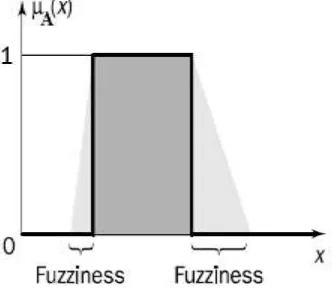
Fuzzy logic is the theory of fuzzy sets, sets that calibrate vagueness. A fuzzy set can be simply defined as a set with fuzzy boundaries. In the fuzzy theory, fuzzy set A of universe X is defined by function μA(x) called the membership function of set A μA(x): X [0,1],
where
μA(x)=1 if x is totally in A; μA(x)=0 if x is not in A; 0 < μA(x) < 1 if x is partly in A.
A fuzzy set A in X is represented as a set of ordered pairs. Fig. 2 represents membership function and fuzziness. A={ x, μA(x)}
Fig. 2: Membership function and Fuzziness
The generic architecture of a fuzzy expert system showing the flow of data through the system is shown in Fig. 3[17]. A fuzzy controller works similar to a conventional system: it accepts input values, performs some calculations and generates an output value.
It includes four main components:
1) Fuzzifier: It translates crisp (real valued) inputs into fuzzy values.
2) Inference Engine: It applies a fuzzy reasoning mechanism to obtain a fuzzy output. 3) Defuzzifier: It translates this latter output into a crisp values.
Fig. 3: Architecture of a fuzzy expert system
A collection of N inference rules for a system with two input variables and one output variable and whose form is typical in fuzzy controllers is such that the j -th rule for 1≤ j ≤ N is expressed as follows [18]:
Rj : IF x is Aj AND y is Bj , THEN z is Cj (1)
In the above rule, x and y denote the input variables of the fuzzy controller and z is the output variable. It is possible to consider more than two inputs and the rules can be rewritten accordingly.
IV.
F
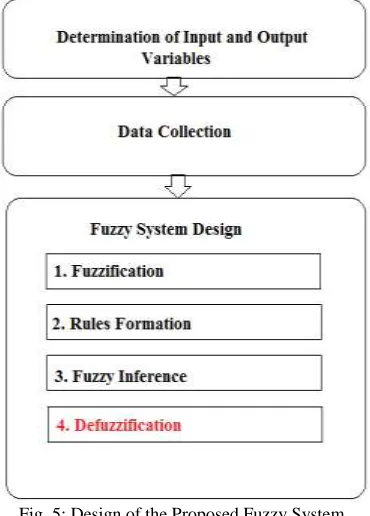
UZZY SYSTEM DESIGNThe design and development of fuzzy rule based expert system for analyzing the performance of students in collegesare carried out in the order as represented in Fig. 5.
Fig. 5: Design of the Proposed Fuzzy System
Determination of Input and Output Variables A.
examination systems. External classroom factors include extracurricular activities, family problems, work and financial, social and other problems. Research studies also show that students’ performance depends on many other factors such as gender and age differences, etc. that can affect their academic performance. In this study the students’ marks have been focused and not solely on social, economic, and cultural features for two main reasons. The first is that bad classification results were obtained when marks were not considered. Secondly, the grades obtained by students have been previously used in a great number of other similar studies [6, 7, and 8].
The inputs to the fuzzy system are the seven most important factors that affect the students’ performance. These are personal factors, college environment, family factors, university factors, teaching factors, attendance and marks obtained by students. All these factors are scaled and ranked based on the various sub-factors that are further divided from these base factors. The output of the system is students’ performance level characterized as 5 categories Poor, Below Average, Average, Above Average and Good.
Data Collection B.
The research is based on the student profile developed on the bases of information and data collected from students of the St. Josephs College of Engineering and Technology, Palai which is one among the renowned self-financing college in Kerala affiliated to Mahatma Gandhi University. Five factors out of the seven that are considered as inputs to the system are collected using a questionnaire which has to be filled by the students. These were the personal factor, family factor, college factor, university factor and teaching factor. The students were asked to provide details about their level of interest in their branch of study, self-confidence level, fear of future security, smoking or drinking habits, relationship problems and their reading skills in personal factors. The family factors considered are the financial issues in family, family disputes and disturbances, fear of live up to parents’ expectation, the size of the family and parents' awareness about the students’ education. The students’ opinion about support from senior students, weather and atmospheric conditions in college, facilities provided in the college and disturbances in college hostel are collected by considering the college factors. The students also get an opportunity to comment about the problems that they face due to the inadequate support from the university. The students’ judgment about the teaching approach, guidance provided by faculty members, subject and practical knowledge of faculty members were collected by considering the teaching factors. The students enter these details based on the difficulties and problems they faced during their respective semester or year of study.
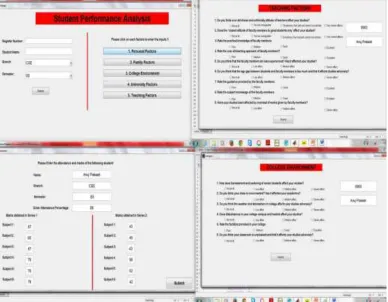
The teachers are responsible for providing the other two factors, marks and attendance of each student to the system. The teachers enter the marks obtained by each student in First and Second Internal Examinations conducted by the respective departments in college. The final attendance percentage of the student is calculated at the end of the semester and entered as input to the system. They are allowed to enter these details only after making sure that the students have entered all the other input factors. Fig. 6 shows some of the user interfaces of the system that is used to collect information about the student.
Fuzzy System Design C.
The students’ academic performance evaluation with fuzzy logic involves four major steps: 1) Fuzzification of inputs examinations outcomes and output performance value. 2) Determination of relevant fuzzy rules
3) Determination of fuzzy inference method 4) Defuzzification of performance value.
Fuzzification 1)
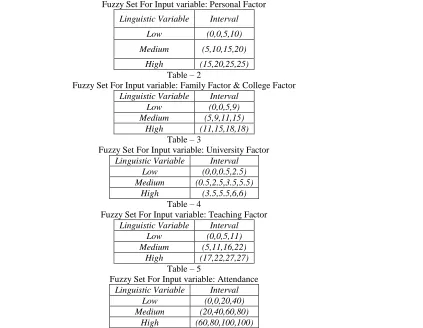
In the proposed fuzzy system triangular and trapezoidal membership functions are used for converting the crisp inputs into fuzzy inputs, due to their simple formula and computational efficiency. The triangular and trapezoidal membership functions have proven popular with fuzzy logic and have been in use extensively in student academic performance evaluation [19] [20] [21] [22]. Fuzzification of each input factor is done as given in the following tables using the triangular and trapezoidal membership functions. The triangular and trapezoidal membership functions are specified by three parameters (a, b, c) and four parameters (a, b, c, d) as follows [20][24]:
trian(x, a, b, c) = max(min (x − a b − a,
c − x c − b) , 0)
trap(x, a, b, c, d) = max(min (x − a b − a, 1,
d − x d − c) , 0)
The input factor Marks has five membership functions and all other factors have only three membership functions categorized as Low, Medium and High. These factors and their linguistic variables and intervals are given in the following tables.
Table – 1
Fuzzy Set For Input variable: Personal Factor Linguistic Variable Interval
Low (0,0,5,10)
Medium (5,10,15,20)
High (15,20,25,25)
Table – 2
Fuzzy Set For Input variable: Family Factor & College Factor Linguistic Variable Interval
Low (0,0,5,9)
Medium (5,9,11,15)
High (11,15,18,18)
Table – 3
Fuzzy Set For Input variable: University Factor
Linguistic Variable Interval
Low (0,0,0.5,2.5)
Medium (0.5,2.5,3.5,5.5)
High (3.5,5.5,6,6)
Table – 4
Fuzzy Set For Input variable: Teaching Factor Linguistic Variable Interval
Low (0,0,5,11)
Medium (5,11,16,22)
High (17,22,27,27)
Table – 5
Fuzzy Set For Input variable: Attendance
Linguistic Variable Interval
Low (0,0,20,40)
Medium (20,40,60,80)
High (60,80,100,100)
Each student’s mark has been categorized as Poor, Below Average, Average, Above Average and Good with the respective intervals as shown in Table 6.
Table – 6
Fuzzy Set for Input variable: Marks
Linguistic Variable Interval
Poor (0,0,20,35)
Below Average (25,35,45)
Average (40,50,60)
Above Average (55,65,80)
Good (75,85,100,100)
Table – 7
Fuzzy Set For Output variable: Performance
Linguistic Variable Interval
Poor (0,0,20,35)
Below Average (25,35,45)
Average (40,50,60)
Above Average (55,65,80)
Good (75,85,100,100)
The linguistic variable in this study is based on an interval that refers to the level of performance given by experts as shown in Table 1 to 7.
Rules Formation 2)
The rules determine the output membership function that will be used in the inference process. These rules are in linguistic form called “IF-THEN” fuzzy rules. These rules are formulated from the discussion with the academic experts and from their practical and past experiences. There are 234 rules for this system.
Fuzzy Inference 3)
In fuzzy inference one or several rules are invoked by the input data and integrated pattern of output membership functions is generated. This corresponds to the fuzzy decision on performance value of a student. In this paper the method proposed by Mamdani [23][36] has been employed and it operates based on inference mechanism described by the following equation.
μz(y) = maxk[min[μA(input(i), μB(input(j))]], k = 1,2,3 … N
It determines an output membership function value for each rule in active mode. When one rule is active, an AND operation is applied between inputs. The smaller input value is chosen and its membership value is determined as the membership value for the output of that rule. This method is repeated, so that output membership functions are determined for each rule.
Defuzzification 4)
Defuzzification is the procedure of determining a quantifiable result in fuzzy system, which in some way is the best demonstration of the output fuzzy set viewed as an isolated entirety. Defuzzification process often is not treated as much in detail as the other processes in the system. It seems that in the domain of defuzzification a designer has too wide possibilities of choices, so that some indicators in connection of defuzzification approach are welcome. It is important to use an appropriate technique as defuzzification technique selection essentially influence the output value determined by selected method [13].In other words, defuzzification is a mapping from a space of fuzzy control action defined over an output universe of discourse into a space of non-fuzzy control actions. The input for the defuzzification process is a fuzzy set that was obtained from the aggregation process, and the output is a single crisp value [14].Some commonly used defuzzification methods are listed below [9, 10, 11, and 12].
a) Centroid Method
The centroid method was developed by Sugeno in 1985 and is also known as center of gravity or center of area defuzzification. This is the most commonly used technique. The centroid defuzzification technique can be expressed as:
z =∫ z. μA(z)dz ∫ μA(z)dz
The only disadvantage of this method is that it is computationally difficult for complex membership functions. b) Bisector Method
The bisector is the vertical line that divides the region into two sub-regions of equal area. It is sometimes, but not always coincident with the centroid line.
c) Mean of Maxima (MOM)
In this method for defuzzification only active rules with the highest degree of fulfilment are taken into account. The output is computed as:
z =1 2(a + b)
d) Smallest of Maxima (SOM)
It selects the smallest output with the maximum membership function as the crisp value Z
SOM. In other words Smallest of Maximum chooses smallest among all z that belong to [z1, z2].
e) Largest of Maxima (LOM)
It selects the largest output with the maximum membership function as the crisp value Z
Fig. 7: Results using different defuzzification methods for a particular function. f) Weighted Average Formula(WAF)
Aj(x0) ∩ Bj(y0) = μj, then with zj denoting the crisp output of rule j in (1), the WAF formula is applied as follows to produce the crisp output z:
z =∑ μjzj
N j=1
∑Nj=1μj
g) WAF-Max
In the case where more than one rule possess the same crisp consequent, then the application of maximum operation is done to the membership grades resulting from these rules. Let
μ1max = max(μ1, μ2, … , μi)
μ(i+1)max= max(μ(i+1), μ(i+2), … , μp)
μ(p+1)max = max(μ(p+1), μ(p+2), … , μq)
μ(q+1)max= max(μ(q+1), μ(q+2), … , μr)
μ(r+1)max= max(μ(r+1), μ(r+2), … , μN)
and z1, z2, z3, z4, z5 be the crisp consequents corresponding respectively to rules 1 to i, i+1 to p, p+1 to q, q+1 to r, r+1 to N, the following equation becomes the WAF-Max formula:
𝑧 =(μ1maxXz1) + (μ(i+1)maxXz2) + (μ(p+1)maxXz3) + (μ(q+1)maxXz4) + (μ(r+1)maxXz5) μ1max+ μ(i+1)max+ μ(p+1)max+ μ(q+1)max+ μ(r+1)max
h) Quality Method (QM)
If the centers of gravity of the output fuzzy sets are taken as the crisp output values and the degree of activation of each rule (μj) is divided by the measure of the support of the rule fuzzy consequent then the following equation becomes the Quality Method.
z =∑ μjzj⁄dj
N j=1
∑Nj=1μj⁄dj
Here zj is the center if gravity of the fuzzy consequent of rule j and djis the measure of support of the consequent of rule j.
i) Max-QM
This is a newly developed method from the previously defined defuzzification techniques. When more than one rule possess the same crisp consequent, maximum operation is done to the membership grades resulting from these rules to obtain the following equation for Max-QM method.
z =(μ1maxX(z1⁄ )) + (μd1 (i+1)maxX(z2⁄ )) + (μd2 (p+1)maxX(z3⁄d3)) + (μ(q+1)maxX(z4⁄d4)) + (μ(r+1)maxX(z5⁄d5)) μ1max+ μ(i+1)max+ μ(p+1)max+ μ(q+1)max+ μ(r+1)max
All the defuzzification methods mentioned in this paper are used for finding the crisp output from the fuzzy output obtained as a result of fuzzy inference.
Results and Discussion D.
Aimed at improving the performance of fuzzy system, several defuzzification methods other than the built methods in MATLAB have been devised in this system for producing more accurate and quantifiable result. This study provides comparison and examination of various defuzzification techniques like Weighted Average Formula (WAF), WAF-max method and Quality Method (QM). The system was tested and optimized using data obtained from 250 students of St. Josephs College of Engineering and Technology, Palai. The students were selected randomly from the college irrespective of their year of study and the branch of Engineering they opted to study. The Table VIII shows the performance values of 10 students obtained using different defuzzification techniques. The final performance level is judged by the Weighted Average Formula method which showed maximum accuracy. The students’ performance level is primarily judged by the marks obtained by the students and hence the defuzzified value has to be somewhat near to the marks obtained by the student.
The mark obtained by Student 1 is 77.67% and his attendance percentage is 76. All the other factors have only a minor contribution to the result since their values are in
Table - 8
Result Obtained Using Different Defuzzification Methods
S eria l N u mb er S tu d en t ID Per so n a l Fa cto rs (0 -2 5 ) Fa mily F a ct o r(0 -18) Co ll eg e F a cto r(0 -18) Un ive rs it y Fa cto r(0 -6) T ea ch in g F a cto r(0 -2 7 ) M a rk s (% ) At ten d a n ce (% ) Defuzzification Methods Per fo rm a n ce lev el Ce n tro id Bi se cto r M OM S OM L OM W AF W AF -M a x QM Max -QM
1 67 10 9 10 2 13 77.67 76 49.74 58 46.51 0 100 78.51 55.26 79.53 60.41 Ab Avg.
2 70 6 9 8 2 12 37 78 42.4 42 35 33 37 37.08 42.25 37.08 42.25 Bl Avg.
3 43 9 9 10 3 12 53.22 78 57.51 59 58.26 47 69 52.33 56.73 51.86 55.70 Avg.
4 35 13 14 10 3 13 25.5 90 16.92 16 12.5 0 25 15.74 17.74 16.98 20.03 Poor
5 76 16 6 8 2 13 93.67 98 50.65 30 92.5 85 100 79.65 57.38 82.32 63.46 Good
The mark obtained by Student 1 is 77.67% and his attendance percentage is 76. All the other factors have only a minor contribution to the result since their values are in medium level. The result of Student 1 obtained using WAF defuzzification method is 78.51 and QM is 79.53 which is close to the marks obtained and hence the final performance level can be judged using any of those methods.
The result obtained using Max-QM method and WAF-Max method are 60.41 and 55.26 respectively for Student 1 which are also better results compared to the built-in defuzzification methods like centroid method, bisector method, MOM, SOM and LOM. The values obtained using SOM and LOM are 0 and 100 respectively which are the lowest and the highest possible values. These methods cannot be used to judge the performance level of students.
Student 2 and Student 3 obtained 37% and 53.22% marks respectively with an attendance percentage of 78. With the minor contribution of other factors the result obtained using different defuzzification methods are almost similar values. Hence any method can be used to figure out the final performance level of the student. The result obtained for Student 3 using LOM method is 69 which cannot be used for final assessment.
The mark attained by Student 4 is 25.5% with high attendance percentage. His family factor is also high. Here Max-QM method is showing more accuracy compared to all other methods. SOM cannot be used as method for judging the performance of student as this method resulted in 0 as the defuzzified value. All other methods showed similar results and can be used for final evaluation of students’ performance.
The mark obtained by Student 5 is 93.67% and his final performance level is Good as assessed by the WAF method. The centroid method, bisector method, LOM, WAF-Max method and Max-QM method cannot be used for evaluating the final performance level of student 5 as there are major variations in their defuzzified results.
Of the nine defuzzification methods presented here, which is the best method remains as an unanswered question. It can be argued here that the performance improvement obtained using the Max-QM method which is the new defuzzification method proposed in this system, could possibly be achieved through the use of the other techniques by making an effort to change the logic operations, accompanied by alterations in the membership functions and rules. Although this seems feasible, the suggested technique is usually difficult to apply due to the enormous number of ways by which the noted entities can be combined. The introduced method can be used in a simple and systematic manner to achieve the performance goals. It is found to be better than all the built in methods in MATLAB and the WAF-Max method.
computational intensity as that of centroid method. However, they have better performance as compared to that of Centroid method.
The choice of which defuzzification technique to use is context or problem-dependent. One among the best defuzzification technique that can be used to analyze the performance of students in colleges considering their various input factors using fuzzy logic is the weighted average formula (WAF) method followed by the Quality Method and the Max-QM method. The student categories Below Average and Poor can be rightly judged using the newly developed defuzzification method, Max-QM and WAF method while the category Good and Poor can be judged correctly using WAF method.
V.
C
ONCLUSION AND FUTURE WORKSFuzzy logic expert systems typically require fewer rules, need fewer variables, use a linguistic rather than a numerical description, and can relate output to input for any device without needing to understand the device's inner workings. The literature reveals that there is a vast potential for expert system and fuzzy logic in education and performance evaluation of students. Building a fuzzy expert system is an iterative process that involves defining fuzzy sets and fuzzy rules, evaluating and then tuning the system to meet the specified requirements.
A typical process in developing the fuzzy expert system incorporates the following steps: 1) Specify the problem and define linguistic variables.
2) Determine fuzzy sets.
3) Elicit and construct fuzzy rules.
4) Encode the fuzzy sets, fuzzy rules and procedures to perform fuzzy inference into the expert system. 5) Evaluate and tune the system.
In order to improve or optimize the system performance various defuzzification methods have been examined and it is shown that these methods help to achieve the design objectives in a simple and systematic manner. The WAF method is found to be the best defuzzification method and the new method Max-QM shows better performance than all the built in methods and WAF-Max method.
The expert system assesses the students’ performance level based in various factors using fuzzy logic. The expert system helps in identifying those factors that affects students’ academic performance and also evaluates the current performance level of the student. This information can be utilized to counsel the students and provide them with more guidance and proper attention before their final university examination. The parents of the students can also be informed about their wards’ current performance level so that more attention can be given to those with poor performance level. So, this system is beneficial in improving the grades of the student. It can be implemented in any university or college and can also be extended to include more factors that may affect the performance of college students.
Finally, as the next step in research, more experiments can be carried out using more input factors and also from students of different educational institutions and to test whether the same performance results are obtained with different defuzzification approaches. As future work, the following can be done:
1) To develop a new defuzzification method solely for solving the problem of assessing the performance level of students. 2) To predict the student failure as soon as possible. The earlier the better, in order to detect students at risk in time before it
is too late.
3) To propose actions for helping students identified within the risk group. Then, to check the rate of the times it is possible to prevent the fail or dropout of that student previously detected.
R
EFERENCES[1] Romiszowski, Alexander. "Artificial intelligence and expert systems in education: Progress, promise and problems." Australasian Journal of Educational Technology 3, no. 1,1987.
[2] Mlambo, Victor. "An analysis of some factors affecting student academic performance in an introductory biochemistry course at the University of the West Indies." The Caribbean Teaching Scholar 1, no. 2, 2012.
[3] Mushtaq, Shabana Nawaz Khan. "Factors affecting students’ academic performance" Global Journal of Management and Business Research 12, no. 9, 2012.
[4] Farooq, Muhammad Shahid, Azizul Haque Chaudhry, Mohammad Shafiq, and Girma Berhanu. "Factors affecting students’ quality of academic performance: a case of secondary school level." Journal of quality and technology management 7, no. 2 (2011): 1-14.
[5] Liao, Shu-Hsien. "Expert system methodologies and applications—a decade review from 1995 to 2004." Expert systems with applications 28, no. 1 (2005): 93-103.
[6] C. Márquez-Vera, Cristóbal R. Morales, and S. Ventura Soto, “Predicting School Failure and Dropuout by Using Data Mining Techniques”, IEEE Journal of Latin-American Learning Technologies, vol. 8,no. 1, February,2013.
[7] L. Fourtin, D. Marcotte, P. Potvin, E. Roger, and J. Joly, “Typology of students at risk of dropping out of school: Description by personal, family and school factors,” Eur. J. Psychol. Educ., vol. 21, no. 4, pp. 363–383, 2006.
[8] L. G. Moseley and D. M. Mead, “Predicting who will drop out of nursing courses: A machine learning exercise,” Nurse Educ. Today, vol. 28, no. 4, pp. 469–475, 2008.
[9] S. Roychowdhury, W. Pedrycz, “A survey of defuzzification strategies”, International Journal of Intelligent Systems 16 (2001) 679–695. [10] W.V. Leekwijck, E.E. Kerre, Defuzzification: Criteria and classification, Fuzzy Sets and Systems 108 (2) (1999) 159–178.
[11] Shi, Yigang, and P. C. Sen. "A new defuzzification method for fuzzy control of power converters." In Industry Applications Conference, 2000. Conference Record of the 2000 IEEE, vol. 2, pp. 1202-1209. IEEE, 2000.
[13] Saletic, D., D. Velasevic, and N. Mastorakis. "Analysis of basic defuzzification techniques." In Proceedings of the 6th WSES international multiconference on circuits, systems, communications and computers, pp. 7-14. 2002.
[14] Na, Li, and Weng Jing. "A New Defuzzification Method for Enhance Performance of Fuzzy Logic Control System." In Software Engineering and Knowledge Engineering: Theory and Practice, pp. 403-409. Springer Berlin Heidelberg, 2012.
[15] Saade, Jean J., and Hassan B. Diab. "Defuzzification methods and new techniques for fuzzy controllers." Iranian journal of electrical and computer engineering 3, no. 2 (2004): 161.
[16] Saade, Jean J., and Hassan B. Diab. "Defuzzification techniques for fuzzy controllers." Systems, Man, and Cybernetics, Part B: Cybernetics, IEEE Transactions on 30, no. 1 (2000): 223-229.
[17] J.M. Mendel. Uncertain Rule-Based Fuzzy Logic Systems: Introduction and New Directions. Prentice Hall PTR, 2001. [18] W. Pedrycz, Fuzzy Control and Fuzzy Systems, Second Extended Edition, Research Studies Press, England, 1993.
[19] Khairul A. Rasmani and QiangShen, “Data-Driven Fuzzy Rule Generation and its Application for Student Academic Performance Evaluation”, Journal on Applied Intelligence, vol. No.25,pp.305-319, 2006.
[20] Ramjeet Singh Yadav et al. “Modeling Academic Performance Evaluation Using Soft Computing Techniques: A Fuzzy Logic Approach” International Journal on Computer Science and Engineering (IJCSE) Vol. 3 No. 2 Feb 2011.
[21] Olufunke O. Oladipupo1 ,Olanrewaju. J. Oyelade2 and Dada. O. Aborisade3. “Application of Fuzzy Association Rule Mining for Analyzing Students Academic Performance” IJCSI International Journal of Computer Science Issues, Vol. 9, Issue 6, No 3, November 2012.
[22] S S Jamsandekar, R.R Mudholkar, “Performance Evaluation by Fuzzy Inference Technique” International Journal of Soft Computing and Engineering (IJSCE), Volume 3, Issue 2, pp. 158-164 May 2013.
[23] John Yen,RezaLangari “Fuzzy Logic –Intelligence, control and Information”, LPE Pearson.
[24] Yadav, Richa S., A. K. Soni, and Shovon Pal. "A study of academic performance evaluation using Fuzzy Logic techniques." In Computing for Sustainable Global Development (INDIACom), 2014 International Conference on, pp. 48-53. IEEE, 2014.
[25] Biswas, Ranjit. "An application of fuzzy sets in students' evaluation." Fuzzy sets and systems 74, no. 2 (1995): 187-194.
[26] Chen, Shyi-Ming, and Chia-Hoang Lee. "New methods for students' evaluation using fuzzy sets." Fuzzy sets and systems 104, no. 2 (1999): 209-218. [27] Echauz, Javier R., and George J. Vachtsevanos. "Fuzzy grading system."Education, IEEE Transactions on 38, no. 2 (1995): 158-165.
[28] Law, Chiu-Keung. "Using fuzzy numbers in educational grading system." Fuzzy sets and systems 83, no. 3 (1996): 311-323.
[29] Wilson, Eric, Charles L. Karr, and L. M. Freeman. "Flexible, adaptive, automatic fuzzy-based grade assigning system." In Fuzzy Information Processing Society-NAFIPS, 1998 Conference of the North American, pp. 334-338. IEEE, 1998.
[30] Ma, Jian, and Duanning Zhou. "Fuzzy set approach to the assessment of student-centered learning." Education, IEEE Transactions on 43, no. 2 (2000): 237-241.
[31] Wang, Hui-Yu, and Shyi-Ming Chen. "Evaluating students' answerscripts using fuzzy numbers associated with degrees of confidence." Fuzzy Systems, IEEE Transactions on 16, no. 2 (2008): 403-415.
[32] Weon, Sunghyun, and Jinil Kim. "Learning achievement evaluation strategy using fuzzy membership function." In Frontiers in Education Conference, 2001. 31st Annual, vol. 1, pp. T3A-19. IEEE, 2001.
[33] Bai, Shih-Ming, and Shyi-Ming Chen. "Automatically constructing grade membership functions of fuzzy rules for students’ evaluation." Expert Systems with Applications 35, no. 3 (2008): 1408-1414.
[34] Bai, Shih-Ming, and Shyi-Ming Chen. "Evaluating students’ learning achievement using fuzzy membership functions and fuzzy rules." Expert Systems with Applications 34, no. 1 (2008): 399-410.
[35] Saleh, Ibrahim, and Seong-in Kim. "A fuzzy system for evaluating students’ learning achievement." Expert Systems with Applications 36, no. 3 (2009): 6236-6243.
[36] Mamdani, Ebrahim H. "Application of fuzzy algorithms for control of simple dynamic plant." In Proceedings of the Institution of Electrical Engineers, vol. 121, no. 12, pp. 1585-1588. IET Digital Library, 1974.
[37] Li, Ting-Kuei, and Shyi-Ming Chen. "A new method for students' learning achievement evaluation by automatically generating the weights of attributes with fuzzy reasoning capability." In Machine Learning and Cybernetics, 2009 International Conference on, vol. 5, pp. 2834-2839. IEEE, 2009.
[38] T.T.Chiang, C.M.Lin, “Application of fuzzy theory to teaching assessment” in “Proceedings of the 1994 second national conference on fuzzy theory and applications”, Taipei, Taiwan, Republic of China, 1994, pp. 92–97.
[39] D.F.Chang, C.M.Sun, “Fuzzy assessment of learning performance of junior high school students”. In “Proceedings of the 1993 first national symposium on fuzzy theory and applications”, Hsinchu, Taiwan, Republic of China, 1993,pp. 1–10.
[40] Kaur, Prabhdeep, Pulin Agrawal, Sanjay Kumar Singh, and Lakshay Jain. "Fuzzy rule based students' performance analysis expert system." In Issues and Challenges in Intelligent Computing Techniques (ICICT), 2014 International Conference on, pp. 100-105. IEEE, 2014.
[41] F. Araque, C. Roldán, and A. Salguero, “Factors Influencing University Drop Out Rates,” Comput. Educ., vol. 53, no. 3, pp. 563–574, 2009.
[42] M. N. Quadril and N. V. Kalyankar, “Drop Out Feature of Student Data for Academic Performance Using Decision Tree Techniques,” Global J. Comput. Sci. Technol., vol. 10, pp. 2–5, Feb. 2010.
[43] Hellendoorn, Hans, and Christoph Thomas. "Defuzzification in fuzzy controllers." Journal of Intelligent & Fuzzy Systems: Applications in Engineering and Technology 1, no. 2 (1993): 109-123.
[44] Barua, Aditi, Lalitha Snigdha Mudunuri, and Olga Kosheleva. "Why trapezoidal and triangular membership functions work so well: Towards a theoretical explanation." (2013).
[45] Y. Yorozu, M. Hirano, K. Oka, and Y. Tagawa, “Electron spectroscopy studies on magneto-optical media and plastic substrate interface,” IEEE Transl. J. Magn. Japan, vol. 2, pp. 740–741, August 1987 [Digests 9th Annual Conf. Magnetics Japan, p. 301, 1982].