Vol. 13, No. 2, 2017, 199-206
ISSN: 2279-087X (P), 2279-0888(online) Published on 7 April 2017
www.researchmathsci.org
DOI: http://dx.doi.org/10.22457/apam.v13n2a5
199
Annals of
3-Equitable and Total Magic Cordial Labeling for the
Extended Duplicate Graph of Splitting Graph of Path
R.Avudainayaki1, B.Selvam2 and P.P.Ulaganathan3
1
Department of Mathematics, Sri Sairam Institute of Technology Chennai – 600 044 India
2,3
Department of Mathematics, S.I.V.E.T. College, Gowrivakkam Chennai – 600 073, India
Email: [email protected]; [email protected] Corresponding author. Email: [email protected]
Received 9 March 2017; accepted 28 March 2017
Abstract. In this paper, we prove that the extended duplicate graph of splitting graph of path admits 3-equitable and total magic cordial labeling.
Keywords: Graph labeling, duplicate graph, splitting graph, 3-equitable, total magic cordial
AMS Mathematics Subject Classification (2010): 05C78 1. Introduction
All graphs in this paper are simple, finite and undirected. The vertex set and edge set of a graph is denoted by V(G) and E(G) respectively. If the vertices of the graph are assigned values subject to certain conditions then it is known as graph labeling. A useful survey to know about the numerous labeling methods is by Gallian [5]. Sampathkumar has introduced the concept of duplicate graph [4]. A new labeling called total Magic cordial labeling and 3-equitable labeling introduced by Cahit [3], Girija and Elumalai have proved that the edge magic total labeling of the cycle Cn with p3 chords [8]. Thirusangu,
200
In this section, we give the basic definitions relevant to this paper. Let G(V,E) be a finite, simple and undirected graph with p vertices and q edges.
Definition 2.1. (Splitting graph) For each vertex v of a graph G, take a new vertex v′. Join v′ to all the vertices of G adjacent to v. The graph Spl(G) thus obtained is called splitting graph of G.
Illustration 1. (The splitting graph of path Spl(P6))
Figure 1:
Definition 2.2. (Duplicate graph) Let G (V,E) be a simple graph and the duplicate graph of G is DG = (V1, E1) ,where the vertex set V1 = V ∪ V′ and V ∩ V′ = φ and f : V → V′
is bijective (for v ∈ V, we write f (v) = v′ for convenience) and the edge set E1 of DG is
defined as the edge ab is in E if and only if both ab′ and a′b are edges in E1.
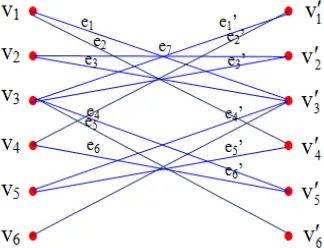
Definition 2.3. (Extended duplicate graph of splitting graph of path) Let DG = (V1,E1) be a duplicate graph of splitting graph of path G(V,E). Extended duplicate
graph of splitting graph of path is obtained by adding the edge v2v2’ to the duplicate
graph. It is denoted by EDG Spl(Pm). Clearly it has 4m vertices and 6m-5 edges, where
2
≥
m
is the number of length.Illustration 2. Extended duplicate graph of splitting graph of a path
Extended Duplicate Graph of Splitting Graph of Path
201
Definition 2.5. (3-equitable labeling) A function f : V → {0,1,2} such that each edge uv receives the label |f (u) – f (v)| is said to be 3-equitable labeling if vf( )i −vf( )j ≤1 and
1 ) ( )
(i −e j ≤
ef f for all 0≤i, j≤2.
Definition 2.6. (Total magic cordial labeling) A graph G(V,E) is said to admit total total magic cordial labeling if f : V ∪ E → {0, 1} such that
( )
i {f (x) + f (y) + f (xy)} (mod 2) is constant for all edges xy ∈ E. 1 ) 1 ( ) 0 ( )(ii f − f ≤ , where
a) f (0) denotes the sum of the number of the vertices labeled with ‘ 0’ and the number of edges labeled with ’ 0’ .
b) f (1) denotes the sum of the number of the vertices labeled with ‘1’ and the number of edges labeled with ‘1’ .
3. Main results Algorithm 3.1.
Procedure [3-Equitable labeling for EDG(Spl(Pm)), m≥≥≥≥ 2] V ← {v1, v2, … ,v2m, v’1, v’2, … ,v’2m}
E ← {e1, e2, … ,e3m-3, e3m-2, e’1,e’2,...,e’3m-3}
v1 ← 1 , v2 ← 1 , v’1 ← 2 , v’2 ← 0
for i=0 to [(m-2)/3] do v3+6i ← 0
v4+6i ← 0
v’3+6i ← 1
v’4+6i ← 2
end for
for i=0 to [(m-3)/3] do v5+6i ← 2
v6+6i ← 0
v’5+6i ← 2
v’6+6i ← 1
end for
for i=0 to [(m-4)/3] do v7+6i ← 1
v8+6i ← 1
v’7+6i ← 2
202 end procedure
Theorem 3.1. The extended duplicate graph of splitting path graph Spl(Pm), m ≥ 2 admits 3-equitable labeling.
Proof: Let Spl(Pm), m ≥ 2 be a splitting path graph . In order to label the vertices, define a function f : V → {0,1,2} as given in algorithm 3.1.
The vertices v1, v2, v’1 and v’2 receive label ‘1’ , ‘1’ , ‘2’ and ‘0’ respectively ;
for 0 ≤ i ≤ [(m-2)/3] , the vertices v3+6i receive label ‘0’ ; the vertices v4+6i receive
label ‘0’ ; the vertices v’3+6i receive label ‘1’ ; the vertices v’4+6i receive label ‘2’ ;
for 0 ≤ i ≤ [(m-3)/3] , the vertices v5+6i receive label ‘2’ ; the vertices v6+6i receive
label ‘0’ ; the vertices v’5+6i receive label ‘2’ and the vertices v’6+6i receive label ‘1’ ;
for 0 ≤ i ≤ [(m-4)/3] , the vertices v7+6i receive label ‘1’ ; the vertices v8+6i receive
label ‘1’ ; the vertices v’7+6i receive label ‘2’ ; the vertices v’8+6i receive label ‘0’ ;
Thus, the entire 4m vertices are labeled.
To obtain the labels for edges , we define the induced function f * : E → {0,1,2} such that f * (vi vj) = | ݂(vi) - ݂(vj) | where vi , vj∈ V
The induced function yields the label ‘0’ for the edges e1 , e3 , e’3 ; the label ‘1’ for
the edges e2 , e3m-2 ; the label ‘2’ for the edges e’1 and e’2 ;
for 0 ≤ i ≤ [(m-3)/3] and 0 ≤ j ≤1 , the edges e4+9i+2j receive label ‘2’ ; the edges e5+9i
receive label ‘1’; the edges e’4+9i+j receive label ‘1’ ; the edges e’6+9i receive label ‘0’ ;
for 0 ≤ i ≤ [(m-4)/3] and 0 ≤ j ≤1, the edges e7+9i receive label ‘0’ ; the edges e8+9i+j
receive label ‘0’ ; the edges e’7+9i+j receive label ‘1’ ; the edges e’9+9i receive label ‘0’ ;
for 0 ≤ i ≤ [(m-5)/3] and 0 ≤ j ≤1 , the edges e10+9i +2j receive label ‘0’ ; the edges e11+9i
receive label ‘1’ ; the edges e’10+9i +j receive label ‘2’ ; the edges e’12+9i receive label ‘0’;
case (i) If (m-2)mod 3 = 0, then 2m-1 edges receive label ‘0’, 2m-2 edges receive label ‘1’ and 2m-2 edges receive label ‘2’;
case (ii) If (m-2)mod 3
≠
0,then 2m-1 edges receive label ‘1’, 2m-2 edges receive label ‘2’ and 2m-2 edges receive label ‘0’;Thus in both the cases all the 6m-5 edges are labeled.Hence the extended duplicate graph of splitting path graph Spl(Pm),m ≥ 2 is 3-equitable labeling.
Extended Duplicate Graph of Splitting Graph of Path
203
(a) EDG(Spl(P6)) (b) EDG(Spl(P5)) Figure 3:
3.2. Total magic cordial labeling Algorithm 3.2.
Procedure[Total magic cordial labeling for(Spl(Pm)), m≥≥≥≥ 2] V ← {v1, v2, … ,v2m, v’1, v’2, … ,v’2m}
E ← {e1, e2, …., e3m-3, e3m-2, e’1,e’2,…,e’3m-3}
v1 ← 1 , v2 ← 1 , e3m-2 ← 1
v’1 ← 0 , v’2 ← 0
for i=0 to [(m-2)/2] do v3+4i ← 1
v4+4i ← 0
v’3+4i ← 1
v’4+4i ← 0
end for
for i = 0 to [(m-3)/2] do
v5+4i ← 1
v6+4i ← 1
v’5+4i ← 0
v’6+4i ← 0
end for
204 e1+6i ← 0
e2+6i ← 1
e3+6i ← 0
e’1+6i ← 1
e’2+6i ← 0
e’3+6i ← 1
end for
for i = 0 to [(m-3)/2] do e4+6i ← 1
e5+6i ← 1
e6+6i ← 0
e’4+6i ← 0
e’5+6i ← 0
e’6+6i ← 1
end for end procedure
Theorem 3.2. The extended duplicate graph of splitting path graph Spl(Pm), m ≥ 2
admits total magic cordial labeling.
Proof: Let Spl(Pm), m ≥ 2 be a splitting path graph . In order to label the vertices and edges, define a function f : V U E→ {0,1} as given in algorithm 3.2.
The vertices v1, v2, v’1 ,v’2 and e3m-2 receive label ‘1’ , ‘1’ , ‘0’ ,’0’and ‘1’respectively ;
for 0 ≤ i ≤ [(m-2)/2] , the vertices v3+4i receive label ‘1’ ; the vertices v4+4i receive
label ‘0’ ; the vertices v’3+4i receive label ‘1’ and the vertices v’4+4i receive label ‘0’;
for 0 ≤ i ≤ [(m-3)/2] , the vertices v5+4i receive label ‘1’ ; the vertices v6+4i receive
label ‘1’ ; the vertices v’5+4i receive label ‘0’ ; the vertices v’6+4i receive label ‘0’ ;
for 0 ≤ i ≤ [(m-2)/2] , the edges e1+6i receive label ‘0’ ; the edges e2+6i receive label
‘1’ ; the edges e3+6i receive label ‘0’ ; the edges e’1+6i receive label ‘1’ ; the edges
e’2+6i receive label ‘0’ ; the edges e’3+6i receive label ‘1’ ;
for 0 ≤ i ≤ [(m-3/2] , the edges e4+6i receive label ‘1’ ; the edges e5+6i receive label
‘1’ ; the edges e6+6i receive label ‘0’ ; the edges e’4+6i receive label ‘0’ ; the edges
e’5+6i receive label ‘0’ ; the edges e’6+6i receive label ‘1’ ;
Thus all the 6m-5 edges are labeled.
The induced function f * : V U E→ {0,1} is defined as f * (vi vj) = {f (vi) + f (vj) + f (vi
Extended Duplicate Graph of Splitting Graph of Path
205
Thus the induced function yields the total magic cordial constant ‘0’.
Hence the extended duplicate graph of splitting path graph SplPm), m ≥ 2 admits total magic cordial labeling.
illustration 4. Total magic cordial labeling for edg of spilitting graph of path
(a) EDG(Spl(P6)) (b) EDG(Spl(P5)) Figure 4:
4. Conclusion
In this paper, we presented algorithms and prove that the extended duplicate graph of splitting graph path Spl(Pm), m ≥ 2 admits 3-equitable and total magic cordial
labeling.
REFERENCES
1. B.Kalantari and G.B. Khosrovshahi, Magic labeling in graphs: Bounds, complexity, and an application to a variant of TSP, Networks, 28(4) (1996) 211-219.
2. M.Pal, Intersection graphs: An introduction, Annals of Pure and Applied Mathematics, 4(1) (2013) 43-91.
3. I.Cahit, On cordial and 3-equitable labelings of graphs, Util. Math., 37 (1990) 189-198. 4. E.Sampathkumar, On duplicate graphs, Journal of the Indian Math. Soc., 37 (1973)
285 – 293.
206
extended duplicate graph of a path, Annals of Pure and Applied Mathematics, 8(2) (2014) 169-174.
7. K.Thirusangu, P.P.Ulaganathan and P.Vijayakumar, Some cordial labeling of duplicate graph of ladder graph, Annals of Pure and Applied Mathematics, 8(2) (2014) 43-50.
8. L.Girija and A.Elumalai, Edge magic total labeling of the cycle Cn with P3 Chords,
Annals of Pure and Applied Mathematics, 8(2) (2014) 175-181.
9. T.Mitchell and B.Kalantari, Magic labeling and its relationship to the traveling salesmen problem, DIMACSREU, Summer (2001).
10. V.Celin Mary, K.Thirusangu and S.Bala, Extended duplicate graph of jahangir graph, Annals of Pure and Applied Mathematics, 8(2) (2014) 143-151.