AN IOT BASED WASTE MANAGEMENT SYSTEM
Abhishek kulkarni , Sagar chavan , Kunal Agrawal ,Tushar Thange,
Prof. Pournima More
Department of Computer Engineering, G . H. Raisoni College Of Engineering
And Management Pune India
Abstract: To make cities smarter the cities must be clean, green, Internet of Things (IoT)
can play an important role. We present a waste collection management solution based on
making waste bin smart using an IoT prototype with sensors. It can read, collect, and
transmit very large volume of data over the Internet. Such system is based on the android
mobile application and the sensor. We are using the different sensor for obtaining the real
time status of the dustbins and then update the information by sending it to the server or
mobile application via wifi module. This paper represents the smart system for the smart
cities which makes the peoples responsible to keep the city clean and healthy. This project
will definitely make the waste management more reliable and smart for the big cities as well
as for small towns to make their city a smart city. We use Raspberry pi microcontroller and
sensor for making the hardware system working and an android application for displaying
and tracking the data which is send by the dustbin module..
Keywords: Smart dustbin, Raspberry pi, Ultrasonic Sensor.
1. INTRODUCTION
Proper waste management is an integral aspect of city management. Continuous development efforts lead to employing novel technology to reduce operational cost while maintaining consistent levels of service.
Current waste collection efforts utilize static route planning with fixed scheduling, which indicates there still exists areas for continued development and improvement in this field.. Such an approach is costly and generates a high-carbon footprint. The slow adoption of recycling in some cities also continues to result in monetary losses. Meanwhile, the absence of waste monitoring and limited waste-bin allocation per household may lead the public to overfill their bins or discard waste in non-designated areas. The city may thereby incur
Journal homepage: www.mjret.in
additional costs for the added demand for waste removal and management. The latter is most pronounced in areas with strained infrastructure, such as restaurant clusters or narrow pathways between houses. Bursts in waste generation, such as those following national holidays, can also generate a widespread high demand for waste collection.
Our interest in this is work is to motivate the use of the Internet of Things (IoT) in order to address the problems in waste management. Specifically, a proposal is made that allows for a) monitoring the current state of waste bins and their surroundings; and b) dynamically schedule and route waste collection in different areas. To the best of our.
The remainder of this work is organized as follows. In the following section, we survey related work and motivate our proposal. In Section III we provide an overview of our proposed system, detailing both the framework for route-planning and scheduling of waste-collection, in addition to the framework for monitoring the waste-bin and its surroundings. Use-case scenarios are detailed in Section IV. Finally, conclusions and hints at future work are provided in Section V.
2. RELATED WORK AND MOTIVATION
Given the twofold objective of this work, this section reviews the related work in the two noted aspects of waste management, namely route planning and collection scheduling, and bin design enhancement efforts.
A. Route Planning for Waste Collection Waste collection relies on dedicated vehicles departing and returning to preset locations (waste sites) thatare fuel-intensive and limited in the roads they can traverse due to their sheer size. Meanwhile, general route planning emphasizes point-to-point shortest path of travel, with considerations recently expanded to avoid congestion. However, these schemes overlook incorporating other information sources such as the surrounding area environment, time of day, and/or special events.
In [2], Wy et al. propose a route-planning scheme for waste-collection vehicles with considerations for bin surroundings. The solution is specifically aimed at large-containers dedicated to large waste removal, e.g. utilizing containers at construction sites and shopping districts. A rollon-rolloff routing scheme is used that is based on a. Vehicle Routing Problem (VRP) variant with the objective of minimizing the number of waste collection vehicles. The solution employs a large-neighborhood search using an iterative heuristic.
storage and computational requirements. The results of the scheme implementation show that the scheme outperforms other classical routing techniques.
Bing et al. modeled waste collection routing as a graph-based problem, with curbside-pickup and facility drop-off modeled as a node-routing problem [4]. The authors propose aggregating nearby nodes through cluster route planning schemes based on an Ant-Colony System (ACS) algorithm. In the scheme, a k-means clustering is initially applied to the bins to generate clusters based on bin content. Collection trucks are then grouped based on the material to be collected, with the ACS utilized to include data about current bin status to improve the waste collection efficiency. While the scheme is reported to perform favorably, considerations for scaling the ACS for large cities were not clearly pronounced. Another nature-inspired proposal is made by Minh et al. in [6], where a memetic-algorithm for the VRP is proposed for waste-collection, under constraints of time-window and conflicts.
B. Smart Bin Technologies and Services A substantial component of enhanced waste-bin design rely on proprietary hardware and software implementation. In those surveyed, a common emphasis on measuring waste level or load can be identified. This type of design tends to be straightforward, where basic sensing for weight or for level (clearance) can be installed in order to recognize The level of waste bin fullness. Prajakta et al. implement a common smart bin design where they employ two types of built-in sensors, namely level-camera sensors and load cell sensors [7]. The level-camera sensor is set at a threshold level to check bin fullness while the load sensor monitors bin weight. Once an event is detected by either sensor, the bin is identified and consequently added to the waste collection route.
Several solutions for smart-bin design can be found in the waste management industry, including solutions from vendors such as Enevo, Ecube, and Labes. For example, Enevo offers a “smartening” solution where a bin is retrofitted with GSM communication capabilities, with a self-contained kit that includes a cyber-based DSS. The kit is comprised ofa level sensor, load sensors, a rapid temperature rise and motion sensors. The temperature sensor allows for the detection of fires, and acts of vandalism while achieving 20-40% reduction in collection cost [10]. Ecube offers a similar service that further includes a solar-power trash-compactor [11]. The retrofitting kit and smart bins are outfitted with multiple fill sensors along with a GPS for location monitoring and theft protection. was investigated by Catania and Daniela propose the use of the Smart-M3 platform to investigate cloud-based aggregation and processing of sensed data [13]. Employing such platforms facilitates easier data sharing, higher scalability and design flexibility. It also allows access to other platforms, both governmental and private, to achieve better resource management to be deployed in city areas and optimal planning of waste collection. It also allows normal users to monitor the status of bins in their vicinity which can work to curb the number of overfilling events. The Smart-M3 system is specifically open-source, which further allows for solution duplication and maintenance.
C. Motivation The aforementioned works in route planning do not comprise a comprehensive survey of the literature. They are representative of the general approaches applied in the context of route-planning for waste collection. It could be observed that such solutions mainly rely on road-network and road-traffic data in order to process collection routing and scheduling problems. Considerations are not made, however, for critical aspects such as neighborhood status (narrow paths with inaccessible bins to trucks), time of day, current events, and special circumstances of the region under consideration. Extending considerations for the status of the waste bin and its content is also yet to be made.
Meanwhile, the offered smart-bin solutions largely rely on level and load sensing to trigger the need for waste collection and including the bin on the collection route/schedule. Identifying load type or surroundings as well as more dynamic aggregation and processing of sensed data are necessary for future improvement and safety considerations. For example, in high temperate climates, even a low level of waste remaining for prolonged periods of time can become a fire hazard or a source of air pollution.
3. AN IOT-BASED ARCHITECTURE FOR WASTE MANAGEMENT
The proposed architecture comprises four main components, namely a smart waste-bin, a mobile app, a driver module and a cloud component. This details the elements and operation of each of these four components, as well as their interaction. A schematic overview of the system is shown in Figure 1.
A. Smart Waste Bin Technology and Services The smart-waste bin component of the architecture is responsible for updating the architecture components on its contents volume and type, as well as its surroundings. The smart waste-bin is equipped with a mix of sensors that facilitates both sensing and communication to the cloud.
The target implementation comprises a microcontroller, such as an Raspberry pi board. The microcontroller provides management to several connected sensors. Sensor choice depends on the implementation objective and configuration. A certain design instance detailed here assumes a basic implementation which includes the minimum necessary combination for our considerations. These include the following components and sensors:
a. Android mobile. b. Raspberry pi board; c. Ultrasonic sensors; d. GPS;
Figures 1 illustrate the placement of the above components and sensors, with the label identifying the component/sensor number. component and sensor choice is discussed afterwards. The ultrasonic sensors provide data about the status of the the bin. For example, it provides information if the bin is temporarily inaccessible due to full of garbage. The output of level detector is given to raspberry pi board When the dustbin is filled up to the highest level, the output of ultrasonic sensor receiver becomes active low, this output is given to raspberry pi board to send the message to the admin module via IoT module.GPS identifies the position of the waste bin, while the microcontroller is used for data collection, aggregation, and transmission to the cloud.
Fig1. Proposed IoT based waste management architecture
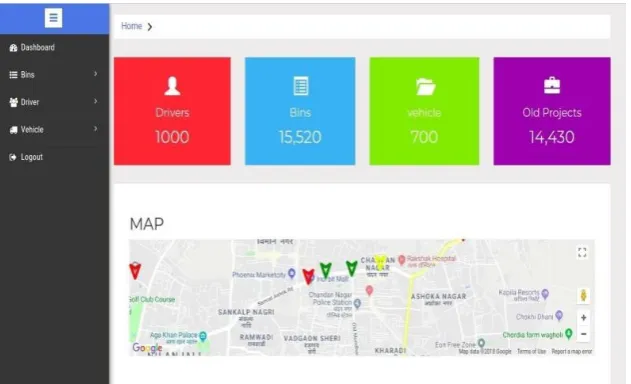
Fig. 2. An illustration of the Home page of the Admin Module
Fig. 3. An illustration of the Home page of the Driver Module
and the ultrasonic sensor.it receives the dustbin status via raspberry pi board and according to that it manages the driver module to collect the garbage from the bins. Fig 2 illustrate the home page of the admin module.
D. The Database Server The database is the main processing unit of the system. Data is aggregated from end-users’ apps and drivers, weather condition, current sport and celebration events with a potential effect on waste truck routing or waste amount (month of Ramadan at night), traffic rush hour, and each bin’s surrounding environment. Our proposed system reacts actively to the triggering events of waste collection by analyzing data from waste bins and drivers’ apps to optimize the waste collection routes. For example, the system can react to traffic rush hour by avoiding waste collection from these areas during this period.
4. RESULT
5. CONCLUSION
This paper presents an architecture based on IoT with the objective of improving waste management systems. Our approach is a holistic review of the waste management system, starting from smartening-up the waste-bin to optimize waste collection times and anticipating the nature of collected waste to considerations of the collection vehicles, their route planning and scheduling. The presented architecture depended on a cloud-based implementation for the processing and computation core.
The system offers great flexibility in terms of implementation, especially given its complete dependence on off-the-shelf technology. It also allows for varied waste-collection objectives. The architecture is currently undergoing prototyping of its different components, and future work will offer further elaboration on their implementation and testing.
1. Admin Module : 1. Receives the status of the bin from IoT module.
2. Allocate new driver. 3. Allocate new bin.
2. IoT Module: 1. Information in this architecture is
transferred Via IoT module.
3. Driver Module : 1. Receives the notification when bin reaches to threshold value
REFERENCES
[1]. J. Wy, B. I. Kim, and S. Kim, “The rollon-rolloff waste collection vehicle routing problem with time windows,” Eur. J. Oper. Res., vol. 224, no. 3, pp. 466–476, Feb. 2013.
[2]. T. Nuortio, J. Kytöjoki, H. Niska, and O. Bräysy, “Improved route planning and scheduling of waste collection and transport,” Expert Syst. Appl., vol. 30, no. 2, pp. 223–232, Feb. 2006.
[3]. X. Bing, M. de Keizer, J. M. Bloemhof-Ruwaard, and J. G. A. J. van der Vorst, “Vehicle routing for the eco-efficient collection of household plastic waste.,” Waste Manag., vol. 34, no. 4, pp. 719– 729, Apr. 2014. [4]. M. Reed, A. Yiannakou, and R. Evering, “An ant colony algorithm for the multi-compartment vehicle routing
problem,” Appl. Soft Comput., vol. 15, pp. 169–176, Feb. 2014.
[5]. T. T. Minh, T. Van Hoai, and T. T. N. Nguyet, “A Memetic Algorithm for Waste Collection Vehicle Routing Problem with Time Windows and Conflicts,” in Computational Science and Its Applications -- ICCSA 2013, 2013, pp. 485–499.
[6]. G. Prajakta, J. Kalyani, and M. Snehal, “Smart Garbage Collection System in Residential Area,” IJRET: International Journal of Research in Engineering and Technology, Volume: 04, Issue: 03, pp.122-124, March 2015.
[7]. S. Thakker and R. Narayanamoorthi, “Smart and wireless waste management,” in 2015 International Conference on Innovations in Information, Embedded and Communication Systems (ICIIECS), 2015, pp. 1– 4.
[8]. A. S. Bharadwaj, R. Rego, and A. Chowdhury, “IoT based solid waste management system: A conceptual approach with an architectural solution as a smart city application,” in 2016 IEEE Annual India Conference (INDICON), 2016, pp. 1–6.
[9]. "We manage your waste." Enevo. Accessed October 11, 2017. https://www.enevo.com/enevo-faq/. [10]. Labs, Ecube. “FAQ.” Ecube Labs, ecubelabs.com/.