Vol. 8, No. 2, 2014, 237-244
ISSN: 2279-087X (P), 2279-0888(online) Published on 17 December 2014
www.researchmathsci.org
Annals of
Time Minimizing Fuzzy Transportation Problem
B.AbiramiDepartment of Mathematics, D.G.Vaishnav College, Chennai, India Email: [email protected]
Received 12 November 2014; accepted 21 November 2014
Abstract. This paper shows a procedure for solving the time Minimizing fuzzy transportation problem by assuming that a decision-maker is uncertain about the precise value of the fuzzy transportation time, fuzzy source and fuzzy destination parameters. These parameters have been expressed as generalized non-normal p-norm trapezoidal fuzzy numbers. A numerical example illustrating the method is included.
Keywords: Time Minimizing – fuzzy transportation problem – generalized non-normal p-norm trapezoidal fuzzy numbers – signed distance
AMS Mathematics Subject Classification: 90C08, 90C90
1. Introduction
The Time Minimizing fuzzy transportation problem is more important than the fuzzy cost factor. Fuzzy Transportation model plays a vital role to ensure the efficient movement and in-time availability of raw materials and finished goods from fuzzy sources and fuzzy destinations. For instance, the time of despatch of the military personnel, equipment’s, food, medicine etc. are to be sent from their basis to fronts. The objective of the fuzzy transportation is to determine the shipping schedule that minimizes the total shipping fuzzy cost while satisfying the fuzzy demand and fuzzy supply limit was given by Kantiswarup et al. [9]. If we are able to minimize the fuzzy transportation time, fuzzy transportation cost comes down naturally. In literature the time minimizing fuzzy transportation has already been studied by Arora and Puri[1], Burkand et al. [3], Garfrinkle and Rao [6], Hammer [7], Iserman [8], Szwarc [13], Mathur and Puri [11] and Bhatia et al. [2] and others. Theoretical approach of Multi-Objective programming and goal programming are shown in [14].
In this paper the fuzzy transportation time, fuzzy supply and fuzzy demand is expressed as generalized non-normal p-norm trapezoidal fuzzy numbers which is solved by the ranking function signed distance. A numerical example illustrating the method is also given.
2. Preliminaries 2.1. Basic Definitions
In this section some basic definitions are reviewed as follows:
that the value assigned to the element of the universal set X fall within a specified range. i.e. : X [0, 1]. The assigned value indicates the membership grade of the element in the set A. The function is called the membership function and the set
= {(, : defined by for each X is called a fuzzy set.
Definition 2.2. [10] A fuzzy number = (a, b, c, d) is said to be a trapezoidal fuzzy number if its membership function is given by
=
0, , ! " ! #∞, , ∞
1, # ! " ! %
&
'&, % ! " !
(
Definition 2.3. A fuzzy set defined on the Universal set of real numbers ) is said to be generalized trapezoidal fuzzy number if its membership function has the following characteristics:
1. : ) [0, w] is continuous 2. = 0 for all ∞, , ∞
3. is strictly increasing on [a, b] and strictly decreasing on [c, d] 4. = w for all #, % where 0 + w! 1
Definition 2.4. [4] A generalized trapezoidal fuzzy number = (a, b, c, d, w) is said to be a non-normal trapezoidal fuzzy number if its membership function is given by
=
0, ∞, , ∞
, -. , ! " ! # , , # ! " ! %, 0 + , + 1 , -&'&. , % ! " !
(
The generalized trapezoidal fuzzy number is said to be a normal trapezoidal fuzzy number if w = 1.
Definition 2.5. [5] A non-normal fuzzy number = (a, b, c, d, w)p is said to be a non-normal /-norm trapezoidal fuzzy number if its membership function is given by
=
0, ∞, , ∞
, 01 - .12
3
4 ! " ! #
, , # ! " ! %, , 01 -'&'.12
3 4
% ! " !
where / is a positive integer.
The left and right inverse functions of are,
56y 8 b a b ;1 -,.<
1
= 3 4
, 0 ! < ! ,
>6y 8 c d c ;1 -,.<
1
= 3 4
, 0 ! < ! ,
2.2. Arithmetic operations [4]
Let 6= (6, #6, %6, 6: ,6)pand A= (A, #A, %A, A: ,A)p be two non-normal /-norm trapezoidal fuzzy numbers defined on the universal set of real numbers). Then the arithmetic operations between 6 and A are
i. 6B A = (6 A, #6 #A, %6 %A, 6 A: ,)p ii. 6C A = (6 A, #6 #A, %6 %A, 6 A: ,)p iii. 6D A = (6 E A, #6E #A, %6E %A, 6E A: ,)p
iv. 6F A = (6 / A, #6/ %A, %6/ #A, 6/ A: ,)p where , 8 HIJ,6, ,A
v. K6 = LKK6, K#6, K%6, K6: ,61 ,K M 0 6, K%6, K#6, K6: ,61 ,K + 0(
While considering more than two non-normal /-norm trapezoidal fuzzy numbers let, 8 HIJ ,6, ,A.
Definition 7. [12] A ranking function is a function O:F() ), where F() is a set of fuzzy numbers defined on set of real numbers which maps each fuzzy number into the real line.
Let = a, b, c, d: wQwhere , = 1 and / = 1 be the p-normal trapezoidal fuzzy
number.The signed distance from 01(y-axis) is given as
d(,01) = RASa b c d: wQ
Γ-3 TU6.Γ3T
QΓVTU6 b cW;
If , X 1 and / M 1 then non-normal /-norm trapezoidal fuzzy number.
For = (6, #6, %6, 6Y ,6)pand Z= (A, #A, %A, A: ,A)p two non-normal /-norm trapezoidal fuzzy numbers with different heights.
i. d ( , Z) > 0 iff d( , 06) > d (Z , 06) iff Z [ ii. d ( , Z) < 0 iff d( , 06) < d (Z , 06) iff [ Z iii d ( , Z) = 0 iff d( , 06) = d (Z , 06) iff Z \ .
3. Mathematical formulation
Thus a time minimizing fuzzy transportation is ]̃_`, "a_`, a_, #b` are represented as a generalized non-normal p-norm trapezoidal fuzzy numbers is
cIJIHIdef 8 Max_,`]̃_`/"a_` X 0 ] subject to the constraints,
(i "a_`8 a_, I 8 1,2,3 … H
m
_n6
i "a_` o
_n6
8 #`, p 8 1,2,3 … J
(
"a_`M 0, qI, p.
∑ ao_n6 _=∑m`n6#`
where H: Total number of sources,
J:Total number of destinations.
a_: The fuzzy supply of the product at Ith source.
#`: The fuzzy demand of the product at pthdestination.
]̃_`: The fuzzy transportation time for transporting goods.
∑ ao_n6 _: Total fuzzy supply of the product.
∑m`n6#`: Total fuzzy demand of the product.
A fuzzy feasible solution 8 s"a_`t for which Max_,`]̃_`/"a_` X 0] is minimal is called an fuzzy optimal solution.
4. Proposed method: algorithm for solving time minimizing fuzzy transportation problem
Step 1: Find the total fuzzy supply∑ ao_n6 _ and the total fuzzy demand ∑m`n6#`. Examine that the problem is balanced or not ∑ ao_n6 _ = ∑m`n6#` or
∑ ao_n6 _u ∑m`n6#`.
Step 2: Determine an initial fuzzy basic feasible solution which can be found by
the methods applicable in the case of the common cost minimizing fuzzy transportation preferably generalized fuzzy Vogel’s approximation method.
Step 3:(i) The time units shown in the non-empty cells are the times in which their
materials despatch are complete. The time units are given in generalized non-normal p-norm trapezoidal fuzzy numbers.
If ]̃_` M v then we omit these empty cells.
(ii) Now, the aim will be to determine another type of distribution of materials for if ]̃_` + v and to find an adjacent better basic feasible solution.
(iii) Construct a loop for the basic cells corresponding to v in such a way that when the values at the corner cells are shifted around the value at the cell towards (not necessarily zero) zero and no variable becomes zero. If no such closed path can be formed the solution under test is fuzzy optimal.
Step 4: Defuzzify by signed distance to get the minimum transportation time.
Step 5: Repetition of step 3 till no better adjacent basic feasible solution can be
found.
5. Numerical example
The proposed method is illustrated by the following example: Let there be three godownsw6, wA, wxhave the stocks
1,4,6,9: 262,5,9,14: 261,2,3,4: 26units of materials which are to be sent to the three
destinations D1, D2, D3 demanding 1,4,6,9: 26, 1,2,5,8: 26, 2,5,7,10: 26 respectively with the following fuzzy transportation time ]̃_`, I 8 1,2,3. p 8 1,2,3.
Godowns
Destination Supply D1 D2 D3
S1 1,4,6,9: 26 0.2,0.8,1,2: 26 3,4,5,8: 46 1,4,6,9: 26
S2 0,1,2,3: 26 2,3,4,5: 26 3,4,5,6: 26 2,5,9,14: 26
S3 2,5,7,10: 26 3,5,8,12: 26 2,3,4,7: 46 1,2,3,4: 26
Demand 1,4,6,9: 26 1,2,5,8: 26 2,5,7,10: 26 4,11,18,27: 26
Table 1: Balanced Fuzzy transportation time
Step 1: ∑o_n6a_ = ∑m`n6#` is a balanced fuzzy transportationtime which has shown in Table 1.
Step 2: Generalized fuzzy Vogel’s Approximation method gives the initial fuzzy basic
Godowns
Destination Supply D1 D2 D3
S1 1,4,6,9: 26
, , , :
---0.2,0.8,1,2: 26
, , , :
---
3,4,5,8: 46
1,4,6,9: 26
S2
, , , :
---
0,1,2,3: 26
2,3,4,5: 26
, , , :
---
3,4,5,6: 26
2,5,9,14: 26
S3 2,5,7,10: 26 3,5,8,12: 26
, , , :
---
2,3,4,7: 46
1,2,3,4: 26
Demand 1,4,6,9: 26 1,2,5,8: 26 2,5,7,10: 26 4,11,18,27: 26
Table 2: An initial fuzzy basic feasible solution 6is given below
Bold numerals denote the allocations in the basic cells of the solution. Therefore, in order to complete the shipment it takes time
v68 c"]̃6A, ]̃6x, ]̃A6, ]̃Ax, ]̃xx
v68 c"0.2,0.8,1,2: 26, 3,4,5,8: 46, 0,1,2,3: 26, 3,4,5,6: 26, 2,3,4,7: 46 = 3,4,5,8: 46 units of time.
Thus, (S1, D3) enters the basis.
Step 3:
Godowns
Destination Supply D1 D2 D3
S1
, , , :
---
1,4,6,9: 26
, , , :
---0.2,0.8,1,2: 26
3,4,5,8: 46 1,4,6,9: 26
S2
, , , :
---
0,1,2,3: 26
2,3,4,5: 26
, , , :
---
3,4,5,6: 26
2,5,9,14: 26
S3 2,5,7,10: 26 3,5,8,12: 26
, , , :
---
2,3,4,7: 46
1,2,3,4: 26
Demand 1,4,6,9: 26 1,2,5,8: 26 2,5,7,10: 26 4,11,18,27: 26
Table 3: The new solution A is given below
Using Step 3(iii) of the proposed method, we get the solution
vA8 2,3,4,7: 46X v6which has shown in Table 3. Therefore, (S1, D3) is omitted.
Thus, (S3, D3) enters the basis.
Godowns
Destination Supply D1 D2 D3
S1
, , , :
---
1,4,6,9: 26
, , , :
---0.2,0.8,1,2: 26
3,4,5,8: 46 1,4,6,9: 26
S2
, , , :
---
0,1,2,3: 26
2,3,4,5: 26
, , , :
---
3,4,5,6: 26
2,5,9,14: 26
S3
, , , :
---
2,5,7,10: 26
3,5,8,12: 26 2,3,4,7: 46 1,2,3,4: 26
Demand 1,4,6,9: 26 1,2,5,8: 26 2,5,7,10: 26 4,11,18,27: 26
Table 4: The new solution x is given below
Again using Step 3(iii) of the proposed method, we get the solution vx8
2,5,7,10: 26X vAwhich has shown in Table 4. Therefore,( S3, D3) is omitted. Thus ( S3, D1) enters the basis.
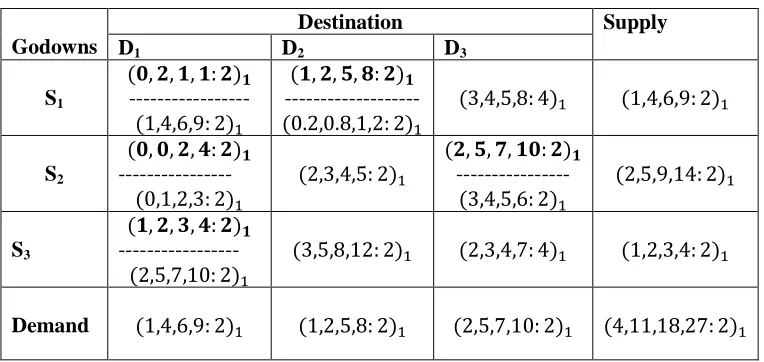
Now we cannot form any loop originating from the cell (S3,D1). Thus the process terminates.Therefore, in order to complete the shipment it takes time
vx8 c"]̃66, ]̃6A, ]̃A6, ]̃Ax, ]̃xx
vx8 c"1,4,6,9: 26, 0.2,0.8,1,2: 26, 0,1,2,3: 26, 3,4,5,6: 26, 2,5,7,10: 26 = 2,5,7,10: 26
Hence, the fuzzy optimal time is v 8 2,5,7,10: 26 . Rank of time minimizing fuzzy transportation = 12 The fuzzy optimal solution is
"a668 0,2,1,1: 26, "a6A8 1,2,5,8: 26, "aA68 0,0,2,4: 2, "Ax8 2,5,7,10: 26, "axx8 1,2,3,4: 26
5. Conclusion
The method presented and discussed above gives us the fuzzy optimal solution for time minimizing fuzzy transportation problem using generalized fuzzy non-normal/-norm trapezoidal fuzzy numbers. Sometimes we can get a fuzzy optimal solution directly.
REFERENCES
1. S.Arora and M.C.Puri, Onlexigraphical optimal solutions in transportation, Management Science, 25 (1979) 73 – 78.
2. H.L.Bhatia and K.Swarup and M.C.Puri, Time-cost trade off in a transportation problem, Opsearch, 13 (3-4) (1976) 129 – 142.
4. S.M.Chen and J.H.Chen, Fuzzy risk analysis based on ranking generalized fuzzy numbers with different heights and different spreads, Experts Systems with Applications, 36 (2009) 6833 – 6842.
5. C.C.Chen and H.C.Tang, Ranking of non-normal p-norm trapezoidal fuzzy numbers with integral value, Computer and Mathematics with Applications, 56 (2008) 2340 – 2346.
6. R.S.Garfinkel and M.R.Rao, the Bottle neck transportation problem, Naval Research Logistics Quarterly, 18 (1971) 465 – 472.
7. P.L.Hammer, Time Minimizing transportation problems, Naval Research Logistics Quarterly, 16 (1969) 345 -357.
8. H.Isermann, Linear bottleneck transportation problem, Asia-pacific Journal of Operations Research, I (1984) 38 – 52.
9. K.Swarup, P.K.Gupta and M.Mohan, Operations Research, Fourteenth Edition, 247 – 293, S.Chand and Sons, New Delhi.
10. Kaufmann and M.M.Gupta, Fuzzy Mathematical Models in Engineering and Management Science, Elsevier Science Publishers. Amsterdam, Netherlands.
11. K.Mathur and M.C.Puri, A bi-level bottleneck programming problem, European Journal of Operation Research, 86 (1955) 337 – 344.
12. S.Rajaram and B.Abirami, A modified approach for ranking non-normal p-norm trapezoidal fuzzy numbers, International Journal of Computer Applications, Applications, 56 (10) (2012).
13. W.Szware, The time transportation problem, ZastowaniaMatematyki, 8 (1966) 231 -242.