Copyright © The Author(s). All Rights Reserved. Published by American Research Institute for Policy Development DOI: 10.15640/jns.v5n2a9 URL: https://doi.org/10.15640/jns.v5n2a9
The Effectiveness of Training Workshop in Changing the Tutors’ Knowledge and
Attitude towards the Integration of Problem Based Learning into Nursing
Curriculum
Faiza A.Abou-El-Soud, Rn, PhD
1,2Hanem F. Mohamed, RN, PhD
1,3Jyothi Prince, RN, PhD
4Abstract
Background: PBL is a self-directed learning method that helps learner to develop critical thinking, problem solving skills and enhance their aptitude.
Aim: The aim of the present study was to measure the effectiveness of training workshop in changing the tutors’ knowledge and attitude towards the integration of PBL into nursing curriculum.
Method: A quasi-experimental design with pre and post-test was used to examine the objectives of the study. A self-report questionnaire was used to collect data from a convenience sample of 78 nursing faculty from two settings; College of Nursing-Riyadh (CON-R), KSA and College of Nursing-Tanta (CON-T), Egypt. Results: The participants’ mean scores of knowledge and attitude were improved from pre-test to post-test in each setting and there was a statistical significant differences in the mean score of knowledge and attitude between CON-R and CON-T. Lack of PBL training, and information, and lack of experts in PBL were reported as barriers for implementing PBL among participants. In addition, participants reported satisfaction with the training workshop and indicated that the gained information were effective and raised their interest to implement this strategy in their classes.
Conclusions and Recommendation:The workshop was effective to change the tutors’ knowledge and attitude towards the integration of PBL in their classes. Implementing such a teaching strategy is important to move from the traditional way of thinking. More research is needed to investigate visibility and applicability of PBL as a new teaching strategy in the field of nursing.
Key words: problem based learning, knowledge, attitude, satisfaction, barriers Introduction
Although lecture-based teaching is particularly good for presenting up-to-date information that support teaching and learning process, but it tends to promote shallow learning where students focus only on memorizing what have been covered in the subject-centered material.
1. Assistant professor, College of Nursing , King Saud Bin Abdul-Aziz University for Health Sciences, Riyadh, Kingdome of Saudi Arabia, King Abdullah International Medical Research Center (KAIMRC), Riyadh, Ministry of National Guard Health Affairs, Kingdome of Saudi Arabia
2. Assistant Professor of Community Health Nursing, College of Nursing, Menoufiya University, Egypt 3. Assistant professor, Medical Surgical Nursing Department, College of Nursing, Tanta University,Egypt.
(1) Nevertheless, moving from the linear way of thinking, a new advancement in organizing and delivering a lecture that focus on understanding, motivation, and analytical way of thinking is needed.Problem based learning (PBL) is a method of learning in which the learners use a systematic, learner-centered inquiry process to solve a problem.(2) It was developed basically in medical education to help shifting from a subject or lecture-based curriculum to an interdisciplinary one guided by real-life problems. Nursing education and practice requires a cognitive ability that includes problem solving, critical thinking, decision-making, clinical judgment, team work and communication. This is needed to prepare committed and responsible nurses who can effectively take different roles and critical nursing duties. (3, 4)
PBL is more about “student /learner learning” in which knowledge is acquired in dynamic and self-directed way rather than the “teacher teaching”way.(5,6) Further, the tutor plays a multifaceted role to facilitate learning by supporting, controlling, and observing the learning procedure.(7-9) Other than that PBL enhances professionalism and collaboration among colleagues and provide chances to construct relationship with students/learners.(10) Numerous medical schools have adopted problem-based learning into their educational program following the lead of McMaster University Medical School in Ontario, Canada (1960s), and more than 80 % of medical schools in the United States now have some form of problem-based learning in their programs.(11,12)
From the students or learners’ point of view, PBL found as a cooperative learning method that have a positive impact on expanding their knowledge, develop problem solving skills, improve independence, enhance motivation and enrich their teamwork experience. (13)
To execute the PBL as a teaching method, faculty initially should be familiar with PBL in order to perform the role of “facilitator” rather than “teacher”. (14) Research evidence suggested that to implement PBL, there is a need to induce change in the roles of faculty and students. Institution ought to provide faculty development programs emphasizing knowledge and skills regarding PBL.(15,16) Faculty training proven understanding and better practice of PBL skills (17) , increase tutor's knowledge and application and attitude toward PBL.(18) Few studies documented workshop as an effective means to enhance the understanding and application of PBL. In addition, tutor training workshop increase tutor's satisfaction with their performance, (19-22) increase the rating of tutor’s self-improvement and demonstrate better tutoring afterwards. (23)
Although, previous studies revealed that PBL enhance critical thinking and problem solving skill, however, still there is a lack of consensus about PBL in the context of nursing. A very few interventional studies conducted among nursing faculties about PBL in Saudi Arabia and Egypt. To implement such a new strategy, it is important for nursing faculty to have the required knowledge and skills about PBL. The aim of the current study was to examine the effectiveness of training workshop about PBL on knowledge, attitude toward integrating PBL into nursing curriculum. Satisfaction regarding the training and barriers to implement PBL were also investigated.
Theoretical framework:
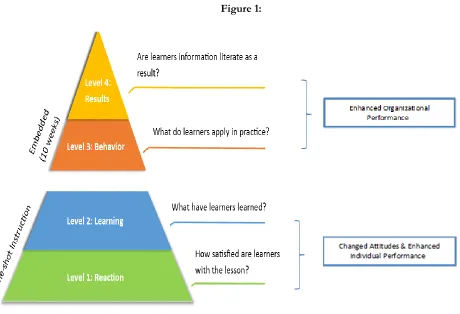
The current study was based on the Kirkpatrick Model, (1959) (24). The model is considered as a worldwide standard for evaluating the effect of educational training considering any training styles. The model include 4 levels mainly reaction, learning, behavior and results (Figure 1).
Level 1: Reaction – At this level, the investigators measure the tutors reaction to the training or learning experience. It is important for the investigator to assess learners’ willingness and readiness to ask questions and to be fully engaged as well as how they perceived the learning experience. This will help enhancing the preparation for the next level.
Level 2: Learning - At this level, the investigators assess to what extent the tutor's knowledge improved or changed from pre to post learning experience and to see how much the learners comprehended. This level is more challenging than the first level.
Level 3: Behavior -The investigators analyze the differences in the learners’ behavior after the training and their ability to apply the change in knowledge and skills gained from the training into their work. This level is challenging because the training usefulness appears at this time and it is hard to estimate the change in attitude that would allow the learners to properly utilize what they’ve learned from the training.
Figure 1:
Materials and Methods:
Research design: A quasi-experimental design with pre-posttest was used to evaluate the effectiveness of the training workshop in changing the tutors’ knowledge, and attitude towards the integration of PBLinto nursing curriculum.
Research setting: The study was conducted in the Fall semester,2017 in two different nursing colleges; College of Nursing, (CON-R), King Saud Bin Abdulaziz University for Health Science (KSAU-HS), Riyadh, Kingdome of Saudi Arabia and College of Nursing–Tanta University (CON-T) – Egypt.
Sample: A convenience sample of 78 nursing faculty according to the inclusion criteria of being full time faculty and assigned for teaching core nursing courses either theoretical or clinical, or both. There were 25 nursing faculties from CON-R and 53 nursing faculties from CON-T.
Tools of the study: A self- report questionnaire was administered to the faculties before and after the training workshop. The questionnaire consisted of five parts:
(I) Socio-demographic characteristics which include age, qualification, academic rank, years of experience, nationality and previous PBL training.
(II) Knowledge of the tutors regarding PBL. This questionnaire include 10items, 7 of them on a dichotomous level where (2) yes and (1) no, and 3 questions on 5 points Likert scale about the practice of PBL process in teaching classes.
(III)Tutors' attitude towards integration of PBL into nursing curriculum. This questionnaire includes 7 questions measured on interval level scale from 0 to 100%. Scores of 50 % and below indicates negative tutors' attitude and scores of more than 50% indicates positive tutors' attitude toward integrating PBL in nursing curriculum. (IV)Barriers to implement PBL in teaching classes. This questionnaire include 2 main categories as barriers;
Results
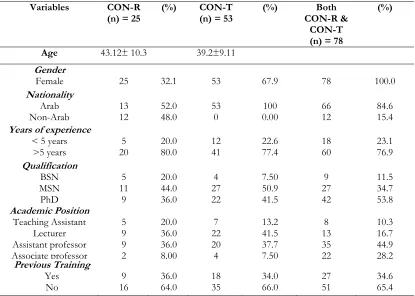
Table (1)shows the socio-demographic characteristics of participants. The mean age was reported as 43.12 +/- 10.3 for CON-R and 39.2 +/- 9.11 for CON-T. Hundred per cent were female and the majority of them were Arab nationality (84.6%). Majority from both settings (80% from CON-R and 77% from CON-T) had more than 5 years of experience in the academic nursing field. More than half of participants hold a PhD in nursing and about one half were having assistant professor position. Regarding previous training about PBL, about one third of the participants from each setting reported having a previous training about PBL.
Table 1: -Socio-demographic profile of the study participants
Table (2)portrays the difference in mean scores of knowledge and attitude in pre-and post-test among the 2 settings. There were an improvement in the mean score of knowledge after the training workshop in both settings. The mean scores of the pre-test and post-test for CON-R group was (11.08+2.15) and (18.86+3.40) respectively, and the mean scores of the pre-test and post-test for CON-T group were (9.52+2.04) and (19.29+2.85) respectively. Regarding attitude, the mean scores for pre and posttest for CON-R group were (21.96+0.69) and (43.86+0.87) respectively, and the mean scores for pre and posttest for CON-T group were (21.54+0.64) and (43.83+.95) respectively.
Table 2: Mean and SD of Knowledge and Attitude in Pre and Post Training Workshop by Regions
Region
Knowledge Attitude
Pre-test Training Post-test Training Pre-test Training Post-test Training CON-R
Mean ± SD 11.0 ± 2.15 18.86 ± 3.40 21.96 + .69 43.86 + .87
CON-T Mean ± SD
9.52 ± 2.04 19.29 ± 2.85 21.54 + .64 43.83 + .95 Variables CON-R
(n) = 25 (%) (n) = 53 CON-T (%) CON-R & Both CON-T (n) = 78
(%)
Age 43.12± 10.3 39.2±9.11
Gender
Female 25 32.1 53 67.9 78 100.0
Nationality
Arab
Non-Arab 13 12 52.0 48.0 53 0 0.00 100 66 12 84.6 15.4
Years of experience
< 5 years
>5 years 20 5 20.0 80.0 12 41 22.6 77.4 18 60 23.1 76.9
Qualification BSN MSN PhD 5 11 9 20.0 44.0 36.0 4 27 22 7.50 50.9 41.5 9 27 42 11.5 34.7 53.8 Academic Position Teaching Assistant Lecturer Assistant professor Associate professor 5 9 9 2 20.0 36.0 36.0 8.00 7 22 20 4 13.2 41.5 37.7 7.50 8 13 35 22 10.3 16.7 44.9 28.2 Previous Training Yes
Table (3)shows the comparison of the mean scores for the participants’ knowledge in pre and post –test by regions. In this table, the result depicts that there were no statistical significant differences in the mean scores in the pre-test between the 2 regions (within group CON-R & CON-T) F = .347, p = .558 while in the post test results showed statistical significance changes in the mean scores of knowledge between the 2 regions as reported by F = 10.785, P = .002.
Table 3: Comparison the Mean Scores of the participants' Knowledge in the Pre and Post-test by Regions Sum of
Squares df Mean Square F Sig.
Pre-test & Region Between Groups
(CON-R & CON-T) 3.205 1 3.205 .347 .558
Within Groups
(CON-R/CON-T)
T)
702.268 76 9.240
Post-test & Region Between Groups
(CON-R & CON-T) 46.661 1 46.661 10.785 .002
Within Groups
(CON-R/CON-T) 328.813 76 4.326
Table (4)reveals the comparison between mean scores of the participants' attitude in pre and post –test by regions. Similarly, results states that the participants' attitude in pre-test between the 2 regions (within group CON-R & CON-T) was not statistically significant F = .068, p = .795. On the other hand, the posttest reported statistical significant differences in the mean scores of attitude between the 2 regions (between group CON-R & CON-T), F = 9.791, p = .001.
Table 4: Comparison the Mean Scores of the Respondents ' Attitude in the Pre and Post-test by Regions Sum of
Squares df Mean Square F Sig.
Pre-test & Region Between Groups
(CON-R & CON-T)
(CON-R & CON-T)
296.700 1 296.700 .068 .795
Within Groups
(CON-R/CON-T) 330.325 76 435.110
Post-test & Region Between Groups
(CON-R & CON-T) 1.548 1 1.548 9.791 .001
Within Groups
(CON-R/CON-T) 161.503 76 213.336
Figure (3)Satisfaction level of the participants towards the PBL training workshop. Results showed that 76% strongly agree, 23% agree that the investigators presented the training effectively. 72% reported strongly agree and
28% reported agree that the materials were useful, and level of information was appropriate. 62.4% reported strongly agree and 38% agree that the investigators offered useful information and strategies. 58.4% reported strongly agree and 42% agree that the goal of the training was met. 54.4% strongly agree and 45% agree that the training simulated my interest and met their expectations.
Lack of PBL training workshop
29%
Lack of information
about PBL process
27% Lack of experts
to create a scenario
19% PBL is not applicable
16% Others
9%
Figure 2.
Self-Report of the Study Respondents
Regarding
Academic Barriers for Implementating of PBL
in Teaching Classes
0 10 20 30 40 50 60 70 80
Offered useful information and strategies Met my expectations
The goals were met
The presenter communicated effectively The level of information was appropriate Stimulated my interest
Increased awareness of the importance of PBL Process Materials were useful
62.4 54.4 58.4 76 72
54.4 60 72
Figure 3.
Satisfication of the Study Respondents Regarding to
Problem-Based Learning Post Training Workshop
Discussion
Implementation of PBL definitely requires proper training and strategies to bring about change in educating nursing students. The present study has addressed that training workshops are effective to bring about change in knowledge and attitude of the faculty toward PBL as a new teaching strategy that would be implemented in nursing curriculum. This was consistent with previous literatures who have reported that workshops were helpful tool to familiarize PBL among faculties, and important way to enhance knowledge, practice and the opinion of PBL. (25-27)
A considerable percentage of the participants in this study reported the ability to practice PBL efficiently in teaching and can implement the seven steps of PBL after attending the training workshop. Likewise, the study conducted by Michelle McLean in South Africa found that a 3-days training workshop was effective in understanding PBL, the role as facilitators and how to manage the groups. (28) A study done in Pakistan showed similar findings that workshop has significant impact on changing the perception of faculties regarding PBL system, its positive effect on academic and professional development and improvement of group dynamics among students.(19)
Participants in this study reported satisfaction with the workshop provided in terms of usefulness of the materials and appropriateness of information. Participants reported increased awareness of the importance of the PBL process. Meanwhile > 50% said that their goals and expectations were met and were stimulated by interest. This was congruent with other works who found that training workshops were convenience, within participants’ interest, and effectively raised their satisfaction, faculty development, and role transition from teacher to facilitator. (18, 29-31)
Regarding the attitude towards PBL, the present study reported statistical significant improvement in attitude after the training. Respondents were willing to share the gained knowledge with colleagues and they acknowledged applicabilityof PBL as a teaching method. Similarly, the findings of Singh (2014) showed that workshop and training are needed to change the attitude of faculties towards PBL as they were sensitized by the workshop and were ready to advocate about PBL as a teaching method. (20)
Lack of workshops and training on how to apply the steps of the PBL, lack of experts to create PBL scenarios were reported as barriers for implementing PBL in the present study. Limited logistics and resources reported a barrier only among CON-T group. Correspondingly, other studies recognized logistical constraints like limited classroom, library and resources, time commitment by faculties for teaching and the need for more faculty members as an obstacle for PBL. (19) On the other hand, the findings of Zaidi indicated that PBL might not be comprehensive for all subjects, and Ruiz-Gallardo et al and Nettath specified that PBL is time consuming. (30, 31) Conclusion and Recommendation
The current study indicated that training workshop is an effective means to improve knowledge and attitude of tutor towards PBL. Participants reported satisfaction with the training and willingness to implement PBL in their classes. Regular training by expert in PBL is needed, piloting the implementation in some nursing courses to better understand the process and the barriers that might hinder application into nursing curriculum is also needed. As technology showed advancement in clinical nursing, advancement in nursing education necessitate utilization of new teaching strategies such as PBL in nursing education. More research is needed to investigate visibility and applicability in the field.
References
Barrows, H.S. (1992). A learning Method Based on the Principle of Using Problems as a Starting Point for the Acquisition and Integration of New knowledge. Spring Publication Co, New York, USA.
Barrows, H.S. (1996). Problem-based learning i1`qn medicine and beyond: A brief overview. In L. Wilkerson & W. H. Gijselaers (Eds.), new directions for teaching and learning. Vol. 68, pp. 3–12. San Francisco: Jossey-Bass.
Schmidt, H.G., Rotgans, J.I., and Yew, E.H.J. (2011). The process of problem-based learning: What works and why. Medical Education. 45 (8): 792–806 . doi: 10.1111/ j. 1365-2923.2011.04035.x. PMID 21752076.
Hung, W. (2011). Theory to reality: A few issues in implementing problem-based learning. Educational Technology Research and Development. 59 (4): 529–552. doi:10.1007/s11423-011-9198-1.
Kaufman, D.M., and Mann, K.V. (1996). Comparing students’ attitudes in problem based and conventional curricula. Academic Medicine. 71: 1096-1099.
George, L. (2001). Educational Foundation, Project-based learning, research Edutopia. WWW.edutpia.org.
Dolmans, D.H., De Grave, W., Wolfhagen, I.H., and Van Der Vleuten, C. P. (2005). Problem-based learning: Future challenges for educational practice and research. Medical Education. 39 (7):732–41. doi:10.1111/j.1365-2929. 02205.x. PMID 15960794.
Armstrong, Elizabeth, G. (2008). "A Hybrid Model of Problem-based Learning". In Boud, David; Feletti, Grahame. The challenge of problem-based learning. London: Routledge. ISBN 978-0-7494-2560-9.
Schmidt, Henk G. ,Loyens, Sofie M. M., Van Gog, Tamara; Paas, and Fred (2006). "Problem-Based Learning is Compatible with Human Cognitive Architecture: Commentary on Kirschner, Sweller, and Clark ". Educational Psychologist.2007. 42 (2): 91–7. doi:10.1080/00461520701263350.
Hussain, O., Ahmad, E., Abdullah, S., andHasyamudin, O. (2007). Adapting Problem-based Learning in the Teaching of Engineering Undergraduates: A Malaysian Experience. International Conference on Engineering Education – ICEE, Coimbra, Portugal.
Railsback, J. (2002). Project-based instruction: Creating excitement for learning. Portland , OR: Northwest Regional Educational Laboratory. http://www.nwrel.org/ request/2002aug/index.html
Dreier-Wolfgramm, A., Homeyer, S., Oppermann, R., and Hoffmann, W. (2018). A model of interprofessional problem-based learning for medical and nursing students: Implementation, evaluation and implications for future implementation. GMS Journal for Medical Education, Vol. 35 (1).
Wood, DF. (2003). ABC of learning and teaching in medicine: Problem Based Learning. BMJ.; 326:328-30. Olmesdahl, P.J. and Manning, D.M. (1999). Impact of training on PBL facilitators. Med Educ, 33:753-755.
Steinert, Y., Mann, K., Centeno, A., Dolmans, D., Spencer, J., Gelula, M., &Prideaux, D. (2006). A systematic review of faculty development initiatives designed to improve teaching effectiveness in medical education: BEME Guide No. 8. Med Teach. Sep; 28(6):497-526.
Jafri, W., Mumtaz K., Burdick, W.P., Morahan, P.S., Freeman, R., Zehra, T. (2007). Improving the teaching skills of residents as tutors/facilitators and addressing the shortage of faculty facilitators for PBL modules. BMC Medical Education; 7(34).
Othman, S.Y., and Shalaby, S.A. (2014). Students’ Perception and Acceptance of Problem-based Learning Approach in Critical Care Nursing Practice. Scientific Cooperation International Workshops on Medical Topics, Ankara-TURKEY, 7-8 June.
Gonc, V., Lorber, M. and Nerat, J. (2017). Experience of Problem‐Based Learning for Raising Quality of Nursing Study. May, DOI: 10.5772/67427
Bucy, M. C. (2006). Encouraging critical thinking through expert panel discussions. Colleague Teaching.. 54(2), 222 – 224. El-Aziz El Naggar, M.A.A., Maklady, F.A.H., Hamam, A.M., Omar, A.S. (2013). Effectiveness of Implementing a Tutor
Training Workshop for Problem Based Learning Class Tutors at the Faculty of Medicine, Suez Canal University. Intel Prop Rights.1-104.
Zaidi, Z., Zaidi, S.M., Razzaq, Z., Luqman, M., Moin, S. (2010). Training workshop in Problem based learning: Changing Faculty attitudes and perceptions in a Pakistani Medical College. Education for Health; 23:1-9.
Baroffio, A., Nendaz, M.R., Perrier, A., Layat, C., Vermeulen, B., Vu N.V. (2006). Effect of teaching context and a tutor workshop on tutorial skills, Medical Teacher, 28: 4, e112-e119, Doi: 10.1080/01421590600726961
Kirkpatrick, D. (1959). Evaluating Training Prgrams. San Francisco:Berrett –Kochter Publishers, Inc.
Singh, A., Saxena, A., Bhambani, P., Nema, S.K., Gaur, R. &Ambey, R. (2014). Faculty perception and attitude on Problem Based Learning (PBL) in the Medical College from Central India. British journal of Medicine and Medical Research; 4 (9):1836-1843.
Des Marchais, J.E., Bureau, M.A., Dumais, B. and Pigeon, G. (1992). From traditional to problem-based learning: a case report of complete curriculum reform. Med Educ. 26:190-199.
Azila, N.M.A., Khairiyah, Mohd, Yusof, Zubaidah H.A.R., Tan, C.P.L., Wan, Ashri W.D., &Atiya, A.S., et al., (2018) Creating interest and exploring implementation of cooperative learning (CL) or problem-based learning (PBL) in three disciplines.repository.um.edu.my/110691/
Joshi, M., Shrestha, I., &Bhandary, S. (2015). Training tutors for implementing problem-based learning at a private medical college of Nepal. Journal of Patan Academy of Health Sciences. Dec 2(2):7-12.
Ruiz-Gallardo, J., Santiago, Castaño, Juan J., Gómez Alday, & Arturo Valdés (2010). Assessing student workload in Problem Based Learning: Relationships among teaching method, student workload and achievement. A case study in Natural Sciences, Teaching and Teacher Education (11) 1-9.
Faul, F., Erdfelder, E., Buchner, A., & Lang, A.G. (2009). G Power is a free power analysis program for a variety of statistical tests.