ISSN 2373-7662 (Print) 2373-7670 (Online) Copyright © The Author(s). 2014. All Rights Reserved. Published by American Research Institute for Policy Development DOI: 10.15640/ijn.v1n2a5 URL: http://dx.doi.org/DOI: 10.15640/ijn.v1n2a5
Simulation Teaching: Developing Instructor Confidence
Robyn Faz1, Dr. Sharon Van Sell2 & Dr. Susan Sheriff2
Abstract
In order to prepare and develop competence among undergraduate nurses, nurse educators support the use of incorporating high fidelity simulation in the laboratory setting. Simulation is proven to enhance: critical thinking, clinical reasoning, and reflection among nursing students (Decker, Sportsman, Puetz, & Billings, 2008). However, many nurse educators fail to understand the full capabilities of simulation and its components. The purpose of this paper is to synthesize the literature and establish guidelines for nurse educators to teach high fidelity simulation. Van Sell’sskillsacquisition nursing theoryand the Internal Nursing Association for Simulation and Clinical Learning (INASCL) standard’s for best practice in simulation (2013)were used to guide the creation of a decision tree.This paper will provide recommendations on initial training in simulation and discuss resources to attain the outlined guidelinesin order to be confident while teaching simulated scenarios.
Keywords: simulation, confidence, guidelines,recommendations, and training
1. Introduction
Simulation is defined as a teaching method in which students are immersed in a controlled clinical scenario in order to resemble real life situations (Waxman, 2010).In order to prepare competent graduate nurses into the workforce, nursing schools are utilizing simulation at all educational levels (Lane & Mitchell, 2013). The benefits simulation brings to students are astounding: facilitation of critical thinking skills, ability to self-reflect, and preparation for future roles as nurses (Decker, Sportsman, Puetz, & Billings, 2008).
1 Texas Woman's University, 5500 Southwestern Medical Ave, Dallas, TX 75235.
Email: [email protected], Phone: 817-908-2262
Due to the growing demands of simulation, institutions are adopting this relatively new teaching methodology into their curriculum without structuring a training program (Seropian, Brown, Gavilanes, Driggers, 2004). Colleges of nursing, such as Texas Tech are evaluating and planning on a curriculum change to increase clinical hours to 50% in simulation. The authors are in agreement with the results from the National Council of State Boards of Nursing (NCSBN) study, that there will be an increase demand for: the use of simulation and the development of confident nurse educators to teach high fidelity simulation.
Unfortunately, simulation instruction does not come with a manual, therefore many institutions are left to guess how to utilize this tool effectively (Seropian et al., 2004). Educators are not prepared to teach simulation for a variety of reasons (Jeffries, 2008). Inexperience with the simulation equipment, fear of technology, shortage of funds, scheduling issues, and lack of understanding regarding thesimulation process pose a barrier tonurse educators adopting simulation (Jeffries, 2008; Taibi & Kardong-Edgren, 2014). In order to have acceptance from nurse educators, it is important to allow an opportunity to observe a scenario in a non-threatening environment and ask questions pertaining to the simulation pedagogy(Seropian et al., 2004).
A review of the literature suggests formal training in simulation is inconsistent among nursing schools and competencies have yet to be developed in order to train educators on simulation principles (Jeffries, 2008). Therefore, there is a need to analyze this topic and discuss guidelines nurse educators must take prior to teachinghigh fidelity simulated scenariosconfidently.Confidence will be defined as: belief in one self and abilities.
2. Literature Review
A comprehensive, systematic evidence based, narrative literature review was conducted to support the topic of confidence while teaching high fidelity simulation. First, the literature review process will be described followed by the key results.
2.1 Data Sources
An online search of the literature was carried out via Texas Woman’s University library. Databases including: CINAHL with Full Text, ProQuest Nursing, PubMed, Medline, and Scopus were utilized. The search was limited to English material only, research, and evidence-based peer reviewed articles. The inclusioncriteria was set togenerate articles from 1980-2014.Inclusion criteria consisted of: nursing simulation articles, quantitative, and qualitative guidelines. Medical-surgical simulation articlesand non-English material were excluded from the search criteria. Keywords and combination of words were used in order to conduct anevidence basedsearch. Search terms consisted of: nursing education, nurse education,
simulator, simulation, simulations, confidence, competency, competencies, trainer, instructor, educator, and faculty.When searched, more than 50 research articles published between 1980
through 2014 were produced. The articles were considered beneficial if information regarding initial training, instructor confidence, and competencies were addressed in simulation. Websites were also used to find information on the topic including: Google Scholar, National League for Nursing (NLN), Society for Simulation in Healthcare (SSIH), and INACSL. Van Sell’s skill’s acquisition nursing theory was utilized to guide the creation of the decision tree.
3. Findings
The abstractand the full journal article were surveyed in detail to determine inclusion and exclusion criteria. Abstracts describing:discrepancies with formal training, competency attainment, and instructor confidence in simulation were utilized. Articles were included for review if they focused on:instructor confidence, initial training measures, simulation symposiums, debriefing process, scenario writing guidelines, and evaluation techniques. Applicable articles were found in the following journals: Journal of Nursing Education, The Journal of Continuing Education in Nursing,
After searching the literature, formal training in simulation has been limited and guidelines have yet to be established (Jeffries, 2008). Faculty members should receive preliminary training and be given enough time to be confident with the simulation setting, equipment, debriefing methods, and how to operate the software before conducting a simulated scenario (Jones & Hegge, 2008). Several resources are available for nurse educators to prepare to teach using simulation confidently. Resources includeonline videos describing basic simulation knowledge,standards of best practice in simulation (2013), debriefing strategies/methods, regional/national symposiums, guidelines for scenario writing, a train-the-trainer methodfor simulation instruction, and advanced education(Taibi & Kardong-Edgren, 2014; Jeffries, 2008; Waxman, 2010; Lane & Mitchell, 2013).
3.1 Simulation Time
The National Council for State Boards of Nursing released findings on a two year simulation study. The purpose of the study was to determine if a percentage of clinical hours (25 or 50%) could be replaced by simulation (Hayden, Smiley, Alexander, Kardong-Edgren, & Jeffries, 2014). The results were compared to a control group in which no more than 10% of hours could be spent in simulation (Hayden et al., 2014). The study assessed: nursing knowledge through an ATI comprehensive exam, clinical competency with an evaluation rubric, and NCLEX pass rates (Hayden et al., 2014). Overall, the results were the same from the control group to the 25% or 50% group (Hayden et al., 2014). “The study provides substantial evidence that up to 50% simulation can be effectively substituted for traditional clinical experiences” (Hayden et al., 2014, p. 38). This study followed certain parameters including: NLN/Jeffries Simulation Framework and the standards of best practice in simulation (2013).
3.2 Online Resources
The Simulation Innovation Resource Center provides nurse educators the ability to register for a variety of courses pertaining to simulation and offers opportunities to engage with experts in the simulation field (National League for Nursing, n.d.).
The five basic courses range from: designing and developing simulations, debriefing and guided reflection, teaching and learning strategies, and evaluating simulations (National League for Nursing, 2014). Two continuing education contact hours are provide per course and can be completed online (National League for Nursing, 2014).
Free evidence based web videos or a “simulation team training toolkit” was created by the University of Washington, which offers four basic courses and three advanced courses on simulation teaching (Taibi & Kardong-Edgren, 2014). Courses include material on: simulation introduction, designing simulation scenarios, debriefing measures, evaluating scenarios, and clinical learning outcomes (Taibi & Kardong-Edgren, 2014). Courses consist of: a pre-test, lesson, and a post test (University of Washington, 2014). The courses have proven to be valuable to several nursing schools in preparing faculty to teach simulation scenarios effectively, “The toolkit materials have been used for 3 years successfully in training activities ... with student evaluations ranging from 4.18 to 4.75 on a 1 to 5 scale (5 = best) (Taibi & Kardong-Edgren, 2014, p. 50). Courses are available at the University of Washington’s Center for Health Science Interprofessional Education, Research, and Practices Web site: (http://collaborate.uw.edu).
3.3 Standards of Best Practice
Table 2: Standards of Best Practice (2013)
3.4 Debriefing Strategies
Debriefing is a major, if not the most important element in a simulation activity in which the nurse educator facilitates reflection among students in order to assess their decisions and actions (Shinnick, Woo, Horwich, & Steadman, 2011; Decker et al., 2013). However, several nurse educators do not know how to effectively debrief nor provide students the opportunity for reflection. Guidelines have been created in order to successfully debrief: “Facilitated by a person(s) competent in the process of debriefing, conducted in an environment that is conducive to learning … facilitated by a person(s) who observes the simulated experience, based on a structured framework for debriefing, and congruent with the participants’ objectives and outcomes” (Decker et al., 2013, p. 27). By understanding these debriefing guidelines, educators can provide an opportunity for active learning.
Standards of Best Practice in Simulation
Standard I: Terminology: “Standardized terminology promotes consistency and understanding in education, practice, research, and publication” (Meakim et al., 2013, p. 4).
Standard II: Professional Integrity of Participants: “It is essential to provide clear expectations for the attitudes and behaviors of simulated participants” (Gloe et al., 2013, p. 13).
Standard III: Participant Objectives: “All simulated-based learning experiences begin with development of clearly written participant objectives, which are available prior to the experience” (Lioce et al., 2013, p. 16).
Standard IV: Facilitation: “Effective facilitation requires using methods congruent with: simulated-based learning objectives and expected outcomes” (Franklin et al., 2013, p. 20).
Standard V: Facilitator: “The facilitator is key to participants learning. The facilitator guides and supports participants to understand and achieve the objectives” (Boese et al., 2013, p. 23).
Standard VI: The Debriefing Process: “All simulation-based learning experiences should include a planned debriefing session aimed toward promoting reflective thinking” (Decker et al., 2013, p. 27).
3.5 Regional/National Symposiums
Regional and national symposiums can be utilized to instruct nurse educators on the simulation process (Jeffries, 2008). INACSL hosts webinars and symposiums throughout the year to instruct their members on new advances in simulation. INACSL has created a simulation scholars mentorship program in which new educators can share ideas and receive feedback from experts in simulation (International Nursing Association for Clinical Simulation and Learning, n.d.).According to Jeffries (2008) administration should support faculty members in continuing their education and learning about this new teaching tool.
3.6 Scenario Writing
Scenario writing can pose a major challenge to nurse educators since guidelines have yet to be fully recognized (Waxman, 2010). Several organizations have created templates for nurse educators including: NLN and Laerdal Medical (Waxman, 2010).From the different templatestwo key components are mentioned throughout: scenarios must be evidence based and have established learning outcomes (National League for Nursing, 2012; Waxman, 2010). According to the NLN, “The objectives of the simulation must reflect the intended outcome of the experience, specify expected learner behaviors, and include sufficient detail to allow the learner to participate in simulation effectively” (National League for Nursing, 2012, p. 32).
The NLN/Jeffries Simulation Framework is a scenario writing guide which is designed to provide a foundation in assisting educators (National League for Nursing, 2012). The five components consist of: facilitator, student, educational practices, simulation design characteristics, and expected student outcomes (National League for Nursing, 2012).These five principles serve as a guide for educators to follow when writing scenarios. The authors are in agreement to incorporate the use of the NLN/Jeffries Simulation Framework model to write evidence based simulation scenarios.
According to the BASC, six key concepts were stated to be instrumental to scenario development: patient safety, priority setting, leadership and delegation, communication, patient teaching, and cultural diversity (Waxman, 2010). From the six key concepts the BASC created a template for nurse educators to follow while writing simulation scenarios. The template outlines: learning objectives, assessment plan, evidence base references for objectives, pre-scenario learner activities, debriefing points, validation, testing, and facilitation (Waxman, 2010).
Simulation instructions should be included when writing the scenario (Lane & Mitchell, 2013). “A sim in a box consists of a box labeled with the title of the simulation that includes written instructions on how to conduct the simulation, instructions on how to constitute the moulage, … and simulation supplies” (Lane & Mitchell, 2013).
3.7 Train-the-Trainer
Faculty who are experienced in simulation must become the “champion” or trainer, to assist others with simulation instruction (Jeffries, 2008). A three step train-the-trainer model was developed to train nurse educators to simulation (Lane & Mitchell, 2013). The first step is to identify individuals who are the “champions” in their institution (Lane & Mitchell, 2013). “Champions in various schools can work together to compile educational materials, develop orientation programs for faculty, and design a resource repository for scenarios, teaching tips, and resources” (Jeffries, 2008, p. 71). The next step, involves training the champion to simulation skills and knowledge (Lane & Mitchell, 2013). Finally, the champion will integrate into the role, educate faculty, and advocate for change (Lane & Mitchell, 2013).
3.8 Advanced Education
The post masters certificate in simulation will allow nurse educators to increase their knowledge of simulation education using high fidelity simulators.
Criteria for admission are as follows: baccalaureate degree in a healthcare field, two years of clinical experience, and a cumulative GPA of a 3.0 (Bryan Health, n.d.).
3.9 Simulation Certification & Accreditation
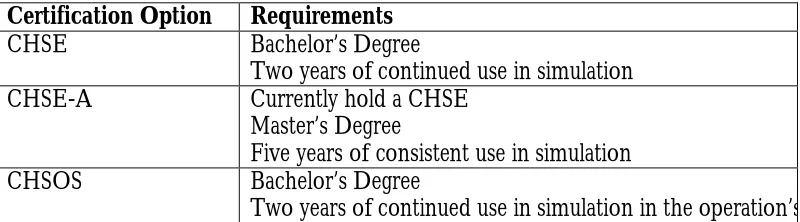
In order to address the solution in attaining instructor confidence while teaching simulated scenarios, simulation certification and accreditation must be described. According to the SSIH, there are three different certifications educators can achieve to be considered competent in simulation: certified healthcare simulation educator (CHSE), certified healthcare simulation educator-advance (CHSE-A), and certified healthcare simulation operations specialists (CHSOS) (Society for Simulation in Healthcare, 2014a). By certifying in simulation, educators continue to demonstrate commitment to nursing and their individual professional growth (Society for Simulation in Healthcare, 2014a). According to Seropian et al., (2004) faculty members should be trained to become the simulation specialists or educator. Table 1 outlines requirements for each certification.
Certification Option Requirements
CHSE Bachelor’s Degree
Two years of continued use in simulation
CHSE-A Currently hold a CHSE
Master’s Degree
Five years of consistent use in simulation
CHSOS Bachelor’s Degree
Two years of continued use in simulation in the operation’s role.
Table 1: Simulation Certification (Society for Simulation in Healthcare, 2014a)
Instructors, facilitators, content experts and simulationists may all be considered educators in the appropriate circumstances” (Society for Simulation in Healthcare, 2014b, p. 13).
According to SSIH (2014) educators must complete initial training and continue to further their ongoing professional development or education by attending regional or national meetings and conferences, and participating in research measures. Therefore, the authors are in agreement that once confidence is attained, the faculty member should continue to advanced education and seek to apply for certification in simulation after two years of continuous use.
4. Critical Analysis and Evaluation of Literature Review
Critical analysis and evaluation of the literature are reflected in the decision tree. The most salient points to the proposed protocol include: formalizing a basic training for faculty new to simulation on entry level information based on the standards of best practice in simulation (2013), in order to establish instructor confidence. Initial training should include: knowledge based information on simulation equipment and software, ability to utilize manikin equipment and operate computer software correctly, and observe/conduct a simulation scenario with a simulation trainer. “The time of greatest learning for simulation specialists is when they are actually using the equipment in real scenarios” (Seropian et al., 2004, p. 172). Therefore, the faculty member should have continuous practice with the simulation equipment, software, and conduct scenarios before moving onto the next step. It is important to note the decision tree will be guided by the trainer and should be conducted using high fidelity manikins. Time period to complete the training (decision tree) should take no more than two weeks to complete.
5. Nursing Theory
Step 1, nursing knowledge, will be determined by completion of the seven evidence based online videos from the University of Washington. The faculty member must score an 80% on each post-test in order to progress to step 2. The rationale behind an 80% is determined by the graduate level standard in nursing education. Step 2 involves the functional skill in turning on and off the manikin and equipment parts.
Fig.2: Decision Tree: Developing Instructor Confidence in High Fidelity Simulation
6. Conclusion
Jones & Hegge (2008) determined that nurse educators would need 0.25 to 1.0 full time equivalent hours a semester to learn how to: design, implement, and evaluate simulations. The question then comes down to, how long does it take a faculty member to become confident and comfortable with simulation and its components? Since few research has been collected on formal training in simulation, a magic number of simulation hours hasn’t been thoroughly examined. Based off the suggested steps and from personal experience, the authors are in agreement, it would take six months of continuous use in the simulation environment to become comfortable. Six months of continuous use involves working in the simulation lab four to five days a week with eight hour days of practice.
The major point of this article is that formal training in simulation has yet to be proposed. Nurse educators must accept simulation first and have adequate time to become comfortable and confident with the teaching strategy and components. Simulation components include: manikin equipment, software, conducting a scenario, debriefing appropriately, writing scenarios, becoming the trainer, and certifying in simulation. Upon completing the eight recommended guidelines and teaching in a simulation setting over a period of six months, nurse educators will become confident in simulation.
References
Boese, T., Cato, M., Gonzalez, L., Jones, A., Kennedy, K., Reese, C., . . . Borum, J. (2013). Standards of bestpractice: Simulation standard V: Facilitator. Clinical Simulation in Nursing, 9(6), 22-25.doi: 10.1016/j.ecns.2013.04.010 Bryan Health. (n.d.). Curriculum Plan. Retrieved from:
http://www.bryanhealth.com/CurriculumPlanSE
Decker, S., Fey, M., Sideras, S., Caballero, S., Rockstraw, L., Boese, T., . . . Borum, J. (2013). Standards of best practice: Simulation standard VI: The debriefing process. Clinical Simulation in Nursing, 9(6s), 26-29. doi: 10.1016/j.ecns.2013.04.008
Decker, S., Sportsman, S., Puetz, L., & Billings, L. (2008). The evolution of simulation and its contribution to competency. The Journal of Continuing Education in Nursing, 39(2), 74-80. doi: 10.3928/00220124-20080201-06
Gloe, D., Sando, C., Franklin, A., Boese, T., Decker, S., Lioce, L., . . . Borum, J. (2013). Standards of best practice: Simulation standard II: Professional integrity of participant(s). Clinical Simulation in Nursing, 9(6), 12-14. doi:
10.1016/j.ecns.2013.04.004
Franklin, A., Boese, T., Gloe, D., Lioce, L., Decker, S., Sando, C., . . . Borum, J. (2013). Standards of best practice: Simulation standard IV: Facilitation. Clinical Simulation in Nursing, 9(6), 19-21. doi: 10.1016/j.ecns.2013.04.011
International Nursing Association for Clinical Simulation and Learning. (n.d.). Simulation scholars mentorship. Retrieved from:
http://www.inacsl.org/i4a/pages/index.cfm?pageid=3378
International Nursing Association for Clinical Simulation and Learning. (2013). Standards of best
practice: Simulation. Clinical Simulation in Nursing, 9(6s), 2-3. doi:
10.1016/j.ecns.2013.05.008
Jeffries, P. (2008). Getting in S.T.E.P. with simulations: Simulations take educator preparation. Nursing Education Perspectives, 29(2), 70-73.doi: 10.1043/1094-2831(2008)29[70:QRGISW]2.0.CO;2 Jones, A.L. & Hegge, M. (2008). Simulation and faculty time investment. Clinical Simulation in
Nursing, 4(2), 5-9. doi: 10.1016/j.ecns.2008.06.003
Lane, A.J. & Mitchell, C. G. (2013). Using a train-the-trainer model to prepare educators for simulation instruction. The Journal of Continuing Education in Nursing, 44(7), 313-317. doi: 10.3928/00220124-20130515-33
Lioce, L., Reed, C., Lemon, D., King, M., Martinez, P., Franklin, A., . . . Borum, J. (2013).Standards of best practice: Simulation standard III: Participant objectives. Clinical Simulation in Nursing, 9(6), 15-18. doi: 10.1016/j.ecns.2013.04.005
Meakim, C., Boese, T., Decker, S., Franklin, A., Gloe, D., Lioce, L., . . . Borum, J. (2013). Standards of best practice: Simulation standard I: Terminology. Clinical Simulation in Nursing, 9(6), 3-11. doi: 10.1016/j.ecns.2013.04.001
National League for Nursing. (n.d.). Simulation innovation resource center. Retrieved from: http://sirc.nln.org/
National League for Nursing. (2014). SIRC-National league for nursing. Retrieved from: http://sirc.nln.org/mod/page/view.php?id=95
National League for Nursing. (2012). Simulation in nursing education: From conceptualization to evaluation, (2nd ed). NY: National League for Nursing.
Sando, C., Coggins, R., Meakim, C., Franklin, A., Gloe, D., Boese, T., . . . Borum, J. (2013). Standards of best practice: Simulation standard VII: Participant assessment and evaluation. Clinical Simulation in Nursing, 9(6), 30-32. doi:
10.1016/j.ecns.2013.04.007
Seropian, M.A., Brown, K., Gavilanes, J.S., & Driggers, B. (2004). An approach to simulation program development. Journal of Nursing Education, 43(4), 170-174.
Shinnick, M.A., Woo, M., Horwich, T.B., & Steadman, R. (2011). Debriefing: The most important component in simulation. Clinical Simulation in Nursing, 7(3), 105-111. doi: 10.1016/j.ecns.2010.11.005
Society for Simulation in Healthcare. (2014a). Certification. Retrieved from: http://www.ssih.org/Certification
Society for Simulation in Healthcare. (2014b). Council for accreditation of healthcare simulation programs: Accreditation standards. Retrieved from:
http://www.ssih.org/Portals/48/Accreditation/14_A_Standards.pdf
Taibi, D.M. & Kardong-Edgren. (2014). Health care educator training in simulation: A survey and web site development. Clinical Simulation in Nursing, 10(1), 47-52.
doi: 10.1016/j.ecns.2013.05.013
University of Washington. (2014). Teaching with simulation. Retrieved from:
http://collaborate.uw.edu/faculty-development/teaching-with-simulation/teaching-with-simulation.html-0