COMPUTER SCIENCE & TECHNOLOGY
www.computerscijournal.org
September 2013, Vol. 6, No. (3): Pgs. 363-369 An International Open Free Access, Peer Reviewed Research Journal
Published By: Oriental Scientific Publishing Co., India.
INTRODUCTION
Network simulator (NS-2) is a good tool for the purpose of network simulation. NS-2 can simulate many types of network like LAN and WPAN depending on script written by the user. NS-2 depends on two programming languages C++ and OTCL. C++ used to make the execution very faster while OTCL used to create network environment and its important occur in modification of the network environment in quickly manner1. The traffic between the source and destination nodes can be is generated by using cbrgen.tcl file. This file can generate only CBR with UDP and FTP with Tahoe TCP2. UDP support
Adding TCP-Variants to NS-2
AHMED JAWAD KADHIM
Ministry of Education, General Directorate for Education Qadisiyah, Iraq.
(Received: August 21, 2013; Accepted: August 30, 2013)
ABSTRACT
The network simulator (NS-2) is very important to simulate the network types such as mobile ad-hoc network efficiently and easily by providing the environment of this network exactly. This simulator helps the researcher in the last years to introduce Their researches without need to the expensive requirements to build the network in real time. This simulator uses file (called cbegen.tcl) to generate the traffic between nodes of the network at random time according to uniform distribution. The original cbrgen.tcl file provides two types of traffics that are CBR with UDP and FTP with TCP. The purpose of this paper is to add the one-way TCP and two-way TCP variants to NS-2. Also, this paper made these variants operate with many types of sink such as TCPSink, TCPSink/DelAck, TCPSink/Sack1, and TCPSink/Sack1/DelAck. This addition make it usable for anyone that wants to study the behaviour of these variants and its effects on the network.
Key word: NS-2, one-way TCP, two-way TCP MANET.
Related Work
Saad Talib Hasson and et al. at 2012 add exponential on/off, Pareto on/off, and Telnet traffic generators to the cbrgen.tcl file in NS-2, as well as made the time of the traffic generator distributed between 0 and the simulation time instead of 0 and 180. They concluded that can be generate many traffics in good manner through the simulation time and prevent the traffics that can be schedule out the range of the simulation period7.
This paper also helps in modifying the cbrgen.tcl file but this addition associated with other types of the traffic generators (one-way and two-way TCP) that can be work with different types of sink like TCPSink, TCPSink/DelAck, TCPSink/ Sack1, and TCPSink/Sack1/DelAck.
Modified File
This section shows the code of the modified file that can be used in NS-2 easily to build the traffic generators between the source and destination nodes in the mobile ad-hoc networks.
To make NS-2 accept this modification, the user must be enter to the following directory ns-allinone-2.34/ns-2.34/indep-utils/cmu-scen-gen, and then open cbrgen.tcl file and delete original code and put in it the following code.
set opt(nn) 0 ; #
Number of Nodes
set opt(seed) 0.0
set opt(mc) 0
set opt(pktsize) 512 set opt(traffic) “”
set opt(rate) 0
set opt(interval) 0.0 ;# inverse of rate
set opt(type) “” set opt(t) 0 set opt(destination) “” #
======================================================================
proc usage {} { global argv0
puts “\nusage: $argv0 \[-type UDP|TCP|TCP/ Vegas|TCP/Linux|TCP/Fack|TCP/Newreno|TCP/ Reno|TCP/Sack1|TCP/FullTcp\] \[-traffic exp|pareto|cbr|FTP|Telnet\] \[-destination
T C P S i n k | T C P S i n k / D e l A c k | T C P S i n k / Sack1|TCPSink/Sack1/DelAck\] nn nodes\] \[-seed \[-seed\] \[-mc connections\] \[-rate rate\] \[-t t\]\n” }
#===================================================================
proc getopt {argc argv} { global opt
lappend optlist type traffic destination nn seed mc rate t
for {set i 0} {$i < $argc} {incr i} { set arg [lindex $argv $i] if {[string range $arg 0 0] != “-”} continue
set name [string range $arg 1 end]
set opt($name) [lindex $argv [expr $i+1]]
} }
#=======================================================================
if {$argc !=16} { puts “error” usage exit 1 }
getopt $argc $argv
#
====================================================================== proc create-udp-all-connection { src dst } {
global rng cbr_cnt opt opt\(type\) traffic nn t set stime [$rng uniform 0.0 $opt(t)]
puts “#\n# $src connecting to $dst at time $stime\n#”
puts “set udp_($cbr_cnt) \[new Agent/ UDP\]”
puts “\$ns_ attach-agent \$node_($src) \$udp_($cbr_cnt)”
puts “set null_($cbr_cnt) \[new Agent/ Null\]”
if { $opt(traffic) == “cbr” } {
puts “set cbr_($cbr_cnt) \[new Application/ Traffic/CBR\]”
puts “\$cbr_($cbr_cnt) set packetSize_ $opt(pktsize)”
puts “\$cbr_($cbr_cnt) set interval_ $opt(interval)”
puts “\$cbr_($cbr_cnt) set random_ 1” puts “\$cbr_($cbr_cnt) set maxpkts_ 10000”
puts “\$cbr_($cbr_cnt) attach-agent \$udp_($cbr_cnt)”
puts “\$ns_ connect \$udp_($cbr_cnt) \$null_($cbr_cnt)”
puts “\$ns_ at $stime \”\$cbr_($cbr_cnt) start\””
} elseif { $opt(traffic) == “exp” } {
puts “set exp_($cbr_cnt) \[new Application/Traffic/Exponential\]”
puts “\$exp_($cbr_cnt) set packetSize_ $opt(pktsize)”
puts “\$exp_($cbr_cnt) set rate_ $opt(rate)\kb”
puts “\$exp_($cbr_cnt) set burst_time_ 0.5”
puts “\$exp_($cbr_cnt) set idle_time_ 0.5” puts “\$exp_($cbr_cnt) attach-agent \$udp_($cbr_cnt)”
puts “\$ns_ connect \$udp_($cbr_cnt) \$null_($cbr_cnt)”
puts “\$ns_ at $stime \”\$exp_($cbr_cnt) start\””
} else {
puts “set pareto_($cbr_cnt) \[new Application/Traffic/Pareto\]”
puts “\$pareto_($cbr_cnt) set packetSize_ $opt(pktsize)”
puts “\$pareto_($cbr_cnt) set rate_ $opt(rate)\kb”
puts “\$pareto_($cbr_cnt) set burst_time_ 0.5”
puts “\$pareto_($cbr_cnt) set idle_time_ 0.5”
puts “\$pareto_($cbr_cnt) set shape_ 1.5” puts “\$pareto_($cbr_cnt) attach-agent \$udp_($cbr_cnt)”
puts “\$ns_ connect \$udp_($cbr_cnt) \$null_($cbr_cnt)”
puts “\$ns_ at $stime \”\$pareto_($cbr_cnt) start\””
}
incr cbr_cnt }
#============================================================== proc create-tcp-all-connection { src dst } {
global rng cbr_cnt opt opt\(type\) traffic destination nn t
set stime [$rng uniform 0.0 $opt(t)]
puts “#\n# $src connecting to $dst at time $stime\n#”
puts “set tcp_($cbr_cnt) \[\$ns_ create-connection \
$opt(type) \$node_($src) $opt(destination) \$node_($dst) 0\]”;
puts “\$tcp_($cbr_cnt) set window_ 32” puts “\$tcp_($cbr_cnt) set packetSize_ $opt(pktsize)”
puts “set ftp_($cbr_cnt) \[\$tcp_($cbr_cnt) attach-source $opt(traffic)\]”
puts “\$ns_ at $stime \”\$ftp_($cbr_cnt) start\””
incr cbr_cnt
}
#==============================================================
if { $opt(nn) == 0 || $opt(seed) == 0.0 || $opt(mc) == 0 || $opt(rate) == 0 || $opt(traffic) == “” || $opt(destination)== “” || $opt(type) == “” } {
usage exit }
set opt(interval) [expr 1 / $opt(rate)] if { $opt(interval) <= 0.0 } {
puts “\ninvalid sending rate $opt(rate)\n” exit
}
puts “#\n# nodes: $opt(nn), max conn: $opt(mc), send rate: $opt(interval), seed: $opt(seed)\n#”
Fig. 1: Number of the dropped packets for each TCP type
Fig. 2: The throughput for each TCP type
Fig. 3: Average jitter for each TCP type
set u [new RandomVariable/Uniform] $u set min_ 0
$u set max_ $opt(t) $u use-rng $rng
set cbr_cnt 0 set src_cnt 0
for {set i 0} {$i < $opt(nn) } {incr i} {
set x [$u value] if {$x < 50} {continue;}
incr src_cnt
set dst [expr ($i+1) % [expr $opt(nn) + 1] ]
if { $opt(type) == “UDP” } {
create-udp-all-connection $i $dst
} else {
create-tcp-all-connection $i $dst
}
if { $cbr_cnt == $opt(mc) } { break }
if {$x < 75} {continue;}
set dst [expr ($i+2) % [expr $opt(nn) + 1] ]
if { $opt(type) == “UDP” } {
create-udp-all-connection $i $dst
} else {
create-tcp-all-connection $i $dst
}
if { $cbr_cnt == $opt(mc) } { break
}
}
puts “#\n#Total sources/connections: $src_cnt/ $cbr_cnt\n#”
#==================================================================
After putting the above code in the cbrgen.tcl file, the user must be writing the following instruction to generate the traffics that are one-way and two-one-way TCP variants with many types of sink easily.
ns cbrgen.tcl –type agent_type –traffic traffic_type -destination destination_type –nn number -seed number -mc number -rate number –time simulation_time>file_name
Where:
agent_type : either UDP, TCP, TCP/Vegas, TCP/ Linux, TCP/Fack, TCP/Newreno, TCP/Reno, TCP/ Sack1, or
TCP/FullTcp
traffic_type : either exp, pareto, cbr, FTP, or Telnet destination_type : either TCPSink, TCPSink/ DelAck, TCPSink/Sack1, or TCPSink/Sack1/ DelAck
simulation _time : is the same time that used in the scenario file and in the simulation environment.
Note
The above instruction is sensitive for the case of the letter (the agent type, traffic type and destination type must be written as found above).
Simulation Environment
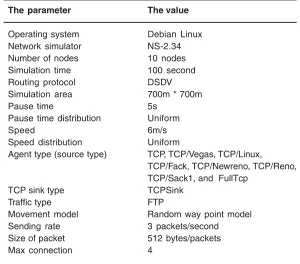
In order to improve the activity of the modified file, the simulation had performed depending on the NS-2 and the mobile ad-hoc network environment that shown in table1.
Simulation Results
CONCLUSION
The old traffic generator file was restricted for little types of traffic that studied in many researches before this paper. The modified file can generate many new types of traffic between source
and destination nodes efficiently to be used in the simulation of the network that depend on the NS-2. This code can be used by any researcher that depends on the NS-2 to study the behaviour of these types of TCP as sender with many types as receiver.
Table 1: Mobile ad-hoc network environment
The parameter The value
Operating system Debian Linux
Network simulator NS-2.34
Number of nodes 10 nodes
Simulation time 100 second
Routing protocol DSDV
Simulation area 700m * 700m
Pause time 5s
Pause time distribution Uniform
Speed 6m/s
Speed distribution Uniform
Agent type (source type) TCP, TCP/Vegas, TCP/Linux,
TCP/Fack, TCP/Newreno, TCP/Reno, TCP/Sack1, and FullTcp
TCP sink type TCPSink
Traffic type FTP
Movement model Random way point model
Sending rate 3 packets/second
Size of packet 512 bytes/packets
Max connection 4
REFERENCES
1. Jyotsna Rathee and A. K. Ver ma,
“Simulation, Analysis and Comparison of DSDV Protocol in MANETS”, MSc. thesis, Computer Science and Engineering Department, Thapar University (2009). 2. FJ Arbona Bernat and P.F.A. Van Mieghem,
“Simulation of Ant Routing Protocol for Ad-hoc networks in NS-2”, MSc. thesis, Delft university of technology, Faculty of Electrical Engineering, Mathematics and Computer Science Network Architectures and Services Group (2006).
3. Teerawat Issariyakul and Ekram Hossain, “Introduction to Network Simulator NS2”,
springer, ISBN: 978-0-387-71759-3 (2009).
4. P.Periyasamy and E.Kar thikeyan,
“Performance evaluation of aomdv protocol based on various scenario and traffic patterns”, International Journal of Computer Science, Engineering and Applications (IJCSEA) 16): (2011).
5. YAMSANI RAVIKUMAR and SARATH
KUMAR CHITTAMURU, “A Case Study on MANET Routing Protocols Performance over TCP and HTTP”, MSc. thesis, School of Engineering blekinge Institute of Technology, Sweden (2010).
Manual (formerly ns Notes and Documentation)”, 2010.
7. Saad Talib Hasson, Ahmed Jawad Kadhim, Zainab Saad Talib, “Enhancing the NS-2