INTRODUCTION
The term Web 2.0 is a read/write web often associated with web applications that facilitate participatory information sharing, interoperability, user-centered design and collaboration on the World Wide Web. A Web 2.0 site allows users to interact and collaborate with each other in a social media dialogue as creators (prosumers) of user-generated content in a virtual
COMPUTER SCIENCE & TECHNOLOGY
www.computerscijournal.org
June 2012, Vol. 5, No. (1): Pgs. 87-92
An International Open Free Access, Peer Reviewed Research Journal Published By: Oriental Scientific Publishing Co., India.
The Effect of Web 2.0 on the Teaching and Learning
Processes in a Developing Country’s Universities
B. OKIKE
Department of Computer Science, University of Abuja, Nigeria. E-mail: [email protected], [email protected]
(Received: February 12, 2012; Accepted: June 04, 2012)
ABSTRACT
Teaching and learning in all aspects of education have taken a dramatic change all over the world today due to the advent of the Internet. Before the Internet came into existence, teaching and learning have always been carried out within classroom environments. But with the Internet, teaching and learning may take place outside the classroom environments. The Internet has made e-learning a reality because students may receive their lectures through the Internet irrespective of geographic locations. Ideally, distance learning programmes are meant for people who are engaged in some full-time jobs. These people may not easily leave their jobs for full-time programmes. Often times, distance learning programmes are online in nature, hence they are usually referred to e-learning. E-learning is one directional in nature and is usually teacher-centered. In other words, the learners are passively involved in the learning process, and as such cannot make contributions to the learning process in which they are directly involved. The learning process in web 2.0 is participatory, hence both the teacher and the learner may engage in dialogue through a web application. This makes the learning process an active one. This study will examine the effect of web 2.0 on the teaching and learning processes of a developing country such as Nigeria’s universities with emphasis on University of Abuja. In the study, questionnaires are to be randomly distributed to teachers and students of University of Abuja to ascertain the effect of web 2.0 in the teaching and learning processes within the university.Data to be collected will be analyzed in other to find the effect of web 2.0 in the teaching and learning processes in the university.
Keywords: web 2.0, Teaching and Learning, Developing Country, Nigeria, University of Abuja.
The Web we know now, which loads into a browser window in essentially static screenfulls, is only an embryo of the Web to come. The first glimmerings of Web 2.0 are beginning to appear, and we are just starting to see how that embryo might develop. The Web will be understood not as screenfulls of text and graphics but as a transport mechanism, the ether through which interactivity happens2.
Web 2.0 focuses on social networking and information sharing among various users. Social networking involves the contact amongst website users. This contact takes place through commenting (leaving comments at the end of a blog or article), sharing (swapping or sharing favorite links, articles, pictures or videos), message boards (traditional forums for discussions), and other such practices.
Web 2.0 and Information Sharing
In 1997 Ballantyne observed that a growing range of web 2.0 applications is revolutionizing how information can be accessed and shared. The experience of Euforic shows how these tools can be applied to increase content on a website while still keeping costs low. Article Sharing is the act of posting articles or blog postings for public viewing. This creates a community-based news site, where articles that are of interest are “voted up” (or down, or removed entirely). In essence, the community is in charge, and collectively decides what is of interest to them.
Sharing information has always been a huge part of Web 2.0 - in fact, several sites have dedicated themselves to the topic. The most important Web 2.0 information sharing site is arguably Yahoo Answers, a site where people can select a broad category and ask any question they want to know about - whether it is about fixing an engine part or getting pregnancy advice. Respondents can immediately answer to the best of their ability, and get “points” for participating. Following close to this methodology is Wis.dm, another social information question & answer sharing Web 2.0 service4.
Web 2.0 as a Blogging Tool
Not necessarily replacing personal
homepages and bulletin boards, blogs (a condensation of the term “web logs”) have become popular and influential manifestations of Web 2.0. Blogs bypassthe need for authors to be able to program in hypertext markup language (HTML) and thus allow easy self-publishing of information, links or opinion on any subject. A blog is an informal online journal, usually reflecting the author’s personal thoughts. Generally published in reverse chronological order with the latest entry at the top, blogs can compensate for search engine inadequacies in publication date searching. A blog can be useful for those who wish to informally follow the progress of a topic more quickly than is possible within the rigorous expert review model of evidence gathering required by academic journals5.
Blogging is an essential part of web 2.0 and is the practice of maintaining one’s own journal or article site for public viewing purposes. Blogging began as a way to create a private or public journal or diary, that friends or the entire public could access. It later evolved into a full-fledged article site that was used to share opinions or create subculture-based communities. Today, it has evolved once again into a money-making and promotional effort.
Deployment of Web 2.0 in the Teaching and Learning Process
Hargadon believed that the read/write Web, or what is referred to as Web 2.0, would culturally, socially, intellectually, and politically have a greater impact than the advent of the printing press. He went further to say that we cannot even begin to imagine the changes that are going to take place as the two-way nature of the Internet begins to flower, and that even those of us who have spent time imagining this future will be astounded by what happens. By this, he meant that web 2.0 would be a great tool for teaching and learning processes6.
world, in which a variety of tributaries are starting tocome together: demographics, technology, accountability, and thegeneral direction of education. But so far, instead of transforming thetraditional classroom with online, we have merely transposed itto what is now the traditional course management system (CMS) orcollaboration and learning environment (CLE).In this system of teaching and learning method, both the teacher and the learner can engage in active and interactive teaching and learning processes7.
Web 2.0 technologies and open education learning design, employed by imaginative teachers, create a landscape of learning-collaborative, problem-based, experiential-that is closer to our nature than the ranked, single voice classrooms so abundant in recent times. The single voice classroom developed because of the lack of other ways to help students learn. We no longer lack the resources and tools to develop learning designs that fit how people learn. For decades, a minority among educators has advocated alternate forms of teaching and learning. The umbrella term for these alternate forms is open education8.
Research Methodology
This research was carried out to find out the effect of web 2.0 in the teaching and learning processes in Nigeria. A total of 200 questionnaires were administered to the staff and students of University of Abuja, those who have one thing or another to do with web 2.0. 183 questionnaires were returned, representing 92% response rate.Out of the returned questionnaires, 13 were not valid due to various response errors. Only 170 questionnaires are valid and are used for the analysis. This represents 85% of the questionnaires initially administered. The survey instrument can be found in the appendix.
Research Statements
The study seeks to obtain the effect of web 2.0 on the teaching and learning processes in developing nation such as Nigeria. Each statement in the research has five options that a respondent is to choose from. The options are: Strongly Agree (SA), Agree (A), Neutral (N),
Disagree (D) and Strongly Disagree (SD). For the purpose of analysis, two statement responses (4 &7) in section B of the questionnaire would be used to find the effect of web 2.0 in the teaching and learning processes in Nigeria. The statements are:
Process of teaching and learning have been made easier with web 2.0
Web 2.0 has not in any way helped to improve on my teaching and leaning.
Data Presentation
Table 1. Data collected from section A part of the questionnaires administered
S. No. No of Respondents
1. Sex
Male 103
Female 67
2. Designation
Teacher 69
Student 101
3. Age
Below 16 0
16-20 6
21-25 94
26-30 33
Above 30 37
4. Faculty
Arts 12
Management Sc. 26
Social Sc. 66
Science 56
Others Specify 10
5. Use of Web 2.0 Application
Upload 0
Download 98
Both upload and download 63
Others specify 9
6. My Favorite Web 2.0 Application
Wikis 33
Blog 15
Online Dictionary 38
Yahoo Answers 79
In a bid to find what effect web 2.0 has on the teaching and learning processes in Nigeria, questionnaires were administered randomly to those directly involved in teaching and learning.
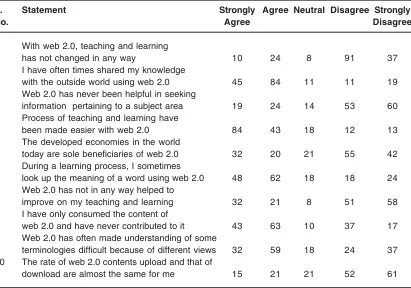
In table 2 below, two statementsand data associated with them will be extracted from the table and will be used for the analysis of data that were collected during the survey. The statements are 4 and 7 in the table above.
Table 2. Data collected from section B of the distributed questionnaires.
S. Statement Strongly Agree Neutral Disagree Strongly
No. Agree Disagree
1 With web 2.0, teaching and learning
has not changed in any way 10 24 8 91 37
2 I have often times shared my knowledge
with the outside world using web 2.0 45 84 11 11 19
3 Web 2.0 has never been helpful in seeking
information pertaining to a subject area 19 24 14 53 60
4 Process of teaching and learning have
been made easier with web 2.0 84 43 18 12 13
5 The developed economies in the world
today are sole beneficiaries of web 2.0 32 20 21 55 42
6 During a learning process, I sometimes
look up the meaning of a word using web 2.0 48 62 18 18 24
7 Web 2.0 has not in any way helped to
improve on my teaching and learning 32 21 8 51 58
8 I have only consumed the content of
web 2.0 and have never contributed to it 43 63 10 37 17
9 Web 2.0 has often made understanding of some
terminologies difficult because of different views 32 59 18 24 37
10 The rate of web 2.0 contents upload and that of
download are almost the same for me 15 21 21 52 61
Results Presentation and Analysis
To carry out the analysis, the simple percentage method was applied. Firstly, considering the statement” Process of teaching and learning have been made easier with web 2.0", table 3 below shows the result.
Table 3: Process of teaching and learning have been made easier with web 2.0 StronglyAgree Agree Neutral Disagree StronglyDisagree
Respondents 84 43 18 12 13
Percentage (%) 49.41 25.29 10.59 7.06 7.65
that respondents believe that web 2.0 has made teaching and learning processes easier.
Similarly, considering the statement that the “Web 2.0 has not in any way helped to improve on teaching and learning”, table 4 below shows the data collected based on that statement.
Table 4: Web 2.0 has not in any way helped to improve on teaching and learning StronglyAgree Agree Neutral Disagree StronglyDisagree
Respondents 32 21 8 51 58
Percentage (%) 18.82 12.35 4.71 30.00 34.12
Again, looking at the above table, 18.82% of the respondents strongly agreed that the Web 2.0 has not in any way helped to improve on their teaching and learning, 30% disagreed, while 34.12% strongly disagreed to that statement, implying that Web 2.0 has helped to improve on their teaching and learning.
Recommendations
With the Internet available for today’s teachers and learners, web 2.0 may be used to improve on the teaching and learning processes and the classroom method of teaching and learning which is common place in Nigeria as a developing nation would give way to interactive teaching and learning methods made possible by web 2.0. Web 2.0 should be adopted as teaching and learning tool in the Nigeria’s educational system.
CONCLUSION
The research data collected show that web 2.0 is a veritable instrument for the teaching and learning processes in Nigeria and as such governments at all levels in Nigeria should formulate policies that would encourage the use of web 2.0 for teaching and learning at least at higher institutions of learning.
1. P. Graham, Web 2.0, http://
www.paulgraham.com, 2005.
2. D. DiNucci, Fragmented Future, http:// www.tothepoint.com, 1999.
3. P. G. Ballantyne, Europe’s For um on International Cooperation (EUFORIC): A cooperative approach to web-based information resources, http:// ictupdate.cta.int/en/Feature-Articles/ Sharing-information/. 1997.
4. Squidoo, Web 2.0 and Information Sharing., http://www.squidoo.com/, 2011.
5. R. McLean, H. Richards, and J. Wardman,
REFERENCES
The effect of Web 2.0 on the future of medical practice and education: Darwikinian evolution or folksonomic revolution?, MJA • Volume 187 Number 3, www.ncbi.nlm.nih.gov/pubmed/, 2007. 6. S. Hargadon, Web 2.0 is the Future of
Education, http://edutechie.com/, 2008. 7. M. Grush, The Future of Web 2.0, http://
campustechnology.com/articles/, 2008. 8. M. S. Kumar and T.Iiyoshi, Opening up
Appendix
Dear Respondent,
This questionnaire is meant for a research work in the Department of Computer Science, University of Abuja, Nigeria. Fill in the correct information. All the information will be treated with utmost confidence and will only be used for the purpose of this research work.
Thanks.
Please fill or tick accordingly.
Section A
1. Sex: A Male [ ] B Female [ ]
2. Designation: A Teacher [ ] B Student [ ]
3. Age: A Below 16 [ ] B 16-20 [ ] C 21-25 [ ] D 26-30 [ ] E Above 30 [ ] 4. Faculty: A Arts [ ] B Management Sc. [ ] C Social Sc. [ ] D Science [ ]
E Others Specify______
5. Use of web 2.0: A upload [ ] B Download [ ] C Both upload and Download [ ] D Others Specify____________
6. My favorite Web 2.0 Application: A Wikis [ ] B Blog [ ] C Online Dictionary [ ] D Yahoo Answers [ ] E Others Specify_____________
Section B
Please, tick the appropriate option
S. Statement Strongly Agree Neutral Disagree Strongly
No. Agree Disagree
1 With web 2.0, teaching and learning has not changed in any way
2 I have often times shared my knowledge with the outside world using web 2.0 3 Web 2.0 has never been helpful in seeking
for information pertaining to a subject area 4 Process of teaching and learning have been
made easier with web 2.0
5 The developed economies in the world today are sole beneficiaries of web 2.0
6 During a learning process, I sometimes look up the meaning of a word using web 2.0
7 Web 2.0 has not in any way helped to improve on my teaching and learning
8 I have only consumed the contents of web 2.0 and have never contributed to it
9 Web 2.0 has often made understanding of some terminologies difficult because of different views 10 The rate of web 2.0 contents upload and that of