Debabrata Sarddar
et al
, International Journal of Computer Science and Mobile Applications,
Vol.3 Issue. 8, August- 2015, pg. 50-61
ISSN: 2321-8363
A New Approach on Optimized Routing
Technique for Handling Multiple Request from
Multiple Devices for Mobile Cloud Computing
Debabrata Sarddar
Assistant Professor, Department of Computer Science & Engineering,
University of Kalyani, Kalyani, India
Email: [email protected]
Enakshmi Nandi
Ph.D. Student, Department of Computer Science & Engineering,
University of Kalyani, Kalyani, India
Email: [email protected]
___________________________________________________________________________
Abstract
Mobile cloud computing (MCC) at its simplest thought of an infrastructure where both the data storage and data processing happen outside of the mobile device. Mobile cloud applications progress the computing power and data storage away from the mobile devices and into powerful and centralized computing platforms placed in clouds, which are then accessed over the wireless connection based on a thin indigenous users. According to the latest study from Juniper Research, the number of mobile cloud computing subscribers is expected to grow briskly in the next five years. MCC influenced consolidated elastic resources of different clouds and network technologies toward unregulated functionality, storage, and mobility to serve a large group of mobile devices anywhere, anytime through the channel of Ethernet or Internet indifferent of heterogeneous environments and platforms based on the pay-as-you-use law [1] .In case of delivering data and information to mobile devices swiftly a critical factor will arise, that is network routing. There are different existing routing methods which include shortest path routing to comfort congestion in mobile network. In this paper authors main objective is to short comings the routing problem and find optimized routing technique to handle multiple request for multiple devices for mobile cloud computing .Here authors used multicast link state routing used source based tree approach for handling multiple request at a time and congestion control algorithm for avoiding congestion at the time of handling multiple request at a time and exchange data smoothly between mobile devices and cloud nodes. Our approach helps to enhancement of data transmission rate in green cloud environment.
Keywords: Mobile Computing, Cloud Computing, Routing Algorithm, Congestion Control Algorithm.
___________________________________________________________________________________________
1.
Introduction
Debabrata Sarddar
et al
, International Journal of Computer Science and Mobile Applications,
Vol.3 Issue. 8, August- 2015, pg. 50-61
ISSN: 2321-8363
servers, and are supplied to mobile devices such as smart phones, portable terminal etc. ( Fig. 1).Thus numerous applications based on mobile cloud computing have been launched and served to clients, such as Goggles ,Gmail, Navigation systems etc for Mobile, Voice Search, and some applications on an Android platform, Mobile Me from Apple, Live Mesh from Microsoft and so on[3] .Mobile cloud Computing specially involves mobile clients to store and access vast data on cloud and maintaining and applications in the cloud scale down the potential for loss of data in case of hardware failure, increasing reliability and availability .
Fig 1: Mobile Cloud Computing
Mobile cloud computing providers have various security services in place like as virus scanning, authentication for mobile clients, malicious code detection etc. Different services from various providers can be integrated quickly through the cloud to fulfil today’s complex client demands. In our paper we demonstrate optimized routing algorithm for finding optimized network route for effective communication and managing many request from different users from different mobile devices at a time by avoiding network congestion with the help of network congestion algorithm.
2.
Related works
As an inheritance and evolution of cloud computing and mobile computing, mobile cloud computing has been a mastermind phase where mobile cloud computing can be thought of as infrastructure where data and processing could occurred outside of the mobile device, activating new types of applications such as context-aware mobile social networks. Mobile Cloud Computing or MCC can be simply divided into mobile computing and cloud computing. The mobile devices can be laptops, PDA, smart phones etc, which connect with a base station or a
Servers and VMs
Internet Cloud
Laptop PC Smartphone
Debabrata Sarddar
et al
, International Journal of Computer Science and Mobile Applications,
Vol.3 Issue. 8, August- 2015, pg. 50-61
ISSN: 2321-8363
a web browser or desktop application. The management component of cloud then allotted resources to the request to establish connection, while the controlling and calculating functions of mobile cloud computing are developed to assured the QoS still the connection is finished. Due to improvement of mobile cloud computing different smart phones those added numerous sensing modules like navigation, optics, gravity, orientation, etc, which brings an appropriate and intelligent mobile experience to clients. In 2010, Google CEO Eric Schmidt defined mobile cloud computing in an interview that ‘it is based on cloud computing service development, mobile phones will become increasingly complicated, and evolve to a portable super computer’ [4].2. 1. Principle and challenges of Mobile Cloud Computing
The main objective of mobile cloud computing is to contribute a convenient and fast method for clients to access and receive data from the cloud, such convenient and rapid method means accessing cloud computing resources efficiently by using mobile devices. The main challenge of mobile cloud computing arises from the characters of mobile devices and wireless networks, as well as their own stipulation and inhabitation, and such challenge makes application designing, programming and deploying on mobile and distributed devices more intricate than on the fixed cloud devices [5]. In mobile cloud computing environment, the hindrance of mobile devices, quality of wireless communication, types of application, and backing from cloud computing to mobile are all important factors that influence determining from cloud computing.
Up until now the industrial and scientific communities have been doing different researches for acknowledging to the above challenges. Some typical research projects and cases are presented in the following.
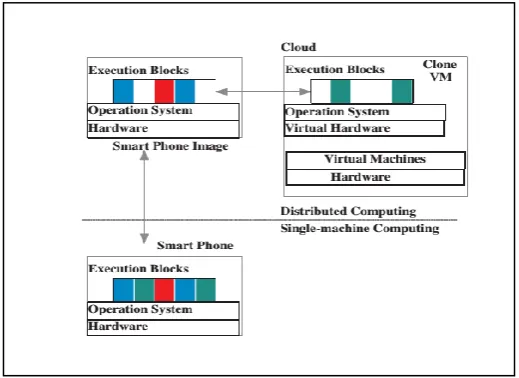
1) Augmented Execution: Clone Cloud is launched by B. Chun [6] in 2011. The basic idea the use of virtual machine migration technology to offload execution blocks of applications from mobile devices to Clone Cloud aimlessly and partly, in order to fully or semi-automatically prolong or alter the smart phone-based execution to a distributed environment. In a Clone Cloud system (Fig. 2), ‘Clone’ is a mirror image of a Smartphone running on a virtual machine. By contrast with smart phones, such a ’clone’ has more hardware, software, network, energy resources in a virtual machine which provides more suitable environment to process complicated tasks. A major advantage of the Clone Cloud is enhanced smart phones performance.
Fig 2.Clone Cloud System infrastructure
Debabrata Sarddar
et al
, International Journal of Computer Science and Mobile Applications,
Vol.3 Issue. 8, August- 2015, pg. 50-61
ISSN: 2321-8363
deliver various layers of application in smart phones and cloud, accordingly, by modelling applications as a consumption graph, and finding the optimal modules. The result shows that such platform increases the performance of applications in cloud computing effectively. Alfred O system resides of three bundles (the interface encapsulation on Java classes and services) .S. Jeong [8] from Samsung develops a novel elastic application model which provides an aimless and transparent use of cloud to widen and solve the hindrance of mobile devices. This model enables a partition to a single application into multiple components called Weblet, and dynamically deploys these Weblets in execution consonance with a configuration strategy at cloud and mobile terminals. Even some aerial is generated in the communication among Weblets, between the Internet and Weblets, and the developing Weblets during the model processing. To resolve the above extra aerial and optimise the cost of elastic applications, researchers presented a cost model in their framework, which collects sensor data (such as battery life, loads of devices and cloud, network conditions etc.)
In 2009 Shen and Tucker in 2011 Cavdar focused on their research work on optical network for reducing Co2 emission rate. Ricciardi et al.2011 demonstrated an idea on reducing the Co2 emission purpose through formulate and compared of energy-aware static RWA strategies for WDM networks [9] . Now a day’s research process is going on how to efficiently involve renewable energies in telecom network framework.
3.
Proposed Method
In this paper we mainly want to directed proper route selection at mobile network within very short time and proposed multicast link state routing used source based tree approach for handling multiple device request at a time and applied network congestion control algorithm for avoiding network congestion at the time of perform multiple activities Here we find the cost of path and channel capacity. We also followed a existing technique on our work that is the selection of base station on the basis of weight factor.
3.1.
Multicast link State Routing used source based tree approach
Debabrata Sarddar
et al
, International Journal of Computer Science and Mobile Applications,
Vol.3 Issue. 8, August- 2015, pg. 50-61
ISSN: 2321-8363
Fig: 3. Shows Multicast source based tree approach
In Multicast link state source based tree approaches the routing table is the translation of shortest path tree. This approach is the direct extension of unicast routing, where router creates the shortest path tree by using Dijkstra’s algorithm. Here each node requires revising the explanation of state. A node notifies each group which has any ardent member on the link. Here the meaning of state is "what groups are active on this link"[10]. The notification about the group arises from IGMP (Internet Group Management protocol). Each router running IGMP ask earnestly for the hosts on the link for searching the membership status. When a router accepts all these LSPs, it generates n (n is the number of groups) topologies, from which n shortest path trees are made by using Dijkstra's
algorithm.
So each router has a routing table that defines as many shortest path trees as there are groups. Multicast Link Based routing (see fig.4.for link state) used source based tree when a router accepts a packet with a multicast destination address [10], it runs the Dijkstra algorithm to estimate the shortest path tree for that group.
The result can be cached when additional packets needs for that destination.Debabrata Sarddar
et al
, International Journal of Computer Science and Mobile Applications,
Vol.3 Issue. 8, August- 2015, pg. 50-61
ISSN: 2321-8363
3.2.
Weighted Fair Queuing Method
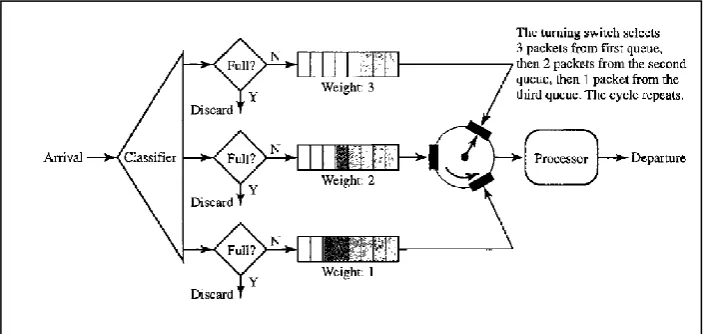
This method is used for improving quality of services or QoS . Here all packets are allocated to various classes and admitted to different queues. The queues are weighted based on the priority of the queues; higher priority means a higher weight. The system processes packets in each queue in a round-robin manner with the number of packets choose from each queue on the basis of corresponding weight .As for example, if the weights are 3, 2, and 1, three packets are transferred from the first queue, two from the second queue, and one from the third queue. If the system does not apply priority on the classes, all weights can be equal and we have got fair queuing
with
priority.
Figure 5 shows the method along with three classes [10].Fig.5. Weighted Fair Queuing Method
3.3.
Congestion Control algorithm
When one or more routers of an area become overloaded then congestion occurred. Due to busty traffic, slow processors, less bandwidth, insufficient memory and routers, those are accepting packets quickly than they can forward them, congestion occurred. Congestion Control is related with efficiently using a network at high load. Several techniques can be employed for congestion control. In our approach we consider load shedding method for congestion control purpose.
Debabrata Sarddar
et al
, International Journal of Computer Science and Mobile Applications,
Vol.3 Issue. 8, August- 2015, pg. 50-61
ISSN: 2321-8363
Fig: 6.Load Shedding (Congestion Control Method)
Once the interface input queue is completed and still packets appear, the device has to discard packets that are called load shedding. Load Shedding exist on the basis of different policies, by which it is decided that which packet will be discarded. Wine policy, milk policy, random early discard policy are those important policies [11]
3.4.
Detail discussion about our method
We assume that mobile device within an area consider as an intersection of two base stations. At first it is required to detect the particular base station to which the mobile device needs to connect. For that purpose we have detected two network factors comprising utility factor and signal strength for a given base station in that particular area. A base station that has a larger weight factor value (W1) will be selected as the home base station according to existing paper “A novel approach on weight based optimized routing for mobile cloud computing” by Debabrata Sarddar , Rajesh Bose and Sudipta Sahana. The default base station will be assumed to be as the home base station when a mobile device is not in any intersection.
In our proposed model, each base station would hold a small device named connector. The connector would communicate with Mobile Switching Centre to assess and searching different links for transmission between source and resource manager (RM) (Sarddar et al. 2014. Connector connects with mobile switching centre. The Resource Manager or RM acts as a central database collector for all cloud nodes registered with it. It is an important duty for periodically updating the routing table. RM performs to deliver message from mobile device to appropriate resource. Using the proposed method, the network congestion will decrease and get the optimized route for attending different request at a time very swiftly and improve the quality of service with maintaining time saving features and energy consumption with less delay and throughput.
3.4.1. Calculate W1 weighted value
A mobile device is permit to compute signal strength of stations that it can arrive for a particular location.W1 weight factor value measures the function of utility and signal strength of a base station.
Throughput = Utility of base station,
Utility = So, Weight factor value W1 is
W1
=
[
a, b weight factor value, where a>b]Debabrata Sarddar
et al
, International Journal of Computer Science and Mobile Applications,
Vol.3 Issue. 8, August- 2015, pg. 50-61
ISSN: 2321-8363
3.5.
Proposed Model Algorithm
Step 1: Mobile device start finding its own location.
Step 2: If it discover its location that is in the interaction of two base stations W1 is called at that time.
Step3: Otherwise the only base station consider as home base station.
Step 4: Mobile devices of different location transmit their connect request to base station.
Step 5: The connector of that base station sends different route request to mobile switching centre.
Step 6: Mobile switching centre or MSC responds with detail information of all possible routes with leading up resource manager or RM
Step7: Mobile switching centre follows Multicast link State Routing used source based tree routing approach for responding different route request generated by multiple devices and finding the optimized route link for multiple devices.
Step 8: After finding optimized route call upon by connector computation has been done.
Step9: Then base station supply the information about optimized route calculation to different mobile devices.
Step 10: Mobile devices then sends data packets to RM through their respective optimized route.
Step 11: For avoiding congestion at the time of data packets transfer from different route at a time, RM follows congestion control algorithm, i.e. Load shedding.
Step 12: RM maintain a routing table. It checks the node address of destination location and starts consulting its routing table.
Step13: For improve the quality of services at the time of communication RM support weighted Fair Queuing Method before packets forward to final destination.
Step 14: After forwarding packets RM give an acknowledgement to all mobile devices.
Step 15: When all communication is over links are terminated.
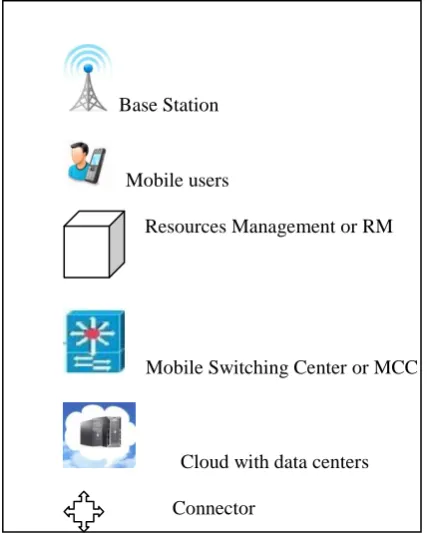
The figure7.shows structure of our model has presented below.
1A
1B
1C
1D
2A
2D3A
3D
Debabrata Sarddar
et al
, International Journal of Computer Science and Mobile Applications,
Vol.3 Issue. 8, August- 2015, pg. 50-61
ISSN: 2321-8363
Base Station
Mobile users
Resources Management or RM
Mobile Switching Center or MCC
Cloud with data centers
Connector
Fig 7.Shows the architecture of our proposed model
MCC follows malticaste link state sourced based tree approach routing algorithm
RM follows Load shedding algorithm for congestion control and weighted fair queuing
for improving Quality Of Services .1A, 1B, 1C, 1D these are the different mobile device users request to base station.
4.
Result and discussion
Throughput =
Queuing delay
=
Queue depth (bits) / link data rate (bit/sec)If path is not congested then there is no queuing depth.
Debabrata Sarddar
et al
, International Journal of Computer Science and Mobile Applications,
Vol.3 Issue. 8, August- 2015, pg. 50-61
ISSN: 2321-8363
our proposed approach consumes less queuing delay time value and enhanced throughput value than a standard routing protocol.Fig.8: Comparison between existing network and proposed network
Fig.9: Comparison of throughput value between existing network and proposed network
05 10 15 20 25 30 35 40
0 20 40 60 80 100
Ti
m
e
Network Overhead
Comparison between existing network and
proposed network
Existing method
Proposed method
0 20 40 60 80 100 120
1 2 3 4
Comparison of throughput value between existing
and proposed method
Proposed method
Debabrata Sarddar
et al
, International Journal of Computer Science and Mobile Applications,
Vol.3 Issue. 8, August- 2015, pg. 50-61
ISSN: 2321-8363
Fig.10: Comparison of Carbon emission rate between existing network and proposed
network
In next graph our approach shows better energy efficiency rates by avoiding link congestions.
5.
Conclusion
In this paper, we have presented our research based on optimized route selection technique for handling multiple mobile device requests at a time with avoiding congestion and getting good quality services. Here we also compared our approach with existing routing method. Our approach resulted good performance with less time delay and reducing carbon emission rate for achieving pollution free environment.
Through our work, we have presented a design to preclude link congestions to the extent possible and analysis the result we obtained, our research acquire a significant advantage in selecting the appropriate route. With our proposed method, all requests give their respective responses to multiple mobile devices by using optimizes network route at a time and no congestion occurred in that case. So, all possible condition for network congestion and waste of energy brought about by resultant carbon emissions will be scale down properly. Using the routing algorithm explained in this paper, data frames that are gathered can be routed and delivered indignantly from cloud data centres to mobile networks or vice versa and energy efficiency will be maintain properly.
References
[1] https://en.wikipedia.org/wiki/Mobile_cloud_computing
[2] http://www.ibm.com/developerworks/cloud/library/cl-mobilecloudcomputing/
[3] Qi, H., & Gani, A. (2012, May). Research on mobile cloud computing: Review, trend and perspectives. In Digital Information and Communication Technology and its Applications (DICTAP), 2012 Second International Conference on (pp. 195-202). ieee.
[4] Kottari, V., Kamath, V., Saldanha, L. P., & Mohan, C. (2013). A Survey on Mobile Cloud Computing: Concept, Applications and Challenges. Journal of Advanced and Innovative Research, 2(3), 487-492.
[5] Chetan, S., Kumar, G., Dinesh, K., Mathew, K., & Abhimanyu, M. A. (2010). Cloud computing for mobile world. available at chetan. ueuo. com.
0 5 10 15 20 25 30 35 40
1 4 7 10 13 16
R ate o f Car b o n E m issi o n
Degree of Network Overhead
Comparison of Carbon emission rate between existing
method and proposed method
Existing Method
Debabrata Sarddar
et al
, International Journal of Computer Science and Mobile Applications,
Vol.3 Issue. 8, August- 2015, pg. 50-61
ISSN: 2321-8363
[6] Chun, Byung-Gon, Sunghwan Ihm, Petros Maniatis, Mayur Naik, and Ashwin Patti. "Clonecloud: elastic execution between mobile device and cloud." In Proceedings of the sixth conference on Computer systems, pp. 301-314. ACM, 2011. [7] Giurgiu, I., Riva, O., Juric, D., Krivulev, I., & Alonso, G. (2009). Calling the cloud: enabling mobile phones as interfaces to cloud applications. In Middleware 2009 (pp. 83-102). Springer Berlin Heidelberg.[8] Zhang, Xinwen, Sangoh Jeong, Anugeetha Kunjithapatham, and Simon Gibbs. "Towards an elastic application model for augmenting computing capabilities of mobile platforms." In Mobile wireless middleware, operating systems, and applications, pp. 161-174. Springer Berlin Heidelberg, 2010.
[9] Sarddar, D., Bose, R., & Sahana, S. (2015). A novel approach on weight based optimized routing for mobile cloud computing. Brazilian Journal of Science and Technology, 2(1), 1-12.
[10] Forouzan, A. B. (2006). Data Communications & Networking (sie). Tata McGraw-Hill Education.
[11] data networking concepts ,overview of important concepts and terms used in data networking protocols and systems ,peter r. Egliindigoo.com
A Brief Author Biography
Debabrata Sarddar is an Assistant Professor at the Department of Computer Science and Engineering, University of Kalyani, Kalyani, Nadia, West Bengal, India. He completed his PhD from Jadavpur University. He did his M. Tech in Computer Science & Engineering from DAVV, Indore in 2006, and his B.E in Computer Science & Engineering from NIT, Durgapur in 2001. He has published more than 75 research papers in different journals and conferences. His research interests include Wireless and Mobile Systems and WSN, and Cloud computing.