http://mojem.um.edu.my 1
School of Hospitality, Tourism and Culinary Arts
Taylor’s University, Malaysia
Corresponding Author: Taylor’s University, Malaysia Email: [email protected]
ABSTRACT
Malaysia has experienced a fast growth in organizing international festivals and business events, especially mega events. Internationalization, recognition and importance of the events as an industry are currently paving the way for a proper events management education. It is generally accepted that event management education combines disciplines that come under the umbrella of business, communication or hospitality schools. Therefore its norms, standards and status as a discipline have yet to be fully established and effectiveness of current curricula in preparing students is yet to be assessed. The current study aims at analyzing event management education in Malaysia, highlighting the gap between event management education and industry needs, especially with regard to the standards for education in events management. This research involves comparing the views of industry professionals and events program education providers to determine the discrepancy between the respective views. The methods of analysis first consist of content analysis of the existing degrees to determine the distance in knowledge transfer. Second, a human resource deployment survey was conducted with graduates to identify gaps between their classroom knowledge and their workplace experiences. Facts suggest that a gap exists between the current curricula of the emerging voice from the Malaysian events management and the needs of the events industry as a tool for tourism growth. The results outline how the tourism industry can participate in acknowledging the importance of events management education in developing qualified professionals needed for the industry both locally and abroad.
Keywords: Event Management, Education, Curriculum Development, Malaysia
JANUARY 2015, VOLUME 3, ISSUE 1, 1 - 17 E-ISSN NO: 2289 – 4489
EVENT MANAGEMENT EDUCATION AND EVENT INDUSTRY: A CASE OF MALAYSIA
http://mojem.um.edu.my 2 INTRODUCTION
Globalization of business and leisure events has resulted in the standardization of activities; professionalization of event management clarification is available since 2013 (ISO, 2012). Corporate events are major communication tools for visibility of any company. Easy communication and information access through technology have created tools to compare prices, products, and processes. The economic and social values of events for destinations, venues and company branding are today being recognized. With these developments, the management of events and the connected activities are increasingly perceived as a demanding profession with requirements and professional codes that are more standardized (Allen, O’Toole, McDonnell, & Harris, 2011).
The term event management is frequently used with a variety of meanings. For the clarity of this paper, the larger definition that encompasses issues related to “temporary-based themed gatherings” will be used. Often, the definition of event management is restricted to the operational management of an event. Recognizing the growing importance of event management, academia has now created tertiary education in this field. However, the curricula of such academic programs are still evolving. Furthermore, recent technological changes have deeply impacted both the social needs and social practice of events. In Malaysia, the event management field has been studied within limited parameters, despite being an important contributor to the economy (Simpson, 2005). This is despite the fact that event management education through its various academic programs from private and public institutions, is slowly being shaped. In western countries, numerous studies have covered the recent developments, notably in Australia and Scandinavia (Harris & Jago, 1999; Slaughter, Reid, & Arcodia, 2003). The events industry in Malaysia since the mid-nineties has become a phenomenon of importance. Business events have grown rapidly in the context of Malaysia.
http://mojem.um.edu.my 3 an event to be planned, articulated, prepared, executed, controlled and assessed involving constraints of time, place, budget, quality, people, and other resources to achieve objectives. Event management education is the intellectual and practical training allowing students to develop skills and abilities encompassing an operational knowledge of the field.
This paper looks at the current academic offerings and the perceptions of event management professionals in Malaysia. First it assesses the education offerings. Secondly, it identifies gaps between education and the industry from the perspective of professional needs and expectations.
Events Industry in Malaysia
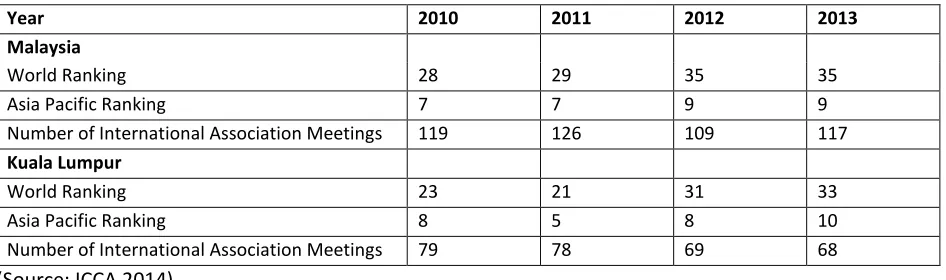
The Malaysia Convention and Exhibition Bureau (MyCEB) is the government agency (under the Ministry of Tourism, Malaysia) responsible for coordination among various MICE organizations. MyCEB is working hand in hand with the private sector whose business events activities are directed to attract foreign organizers and participants to stage their organization activities in Malaysia in the future. The Tourism National Key Economic Areas (NKEA) specifically targets the business events industry to contribute RM 3.9 billion in incremental Gross National Income (GNI) and 16,700 jobs to the nation by 2020. In order to achieve these business events economic targets, recently the government through MyCEB has allotted RM 50 million funding for the business tourism sector of which RM 25 million will be allocated for a subvention program. This program focuses on supporting bids for every targeted international business events which offers a high economic value to the nation. This is also in support to maintain or if not improve its rank with International Congress and Convention Association (ICCA). For instance in 2013 Malaysia was placed 35th worldwide and 9th in Asia Pacific and Kuala Lumpur was placed 31st worldwide and 8th in Asia Pacific as one of the top choices for MICE-related activities (Table 1).
Table 1
ICCA Ranking 2010-2013
Year 2010 2011 2012 2013
Malaysia
World Ranking 28 29 35 35
Asia Pacific Ranking 7 7 9 9
Number of International Association Meetings 119 126 109 117 Kuala Lumpur
World Ranking 23 21 31 33
Asia Pacific Ranking 8 5 8 10
Number of International Association Meetings 79 78 69 68
http://mojem.um.edu.my 4 The support from MyCEB encourages the business events industry to bring the best of Malaysia to foreign business tourists. According to MyCEB (2013), positive (+) growth regarding international business tourism visitors’ arrival to Malaysia shows a promising future to business events industry.
Table 2
International Business Tourism Visitors Arrival to Malaysia 2011-2012
2011 2011 2012
International Business Tourism Visitors 1,278,014 1,285,145 1,326,734
Growth Rate +1% +3.2%
(Source: MyCEB ,2013)
According to Hussain and Ragavan (2013), an international business tourist spends an average amount of US$ 3,700 for his or her trip and has 3-5 days an average length of stay. Business tourists attending MICE-related events in Malaysia have higher spending thus generate more income for the domestic economy of Malaysia.
Event management is associated to tourism because of the volume of events it can generate and bring numbers of international business tourists to a destination. Therefore event tourism can be introduced by the function of the event: business (e.g., conferences, trade fairs), cultural events (e.g., festivals, exhibitions) and leisure events (e.g., F1 racing, concerts). An event like the Borneo Rainforest Festival in Kuching, for example, contributes to the development of destination branding and to a broader extension to regional development. A destination brand can be thought of as the impression or feeling associated with a place. Events are an opportunity to (re)-shape a brand (Allen et al., 2011). It appears that statistics and choice of categorization for event management can be redefined under criteria allowing a sharper insight into the event industry components. And they also contribute to refining the understanding of the profession and the organization of curriculum to teach it. Generally, education providers will choose a more structured approach with categories based on the type of event, and the operational skills to be learned (e.g., Fairs & exhibitions, conferences, hallmark events, meetings and banqueting). At diploma level students pursuing events management studies need to acquire more practical skills; at undergraduate level students require more management skills and at postgraduate level students must master leadership skills. However, this study concentrates only up to management level.
Approach of Event Management Education
http://mojem.um.edu.my 5 learn the rudiments of the job only at the stage of entering the work force. However, it is argued that without a solid foundation at the academic stage, “professional” status is suspect and subject to degradation by the actions of untrained and inexperienced practitioners. Such practitioners usually lack awareness of the scope of knowledge for a qualified profession. More importantly, many may lack the legal and ethical responsibilities associated with such endeavors. Indeed, like all other service professions, the need for proper training and skills is crucial. Event management has becomes a mature industry, that is ready to become a more professional and educated industry (Arcodia & Reid, 2003).
In any case, the growth and internationalization of the event industry has generated buzz in academia. Event management and its impact is the most recurrent area of focus by academics. Much of this is due to the career orientation of the academic programs and the economic and commercial interests driving event creation (Getz, 2002). Today, increasing effort has been placed on classifying and categorizing event management into areas, thereby shaping a theoretical structure. This includes developments in taxonomy and discussions on the perspectives of understanding that are quintessential to emerging fields. It also contributes to the expansion of the interpretation and vision of events from the trivial to the unique. Furthermore, epistemological debate on event management has shed light on the foundation and recognition of a new field. This knowledge is essential for society based information and knowledge.
Once a body of knowledge has developed in this field, the scientific protocols and investigations of the event management field can then be undertaken (Silvers, Bowdin, O’Toole, & Nelson, 2006). With new models and frameworks established, academic research and institutions will be able to diversify and sharpen the event management education curriculum. An example where this was undertaken at tertiary level was the research conducted to test student participation in projects in various contexts and countries having different levels of the event management industry (Landey, 2004; McDonald & McDonald, 2000; Robinson, Barron & Solnet, 2008). A model combined with humanistic methodology of teaching and experiential education was studied and applied to an event management class. The learning objectives of the teaching combination were the ability to plan and manage an event. It involved both operational knowledge but also general knowledge to develop a broader understanding of the context, objectives and impacts of an event. Creating a festival gave students opportunities to learn about the multidisciplinary processes pertaining to an event.
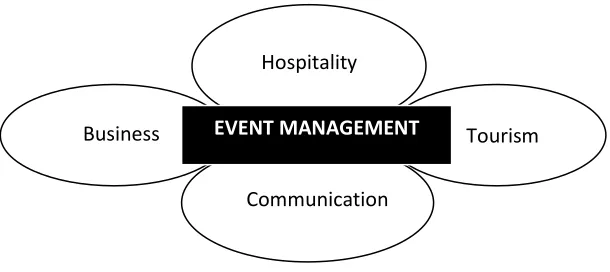
http://mojem.um.edu.my 6 concern for policy makers. However, the responsibility for developing the skills associated for communicating the events has traditionally been the responsibility of the communications discipline.
Figure 1. Event management as a multidisciplinary field
Slaughter et al. (2003) identified five key knowledge areas in Finland’s event management education system. The study encompassed an integrated event management program covering the areas of legal/financial, management, public relations/marketing, economic/analytical and ethical/contextual. In short the study stressed on the type of institution and their objectives as well as the educational structure for event management.
This article follows a similar approach. It analyzes the relationship between curriculum design, governmental precognition, education system, but goes further to include graduates’ feedback at a human resources level. This study has its own significance and differs from other studies of event management that review impacts and knowledge transfers from large-scale hallmark events.
Framework for Event Management Education in Malaysia
To attain a full professional status, event management education needs an established body of knowledge with a clear scope of skill competencies necessary for one to be considered qualified to practice. This must be identified, with a reliable system of formal knowledge and diffusion. It also requires a consistent method of skills measurement and transparent and impartial accountability procedures. Only then will event management be legitimate through the warrant of an exclusive jurisdiction based on expert knowledge and experience (Silvers et al., 2006). Malaysia follows international practices in the education sector under the supervision of the Malaysian Qualifications
Agency (MQA). The MQA under the Ministry of Higher Education provides guidelines and requirements for institutions to create channels of education according to their specialization (MQA, 2012). It acts as a regulatory body, for private institutions by setting out guidelines, teaching requirements, and a
Hospitality
Communication
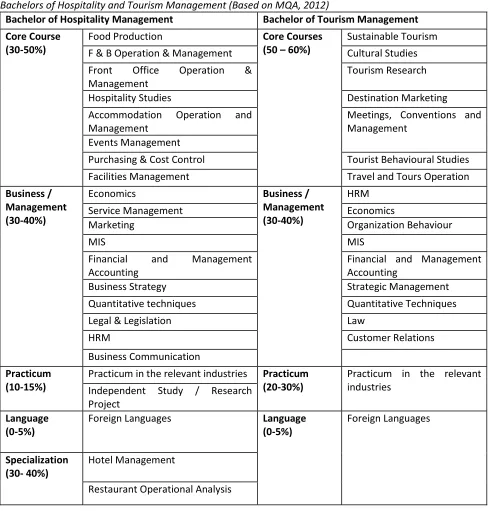
http://mojem.um.edu.my 7 framework for curriculum design and development. Table 3 illustrates the core courses, practicum, language and specialization requirements for the Bachelor of Hospitality and Bachelor of Tourism Management in Malaysia.
Table 3
Bachelors of Hospitality and Tourism Management (Based on MQA, 2012)
Bachelor of Hospitality Management Bachelor of Tourism Management
Core Course (30-50%)
Food Production Core Courses
(50 – 60%)
Sustainable Tourism F & B Operation & Management Cultural Studies Front Office Operation &
Management
Tourism Research
Hospitality Studies Destination Marketing
Accommodation Operation and Management
Meetings, Conventions and Management
Events Management
Purchasing & Cost Control Tourist Behavioural Studies
Facilities Management Travel and Tours Operation
Business / Management (30-40%)
Economics Business /
Management (30-40%)
HRM
Service Management Economics
Marketing Organization Behaviour
MIS MIS
Financial and Management Accounting
Financial and Management Accounting
Business Strategy Strategic Management
Quantitative techniques Quantitative Techniques
Legal & Legislation Law
HRM Customer Relations
Business Communication Practicum
(10-15%)
Practicum in the relevant industries Practicum (20-30%)
Practicum in the relevant industries
Independent Study / Research Project
Language (0-5%)
Foreign Languages Language
(0-5%)
Foreign Languages
Specialization (30- 40%)
Hotel Management
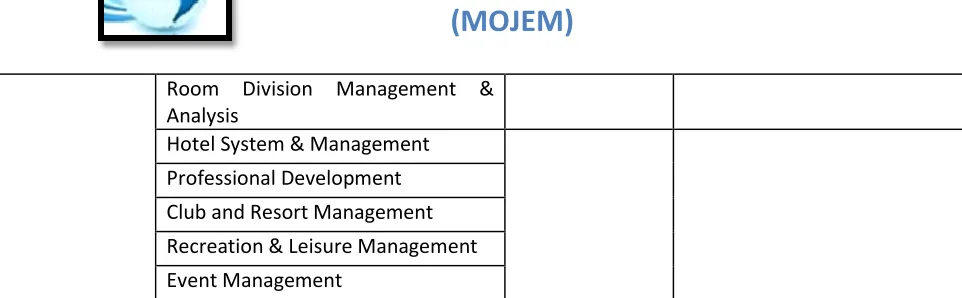
http://mojem.um.edu.my 8 Room Division Management &
Analysis
Hotel System & Management Professional Development Club and Resort Management Recreation & Leisure Management Event Management
Determining the fields of study taught at an educational institution is a process of negotiation between the institution and the regulatory authority (MQA). Colleges usually are the franchisees of foreign programs at the bachelor’s degree level. They need to adjust foreign curricula to pass MQA requirements to obtain accreditation. University colleges are already a step ahead with the ability to develop their own curriculum after having satisfied numerous criteria for their status. Universities have an obligation to design their own curriculum and cannot be franchisees. However, many university colleges engage in student exchange programs and twinning activities to ensure international exposure. Generally, event management has been associated with tourism and incorporated into hospitality or tourism programs. Malaysia offers a different scene from Finland, and most other European countries where an event management independent course is generally absent from the institutions’ curricula (Slaughter et al., 2003).
Due to the interdisciplinary nature of events, event management also appears in the curriculum of communication and business studies. In Malaysia, on the whole, event management education does not come as a separate entity. It appears as a subject, or clusters under tourism studies and hospitality studies and follows the official recommendations (Table 3). An event manager’s job is to oversee and arrange every aspect of an event, including researching, planning, organizing, implementing, controlling, and evaluating an event’s design, activities, and production. MQA inserts event management within the hospitality program. Components of event management, such as MICE are taught as an individual subject within the hospitality program; the components represent less than 10% of the total course. It should be noted, however, that business and management clusters can be shared in the case of an independent program in event management. To obtain the title of event management alone, the core subjects must constitute more than 50% of the total number of subjects. In a similar way, event management courses can also appear also under specialized minor of tourism programs (Table 4).
Table 4
Requirements for Qualifications Denomination and Contents (based on MQA, 2012) Qualifications Denomination
Diploma in: Bachelor of: Breakdown of Subjects
Hospitality (Event Management) Travel (Event Management) Tourism (Event Management) International Tourism
Hospitality (Event Management) Travel (Event Management) Tourism (Event Management) International Tourism
Core 50 %
http://mojem.um.edu.my 9 Management (Event
Management)
Business (Event Management) Communication (Event Management)
Management (Event Management)
Business (Event Management) Communication (Event Management)
Event Management Event Management Core 60%
This situation of integration of event management subjects within tourism courses is in line with the continental European configuration (Slaughter et al., 2003). Nevertheless, the case of Malaysia is the closest to that of the United Kingdom with a greater flexibility in curriculum design and combination of disciplines as shown by the MQA recommendations (Table 4). Although the MQA guidelines do not offer detailed content for an independent diploma or bachelor of event management, the possibility remains to establish such a program. Indeed, some institutions have started to offer a specialization in event management. Therefore the guidelines build a framework for event management education, although the courses gauged necessary to have a sound knowledge and practice of the field of study have yet to be drafted and agreed on.
Event Management Curriculum
Malaysian event management education is quite diverse, most probably because of its relative recent character as a field of teaching. A brief background of the higher education system helps to provide a context for event management education in Malaysia. Both public universities and private higher learning institutions are involved in event management courses. Because of a market-led approach, private colleges are characterized by reaction to trends and anticipation of employment needs. Programs are shaped in by curricula focusing on pragmatic and market oriented skills in preparation for future careers. The anticipation of industry needs, and a pull approach to the student market has resulted in an increased interest for event management education (Xu & Luo, 2007). It started with professional certificate courses introduced in the late 1990s. Since then the offer has expanded fast in higher education to full-time courses. Some colleges offer diplomas and higher diplomas in event management. Recently, a step forward was made with the launch of an independent bachelor’s degree in two institutions. Public universities have developed event management education at two levels. A pragmatic one at diploma level focuses on the fundamentals of running events. At a bachelor’s degree
level, components involve broader issues such as event tourism and destination management. The scope of the program is field-related with an interdisciplinary emphasis (Mohd Khir, 2014).
http://mojem.um.edu.my 10 the advertising, PR and branding because of this general impact of events. Likewise, hospitality institutions will stress on operations and catering. Business schools will offer a strong foundation in management and business. This is similar to the position in the United Kingdom, but differs from that of the rest of Europe. Generally, in Malaysia, event related subjects are found in areas such as tourism, hospitality, business and communication (Table 5). Harris and Jago (1999) in their Australian Universities study highlighted the same patterns, although areas such as sport management or humanities programs are unique.
Table 5
Core Event Management Subjects Generally Offered
List of Core Subjects Hospitality Tourism Communication Business
1 Introduction to MICE 1 1
2 Meeting and Congresses 1 1 1
3 Project Management 1 1 2
4 Web Technology 1 1 1
5 Conventions and Sales 2
6 Exhibitions 1 1
7 Urban and Event Tourism 1
8 Entrepreneurship 1 1 1
9 Entertainment Management
1
10 Integrated Marketing Communications
1 1 1
11 Sporting events 1 1
12 Festival & Special Events 1 1
13 Event Sponsorship & Fundraising
1 2
14 Tourism, Leisure, Hospitality: Principles
1 1 1
15 Asian Cultures & Events 1 1
16 Event Industry Operations 1 1
17 Event Facilities Management
1 1
18 Practicum 1 1 1 2
19 Tourism Planning and Development
1
20 MICE IT Resource Management
1 1
21 Incentive Tours Management
1 1
22 Event risk management 1
http://mojem.um.edu.my 11 Few complete event management programs at bachelor or diploma level have been listed and all of them are recent. A certificate in event management has been running for 10 years, but now the trend has caught on to offer higher qualifications. Event management subjects appear in many colleges but they are often designated under different names (Table 5). Components of event management, such as conference or congress management are taught within the tourism program, while communication, integrated marketing will come from the school of communication. The expected scenario is that event management programs tend to follow the major offered by the original faculty and its angle of interpretation. For instance, a business faculty would emphasize more on business and management subjects while a hospitality faculty would lack the communication subjects. While this illustrates the broad perspective, some institutions stress on specialist areas of event management, such as sports events or Asian cultures and events, as an opportunity for differentiation between institutions. In total there are over ten higher education institutions in Malaysia offering event management subjects. Of these, only two private higher education institutions and one public university offer a specialized event management course. The rest of the programs in event management education come under subjects incorporated within programs from different disciplines.
As stated earlier, event management education does not come as a separate entity. It appears as a subject, or cluster under tourism studies and hospitality studies. Because of the interdisciplinary nature of events, event management education is articulated into various programs either independent or as a minor or a subject within a wider domain. It depends on the college background and concentration. Diplomas in event management have a strong vocational component, whereas bachelor’s degree curricula have a stronger management and business emphasis. Therefore event management education can appear under a diploma of communication or business with special interest courses. But generally the majority of tourism and hospitality courses incorporate event and meeting management subjects. Higher learning institutions have started developing ways to expand event management education. After designing curriculum and creating new programs, universities are developing the academic interest for the area. They participate in delineating the field of study and opening the trail for research in event management.
METHODOLOGY
http://mojem.um.edu.my 12 education qualification that ranged from certificate to diploma level. Half of the respondents hold a Diploma in Conventions and Events Management (DCEM) and the others are graduates from Diploma in Hospitality and Tourism Management (DHTM), Diploma in Business Management (DBM) and Diploma in Communications (DC). The majority of the respondents have been working in the event industry for over three years.
FINDINGS
All the respondents unanimously agreed that their training had adequately prepared them to deal with the event operations and administration work. However, 37.5% gave the opinion that they were less prepared to handle the marketing aspect and 62.8% indicated that they were not really prepared to handle risk management in event management. However, 67% of the respondents from DHTM and DBM training felt that they were able to cope with the demands of the event operation and marketing aspect in their job. Nevertheless, they also were of the opinion they were weak in event risk management. Respondents with DCEM training gave differing opinions when asked if they think their qualification in events management helped them to secure a better job package and competitive edge in the job market. While 33% indicated that their training did not really help, others in contrast felt that their training was an important factor in giving them a competitive advantage, but did not secure a better job package (67%). The need for event management education is not obvious for all the respondents (Fig. 1).
http://mojem.um.edu.my 13
What part of your training was important?
0% 20% 40% 60% 80% 100%
M
an
ag
em
en
t
su
bj
ec
t
E
ve
nt
su
bj
ec
ts
P
ra
ct
ic
al
In
te
rn
sh
ip
P
ro
je
ct
s
Ta
lk
s
yes, a lot yes, a bit
not really no
Figure 1. Respondents’ appreciation of event management education.
Respondents with DCEM training were further asked to reflect on which part of their training was most beneficial to them. Areas identified as the most beneficial include conducting projects, practical and studying event subjects. Undergoing internship and management subjects are considered less beneficial yet still useful to the respondents. These students expressed reservations on the benefit of proper event qualifications for promotion in the workplace. The respondents from DHTM and DBM training rated management subjects, practical and networking as the most beneficial in their training, while internships and projects were regarded as having a positive impact. Both groups of respondents emphasized the advantages provided by practicum to network with industry people.
With respect to improving event management training, the DCEM holders stated that there should be more practical training with hands-on experience scheduled in their program. This illustrates the importance of experiential learning in this specialization. Others suggested that more professional and experienced lecturers are needed to raise the standard of event management training; “to have more professional and experienced lecturers” (Respondent D). This reflects the only recent establishment of event management education, hence the limited number of trained educators. Besides, it is possible that professionals are unwilling to go into events education due to lack of incentives from education institutions.
http://mojem.um.edu.my 14 person should attend seminars in event management” (Respondent F). Forming a professional body in Malaysia to unify the industry and standardize practices was also stated as one of the push factors in professionalizing the industry; “Need for a professional body or association in Malaysia to support the industry and the professionals” (Respondent C). One respondent even suggested that event companies should aim to attain ISO status in order to be regarded as more professional (Respondent G). Respondents from DCEM agreed that the choice of study was motivated by the excitement for events and they were unaware of the amount of work involved in events management.
CONCLUSIONS AND IMPLICATIONS
At an undergraduate level a few institutions have a generic event management course that incorporates most types of events, while other institutions cover only one type of event. Malaysia has been active in integrating event management into the education curriculum. Industry input, although encouraging, however, is still ambivalent in providing concerted efforts with academia. Clearly opportunities exist for industry and educators to collaborate in bridging the gap by offering a well-rounded event management program. Many academics have entered the event management academic field from other disciplines. This group with various backgrounds participates in the making of a multidisciplinary profession in a similar way with architecture with different levels, coordination and designing plans. The timeline for an event would be the main difference. Architects projects are for a longer period, while the event manager’s projects are a shorter term. And the intangibility of it must generate emotions to ensure a legacy.
It was noted that few opportunities are given for independent event management courses due to the lack of confidence in the sustainability of such programs. Areas such as risk management, event legacy, best and sustainable practices should be a fundamental component to understand event management in a holistic approach. In this way, an event management curriculum would qualify for a recognized discipline with added value for the development of the industry and the quality of the graduates. The scale of this research could be expanded to a wider population to give a more exhaustive data.
Another angle to analyze event management education in Malaysia could encompass the industry, event’s users and also the educators. Demand for event management training is increasing, and the education system at least in the private sector has been quick in recognizing this need and developing a curriculum. However, little has been done to assess the appropriateness of the imported curricula with the local scene and what adjustments could be made to tap the latent needs that only research can unveil. The guidelines set by MQA allow event management education to be organized through academic progression from diploma to master’s degree. However, the required subjects should be designated to offer a more consistent content. Our research findings indicate that there is a lack of a defined core curriculum for event management education in Malaysia.
http://mojem.um.edu.my 15 all the range of possible entries for events, business, hospitality and communication notably for its branding part. Each of them is stressing its own strengths.
For graduates it appears that event management education is becoming more important to master the full extent of the profession with a vision and a sound foundation. The challenge for educators is to translate event management global concepts and rhetoric into a professional curriculum that will prepare future practitioners to conduct business, engage communities and customers and take a more professional approach in planning, organizing and implementing events. The trend is changing and now programs can sustain themselves, although it is too soon to measure their long term viability.
From the employers’ viewpoint, we can conclude that there are contradictory discourses. On one hand, professionals without event management education, generally based on their own experience, assume that a career in this industry is possible without proper event management education. On the other hand, most of them complain about the difficulty in finding competent employees who can handle all the areas of expertise required of a professional event manager. Too often, employees can only perform one part of the job, be it communications, marketing or operations. The research conducted with event professionals shows that the gap between curricula and event professional expectations is still important with regard to the need for a specific event management curriculum. It can only be reduced with a new generation of qualified event professionals enforcing the recognition that the industry deserves and consequently pushing toward the necessity of specialized education. Furthermore, the standards set by the authorities should encompass this new direction. Events and meetings are forecasted to continue to grow in the future, and this growth will influence destination physical, social, cultural and natural environments. The development of event management and event management education in the context of South-East Asia is therefore a promising field of education and research.
REFERENCES
Allen, J., O’Toole, W., McDonnell, I. & Harris, R. (2011). Festival and special event management (4th ed.). Milton, Queensland: Wiley.
Arcodia, C., & Reid, S. (2003). Goals and objectives of event management associations. Journal of Convention and Exhibition Management,5(1), 57-75.
Getz, D. (2002). Event studies and event management: On becoming an academic discipline. Journal of Hospitality and Tourism Management, 9(1), 12-23.
http://mojem.um.edu.my 16 Hussain, H., & Ari Ragavan, N. (2013). Managerial report: A comparative analysis for Year 2011-2012. Micro impacts and benefits of business tourism in Malaysia: A case study of Kuala Lumpur Convention Centre. Subang Jaya, Malaysia: Taylor’s University.
ICCA. (2014). International Congress and Convention Association Report: A Modern History of International Association Meetings (1963-2013). Retrieved from www.iccaworld.com
International Organization for Standardization. (2013). Sustainable Events with ISO 20121. ISO/PC 250 (pp. 6-7). London: ISO Central Secretariat.
Landey, J. & Silvers, J.R. (2004). The miracle of training in event management. Journal of Convention & Event Tourism, 6(3), 21-46.
Malaysian Qualifications Agency. (2012). Guidelines on criteria and standards for courses of study. Ministry of Higher Education Malaysia.
McDonald, D., & McDonald, T. (2000). Festival and event management: An experiential approach to curriculum design. Event Management, 6(1), 5-13.
Mohd Khir, M. (2014). Developing an event safety risk typology: A qualitative study of risk perception amongst event planners and venue managers in Malaysia (Doctoral dissertation, Liverpool John Moores University).
MyCEB. (2013). Malaysia Convention and Exhibition Bureau Report: Business Tourism Industry Stats. Retrieved from www.myceb.com.my
Report, B., Summit, I., & Profession, T. (n.d.). (2011). Building a High-Quality Teaching Profession: Lessons from around the world.
Robinson, R., Barron, P., & Solnet, D. (2008). Innovative approaches to event management education in career development: A study of student experiences. Journal of Hospitality, Leisure, Sport and Tourism Education, 7(1), 4-17.
Schleicher, A. (2011). Building a High-Quality Teaching Profession. International Summit on the Teaching Profession. Danvers: OCED Report, pp. 37-78. doi:10.1787/9789264113046-en.
Silvers, J. R., Bowdin, G., O’Toole, W., & Nelson, K. (2006). Towards an international event management body of knowledge. Event Management, 9(4), 185-198.
http://mojem.um.edu.my 17 Slaughter, L., Reid, S., & Arcodia, C. (2003). Event Management Education in Finland. In: K. Weber (Ed.,),
Advances in Convention, Exhibition & Event Research, Convention and Expo Summit, 29-31 August, Hong Kong.