The prioritisation of a short list of alien plants for risk
analysis within the framework of the Regulation (EU)
No. 1143/2014
Rob Tanner1, Etienne Branquart2, Giuseppe Brundu3, Serge Buholzer4, Daniel Chapman5, Pierre Ehret6, Guillaume Fried7,
Uwe Starfinger8, Johan van Valkenburg9
1 European and Mediterranean Plant Protection Organization, Paris, France 2 Invasive Species Unit, Service Public de Wallonie, Gembloux, Belgium 3 University of Sassari, Department of Agriculture, Sassari, Italy
4 Agroscope Institute for Sustainability Sciences, Zurich, Switzerland 5 NERC Centre for Ecology and Hydro-logy, Edinburgh, UK 6 Ministry of Agriculture, Montpellier Cedex 2, France 7 Anses, Laboratoire de la Santé des Végétaux, Unité Entomologie et Plantes invasives, Montferrier-sur-Lez cedex, France 8 Julius Kühn Institut (JKI), Federal Research Centre for Cultivated Plants, Institute for National and International Plant Health, Braunschweig, Germany 9 National Plant Protection Organization, Wageningen, Netherlands
Corresponding author:Rob Tanner ([email protected])
Academic editor:Franz Essl | Received 22 February 2017 | Accepted 29 May 2017 | Published 19 June 2017
Citation: Tanner R, Branquart E, Brundu G, Buholzer S, Chapman D, Ehret P, Fried G, Starfinger U, van Valkenburg J (2017) The prioritisation of a short list of alien plants for risk analysis within the framework of the Regulation (EU) No. 1143/2014. NeoBiota 35: 87–118. https://doi.org/10.3897/neobiota.35.12366
Abstract
Thirty-seven alien plant species, pre-identified by horizon scanning exercises were prioritised for pest risk analysis (PRA) using a modified version of the EPPO Prioritisation Process designed to be compliant with the EU Regulation 1143/2014. In Stage 1, species were categorised into one of four lists – a Residual List, EU List of Minor Concern, EU Observation List and the EU List of Invasive Alien Plants. Only those species included in the latter proceeded to the risk management stage where their priority for PRA was assessed. Due to medium or high spread potential coupled with high impacts twenty-two species were included in the EU List of Invasive Alien Plants and proceeded to Stage 2. Four species (Ambrosia trifida,
Egeria densa, Fallopia baldschuanica and Oxalis pes-caprae) were assigned to the EU Observation List due to moderate or low impacts. Albizia lebbeck, Clematis terniflora, Euonymus japonicus, Lonicera morrowii,
Prunus campanulata and Rubus rosifolius were assigned to the residual list due to a current lack of infor-mation on impacts. Similarly, Cornus sericea and Hydrilla verticillata were assigned to the Residual List
Copyright Rob Tanner et al. This is an open access article distributed under the terms of the Creative Commons Attribution License (CC BY 4.0), which permits unrestricted use, distribution, and reproduction in any medium, provided the original author and source are credited.
due to unclear taxonomy and uncertainty in native status, respectively. Chromolaena odorata, Cryptostegia grandiflora and Sphagneticola trilobata were assigned to the Residual List as it is unlikely they will establish in the Union under current climatic conditions. In the risk management stage, Euonymus fortunei, Ligus-trum sinense and Lonicera maackii were considered a low priority for PRA as they do not exhibit invasive tendencies despite being widely cultivated in the EU over several decades. Nineteen species were identi-fied as having a high priority for a PRA (Acacia dealbata, Ambrosia confertiflora, Andropogon virginicus,
Cardiospermum grandiflorum, Celastrus orbiculatus, Cinnamomum camphora, Cortaderia jubata, Ehrharta calycina, Gymnocoronis spilanthoides, Hakea sericea, Humulus scandens, Hygrophila polysperma, Lespedeza cuneata, Lygodium japonicum, Pennisetum setaceum, Prosopis juliflora, Sapium sebiferum, Pistia stratiotes
and Salvinia molesta).
Keywords
Biodiversity, ecosystem services, Europe, impact, non-native, risk management
Introduction
Trade liberalisation and rapid globalisation have led to the increased spread of invasive alien species (IAS) around the world (van Kleunnen et al. 2015). IAS (plants, animals, fungi or micro-organisms) are recognised as one of the greatest threats to biological diversity by inflicting irreversible damage to the ecosystems they invade (Wilcove et al. 1998). In Europe, there are an estimated 12,000 alien species with 10-15 % considered invasive and it is these species that cost the EU around €12-billion per year (European Commission 2014, Kettunen et al. 2008).
Established invasive alien plant species are one of the largest groups of IAS both in terms of species numbers and the area they occupy (Sheppard et al. 2006). There are an estimated 3,749 naturalised alien plant species in Europe of which 1,780 are alien to Europe, with the remaining being native to parts of Europe (Pyšek et al. 2009). When alien plants invade regions, they can outcompete native plant species through direct (Daehler 2003) or indirect competition (Murrell et al. 2011). Impacts, because of habitat modification and displacement of native plant species can cascade to higher trophic levels impacting at an ecosystem scale (Tanner et al. 2013, Daniel et al. 2003, Levine et al. 2003). Although impacts on ecosystem services are less studied, examples show negative effects on provisioning (Kasulo 2000, Eagle et al. 2007), regulating (Chittka and Schürkens 2001, Prater et al. 2006) and cultural services (Chilton et al. 2002, McFarland et al. 2004).
To mitigate the threat of IAS to the European Union (EU), the European Commission adopted the EU Regulation (No. 1143/2014) ‘on the prevention and management of the introduction and spread of invasive alien species’ which came into force on the 1st January 2015 (EU 2014, Genovesi et al. 2015, Tollington et al. 2015).
IAS Regulation is centred around three main themes (1) prevention, (2) early warning and rapid response, and (3) management. The IAS Regulation will restrict the use, trade and transport of certain IAS and will be underpinned by a list of IAS of Union concern. At present the Union List contains 37 IAS, of which 14 species are invasive alien plants (European Commission 2016).
The IAS of Union concern will be subject to stringent enforcements including a ban on sale and preventative actions such as a ban on import (see Genovesi et al. 2015). Member States will be obliged to prevent the spread and conduct eradication and man-agement measures for species on the list and already present in Member States (EU 2014). In theory, such measures would go a long way to mitigating entry and impacts of invasive, or potentially invasive alien plants in the EU, especially when considering two thirds of established alien plant species have been introduced intentionally for horticulture or agricultural purposes (Keller et al. 2011).
The IAS Regulation places an emphasis on prevention as opposed to cure, and as such the focus should be on species with a limited regional distribution within the Union, and species that are currently absent but pose a potential threat in the future. Many European countries and regional organisations have produced species lists and conducted horizon scanning studies which have identified priority species (Gallardo et al. 2015, Roy et al. 2015). However, for a species to be included in the list of Un-ion concern a risk assessment is required to technically and objectively evaluate scien-tific and economic evidence to determine the level of risk associated with a species. It should be noted that the European and Mediterranean Plant Protection Organization (EPPO) always combines risk assessment with risk management, resulting in a risk analysis and hereafter referred to as a pest risk analysis (PRA).
A PRA can be a time-consuming process requiring significant finances and high levels of species specific expertise. When presented with a large pool of invasive, or potentially invasive alien plants, prioritizing species for PRA is an essential prerequisite to focus limited resources. High priority species would be those that have the highest negative impact and can be prevented from entering, or cost effectively managed in the European Union (Kumschick et al. 2012, Branquart et al. 2016).
The objective of this study was to produce a list of alien plant species that comply with the definitions and criteria of Article 4 of the IAS Regulation, i.e. alien species that would be capable of causing major detrimental impacts on biodiversity and as-sociated ecosystem services after establishment and spread within the EU territory, and to determine which of these have the highest priority for PRA at the European level.
Method
In March 2016, a three-day workshop was held at EPPO in Paris (FR), with the purpose of prioritising a list of invasive alien plants for PRA as part of a LIFE funded project ‘Mitigating the threat of invasive alien plants in the EU through pest risk analysis to support the EU Regulation 1143/2014’ (LIFE15 PRE FR 001) (see, www.IAP-risk.eu). Eight experts from the EPPO Panel on Invasive Alien Plants, the NERC Centre for Eco-logy and HydroEco-logy and the EPPO Secretariat attended the workshop.
Species selected for prioritisation
We appreciate that there are numerous alien plants which could be proposed as can-didates for prioritisation, however, due to limited time and financial resources we focused on species that had already been preselected by horizon scanning from two sources. Species were taken from the EPPO List of Invasive Alien Plants (see www. eppo.int) and a recent horizon scanning exercise by Roy et al. (2015).
EPPO prioritisation process compliant with the IAS Regulation
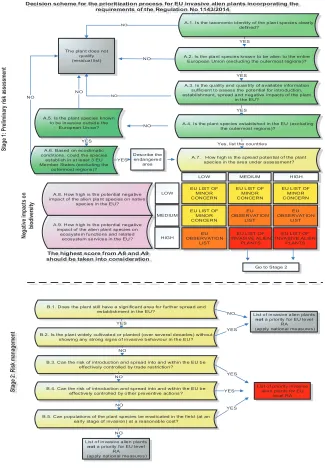
The prioritisation scheme used for this study was an amended version of the EPPO prioritisation process for Invasive Alien Plants (Brunel et al. 2010, EPPO standard PM5/6), specifically adapted within the remit of the LIFE project to be fully compliant with the IAS Regulation. A full description of the process is given in Branquart et al. (2016) and depicted in figure (1). The prioritisation process was designed to meet the requirements of Article 4 (IAS Regulation) where the highest priority for performing a PRA at the European level is given to species that satisfy the following criteria: (i) they are alien to the territory of the EU excluding the outermost regions, (ii) they are capable of establishing a viable population and spreading rapidly in the environment in the EU (excluding the outermost regions), (iii) they are capable of causing major det-rimental impacts to biodiversity and the associated ecosystem services, (iv) actions can be taken to effectively prevent, minimise or mitigate their adverse impact, which in-volves that they are moved from country to country primarily by human activities and they still have a significant area suitable for further spread within the EU (EU 2014).
The first stage of the process, the preliminary risk assessment stage, categorises each species into one of four lists (Residual List, EU List of Minor Concern, EU Observation List and the EU List of Invasive Alien Plants) by addressing pre-determined criteria (ques-tions). To proceed to any of the three EU lists, each species needs to meet the requirements of questions A1, A2, A3, A5 and A6, i.e. a positive (yes) answer is required. If a negative (no) answer is recorded, the species is included in the Residual List of species that do not qualify. Reasons a species (including subspecies, varieties, hybrids and cultigens, hereafter collectively called species) may be included in the Residual list include uncertainty in tax-onomy and nomenclatural (question A1. Fig. 1), or a lack of current scientific information (question A3. Fig.1). Only those species included in the EU List of Invasive Alien Plants (those species which have the highest potential spread capacity and high negative impacts on biodiversity or ecosystem services) proceed to the risk management stage.
Within the second stage, the preliminary risk management stage, priority for a PRA at the EU level is evaluated based on the feasibility and cost-effectiveness of miti-gating impacts with management measures and/or preventative actions. The output of stage two is to define the species into one of two categories:
(1) the plant species is included in a List of Priority Invasive Alien Plants for performing an EU level PRA,
(2) the plant species is included in a List of Invasive Alien Plants that are not considered as a priority to conduct a EU level PRA.
Gathering of species information
predeter-YES
Decision scheme for the prioritization process for EU invasive alien plants incorporating the requirements of the Regulation No 1143/2014
St ag e 1 : P rel im ina ry risk assess me nt NO The plant does not
qualify (residual list) LOW LOW MEDIUM HIGH MEDIUM HIGH
EU LIST OF MINOR CONCERN
EU LIST OF MINOR CONCERN
EU LIST OF MINOR CONCERN
EU LIST OF MINOR CONCERN EU OBSERVATION LIST EU OBSERVATION LIST EU OBSERVATION LIST
EU LIST OF INVASIVE ALIEN
PLANTS
EU LIST OF INVASIVE ALIEN
PLANTS A.7. How high is the spread potential of the plant
species in the area under assessment? A.2. Is the plant species known to be alien to the entire
European Union (excluding the outermost regions)? A.1. Is the taxonomic identity of the plant species clearly
defined?
A.5. Is the plant species known to be invasive outside the
European Union?
A.6. Based on ecoclimatic conditions, could the species
establish in at least 3 EU Member States (excluding the
outermost regions)?
A.8. How high is the potential negative impact of the alien plant species on native
species in the EU?
A.9. How high is the potential negative impact of the alien plant species on
ecosystem functions and related ecosystem services in the EU?
B.4. Can the risk of introduction and spread into and within the EU be effectively controlled by other preventive actions? B.2. Is the plant widely cultivated or planted (over several decades) without
showing any strong signs of invasive behaviour in the EU?
B.3. Can the risk of introduction and spread into and within the EU be effectively controlled by trade restriction?
B.1. Does the plant still have a significant area for further spread and establishment in the EU?
B.5. Can populations of the plant species be eradicated in the field (at an early stage of invasion) at a reasonable cost?
St ag e 2 : R isk m an ag em en t
List of invasive alien plants
not a priority for EU level RA (apply national measures) A.3. Is the quality and quantity of available information
sufficient to assess the potential for introduction, establishment, spread and negative impacts of the plant
in the EU? YES
A.4. Is the plant species established in the EU (excluding the outermost regions)?
YES
Yes, list the countries
Describe the endangered area YES NO YES NO
List of invasive alien plants
not a priority for EU level RA (apply national measures)
Ne ga tive im pa cts on biod ive rsi ty YES NO NO NO NO YES YES YES NO NO
List of priority invasive alien plants for EU
level RA
NO
YES NO
The highest score from A8 and A9 should be taken into consideration
Go to Stage 2
Figure 1. Decision scheme for the EU prioritisation process for alien plants (Taken from Branquart et al. 2016).
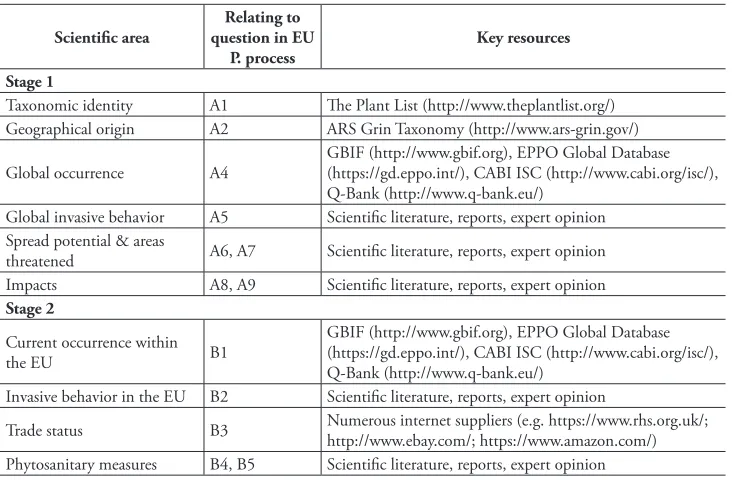
Table 1. Key information sources.Information resources utilised when collecting information on the species.
Scientific area question in EU Relating to
P. process Key resources
Stage 1
Taxonomic identity A1 The Plant List (http://www.theplantlist.org/)
Geographical origin A2 ARS Grin Taxonomy (http://www.ars-grin.gov/)
Global occurrence A4 GBIF (http://www.gbif.org), EPPO Global Database (https://gd.eppo.int/), CABI ISC (http://www.cabi.org/isc/),
Q-Bank (http://www.q-bank.eu/)
Global invasive behavior A5 Scientific literature, reports, expert opinion
Spread potential & areas
threatened A6, A7 Scientific literature, reports, expert opinion
Impacts A8, A9 Scientific literature, reports, expert opinion
Stage 2
Current occurrence within
the EU B1
GBIF (http://www.gbif.org), EPPO Global Database (https://gd.eppo.int/), CABI ISC (http://www.cabi.org/isc/), Q-Bank (http://www.q-bank.eu/)
Invasive behavior in the EU B2 Scientific literature, reports, expert opinion
Trade status B3 Numerous internet suppliers (e.g. https://www.rhs.org.uk/; http://www.ebay.com/; https://www.amazon.com/)
Phytosanitary measures B4, B5 Scientific literature, reports, expert opinion
mined resources, including online databases scientific publications (internet searches and Web of Science), grey literature and relevant books and personal communications (see Table 1). For each species, where possible, the primary data sources were reviewed.
Quality and quantity of information for each species was evaluated under the main headings set out in Table 1. Quantitative data from scientific publications (scientific papers and reports) was considered superior to unreferenced information gathered from online databases. However, during the prioritisation assessment, all information was included and where unreferenced information was considered important, a con-certed effort was taken to substantiate any reports. Each species was prioritised using compiled information where each question was answered in chronological order (see Figure 1). A consensus was reached between the experts based on available information and expert opinion.
Uncertainty scores were assigned to questions A7 (spread) and A8–A9 (impacts) following the criteria set out in Branquart et al. (2016). Uncertainty scores increase where the species is absent from the EU or information on a species was conflicting.
Modelling the potential occurrence of species
However, modelling the potential distributions of alien species presents challenges, including the non-equilibrium nature of the distribution, presence of casual records representing failed introductions and spatial biases in recording effort (Václavik and Meentemeyer 2012). Substantial effort is usually required to develop accurate models that account for these effects, prohibiting the use of such models for rapid multi-species PRA prioritisation exercises. Therefore, we adopted a simple but precautionary approach based on delimiting a ‘climate envelope’ of each species that can be projected onto a map of Europe.
To delimit climate envelopes, we used the 19 standard bioclimatic variables grid-ded at 10 arcminute resolution (0.167 × 0.167 decimal degrees) from WorldClim (Hijmans et al. 2005). ‘Climate space’ was summarised by taking the first two axes of a principal components analysis (PCA) on centred and scaled bioclimatic variables, with log-transformed precipitation variables. These axes captured 77.5 % of the variation in climate. For each species, georeferenced occurrence data was obtained from the Global Biodiversity Information facility (GBIF: www.gbif.org). Data points were filtered ac-cording to expert opinion (Figure 2A). The species occurrences were then plotted in climate space, by extracting the PCA axis scores for occurrence locations (Figure 2B). To delimit a climate envelope for each species, bivariate density kernels were fitted to the occurrences in climate space using the kernelUD function of R package adehabi-tat with automatic selection of the smoothing parameter (Calenge 2006). From these models, 95 % kernel density polygons were extracted for each species. These bound the region of climate space containing 95 % of the smoothed occurrence density of each species. Finally, the climate envelopes were projected onto the EU by identifying the grid cells whose PCA axis scores fell inside the species’ climate envelope (Figure 2C). The resulting maps were critically appraised by the working group panel, using their expert knowledge to consider the accuracy of the estimates and the potential for non-climatic factors such as habitat availability to limit establishment.
We emphasise that this method does not provide a definitive estimate of the poten-tial for further species establishment, but rather a way of rapidly assessing if a species is worthy of further consideration in full PRA. We also note that the 95 % density ker-nels may be overly generous and exceed the climatic tolerances of the species. However, while a lower percentage threshold could have been used to constrict the envelopes, a precautionary approach is desirable for our purpose, given that invasive species may not have fully filled their climate niche space and because many species can invade outside of their native climatic niche (Bocsi et al. 2016).
Results
species included 4 perennial grasses, 10 vines, 6 tree species, 7 woody shrubs and 4 perennial herbs. Almost half of the species (43 %) were native to Asia, followed by South America (18 %), North America (13 %), Africa (8 %), Australia (5 %) and pan-global species (8 %).
Figure 2. An example of the distribution maps and potential occurrence in Europe – Ambrosia confer-tiflora. A Global occurrence locations were obtained from the Global Biodiversity Information Facility
B The global climate was summarised as two principal components analysis (PCA) axes on the 19 World-Clim layers (Hijmans et al. 2005). Species occurrences were plotted in this climate space and a bivariate normal kernel density model (Calenge 2006) was used to estimate ‘climate envelopes’ at different percen-tiles C These envelopes were then projected onto geographic space in the EU. Shading indicates these percentiles, with smaller numbers indicating higher density of occurrences.
A
Stage 1 (risk assessment)
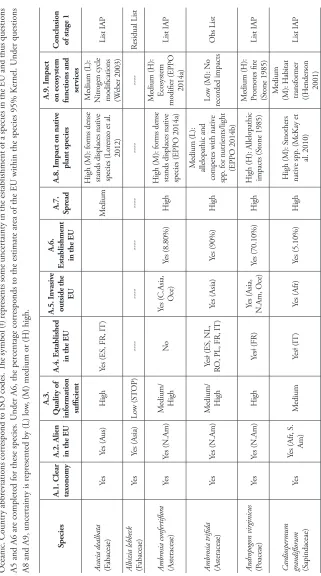
The first stage of the prioritisation process categorised 22 plant species in the EU List of Invasive Alien Plants, 4 plant species in the EU Observational List and 11 species in the Residual List (Table 2). None of the species were assigned to the List of Minor Concern. All species assigned to the EU List of Invasive Alien Plants fulfilled the crite-ria set out in questions A1 to A3; indicating a clear taxonomy, alien to the EU and the quality of information was sufficient to assess traits and impacts.
Cornus sericea L. did not fulfil the criteria of the first question in the prioritisation process ‘Is the taxonomic identity of the plant species clearly established’ as naturalised plants belong to a complex of hybrids of C. sericea and C. alba (Q-Bank 2016) and thus was included in the Residual List. Similarly, Hydrilla verticillata (L.f.) Royle was included in the Residual List as there is evidence the species is native in the EU (Ire-land, Poland and the Baltic states; Cook and Lüönd 1982). Albizia lebbeck (L.) Benth., Clematis terniflora DC., Euonymus japonicus Thunb., Lonicera morrowii A. Gray, Pru-nus campanulata Maxim. and Rubus rosifolius SM. were assigned to Residual List as the quality of information for each was insufficient, potentially impeding a consise PRA.
Of the 29-species assessed under question A4 (is the plant species established in the EU excluding the outermost regions?), 68 % are recorded as established (Table 2). However, this includes 12 species where a clear established population could be de-bated, and for these species questions A5 and A6 were answered for completeness. All species were invasive in at least one geographical region in the world (excluding the EU), though 50 % of the species are recorded as invasive in two geographical regions, 13 % in three geographical regions and one species Pistia stratiotes L. is recorded as invasive in four regions.
Three species, Chromolaena odorata (L.) King & H.E.Robins, Cryptostegia grandi-flora R.Br. and Sphagneticola trilobata (L.) Pruski were assigned to the Residual List due to uncertainty in potential for establishment (A.6). Species occurrence maps overlaid in EU climate space indicated establishment at 0.1 %, 0.3 % and 0.2 %, respectively.
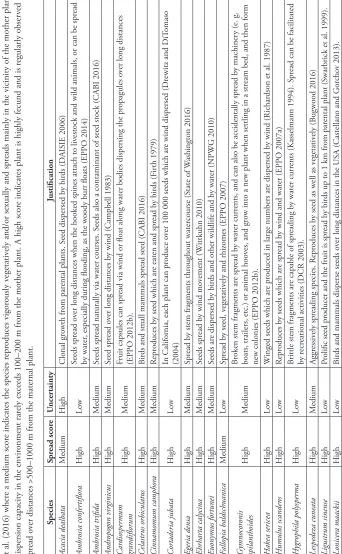
The majority of species evaluated in question A7 (88 %) were assigned a high score for spread potential, indicating the species is highly fecund and propagules can spread over distances of 500 to 1,000 m from the parent plant (Table 3). Except for the aquatic species, all species are vigorous seed producers with evidence that propagules are carried by wind, water or wildlife (see Table 3).
Tab le 2. R esults from the prioritisation ex er cise (S tage 1: risk assessment). The first stage of the prioritisation pr ocess categorised tw enty-two plant species in the Eu
-ropean List of I
nv
asiv
e Alien P
lants (List IAP), 4 plant species in the E
ur
opean O
bser
vational List (O
bs List) and 11 species w
er
e r
ejected fr
om the pr
ocess (R
esidual
List) as they did not fulfil the criteria of specific questions. Ar
ea abbr
eviations follo
w: A
us: A
ustralia, N. Am: N
or
th America, Afr: Africa, S.Am: S
outh America, O
ce:
O
ceanic. Countr
y abbr
eviations corr
espond to ISO codes. The symbol (
ǂ
) r
epr
esents some uncer
tainty in the establishment of a species in the EU and thus questions
A5 and A6 ar
e completed for these species. U
nder A6, the per
centage corr
esponds to the estimate ar
ea of the EU within the species 95% K
ernel. U
nder questions
A8 and A9, uncer
tainty is r
epr
esented b
y (L) lo
w, (M) medium or (H) high.
Species
A.1. Clear taxonomy A.2. Alien in the EU
A.3. Q uality of infor mation sufficient A.4. Established
in the EU
A.5. I nv asiv e outside the EU A.6.
Establishment in the EU A.7. Spread
A.8. I
mpact on nativ
e
plant species
A.9. I
mpact
on ecosystem functions and ser
vices
Conclusion of stage 1
Acacia dealbata (Fabaceae)
Ye s Yes (A us) H igh
Yes (ES, FR, IT
)
M
edium
H
igh (M): forms dense stands displaces nativ
e
species (Lor
enz
o et al.
2012) M edium (L): N itr ogen cy cle
modifications (Weber 2003)
List IAP
Albizia lebbeck (Fabaceae)
Ye s Yes (Asia) Lo w (ST OP) ----Residual List Ambr osia confer tiflor a (Asteraceae) Ye s Yes (N.Am) M
edium/ High
No
Yes (C.Asia, O
ce)
Yes (8.80%)
H
igh
H
igh (M): forms dense stands displaces nativ
e
species (EPPO 2014a)
M
edium (H): Ecosystem
modifier (EPPO 2014a) List IAP Ambr osia trifida (Asteraceae) Ye s Yes (N.Am) M
edium/ High
Ye
s
ǂ
(ES, NL,
RO, PL, FR, IT
) Yes (Asia) Yes (90%) H igh M edium (L): allelopathic and
competes with nativ
e
spp
. for nutrients/light (EPPO 2014b)
Lo
w (M): N
o recor ded impacts O bs List Andr opogon virginicus (P oaceae) Ye s Yes (N.Am) H igh Ye s ǂ (FR)
Yes (Asia, N.Am, O
ce)
Yes (70.10%)
H
igh
H
igh (H): Allelopathic impacts (S
tone 1985) M edium (H): Pr omotes fir e (S tone 1985) List IAP Car diosper mum gr andiflor um (S apindaceae) Ye s Yes (Afr , S. Am) M edium Ye s ǂ (IT ) Yes (Afr) Yes (5.10%) H igh H
igh (M): S
Species A.1. Clear taxonomy A.2. Alien in the EU
A.3. Q uality of infor mation sufficient A.4. Established
in the EU
A.5. I nv asiv e outside the EU A.6.
Establishment in the EU A.7. Spread
A.8. I
mpact on nativ
e
plant species
A.9. I
mpact
on ecosystem functions and ser
vices
Conclusion of stage 1
Celastr us orbiculatus (Celastraceae) Ye s Yes (Asia) H igh Ye s ǂ (GB)
Yes (N.Am, O
ce)
Yes (77%)
H
igh
H
igh (H): S
uppr ession nativ e spp . (F ike and N iering 1999) M
edium (H): Negativ
ely
affects aesthetics (CABI 2016)
List IAP Chr omolaena odor ata (Asteraceae) Ye s Yes (S.Am) H igh No Yes (Afr , N.Am, O ce) N o (ST OP) ----Residual List Cinnamomum camphor a (Lauraceae) Ye s Yes (Asia) H igh Casual (FR)
Yes (N.Am, O
ce)
Yes (35.10%)
H
igh
H
igh (H): F
orms monocultur es/ Allelopathic impacts (F irth 1979) M
edium (H): Ecosystem
modifier (CABI 2016) List IAP Clematis ter niflor a (Ranunculaceae) Ye s Yes (Asia) Lo w (ST OP) ----Residual List Cor nus sericea (Cornaceae) No (ST OP) ----Residual List Cor taderia jubata (P oaceae) Ye s
Yes (S. Am)
H
igh
No
Yes (N.Am, O
ce)
Yes (55.80%)
H
igh
H
igh (M): S
trongly
competes for r
esour ces (Lambrinos 2000) H igh (M): Alters tr ophic lev els/r educes aesthetics (Bossar
d et al.
2000) List IAP Cr yptostegia gr andiflor a (A pocynaceae) Ye s Yes (Afr) H igh No Yes (O ce, S.Am) N o (ST OP) ----Residual List
Egeria densa (Hydr
ocharitaceae)
Ye
s
Yes (S. Am)
H
igh
Yes (FR, BE, IT
,
NL, UK)
H
igh
M
edium (H): D
isplaces nativ e spp . (CABI 2016) M edium (H): R educes recr eation activities (CABI 2016) O bs List Ehr har ta caly cina (P oaceae) Ye s
Yes (S. Afr)
H igh Ye s ǂ (ES, PT ) Yes (N.Am) Yes (15.30%) H igh H igh (M): O utcompetes nativ e plant spp . (Bossar d et al. 2000) M edium (M): Alter fir e r egimes (F
isher et al. 2006)
Species A.1. Clear taxonomy A.2. Alien in the EU
A.3. Q uality of infor mation sufficient A.4. Established
in the EU
A.5. I nv asiv e outside the EU A.6.
Establishment in the EU A.7. Spread
A.8. I
mpact on nativ
e
plant species
A.9. I
mpact
on ecosystem functions and ser
vices
Conclusion of stage 1
Euonymus for tunei (Celastraceae) Ye s Yes (Asia) H igh Ye s ǂ (LV ) Yes (N.Am) Yes (70.10%) H igh H igh (M): O utcompetes nativ e plant spp . (B auer and Reynolds 2016) M
edium (H): Ecosystem
modifier (B auer and R eynolds 2016) List IAP
Euonymus japonicus (Celastraceae)
Ye s Yes (Asia) Lo w (ST OP) ----Residual List
Fallopia baldschuanica (Polygonaceae)
Ye s Yes (Asia) H igh Yes (widespr ead) M edium M edium (M): Smoothers nativ e spp . (EPPO 2012a) M
edium (M): Ecosystem
modifier (EPPO 2012a) O bs List G ymnocor onis spilanthoides (Asteraceae) Ye s
Yes (N. Am, S.Am.)
H igh Ye s ǂ (HU, IT )
Yes (Asia, O
ce)
Yes (14.20%)
H
igh
H
igh (M): forms dense
monocultur
es/ displaces
nativ
e species (CAB, 2016)
M edium (M): R educes recr eation activities ( W eeds CR C 2008, EPPO 2012b) List IAP H akea sericea (P roteaceae) Ye s Yes (A us) M edium
Yes (FR, ES, PT
)
H
igh
H
igh (H): Alter composition of
nativ
e communities
(Richar
dson et al. 1989)
M edium (M): R educes recr eation activities (CABI 2016) List IAP H umulus scandens (Cannabaceae) Ye s Yes (Asia) H igh
Yes (FR, IT
, HU)
H
igh
H
igh (M): D
ense stands outcompete nativ e spp . (EPPO 2007a) M
edium (M): Ecosystem
Species A.1. Clear taxonomy A.2. Alien in the EU
A.3. Q uality of infor mation sufficient A.4. Established
in the EU
A.5. I nv asiv e outside the EU A.6.
Establishment in the EU A.7. Spread
A.8. I
mpact on nativ
e
plant species
A.9. I
mpact
on ecosystem functions and ser
vices
Conclusion of stage 1
H ygr ophila polysper ma (A canthaceae) Ye s Yes (Asia) H igh Ye s ǂ (DE) Yes (N.Am) Yes (75.20%) H igh H
igh (H): D
ense mats outcompete nativ e plant spp . (C uda and Sutton 2000) H
igh (M): Reduces recreation
activities (CABI 2016) and blocks drainage systems (C
uda
and S
utton
2000)
List IAP
Lespedeza cuneata (Fabaceae)
Ye s Yes (A us, Asia) M edium No Yes (N.Am, Afr) Yes (49.10%) H igh H igh (M): O utcompetes nativ e
species/ allelopathic (Co
ykendall 2011)
M
edium (H): Ecosystem modifier
(NW CA 2016) List IAP Ligustr um sinense (O leaceae) Ye s Yes (Asia) H igh Ye s ǂ (IT , PT , GB) H igh H
igh (M): R
educes
abundance and species richness of nativ
e plant
spp
. (
W
ilco
x and B
eck
2007)
M
edium (H): Ecosystem modifier
(M
erriam and Feil 2002)
List IAP Lonicer a maackii (Caprifoliaceae) Ye s Yes (Asia) M edium No Yes (N.Am) Yes (72.60%) H igh H
igh (M): R
educes
plant species richness (Gould and G
or
cho
v
2000; Collier et al.
2002)
Lo
w (H): N
o recor ded impacts List IAP Lonicer a morr owii (Caprifoliaceae) Ye s Yes (Asia) Lo w (ST OP) ----Residual List
Lygodium japonicum (Lygodiaceae)
Ye s Yes (Asia) M edium No
Yes (N.Am, O
ce)
Yes (26.50%)
H
igh
H
igh (H): D
ense monocultur es outcompete nativ e spp .
(Leichty et al. 2011)
M
edium (H): Ecosystem
modifier (CABI
2016)
Species A.1. Clear taxonomy A.2. Alien in the EU
A.3. Q uality of infor mation sufficient A.4. Established
in the EU
A.5. I nv asiv e outside the EU A.6.
Establishment in the EU A.7. Spread
A.8. I
mpact on nativ
e
plant species
A.9. I
mpact
on ecosystem functions and ser
vices
Conclusion of stage 1
O xalis pes-capr ae (Oxalidaceae) Ye s Yes (Afr) H igh
Yes (FR, IT
, PT
,
ES, GB, MT
) M edium M edium (M): O utcompetes nativ e plant spp . (P etsikos et al. 2007) M
edium (M): Ecosystem modifier
(P
etsikos et al. 2007)
O
bs List
Pennisetum setaceum (Poaceae)
Ye s Yes (Afr , Asia) H igh Yes (IT , PT , ES) H igh H
igh (H): D
isr
upts
primar
y succession and
competes with nativ
e
species for r
esour
ces
(Cor
dell and S
andquist
2008)
Lo
w (H): N
o recor ded impacts List IAP Pistia str atiotes (Araceae) Ye s Yes (S.Am) H igh Ye s ǂ
(DE, ES, IT, SI)
Yes (Afr , Asia, N.Am, O ce) Yes (69.40%) H igh H
igh (M): forms dense mats displaces nativ
e
species (H
ussner 2014;
Cilliers et al. (1996)
M edium (H): R educes recr eation activities
(Chamier et al.
2012) List IAP Pr osopis juliflor a (M imosoideae) Ye s
Yes (C.Am, S. Am)
H
igh
No
Yes (Asia, Afr, O
ce) Yes (7.10%) H igh H igh (M): O utcompetes nativ e plant spp
. (Kaur et al. 2012)
H
igh (H):
D
egrades land/ negativ
e social
effect (Choge et al. 2002)
Species A.1. Clear taxonomy A.2. Alien in the EU
A.3.
Q
uality of
infor
mation
sufficient
A.4. Established
in the EU
A.5. I
nv
asiv
e
outside the
EU
A.6.
Establishment in the EU A.7. Spread
A.8. I
mpact on nativ
e
plant species
A.9. I
mpact
on ecosystem functions and ser
vices
Conclusion of stage 1
Salvinia molesta (Salviniaceae)
Ye
s
Yes (S.Am)
H
igh
Ye
s
ǂ
(IT
, PT
)
Yes (Afr
,
N.Am, O
ce)
Yes (62.80%)
H
igh
H
igh (M): forms dense
monocultur
es/ displaces
nativ
e species (Thomas 1981)
H
igh (M): Alters trophic lev
els,
reduces ar
eas
for r
ecr
eation
(M
cF
arland et al.
2004; Chilton et
al. 2002)
List IAP
Sapium sebifer
um
(E
uphorbiaceae)
Ye
s
Yes (Asia)
M
edium
No
Yes (N.Am, O
ce)
Yes (21.70%)
H
igh
H
igh (M):
O
utcompetes nativ
e
plant spp
. (Camarillo et
al. 2015)
H
igh (H):
Alters nutrient composition (B ruce et al. 1997)
List IAP
Sphagneticola trilobata (Asteraceae)
Ye
s
Yes (S.Am)
M
edium
Ye
s
ǂ
(ES, IT
)
Yes (Asia, Afr, C. Am,
N. Am, O
ce)
N
o (ST
OP)
Tab
le 3.
The spr
ead potential scor
es, uncer
tainty rating and justification for the 24 plant species assessed under question A7. S
pr
ead scor
es ar
e based on B
ranquar
t
et al. (2016) wher
e a medium scor
e indicates the species r
epr
oduces vigor
ously v
egetativ
ely and/or sexually and spr
eads mainly in the vicinity of the mother plant;
dispersion capacity in the envir onment rar ely ex ceeds
100–200 m fr
om the
mother plant. A high scor
e
indicates
plant is
highly fecund and
is r
egularly obser
ved to
spr
ead o
ver distances >500–1000 m fr
om the maternal plant.
Species Spr ead scor e U ncer tainty Justification Acacia dealbata M edium H igh Clonal gr owth fr om par
ental plants. S
eed dispersed b
y bir
ds (DAISIE 2006)
Ambr osia confer tiflor a H igh Low Seeds spr ead o
ver long distances when the hooked spines attach to liv
estock and wild animals, or can be spr
ead
by water
, especially during flooding, as the woody burr floats (EPPO 2014)
Ambr osia trifida H igh M edium Seeds spr
ead naturally via water courses. S
eeds also a contaminant of seed stock (CABI 2016)
Andr opogon virginicus H igh M edium Seed spr ead o
ver long distances b
y wind (Campbell 1983)
C ar diosper mum gr andiflor um H igh M edium Fr
uit capsules can spr
ead via wind or float along water bodies dispersing the pr
opagules o
ver long distances
(EPPO 2012b). C elastr us orbiculatus H igh M edium Bir
ds and small mammals spr
ead seed (CABI 2016)
C innamomum camphor a H igh M edium Repr oduces b
y seed which ar
e eaten and spr
ead b y bir ds (F irth 1979) Cor taderia jubata H igh Low
In California, each plant can pr
oduce o
ver 100 000 seeds which ar
e wind dispersed (D
re
witz and D
iT omaso (2004) Egeria densa H igh M edium Spr ead b
y stem fragments thr
oughout water course (S tate of W ashington 2016) Ehr har ta caly cina H igh M edium Seeds spr ead b
y wind mo
vement ( W ittkuhn 2010) Euonymus for tunei H igh M edium Seeds ar
e dispersed b
y bir
ds and other wildlife and b
y water (NPW
G 2010) Fallopia baldschuanica M edium Low Spr ead b
y seed, v
egetativ
ely and rhiz
omes (EPPO 2007)
G ymnocor onis spilanthoides H igh M edium Br
oken stem fragments ar
e spr
ead b
y water curr
ents, and can also be accidentally spr
ead b
y machiner
y (e. g.
boats, trailers, etc.) or animal hoo
ves, and gr
ow into a ne
w plant when settling in a str
eam bed, and then form
ne
w colonies (EPPO 2012b).
H akea sericea H igh Low W
inged seeds which ar
e pr
oduced in large numbers ar
e dispersed b
y wind (Richar
dson et al. 1987)
H umulus scandens H igh Low Repr oduces b
y seeds which ar
e spr
ead b
y wind and water (EPPO 2007a)
H ygr ophila polysper ma H igh Low
Brittle stem fragments ar
e capable of spr
eading b
y water curr
ents (Kasselmann 1994). S
pr
ead can be facilitated
by r
ecr
eational activities (DCR 2003).
Lespedeza cuneata H igh M edium Aggr essiv ely spr
eading species. R
epr
oduces b
y seed as w
ell as v
egetativ ely (B ugwood 2016) Ligustr um sinense H igh Low Pr
olific seed pr
oducer and the fr
uit is spr
ead b
y bir
ds up to 1 km fr
om par
ental plant (S
warbrick et al. 1999).
Lonicer a maackii H igh Low Bir
ds and mammals disperse seeds o
ver long distances in the USA (Castellano and G
or
cho
Species
Spr
ead scor
e
U
ncer
tainty
Justification
Lygodium japonicum
H
igh
Low
Tiny spor
es ar
e r
eadily dispersed b
y wind (CABI 2016)
O
xalis pes-capr
ae
M
edium
M
edium
Vegetativ
e r
epr
oduction dispersed b
y agricultural activity and water (DAISIE 2006).
Pennisetum setaceum
H
igh
Low
Seeds spr
ead o
ver long distances b
y wind (PCA 2005)
Pistia str
atiotes
H
igh
Low
Long dispersal of plants facilitated b
y water mo
vement (H
ussner and H
eiligtag 2013). A
dditional spr
ead likely
from water bir
ds and r
ecr
eational activities
Pr
osopis juliflor
a
H
igh
Low
Seed is spr
ead b
y bir
ds and mammals o
ver long distances. S
eeds can become incorporated into waterbodies
facilitating spr
ead (CR
C
W
eed M
anagement 2003)
Salvinia molesta
H
igh
M
edium
The floating form of the plant facilitates its spr
ead within waterbodies (M
cF
arland et al. 2004); like
wise,
flooding also has the potential to carr
y plants to ne
w waterbodies or w
etland habitats (M
cF
arland et al. 2004).
Sapium sebifer
um
H
igh
M
edium
Seeds can become incorporated into waterbodies and disperse thr
ough the system. B
irds eat and disperse seeds
(J
plant species. Four species, Ambrosia trifida L., Egeria densa Planch., Fallopia balds-chuanica (Regel) Holub and Oxalis pes-caprae L., were assigned to the EU Observation list due a medium impact score.
Stage 2 (Risk management)
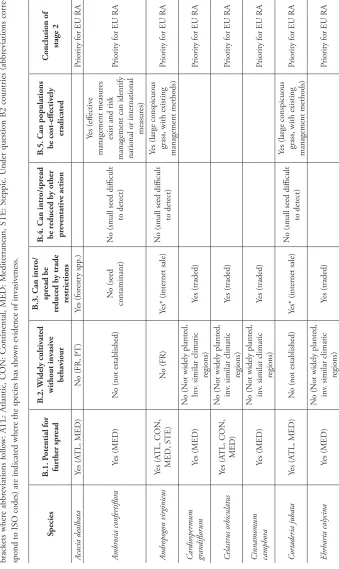
Of the 22 species assessed under stage 2, 19 were considered as a high priority for a PRA at the EU level (Table 4). All species were regarded as having the potential for further spread in climatically suitable regions (see Table 4).
Andropogon virginicus L., Humulus scandens (Lour.) Merr., and Lespedeza cuneata (Dum. Cours.) G.Don, were regarded as having the highest potential for further spread where each could colonise 4 biogeographical regions.
Three species, Euonymus fortunei (Turcz.) Hand.-Maz., Ligustrum sinense Lour. and Lonicera maackii (Rupr.) Maxim., were considered low priority for PRA as all are widely cultivated within the EU without showing significant signs of invasive behav-iour (Table 4). However, all three species are known to be invasive in North America, particularly in the eastern States which have similar climatic zones to regions in Europe (see Köppen-Geiger climate classification, Kottek et al. 2006). Based on the precau-tionary principle, national measures could be applied to these species, including coun-try specific PRA.
Most species (68 %) evaluated under question B3 (can the risk of introduction and spread into and within the EU be effectively controlled by trade restrictions?), are sold within the EU and therefore a European level PRA would be required to assess if trade restrictions could prevent further introduction and spread (Table 3). Where trade restrictions were regarded as ineffective, as in the case of Ambrosia confertiflora DC, Andropogon virginicus, Cortaderia jubata and Prosopis juliflora (Sw.) DC., members of the workshop considered that cost-effective integrated control actions could be applied against these species and therefore they are a priority for a European level PRA.
Discussion
Tab
le
4.
R
esults fr
om the prioritisation ex
er
cise (S
tage 2: risk management). B
ased on the potential for fur
ther spr
ead and av
ailable pr
ev
ention and contr
ol methods,
19 species wher
e identified a priority for an EU lev
el risk assessment. U
nder question B1, the potential biogeographical r
egions that could be inv
aded ar
e listed in
brackets wher
e abbr
eviations follo
w: A
TL: A
tlantic, CON: Continental, MED: M
editerranean, STE: S
teppic. U
nder question B2 countries (abbr
eviations corr
e-spond to ISO codes) ar
e indicated wher
e the species has sho
wn evidence of inv
asiv eness. Species B.1. P otential for fur ther spr ead B.2. W idely cultiv ated without inv asiv e behaviour B.3. C an intr o/ spr ead be reduced b y trade restrictions B.4. C an intr o/spr ead be r educed b y other pr ev entativ e action B.5. C an populations be cost-effectiv ely eradicated Conclusion of stage 2 Acacia dealbata Yes (A TL, MED) N
o (FR, PT
)
Yes (for
estr
y spp
.)
Priority for EU RA
Ambr osia confer tiflor a Yes (MED) N
o (not established)
N
o (seed
contaminant)
N
o (small seed difficult
to detect)
Yes (effectiv
e
management measur
es
exist and risk
management can identify national or international
measur
es)
Priority for EU RA
Andr opogon virginicus Yes (A TL, CON, MED, STE) N o (FR)
Yes* (internet sale)
N
o (small seed difficult
to detect)
Yes (large conspicuous grass, with existing management methods)
Priority for EU RA
C ar diosper mum gr andiflor um Yes (MED) N o (N
ot widely planted,
Inv
. similar climatic regions)
Yes (traded)
Priority for EU RA
C
elastr
us orbiculatus
Yes (A
TL, CON, MED)
N
o (N
ot widely planted,
inv
. similar climatic regions)
Yes (traded)
Priority for EU RA
C
innamomum camphor
a
Yes (MED)
N
o (N
ot widely planted,
inv
. similar climatic regions)
Yes (traded)
Priority for EU RA
Cor
taderia jubata
Yes (A
TL, MED)
N
o (not established)
Yes* (internet sale)
N
o (small seed difficult
to detect)
Yes (large conspicuous grass, with existing management methods)
Priority for EU RA
Ehr har ta caly cina Yes (MED) N o (N
ot widely planted,
inv
. similar climatic regions)
Yes (traded)
Species B.1. P otential for fur ther spr ead B.2. W idely cultiv ated without inv asiv e behaviour B.3. C an intr o/ spr ead be reduced b y trade restrictions B.4. C an intr o/spr ead be r educed b y other pr ev entativ e action B.5. C an populations be cost-effectiv ely eradicated Conclusion of stage 2 Euonymus for tunei
Yes (CON, STE)
Yes (ST OP) ----N
ot a priority for RA (national measur
es) G ymnocor onis spilanthoides Yes (MED) N
o (HU, IT
)
Yes (widely sold within EU)
Priority for EU RA
H akea sericea Yes (A TL, MED) N o (PT ) Yes (traded)
Priority for EU RA
H umulus scandens Yes (A TL, CON, MED, STE) N o (FR) Yes (traded)
Priority for EU RA
H ygr ophila polysper ma Yes (MED) N o (DE) Yes (traded)
Priority for EU RA
Lespedeza cuneata
Yes (A
TL, CON,
MED, STE)
N
o (not established)
Yes (curr
ently absent
from EU)
Priority for EU RA
Ligustr um sinense Yes (AL T, CON, MED) Yes (ST OP) ----N
ot a priority for RA (national measur
es) Lonicer a maackii Yes (AL T, CON, MED) Yes (ST OP) ----N
ot a priority for RA (national measur
es)
Lygodium japonicum
Yes (MED)
N
o (not established)
Yes (curr
ently absent
from EU)
Priority for EU RA
Pennisetum setaceum Yes (A TL, MED) N o (ES) Yes (traded)
Priority for EU RA
Pistia str
atiotes
Yes (MED)
N
o (DE)
Yes (widely traded
within EU)
Priority for EU RA
Pr
osopis juliflor
a
Yes (MED)
N
o (not established)
Yes* (internet sale)
No
Yes (large conspicuous shr
ub species, with
existing management
methods)
Priority for EU RA
Salvinia molesta
Yes (MED)
N
o (A
U, BE, FR, IT
,
PT
)
Yes (widely traded
within EU)
Priority for EU RA
Sapium sebifer
um
Yes (A
TL, MED)
N
o (not established)
Yes (curr
ently absent
from EU)
prioritisation scheme has been specifically designed to incorporate the requirements of the IAS Regulation and to the best of our knowledge, this is the first-time invasive alien plant species have been prioritised using a scheme compliant with the IAS Regulation.
This study identified 19 globally invasive alien plant species with a high priority for a PRA at the EU level. As shown in our results, all 19 species comply with the IAS definition and criteria of art. 4 of the IAS Regulation, i.e. alien species being capable of causing major detrimental impacts to biodiversity and the associated ecosystem servic-es after servic-establishment and spread within the territory of the EU. Within the first stage of the prioritisation scheme, four species (A. trifida, E. densa, F. baldschuanica and O. pes-caprae) were assigned to the EU Observation List highlighting that at the current time the species are likely to cause only a moderate detrimental impact to biodiversity and associated ecosystem services. A. trifida has become a major weed of annual crops in the US (Weaver 2003) and is a threat for the economy where it has established in Europe, especially in SW France (Chauvel et al. 2015), while O. pes-caprae has impacts on livestock. It should be noted that the placement of species in the three lists is not a definitive placement and each species should be reviewed as and when new informa-tion comes to light. This is particularly important for any species included in the EU list of Minor Concern and EU Observational List.
In the first stage of the prioritisation scheme, eleven species were assigned to the Residual List and thus did not qualify for further assessment. Having a clear under-standing of the taxonomic identity of a species is an essential component in any pri-oritisation, and subsequent PRA. This is important to ensure that the assessment is performed on a distinct organism (IPPC 2016) but also to ensure that information used in the assessment is relevant to the organism under consideration (Elith et al. 2012). In our initial list of 37 species, the taxonomy of one species, Cornus sericea, was identified as being uncertain as in Europe naturalised plants belong to a complex of hybrids of C. sericea and C. alba (Q-Bank 2016). It has also been suggested that C. alba is conspecific with C. sericea (National Botanic Garden of Belgium 2016). We suggest that further research is carried out on the exact identity of the species within Europe before any PRA is conducted to reduce uncertainty.
If an invasive plant is native to part of the European Union, this would preclude its inclusion on the list of species of Union concern. Although Hydrilla verticillata is often considered non-native to Europe, there is some uncertainty to the status of the species and Lansdown (2013) details the species as native to Belarus, Ireland, the United King-dom (southern Scotland) and the Russian Federation. There is additional uncertainty of its native status in Latvia and Poland (Cook and Lüönd 1982). In the absence of a pan-global biogeographical molecular study the uncertainty of native populations within Europe will remain (Zhu et al. 2015). It should be noted that provisions are made within the IAS Regulation (Article 11) for species native to the Union, where their inclusion on national lists can be used to enhance regional cooperation.
rat-ings can go some way to capturing data gaps, or conflicting information, without some baseline data consideration is needed to whether a PRA is warranted. Based on the lack of quantitative impact studies, and to some extent information on the biology and ecology of the species (at a global scale), we considered Albizia lebbeck, Clematis terni-flora, Euonymus japonicus, Lonicera morrowii, Prunus campanulata and Rubus rosifolius are not suited for a PRA at this time. We do suggest that a comprehensive literature review is conducted periodically for each species in the Residual List, including those species where there is uncertainty in potential for establishment (C. odorata, C. grandi-flora and S. trilobata). If new scientific information comes to light that may change the outcome of the prioritisation, the species should be re-evaluated.
Impact studies can be biased to species which are widespread and/or high-profile species to particular sectors of society (Hulme et al. 2013). When considering species which are absent from the EU, there is a clear need to use the invasion history from another region as a proxy (Gallardo et al. 2015). As already mentioned, most species assessed under question A9, impacts on ecosystem functions and services, received a medium score (69 %) with a high level of uncertainty (55 %). This is in contrast with the previous question on impacts on native species where 84 % of the species received a high score with medium uncertainty (68 %). This is not a surprise as impacts can be ambiguous to define in relation to ecosystem services and impacts can be inconspicu-ous in many studies conducted over a short timeframe (Eviner et al. 2012). It is how-ever fair to note that our understanding of the effects of invasive plants on ecosystem services is growing (Vilà et al. 2010), and with the prominence of ecosystem services in the IAS Regulation further studies will undoubtedly follow.
All 22 species evaluated under stage 2 have potential for further spread, though three species, namely Euonymus fortunei, Ligustrum sinense and Lonicera maackii were not con-sidered a priority for an European level PRA due to being widely cultivated within the region without showing any signs of invasive behaviour. E. fortunei has been cultivated within the region since the late 1800s where it is grown in parks and gardens (Personal Communication, John David, Royal Horticultural Society, UK, 2016). It has however, been identified in the eastern USA as a species spreading into native plant communities (Missouri Botanical Garden 2016), and research has shown it causes native species decline (Bauer and Reynolds 2016, Mattingly et al. 2016). We recommend that Member States monitor these species, e.g. considering the possibility to join a network of sentinel gardens (to detect as soon as possible any sign of potential invasiveness) (Visser et al. 2014).
propagules. As all species are relatively large in form, management in situ should be a feasible cost-effective option for isolated incurrences, particularly as management op-tions exist for each species (see Panetta 2015).
It should be noted for Andropogon virginicus, Prosopis juliflora and Cortaderia ju-bata, trade in these species is predominately via internet sites such as eBay and Amazon and as such any trade restrictions may be ineffective in the absence of greater enforce-ment of existing regulations (Lenda et al. 2014). The volume of moveenforce-ment of these species is likely to be low along this pathway, but not necessarily insignificant, as has been shown for other species where a small number of introductions have resulted in invasive populations (for example Polygonum perfoliatum in the USA (IPANE 2016)).
The EU prioritisation scheme does not consider potential impacts which may be realised because of climate change scenarios, or indeed the potential for further spread and establishment because of future climatic projections. Of course, the effect of cli-mate change on a species is a key consideration in any subsequent PRA but we suggest that the detailed analysis needed to address this issue is not suited to a prioritisation scheme. We reiterate the point made in Branquart et al. (2016) that a prioritisation scheme is no substitution for a comprehensive PRA but instead acts as a valuable tool to filter out those species where a PRA is not currently needed allowing efforts to focus on those species where a detailed RA is required.
In conclusion, in utilising the EU prioritisation process for alien plants, 19 species have been identified as high priorities for PRA. These species present a prominent risk to the EU, either now or in the future and thus warrant a full PRA. Whether these species are eventually included on the list of Union concern remains to be seen and will depend, in part, on the outcome of the subsequent PRA and decision makers of the Member States.
Acknowledgements
This research was funded in part by the European Commission, DG Environment LIFE funding under the project LIFE15 PRE-FR 001: Mitigating the threat of invasive alien plants in the EU through pest risk analysis to support the Regulation (EU) No 1143/2014.
References
Bauer JT, Reynolds HL (2016) Restoring native understory to a woodland invaded by
Euony-mus fortunei: multiple factors affect success. Restoration Ecology 24: 45–52. https://doi. org/10.1111/rec.12285
Bossard CC, Randall JM, Hoshovsky MC (2000) Invasive Plants of California’s Wildlands. University of California Press, New York, 360 pp.
Branquart E, Brundu G, Buholzer S, Ehret P, Fried G, Starfinger U, van Valkenburg J, Tanner R (2016) A prioritisation process for invasive alien plant species compliant with Regulation (EU) No. 1143/2014. EPPO Bulletin 46: 603–617. https://doi.org/10.1111/epp.12336 Bruce KA, Cameron GN, Harcombe PA, Jubinsky G (1997) Introduction, impact on native
habitats, and management of a woody invader, the Chinese tallow tree, Sapium sebiferum
(L.) Roxb. Natural Areas Journal 17: 255–260.
Brunel S, Branquart E, Fried G, van Valkenburg J, Brundu G, Starfinger U, Buholzer S, Uludag A, Joseffson M, Baker R (2010) The EPPO prioritisation process for invasive alien plants. EPPO Bulletin 40: 407–422. https://doi.org/10.1111/j.1365-2338.2010.02423.x
Bugwood (2016) Lespedeza cuneata. http://wiki.bugwood.org/Lespedeza_cuneata
CABI (2016) Invasive Species Compendium. http://www.cabi.org/isc
Calenge C (2006) The package adehabitat for the R software: a tool for the analysis of space and habitat use by animals. Ecological Modelling 197: 516–519. https://doi.org/10.1016/j. ecolmodel.2006.03.017
Camarillo SA, Stovall JP, Sunda CJ (2015) The impact of Chinese tallow (Triadica sebifera) on
stand dynamics in bottomland hardwood forests. Forest Ecology and Management 344: 10–19. https://doi.org/10.1016/j.foreco.2015.02.013
Campbell CS (1983) Systematics of the Andropogon virginicus complex (Gramineae). J. Arnold
Arboretum 64: 171–254. https://doi.org/10.5962/bhl.part.27406
Castellano SM, Gorchov DL (2013) White-tailed deer (Odocoileus virginianus) disperse seeds
of the invasive shrub, Amur Honeysuckle (Lonicera maackii). Natural Areas Journal 33:
78–80. https://doi.org/10.3375/043.033.0109
Chamier J, Schachtschneider K, Maitre DC, Ashton PJ, van Wilgen BW (2012) Impacts of invasive alien plants on water quality, with particular emphasis on South Africa. http:// www.wrc.org.za
Chauvel B, Rodriguez A, Moreau C, Martinez Q, Bilon R, Fried G (2015) Développement d’Ambrosia trifida L. en France: connaissances historiques et écologiques en vue d’une éra-dication de l’espèce. Journal de Botanique de la Société Botanique de France 71: 25–38.
Chilton E, Jacono CC, Grodowitz M, Dugas C (2002) Salvinia molesta: Status report and
ac-tion plan. Unpublished report by the Giant Salvinia Interagency Task Force.
Chittka L, Schürkens S (2001) Successful invasion of a floral market. Nature 411: 653. https:// doi.org/10.1038/35079676
Choge SK, Ngujiri FD, Kuria MN, Busaka EA, Muthondeki JK (2002) The status and impact of Prosopis spp in Kenya. Kenya Forestry Research Institute (KEFRI), Nairobi, Kenya, 59 pp.
Cilliers CJ, Zeller D, Strydom D (1996) Short- and long-term control of water lettuce (Pistia
stratiotes) on seasonal water bodies and on a river system in the Kruger National Park, South Africa. Hydrobiologia 340: 173–179. https://doi.org/10.1007/BF00012751
Cook CDK, Lüönd R (1982) A revision of the genus Hydrilla (Hydrocharitaceae). Aquatic
Collier MH, Vankat JL, Hughes MR (2002) Diminished plant richness and abundance below Lonicera maackii, an invasive shrub. American Midland Naturalist, 147: 60–71. https:// doi.org/10.1674/0003-0031(2002)147[0060:DPRAAB]2.0.CO;2
Cordell S, Sandquist DR (2008) The impact of an invasive African bunchgrass (Pennisetum
setaceum) on water availability and productivity of canopy trees within a tropical dry forest in Hawaii. Functional Ecology 22: 1008–1017. https://doi.org/10.1111/j.1365-2435.2008.01471.x
Coykendall K (2011) Invasive success of Lespedeza cuneata: allelopathy and competition. PhD Thesis
2011. http://kars.ku.edu/media/uploads/work/COYKENDALL_Katherine_FL2011.pdf
CRC Weed Management (2003) Mesquite (Prosopis species). Weed Management Guide. https://
www.environment.gov.au
Cuda JP, Sutton DL (2000) Is the aquatic weed Hygrophila, Hygrophila polysperma
(Polemoni-ales: Acanthaceae), a suitable target for classical biological control? In: Spencer NR (Ed.) Proceedings of the X International Symposium on Biological Control of Weed Risk
Assess-ment for Hygrophila polysperma Ver. 1 January 28, 2015 7 Weeds, Montana State
Univer-sity, Bozeman, Montana. July 4–14, 1999, 337–348.
Daehler CC (2003) Performance’s comparisons of co-occurring native and alien invasive plants: Implications for conservation and restoration. Annual Review of Ecology and Systematics 34: 183–211. https://doi.org/10.1146/annurev.ecolsys.34.011802.132403
DAISIE (2006) Acacia dealbata. http://www.europe-aliens.org/pdf/Acacia_dealbata.pdf
Daniel MS, Bollinger EK, Johnson DH (2003) Effects of leafy spurge infestation on grassland birds. Journal of Wildlife Management 67: 115–121. https://doi.org/10.2307/3803067 Dawson J, Oppel S, Cuthbert R, Holmes N, Bird JP, Butchart SHM, Spatz DR, Tershy B
(2015) Prioritizing islands for the eradication of invasive vertebrates in the UK overseas territories. Conservation Biology 29: 143–153. https://doi.org/10.1111/cobi.12347 DCR (2003) Eastern Indian Hygrophila: An Exotic Aquatic Plant. Massachusetts, USA:
De-partment of Conservation and Recreation. http://www.mass.gov/dcr/waterSupply/lake-pond/factsheet/Hygrophila.pdf
Dehnen-Schmutz K (2011) Determining non-invasiveness in ornamental plants to build green lists. Journal of Applied Ecology 48: 1374–1380. https://doi.org/10.1111/j.1365-2664.2011.02061.x
D’hondt B, Vanderhoeven S, Roelandt S, Mayer F, Versteirt V, Ducheyne E, San Martin G, Gré-goire J-C, Stiers I, Quoilin S, Branquart E (2014) Harmonia+ and Pandora+ : risk screening tools for potentially invasive organisms. Belgian Biodiversity Platform, Brussels, 63 pp.
Drewitz JJ, DiTomaso JM (2004) Seed biology of jubatagrass (Cortaderia jubata). Weed Science
52: 525–530. https://doi.org/10.1614/WS-03-081R
Eagle AJ, Eiswerth ME, Johnson WS, Schenig SE, van Kootens GC (2007) Costs and losses imposed on California ranchers by yellow starthistle. Rangeland Ecological Management 60: 369–377. https://doi.org/10.2111/1551-5028(2007)60[369:CALIOC]2.0.CO;2 Elith J, Simpson J, Hirsch M, Burgman MA (2012) Taxonomic uncertainty and decision making
EPPO (2012a) Datasheet: Fallopia baldschuanica (Polygonaceae). http://www.eppo.int
EPPO (2012b) Datasheet: Gymnocoronis spilanthoides. http://www.eppo.int
EPPO (2007a) Datasheet: Humulus japonicus (Cannabaceae). http://www.eppo.int
EPPO (2007b) Datasheet: Cardiospermum grandiflorum (Sapindaceae). http://www.eppo.int
EPPO (2014a) Datasheet: Ambrosia confertiflora (Asteraceae). http://www.eppo.int
EPPO (2014b) Datasheet: Ambrosia trifida (Asteraceae). http://www.eppo.int
Essl F, Nehring S, Klingenstein F, Milasowszky N, Nowack C, Rabitsch W (2011) Review of risk assessment systems of IAS in Europe and introducing the German-Austrian Black List Information System (GABLIS). Journal for Nature Conservation 19: 339–350. https:// doi.org/10.1016/j.jnc.2011.08.005
European Commission (2016) Commission Implementing Regulation (EU) 2016/1141 of 13 July 2016. Adopting a list of invasive alien species of Union concern pursuant to Regula-tion (EU) No 1143/2014 of the European Parliament of the Council. Official Journal of the European Union. L. 189/4.
European Commission (2014) Invasive Alien Species. http://ec.europa.eu/environment/nature/ invasivealien/ [assessed 23.8.2016]
EU (2014) Regulation (EU) No. 1143/2014 of the European Parliament and of the Council on the prevention and management of the introduction and spread of invasive alien species. Official Journal of the European Union L 317, 4 November 2014, 35–55.
Eviner VT, Garbach K, Baty JH, Hoskinson SA (2012) Measuring the effects of invasive plants on ecosystem services: challenges and prospects. Invasive Plant Science and Management 5(1): 125–136. https://doi.org/10.1614/IPSM-D-11-00095.1
Fike J, Niering WA (1999) Four decades of old field vegetation development and the role of Celastrus orbiculatus in the northeastern United States. Journal of Vegetation Science 10: 483–492. https://doi.org/10.2307/3237183
Firth DJ (1979) The ecology of Cinnamomum camphora (camphor laurel) in the
Richmond-Tweed region of north-eastern New South Wales. Journal of the Australian Institute of Agricultural Science 45:237–238.
Fisher JL, Veneklaas EJ, Lambers H, Loneragan WA (2006) Enhanced soil and leaf nutrient
status of a Western Australian Banksia woodland community invaded by Ehrharta
caly-cina and Pelargonium capitatum. Plant and Soil 284:253–264. https://doi.org/10.1007/ s11104-006-0042-z
Funk J, Matzek V, Bernhardt M, Johnson D (2013) Broadening the case for invasive species management to include impacts on ecosystem services. BioScience 64: 58–63. https://doi. org/10.1093/biosci/bit004
Gallardo B, Zieritz A, Adriaens T, Bellard C, Boets P, Britton JR, Newman JR, van Valkenburg JLCH, Aldridge DC (2015) Trans-national horizon scanning for invasive non-native species: a case study in western Europe. Biological Invasions 18: 17–30. https://doi.org/10.1007/ s10530-015-0986-0