International Doctorate School in Information and Communication Technologies
DISI - University of Trento
Implicit Culture Framework
for behavior transfer.
Definition, implementation and applications.
Aliaksandr Birukou
Advisor:
Prof. Paolo Giorgini
Universit`a degli Studi di Trento
Co-Advisor:
Prof. Enrico Blanzieri
Universit`a degli Studi di Trento
Abstract
People belong to different communities: business communities, Web 2.0 communities, religious communities, scientific communities, just to name a few. Everyone can belong to and acquire experience in more than one community. This experience is related to the community activity and comes in the form of best practices, behavior, implicit (tacit) knowledge, ways of using artifacts, etc. All these accumulates and evolves over time and slowly becomes a part of the culture of the community. If community activity is very specific, it can be reflected also in the specificity of the community culture. Newcomers in such community might suffer from what is called “culture shock”, i.e. a feeling of confusion when not able to grasp what is common for old-timers. This occurs because part of the community culture is not explicit, i.e. not readily available, and it is very hard to extract valuable information from it. Such information can be used for increasing economic and social benefits of the community members (e.g., for performing recurring tasks, easier integration of newcomers, better quality of life). Moreover, the awareness of the community culture could help the community to handle the turnover of members and structural changes, while preserving the culture. All these introduce the need for transfer of culture between or within communities.
Currently, there is no domain-independent approach for discovering, representing, trans-ferring, and preserving community culture. Moreover, taking into account the amount of information accumulated by communities, computer aided tools for such representation and transfer are of utmost importance. A key property of such tools should be their non-intrusiveness, i.e. they must be as much integrated in the community practices as possible. Research challenges in solving these problems include, but are not limited to: 1) providing a generic approach for dealing with community culture; 2) designing a framework and computer aided supporting tools for transferring culture; 3) implementing the framework, applying and evaluating it in different domains.
This thesis addresses the problem of culture transfer. First, we formalize the notion of culture, which includes behavior, knowledge, artifacts, best practices, etc., and provide a classification of problems that involve culture. Second, using this formalism, we pro-pose the Implicit Culture Framework, which is an agent-based framework for transferring behavior between community members or between communities. Then we describe three applications developed using the IC-Service in the domain of recommendation systems: a system for web search, a system for software pattern selection, and a system for web service discovery. Finally, we present the results of the evaluation of the applications with real users and with ad-hoc user models.
Keywords
Contents
1 Introduction 1
1.1 Motivation . . . 1
1.2 The problem . . . 2
1.3 Challenges and objectives . . . 3
1.4 The solution . . . 3
1.5 Contribution of the thesis . . . 4
1.6 Structure of the thesis . . . 5
2 State of the Art 7 2.1 Culture in computer science . . . 7
2.2 Explicit and implicit knowledge . . . 9
2.2.1 Implicit and explicit culture . . . 11
2.3 Knowledge, behavior and culture transfer . . . 11
2.3.1 Behavior transfer in AI . . . 11
2.3.2 Transferring implicit knowledge . . . 12
2.3.3 Knowledge and culture transfer in organizations . . . 13
2.4 Concluding remarks . . . 15
3 Formal Definition of Culture 17 3.1 The concept of culture . . . 17
3.1.1 Culture in historical perspective . . . 18
3.1.2 Defining culture . . . 19
3.1.3 Mapping between existing definitions and our definition . . . 20
3.1.4 Culture and the individual . . . 21
3.1.5 Culture and two individuals . . . 22
3.1.6 Culture and the group . . . 22
3.1.7 Culture of an individual vs. culture of the group . . . 22
3.2 A formal definition of culture . . . 23
3.3 Dynamics of culture . . . 29
3.4 Problems involving culture . . . 35
3.5 Measures for comparison of cultures . . . 39
3.5.1 Measuring culture as a snapshot . . . 40
3.5.2 Measuring culture evolution . . . 41
3.5.3 Example . . . 42
3.6 A case study . . . 43
3.6.1 Scenario description . . . 43
3.6.2 Applying our approach . . . 45
3.6.3 Discussion . . . 45
3.7 Concluding remarks . . . 46
4 Implicit Culture Framework 49 4.1 The problem of the transfer of culture . . . 50
4.2 Meta-model . . . 52
4.2.1 Cultural theory . . . 53
4.3 General architecture of a SICS . . . 53
4.4 Detailed architecture of a SICS . . . 55
4.4.1 Cultural Actions Finder . . . 56
4.4.2 Scene Producer . . . 56
4.5 IC-Service . . . 59
4.5.1 The IC-Service architecture and invocation scenarios . . . 59
4.5.2 The cultural theory . . . 64
4.5.3 Developing recommendation systems using the IC-Service. Lessons learned . . . 66
4.5.4 Implementation and integration details . . . 67
4.6 Applying the Implicit Culture Framework in a particular scenario: a method-ology . . . 68
4.7 Concluding remarks . . . 69
5 Applications of the Implicit Culture Framework 71 5.1 Web search . . . 71
5.1.1 Applying the Implicit Culture Framework . . . 73
5.1.2 The Implicit system . . . 74
5.1.3 Agent architecture and communication mechanism . . . 78
5.1.4 Related work . . . 86
5.2 Software pattern selection . . . 88
5.2.1 Software patterns . . . 88
5.2.2 Applying the Implicit Culture Framework . . . 90
5.2.3 The IC-Patterns system . . . 91
5.2.4 Related work . . . 97
5.3 Web service discovery . . . 98
5.3.1 Applying the Implicit Culture Framework . . . 99
5.3.2 The system for web service discovery . . . 100
5.4 Concluding remarks . . . 103
6 Experimental evaluation 105 6.1 Objectives and the evaluation methodology . . . 105
6.1.1 Objectives of the evaluation . . . 105
6.1.2 The user model . . . 106
6.1.3 Dimensions and metrics . . . 109
6.2.1 Web search . . . 110
6.2.2 Software pattern selection . . . 112
6.2.3 Web service discovery . . . 117
6.3 Evaluation with real users . . . 119
6.4 Scalability evaluation . . . 120
6.5 Discussion . . . 121
7 Related work 125 7.1 Recommendation systems . . . 125
7.2 Collaborative filtering . . . 126
7.3 Stigmergy . . . 127
7.4 Social navigation . . . 127
7.5 Concluding remarks . . . 128
8 Conclusion 129 8.1 Future work . . . 130
8.2 Dissemination of results . . . 130
Bibliography 133
A The language used in the Implicit Culture Framework 145
B The list of publications 147
List of Acronyms
CBR Case-Based Reasoning
FIPA Foundation for Intelligent Physical Agents
JADE Java Agent DEvelopment framework
MAS Multi-Agent System
SICS System for Implicit Culture Support
Chapter 1
Introduction
1.1
Motivation
In different areas of their lives, people form and become part of different communities. Examples include, but are not limited to business communities, hobby communities, Web 2.0 communities (e.g., in Flickr, Delicious, CiteULike, Bibsonomy), and communities of software users (e.g., BitTorrent, Firefox, OpenOffice). Such communities are often called communities of practice and are defined as “... groups of people who share a concern or a passion for something they do and learn how to do it better as they interact regu-larly” [152]. People in a community of practice interact and develop shared competence and experience related to their activity [153]. The accumulated experience is probably the most important result of the community interactions and it comes in the form of behav-ior, best practices [125], ways of using community artifacts [88] and addressing recurring problems [152], and implicit or explicit knowledge [12, 106]. In other words, we can speak about theculture developed by a community.
Information about the culture can be used for improving the state of affairs of the community, e.g. by providing economic and social benefits to community members. For example, we can use the culture to facilitate the integration of newcomers into the com-munity; to transfer and share knowledge, behavior and experience within or between communities; to discover and characterize communities. Benefits and impact achieved from more effective use of the community culture are not always the same, but, rather, depend on the community. For instance, sharing experience of university professors in writing grant proposals would attract more money to the university. For the users of a system, learning best practices and usage patterns would help them to use the system in a more efficient way. Dimitrova et al. [42] states unawareness of current trends in the community, and difficulties in finding users’ role in the group among possible difficulties in online communities of users of social software. According to the authors, these difficul-ties ultimately reduce “[...] the effectiveness of the community to create, share, evaluate and evolve knowledge”. Moreover, in many cases it is critical to preserve the community culture in spite of the turnover of members and other changes in the community struc-ture. For instance, the software release process should not depend on the people currently working in the company [132]. Finally, some communities can benefit from acquiring the culture of another community. For instance, a university network administrator has to
acquire the knowledge about peculiarities of the network; PhD students would like to use the knowledge of more senior members of the research group about the state-of-the-art; a researcher that needs to go to a conference could ask colleagues for suggestions about hotels and airlines flying there.
1.2
The problem
A substantial part of the community culture is implicit, i.e. not readily available to all community members, even though sometimes accessible by single individuals. Still, as we have already pointed out, in many cases the culture should be preserved even if the community changes. Thus, the problem of dealing with culture of communities can be formulated in terms of discovering, representing, transferring, and preserving culture. Instances of this problem are described in the literature as transfer of knowledge and re-tention of experience in organizations [14], leveraging company’s knowledge [106], sharing implicit knowledge in communities of practice [60, 102].
Different approaches address some aspects of the above-mentioned problem. Nonaka and Takeuchi [106] highlight the importance of knowledge for the organizations and pro-pose a theoretical framework for knowledge creation. The framework implements the resource-based approach and describes elements of knowledge creation and their inter-actions that lead to creating new knowledge. Another approach is legitimate peripheral participation, i.e. actively involving newcomers into social practices of communities. It is proposed by Lave and Wenger [88] as an approach that facilitates acquiring of existing sociocultural practices by new community members. In computer science, examples in-clude recommending friends and communities in Facebook and LinkedIn, using forums, blogs, FAQ lists. There are also social navigation systems that help communities to share their experience in web search [130], in using educational resources [26, 51], etc. Knowl-edge management in general deals with organizing, creating, capturing and transferring knowledge, trying to ensure its availability for future users. However, as we discuss in Chapter 2, knowledge management approaches mainly focus on the “codifiable” part of the body of knowledge. Also, the notion of culture is broader than the notion of knowl-edge, thus the problem of culture management is broader than the problem of knowledge management.
1.3
Challenges and objectives
The problem of discovering, representing, transferring, and preserving community culture raises a number of challenges. Such challenges include but are not limited to:
C1. How to determine the scope of the community culture, i.e. what is the content of culture and how to distinguish the culture of the community from cultures of community members?
C2. What are the causes and means of spreading the community culture?
C3. How to transfer some elements of culture, while preventing the transfer of some other element?
C4. How to manage community culture so as to keep it within certain bounds or preserve certain aspects?
C5. How to provide methodologies, computational models and software tools for discov-ering, representing, transferring, and preserving community culture?
C6. How to develop software for communities taking into account their cultures?
We refine some of the listed challenges into more specific objectives of the thesis (in parentheses for each objective, we specify the related challenges):
O1. How to define a culture of a community? (C1) Moreover, how to provide an oper-ational definition that can be applied to practical problems, including computation and measurement of culture? (C6)
O2. How to devise an engineering approach for discovering, representing, transferring, and preserving community culture? (C5)
O3. How to design and implement the architecture of a general-purpose framework sup-porting the approach? (C5)
O4. How to develop computer aided tools, supporting the framework, for discovering, representing, transferring, and preserving elements of culture? (C5)
O5. How to apply the tools in practice, for instance, for developing systems? (C6)
1.4
The solution
With respect to the stated objectives, the thesis is developed as follows.
set of personal traits of an individual to the culture of a community, and (2) to filter out traits which only pertain to the community as a whole, but not to individuals. Examples of latter traits include marriage habits and birth rate. Apart from the definition of culture, in this part of the thesis, we propose a classification of problems that involve culture and occur in various research and application domains.
Second, we focus on behavior as an important aspect of culture and propose the Im-plicit Culture Framework, an agent-based framework for transferring behavior between community members or between communities. The Implicit Culture Framework addresses objectives O2 and O3. It includes a meta-model for defining the application domain, a general architecture of System for Implicit Culture Support (SICS) for behavior transfer, a detailed architecture of SICS modules, algorithms for their functioning, an implemen-tation and guidelines for applying the architecture in practice. We define implicit culture relation as a relation between a set and a group of agents such that the elements of the set behave according to the culture of the group. The SICS architecture performs the transfer of behavior required for achieving the implicit culture relation.
Third, we describe the IC-Service, a general-purpose and domain-independent im-plementation of the SICS architecture and algorithms. It was developed using modern technologies, such as web services and JavaBeans. The IC-Service addresses objective O4. The IC-Service supports behavior transfer that is specified by a pre-defined configuration for the domains that can be represented using the concepts used in the Implicit Culture Framework, namely the concepts of agent, action, object and attribute.
Finally, using the proposed solution we present three applications based on the Implicit Culture Framework in the domain of recommendation systems: a system for web search, a system for software pattern selection, and a system for web service discovery. The developed applications address objective O5.
1.5
Contribution of the thesis
The thesis improves the state of the art in several directions.
First, the notion of culture of a community is formally defined in an operational way, and an engineering approach dealing with culture is proposed. This includes discovering, representing, transferring, and preserving culture of a community. Using the proposed formalism it is possible to compute and measure culture in different scenarios and to develop applications adapted to the culture of their users.
Second, a classification of problems involving culture is proposed. The classification helps to treat such problems in a systematic way, e.g. for finding generic problems occur-ring in different domains and then providing a common solution.
Third, we propose the Implicit Culture Framework that includes a meta-model, the SICS architecture for behavior transfer, a general-purpose and domain-independent imple-mentation of the SICS architecture, and a methodology for its deployment. The Implicit Culture Framework implements an engineering approach for behavior transfer between or within agent communities. Thus, it addresses the need for approaches that transfer culture.
has been applied in different applications, some of them are presented in the following chapters [18, 19] and some of them are out of the scope of this thesis [15, 111, 133], although we briefly mention them in Chapter 8.
Finally, three applications of the proposed approach in the area of recommendation systems are developed and evaluated. The applications illustrate that our approach can be applied and improves quality of recommendations in different domains.
1.6
Structure of the thesis
The thesis has the following structure: in Chapter 2 we present the state-of-the-art that include research on culture and sociality in computer science, implicit and explicit knowl-edge in knowlknowl-edge management, and existing approaches for transferring behavior, im-plicit knowledge, and culture in various disciplines.
In Chapter 3 we review the notion of culture as it comes in anthropology and social science, and propose a formal definition of culture of a set of agents. We then add the temporal dimension to consider dynamics and evolution of culture and propose a classification of problems that involve culture. We conclude that chapter with a set of measures for comparison and assessment of cultures of different communities or cultures of the same community in different moments of time.
In Chapter 4 we consider the problem of culture transfer in terms of the proposed for-malism and introduce a narrower problem of transferring such important aspect of culture as behavior. We then describe the Implicit Culture Framework, an agent-based frame-work for behavior transfer within or between communities and we argue that transferring behavior can lead to knowledge and experience transfer. We present a general architecture of a SICS, which implements the behavior transfer. We then describe a detailed archi-tecture of SICS and algorithms we use inside the archiarchi-tecture. We continue this chapter with the description of the IC-Service, an implementation of the SICS architecture and present a methodology of using the Implicit Culture Framework in different scenarios.
In Chapter 5 we present three applications of the Implicit Culture Framework in the domain of recommendation systems. Section 5.1 describes Implicit, a recommendation system for web links. The IC-Patterns system, a system for recommending software patterns in communities of software developers and architects, is presented in Section 5.2. An application of the Implicit Culture Framework to web service discovery is provided in Section 5.3. For each application we first introduce the reader to the domain, then show how the domain is formulated in terms of agents, objects, actions and attributes, used in the Implicit Culture Framework, and then describe the system. In Section 5.4 we compare the applications.
Chapter 6 contains the description of the objectives, methodology, and results of the evaluation of the developed applications. The measures used in the evaluation include performance, scalability and quality of recommendations.
Chapter 7 overview related work in the following research areas: recommendation systems, collaborative filtering, stigmergy, social navigation. For each area we show the similarities and differences between the area and our approach.
Chapter 2
State of the Art
In this chapter, we review the state of the art. We start with the discussion of computer science approaches that address culture and sociality in Section 2.1. Then we present the notions of implicit and explicit knowledge from the literature on knowledge management, and briefly discuss the implicit-explicit distinction for culture in Section 2.2. In line with our focus on transfer, in Section 2.3, we review existing approaches for transferring behavior, implicit knowledge, and culture. Finally, we conclude this chapter in Section 2.4
2.1
Culture in computer science
Carley [31] considers culture as the distribution of information (ideas, beliefs, concepts, symbols, technical knowledge, etc.) across the population and proposes a model for knowledge transfer based on interactions. In that model, the probability of an interaction between two agents is based on the principle of homophily, i.e. the greater the amount of knowledge they share the more probable the interaction is. During an interaction, agents exchange facts, so after the interaction one of the agents might know more than before the interaction. The knowledge transfer in these settings can be seen as a particular kind of culture spread. This work is further extended in the Construct project [74, 73]. For instance, one of the recent applications of Construct studies the effects of different methods of information diffusion on spreading beliefs and knowledge about illegal tax schemes in different American cities [72]. With respect to the definition of culture we give in Chapter 3, this model of information diffusion is complementary, because it models transmission of elements of culture (e.g., beliefs, knowledge) in a society.
Axelrod [7] considers culture as a list of features or dimensions. Each feature represents an individual attribute that is subject to social influence and can have different values called traits. Two individuals have the same culture if they have the same traits for all features. Similarly to the work by Carley, feature of an agent can change its value during an interaction and the probability of interaction is based on the homophily.
The notion of trait we use in our formalism is similar to the notion of feature used by Axelrod and also includes ideas, beliefs and technical knowledge used as culture elements by Carley. Both theories by Carley and by Axelrod are based on the assumption that culture changes as a result of an interaction. Thus, in our terms, interaction in that sense
can be considered as a particular kind of transmission: there are two agents participating, it takes place in some specific state and it leads to the appearance of some cultural element in one of the agents.
Epstein and Axtell [47] study the emergence of the group rules from local ones defined at an agent’s level in an artificial society of simple agents living and consuming sugar in an artificial environment called “Sugarscape”. The authors consider a culture of the society as a string of binary cultural attributes and model cultural transmission both on horizontal (between agents) and vertical (through generations) levels using simple rules. However, they do not provide any formal definition of culture since the main focus of the book is on the emergence of group rules from the local ones.
According to O’Reilly [109], the culture of an organization is considered as strong if wide consensus exists about the content and participants believe in the importance of the content. They also formulate this as a [not necessarily big] set of values that are widely shared and strongly held. This is similar to the notion of strong culture, i.e. culture shared by all pairs of agents in a group, we consider in our formalism.
Some approaches in the field of autonomous agents and multi-agent systems address the issues of sociality in agent societies. Castelfranchi [33] elaborates the concept of social action and stresses that it cannot be reduced to communication. In his view, communication is just a particular kind of social action, and is used by agents because agents are social. Ossowski [110] proposes social coordination architectures and social interaction strategies for decentralized coordination in multi-agent systems. Shoham and Tennenholtz introduce the concept of social laws in multi-agent environments [128]. They define social laws as norms that restrict agent activities so as to achieve dynamically acquired goals while not interfering with other agents. They further extend this work in the direction of co-learning [127], when several agents simultaneously try to adapt to the behavior of each other in order to reach a desirable state of the system. More recent work of the authors studies the emergence of social conventions in agent societies in stochastic settings [129]. Masolo et al. [95] provide a framework for providing a foundational ontology of socially constructed entities. They consider not only social individuals, but also social concepts, such as social roles. Omicini et al. [107] propose the use of the notion of artifact to represent reactive entities (as opposed to pro-active entities, i.e. agents) in multi-agent systems. In particular, artifacts can be used to address social issues of coordination, organization, security in multi-agent systems. The application of artifacts to coordination in multi-agent systems is discussed, for instance, in [108].
However, the issue of sociality alone does not help neither to understand what dif-ferentiates one set of agents from another nor to grasp what are the peculiarities of the behavior of agents of a specific society. Although in two different agent societies agents can be able to communicate with each other and perform other social actions, these two societies can be very different from each other. We claim that the concept of culture can be used to describe and compare sets of agents.
to sauna on Saturday afternoon, shaking hands, sharing a ride to work. They also note that the maintenance (change, preservation, renewal) depend on the success of a practice. The main contribution of the paper is a mathematical model for the description of social practices and their maintenance in groups.
Our model of culture is not limited to social practices. Moreover, it allows for inclusion of normative practices as well. However, as a consequence, the model of Balzer and Tuomela allows for a richer description of informal social practices. For instance, our model does not permit expressing intentions, but allows operating on manifestations of activities without going into details of underlying intentions. While authors show that success of a social practice is important for its adoption, for our model it is irrelevant whether a trait is successful in some sense. Our model just captures the fact that the trait is a part of culture, no matter how it occurred. The model presented by Balzer and Tuomela is defined for groups and then goes to the individual level, thereby implementing top-down approach. In our model of culture, we start from a set of traits of an individual, consider transmission as an important means of spreading culture, and then go to the culture of a group. Thus, we implement bottom-up approach. Balzer and Tuomela, while requiring sharing of a social practice within a group, and noting the importance of transmission for spreading practice, include transmission into the model only to a certain extent, namely, considering imitation as an example of transmission. Our model of culture allows for different types of transmission as long as there is a predicate that helps to distinguish occurred transmissions.
2.2
Explicit and implicit knowledge
intelligence, explicit knowledge of an agent is defined as the knowledge explicitly contained in the formulas in their knowledge base, while implicit knowledge is that which can be derived from those formulas [49].
As we can see, different authors agree on defining explicit knowledge as formally ex-pressed knowledge, while there is no single definition for implicit knowledge. In fact, Gourlay points out that the concept of implicit knowledge is not clearly defined [62, 63] and reviews the use of the concept of implicit knowledge in the literature on knowledge management, artificial intelligence, sociology, and practical intelligence. He lists six main uses of the concept to describe the knowledge of an individual [63]:
1. someone can do something, but apparently cannot give an account;
2. someone claims they feel something of which they cannot give an account, but it is not clear if subsequent events validate the claim;
3. someone can do something, but not give an account at that moment, but can, if pressed, recall the explicit knowledge that was used tacitly when acting;
4. knowledge existing prior to the situation in which it is effective, and due to innate (biological) characteristics;
5. knowledge existing prior to the situation in which it is effective, and due to cultural factors;
6. situations where A knows something that B does not, but where it could be argued A and B share the same practice.
It is also worth noting that some authors make distinction between tacit and implicit knowledge. For instance, Baumard [12], cited in Gourlay [62], defines implicit knowledge as something we might know, but do not wish to express. For him, tacit knowledge is something that we know but cannot express; it is personal, difficult to convey, and which does not easily express itself in the formality of language and is thus non-communicable. In general, it is hard to map these definitions to the above-mentioned classification of implicit knowledge, but, for instance, use 3 corresponds to Baumard’s definition of implicit knowledge, while use 1 corresponds to Baumard’s definition of tacit knowledge.
approaches in knowledge management usually able to deal only with hard, i.e. explicit, aspect of knowledge. In our approach, we are trying to focus on both aspects of culture, as introduced below.
2.2.1 Implicit and explicit culture
Going beyond knowledge, some authors suggest that there are explicit and implicit di-mensions also in culture. For instance, Kroeber and Kluckhohn [85, p. 157], cited in Kuroda and Suzuki [87], wrote:
All cultures are largely made up of overt, patterned ways of behaving, feel-ing, and reacting. But cultures likewise include a characteristic set of unstated premises and categories (“implicit culture”) which vary greatly between soci-eties. Thus one group unconsciously and habitually assumes that every chain of actions has a goal, and that when this goal is reached tension will be reduced or disappear. To another group, thinking based upon this assumption is by no means automatic. They see life not primarily as a series of purposive sequences but more as made up of disparate experiences which may be satisfying in and of themselves, rather than as means to ends.
Gillin and Gillin [58], cited in Kuroda ans Suzuki [87], use the terms “overt” and “covert” to refer to the explicit and implicit dimensions of culture.
An interesting finding by Kuroda and Suzuki [87] is that while learning English, i.e. an explicit part of American culture, Arab students also learned some patterned ways of behavior and reasoning, belonging to the implicit part of American culture. In other words, learning language also influences one’s identity.
2.3
Knowledge, behavior and culture transfer
In this section we review existing approaches for transferring knowledge, behavior, and culture.
2.3.1 Behavior transfer in AI
The field of transfer learning problems is an AI field related to behavior and knowledge transfer. The goal of transfer learning is to develop methods for using knowledge acquired in a set of source tasks to improve performance in a related, but previously unseen target task [124]. Below we review some existing approaches to transfer learning and compare them with our approach.
Talvitie and Singh [139] consider a similar problem of reusing knowledge about some tasks in other tasks. In the terms of Markov Decision Process (MDP), the algorithm they propose allows to produce a mapping from the state space of a new problem to the state space of an already known problem. The algorithm has been tested and proved effective in two transfer learning problems: reusing knowledge for a more complex task than the one already learned, and reusing knowledge for the same task, but without considering some inputs (losing the use of some of agent’s sensors).
A multi-layered architecture named CAse-Based Reinforcement Learner (CARL) that uses a novel combination of Case-Based Reasoning and Reinforcement Learning is pro-posed by Sharma et al. [124]. The architecture is applied in the domain of Real Time Strategy games and allows for transferring experience about game tasks. The authors have shown that using the CARL architecture, the agent’s capability to perform transfer learning is not just limited to speeding up learning, but can also lead to either better or the same overall final performance in complex scenarios.
With respect to the topic of this thesis, the approaches discussed above focus on narrow problems occurring in the context of multi-agent learning. More specifically, most of them deal with learning some tasks using the reinforcement learning framework. Therefore, the applicability of the approaches is constrained by the applicability of the reinforcement learning. We see the approach proposed in this thesis as a more general, and more applicable to agent societies that involve humans as opposed to artificial agents. However, it is most probable that for the domains that involve only artificial agents, the approaches described above work better as they are more specialized. Another difference is in the way how past experience is used. The key challenge for the behavior transfer approach is mapping a value function from one problem representation to another, typically larger. The key issue in our approach is to determine the similarity between the states of the environment as faced by an agent at the moment and by some other, similar, agent in the past.
2.3.2 Transferring implicit knowledge
Existing approaches for transferring implicit knowledge include implicit learning [63], social learning [153], and socializing [71]. Here, implicit learning is “[...] a cognitive phenomenon in which people acquire new knowledge without conscious intent or awareness [...]” [137]. Social learning can be defined from the books by Wenger [88, 153] as learning by social participation in the community, i.e. by acquiring sociocultural practices of the community and by construction of an individual’s identity through the community. Socialization is not defined, but rather used in a general sense, referring to the process of integrating into community so as to behave in a way that others in the group think is suitable.
adding, combining and categorizing processes and is spread within an organization. In the last step, internalization translates explicit knowledge obtained by individuals into their implicit knowledge. This process repeats over time, which leads to the phenomenon, called “knowledge spiral”, that helps knowledge creation and sharing become a part of the culture of an organization.
Hildreth and Kimble [71] point out that the management of hard knowledge is well established in knowledge management field, and many tools and techniques available to support this form of knowledge management. On the contrary, there are no tools for managing implicit knowledge. However, the authors argue that communities of practice should provide the means for transferring implicit knowledge. They also highlight the importance of social aspect of the implicit knowledge.
Van den Hooff et al. [145] show that different authors agree that communities are an effective environment for sharing implicit knowledge. Then, Van den Hooff et al. investi-gate the impact of ICT on the knowledge sharing in communities of practice. Based on the literature, they develop a theoretical model that identifies possible impacts of ICT on knowledge sharing within a community. They test the model on two communities that use ICT. The results of the investigation show that willingness and ability to share were not found to predict knowledge sharing behavior, while knowledge sharing is directly influ-enced by identification, trust, communality (shared information bases) and connectivity (ability to communicate independent of time and place). They also show that face-to-face communication is not pre-requisite for trust, even though it helps to develop trust. This suggest that ICT can be used as a tool for knowledge sharing in distributed environments, online communities being an example of those. They conclude that ICT has a positive contribution to knowledge sharing in communities, but this contribution involves a set of complex influences and relationships.
2.3.3 Knowledge and culture transfer in organizations
In the literature on organizations we can distinguish two directions related to our work. The first direction deals with knowledge transfer, while the second direction deals with acquiring organizational culture by newcomers. In this section, we briefly discuss existing literature with respect to these two research directions.
Cataldo et al. [34] studies how breadth of skills, task experience, group experience, and certain environmental attributes affect knowledge transfer within an organization and among organizations. They implement a simulation model based on constructural theory [31]. The results show that skills, task experience, and group experience are im-portant factors affecting how knowledge is transferred in an organization. With respect to inter-organizational knowledge transfer, the results indicate that uncertainty, environ-mental competitiveness, and breadth of skill are important factors affecting knowledge transfer.
Bender and Fish [14] discuss the transfer of knowledge and expertise in organizations operating on a global scale. They advocate information technology as a necessary tool for knowledge transfer and provide examples of such tools: e-mail, groupware, Internet, intranet, and videoconferencing. They then identify some barriers for knowledge sharing: first, people do not like to share their best ideas, second, people do not like to use other people’s ideas, and third, people like to consider themselves experts and prefer not to collaborate with others.
When a new person joins an organization, by reading regulations, norms, etc., they very quickly grasp the explicit part of the culture of the organization. However, the implicit part of organizational culture remains unknown to the newcomer. Examples of elements of such implicit part of organization culture may include the following rules and knowledge items:
• you do not go to the canteen between 12.30 and 13.00 because there is a huge queue; • even though you can take 28 days of holiday a year, in practice employees take no
more than 15 days a year;
Wyatt-Haines [154] formulates the problem of a newcomer in organizational settings: Culture has been described in many ways by many people:
• A set of guiding beliefs and philosophies • The way we do things round here
• A way of thinking and acting • Just the way things are
• The glue that holds the organization together
• Shared beliefs, customs and practices which are often accepted without question
In light of this, it is a strange, yet sad, fact of organizational life that when you join a new organization you are inducted into its systems and processes and introduced to the key people, but it is left to you to learn about the culture. Whereas, if an introduction to the culture was an overt part of the induction process, your ability to fit in and perform in the expected manner would be much accelerated.
2.4
Concluding remarks
We have reviewed the state of the art with respect to addressing notions of culture, sociality, knowledge in the literature. Existing computer science approaches consider culture as distribution of information, set of features, and string of cultural attributes. As we show in the next chapter, our definition of culture allows for various types of culture content, including the above-mentioned knowledge, features, ideas, and beliefs. Current approaches focus on the means of transmission of culture. Our formalism, as we show in the next chapter, uses the notion of transmission to define culture. On the one hand, we not address the issue about how transmission takes place. On the other hand, in Chapter 4 we propose an approach for transferring some elements of culture. Transfer can be seen as a kind of transmission, but it is usually directed and has some purpose.
We have introduced the implicit and explicit dimensions of culture and knowledge, providing an extensive discussion on the implicit knowledge and showing why it is so hard to capture. Implicit knowledge is addressed in the literature much broader than implicit culture and approaches for dealing with it could provide some insights on how to deal with implicit culture.
Finally, in line with our our focus on transfer, we have reviewed existing approaches for transferring behavior, implicit knowledge, and culture. We have discussed how the problem of behavior transfer is addressed in multi-agent learning, and why communities of practice could become a tool for sharing implicit knowledge.
Chapter 3
Formal Definition of Culture
In the previous chapter, we discussed how culture is addressed in the computer science literature. We start this chapter in Section 3.1, with a discussion of the concept of culture in a variety of disciplines, including anthropology and social science. We also informally introduce basic notions used through this chapter. In Section 3.2, we provide a formal definition of the culture of a set of agents and of the related concepts, while in Section 3.3 we introduce states to investigate the dynamics of culture. Our goal is not to provide a formalism or a reasoning framework per se, but, rather, to give an operational definition of culture that can be used for computing and measuring culture in different scenarios. Therefore, in Section 3.4, we classify the problems that involve culture and occur in various research and application domains. We then define measures for culture in Section 3.5. Through the chapter we use an example of culture of people from a fictitious country to show how our approach can be used to deal also with culture in the anthropological sense. To show that it is suitable for studying culture in Web 2.0 systems and other software, in Section 3.6, we consider a case study of culture in one of Web 2.0 communities. We conclude the chapter in Section 3.7.
3.1
The concept of culture
Culture is a slippery and ubiquitous concept. Initially, culture was associated with the notion of civilization tout-court. At the end of the 30s Margaret Mead put in contrast “culture” with “a culture”. “Culture means the whole complex of traditional behav-ior which has been developed by the human race and is successively learned by each generation”([98] cited in [25]). However, specificity of the notion of culture with respect to a given human society was needed in order to study other societies. So the same cita-tion goes on as: “A culture is less precise. It can mean the forms of tradicita-tional behavior which are characteristic of a given society, or of a group of societies, or of a certain race, or of certain area, or of a certain period of time” (cited in [25]). As a consequence, in the anthropological literature culture has been introduced as the concept denoting the object of study of cultural anthropology. Other definitions were proposed and they largely vary. However, they seem to converge to the notion that culture is learned [7], it is associ-ated with groups of people and its content includes a wide range of phenomena including
norms, values, shared meanings, and patterned ways of behaving [109, 99, 97, 24, 23, 85]. In anthropological literature the usefulness of the notion of culture as a scientific tool has been attacked giving rise to the so-called “writing against culture movement” (see Bru-mann [25] for a reaction against it). The culture as defined in anthropology usually refers to societies defined in national or ethnic terms, however, the concept of culture has been recently used for describing knowledge and behavior of other groups like in the concepts of corporate culture or organizational culture [109, 69, 117]. Moreover, globalization has brought about the problem of interaction of cultures. On the one hand, such interaction leads to blurring boundaries between cultures, while on the other hand it leads to the increasing need of cultural-aware managers and professionals. Recent anthropology text-book definitions take into account the shift in meaning as, for example, in the definition by Peoples and Bailey:
Culture is the socially transmitted knowledge and behavior shared by some group of people (Peoples and Bailey [8, p. 23] cited in [25]).
3.1.1 Culture in historical perspective
Earlier authors define culture in the following ways (cited in Brumann [25]):
• Culture ... refers ... to learned, accumulated experience. A culture ... refers to those socially transmitted patterns for behavior characteristic of a particular social group (Keesing [78, p. 68]).
• Culture, or civilization, ... is that complex whole which includes knowledge, belief, art, law, morals, custom, and any other capabilities and habits acquired by man as a member of society (Tylor [143, p. 1]).
• The culture of any society consists of the sum total of ideas, conditioned emotional responses, and patterns of habitual behavior which the members of that society have acquired through instruction or imitation and which they share to a greater or less degree (Linton [91]).
• A culture is the total socially acquired life-way or life-style of a group of people. It consists of the patterned, repetitive ways of thinking, feeling, and acting that are characteristic of the members of a particular society or segment of a society (Harris [68]).
As we can see, definitions agree on the fact that culture consists of something that is shared and/or learned by a group of people, but the content of the culture varies in different definitions. Similarly to Axelrod [7], we see the content of the culture as a set of traits1, which can refer to behavior, knowledge facts, ideas, beliefs, norms, etc. In
the anthropological literature traits are defined by Mulder as “characteristics of human societies that are potentially transmitted by non-genetic means” [103].
Sperber [135] aims at reconciling the materialist point of view with the study of culture and his solution is that culture is related to mental representations and, consequently, to
1
physical brain states. In Sperber’s view, cultural representation are mental representa-tions which are widely shared within a human group, where “shared” means that individ-uals belonging to the group have mental representations similar enough to be considered versions of one another. Transmission, according to Sperber, is
[...] a process that may be intentional or unintentional, cooperative or non-cooperative, and which brings about a similarity of content between a mental representation in one individual and its causal descendant in another individual.
Imitation and communication are listed as two main means of cultural transmission, and Sperber does not agree with defining communication as a coding process that is followed by a symmetrical decoding process and which implies the replication of thoughts in the minds of the audience. He suggests that communication is essentially a transformation process and there are different degrees of transformation ranging from total loss of information to duplication. The same property is advocated for the imitation. From Sperber’s point of view, “[...] only those representations which are repeatedly communicated and minimally transformed in the process will end up belonging to the culture” [135, p. 83] and he points out that it is the epidemiology of these representation that should be taken into account. As for transmission, Sperber suggests that the transformations in the process of transmission of representations occur because of the cognitive modularity [136]. It is worth noting that Sperber proposes to study and model the cultural phenomenon as the epidemiology of specific representations and believes that culture is not possible without cognition. So, Sperber emphasized both aspects that we think are important for culture: sharing and transmission.
3.1.2 Defining culture
Looking closer at the definition of culture by Peoples and Bailey [8], it is worth noting that it can be specified as composed of two separate dimensions: 1) knowledge and behavior shared by a group; 2) knowledge and behavior (socially) transmitted. Following Peoples, Bailey, and Sperber, we call “cultural” the traits that respect both the condition of sharing and transmission.
Sharing in our terms means that individuals of a group have the same trait. We would like to stress that some traits cannot be “owned” by individuals and only occur in a group, e.g., low birth rate in a country. Another example is a property of culture of being individualistic, collectivistic, or familistic. Such “society” traits are not covered by our definition of cultural traits. This is not a limitation, in fact, from Sperber’s view of representations as residing in minds of individuals it follows that each culture trait can be owned by an individual. Moreover, we believe that such society traits can be added as an extension to our model later, and some of them can be computed from the traits of individuals. To summarize, there are two levels of traits: personal traits and society traits, and at the moment we are modeling only personal traits.
Culture is a set of traits that are shared and transmitted.
In the following examples, we use knowledge and behavior as particular kinds of traits to show that both sharing and transmission dimensions are important; indeed, we cannot have culture without any of them. The examples are summarized in Table 3.1.
Pasta. As a positive example of culture let us mention pasta in the Italian food culture. The knowledge and behavior related to cooking and consuming pasta are both shared and transmitted.
Mendel’s experiments. In other cases, the transmission to some members of the group does not necessarily imply sharing by the group. For instance, even that Mendel’s pioneering work in genetics was published in 1866 and it was ignored for the following thirty-five years. In this case, the results were transmitted to some people, and were shared by them, including Mendel himself, but the results were not shared by the general public during Mendel’s life, so they can be hardly considered a part of the culture of the scientists at that time.
Explosion. Similarly, sharing of knowledge and behavior without transmission does not constitute culture. For example, let us consider a group of people that witness an extraordinary event, e.g., an explosion. These people share the knowledge about the event, such as when and where it occurred, and may share some behavior such as fleeing, but the knowledge about when and where the explosion occurred and the behavior of fleeing are not culture until they are transmitted. For instance, if all the people who witnessed the explosion die the next day, the knowledge about the explosion will disappear. However, once transmitted, it can be transmitted again and again, and even evolve in a kind of legend, which certainly can be considered a part of culture.
Robinson Crusoe. To give an example of knowledge and behavior that are neither shared nor transmitted, let us consider a group of people from different cultures. As an example of such a group, we could consider fictional characters of Robinson Crusoe and Friday who in the beginning had nothing in common except for being on the same island. However, as the time passed they worked out communication methods and there was even transmission, e.g. of the behavior of salting the food, that lead to shared behavior. This example, apart from showing that no culture is possible without transmission and sharing, shows that the culture can evolve over time and motivates the study of the dynamic aspect of culture we undertake in Section 3.3.
Example Sharing Transmission Conclusion
Pasta Yes Yes culture (all Italians do it and they are told to do it) Mendel’s experiments No Yes no culture before the re-discovery of the experiments
Explosion Yes No no culture
Robinson Crusoe No No no culture
Table 3.1: Culture in the perspective of sharing and transmission dimensions.
3.1.3 Mapping between existing definitions and our definition
how the concepts that occur in the definitions of culture most often can be related to our definition.
Let us start from the fact that culture is considered to belearned (Mead [98],Keesing [78, p. 68] cited in [25]). As we mentioned, a behavior is a particular kind of trait. Thus, in our terms, a learned behavior is either a particular case of a transmitted behavior or a behavior acquired by someone. Learning in the former case could be seen as one of the means of transmissions, together with imitation and communication. In the case of an individual acquiring the behavior alone, the behavior can hardly be considered a part of culture, as we show in the following subsection.
It is often assumed [99], [68, p. 144], [78, p. 68], [91, p. 288], all cited in [25], that culture contains patterns of behavior, i.e. behavior that repeatedly occurs across the society. A pattern of behavior, or a patterned way of behaving is an intensional definition of behavior, so it fits our definition. The culture content is normally considered to be shared by the society members [91, p. 288], [8] and, as highlighted by Brumann, it is very often only partially shared. As we see in the following, our definitions allow for culture that is partially or, in our terms, weakly shared. Norms, rules, values are also named as parts of culture [97, 24], [23, p. 44]. In our terms, norms, rules, values, knowledge and beliefs [97, 143], shared meaning [109] are just particular kinds of traits. The list of traits given here is not exhaustive, and if something is seen as a potential culture element, it can be classified as trait if it is not innate (the requirement of being transmitted by non-genetic means), can be owned by an agent and shared by a set of agents.
3.1.4 Culture and the individual
The relationship between culture and a single individual is twofold. On the one hand, culture forms and changes some personal traits of the individual. On the other hand the individual contributes to the development of the traits that are a part of culture, i.e. cultural traits. We can see the process of the formation and changing of someone’s traits as the development of the culture of a specific human being. Without social influence the personal traits of an individual cannot become similar to the culture of the society. For instance, there are serious doubts that feral children [30] are able to develop even their own identity not speaking about culture. Nature against nurture debates [115] also suggest that there is something beyond nature which makes someone human. Looking on the individual-culture relationship from the other side, the culture of a person who stops being part of a society is not evolving in the same way as the culture of the society. Consider Robinson Crusoe whose personal traits were influenced by the cultural traits of the society he belonged to, but since his arrival on the island he had not been contributing to the evolution of the English culture anymore nor he received recent developments of that culture as a result of transmission. All these strongly suggests that one person is not enough to grasp the phenomenon of culture. In the case of languages, this is consistent with Wittgenstein’s argument about the fact that it is not possible to have a private language.
of monkeys, do not actually share knowledge and behavior with other humans nor they transmitted them. In the case of Tarzan the absence of sharing is even more evident, because there is no group. Since the knowledge and behavior are not shared in the example of feral children, it is impossible to talk about culture in that case. The case of Robinson Crusoe is different, because even being alone, he preserves and tries to transmit, for instance to Friday, the culture he acquired in his home country. While in the case of feral children we can speak about attempts to produce culture, in the case of Crusoe there are attempts to preserve culture.
3.1.5 Culture and two individuals
In case of two individuals, it is possible to speak about culture because it is possible to define sharing and transmission. Similarly to the interpretation given by Sperber, “sharing” in our approach means that two individuals have the same trait. For instance, if both individuals are able to read in English, this trait can be a part of their culture. If one of them is able to speak Japanese and the other one is not, then this behavior is not shared and, consequently, is not a part of their culture. However, if the person who speaks Japanese teaches another one to do it, this is a transmission. Moreover, since they both have the behavior of speaking Japanese and this behavior has been transmitted, this behavior becomes a part of their culture because it is both shared and transmitted. In Robinson Crusoe’s case, an example of transmission would be teaching Friday to salt food.
3.1.6 Culture and the group
The examples above show that a culture is tightly coupled with the group. Therefore, we define a culture of a group of people, leaving the definition of culture per se to an-thropologists. Let us see how it is possible to extend the ideas of defining culture for two individuals, as presented in previous subsection, for groups that consist of more than two people.
If we consider only two people, it is easy to determine if a trait is shared or not. With more than two people it is not so simple. For instance, let us consider two individuals from the previous example, they both can speak Japanese and English now. Let us imagine that a third person, who speaks and reads only English, joined them. Is the behavior of speaking Japanese still shared, even though there is a person who cannot speak Japanese? Or only the behavior of reading in English, which all three have, is shared? We will address this issue by introducing two definitions. We define a culture as traits shared by at least two members of the group and transmitted to at least one member of the group. We define a culture in a strong sense as the traits that are shared by everyone and were transmitted to at least one member of the group.
3.1.7 Culture of an individual vs. culture of the group
Crusoe did, or who is a member of several groups. In these settings, individuals receive some information related to the culture of the groups they do not belong currently. It leads to the situation in which someone belongs to the group and has some traits that are part of the culture of the group, and some traits which are not. For instance, while in Italy speaking Italian language is a part of culture, some Italian could speak Japanese and this behavior is not part of culture in Italy. So, the set of all cultural traits that a person has, which could be probably called the culture of the person, is the union between projections of the group cultures the person belongs to. In the example above, it would be the behavior of speaking Italian and the behavior of speaking Japanese, projected, respectively, from the Italian culture and from the culture of the people who attended courses of Japanese or lived in Japan for a while. We should also note that sometimes there are traits that are an essential part of the culture of some society, but cannot be attributed to individuals, as in above mentioned examples of birth rate and individualistic/collectivistic/familistic property of culture. In the following sections we do not consider such society traits and focus only on those cultural traits an individual can possess.
3.2
A formal definition of culture
Consistently with AI literature, we define an agent as a “physical or virtual entity that can act, perceive its environment (in a partial way) and communicate with others, is autonomous and has skills to achieve its goals and tendencies” [52]. An agent can have different cultural traits, which are characteristics of human societies that are potentially transmitted by nongenetic means and can be owned by an agent. The requirement “can be owned by”, which we add to the definition by Mulder [103], means that it is possible for an agent to have a cultural trait. As we mentioned previously, different kinds of behavior, beliefs, knowledge are particular kinds of cultural traits.
Let us consider the set of agents Ag and the set of traits T. Given an agent a ∈ Ag
we denote its set of cultural traits withTa ={τi} ⊆ T and we use the predicatehas(a, τ)
to represent the fact that the agent a has a traitτ ∈Ta. In the following, we call the set
of traits of an individualthe culture of an individual.
Example 1. Let Ag in our example be a set of people: Charlie, Pedro, Maria, and Andrea are European citizens, and Toru is from Japan. LetT be a set of traits of different types, as shown in Table 3.2. For each trait, we also put its abbreviation (used in the figures in this section) in parentheses.
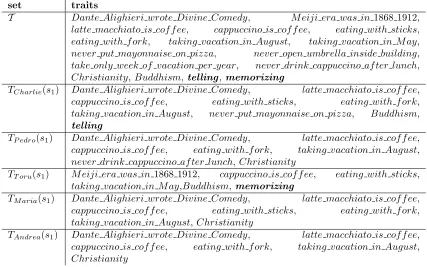
Table 3.3 lists the set of traits T, and the sets of traits of the specific agents of
Ag={Charlie, P edro, T oru, M aria, Andrea}.
We can write has(M aria, Dante Alighieri wrote Divine Comedy), or
has(Charlie,cappuccino is cof f ee), but not has(Andrea,eating with sticks). We will use this example as a running example through the section
Note that we do not introduce types of traits and use them in the example only for convenience. One might propose a different classification of traits, e.g. putting
trait type traits
knowledge Dante Alighieri wrote Divine Comedy(DA), latte macchiato is cof f ee(LM),
M eiji era was in1868 1912(M E),cappuccino is cof f ee(CI)
behavior eating with sticks(ES),eating with f ork(EF),taking vacation in August(T V A),
taking vacation in M ay(T V M)
norms, rules never put mayonnaise on pizza(N P),take only week of vacation per year(T1W),
never drink cappuccino af ter lunch(N D),never open umbrella inside building(N O) beliefs Christianity(Chr),Buddhism(Bud)
Table 3.2: The set of traitsT in Example 1.
set traits
T Dante Alighieri wrote Divine Comedy, latte macchiato is cof f ee,
M eiji era was in1868 1912,cappuccino is cof f ee,eating with sticks,eating with f ork,
taking vacation in August, taking vacation in M ay, never put mayonnaise on pizza,
take only week of vacation per year, never drink cappuccino af ter lunch,
never open umbrella inside building,Christianity,Buddhism
TCharlie Dante Alighieri wrote Divine Comedy, latte macchiato is cof f ee,
cappuccino is cof f ee, eating with sticks, eating with f ork, taking vacation in August,
never put mayonnaise on pizza,Buddhism
TP edro Dante Alighieri wrote Divine Comedy,latte macchiato is cof f ee,cappuccino is cof f ee,
eating with f ork, taking vacation in August, never drink cappuccino af ter lunch,
Christianity
TT oru M eiji era was in1868 1912, cappuccino is cof f ee, eating with sticks,
taking vacation in M ay,Buddhism
TM aria Dante Alighieri wrote Divine Comedy,latte macchiato is cof f ee,cappuccino is cof f ee,
eating with sticks,eating with f ork,taking vacation in August,Christianity
TAndrea Dante Alighieri wrote Divine Comedy,latte macchiato is cof f ee,cappuccino is cof f ee,
eating with f ork,taking vacation in August,Christianity
Charlie T oru
M aria
Andrea
P edro CI, ES, Bud
DA,LM,CI,ES,EF,TVA
DA,LM,CI,EF,TVA
DA,LM,CI,EF,TVA CI,ES
CI
CI
DA,LM,CI,EF,TVA,Chr
DA,LM,CI,EF,TVA,Chr
DA,LM,CI,EF,TVA,Chr
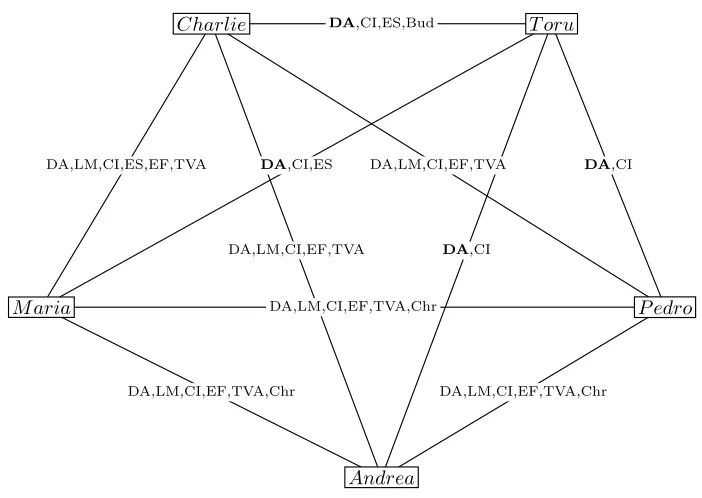
Figure 3.1: The graph showing for which agents and traits the predicate sharing holds in Ex-ample 1. The nodes are agents and labels on each edge denote traits that are shared by the pair of agents connected by the edge. For instance, the edge between T oru and Andrea labeled
CI means that sharing(Andrea, T oru, cappuccino is cof f ee). The traits are abbreviated as in Ta-ble 3.2, i.e., Dante Alighieri wrote Divine Comedy is abbreviated as DA, latte macchiato is cof f ee
as LM, cappuccino is cof f ee as CI, eating with sticks as ES, eating with f ork as EF,
taking vacation in Augustas T V A,Christianityas Chr,Buddhismas Bud.
Definition 1 (sharing) For each pair of agents ai, aj ∈Ag and for each trait τ ∈ T, ai
and aj share the trait τ iff they both have such a trait:
has(ai, τ)∧has(aj, τ)↔sharing(ai, aj, τ).
Example 1 (continued). In the example, we can write sharing(T oru, M aria, eating with sticks), or sharing(P edro, Andrea, cappuccino is cof f ee), etc. To avoid giving the complete list of tuples for which sharing holds, we represent them as a graph where nodes are agents and labels on each edge denote traits that are shared by the pair of agents connected by the edge, see Figure 3.1.
We can represent the restriction of sharing to specific agents and traits, like the set {(ai, aj, τ)|τ = cappuccino is cof f ee, ai, aj ∈ {Charlie, T oru, M aria, Andrea, P edro}}
as in Figure 3.2. This figure shows how one trait,cappuccino is cof f ee, is shared by the set of agents.
Let us assume that if an agent ai has a trait τ, the trait τ can be transmitted to
another agentaj and we use the predicate transmitted(ai, aj, τ) to represent this.
Axiom 1 ∀ai, aj ∈Ag, ∀τ ∈ T : transmitted(ai, aj, τ)→sharing(ai, aj, τ)
Note that the axiom does not necessarily imply that if has(ai, τ) and has(aj, τ) then
transmitted(ai, aj, τ). We represent transmitted(ai, aj, τ) in a graph by a directed edge
Charlie T oru
M aria
Andrea
P edro
CI
CI
CI
CI CI
CI
CI
CI
CI
CI
Figure 3.2: The graph that shows for which agents the sharing predicate holds for the
cappuccino is cof f ee(CI) trait in Example 1.
Charlie T oru
M aria
Andrea
P edro
ES
DA
DA ES
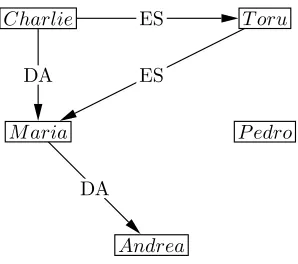
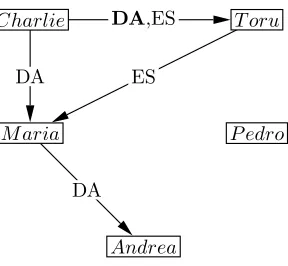
Figure 3.3: The graph representing the transmitted predicate. Each edge shows direction of the trans-mission of the trait in the label.
Example 1 (continued). Figure 3.3 shows the graph representing the transmitted
predicate in our example. The traits Dante Alighieri wrote Divine Comedy and
eating with stickshave been transmitted. On the contrary, the traitscappuccino is cof f ee
and never put mayonnaise on pizza have not been transmitted (the latter trait is not even shared by any pair of agents). In particular, theDante Alighieri wrote Divine Comedy
trait has been transmitted from Charlie to M aria, and from M aria to Andrea. Also, theeating with stickstrait has been transmitted fromCharlietoT oruand fromT oruto
M aria. We can writetransmitted(Charlie, M aria,Dante Alighieri wrote Divine Comedy). We can represent a restriction of transmitted to the set {(ai, aj, τ)|ai, aj ∈ {Charlie,
T oru,M aria,Andrea,P edro}, τ =Dante Alighieri wrote Divine Comedy}as shown in
Figure 3.4.
Given a set of agentsG⊆Agand a set of traitsTG ⊆ T we define the notions ofweak
sharing and strong sharing.
Definition 2 (weak sharing) A set of traits TG is weakly shared by a set of agents G
Charlie T oru
M aria
Andrea
P edro
DA
DA
Figure 3.4: The transmission of theDante Alighieri wrote Divine Comedy(DA) trait.
Definition 3 (strong sharing) A set of traits TG is strongly shared by a set of agents
G iff each trait τ ∈TG is shared by all pairs of agents ai, aj ∈G.
Example 1 (continued). Let us consider two sets of traitsTG={cappuccino is cof f ee,
eating with sticks,Dante Alighieri wrote Divine Comedy}, TG0 ={cappuccino is cof f ee}, and the set G = {Charlie, T oru, M aria, Andrea, P edro}. Using the sharing predicate represented in Figure 3.1, we can see that thecappuccino is cof f eetrait is shared by each pair of agents, soTG0 is strongly shared byG. TGcontains three traits that are shared by at
least one pair of agents: e.g., cappuccino is cof f ee, eating with sticks shared by T oru
and Charlie, Dante Alighieri wrote Divine Comedy shared by Charlie and Andrea. So, TG is weakly shared byG.
Property 1 Strong sharing implies weak sharing.
Proof. Strong sharing of a set of traits TG by a set of agents G means that for each
τ ∈ TG all pairs of agents ai, aj ∈ G share τ. Thus, the condition for weak sharing, i.e.
existence of one pair of agents ai, aj ∈G, ai 6=aj that share τ is fulfilled.
Given a set of agents G ⊆ Ag such that |G| ≥ 2, and a transmitted predicate we introduce the notion of culture ofG.
Definition 4 (culture of a set of agents) A non-empty set of traits TG⊆ T is a
cul-ture of G iff
• the set TG is weakly shared byG,
• for each trait τ ∈ TG there exists an agent a ∈ Ag that transmitted τ to another
agent aj ∈G, i.e. transmitted(a, aj, τ),
• for each agent a ∈G there exists a trait τ ∈TG such that has(a, τ).
In other words, for a set of agents, a culture is defined as a set of transmitted traits weakly shared by agents, and each agent has at least one trait in the culture. Please, note that since the traits are transmitted not necessarily within the set, the transmission alone does not ensure sharing between the agents of G.
Example 1 (continued). Considering G={Charlie, T oru, M aria, Andrea, P edro}
and thetransmittedpredicate as in Figure 3.3,TG0 ={cappuccino is cof f ee}is not a cul-ture because thecappuccino is cof f eetrait has not been transmitted. The same holds for
TG={Dante Alighieri wrote Divine Comedy,cappuccino is cof f ee,eating with sticks}
because it contains the cappuccino is cof f ee trait. On the other hand, the set TG00 = {Dante Alighieri wrote Divine Comedy,eating with sticks}is a culture since the traits
Dante Alighieri wrote Divine Comedy and eating with sticks have been transmitted (from M ariato Andreaand from T orutoM aria, respectively), TG00 is weakly shared by
G and each agent has at least one trait in TG00 (T oru has eating with sticks, and others have Dante Alighieri wrote Divine Comedy).
Let us consider a set G0 = {P edro, M aria}, and the set TG0 ={eating with sticks}.
Although the trait eating with sticks has been transmitted to M aria, it is not a culture of G0, becauseT
G0 is not a weakly shared by G0.
Taking G00 = {Charlie, M aria}, T
G00 = {eating with sticks} is a culture, because
even that it has not been transmitted within the set, it has been transmitted to M aria
from outside, it is shared by the set, and each agent has the eating with sticks trait. Considering G000 ={Charlie, M aria, Andrea, P edro}, TG000 ={cappuccino is cof f ee, Dante Alighieri wrote Divine Comedy}is not a culture, because thecappuccino is cof f ee
trait has not been transmitted. The setTG0000 ={Dante Alighieri wrote Divine Comedy}
is a strong culture since theDante Alighieri wrote Divine Comedytrait has been trans-mitted (e.g. fromCharlie toM aria), is owned by each agent, and the setTG0000 is strongly
shared by G000.
Property 2 Given a set of agents G⊆Ag andTG, a culture of G, it is possible to find a
non-empty set G0 ⊆G and a non-empty set TG0 such that TG0 is a strong culture of G0.
Proof. If |G| = 2 then all traits that are weakly shared are also strongly shared and
TG0 = TG is a strong culture of G0 = G. Otherwise, let us consider G 0
0 = {a1, a2},
wh