The influence of mowing regime on the soil seed bank
of the invasive plant Ambrosia artemisiifolia L.
Ivana Milakovic1, Gerhard Karrer1
1 Institute of Botany, Department of Integrative Biology and Biodiversity Research, University of Natural Re-sources and Life Sciences, Gregor Mendel Strasse 33, 1180 Vienna, Austria
Corresponding author: Ivana Milakovic ([email protected])
Academic editor: M. Rejmanek | Received 13 October 2015 | Accepted 26 November 2015 | Published 8 January 2016
Citation: Milakovic I, Karrer G (2016) The influence of mowing regime on the soil seed bank of the invasive plant
Ambrosia artemisiifolia L. NeoBiota 28: 39–49. doi: 10.3897/neobiota.28.6838
Abstract
Ambrosia artemisiifolia is an invasive annual herb infamous for the high allergenicity of its pollen, which is related to increasing medical costs. Additionally, it can cause serious yield losses as agricultural weed. Common ragweed seeds accumulate in the soil and can remain therein viable for decades, which poses a problem for the sustainable management of these populations. A long term management should thus target a reduction of the soil seed bank. We observed the influence of four different mowing regimes on the ragweed soil seed bank at six roadside populations in eastern Austria. The mowing regimes were based on methods from common roadside management practice and specifically adapted to reduce seed produc-tion. After three years of application, the soil seed bank was indeed reduced by 45 to 80 percent through three of the four mowing regimes tested. Therefore, we suggest that the best mowing regime for the most effective reduction of the size of the soil seed bank is the one consisting of one cut just after the beginning of female flowering (around the 3rd week of August in Eastern Central Europe), followed by a second cut 2–3 weeks later.
Keywords
Common ragweed, invasive plant, management, mowing, roadside vegetation, seed bank, neophyte
Introduction
Invasive alien species (IAS) are evident threats to local and regional biodiversity (McGeoch et al. 2010, Vilá et al. 2010, SBSTTA 2014). Additionally, many IAS have severe economic impact (Jeschke et al. 2014) either as weeds that reduce agricultural
Copyright Ivana Milakovic, Gerhard Karrer. This is an open access article distributed under the terms of the Creative Commons Attribution License (CC BY 4.0), which permits unrestricted use, distribution, and reproduction in any medium, provided the original author and source are credited.
yield (Oerke 2006) or by endangering human health (Reinhardt 2003, Salo et al. 2011). Control and eradication of IAS is of increasing importance for diversity conservation and environmental health (Pyšek et al. 2007, Shine et al. 2009, Smith et al. 2013).
Common ragweed (Ambrosia artemisiifolia) is an annual IAS, growing on disturbed sites like roadsides, fields, riversides and gardens. It is feared for the allergenic prop-erties of its pollen, as well as a weed in agriculture, in both instances related to high financial costs (Coble et al. 1981, Buttenschøn et al. 2009, Rosenbaum et al. 2011, Smith et al. 2013). A. artemisiifolia is native to North-America and currently spread-ing through Europe and Asia (Kazinczi et al. 2008). In Europe, preferred habitats are summer crop fields in summer warm climates, but also ruderal places and roadsides.
The plant reproduces exclusively by seeds. One individual can produce up to 62000 seeds in North-America (Dickerson and Sweet 1971) or up to 18000 in Europe (Fu-manal 2007). Ragweed seeds can enter primary dormancy and germinate next spring, or enter secondary dormancy after failure to germinate in spring (Bazzaz 1970, Baskin and Baskin 1980) and remain dormant in the soil seed bank for up to 39 years (Toole and Brown 1946). Ragweed dormancy is broken by stratification (Bazzaz 1970).
The persistent soil seed bank of A. artemisiifolia compromises the efficacy of any kind of control measure. Even if a control option succeeds in killing green plants aboveground, some part of the population remains dormant in the soil awaiting more favorable conditions to germinate. Another disadvantage of a persistent soil seed bank is that it acts as a source of further spreading of the weed in soil containments (Naw-rath and Alberternst 2013, Karrer 2014). Soil is relocated from many habitats where the plant is growing, such as construction sites or roadsides to other sites. Therefore, aim of any sustainable long-term control of common ragweed should be a reduction of the soil seed bank in established populations.
Milakovic et al. (2014a and 2014b) and Bohren et al. (2008) found that seed pro-duction per plant could be influenced by carefully timed mowing. This study’s goal is to test the effect of different cutting regimes applied for three years (Milakovic et al. 2014a) on the quantity and quality of the ragweed soil seed bank.
Regrowth of ragweed after mowing is well-documented (Barbour and Meade 1981, Bohren et al. 2005, Bohren et al. 2008, Meiss et al. 2008, Karrer et al. 2011, Patracchini et al. 2011, Simard and Benoit 2011, Tokarska-Guzik et al. 2011) and varies with season (Milakovic et al. 2014b). Timing and frequency of cutting has specific influences on the seed production of ragweed (Simard and Benoit 2011, Milakovic et al. 2014a). Higher ranked resprouts after cuts tend to produce only female flowers (Karrer et al. 2011) and, in consequence, preferably seeds that are incorporated into the soil seed bank.
The effects of different tillage systems were analyzed with respect to the composi-tion of the soil seed bank of arable fields (Clements et al. 1996, Buhler et al. 1997, Cardina et al. 2000, Clay et al. 2006). Up to now, no study has considered the soil seed bank of ragweed for measuring the success of control options, even though the seeds in the soil make up a great portion of the population in annual weeds with a persistent soil seed bank. In this study, we used the soil seed bank of ragweed popula-tions as long-term efficacy measure of non-chemical control oppopula-tions. We varied the mowing regime of ragweed roadside populations in Austria with respect to timing and frequency (Milakovic et al. 2014a) and analyzed the soil seed bank of ragweed at the beginning and at the end of the experiment.
Methods
We sampled the soil seed bank of six roadside populations in Eastern Austria before and after three years of application of management practices. Austrian arterial road verges are cut at least two times a year; a first cut in spring and a second cut between July and October. This resulted in a significant spread of common ragweed along arte-rial roads since 2000 (Karrer et al. 2011, Essl et al. 2009).
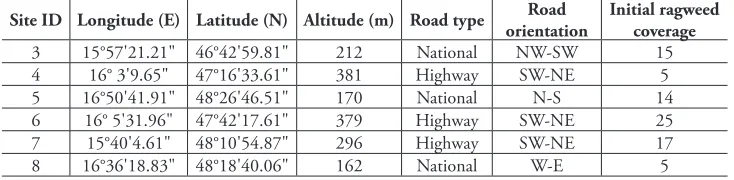
The cutting experiment was set up in 2009 in the heavily infested parts of Austria (Lower Austria, Styria and Burgenland) (Table 1). All populations have been natural-ized for about one or two decades before the experiment.
Experimental design:
On each site, five experimental plots were installed on continuous spontaneous popu-lations of A. artemisiifolia with coverages ranging from 5 to 25%. The plots were ar-ranged along a line of 100 m, adjacent and parallel to the asphaltic surface of highways or arterial roads. Each plot sized 20 × 0.5 m and received one of the following treat-ments (mowing regimes), as defined in Milakovic et al. (2014a):
Treatment 1: not mown (control),
Treatment 2: first cut before the start of flowering (the last week of June), and second cut at the beginning of seed set (second week of September). Treatment 2 resem-bles the common roadside cutting regime in eastern Austria.
Treatment 3: first cut after the beginning of female mass flowering (third week of August), and second cut at the beginning of seed set (second week of September), Treatment 4: first cut before the start of flowering (last week of June), second cut
before the onset of male mass flowering (last week of July), and third cut at the beginning of seed set (second week of September),
Soil seed bank sampling
All sites have been sampled for soil seed bank before the start of the mowing experi-ment in spring 2009 and after three years of the experiexperi-ment in spring 2012. The sam-pling was always performed just before or at the very start of the germination period in the field. First sampling was done in March 2009 preceding the different treatment of the plots: 20 soil cores (depth 7cm, 285cm³, equally distributed over 100m of the experiment plot) were taken at each site. After three years of applying the various treat-ments, in March 2012, 19 soil cores were taken per plot on each site.
The soil cores were analyzed for ragweed seed content using a wet sieving ma-chine (Retsch). We counted all intact seeds and put them into wetted Petri dishes. In order to detect the proportion of viable seeds, first germination was induced by putting them into climate chambers at the following conditions: daylight for 8 hours at 30 °C and darkness for 16 hours at 15 °C. We stopped the germination trial after 4 weeks, left the dishes for drying out and stored them for 4 weeks at +4 °C in darkness, in order to overcome secondary dormancy by additional stratifi-cation. Afterwards, a second germination period was started at the same conditions like in the first session.
All seeds that did not germinate within the second germination session were tested for vitality by a standard staining (TTC-test with 1 % solution of 2,3,5 triphenyl tetra-zolium chloride in pure water). For that, Ambrosia-achenes were first imbibed in tap water at room temperature for 24 hours. The achenes were then cut open with a scalpel to expose the embryo. The bigger part of the achene was used for testing, the other part was discarded. Achene halves were put into petri dishes, covered with TTC solution and left at 30 °C for 6 hours in absolute darkness. Finally seeds were evaluated under a dissecting microscope. All fully stained seeds were classified vital.
The soil seed bank samples in 2009 were taken from the whole sites that where covered consistently with A. artemisiifolia, and can therefore be used as baseline data for comparison to the soil seed bank counting at the differently treated plots three years later. That way, it is possible to observe the effect of the tested mowing regimes on the soil seed bank after three years of application.
Table 1. Location (coordinate system WGS84) and habitat characteristics (road type, road orientation, initial ragweed coverage (%)) of the experimental sites along arterial roads in Austria.
Site ID Longitude (E) Latitude (N) Altitude (m) Road type orientationRoad Initial ragweed coverage
Data were analyzed by GLM (generalized linear model) using Poisson distribu-tion procedures and a log link in the package Statistica 10 (StatSoft 2011). Treatment was included in the model as independent categorical factor and seed number per m2
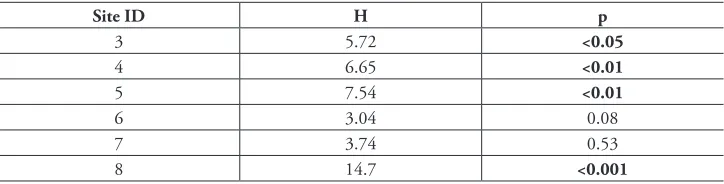
as dependent variable. Pairwise differences between treatments were judged at 95% confidence intervals. We compared the overall most effective treatment with the initial seed bank of the populations of each site by Kruskal-Wallis Tests.
Results
Soil seed bank at different sites
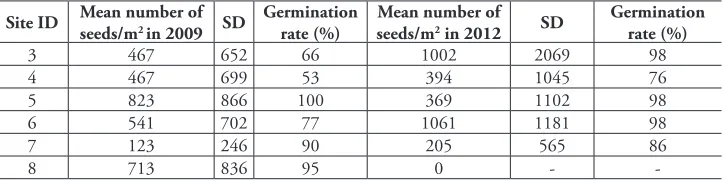
In 2009, soil seed bank varied from 123 to 823 (522 in average) seeds per m² at all sites (Table 2), with germination rates varying from 53 to 100% (mean 80%). In 2012, soil seed bank at different sites varied from 0 to 1061 seeds per m². The germination rates were generally very high (mean 91%). From the 2012 samples, no seeds germinated during the second germination test, and no living seeds could be detected by the subsequent TTC test.
Soil seed bank in different treatments
After 3 years of applying different mowing regimes, significant differences in the soil seed bank under different treatments were found (Wald χ2 (5) = 188795; p ≤ 0,01).
The soil seed bank of treatment 1 (control, unmown) was three times higher than the soil seed bank of the population before the experiment (Figure 1). The soil seed bank of treatment 2 did not differ significantly from the soil seed bank of the population in 2009 (Figure 1). The soil seed bank of the treatments 3, 4 and 5 decreased by ca. 80%, 60% and 45%, respectively, compared to the magnitude order before the experiment (Figure 1). Efficacy of treatment 3 is obviously highest in controlling the ragweed populations sustainably. The soil seed bank decreased on all sites on the plots of treat-ment 3 (Figure 2), at most sites significantly (Table 3).
Table 2. Number of Ambrosia artemisiifolia seeds per m2 (means and standard deviation (SD) calculated from 20 soil cores) in spring 2009 and in spring 2012 (calculated from 95 cores) at six experimental sites.
Site ID Mean number of seeds/m2 in 2009 SD
Germination
rate (%) seeds/mMean number of 2 in 2012 SD
Germination rate (%)
3 467 652 66 1002 2069 98
4 467 699 53 394 1045 76
5 823 866 100 369 1102 98
6 541 702 77 1061 1181 98
7 123 246 90 205 565 86
-Figure 1. Means and confidence intervals of the number of seeds of Ambrosia artemisiifolia per m² (depth 7cm) after 3 years of different mowing treatments (1–5) in 2012 compared to the soil seed bank of the population before the experiment in 2009 (“Treatment” 0 = baseline)
Discussion
The number of ragweed seeds per m2 found in populations along Austrian roadsides
before the start of treatments in 2009 indicate that those are all well-established popu-lations that cannot be controlled by a one time management action. The aboveground assimilating part of the A. artemisiifolia population varied between the sites at the be-ginning of the experiment (Table 1) but showed similar dynamics to the soil seed bank towards the end of the experiment. Compared to the soil seed bank of other ruderal habitats (waste lands and set-asides) our roadside populations showed relative low seed densities. Fumanal et al. (2008) describe seed densities ranging from 510–3324 seeds per m² in the upper 5 cm of soil. This indicates that the Austrian roadside populations are relatively young but ‘active’ populations. Corresponding to the high population turnover rates, most seeds accumulate in the uppermost soil layer and germinate at high rates to produce many new seeds every generation. The fraction of old seeds from former population establishment phases that might have lower germination rates, seems to be relatively low as the overall germination rates of the seeds in the soil is considerably high (Table 2).
The seed bank densities of ragweed along Austrian highways are generally lower than in European arable fields (Vitalos and Karrer 2008). Habitat types that have been infested by ragweed for decades, like abandoned fields in N-America, have a load of 0–200 ragweed seeds per m² even when sampling only the persistent soil seed bank in summer (Rothrock et al. 1993). Bigwood and Inouye (1988) found on average 36 ragweed seeds per m2 in the upper soil (0–8 cm) and 57.6 seeds per m2 at a depth of
8–16 cm in an old field in Maryland (US). Raynal and Bazzaz (1973) counted means of 64 ragweed seeds per m2 in maize fields on former forest soil and 4.8 seeds per m2
on former prairie soil, when analyzing the upper soil (0–5 cm) in early spring; autumn samples did not contain ragweed seeds. Considering that the Austrian ragweed seed populations along highways are concentrated at the upper horizons of the road shoul-der soil, they can be classified as very active and contribute to an increasing infestation. Because most management options act on the green parts of the plant, they are not sustainable. The most desired aspect of ragweed control is the successful elimination of persistent seeds from the soil. The results of this long term experiment show, that the Table 3. Kruskal-Wallis test for the differences between the soil seed bank (seeds per m2) in plots of treatment 3 in 2012 and the soil seed bank of the respective populations in 2009, differentiated by sites.
Site ID H p
3 5.72 <0.05
4 6.65 <0.01
5 7.54 <0.01
6 3.04 0.08
7 3.74 0.53
soil seed bank can be diminished vigorously by a sophisticated mowing management. The mowing regime should consist of a first cut in August, just at the first appearance of female flowers, and a second cut in early September, just before fertility of the fe-male flowers on the regrowth from the base (Milakovic et al. 2014a). According to our results, we suggest to rate this mowing regime as the most sustainable and environmen-tally friendly control option, because it progressively leads to indirect depletion of the soil seed bank. This way the ragweed populations decline and can be managed easier. Hence the biologically most effective control measure of pulling out the remaining few plants by hand (Bohren et al. 2008) might become economically feasible.
We advise analyzing the soil seed bank of ragweed before installing a field experi-ment or defining a manageexperi-ment regime for ragweed control, as well as after the activ-ity. Thus sustainability can be proven. The knowledge about the status of soil seed bank is particularly important for ragweed populations growing on roadsides, as the upper soil is prone to transportation elsewhere, which contributes to further dispersal of ragweed seeds and creates new populations.
Acknowledgement
We would like to thank the Austrian road authorities and ASFINAG for supporting us by co-operating in mowing of the experimental plots. Furthermore, we cordially thank Prof. Konrad Fiedler for statistical advice and Irene Karrer for language revising.
Financial support
The project was financially supported by the National Research Fund Luxembourg (I.M., Grant number PHD-09-010), the Austrian Ministry of Agriculture, Forestry, Environment and Water, eight Federal State Governments of Austria, as well as the Euro-pean Commission, DG Environment (Grant Agreement No. 07.0322/2010/586340/ SUB/B2). Additionally, we acknowledge support from EU COST Action FA1203 “Sustainable management of Ambrosia artemisiifolia in Europe” (SMARTER).
References
Barbour BM, Meade JA (1981) The effects of cutting date and height on anthesis of common ragweed (Ambrosia artemisiifolia L.). Proceedings of the Annual Meeting Northeast Weed Science Society 35: 82–86.
Baskin JM, Baskin CC (1980) Ecophysiology of secondary dormancy in seeds of Ambrosia artemisiifolia. Ecology 61: 475–480. doi: 10.2307/1937410
Bassett IJ, Crompton CW (1975) The biology of Canadian weeds 11 – Ambrosia artemisiifolia
Bazzaz FA (1970) Secondary dormancy in the seeds of the common ragweed Ambrosia arte-misiifolia. Bulletin of the Torrey Botanical Club 97: 302–305. doi: 10.2307/2483650 Bigwood DW, Inouye DW (1988) Spatial pattern analysis of seed banks: an improved method
and optimized sampling. Ecology 69: 497–507. doi: 10.2307/1940448
Bohren C, Delabays N, Mermillod G, Keimer C, Kündig C (2005) Ambrosia artemisiifolia
in der Schweiz–eine herbologische Annäherung. AgrarForschung 12: 71–78. http://www. agrarforschungschweiz.ch/archiv_11de.php?id_artikel=933
Bohren C, Delabays N, Mermillod G, Baker A, Vertenten J (2008) Ambrosia artemisiifolia L: Optimieren des Schnittregimes. Agrarforschung 15: 308–313. http://www.agrarforschun-gschweiz.ch/artikel/2008_07_1393.pdf
Buhler DD, Hartzler RG, Forcella F (1997) Implications of weed seedbank dynamics to weed management. Weed Science 45: 329–336. http://www.jstor.org/stable/4046027
Buttenschøn RM, Waldispühl S, Bohren C (2009) Guidelines for management of common ragweed, Ambrosia artemisiifolia. http://xwww.agrsci.dk/ambrosia/outputs/ambrosia_eng. pdf [last accessed March 2015]
Cardina J, Herms CP, Doohan DJ (2000) Crop rotation and tillage system effects on weed seedbanks. Weed Science 50: 448–460. doi: 10.1614/0043-1745(2002)050[0448:CRA TSE]2.0.CO;2
Clements DR, Benott DL, Murphy SD, Swanton CJ (1996) Tillage effects on weed seed re-turn and seedbank composition. Weed Science 44: 314–322. http://www.jstor.org/sta-ble/4045684
Coble HD, Williams FM, Ritter RL (1981) Common Ragweed (Ambrosia artemisiifolia) In-terference in Soybeans (Glycine max). Weed Science 29: 339–342. http://www.jstor.org/ stable/4043252
Clay SA, Kreutner B, Clay DE, Reese C, Kleinjan J, Forcella F (2006) Spatial distribution, temporal stability, and yield loss estimates for annual grasses and common ragweed ( Am-brosia artimisiifolia) in a corn/soybean production field over nine years. Weed Science 54: 380–390. doi: 10.1614/WS-05-090R1.1
Dickerson CT (1968) Studies on the germination, growth, development and control of com-mon ragweed (Ambrosia artemisiifolia L.). Dissertation, Cornell Univ. Ann Arbour, Mich-igan.
Dickerson CT, Sweet RD (1971) Common ragweed ecotypes. Weed Science 19: 64–66. http://www.jstor.org/stable/4041819
Essl F, Dullinger S, Kleinbauer I (2009) Changes in the spatiotemporal patterns and habitat preferences of Ambrosia artemisiifolia during its invasion of Austria. Preslia 81: 119–133. www.preslia.cz/P092Essl.pdf
Fumanal B, Chauvel B, Bretagnolle F (2007) Estimation of pollen and seed production of common ragweed in France. Annals of Agricultural and Environmental Medicine 14: 233–236. http://www.aaem.pl/pdf/14233.pdf
Jeschke JM, Bacher B, Blackburn TM, Dick JTA, Essl F, Evans T, Gaertner M, Hulme PE, Kühn I, Mrugala A, Pergl J, Pyšek P, Rabitsch W, Ricciardi A, Richardson DM, Sendek A, Vilà M, Winter M, Kumschick S (2014) Defining the impact of non-native species. Conservation Biology 28: 1188–1194. doi: 10.1111/cobi.12299
Karrer G, Milakovic I, Kropf M, Hackl G, Essl F, Hauser M, Mayer M, Blöch C, Leitsch-Vitalos M, Dlugosch A, Hackl G, Follak S, Fertsak S, Schwab M, Baumgarten A, Gansberger M, Moosbeckhofer R, Reiter E, Publig E, Moser D, Kleinbauer I, Dull-inger S (2011) Ausbreitungsbiologie und Management einer extrem allergenen, ein-geschleppten Pflanze – Wege und Ursachen der Ausbreitung von Ragweed (Ambro-sia artemisiifolia) sowie Möglichkeiten seiner Bekämpfung. Final report, BMLFUW, Wien, 329 pp.
Karrer G (2014) Das österreichische Ragweed Projekt – übertragbare Erfahrungen? Julius-Kühn-Archiv 445: 27–33. doi: 10.5073/jka.2013.445.003
Kazinczi G, Béres I, Novák R, Bíró K (2008) Common ragweed (Ambrosia artemisiifolia L.): A review with special regards to the results in Hungary: I. Taxonomy, origin and distribu-tion, morphology, life cycle and reproduction strategy. Herbologia 9: 55–91.
McGeoch MA, Butchart SHM, Spear D, Marais E, Kleynhans EJ, Symes A, Chanson J, Hoff-mann M (2010) Global indicators of biological invasion: species numbers, biodiversity im-pact and policy responses. Diversity and Distributions 16: 95–108. doi: 10.1111/j.1472-4642.2009.00633.x
Meiss H, Munier-Jolain N, Henriot F, Caneill J (2008) Effects of biomass, age and functional traits on regrowth of arable weeds after cutting. Journal of Plant Diseases and Protection XXI: 493–499. https://www.researchgate.net/publication/230691479_Effects_of_bio-mass_age_and_functional_traits_on_regrowth_of_arable_weeds_after_cutting
Milakovic I, Fiedler K, Karrer G (2014a) Management of roadside populations of invasive Am-brosia artemisiifolia by mowing. Weed Research 54: 256–264. doi: 10.1111/wre.12074 Milakovic I, Fiedler K, Karrer G (2014b) Fine tuning of mowing regime, a method for the
management of the invasive Ambrosia artemisiifolia L. at different population densities. Weed Biology and Management 14: 232–241. doi: 10.1111/wbm.12051
Nawrath S, Alberternst B (2013) Aktionsprogramm Ambrosia-Bekämpfung in Bayern: Ergeb-nisse aus sechs Jahren Monitoring. ANLiegen Natur 35: 44–58. http://www.anl.bayern. de/publikationen/anliegen/doc/an35205nawrath_et_al_2013_ambrosia.pdf [last accessed March 2015]
Oerke EC (2006) Crop losses to pests. Journal of Agricultural Science 144: 31–43. doi: 10.1017/S0021859605005708
Patracchini C, Vidotto F, Ferrero A (2011) Common ragweed (Ambrosia artemisiifolia) growth as affected by plant density and clipping. Weed Technology 25: 268–276. doi: 10.1614/ WT-D-09-00070.1
Pyšek P, Cock MJW, Nentwig W, Ravn HP (2007) Ecology and Management of Giant Hogweed (Heracleum mantegazzianum). CABI International, Wollingford, 352 pp. doi: 10.1079/9781845932060.0000
Reinhardt F, Herle M, Bastiansen F, Streit B (2003) Economic Impact of the Spread of Alien Species in Germany. Environmental Research of the Federal Ministry of the Environment, Nature Conservation and Nuclear Safety, Research Report 201 86 211 UBA-FB 000441e, Texte Nr. 80/2003. Federal Environmental Agency (Umweltbundesamt), Berlin, 229 pp. Rosenbaum KK, Bradley KW, Roberts CA (2011) Influence of Increasing Common Ragweed
(Ambrosia artemisiifolia) or Common Cocklebur (Xanthium strumarium) Densities on For-age Nutritive Value and Yield in Tall Fescue Pastures and Hay Fields. Weed Technology 25: 222–229. doi: 10.1614/WT-D-10-00114.1
Rothrock PE, Squiers ER, Sheeley S (1993) Heterogeneity and size of a persistent seedbank of
Ambrosia artemisiifolia L. and Setaria faberi Herrm. Bulletin of the Torrey Botanical Club 120: 417–422. doi: 10.2307/2996745
Salo PM, Calatroni A, Gergen PJ, Hoppin JA, Sever ML, Jaramillo R, Arbes SJ, Zeldin DC (2011) Allergy-related outcomes in relation to serum IgE: results from the National Health and Nutrition Examination Survey 2005–2006. Journal of Allergy and Clinical Immunology 127: 1226–1235. doi: 10.1016/j.jaci.2010.12.1106
SBSTTA (Subsidiary Body on Scientific, Technical and Technological Advice of the CBD) (2014) Review of work on invasive alien species and considerations for future work. SBST-TA 18 Recommendation XVIII/6: http://www.cbd.int/recommendation/sbstta/default. shtml?id=13331 [last accessed March 2015]
Shine C, Kettunen M, ten Brink P, Genovesi P, Gollasch S (2009) Technical support to EU strategy on invasive alien species (IAS) Recommendations on policy options to minimize the negative impacts of invasive alien species on biodiversity in Europe and the EU. Fi-nal report for the European Commission, Institute for European Environmental Policy (IEEP), Brussels, Belgium, 35 pp.
Simard M-J, Benoit DL (2011) Effect of repetitive mowing on common ragweed (Ambrosia artemisiifolia L.) pollen and seed production. Annals of Agricultural and Environmen-tal Medicine 18: 55–62. http://agro.icm.edu.pl/agro/element/bwmeta1.element.agro-cd-4c08b7-27dc-439d-a420-995a9de0669a/c/fulltext-8.pdf
Smith M, Cecchi L, Skjøth CA, Karrer G, Šikoparija B (2013) Common ragweed: A threat to environmental health in Europe. Environment International 61: 115–126. doi: 10.1016/j. envint.2013.08.005
Tokarska-Guzik B, Bzdęga K, Koszela K, Żabińska I, Krzuś B, Sajan M, Sendek A (2011) Aller-genic invasive plant Ambrosia artemisiifolia L. in Poland: threat and selected aspects of biol-ogy. Biodiversity: Research and Conservation 21: 39–48. doi: 10.2478/v10119-011-0008-8 Toole HE, Brown E (1946) Final results of the Durvel buried seed experiment. Journal of
Agricultural Research 72: 201–210.
Vilà M, Basnou C, Pyšek P, Josefsson M, Genovesi P, Gollasch S, Nentwig W, Olenin S, Roques A, Roy D, Hulme PE, DAISIE partners (2010) How well do we understand the impacts of alien species on ecosystem services? A pan-European, cross-taxa assessment. Frontiers in Ecology and the Environment 8: 135–144. doi: 10.1890/080083