New insights into the taxonomy of tribe Euclidieae
(Brassicaceae), evidence from nrITS sequence data
Hongliang Chen1,2, Ihsan A. Al-Shehbaz3, Jipei Yue1, Hang Sun1
1 Key Laboratory for Plant Diversity and Biogeography of East Asia, Kunming Institute of Botany, Chinese Academy of Sciences, 132 Lanhei Road, Kunming, Yunnan 650201, China 2 University of Chinese Academy of Sciences, Beijing 100049, China 3 Missouri Botanical Garden, P.O. Box 299, St. Louis, Missouri 63166-0299, USA
Corresponding authors: Hang Sun ([email protected]); Jipei Yue ([email protected])
Academic editor:K. Marhold | Received 1 March 2018 | Accepted 1 May 2018 | Published 21 June 2018
Citation: Chen H, Al-Shehbaz IA, Yue J, Sun H (2018) New insights into the taxonomy of tribe Euclidieae (Brassicaceae), evidence from nrITS sequence data. PhytoKeys 100: 125–139. https://doi.org/10.3897/phytokeys.100.24756
Abstract
As currently delimitated, the species-rich mustard tribe Euclidieae DC. (Brassicaceae) comprises 28 genera and 152 species distributed primarily in Asia. To date, no tribe-wide comprehensive phylogenetic analysis has been conducted. In this study, sequence data from the nuclear ribosomal internal transcribed spacer (nrITS) region of 82 species in all 28 genera of Euclidieae were used to test its monophyly and infer inter- and intra-generic relationships within. Phylogenetic analyses revealed that Rhammatophyllum and
Sisymbriopsis are embedded within Solms-laubachia s.l., and Solms-laubachia lanuginosa (Eurycarpus lanu-ginosus) fell outside the tribe. Therefore, Solms-laubachia s.l. as currently recognized is not monophyletic and its generic delimitation needed further study. Besides, our results suggest that the genera Lepidostemon,
Neotorularia, and Tetracme are polyphyletic.
Keywords
Euclidieae, Brassicaceae, Cruciferae, Solms-laubachia, Phylogeny, nrITS
Introduction
The Brassicaceae (Cruciferae) includes 52 tribes, 341 genera, and 3,997 species (Bras-siBase: https://brassibase.cos.uni-heidelberg.de/, accessed 5 February 2018, Koch et al. 2012, Kiefer et al. 2014) distributed worldwide, primarily in the temperate regions
http://phytokeys.pensoft.net
Copyright Hongliang Chen et al. This is an open access article distributed under the terms of the Creative Commons Attribution License (CC BY 4.0), which permits unrestricted use, distribution, and reproduction in any medium, provided the original author and source are credited.
(Al-Shehbaz 1984, Al-Shehbaz et al. 2006). The family is academically and economi-cally important (Franzke et al. 2011, Al-Shehbaz 2012, Huang et al. 2016), as it con-tains the well-known model plant species Arabidopsis thaliana (L.) Heynh. and many crops (e.g., cabbage, cauliflower, turnip, rape, canola, radish, wasabi) and ornamentals (e.g., species of Lobularia Desv., Iberis L., Hesperis L., Matthiola W. T. Aiton). Al-though the family is easily recognized morphologically, it is often difficult to assign an individual plant to a given genus, and there are tremendous controversies on generic delimitations and tribal assignments (Al-Shehbaz et al. 2006, Al-Shehbaz 2012). The total number of tribes and genera they include varied among different systems. For example, Schulz (1936) and Janchen (1942) recognized 19 and 15 tribes, respectively. By contrast, others (e.g., Zhou et al. 2001, Appel and Al-Shehbaz 2003) adopted an alphabetical arrangement of genera. The use of molecular sequences to infer phyloge-netic relationships during the past two decades have greatly improved our understand-ing of the evolution within the Brassicaceae. That led Al-Shehbaz et al. (2006) to pro-pose the first phylogenetic tribal classification system based on prior molecular studies, especially the chloroplast ndhF sequences (Beilstein et al. 2006), and had since been expanded to include 52 tribes (Al-Shehbaz 2012, German and Friesen 2014, Chen et al. 2016). Generic boundaries had also been redefined, and studies on Solms-laubachia s.l. (Yue et al. 2006, 2008), Eutrema R. Br. (Al-Shehbaz and Warwick 2005), Microth-laspi F. K. Mey. (Ali et al. 2016), to name a few, demonstrate that trend.
The tribe Euclidieae DC. was established ca. 200 years ago (de Candolle 1821), and it has been accepted in subsequent tribal classifications, though the delimitation of its component genera remained controversial. Of the 14 genera recognized by Schulz (1936) in the tribe, only Euclidium W. T. Aiton and Lachnoloma Bunge were maintained by Al-Shehbaz (2012) (Table 1). As currently delimited (Warwick et al. 2007, Al-She-hbaz and German 2016, BrassiBase) (Table 1), the tribe comprises 28 genera and 152 species, including the species-rich Solms-laubachia Muschl. (33 spp.), Strigosella Boiss. (24 spp.), and Braya Sternb. & Hoppe (22 spp.), as well as 12 monospecific genera.
Because taxa sampling varied in previous studies, the interrelationships among genera of Euclidieae varied a great deal. In order to gain knowledge of phylogenetic relationship of the tribe, we conducted the first comprehensive study that included representatives of all genera.
Materials and methods
Plant materials and molecular data
Table 1.Three different taxonomic treatments and current delimitation of Euclidieae. Number of species included in the study and the total species number of the genus based on current delimitation (BrassiBase) are given in parentheses (sampled/total).
de Candolle (1821) Schulz (1936) Al-Shehbaz (2012) Current delimitation (BrassiBase)
Euclidium W. T. Aiton Anastatica L. Atelanthera Hook. f. & Thomson Anzhengxia A. German (1/1)Al-Shehbaz & D.
Ochthodium DC. Boreava Jaub. & Spach Braya Sternb. & Hoppe Atelanthera Thomson (1/1)Hook. f. &
Pugionium Gaertn.
Bunias L. Catenulina Soják Braya Sternb. & Hoppe (13/22) Euclidium W. T. Aiton Christolea Cambess. Catenulina Soják (1/ 1) Hymenophysa C. A. Mey. Cryptospora Kar. & Kir. Christolea Cambess. (1 /2)
Lachnoloma Bunge Cymatocarpus O. E. Schulz Cryptospora Kar. & Kir.(/3) Myagrum L. Dichasianthus Ovcz. & Yunussov Cymatocarpus(1/3) O. E. Schulz
Neslia Desv. Dilophia Thomson Dichasianthus Yunussov (1 /1)Ovcz. & Ochthodium DC. Euclidium W. T. Aiton Dilophia Thomson (1/2) Octoceras Bunge Lachnoloma Bunge Euclidium W. T. Aiton (1/1) Schimpera Hochst. &
Steud. ex Schimper Leiospora (C.A.Mey.) Dvořák Lachnoloma Bunge (1/1) Spirorhynchus Kar. & Kir. Lepidostemon Thomson Hook. f. & Leiospora (C.A.Mey.) Dvořák (5/8)
Tauscheria Fisch. ex DC. Leptaleum DC. Lepidostemon Thomson (2/6)Hook. f. &
Texiera Jaub. & Spach
Neotorularia Hedge & J. Léonard Leptaleum DC. (1/2) Octoceras Bunge Metashangrilaia & D. A. German (1/1)Al-Shehbaz
Pycnoplinthopsis Jafri NeotorulariaLéonard (4/6) Hedge & J. Pycnoplinthus O. E. Schulz Octoceras Bunge (1/1) Rhammatophyllum O. E. Schulz Pycnoplinthopsis Jafri (1 /1) Shangrilaia Al-Shehbaz, J. P. Yue
& H. Sun Pycnoplinthus (1/1)O. E. Schulz Sisymbriopsis Botsch. & Tzvelev RhammatophyllumSchulz (5/7) O. E.
Solms-laubachia Muschl. Rudolf-kamelinia & D. A. German (1/1)Al-Shehbaz
Spryginia Popov Shangrilaia Yue & H. Sun (1/1)Al-Shehbaz, J. P.
Streptoloma Bunge SisymbriopsisTzvelev (3/4) Botsch. &
Strigosella Boiss. Solms-laubachia (23/33)Muschl.
Tetracme Bunge
Spryginia Popov (2/7) Streptoloma Bunge (1/2)
Table 2.List of studied taxa including voucher information and GenBank accession numbers.
Taxon Geographical origin (Herbarium: KUN)Collection number GenBank accession No. Anzhengxia yechengnica (Z. X. An) Al-Shehbaz
& D. A. German
Pishan, Xinjiang YC-XZ111 MH237681 Yecheng, Xinjiang YC-XZ115 MH237682
Braya parvia (Z. X. An) Al-Shehbaz & D. A. German Aheqi, Xinjiang YC-XZ090 MH237683 Zhada, Xizang YC-XZ150 MH237684
Braya rosea Bunge Aketao, Xinjiang YC-XZ105 MH237685
Kunming, Yunnan SCSY-042 MH237686 Braya scharnhorstii Regel & Schmalh. Aketao, Xinjiang YC-XZ101 MH237687 Christolea crassifolia Cambess. Aketao, Xinjiang YC-XZ103 MH237688
Dilophia salsa Thomson Pishan, Xinjiang YC-XZ128 MH237689
Qumalai, Qinghai ZH645 MH237690
Euclidium syriacum (L.) W. T. Aiton Urumqi, Xinjiang YC-XZ076 MH237691
Eurycarpus lanuginosus (Hook. f. & Thomson) Botsch. Zhada, Xizang YC-XZ152
MH237692 MH237693 MH237694
Leiospora eriocalyx (Regel & Schmalh.) F. Dvořák Yecheng, Xinjiang YC-XZ122 MH237695 Pishan, Xinjiang YC-XZ125 MH237696
Leiospora pamirica (Botsch. & Vved.) Botsch. & Pachom. Aketao, Xinjiang YC-XZ102 MH237697 Aketao, Xinjiang YC-XZ104 MH237698 Lepidostemon rosularis (K. C. Kuan & Z. X. An)
Al-Shehbaz Cuona, Xizang ZJW3888 MH237699
Metashangrilaia forrestii (W. W. Sm.) Al-Shehbaz
& D. A. German Baqing, Xizang YZC227 MH237700
Pycnoplinthus uniflora (Hook. f. & Thomson) O. E.
Schulz Ritu, Xizang YC-XZ134 MH237701
Rudolf-kamelinia korolkowii (Regel & Schmalh.) Al-Shehbaz & D. A. German
Aheqi, Xinjiang YC-XZ089 MH237702 Aketao, Xinjiang YC-XZ107 MH237703 Shangrilaia nana Al-Shehbaz, J. P. Yue & H. Sun Shangrila, Yunnan CHY008 MH237704 Sisymbriopsis mollipila (Maxim.) Botsch. Yecheng, Xinjiang YC-XZ119 MH237705 Sisymbriopsis pamirica (Y. C. Lan & Z. X. An)
Al-Shehbaz, Z. X. An & G. Yang Aketao, Xinjiang YC-XZ100 MH237706 Sisymbriopsis schugnana Botsch. & Tzvelev Aketao, Xinjiang YC-XZ106 MH237707 Solms-laubachia angustifolia J. P. Yue, Al-Shehbaz &
H. Sun Daocheng, Sichuan YZC252 MH237708
Solms-laubachia baiogoinensis (K. C. Kuan & Z. X. An) J.
P. Yue, Al-Shehbaz & H. Sun Gongbujiangda, Xizang YZC195 MH237709 Solms-laubachia calcicola J. P. Yue, Al-Shehbaz & H. Sun Leiwuqi, Xizang YZC233 MH237710 Solms-laubachia eurycarpa (Maxim.) Botsch. Basu, Xizang YZC023 MH237711 Solms-laubachia himalayensis (Cambess.) J. P. Yue,
Al-Shehbaz & H. Sun
Ritu, Xizang YC-XZ130 MH237712 Zhada, Xizang YC-XZ151 MH237713 Solms-laubachia jafrii (Al-Shehbaz) J. P. Yue, Al-Shehbaz
& H. Sun
Lhasa, Xizang YZC214 MH237714
Jilong, Xizang NZ143 MH237715
Solms-laubachia kashgarica (Botsch.) J. P. Yue, Al-Shehbaz
Taxon Geographical origin (Herbarium: KUN)Collection number GenBank accession No.
Solms-laubachia lanata Botsch. Lhasa, Xizang YZC215 MH237717
Solms-laubachia linearlifolia (W. W. Sm.) O. E. Schulz Deqin, Yunnan YZC001 MH237718 Solms-laubachia linearis (N. Busch) J. P. Yue, Al-Shehbaz
& H. Sun Pishan, Xinjiang YC-XZ123 MH237719
Solms-laubachia mieheorum (Al-Shehbaz) J. P. Yue,
Al-Shehbaz & H. Sun Angren, Xizang YC-XZ160 MH237720
Solms-laubachia platycarpa (Hook. f. & Thomson) Botsch. Dangxiong, Xizang YZC216 MH237721 Solms-laubachia prolifera (Maxim.) J. P. Yue, Al-Shehbaz
& H. Sun Mangkang, Xizang YZC019 MH237722
Solms-laubachia pulcherrima Muschl. Lijiang, Yunnan ChenHongliang202 MH237723 Solms-laubachia retropilosa Botsch. Xiangcheng, Sichuan ChenHongliang209 MH237724 Solms-laubachia villosa (Maxim.) J. P. Yue, Al-Shehbaz
& H. Sun Yushu, Qinghai YZC239 MH237725
Solms-laubachia xerophyte (W. W. Sm.) H. F .Comber Shangrila, Yunnan YZC277 MH237726 Solms-laubachia zhongdianensis J. P. Yue, Al-Shehbaz
& H. Sun Shangrila, Yunnan CHY007 MH237727
Strigosella africana (L.) Botsch. Yecheng, XinjiangAltay, Xinjiang YC-XZ031YC-XZ117 MH237728MH237729
L. (Buniadeae), Clausia aprica (Stephan ex Willd.) Korn.-Trotzky (Dontostemoneae), and Hesperis sibirica L. and H. isatidea (Boiss.) D. A. German & Al-Shehbaz (Hes-perideae), were used as outgroups.
DNA extraction, PCR amplification, and sequencing
Total genomic DNA was extracted from silica gel-dried leaf materials using the Plant Genomic DNA Kit (Tiangen Biotech, Beijing, China) following the manufacturer’s proto-col. The ITS region was amplified with the primers ITS-18F as modified by Mummenhoff et al. (1997) and ITS4 (White et al. 1990). All polymerase chain reactions (PCR) were per-formed in a 25 μL volume consisting of 1–2μL sample DNA (approx. 1–10 ng), 12.5μL Premix TaqTM (Takara Biomedical Technology, Beijing, China), 1μL of 10 μM stock of
each primer, adjusted to 25 μL with ddH2O. The PCR protocol of the ITS region involved a hot start with 4 min at 94 °C, and 30–32 cycles of amplification (1 min denaturing at 94 °C, 45–60 s annealing at 52–53 °C, 60–80 s extension at 72 °C), and a final elongation step for 10 min at 72 °C. The sequencing primers are the same as amplified primers.
Phylogenetic analyses
were aligned with MAFFT v7.311 (Katoh et al. 2002, Katoh and Standley 2013) and were manually adjusted with MEGA 7.0.14 (Kumar et al. 2016). The aligned sequences were analyzed with maximum parsimony (MP) and Bayesian inference (BI).
Maximum parsimony analysis were performed by PAUP* 4.0a161 (Swofford 2018) with all characters unweighted. Heuristic parsimony searches were conducted with 100 replicates of random addition of sequences to search for multiple islands of most parsimonious trees (Maddison 1991). Bootstrap analyses (BS) (Felsenstein 1985) to assess the relative support for monophyletic groups were calculated from 1000 rep-licates using a heuristic search with ten random-addition subreprep-licates, TBR branch swapping and MULPARS in effect. For Bayesian inference analysis, jModeltest v2.1.7 (Darriba et al. 2012) was used to select the best-fitted model of nucleotide substitution based on the Akaike information criterion (AICc), and the SYM+I+G model was se-lected for the ITS dataset. Bayesian inference based on the Markov chain Monte Carlo methods (Yang and Rannala 1997) was performed using MrBayes v3.2.6 (Ronquist et al. 2012), four simultaneous Monte Carlo Markov chains (MCMCs) were run for five million generations, and one tree sampled every 1000 generations. The first 1250 trees (25% of total trees) were discarded as burn-in. The remaining trees were sum-marized in a 50% majority-rule consensus tree, and the posterior probabilities (PP) were calculated.
Results
The aligned ITS dataset comprised 88 species (100 accessions) with 609 characters, of which 256 were variable and 187 (30.7%) were parsimony-informative.
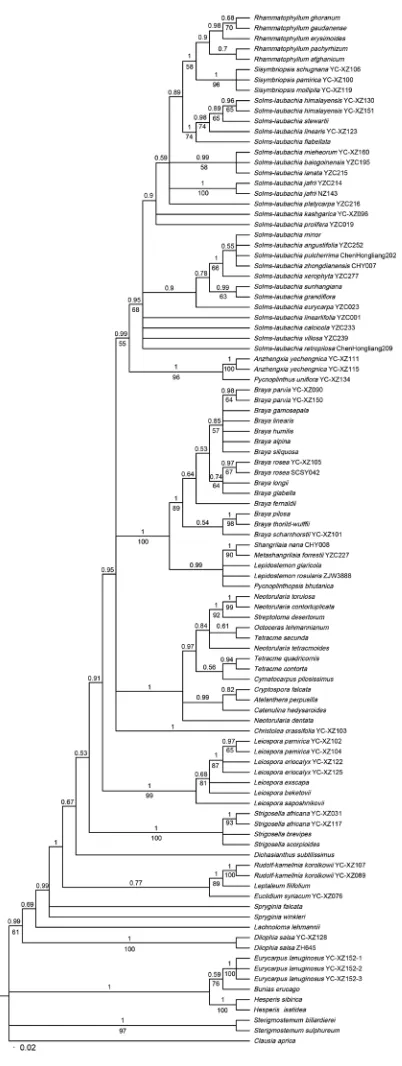
The resolution of MP analysis was relatively weaker than the outcome of BI analy-sis. Only the topologies of Bayesian phylogenetic analysis were shown (Figure 1). The result clearly showed that all 28 genera of Euclidieae formed a moderately to strongly supported clade ( PP / BS = 0.99 / 61; Figure 1). Dilophia Thomson, Lachnoloma, and Spryginia Popov formed the early branching lineage of the tribe in BI analysis (Figure 1). Five species of Rhammatophyllum, three of Sisymbriopsis, and 23 of Solms-laubachia formed a well-supported subclade within Euclidieae (PP / BS = 0.95 / 68; Figure 1), and then clustered with Anzhengxia Al-Shehbaz & D.A.German and Pycnoplinthus O.E.Schulz (PP / BS = 0.99 / 55; Figure 1).
while N. tetracmoides (Boiss. & Hausskn.) Hedge & J. Léonard and N. dentata (Freyn & Sint.) Hedge & J. Léonard each formed a solitary branch. The three species of Tet-racme formed two independent subclades in BI analysis, one of which comprised of T. quadricornis (Stephan ex Willd.) Bunge and T. contorta Boiss. ( PP = 0.94; Figure 1), and the other consisted of T. secunda Boiss. and Octoceras lehmannianum Bunge (PP = 0.61; Figure 1).
In addition to the above clades, species of Leiospora (C. A. Mey.) Dvořák and Strigosella formed two well supported clades, suggesting that both are monophyletic. However, Solms-laubachia lanuginosa (Hook. f. & Thomson) D. A. German & Al-Shehbaz (formerly Eurycarpus lanuginosus (Hook. f. & Thomson) Botsch.) did not fall within the Solms-laubachia-Rhammatophyllum-Sisymbriopsis clade. Instead, three accessions of this species formed a clade with outgroup taxa Bunias erucago (PP / BS = 0.59 / 76; Figure 1), indicating that S. lanuginosa is neither a member of genus Solms-laubachia nor of the tribe Euclidieae.
Discussion
Our results suggested that Solms-laubachia s.l. is not monophyletic, within which both Rhammatophyllum and Sisymbriopsis are embedded. Besides, S. lanuginosa fell outside of the clade. The closeness of Solms-laubachia, Rhammatophyllum, and Sisymbriopsis was revealed in previous studies (e.g., Belstein et al. 2006, 2008, Warwick et al. 2007, German et al. 2009). However, these studies only sampled one or two representative species of each genus and therefore did not reach a convincible conclusion on their generic status. By contrast, this study sampled 23 of 33 species of Solms-laubachia, five of seven of Rhammatophyllum, and three of four of Sisymbriopsis, representing thus far the most complete taxa sampling on these three genera.
Solms-laubachia had recently been subjected to a series of studies, including taxo-nomy (Lan and Zhou 1981, Al-Shehbaz and Yang 2000), cytology (Yue et al. 2003, 2004), molecular phylogeny (Yue et al. 2006, 2008), and biogeography (Yue et al. 2009). As traditionally circumscribed, this genus contained nine to thirteen species di-stributed from Southwest China to East-Himalayan. However, molecular phylogenetic studies demonstrated that Desideria Pamp. and Phaeonychium O. E. Schulz should be included in it, and that led to greatly expanding of the morphological and geographic boundaries of Solms-laubachia. For example, previously delimited Solms-laubachia spe-cies have entire, pinnately veined leaves and latiseptate fruit, whereas the expanded Solms-laubachia also has palmately veined leaves, and terete fruit. The geographic di-stribution of Solms-laubachia s.l. is also expanded westward into Central Asia.
By contrast, Sisymbriopsis includes annual, biennial or perennial herbs primarily with stalked and 1- or 2-forked to dendritic trichomes, pinnately lobed to coarsely dentate or rarely subentire basal and cauline leaves, and linear, flattened and latiseptate fruit with torulose valves and complete septum. Its four species are distributed in Afghani-stan, China (Qinghai, Xinjiang, and Xizang), KyrgyzAfghani-stan, and Tajikistan (Al-Shehbaz et al. 1999, Al-Shehbaz and German 2016).
Although our results suggest combining Solms-laubachia, Rhammatophyllum, and Sisymbriopsis into one monophyletic genus, merging these three genera into one will make it vastly heterogeneous morphologically (Table 3).The combined genus would be highly variable by encompassing nearly all habit types in the family, nearly all petals colors, and almost all inflorescence types, and would be almost impossible to delimit morphologically. Alternatively, one could keep both Rhammatophyllum and Sisymbri-opsis as separate monophyletic genera (Figure 1), and split Solms-laubachia s.l. into several well-delimited smaller genera depending on how different the species cluster together. Because our phylogenetic analyses was based on single ITS sequence frag-ments, infra-generic relationships can be satisfactorily resolved only by further studies dealing with cpDNA and other single-copy nuclear markers.
As for the outlier Solms-laubachia lanuginosa, its three accessions formed a clade clustered with Bunias erucago (Buniadeae), Hesperis sibirica, and H. isatidea (Hesperi-deae). Because it fell out of Solms-laubachia and the remainder of Euclidieae, we suggest restoring its previous status in the genus Eurycarpus Botsch. The incongruence between taxonomic treatments based strictly on morphology call for the need to draw generic limits and relationships after conducting adequate molecular phylogenetic analyses. Identifying the tribal position of Eurycarpus is beyond the scope of this paper, and it will be conducted in the near future with nuclear and chloroplast sequences data.
The monospecific genus Metashangrilaia was established based on M. forrestii (W.W.Sm.) Al-Shehbaz & D.A.German, a species used to be put in Braya. Previous molecular analyses revealed that it had very distinct ITS sequences and formed a well-supported clade sister to the rest of Braya (Warwick et al. 2004). Besides, it showed great morphological divergences from other Braya species (Al-Shehbaz et al. 2004, Al-Shehbaz and German 2016). All these led Al-Shehbaz and German (2016) to separate it from Braya and accommodate it in the newly established Metashangrilaia. This study provides further evidence on a strong sister taxon relationship between Metashangrilaia and Shangrilaia (Figure 1), supporting the decision by Al-Shehbaz and German (2016).
Tab
le 3.
Comparsions on morphological characters of
Solms-laubachia , Sisymbriopsis , Rhammatophyllum, and E ur ycarpus . Sisymbriopsis R hammatophyllum Solms-laubachia E ur ycarpus H abit
annual, biennial, or per
ennial herbs
shr
ubs or subshr
ubs per ennial herbs per ennial herbs Trichomes
simple and/or stalked for
ked or
dendritic
softly malpighiaceous, submalpighiaceou, rar
ely
subdendritic
absent or simple, rar
ely shor
t-stalked, 2-ray
ed
simple mix
ed with stalked 1- to 3-for
ked
ones
Basal leav
es
rosulate or not
not r osulate rosulate rosulate Leaf margin dentate, rar ely subentir e entir e entir
e or 3- to 9(to 11)-toothed
entir e Leaf v enation pinnate pinnate
pinnate or palmate
pinnate Cauline leav es pr esent pr esent pr
esent or absent
absent
Flo
w
er
in racemes, ebracteate or bracteate
cor
ymbose
in racemes, ebracteate cor
ymbose
solitar
y or in racemes, ebracteate or bracteate cor
ymbose
in racemes, ebracteate cor
ymbose Sepals equal, nonsaccate subequal, nonsaccate equal, nonsaccate equal, nonsaccate Petal colour
white or lav
ender
yello
w, cr
eamy white, or rar
ely purple
purple, blue, pink, or rar
ely white
purple
Anther apex
obtuse or apiculate
apiculate
obtuse
obtuse
Anther shape
ov
ate or oblong
oblong
oblong-linear to o
vate oblong M edian nectaries pr esent
absent or pr
esent
absent or pr
esent
pr
esent
Fr
uit shape
dehiscent silicles, linear
, flattened
and latiseptate
dehiscent siliques, linear
, latiseptate
dehiscent silique or silicle, linear
,
oblong, o
vate, lanceolate, or
ellipsoid, latiseptate or ter
ete
dehiscent silicles, oblong, elliptic, o
vate-oblong, or o
vate-lanceolate, str ongly latiseptate Fr uit v alv e valv es paper y, pr ominently v eined, glabr
ous or pubescent, tor
ulose valv es paper y, pr ominently v eined, pubescent, tor ulose valv es paper y, r eticulate v eined, glabr
ous or pubescent, smooth or
tor ulose valv es obscur ely v eined, glabr ous, smooth Septum complete complete
complete or rar
ely per
forated or
reduced to a rim
complete or r
educed to a rim
Style
obsolete
obsolete or distinct
obsolete or distinct
obsolete
Stigma
capitate, entir
e or 2-lobed, lobes not decurr
ent
capitate, entir
e or 2-lobed, lobes not decurr
ent
capitate, entir
e or 2-lobed, lobes not decurr
ent
capitate, entir
e
Seed
uniseriate, wingless or rar
ely distally
with a small wing
uniseriate, winged, margined, or
wingless
uniseriate or biseriate, wingless, seed coat r
eticulate, r
ugose, or papillate,
not mucilaginous when w
etted
biseriate, wingless, seed coat minutely
reticulate, not mucilaginous when w
etted
Cotyledons
obliquely accumbent
accumbent or rar
ely incumbent
accumbent
Finally, Lepidostemon used to be a monospecific genus, the type species is L. pedun-culosus Hook. f. & Thomson. It was expanded by Al-Shehbaz (2000, 2002), to include six species endemic to the Mid-western Himalaya (Al-Shehbaz 2015). The ITS sequence of L. glaricola (H. Hara) Al-Shehbaz (Couvreur et al. 2010) did not fall with our newly sequenced L. rosularis (K. C. Kuan & Z. X. An) Al-Shehbaz in one clade. However, due to limited data and low solution of ITS sequences, further studies with extensive sam-pling and more molecular markers are needed to clarify the taxonomic circumscription of the non-monophyletic genera – Neotorularia, Tetracme, and Lepidostemon.
Acknowledgements
We are grateful to Prof. Dunyan Tan for help in field work, and to Minshu Song for assistance on molecular studies. Thanks are due to Dr Dmitry A. German for gener-ously giving advice and helpful discussions. This study was supported by the National Natural Science Foundation of China (31590823, 31170181) and the National Key R&D Program of China (2017YFC0505200).
References
Ali T, Schmuker A, Runge F, Solovyeva I, Nigrelli L, Paule J, Buch A-K, Xia X, Ploch S, Or-ren O, Kummer V, Linde-Laursen I, Ørgaard M, Hauser TP, Ҫelik A, Thines M (2016) Morphology, phylogeny, and taxonomy of Microthlaspi (Brassicaceae: Coluteocarpeae) and related genera. Taxon 65(1): 79–98. https://doi.org/10.12705/651.6
Al-Shehbaz IA (1984) The tribes of Cruciferae (Brassicaceae) in the southeastern United States. Journal of the Arnold Arboretum 65(3): 343–373.
Al-Shehbaz IA (2000) Lepidostemon (Brassicaceae) is no longer monotypic. Novon 10(4): 329–333. https://doi.org/10.2307/3392977
Al-Shehbaz IA (2002) New combinations in Brassicaceae (Cruciferae): Draba serpens is a
Hemi-lophia and D. williamsii is a Lepidostemon. Edinburgh Journal of Botany 59(3) : 443–446.
https://doi.org/10.1017/S0960428602000264
Al-Shehbaz IA (2012) A generic and tribal synopsis of the Brassicaceae (Cruciferae). Taxon 61(5): 931–954.
Al-Shehbaz IA (2015) Lepidostemon. In: Hong DY (ed.) Flora of Pan-Himalaya Vol. 30. Cam-bridge University Press (CamCam-bridge) and Science Press (Beijing), 397–404.
Al-Shehbaz IA, An ZX, Yang G (1999) A revision of Sisymbriopsis (Brassicaceae). Novon 9(3): 308–312. https://doi.org/10.2307/3391725
Al-Shehbaz IA, Appel O (2002) A synopsis of the central Asian Rhammatophyllum (Brassi-caceae). Novon 12(1): 1–4. https://doi.org/10.2307/3393228
Al-Shehbaz IA, German DA (2016) Three new genera in the tribe Euclidieae (Brassicaceae). Novon 25(1): 12–17. https://doi.org/10.3417/2016015
Al-Shehbaz IA, Yang G (2001) A revision of Solms-laubachia (Brassicaceae). Harvard Papers in Botany 5(2): 371–381.
Al-Shehbaz IA, Yue JP, Sun H (2004) Shangrilaia (Brassicaceae), a new genus from China. Novon 14(3): 271–274.
Al-Shehbaz IA, Warwick SI (2005) A synopsis of Eutrema (Brassicaceae). Harvard Papers in Bota-ny 10(2): 129–135. https://doi.org/10.3100/1043-4534(2005)10[129:ASOEB]2.0.CO;2 Appel O, Al-Shehbaz IA (2003) Cruciferae. In: Kubitzki K, Bayer C (Eds) The families and
genera of vascular plants 5. Springer-Verlag, Berlin, 75–174. https://doi.org/10.1007/978-3-662-07255-4_17
Beilstein MA, Al-Shehbaz IA, Kellogg EA (2006) Brassicaceae phylogeny and trichome evolu-tion. American Journal of Botany 93(4): 607–619. https://doi.org/10.3732/ajb.93.4.607 Beilstein MA, Al-Shehbaz IA, Mathews S, Kellogg EA (2008) Brassicaceae phylogeny inferred
from phytochrome A and ndhF sequence data: tribes and trichomes revisited. American Journal of Botany 95(10): 1307–1327. https://doi.org/10.3732/ajb.0800065
Botschantzev VP (1987) De genere Prionotrichon Botsch. et Vved. (Cruciferae–Arabideae). Novosti Sistematiki Vysshikh Rastenii (Novitates Systematicae Plantarum Vascularium) 24: 96–100.
Chen HL, Deng T, Yue JP, Al-Shehbaz IA, Sun H (2016) Molecular phylogeny reveals the non-monophyly of tribe Yinshanieae (Brassicaceae) and description of a new tribe, Hillielleae. Plant Diversity 38(4): 171–182. https://doi.org/10.1016/j.pld.2016.04.004
Couvreur TLP, Franzke A, Al-Shehbaz IA, Bakker FT, Koch MA, Mummenhoff K (2010) Molecular phylogenetics, temporal diversification, and principles of evolution in the mus-tard family (Brassicaceae). Molecular Biology and Evolution 27(1): 55–71. https://doi. org/10.1093/molbev/msp202
Darriba D, Taboada GL, Doallo R, Posada D (2012) jModelTest 2: more models, new heu-ristics and parallel computing. Nature Methods 9(8): 772–772. https://doi.org/10.1038/ nmeth.2109
de Candolle AP (1821) Mémoire sur la famille des Crucifères. Mémoires du Muséum d’Histoire Naturelle 7(1): 236.
Felsenstein J (1985) Confidence limits on phylogenies: an approach using the bootstrap. Evolution 39(4): 783–791. https://doi.org/10.1111/j.1558-5646.1985.tb00420.x
Franzke A, Lysak MA, Al-Shehbaz IA, Koch MA, Mummenhoff K (2011) Cabbage family affairs: the evolutionary history of Brassicaceae. Trends in Plant Science 16(2): 108–116. https://doi.org/10.1016/j.tplants.2010.11.005
German DA, Friesen N (2014) Shehbazia (Shehbazieae, Cruciferae), a new monotypic ge-nus and tribe of hybrid origin from Tibet. Turczaninowia 17(4): 17–23. https://doi. org/10.14258/turczaninowia.17.4.3
German DA, Shmakov AI, Zhang XC, Chen WL, Smirnov SV, Xie L, Kamelin RV, Wang J (2006) Some new floristic findings in Xinjiang, China. Acta Phytotaxonomica Sinica 44(5): 598–603. https://doi.org/10.1360/aps050105
Huang CH, Sun RR, Hu Y, Zeng LP, Zhang N, Cai LM, Zhang Q, Koch MA, Al-Shehbaz IA, Edger PP, Pires JC, Tan DY, Zhong Y, Ma H (2016) Resolution of Brassicaceae phylogeny using nuclear genes uncovers nested radiations and supports convergent morphological evolution. Molecular Biology and Evolution 33(2): 394–412. https://doi.org/10.1093/molbev/msv226 Jachen E (1942) Das System der Cruciferen. Oesterreichische botanische Zeitschrift 91: 1–18.
https://doi.org/10.1007/BF01257342
Kamelin R (2002) Notes on Cruciferae of Asia. Genus Rhammatophyllum and its affinity. Bo-tanicheskii Zhurnal 87 (12): 97–109.
Katoh K, Misawa K, Kuma K, Miyata T (2002) MAFFT: a novel method for rapid multiple se-quence alignment based on fast Fourier transform. Nucleic Acids Research 30(4): 3059–3066. https://doi.org/10.1093/nar/gkf436
Katoh K, Standley DM (2013) MAFFT Multiple Sequence Alignment Software Version 7: Improvements in Performance and Usability. Molecular Biology and Evolution 30 (4): 772–780. https://doi.org/10.1093/molbev/mst010
Kiefer M, Schmickl R, German DA, Mandáková T, Lysak MA, Al-Shehbaz IA, Franzke A, Mummenhoff K, Stamatakis A, Koch MA (2014) BrassiBase: Introduction to a novel knowledge database on Brassicaceae evolution. Plant and Cell Physiology 55(1): e3(1-9). https://doi.org/10.1093/pcp/pct158
Koch MA, Kiefer M, German DA, Al-Shehbaz IA, Franzke A, Mummenhoff K, Schmickl R (2012) BrassiBase: Tools and biological resources to study characters and traits in the Bras-sicaceae – version 1.1. Taxon 61(5): 1001–1009.
Kumar S, Stecher G, Tamura K (2016) MEGA7: Molecular Evolutionary Genetics Analysis Version 7.0 for Bigger Datasets. Molecular Biology and Evolution 33 (7): 1870–1874. https://doi.org/10.1093/molbev/msw054
Lan YZ, Cheo TY (1981) On the Chinese genus Solms-laubachia Muschler (Cruciferae). Acta Phytotaxonomica Sinica 19(4):472–480.
Maddison DR (1991) The discovery and importance of multiple islands of most-parsimonious trees. Systematic Biology 40(3): 315–328. https://doi.org/10.1093/sysbio/40.3.315 Moazzeni H, Zarre S, Assadi M, Joharchi MR, German DA (2014) Erysimum hezarense, a new
species and Rhammatophyllum gaudanense, a new record of Brassicaceae from Iran. Phyto-taxa 175(5): 241–248. https://doi.org/10.11646/phytoPhyto-taxa.175.5.1
Mummenhoff K, Franzke A, Koch MA (1997) Molecular phylogenetics of Thlaspi s.l. (Bras-sicaceae) based on chloroplast DNA restriction site variation and sequences of the inter-nal transcribed spacers of nuclear ribosomal DNA. Canadian Jourinter-nal of Botany 75(3): 469–482. https://doi.org/10.1139/b97-051
Schulz OE (1936) Cruciferae. In: Engler A, Prantl K (eds) Die natürlichen Pflanzenfamilien Vol 17B. Verlag von Wilhelm Engelmann, Leipzig, 227–658.
Swofford DL (2018) PAUP*: Phylogenetic Analysis Using Parsimony (*and other methods). Version 4.0a161. http://phylosolutions.com/paup-test/
Warwick SI, Al-Shehbaz IA, Sauder CA, Harris JG, Koch MA (2004) Phylogeny of Braya
and Neotorularia (Brassicaceae) based on nuclear ribosomal internal transcribed spacer and
chloroplast trnL intron sequences. Canadian Journal of Botany 82(3): 376–392. https:// doi.org/10.1139/b04-012
Warwick SI, Sauder CA, Al-Shehbaz IA, Jacquemoud F (2007) Phylogenetic relationships in the tribes Anchonieae, Chorisporeae, Euclidieae, and Hesperideae (Brassicaceae) based on nuclear ribosomal ITS DNA sequences. Annals of the Missouri Botanical Garden 94(1): 56–78. https://doi.org/10.3417/0026-6493(2007)94[56:PRITTA]2.0.CO;2
White TJ, Bruns T, Lee S, Taylor J (1990) Amplification and direct sequencing of fungal ri-bosomal RNA genes for phylogenetics. In: Innis MA, Gelfand DH, Sninsky JJ, White TJ (eds) PCR protocols: a guide to methods and applications. Academic Press, San Diego, 315–322. https://doi.org/10.1016/B978-0-12-372180-8.50042-1
Yang ZH, Rannala B (1997) Bayesian phylogenetic inference using DNA sequences: a Markov chain Monte Carlo method. Molecular Biology and Evolution 14 (7): 717–724. https:// doi.org/10.1093/oxfordjournals.molbev.a025811
Yue JP, Sun H, Al-Shehbaz IA, Gu ZJ (2003). Cytological studies of five Chinese species of
Solms-laubachia (Brassicaceae). Harvard Papers in Botany 7(2): 467–473.
Yue JP, Gu ZJ, Al-Shehbaz IA, Sun H (2004) Cytological studies on the Sino-Himalayan en-demic Solms-laubachia (Brassicaceae) and two related genera. Botanical Journal of the Lin-nean Society 145(1): 77–86. https://doi.org/10.1111/j.1095-8339.2003.00268.x Yue JP, Sun H, Al-Shehbaz IA, Li JH (2006) Support for an expanded Solms-laubachia
(Bras-sicaceae): evidence from sequences of chloroplast and nuclear genes. Annals of the Missouri Botanical Garden 93(3): 402–411. https://doi.org/10.3417/0026-6493(2007)93[402:SF AESB]2.0.CO;2
Yue JP, Sun H, Li JH, Al-Shehbaz IA (2008) A synopsis of an expanded Solms-laubachia (Bras-sicaceae), and the description of four new species from western China. Annals of the Mis-souri Botanical Garden 95(3): 520–538. https://doi.org/10.3417/2006214
Yue JP, Sun H, Baum DA, Li JH, Al-Shehbaz IA, Ree R (2009) Molecular phylogeny of
Solms-laubachia (Brassicaceae) s.l., based on multiple nuclear and plastid DNA sequences, and its
biogeographic implications. Journal of Systematics and Evolution 47(5): 402–415. https:// doi.org/10.1111/j.1759-6831.2009.00041.x
Appendix 1
Taxa and accession numbers downloaded from GenBank for the ITS sequences used in the study.