Taxonomic revision of Chenopodiaceae
in Himalaya and Tibet
Alexander P. Sukhorukov1, Pei-Liang Liu2, Maria Kushunina3
1 Department of Higher Plants, Biological Faculty, Lomonosov Moscow State University, 119234, Moscow, Russia 2 College of Life Sciences, Northwest University, 710069, Xi’an, Shaanxi, China 3 Department of Plant Physiology, Biological Faculty, Lomonosov Moscow State University, 119234, Moscow, Russia
Corresponding author: Alexander P. Sukhorukov ([email protected])
Academic editor: E. Roalson | Received 13 June 2018 | Accepted 7 December 2018 | Published 31 January 2019
Citation: Sukhorukov AP, Liu P-L, Kushunina M(2019) Taxonomic revision of Chenopodiaceae in Himalaya and Tibet. PhytoKeys 116: 1–141. https://doi.org/10.3897/phytokeys.116.27301
Abstract
The composition of many Chenopodiaceae genera in different parts of Himalaya and Tibet has been insuf-ficiently known or contradictory. A revision of the family in Himalaya including Bhutan, Nepal, parts of India (Himachal Pradesh, Jammu and Kashmir, Sikkim and Uttarakhand) and Tibet (Xizang, China) is presented for the first time. Altogether, 57 species from 20 genera are reported, including three species new to science (Agriophyllum tibeticum, Salsola austrotibetica and Salsola hartmannii). Atriplex centralasiatica, Corispermum dutreuilii and Salsola monoptera are identified as new records for India and Chenopodium pamiricum is recorded in China for the first time. Dysphania ambrosioides and Sympegma regelii are recorded for Xizang. The generic and species keys, species distributions (including maps) and taxonomic notes are provided. We indicate for the first time that the presence of short yellow hairs is the remarkable morpho-logical characteristic of the genus Grubovia. Evident heterocarpy and heterospermy is found in Dysphania for the first time (Dysphania tibetica). Agriophyllum pungens, Atriplex crassifolia, Atriplex laciniata, Atriplex sagittata, Axyris amaranthoides, Axyris hybrida, Bassia indica, Corispermum korovinii, Dysphania schraderiana (=Chenopodium foetidum auct.), Halocharis violacea and Suaeda microsperma are excluded from the species list. Neobotrydium corniculatum is synonymised with Dysphania kitiae, Neobotrydium longii with Dysphania himalaica and Neobotrydium ornithopodum seems to be conspecific with Dysphania nepalensis. Corispermum ladakhianum is a new synonym of Corispermum tibeticum. Amaranthus diandrus is added to the synonyms of Acroglochin persicarioides, and Bassia fiedleri, previously considered as conspecific with Grubovia dasyphylla, is added to the synonymy of Bassia scoparia. Lectotypes of Anabasis glomerata (≡Halogeton glomeratus), Haloge-ton tibeticus (=Halogeton glomeratus), Amaranthus diandrus (=Acroglochin persicarioides), Chenopodium tibeti-cum (≡Dysphania tibetica), Corispermum dutreuilii, Corispermum falcatum, Corispermum lhasaense, Corisper-mum pamiricum var. pilocarpum (=Corispermum gelidum, syn. nov.), Corispermum tibeticum, Kochia indica
http://phytokeys.pensoft.net
Copyright Alexander P. Sukhorukov et al. This is an open access article distributed under the terms of the Creative Commons Attribution License (CC BY 4.0), which permits unrestricted use, distribution, and reproduction in any medium, provided the original author and source are credited.
(≡Bassia indica), Kochia odontoptera (≡Bassia odontoptera) and Salsola monoptera are selected. Out of 53 na-tive elements, 42 are restricted in their distribution to Himalaya and Tibet at altitudes 2000–4500 m above sea level. The greatest taxonomic diversity of the Chenopodiaceae is represented in Jammu and Kashmir (India) and Xizang (China) with a continuous decrease in the number of species southwards.
Keywords
Bhutan, China, distribution, ecology, India, Nepal, new species, typification
Table of content
Introduction ... 2
Materials and methods ... 4
Results and discussion ... 9
Key to the genera ... 12
Genus Chenopodium ... 15
Genus Chenopodiastrum ... 34
Genus Oxybasis ... 39
Genus Atriplex ... 41
Genus Microgynoecium ... 47
Genus Blitum ... 50
Genus Dysphania ... 52
Genus Teloxys ... 74
Genus Axyris ... 75
Genus Krascheninnikovia ... 81
Genus Acroglochin ... 84
Genus Corispermum ... 85
Genus Agriophyllum ... 98
Genus Suaeda ... 101
Genus Bassia ... 105
Genus Grubovia ... 110
Genus Salsola ... 112
Genus Halogeton ... 126
Genus Haloxylon ... 129
Genus Sympegma ... 131
Acknowledgements ... 133
References ... 133
Introduction
the relationships in the family, its placement within the order Caryophyllales and the physiological or anatomical peculiarities of its species have greatly increased. However, there have only been a limited number of taxonomic revisions of the family based on recent taxonomy and critical analysis of collections.
Taxonomy and generic delimitation
The Chenopodiaceae is a part of the large Chenopodiaceae-Amaranthaceae clade with-in the core order of Caryophyllales and it is a sister group to the Amaranthaceae family (Cuénoud et al. 2002, Kadereit et al. 2003, Brockington et al. 2009). Although all morphological characters seem to overlap in Chenopodiaceae and Amaranthaceae s. str., the familial status of the Chenopodiaceae is accepted in recent taxonomic treat-ments (e.g. Sukhorukov 2014, Hernández-Ledesma et al. 2015). The carpological differences that have been discovered (Sukhorukov et al. 2015a) have filled the gaps in the character set of both Chenopodiaceae and Amaranthaceae s. str., but they are not strongly specific at the familial level except the horizontal embryo position which evolved in many Chenopodiaceae.
When separated from Amaranthaceae, the Chenopodiaceae includes ~100 gen-era and 1600 species that are mostly distributed in the deserts and steppes in the temperate regions of the world (Sukhorukov 2014). During the last fifteen years, the generic composition of many groups in the family has undergone extensive changes following molecular phylogenetic revisions, with the splitting or merging of many genera. Chenopodium was found to be polyphyletic and its members occupy different phylogenetic positions within Chenopodioideae (Fuentes et al. 2012; Sukhorukov et al. 2018). In the previous broader sense, Salsola appeared to be strongly poly-phyletic (Akhani et al. 2007), but in contrast, the formerly accepted genus Kochia
is now merged with Bassia (Kadereit & Freitag, 2011). The monophyly of many other traditional genera, e.g. Agriophyllum (Kadereit et al., 2003), Suaeda (Schütze et al., 2003), Atriplex except Halimione (Kadereit et al., 2010), Corispermum (Xue & Zhang, 2011) and Dysphania, including Neobotrydium and Ambrina (Uotila et al. in prep.) is confirmed.
Progress towards disentangling the generic composition of Chenopodiaceae in Himalaya and Tibet began with the critical revisions and additions to Axyris (Sukho-rukov, 2011), Dysphania (Sukhorukov 2012, 2014, Uotila 2013, Sukhorukov et al. 2015b, Nobis et al. 2015, 2017) and part of Chenopodium s. str. (Sukhorukov and Kushunina 2014, 2015).
Study premise
The most recent taxonomic revision of the Chenopodiaceae was performed for Nepal (Sukhorukov and Kushunina 2014), but the species composition of some genera and their distributions are still insufficiently known in other parts of the entire Himala-yas and Tibet. The latest Chenopodiaceae treatment for India (Paul 2012) contained many taxa that are, in fact, distributed only in Central Asia (e.g. Atriplex crassifolia,
Axyris amaranthoides, Chenopodiastrum hybridum and Suaeda microsperma), Eastern Europe/North Kazakhstan (Atriplex sagittata) or the Mediterranean (Atriplex rosea). Taxonomic novelties to the chenopodiaceous flora of China were provided by Zhu and Sanderson (2017) and some new species (i.e. Neobotrydium corniculatum, N. longii) were also reported from Xizang. All these taxa reported from India or China are dis-cussed in our article.
The present revision is a part of the treatment of the family in the Old World. Until now, the Chenopodiaceae had been revised for the flora of European Russia (Sukho-rukov 2014), Iraq (Sukho(Sukho-rukov et al. 2016) and historical Palestine (Danin et al. in press). In addition to Himalaya and Tibet, further contributions are planned for all of Africa, Russia and Uzbekistan.
Materials and methods
Choosing the study territory
Materials investigated
The field investigations were conducted by Alexander Sukhorukov in different prov-inces of Nepal in 2005 and 2008–2015 and in Dehradun and its surroundings in 2018 (Uttarakhand, India). The main collection is in MW with duplicates in B, BM, BR, E, G, H, K, M and W. The revision of the herbarium material was undertaken by the first author (AS) at B, BM, BR, BSD, DD, E, G, H, HUJ, K, KATH, L (in-cluding U and WAG), LE, LY, M, MHA, MSB, MW, P, PE, PRA, SHI, TO, TUCH, W, WU, WUK, XIA and XJBI (herbarium abbreviations according to Thiers 2018+) and the Axyris and many Dysphania specimens were revised by the first author in CAL in 2011. The Chinese Virtual Herbarium (CVH, http://www.cvh.ac.cn/) and the herbarium database of the Kunming Institute of Botany of the Chinese Academy of Sciences (Kingdonia, http://db.kun.ac.cn/) were used as citations for some specimens kept in HNWP, NAS and KUN if their identification were possible using the images. The great number of examined specimens was mostly provided by the following col-lectors or collection teams.
Adolph, Hermann and Robert Schlagintweit. Expeditions to Himalaya 1854–1857 including West/Central Himalaya, Tibet and adjacent territories (Büchler 1990). Many interesting facts about the lives of these brothers, their relationships with other botanists and the destiny of their herbarium can be found in the book by von Brescius et al. (2015). The examined collections are available from the year 1856 in the BM, E, G and LE herbaria.
1847–1848, mostly from North India (Jammu and Kashmir, Himachal Pradesh and Uttarakhand). The sheets often labelled as “collected in Thibet occ.” [West Ti-bet] were probably collected in West Himalaya (former British India), but without precise locations, therefore these records could not be mapped.
Walter Koelz. Expeditions to North India (Jammu and Kashmir). Although the main goal of the expeditions was ornithology, he gathered many plant species including Chenopodiaceae. The collections, kept at the herbarium of Michigan University (n.v.), are also stored in herb. P (1930; Himachal Pradesh) and dispersed in E, G, H, K, L, LE and W (1931, 1933; Jammu and Kashmir).
Francis Ludlow (often collected together with George Sherriff and other scientists). The Tibetan and North Himalayan collections are available from 1928, 1939, 1940–1943 in BM and E with some duplicates in G and LE. The explorations of F. Ludlow and G. Sherriff are described by Fletcher (1975).
Andrew John Charles Grierson and David Geoffrey Long. Their joint collections of Chenopodiaceae are from Bhutan (1979, 1982, 1984) and are kept in Edinburgh (E) with duplicates in Kew (K). Additionally, D.G. Long collected some material in Nepal (1991–1992, kept in E).
Hans Hartmann. Worked in Jammu and Kashmir (India) and adjacent territories from 1976 until 1997; the Chenopodiaceae collections are available from 1976, 1979, 1992, 1995 and 1997 in G and MSB.
Brij Mohan Wadhwa. Had special interest in the Chenopodiaceae of Indian Hima-laya. His collections from Jammu and Kashmir (1976 and 1986) and Himachal Pradesh (1974) are mostly kept in BSD.
Upendra Chandra Bhattacharyya. Collected many Chenopodiaceae taxa in India: Jammu and Kashmir (1970, 1980), Himachal Pradesh (1970–1972) and Uttara-khand (1961, 1970, 1983). His collections are deposited in BSD.
Georg and Sabine Miehe. Mostly worked in Tibet (Xizang, China) from 1977 to 2005. The main collections are in Marburg (“High Asia Project Herbarium G. & S. Miehe”, Faculty of Geography, University of Marburg, Deutschhausstr. 10, D-35032 Marburg, Germany). The herbarium does not have an acronym. Instead, “herb. Miehe” was used when citing their specimens in this paper.
Bernhard Dickoré. Worked in Tibet (Xizang) in 1989, 1994 and 1998. The main collections are in Munich (MSB with some duplicates in K and KAS). Some specimens were not seen by the first author (A.S.) during his visit to Munich in May 2016.
Leoš Klimeš (Leosh Klimesh). Collections available from Ladakh, North India, col-lected in 1989 (MSB) and 1999–2007 (PRA). He has been missing in Ladakh since September 2007. His collections in PRA are the most complete recent speci-mens of Chenopodiaceae from Ladakh. However, not all specispeci-mens are present or mounted in PRA (pers. comm. Jan Štepanek).
in-cluded Wang Jin-Ting, Lang Kai-Yong, Ma Cheng-Gong and Bao Xian-Cheng (Wang et al. 2004).
Qinghai-Tibet Complex Expedition Team, abbreviated Qinghai-Tibet Team. Col-lected throughout Xizang in 1973–1976. The team also consisted of several sub-divisions, such as the “Vegetation Group”, “Meadow Group” and “Additional Group”. In total, nearly 40000 collections on approximately 150000 sheets were made and these specimens were deposited in PE, KUN and HNWP. Collectors worked in the Team were Wu Su-Gong, Ni Zhi-Cheng, Lang Kai-Yong, Chen Shu-Kun, He Guan-Fu, Cheng Shu-Zhi, Gu Li-Min, Nan Yong, Luosangxi’nao, Xiao Yonghui, Yang Yong-Chang, Huang Rong-Fu, Tao De-Ding, Zang Mu, Yin Wen-Qing, Su Zhi-Yun, Wu Zheng-Yi, Du Qing, Yang Chong-Ren, Guan Kai-Yun, Chen Wei-Lie, Li Bo-Sheng and Wang Jin-Ting (Wang et al. 2004).
The recent collections from Nepal (2005, 2008–2015) were made by Alexander Sukhorukov (see above).
Preparation of the material for carpological studies
The perianth, fruit and seed characters play significant roles in the identification of some large genera, e.g. Atriplex, Chenopodium, Corispermum and Dysphania (e.g. Uo-tila 2001, Sukhorukov 2006, 2007a, 2007b, Sukhorukov and Kushunina 2014) and we used scanning electron microscopy (SEM) to show the important differences in the reproductive traits. The hard tissues (seed coat) do not require any special prepara-tion prior to SEM, but other objects that contain living cells, such as hairs or papil-lae (on perianth or pericarp), were dehydrated in aqueous ethyl alcohol solutions of increasing concentration, then in alcohol-acetone solutions and pure acetone and then finally critical-point dried. After sputter coating the material with gold-palladium, all SEM observations were made with a JSM–6380 microscope (JEOL Ltd., Japan) in the Laboratory of Electron Microscopy of Moscow State University.
The anatomy of the fruit and seed is important for the diagnostics and taxonomy of many Chenopodiaceae (for more see, e.g. Sukhorukov 2008, 2014, Sukhorukov and Zhang 2013, Sukhorukov et al. 2013, 2014, 2015a). The fruit anatomy appears crucial to the diagnostics of many Corispermum and the fruits of almost all members were anatomically investigated in previous studies (Sukhorukov 2007a, 2007b, 2014, Sukhorukov et al. 2014). Here, we present the fruit anatomy of Corispermum tibeticum
Iljin and add the most important data to the description of the species.
The list of specimens used for SEM is given below.
Chenopodium album: Nepal, Karnali zone, Jumla vill., 23 Sep 2010, A. Sukhorukov 463 (MW);
C. ficifolium: Central Nepal, Narayani zone, Chitwan [distr.], 4 Mar 2008, A. Sukho-rukov s.n. (MW);
C. karoi: India, Jammu & Kashmir, Ladakh, Zanskar Region, S of Padum, 4150 m alt., 29 Aug 2003, L. Klimeš 3322 (PRA);
C. bengalense: Nepal, Dhaulagiri zone, Annapurna conservation area, near Tikhed-hunga vill., 1700 m a.s.l., 13 Nov 2008, A. Sukhorukov s.n. (MW);
C. novopokrovskyanum: India, Jammu & Kashmir, Ladakh, Leh, 3400 m a.s.l., 20 Aug 1979, Bruhn s.n. (MSB144211);
C. atripliciforme: Afghanistan, Konar, Dewagal Darrah, Aug 1973, O. Anders 11078
(W06301);
C. perttii: Nepal, Karnali zone, Jumla vill., 29 Sep 2014, A. Sukhorukov 62 (MW);
Chenopodiastrum murale: Uzbekistan, Tashkent, 1921, Ovchinnikov s.n. (MW);
C. badachschanicum: Nepal, Karnali zone, [Mugu distr.] Purana Mugu, Mugu Khola, 13000 ft a.s.l., 23 Aug 1952, O. Polunin, W.R. Sykes & L.H.J. Williams 3010 (LE);
Dysphania ambrosioides: Nepal, Bagmati zone, [Kathmandu distr.] Godawari, 1400 m a.s.l., 15 Nov 2005, A. Sukhorukov s.n. (MW);
D. himalaica: 1) China, Xizang, Ngari Prefecture, Gêrzê (Gaize) County, 4250 m a.s.l., Aug 1972, Li 069 (PE00510702); 2) Gêrzê (Gaize) County, 4500 m a.s.l., 8 Sep 1976, K.-Y. Lang 10153 (PE00511004);
D. bhutanica: Bhutan, Thimphu distr., Chapcha, 2200–2400 m a.s.l., 1 Jul 1992, C. Parker 7270 (E00051982);
D. kitiae: China, [Shaanxi prov.] Wuqi County, 13 Sep 1984, Yang Jinxiang 5115 (WUK);
D. botrys: China, Xinjiang, Urumqi, Sep 2014, A. Sukhorukov s.n. (MW);
D. geoffreyi: China, Xizang, [Doilungdêgên County] Kui Chu, Nyimathang, 29°30'N, 91°02'E, 1 Oct 2001, G. & S. Miehe 01-141-10 (herb. Miehe); Yunnan prov., Deqin [Diqing] County, Adunzi, 2700 m a.s.l., 26 Sep 1935, Wang Qiwu 70221 (WUK);
D. tibetica: India, Jammu & Kashmir, Leh, Lato, 33°40'42"N, 77°43'48"E, 4020 m a.s.l., 5 Sep 2001, L. Klimeš 1562 (PRA);
D. neglecta: Nepal, Karnali zone, border of Jumla & Mugu distr., 1 km from Naurigar vill., 2300 m a.s.l., 26 Sep 2013, A. Sukhorukov s.n. (G);
D. nepalensis: 1) Nepal, Karnali zone, Jumla vill., 29°17'N, 82°05'E, 2400 m a.s.l., 3 Oct 2010, A. Sukhorukov 464 (MW); 2) China, Dechin prefecture, W of Dechin near Marbating, 28°33'3"N, 98°47'4"E, 2230 m a.s.l., 16 Sep 1995, D. Chamber-lain & al. 275 (H1684317);
Corispermum falcatum: China, Xizang prov., Gar (Gaer) County, 4250 m a.s.l., 29 Jul 1976, Qinghai-Tibet Team 76-8613 (PE00540486);
C. nanum: China, Xizang prov., Central Plateau, Nagqu to Siling Co (Lake Siling Tso), 31°28'N, 91°0'E, 4580 m a.s.l., lake terraces, 16 Aug 1993, G. & S. Miehe 9488/03 (MSB147355);
C. pamiricum: [Tajikistan] Buchara prov. [Gorno-Badakhshan Autonomous province], Wachan [Vakhan], Pamir river valley near Langar-Gisht fortress, 9500 ft a.s.l., 27 Jul 1901, Th. Alexeenko 3217 (LE);
C. dutreuilii var. montanum: China, Xizang, Shiquan [Sênggê] river, alt. 3800 m a.s.l., 3 Aug 1984, Zhengxi An 1-10092 (XJA);
C. pseudofalcatum: China, Xizang, vicinity of Xigazê (Rikaze), 3800 m a.s.l., [no exact date] 1960, Fu Guo-Xun 789 (PE00934050);
C. lhasaense: China, Xizang, Lhasa, the Sera Monastery, Liushahe river, 3760 m a.s.l., 10 Sep 1960, Fu Guo-Xun 658 (PE00540404);
C. lepidocarpum: China, Xizang, Temo, Tsangpo valley, 9500 ft a.s.l., 6 Sep 1938, F. Ludlow, G. Sherriff & G. Taylor 6227 (LE);
C. gelidum: [Tajikistan] nr Rang-kul Lake, Zor-Burlyuk valley, 29 Aug 1935, H. Rai-kova s.n. (LE);
C. tibeticum: 1) [Afghanistan or Pakistan] Karakoram, Aug 1876, Falconer s.n. (K); 2) China [Ngari Pref., Burang County], nr Manasarovar Lake, Langa Tso [Lake], 4680 m a.s.l., 29 Aug 1993, G. & S. Miehe 9598/03 (MSB147354); 3) India, Ladakh, Pangong Region, 4300 m a.s.l., 10 Sep 2002, L. Klimeš 10 (PRA);
Agriophyllum tibeticum: China, Xizang, Kongbo [Kongpo] County, Temo, Tsangpo valley, 8 Sep 1938, F. Ludlow & al. 6238 (BM);
Suaeda olufsenii: India, Jammu & Kashmir, Ladakh, Rupshu Region, Chumur, 4660– 4860 m a.s.l., 21 Aug 2001, L. Klimeš 1382 (PRA).
Morphological description
Where not stated otherwise, the generic and species descriptions are based on speci-mens of various origins. The habitats and altitudes relate to populations growing in Himalaya and Tibet.
Results and discussion
Ecology and altitudinal gradient of the Himalayan and Tibetan Chenopodiaceae
In general, the taxonomic diversity of the Chenopodiaceae is low in mountainous re-gions of the tropics compared with the steppes and deserts of temperate rere-gions. The altitudes, where the Chenopodiaceae can be found, range from 0 to 5500 m above sea level. The diversity of representatives of Chenopodiaceae and their phytosociological role differ amongst three major altitudinal belts (Fig. 2).
The altitudes from 0 to 2200 m above sea level. The lower altitudes are appropriate only for several species that occupy (semi-)disturbed places. In Central and Eastern Himalaya, the annuals Chenopodium album and C. ficifolium are common ruderal and segetal plants that vegetate in late winter and spring. Dysphania ambrosioides, the only alien naturalised species from the tropical Americas, usually colonises dump sites along roads, but it can also be found on semi-disturbed river banks. Chenopodiastrum murale
The altitudes from 2200 to 3500 m above sea level. Most annual Chenopodiaceae growing at these altitudes are found on the screes, on limestone or sand or often in dis-turbed habitats (being apophytic). In North Himalaya and Tibet, some annuals that usu-ally grow at 3500–5000 m above sea level can be found at lower altitudes (Chenopodium
sp. div., Corispermum sp. div. and Dysphania spp.). In Central Himalaya, 2200–3500 m is the most appropriate altitude for Acroglochin persicarioides and Dysphania nepalensis, where they are abundant, weedy species (Sukhorukov and Kushunina 2014). In West Nepal, Chenopodium perttii and Dysphania neglecta are common. Different Chenopodium
at altitudes of 3500–4000 m (Hartmann 2009). Another dwarf subshrub, Haloxylon thomsonii, is localised only in Ladakh and adjacent territories in Pakistan at altitudes of (3200)3500–4000 m, where it forms characteristic alpine semi-desert and steppe landscapes together with some Artemisia, Caragana, Potentilla and Ptilotrichium species (Dhar and Kachroo 1983, Hartmann 1983, 2009, Eberhardt et al. 2007, Gruber and Peer 2008). Sympegma regelii, a common plant on the screes in Tian-Shan and Kunlun (Grubov 1966, Eberhardt et al. 2007), has been found in northwest Tibet during the last several decades.
Amongst the annuals, Axyris mira, Axyris prostrata, Corispermum sp. div. and some
Dysphania (D. himalaica, D. nepalensis and D. tibetica) are widespread in stony deserts, river basins and disturbed areas. Microgynoecium tibeticum, a small, often-overlooked herb, reaches altitudes up to 5500 m, and this altitudinal zone appears to be the highest level at which only a few flowering plants are observed (Sukhorukov 2014). All Che-nopodiaceae at the higher altitudes are native species growing in natural or degraded communities (Klimeš and Dickoré 2005, Miehe et al. 2009).
Taxonomy and geographical subdivision of the species
The best-represented genera are Chenopodium, Corispermum and Dysphania (9 species each). None of the taxa can be recommended for inclusion in the IUCN Red List (IUCN 2017) since they are either dominant species, occupy ruderal habitats or are insufficiently studied.
In the past, very few species were recorded for the entirety of Himalaya and Tibet (within the borders of Xizang) and the number of Chenopodiaceae species reported for Tibet was only 15 (Grubov 1966) or 29 (Zhu et al. 2003). Fifteen species were re-ported for Lower Ladakh, India (Klimeš and Dickoré 2005). Here, we present the first attempt to evaluate the number of species in the main divisions of the region under study. The number of species was counted for all the countries of Bhutan and Nepal, the major administrative subdivisions of Xizang (prefectures) and the Indian states of Jammu and Kashmir, Himachal Pradesh, Uttarakhand and Sikkim (Fig. 1).
Bhutan – 9; Nepal – 25; Xizang, China – 42 species in total (Ngari Prefecture – 26, Nagqu Prefecture – 12, Xigazê Prefecture – 24, Lhasa City – 19, Shannan Prefec-ture – 16, Nyingchi PrefecPrefec-ture – 19, Qamdo PrefecPrefec-ture – 11); India – 43 species in to-tal (Jammu & Kashmir – 41, Himachal Pradesh – 21, Uttarakhand – 15, Sikkim – 6). Although phylogeographic analysis has yet to be conducted for the Asian Cheno-podiaceae, the origin and migration routes of the widely distributed taxa may be more complex than previously thought (Li et al. 2010, Jia et al. 2012, Zhang et al. 2014, 2017). However, we note here that many taxa (42%) are clearly autochthonous, distributed only or predominantly in Himalaya and Tibet (Acroglochin persicarioides, Agrio phyllum tibeti-cum, Axyris mira, Chenopodium atripliciforme, C. bengalense, C. harae, C. perttii, Corisper-mum falcatum, C. pseudofalcatum, C. lepidocarpum, C. lhasaense, C. nanum, C. tibeticum,
Dysphania bhutanica, D. himalaica, D. geoffreyi, D. neglecta, D. nepalensis, D. tibetica, Ha-loxylon thomsonii, Microgynoecium tibeticum, Salsola austrotibetica, S. hartmannii, S. jac-quemontii). Many taxa (~28%) clearly demonstrate the distribution pattern across Cen-tral Asia (Atriplex centralasiatica, A. pallida, A. pamirica, Axyris prostrata, A. sphaerosperma,
Bassia scoparia, Chenopodium karoi, C. pamiricum, Corispermum dutreuilii, C. gelidum,
Grubovia dasyphylla, Halogeton glomeratus, Salsola collina, Suaeda olufsenii, Sympegma regelii, Teloxys aristata). Bassia odontoptera has an Irano-Turanian origin.
Two species, Atriplex hortensis and Dysphania ambrosioides, are adventive plants (ergasyophytes). The adventive status of Chenopodium album and C. ficifolium is still not confirmed.
Key to the genera
1 Plants with dendroid, branched (when main axis bears lateral outgrowths arranged one above the other) or stellate hairs (sometimes intermixed with simple hairs) covering all the plant or the young parts only ...2 – Plant glabrous or covered with papillae, simple, bladder (‘white meal’), glan-dular hairs or subsessile glands ...5 2 Plants with stellate hairs, sometimes intermixed with long simple hairs; flow-ers unisexual (male inflorescence terminal; female flowflow-ers located below in the bract axils) ...3 – Plants covered with dendroid or branched hairs; simple hairs absent; flowers
bisexual ...4 3 Plants subshrublets or subshrubs; female flowers without perianth, enclosed
by two bracts that are fused at least halfway; at fruiting, bracts slightly en-larged and covered with long simple and short-rayed stellate hairs ... ...10. Krascheninnikovia
– Plants annuals; female flowers with a bract and free hyaline not enlarging perianth segments covered with simple hairs ...9. Axyris
4(2) Hairs dendroid (additional outgrowths are small) on the stem and branched on the leaves; leaves and bracts quickly hardened, persistent; fruit dehiscent in the lower half ...13. Agriophyllum
– Hairs branched (lateral outgrowths large); leaves and bracts not hardened, partially caducous; bracts of the same consistency; fruit indehiscent ... ...12. Corispermum
5(1) Plants covered (usually densely) with straight (sometimes with curved) simple multicellular hairs; the majority or all hairs 2.0–7.0 mm long ...6 – Plants glabrous or with diverse types of indumentum; if long hairs present,
they are clearly curved ...7 6 Stem and leaves covered with large horizontally spreading white hairs (which
often turn brownish after drying) and short (up to 0.3 mm), scattered, bright-yellow hairs; leaves terete, fleshy; fruits with star-like subulate spines; annual tumble-weed ...16. Grubovia
– Stem and leaves covered with (semi)appressed or obliquely directed white hairs; bright-yellow hairs absent; fruits with wing-like or tuberculate outgrowths, rarely without any projections; annuals, subshrubs or subshrublets ... ...15. Bassia
7(5) Leaves subulate or semi-terete, stout or fleshy; seeds with scant or no perisp-erm; embryo coiled ...8 – Leaves flat; seeds with abundant perisperm; embryo horseshoe-shaped or
annular ...12 8 Plants subshrubs or subshrublets ...9 – Plants annuals ...10 9 Sub-shrublet with several pairs of opposite leaves in the lower part of the stem
and alternate leaves in the upper part and in the inflorescence ....19. Haloxylon
10(8) Leaves fleshy, not mucronate or with a tiny mucro; bracteoles small, white; perianth with short conical outgrowths; seeds heterospermous (dark red and brown) ...14. Suaeda
– Leaves (or at least bracts) fleshy or stout, with caducous or persistent mucro; bracteoles green or with reddish stripes, similar in shape to the bracts; peri-anth segments mostly with short or clearly visible wings at the fruiting stage; seed covers transparent (whitish) ...11 11 Leaf mucro falls off easily (sometimes all leaves with reduced or hardly notice-able mucro); seed embryo vertically orientated ...18. Halogeton
– Leaf mucro always persistent, not caducous; seed embryo horizontally or obliquely orientated ...17. Salsola
12(7) Plants usually aromatic, covered with different sets of trichomes (simple and/ or white glandular hairs) and yellow or orange glands (glands are sometimes very scattered and the pubescence mostly consists of simple hairs, as in Dys-phania tibetica)...7. Dysphania
– Plants without strong aromatic scent, glabrous or with white (sometimes with brown) bladder hairs or short and curved simple hairs; rarely, yellowish glan-dular hairs are present in the inflorescence ...13 13 Leaves short (up to 3.0 cm) ...14 – Leaves (at least lower ones) longer than 3.0 cm ...15 14 Flowers unisexual: male flowers with perianth and female flowers subtended
by a leaf-like bract; pericarp forms easily visible ear-like outgrowths, at least in the upper part of the fruit; plant green, glabrous or sparsely farinose ... ...5. Microgynoecium
– Flowers bisexual with perianth consisting of 5 segments; pericarp papillate (reticulate in dry fruits) or almost smooth without ear-like appendages; plant greyish-farinose ...1. Chenopodium (part) 15(13) Leaves sessile or subsessile, cuneate, entire, mostly curved ventrally ....8. Teloxys
– Leaves clearly short- or long-petiolate, at least lower leaves not entire ...16 16 Branches with acicular apices (rarely without them); leaves glabrous or with
simple short hairs with small mucronate teeth; fruits dehiscent by a lid ... ...11. Acroglochin
– Branches without acicular apices; leaves without mucro; if present, hairs of other shape; fruit indehiscent or pericarp ruptures irregularly ...17 17 All or most flowers unisexual; male (and bisexual, if present) flowers with
small hyaline actinomorphic perianth; each female flower subtended by bract-like cover consisting of two ± accrescent segments ...4. Atriplex
– All or almost all flowers bisexual; perianth actinomorphic, not accrescent ...18 18 Plant with basal (“rosulate”) and cauline leaves; perianth segments at fruiting red
and fleshy; pericarp tightly adhering to the seed coat; seeds ovoid ...6. Blitum
19 Plant prostrate or with ascending stems; perianth of 3–5 segments; pericarp smooth; seeds with both horizontally and vertically orientated embryo on the same plant ...3. Oxybasis
– Plant with prominent erect stem; perianth of (4)5 segments; pericarp papil-late (often reticupapil-late or smooth when dry); seeds with horizontally orien-tated embryo ...20 20 Leaves slightly cordate at base; seed diameter 1.5–2.0 mm; yellowish glan-dular hairs present in the inflorescence ... ...2. Chenopodiastrum (C. badachschanicum) – Leaves cuneate or broadly truncate; seed diameter less than 1.5 mm; yellow-ish glandular hairs absent ...21 21 Inflorescence short (usually up to 10 cm), leafy; seeds prominently keeled; leaves
rhombic, dentate or erose-dentate; plants growing below 2000 m a.s.l. ... ...2. Chenopodiastrum (C. murale) – Inflorescence mostly larger and often leafless; seeds keeled or not; leaves tri-lobate, dentate or entire; plants growing at various altitudes ... ...1. Chenopodium s. str.
Subfam. Chenopodioideae Tribe Chenopodieae
1. Chenopodium L.
Type.Chenopodium album L. (typ. cons. prop.)
Notes. A formal proposal to conserve the name Chenopodium L. with the type
Chenopodium album L. has only recently been put forward (Mosyakin 2015). The con-servation of the name with this type would be most desirable to maintain the recent taxonomy of Chenopodium and its relatives, especially Oxybasis.
In its current circumscription (Fuentes et al. 2012), the genus comprises more than 100 species, but the exact number is still unknown. The species are mostly dis-tributed in extratropical parts of the world or in mountainous regions of the tropics.
Key to the species
1 Plant usually robust, up to 2.5 m tall; young leaves trilobate, mature leaves up to 25(30) cm long ...6. C. bengalense
– Plant 15–80(100–200) cm; leaves much smaller ...2 2 Leaves lobate with the terminal lobe two to four times as long as the lat-eral ones ...3. C. ficifolium
– Leaves without lobes or lobate; in the latter case, the apical lobe slightly (up to two times) or not larger than the lateral ones ...3 3 Seeds evidently dimorphic: dark-red to blackish, subspherical, marginally
keeled and brown, flattened and marginally rounded; one of the types often predominates on the plant ...2. C. pamiricum
– All seeds black ...4 4 Inflorescence “spiciform” in appearance (branches with loosely arranged clus-ters of 2–4 flowers); leaves triangular, basally truncate or broadly cuneate, blades not lobate ...8. C. atripliciforme
– Inflorescence not spiciform, clusters prominent, of 4–10 flowers ...5 5 Plant prostrate to ascending; leaves mostly entire, rhombic or slightly trilo-bate with indistinct lateral lobes ...5. C. karoi
– Plant (sub)erect; at least the lower leaves dentate or lobate ...6 6 Leaves truncate or slightly cuneate; at least middle and upper leaves lobate,
middle lobe gradually tapering; pericarp almost smooth when dry and with minute papillae in fresh fruits or after soaking; seeds with distinct keel ... ...9. C. perttii
– Leaves cuneate, without lobes or only slightly lobate; pericarp papillate, rarely mamillate or almost smooth; seeds without keel or with indistinct keel ...7 7 Leaves (at least abaxially) white farinose ...7. C. novopokrovskyanum
– Leaves green or greyish ...8 8 Leaves not fleshy, rhombic to lanceolate, long-petiolate, not fleshy, abaxially
green or greyish ...1. C. album
– Leaves fleshy, oblong, short-petiolate (petioles to 1 cm), abaxially grey ... ...4. C. harae
1. Chenopodium album L., Sp. Pl.: 219 (1753)
≡Botrys alba (L.) Nieuwl., Am. Midl. Naturalist 3: 276 (1914).
Taxonomic notes. The description of the species is based on the most characteristic features of the populations growing in West/Central Himalaya; this aggregate still re-quires further investigations in our territory and other parts of Eurasia. A strange speci-men was seen from Ladakh (Zanskar, Tsarap, Kuru Village to Tetha Village, 3950 m alt., 21 Aug 2004, 33°10'18"N, 77°10'32"E, L. Klimeš 4163, PRA) bearing a small (up to 15 cm) plant with entire, ovate leaves up to 2 cm, a small inflorescence up to 5 cm long and pitted seeds that may represent a new taxon. Some plants of C. album from India are characterised by smooth pericarp, a trait of C. perttii, although they differ from the latter taxon in leaf shape.
Description. Annual, up to 150 cm, erect, branched, green. Leaves up to 10 × 4 cm, rhombic, oblong or lanceolate, entire or dentate, lower leaves often 3-lobed (termi-nal lobe tapering to apex). Inflorescence leafy or not. Flowers in glomerules arranged in loose inflorescence. Perianth farinose or glabrous. Fruit 1.3–1.5 mm, pericarp papillate (papillae up to 80 µm), can be scraped off the seed; seeds obtuse or acutish on margins, nearly smooth with shallow radial furrows (Fig. 4A, B), with structural heterospermy expressed in different thickness of the seed-coat testa.
Habitat. Disturbed areas; 0–4500 m a.s.l. The most common chenopodiaceous species in Himalaya and Tibet.
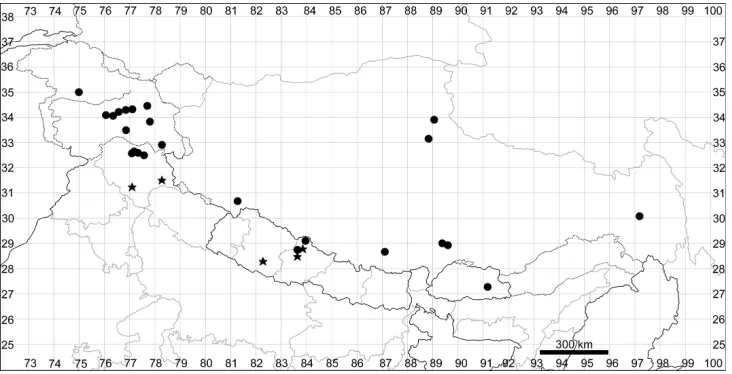
Phenology. Flowering: March-September; fruiting: April-November. Distribution. See Fig. 5.
Specimens examined. BHUTAN: Charithang, Aug 1938, B.J. Gould 1396 (DD); Byakar, 27°33'N, 90°44'E, 2700 m a.s.l., 9 Jun 1979, A. Grierson & D. Long 1779 (K, E00168228); Upper Mo Chu distr., Chebesa, 3880 m a.s.l., 27 Sep 1984, I. Sinclair & D. Long 5361 (E00168227); Tashigang distr., nr Rolong, 800 m a.s.l., 20 Mar 1991,
C. Parker 4926 (E00168225);
CHINA: Xizang: Ngari Prefecture: Gêrzê (Gaize) County, 4250 m a.s.l., Aug 1972, Li 063 (PE00510181), Li 070 (PE00510179); Burang (Pulan) County, 4100 m a.s.l., 14 Jul 1976, Qinghai-Tibet Team 76-8449 (PE00510198); Nagqu Prefecture: Xainza (Shenzha) County, 4500 m a.s.l., 19 Sep 1976, Qinghai-Tibet Team Vegeta-tion Group 13764 (PE00235194); Xigazê Prefecture: Gyangtse (Gyangzê, Jiangzi), 4 Jul 1904, H.J. Walton 38 (K); Xigazê (Rikaze), 3830 m a.s.l., 7 Jul 1960, Fu 348
(PE00510208); Nyalam (Nielamu) County, Zham (Zhangmu), 2000 m a.s.l., 13 May 1966, Zhang & Lang 3361 (PE00510188); Namling (Nanmulin) County, Gangba, 3 Aug 1972, Tibet Chinese Herbal Medicine Survey Team 993 (PE00510200); Gyangzê (Ji-angzi) County, 3960 m a.s.l., 5 Sep 1974, Qinghai-Tibet Team 74-2072 (PE00510201, KUN0586975); Gyirong (Jilong) County, nr Mangmu, 2300 m a.s.l., 16 Jul 1975,
22350 (WUK0345060); Nyingchi Prefecture: Bomi County, Guxiang, 29°55'N, 95°30'E, 2550 m a.s.l., 3 Jul 1965, Ying & Hong 650415 (PE00510164); Bomi Coun-ty, Tangmai (Tongmai), 2030 m a.s.l., 23 Jul 1965, Zhang & Lang 892 (PE00510166); Bomi County, Sumzom (Songzong), 3500 m a.s.l., 4 Sep 1965, Ying & Hong 651075
(PE00510171); Bomi County, Yi’ong (Yigong), 2400 m a.s.l., 19 Jun 1966, Zhang & Wang 0401 (PE00510223); Mainling (Milin) County, Jiage, 3100 m a.s.l., 10 Jul 1972, Tibet Chinese Herbal Medicine Survey Team 3660 (PE00510218); Qamdo Prefecture: Qamdo (Changdu) County, 23 Aug 1952, Zhong 7203 (PE00510204); Qamdo (Changdu) County, 6 July 1965, Zhang & Lang 230 (PE00510172), Zhang & Lang 232 (PE00510174); Qamdo (Changdu) County to [Baxoi (Basu) County] Bam-da (BangBam-da), 3150 m a.s.l., 6 Jul 1965, Zhang & Lang 403 (PE00510173); Zogang (Zuogong) County, 3750 m a.s.l., 28 Jun 1976, Qinghai-Tibet Team Vegetation Group 8689 (PE00510216); Markam (Mangkang) County, nr Dengba vill., 30 Aug 2011, Yu
et al. 6149 (PE);
INDIA: Jammu & Kashmir: Pata, 7500 ft a.s.l., 28 May 1848, T.T. Thomson s.n. (K); Srinagar, [year] 1856, Schlagintweit 4286 (G); Sonamarg, 1 Sep 1896, C.B. Clarke 30890 (K); [Srinagar] Dal lake, 17 Aug 1917, R.R. Stewart 3324 (K); Ladakh, Zanskar Region, S of Padum, Dibling to Barmi La, 3730 m a.s.l., 24 Aug 2003, 33°54'18"N, 76°41'6"E, L. Klimeš 3227 (PRA); Ladakh, Zanskar, Tsarap, Kuru to Tetha, 3950 m a.s.l., 21 Aug 2004, 33°10'18"N, 77°10'32"E, L. Klimeš 4163 (PRA); Ladakh, Suru Region, Parkachik, 3620–3740 m a.s.l., 25 Aug 2005, L. Klimeš 6048 (PRA); Himachal Pradesh: Simla, 4 Jul 1877, J.S. Gamble 4500 (K); Simla, 7000 ft a.s.l., 10 Jul 1886, H. Collett 311 (K); Simla, 8 Oct 1890, Watt 13674 (E); Lahaul, Koksu Lahaul, 10000 ft a.s.l., 7 Aug 1916, R.E. Cooper 5283 (E00394442); Tangmang, 6000 ft a.s.l., 17 Aug 1956, Polunin 56-363 (BM); Uttarakhand state: Kumaon, Almora, 5500 ft a.s.l., [without date] S. Strachey & J.E. Winterbottom 5 (BR, BM); 20 km SW of Dehradun, 670 m a.s.l., 15 Jun 1972, P. Uotila 17668 (H1154022); Tehri Garhwal Distr., Kharsali, 3 Oct 1991, S.C. Majumdar & B. Balodi 81561 (BSD);
NEPAL: Far-Western: Seti Zone: Bajhang Distr., 19 Jul 1991, Suzuki et al.
9160766 (BM); Bajhang Distr., Khaptad National Park, trail from Ghoda Daune to Lokhada, 29°24'N, 81°8'E, 2559 m a.s.l., 3 Jul 2009, H. Ikeda et al. 20913048
(E00509893); Midwestern: Karnali Zone: [Dolpa Distr.] nr Tarakot, Bheri river, 10500 ft a.s.l., 11 Jul 1952, O. Polunin, W.R. Sykes & L.H.J. Williams 2432 (BM, E); [Dolpa Distr.] Dunai, 28°55'N, 82°55'E, 2100 m a.s.l., 26 Apr 1974, J.-F. Dobremez 2761 (BM, E00214373); Dolpa Distr., Polam, 29°10'N, 82°50'E, 3250 m a.s.l., 6 Oct 1991, M. Minaki et al. 9104404 (BM); [Jumla Distr.], Jumla vill., 23 Sep 2010,
A. Sukhorukov 463 (MW); Rapti Zone: [Rolpa Distr.] Phalabang, 4500 ft a.s.l., 27 Mar 1952, O. Polunin, W.R. Sykes & L.H.J. Williams 654 (E); Western: Dhaulagiri Zone: [Baglung Distr.] nr Bongakhani, 500 ft a.s.l., 5 May 1954, J. Stainton, W.R.
Sykes & L.H.J. Williams 2708 (BM); Mustang Distr., 3185 m a.s.l., 22 Sep 1995, M.
Bhaktapur, Mar 2012, A. Sukhorukov s.n. (MW); Narayani Zone: Chitwan Distr., Sauraha, 160 m a.s.l., 19 Jan 1996, M. Mikage et al. 9614220 (E00152131); Chit-wan National Park, Sauraha, 4 Mar 2008, A. Sukhorukov 56 (MW, E00665443); Eastern: Mechi Zone: [Taplejung Distr.] Talung, 2600 m a.s.l., 3 Oct 1971, C. Jest 71-18 (E00214371).
General distribution. Subcosmopolitan.
2. Chenopodium pamiricum Iljin, Fl. SSSR 6: 873 (1936)
Holotype. [TAJIKISTAN] Pamir Orientale, declivia ad confluentes Baital et Murgab [Bartang], [East Pamir, slopes near confluence of Baital and Murgab rivers], 1 Septem-ber 1923, H. Raikova 417 (TASH – photo seen (!) and fragments of type material (!); isotype – LE!).
Taxonomic notes. Morphologically, C. pamiricum can be easily confused with
C. vulvaria, but all data on the presence of C. vulvaria in mountainous regions of Central Asia belong to C. pamiricum. In contrast to the latter species, either fresh or dry leaves of C. pamiricum do not have a scent. Further investigations have shown that the type material and many other specimens of C. pamiricum have evident het-erospermy, a rare characteristic in Chenopodium s. str. discovered by Sukhorukov and Zhang (2013).
Description. Annual up to 25 cm with several or numerous prostrate or ascend-ing stems. Leaves farinose, shortly petiolate (petioles up to 1.5 cm but usually much smaller) with blades up to 2 cm, rhombic or ovate, entire or subhastate. Inflorescence leafy almost to the top. Flowers in glomerules arranged in ± dense inflorescence. Perianth farinose. Fruits and seeds heteromorphic. The first type of fruits and seeds is formed in terminal flowers, the fruits ripen in July-August. These fruits are ca. 1 mm in diameter and 0.5 mm thick; pericarp with papillae up to 20(25) µm (Fig. 4C); seed dark red or blackish with median keel (Fig. 4E, F), testa 17–25 µm thick. Fruits of the second type (which dominates at the end of the vegetation period) are ovoid, 1.0–1.2 mm long, ca. 0.5 mm thick, pericarp papillate or not (Fig. 4D); seeds yellow-brownish, elongated.
Habitat. Sandy or rocky places, 3400–5000 m a.s.l. (in Himalaya) and at lower altitudes in Central Asia.
Phenology. Flowering: June-September; fruiting: August-October. Distribution. See Fig. 5.
Specimens examined. CHINA (new records for China): Xizang: Ngari Prefecture: Gê’gyai (Geji) County, Yanhu Distr., 4450–4500 m a.s.l., 24 Aug 1976, Qinghai-Tibet Team Vegetation Group 13541 (PE00235028); Rutog (Ritu) County, Rabang (Rebang), 4360 m a.s.l., 28 Aug 1976, Qinghai-Tibet Team Vegetation Group 13653 (PE00235010).
INDIA: Jammu & Kashmir: [Ladakh] Nubra [valley], Kardong [La], Aug 1856,
(G455287); Ladakh, Rupshu [Plateau], Tso Kar [lake], 4600 m a.s.l., 22 Aug 1995, H. Hartmann 5037 (MSB137926); Ladakh, Zanskar Region, Ruberung La, 4300 m a.s.l., Aug 1997, L. Klimeš s.n. (PRA); Ladakh, Zanskar, Tsarap, 4180 m a.s.l., 5 Sep 1998,
L. Klimeš 380 (PRA); Indus valley, Stot (E) [Stod River valley], Nyi, 4600–4700 m a.s.l., 2 Sep 2002, L. Klimeš 6176 (PRA); Ladakh, Pangong Region, Spangmik, 4300 m a.s.l., 9 Sep 2002, L. Klimeš 2676 (PRA); Indus valley, Stot (E), Sumdo Gonma to Kiagar La, 4690 m a.s.l., 7 Sep 2003, L. Klimeš 3463 (PRA); Shyok (E), Laga vill., 4220–4230 m a.s.l., 12 Sep 2003, L. Klimeš 2745 (PRA); Indus valley, Sham (W), Basgo to Nye, 3490–3590 m a.s.l., 7 Aug 2006, L. Klimeš 6712 (PRA).
General distribution. Central Asia south to North Himalaya and North Tibet. For a long time, C. pamiricum has been considered endemic to Pamir (Iljin 1936, Pratov 1972). The analysis of the material collected in the fruiting stage proved that the range of Chenopodium pamiricum covers almost all parts of Central Asia with re-cords in Mongolia, West China (Xizang and Xinjiang), North Pakistan, North India, Kyrghyzstan, Tajikistan, Russia (Altay Mountains) and Eastern Kazakhstan. The re-cords from Pamir, Karakoram, NW Tibet and North Himalaya represent the south-ernmost boundary of the distribution of C. pamiricum.
3. Chenopodium ficifolium Sm., Fl. Brit. 1: 276 (1800)
Lectotype (Al-Turki and Ghafoor 1996): figure 16 in Curtis, Fl. Londinensis 1, fasc. 2 (1778).
lected in England [Yarmouth, Sep 1801, Mr. D. Turner] and kept at LINN-HS (sheet 459.24) is not a part of the original material used for the description. Citing the “type”, Al-Turki and Ghafoor (1996) refer to the drawing of Curtis (1778, fig. 16), but Curtis did not describe any Chenopodium in his work and erroneously labelled his fig. 16 as “Chenopodium viride”, although the image of the plant completely corresponds with
Chenopodium ficifolium later described by Smith (1800). Citing the type of Chenopo-dium ficifolium, Al-Turki and Ghafoor (1996) have unintentionally lectotypified the species with the drawing in Curtis (1778). The chosen lectotype shows the plant with clearly trilobate leaves with prominent and elongated middle lobe (Chenopodium fici-folium subsp. ficifolium: Uotila 1997, 2001).
Description. Annual up to 60(80) cm, loosely branched, stem green but often with red stripes. Leaves bright green, long-petiolate, 2–7 × 1–3 cm, three-lobed; apical lobe 2–4 times longer than lateral lobes; lateral lobes in the lower part of leaf short, entire or sinu-ate; apical lobe long, narrow with ± parallel margins, entire or irregularly sinuate-dentate. Inflorescence leafy in the lower and middle parts, short (up to 15 cm). Perianth green, en-closing the fruit; dorsal segments slightly carinate. Fruit 1.2–1.5 mm in diameter, pericarp separating from the seed, papillate (honeycomb-like when dry). Seed marginally rounded or slightly keeled; testa longitudinally striate (Fig. 4G, H), slightly sinuate in cross-section.
Habitat. Disturbed places, river-sides, sands; 0–2200(3000) m a.s.l. Common at least in many parts of Nepal and Bhutan. Numerous seedlings were observed by AS near Mussoorie (Uttarakhand, India) in mid-February 2018.
Phenology. Flowering: February-May; fruiting: April-June. At higher altitudes (where the plant is rare), the blooming and fruiting times appear to be much later.
Distribution. See Fig. 6.
Specimens examined. BHUTAN: Torsa valley, Jan 1912, anonym s.n. (E00168226); Samchi Distr., Samchi [Samtse], 500 m a.s.l., 27 Feb 1982, A. Grierson & D. Long 3267 (E00168235, K); Tongsa Distr., Pertimi, 1300 m a.s.l., 5 Apr 1982,
A. Grierson & D. Long 4336 (K); Punakha Distr., Toiberong Chu, 1310 m a.s.l., 21 Apr 1982, A. Grierson & D. Long 4584 (E, K); Punakha Distr., Wangdi [Wangdue] Phodrang, 1200 m a.s.l., 12 Mar 1991, C. Parker 4873 (E);
INDIA: Jammu & Kashmir: Srinagar, [year] 1856, Schlagintweit 4286 (G); Ladakh, Zanskar Region, Zara, Sangtha vill., 4420–4430 m a.s.l., 31 Aug 2001, L. Klimeš 1454 (PRA); Ladakh, Shyok Region, Hodtong, 3280–3320 m a.s.l., 26 Sep 2004, L. Klimeš 5063 (PRA); Ladakh, Dras Region, Matayan to Pindras, 3220 m a.s.l., 15 Aug 2005, L. Klimeš 5747 (PRA); Sikkim: 4000 ft a.s.l., 28 May 1874, anonym 158 (K, LE); Uttarakhand: Dehradun, Niranjanpur, 700 m a.s.l., 25 May 1962, N.P. Singh 19649 (BSD); Dehradun, 600 m a.s.l., 26 Mar 1964, N.P. Singh 31695 (BSD); Dehradun city (Bot. Garden) and nr Mussoorie, obs. by AS in Feb 2018;
L.H.J. Williams 38 (BM); Kathmandu Distr., Kathmandu, N bank of Bagmati river, Thapathali, 1300 m a.s.l., 20 Apr 1992, D.G. Long & S.E. McDermott 21909 (E); Janakpur Zone: [Dolakha Distr.] Namdu, Apr 1995, Bhandari s.n. (KATH); Narayani Zone: Chitwan [Distr.], 4 Mar 2008, A. Sukhorukov s.n. (MW); [Bhaktapur Distr.] Nagarkot to Bhaktapur, 1700 m a.s.l., 19 Mar 2012, A. Sukhorukov s.n. (MW); East-ern: Mechi Zone: [Jhapa Distr.] Bhadrapur, 1987, anonym s.n. (KATH).
General distribution. Widespread in the tropical submountainous territories of SE Asia (e.g. China, Myanmar), where it may be native. Rarely found in the temperate climates of Eurasia and America.
4. Chenopodium harae Sukhor., Phytotaxa 226(3): 290 (2015)
=Chenopodium pallidum sensu Sukhorukov (in Sukhorukov and Kushunina 2014), non Moquin-Tandon (1840).
Holotype. NEPAL, [Dhaulagiri Zone], Mustang Prov. [Distr.], Annapurna Conservation area, Trekking route Jomosom-Muktinath, valley of Khali Gandaki river, between Jomo-som and Kagbeni villages, riverside, 2700 m alt., 22 Sep 2009, A. Sukhorukov 566 (MW!). Taxonomic notes. In the latest revision of the Chenopodiaceae in Nepal (Sukho-rukov and Kushunina 2014), this species is cited as Chenopodium pallidum Moq., but a closer look at the authentic specimens in P has proved that all plants (collected in early blooming stage) are indeed Atriplex pallida, now synonymised with A. schugnanica Iljin (Sukhorukov and Kushunina 2015).
ovate, slightly cuneate, green above, greenish below, dentate, margins often red. Inflo-rescence bracteate or aphyllous. Perianth green, enclosing the fruit; segments abaxially carinate. Fruit 1.3–1.5 mm, pericarp easily separating from the seed; papillae up to 25 µm. Seed blackish or reddish-black, surface striate with obtuse or acutish margin (im-mature seeds with acute margin) with small depression apically.
Habitat. Disturbed areas; 1500–3200 m a.s.l.
Phenology. Flowering: March-September; fruiting: April-November. Distribution. See Fig. 7.
Specimens examined.INDIA: Himachal Pradesh: Kinnaur Distr., Shongtong, 11 Jun 1972, K.P. Janandhanan 48358 (BSD); Simla Distr., Seoni, 2 Jun 1986, P.C. Pani 80903 (BSD);
NEPAL: Midwestern: Rapti Zone: [Rolpa Distr.] Phalabang, 4500 ft a.s.l., 24 Mar 1952, O. Polunin, W.R. Sykes & L.H.J. Williams 654 (BM, LE); Western: Dhaula-giri Zone: Mustang [Mustang Distr.], Jomosom to Kagbeni, 22 Sep 2009, A. Sukho-rukov 566 (E00757737, MW); Myagdi Prov. [Distr.], nr Dana vill., 1500 m a.s.l., 11 May 2010, A. Sukhorukov 510 (MW).
General distribution. Central and Northern Himalaya (India, Nepal, Pakistan [Gilgit: E!]).
5. Chenopodium karoi (Murr) Aellen, Fedd. Repert. 26: 149 (1929)
≡C. album subsp. karoi Murr, Neu. Übers. Farn & Blütenpfl. Vorarlberg 1: 97 (1923). Lectotype (designated here by Sukhorukov): [RUSSIA] Nerczynsk [Nerchinsk], dump places, 1892, Karo 169 (G00405813!).
=C. prostratum Bunge in Herder, Acta Hort. Petrop. 10: 594 (1889) nom. illegit. non Schultes (1820). The name is a later homonym (ICN, art. 53.1). Lectotype (Uo-tila and Lomonosova 2016): [RUSSIA, Saha Republic] Nizhnekolymsk, 6 July 1832, Sharypov 20 (LE01015991!).
=(?)C. jenissejense Aellen & Iljin, Fl. SSSR 6: 873 (1936). Lectotype (Uotila and Lo-monosova 2016): [RUSSIA] Yenisey Prov., Turukhanskiy Krai [Krasnoyarskiy Krai, Turukhanskiy distr.], Kureyka river mouth, 66°30'N, 87°17'E, sandy and pebbly river bank, 7 Sep 1914, N.I. Kuznetsov & V. Reverdatto 4102 (LE01015992! for individuals at the bottom and to the right; isolectotypes – G! LE! NS). This species was only recently synonymised with Chenopodium karoi (Uotila and Lomonosova 2016). However, C. jenissejense is quite distinct in its morphological characters and needs to be studied in detail.
Description. The species is similar to C. album, but plants are dark green, usually with ascendant or prostrate stems up to 25 cm. Leaves ± ovate, somewhat longer than broad, sometimes inconspicuously three-lobed. Fruit 1.1–1.3 mm, pericarp reticulate in dry fruits, soaked papillae up to 50 µm long (Fig. 8A). Seed margin obtuse, surface with sinuate furrows (Fig. 8B, C).
Habitat. Disturbed areas, rocky habitats; 2500–5100 m a.s.l. Phenology. Flowering: May-August; fruiting: July-September.
Distribution. Common plant in many parts of Himalaya and Tibet (Fig. 7). Specimens examined.BHUTAN: Mongar Distr., Lingmethang, 14 Jun 1992, C. Parker 7241 (E);
CHINA: Xizang: Ngari Prefecture: Burang County, Langacuo lake, 4560 m a.s.l., 27 Aug 1990, Y. Fei et al. 667 (KUN0265513); Nagqu Prefecture: Shuanghu County, 4850 m a.s.l., 22 Jul 1976, Qinghai-Tibet Team Lang 9780 (KUN0587328); N Xizang, Jialin, 5100 m a.s.l., 24 Jul 1976, Gansu Agriculture University 088 (PE00541004); Xigazê Prefecture: Tingri, Jul 1921, A. Wollaston 264 (BM); [Gyangste County] Kala [tso], 14000 ft a.s.l., 8 Aug 1936, Chapman 499 (K); [Tingri County] Shelkar Dzong, 14000 ft a.s.l., 24 Jun 1938, Lloyd 81 (K); [Gyantse] Gobshi, 14000 ft a.s.l., 16 Aug 1936, Chapman 230 (K); Gyangzê (Jiangzi) County, 3960 m a.s.l., 5 Sep 1974, Qing-hai-Tibet Team 74-2070 (KUN0587330); Qamdo Prefecture: Baxoi (Basu) County, Nu river, 3000 m a.s.l., 5 Jul 1976, Qinghai-Tibet Team 12208 (KUN0586973);
INDIA: Jammu & Kashmir: Ladakh, between Nubra & Leh, 4 Sep 1848, T.T.
Thomson s.n. (K); Zanskar, Bok, 13 Sep 1931, W. Koelz 2948 (LE); Ladakh, Uphse– Murul, 3500 m a.s.l., 7 Aug 1976, B.M. Wadhwa 59711 (BSD); Ladakh, Saspole, 4200 m a.s.l., 29 Jul 1976, B.M. Wadhwa 59341 (BSD); Ladakh, Rangdum, 4000 m a.s.l., 1980, Southampton Univ. Team 126 (K); Ladakh, Kanji, 15300 ft a.s.l., 30 Jun 1984,
2003, L. Klimeš 3161 (PRA); Ladakh, Zanskar Region, S of Padum, 4150 m a.s.l., 29 Aug 2003, L. Klimeš 3322 (PRA); Ladakh, Rupshu region, Tso Moriri, 4550 m a.s.l., 13 Sep 2005, L. Klimeš 6314 (PRA); Himachal Pradesh: Lahaul, Sep 1869, anonym
s.n. (K); Lahaul, Jispa vill., 13000 ft a.s.l., 11 Aug 1930, W. Koelz 1003 (P05158996); Badadara, 3975 m a.s.l., 11 Sep 1961, N.C. Nair 16855 (BSD); Chandra Tal, 4 Jul 2003, S.K. Srivastava 103111 (BSD);
Lo Tsho Dhyun, Yara [Yara Gaun] area, 16 Jul 1998, W.R. Sykes 331/98 (E00649126); Mustang Distr., Tangbe, 28°54'N, 83°49'E, 3065 m a.s.l., 31 Aug 2001, G. & S. Miehe & Koch 01-098-02 (herb. Miehe); Mustang Distr., Marpha vill., 2600 m a.s.l., 17 Apr 2009, A. Sukhorukov s.n. (E, MW).
General distribution. Himalaya, Central Asia, Siberia.
6. Chenopodium bengalense (Lam.) Spielm. ex Steud., Nomencl. Bot., ed. 2, 1: 348 (1840)
≡Atriplex bengalensis Lam., Encycl. 1(1): 276 (1783). Lectotype (designated by Suk-horukov and Kushunina 2014): “Plante potagére des Indes [vegetable plant from India], herb. De Lamarck” (P-LA00381128!). Epitype (designated by Sukhorukov and Kushunina 2014): NEPAL, [Dhaulagiri zone, Myagdi distr.] Annapurna con-servation area, near Tikhedhunga vill., 1700 m alt., edge of vegetable garden, 13 Nov 2008, A. Sukhorukov s.n. (MW! isoepitype W2010-0007930!). All branches of the epitype and isoepitype are from one individual.
=Chenopodium giganteum D.Don, Prodr. Fl. Nepal.: 75 (1825). Lectotype (designated by Sukhorukov and Kushunina 2014): Herb. Wallich 6952 F [N. Wallich] (K!). =Chenopodium album L. subsp. amaranticolor H.J.Coste & Reyn., Bull. Herb. Boissier,
sér. 2, 5: 979 (1905). Type: n.v.
≡Chenopodium amaranticolor (H.J.Coste & Reyn.) H.J.Coste & Reyn., Bull. Soc. Bot. France 54: 181 (1907).
Taxonomic notes. The correct name for this taxon previously known as Chenopo-dium giganteum was reinstated by Sukhorukov and Kushunina (2014), but the year of Spielmark’s combination Chenopodium bengalense (Lam.) Spielm. in Steudel (1821) is wrong, because Spielmark considered Chenopodium bengalense (Lam.) Spielm. as a synonym of Atriplex bengalense Lam. The combination Chenopodium bengalense is indeed validated in Steudel (1840).
Description. Robust annual up to 2.5 m, branched from the base. Petioles of lower caducous leaves up to 10 cm, blades 10–25(30) × 5–10 cm, usually rhombic, dentate, erose or trilobate with elongated terminal lobe; middle leaves rhombic or ovate, smaller; upper leaves oblong or lanceolate, completely entire, abaxially grey; young leaves often reddish. Inflorescence whitish due to the presence of abundant bladder hairs on the branches and perianth. Fruit 1.2–1.5 mm, pericarp hyaline, adjoining to the seed coat, but separating from it when rubbed, long-papillate in fresh or even dry fruits (Fig. 8D). Seed black, ± keeled, with small crater-like micro-depressions (Fig. 8E, F).
Habitat. Edges of vegetable gardens and other places with secondary vegetation; 700–2900 m a.s.l. Cultivated as a crop but very locally.
Phenology. Flowering: June-September; fruiting: August-November. Distribution. See Fig. 9.
(PE00510185, PE00510186); Nyingchi (Linzhi) County, Bayi Town, 2950 m a.s.l., 20 Jun 1989, K.Yao et al. 1298 (NAS00003754);
INDIA: Himachal Pradesh: Upper Kinnaur, Poari, 21 Sep 1890, J.H. Lace 623
(E, G); Uttarakhand: Tehri Garhwal [Distr.], Jhala, 8000–9000 ft a.s.l., 25 Jun 1853,
J.F. Duthie s.n. (DD, G); Sikkim: Sikkim Himal [without date and collector] (K); NEPAL: Western: Dhaulagiri Zone: [Baglung Distr.] nr Lumsum, 8000 ft a.s.l., 10 Sep 1954, J. Stainton, W.R. Sykes & L.H.J. Williams 4315 (BM; LE); [Myagdi Dis-tr.] between Ramche & Gram, 1800–1900 m a.s.l., 20 Aug 1972, Kanai et al. 723625
(BM); [Myagdi Distr.] Annapurna conservation area, near Tikhedhunga vill., 1700 m a.s.l., 13 Nov 2008, A. Sukhorukov s.n. (MW, W2010-0007930); Central: Bagmati Zone: Nuwakot Distr., Bidur, anonym s.n. (KATH); [Rasuwa Distr.] Dhunche, 2000 m a.s.l., 22 Aug 1972, Kanai et al. 723624 (BM).
General distribution. Himalaya and Tibet and as casual alien in some parts of Eurasia (Uotila 1997; 2001). The specimens from Eastern China labelled as Cheno-podium giganteum (PE, see also Zhu et al. 2003) do not belong to C. bengalense. The easternmost records of C. bengalense are known from Sichuan, Guizhou, Shensi and Shaanxi provinces in China (PE!).
7. Chenopodium novopokrovskyanum (Aellen) Uotila, Ann. Bot. Fenn. 30: 192 (1993)
Aschabad, in ruderatis [in dump areas], 25 Jun 1900, P. Sintenis 527 (S, isolecto-types G-DC! G75415! G75426! K! LD, LE!).
Taxonomic notes. This species was described from the deserts of Turkmenistan and the identity of the populations growing in the Central Asian plains and in the Hima-layan Mountains is not obvious despite the morphological similarities. The material from Himalaya is scarce and collected in the blooming or early fruiting stages. Further investigations are needed to establish the taxonomic status of Himalayan plants named
C. novopokrovskyanum.
Description. The species is similar to C. album, but the leaves are bi-coloured (green or greyish adaxially and white-farinose abaxially), narrowly oblong to lanceo-late. Fruit 1.0–1.1 mm in diameter, ca. 0.6 mm thick, seed almost smooth with indis-tinctly polygonal ultra-sculpture and indistinct pits (Fig. 10A, B).
Phenology. Flowering: June-September; fruiting: August-October. Distribution. See Fig. 9.
Specimens examined.INDIA: Jammu & Kashmir: Ladakh, Leh, 3400 m a.s.l., 20 Aug 1979, Bruhn s.n. (MSB144211); Ladakh, Sabu [Saboo village], 3680 m a.s.l., 15 Jul 1992, H. Hartmann 4013 (MSB137924).
General distribution. SE Europe, Central Asia, North Himalaya, Karakoram.
8. Chenopodium atripliciforme Murr, Magyar Bot. Lapok 1: 360 (1902).
Lectotype (Uotila 1993): AFGHANISTAN, Kurrum valley, 1879, J.E.T. Aitchinson 980 (G11875! isolectotypes BM000629112! C, G-BOISS! FI, K! S).
Taxonomic notes. Murr (1902) cited two distant records (Russian Far East and Afghanistan) in the protologue of C. atripliciforme. We agree with Uotila (1993) that the specimen from the first location (Ussuri) probably belongs to C. bryoniifolium
Bunge, which is similar in leaf shape to C. atripliciforme.
Description. Annual up to 1 m, mostly branched; leaves petiolate (petioles up to 4 cm). Leaf blades triangular, basally truncate or broadly cuneate, entire to erose-dentate. Inflorescence branched, terminal and axillar, slender; clusters consisting of 2–4 flowers or rarely flowers solitary. Fruit 1.2–1.4 mm with papillate pericarp. Seed black, almost smooth with indistinct small pits (Fig. 10C, D).
Habitat. Rocky places, forest margins; (1800)2000–3300 m a.s.l. Phenology. Flowering: June-September; fruiting: August-October. Distribution. See Fig. 9.
Specimens examined.INDIA: Jammu & Kashmir: Baramulla, Aug 1880, Young
s.n. (BM); Sind valley, 7500 ft a.s.l., 2 Sep 1876, C.B. Clarke 30934 (LE); Srinagar, in monte Shankaracharya, 1770–2000 m a.s.l., 24 Aug 1986, K.H. Rechinger 62146
1877, J.S. Gamble 4909 (K); Lahaul, Kyelang, 3100 m a.s.l., 11 Aug 1970, U.C. Bhattacharyya 40754 (BSD); [Kinnaur Distr.] Purbani, 2500 m a.s.l., 7 Oct 1971,
K.P. Janardhanan 46510 & 46519 (BSD); Uttarakhand: Garhwal, Jumma area, 2800 m a.s.l., 14 Aug 1974, B.D. Nailhani 53892 (BSD); [Uttarkashi Distr.] Kalyani, 3000 m a.s.l., 13 Aug 1978, A.K. Goel 64457 (BSD); Chamoli Distr., Aug 1988, P.K. Hajra 87078 (BSD); Uttarkashi Distr., Janki Chatti, 7 Oct 1993, S.C. Majumdar & S. Singh 88100 (BSD).
General distribution. East Afghanistan, North Pakistan, North India (Jammu & Kashmir, Himachal Pradesh, Uttarakhand and Punjab).
9. Chenopodium perttii Sukhor., Phytotaxa 191(1): 21 (2014)
Holotype. NEPAL, [Dhaulagiri Zone] Mustang [Distr.], 13000 ft alt., at edge of field, 3 Aug 1954, J. Stainton, W.R. Sykes & L.H.J. Williams 2159 (BM000832654! isolec-totype LE!).
Taxonomic notes. Morphologically, Chenopodium perttii resembles a Far Eastern and Siberian species, C. bryoniifolium Bunge, but the species have different distribu-tions and reproductive characters (Sukhorukov and Kushunina 2014). The recently identified chromosome number for C. perttii is 54, so it is genetically distant from other species previously identified as C. album (Bohumil Mandak, pers. comm.). How-ever, we assume that C. perttii is more closely related to Chenopodium album subsp.
yunnanense Aellen in Handel-Mazzetti (1929). This subspecies was described from Yunnan (China) and differs by the absence of the seed keel. The lectotype of Cheno-podium album subsp. yunnanense was selected in Sukhorukov and Kushunina (2014).
Description. Annual up to 1(1.5–2) m with erect, scarcely branched stem. Leaves dark green, petiolate (petioles up to 3 cm), blades 3–4 × 2–3 cm, base truncate or broadly cuneate, margins often red; lower leaves triangular, entire to lobate; middle leaves trilobate with elongated mid-lobe (less than two times as long as the lateral ones) gradually tapering to apex and slightly upward-directed lateral lobes, lobes mostly en-tire; upper leaves also trilobate or entire, narrowly oblong. Inflorescence green, aphyl-lous or rather bracteose. Fruit ~1.5 mm, pericarp separating from the seed (not easily) with minute papillae that are hardly restored after soaking, almost smooth in dry fruit. Seed prominently keeled, surface with radial striae (Fig. 10E, F).
Habitat. Disturbed places, often as a weed in crop fields; 2400–4500 m a.s.l. Phenology. Flowering: June-September; fruiting: August-October.
Distribution. See Fig. 11.
Specimens examined.CHINA: Xizang: Ngari Prefecture: Gêrzê County, 4250 m a.s.l., Aug 1972, Li 67 (PE00510178); Xigazê Prefecture: Nyalam (Nielamu) County, Zham (Zhangmu), 13 May 1966, Zhang & Lang 3361 (PE00510187); Gyi-rong (Jilong) County, GyiGyi-rong (Jilong) Town, 2900 m a.s.l., 6 Jun 1972, Tibet Chinese Herbal Medicine Survey Team 151 (PE00510191, PE00510220); Namling (Nanmulin) County, Qunmo, 4000 m a.s.l., 2 Aug 1972, Tibet Chinese Herbal Medicine Survey Team 912 (PE00510199, PE00510219); Namling (Nanmulin) County, Gangba, 4000 m a.s.l., 3 Aug 1972, Tibet Chinese Herbal Medicine Survey Team 993 (PE00510221); Lhasa City: nr Lhasa, July 1939, H.E. Richardson 215 (BM); Lhasa, 3800 m a.s.l., 16 Aug 1965, Zhang & Lang 1532 (PE00510965); [Damxung (Dangxiong) County] Lake Natso, 30°55'N, 90°59'E, 4740 m a.s.l., 4 Sep 2005, Nölling & Hanspach NX05-201-10 (herb. Miehe); Shannan Prefecture: Zhanang (Chatang) County, 3500 m a.s.l., 13 Aug 1960, Fu 528 (PE00510203); Lhünzê (Longzi) County, 3800 m a.s.l., 17 Aug 1960, Fu 564 (PE00510209); Nyingchi Prefecture: [Mainling (Milin) County] Tsangpo valley, Timpa, 29°33'N, 94°52'E, 9700 ft a.s.l., 6 Jul 1938, F. Ludlow et al.
Sur-vey Team 3330 (PE00510163, PE00510222); Mainling (Milin) County, Jiage, 3100 m a.s.l., 10 Jul 1972, Tibet Chinese Herbal Medicine Survey Team 3660 (PE00510162); Zayü (Chayu) County, 1700 m a.s.l., 4 Jul 1980, Ni et al. 0420 (PE00510183); Zayü (Chayu) County, 2600 m a.s.l., 13 Aug 1980, Ni et al. 1026 (PE00510182); Qamdo Prefecture: Baxoi (Basu) County, Rawu (Ranwu) to Baima, 4200 m a.s.l., 27 Aug 1973, Qinghai-Tibet Team 73-1279 (PE00510176, PE00510177); Zhag’yab County, 3100 m a.s.l., 7 Aug 1976, Qinghai-Tibet Team Vegetation Group 9492 (PE00235126);
INDIA. Jammu & Kashmir, Tangmarg, 6000 ft a.s.l., 17 Aug 1956, O. Polunin 56-364 (E); Banihal river, 3300–3835 m a.s.l., 14 Sep 1958, T.A. Rao 7665 (BSD); Lo-ran, 2000–2500 m a.s.l., 17 Sep 1985, Vohra 78338 (BSD); Raydha La, 18 Sep 1986,
B.M. Wadhwa 83855 (BSD); Himachal Pradesh: [Kinnaur Distr.] Kalpa, 2775 m a.s.l., 3 Jun 1962, N.C. Nair 22343 (BSD); Chamba Distr., Kilar, 2625 m a.s.l., 19 Jul 1964, N.C. Nair 32634 (BSD); [Kinnaur Distr.] Sangla, 1950 m a.s.l., 20 Sep 1964,
N.C. Nair 33027 (BSD); Lahaul, Chimrat, 2900 m a.s.l., 2 Aug 1990, McBeath 2275
(E); Kulu Distr., Kasol, 1667 m a.s.l., Sep 2000, S. Singh s.n. (BSD); Lahaul, 3000 m a.s.l., Aug 2000, S. Singh 144 (BSD); Spiti Distr., Pin Valley National Park, 3800 m a.s.l., 3 Sep 2002, K.C. Sekar 102975 (BSD); Uttarakhand: Kumaon, Nainital, 2100– 2500 m a.s.l., 8 Oct 1957, T.A. Rao 4881 (BSD); Mussoorie, 2320 m a.s.l., 6 Aug 1960, anonym 12470 (BSD); Chakrata, 6750 ft a.s.l., 29 Jul 1961, U.C. Bhattacharyya 13069 (BSD); Pauri Garhwal Distr., Pauri, 21 Sep 1979, A.S. Rao 56423 (BSD); Ut-tarkashi distr., Janki Chatti, 4 Oct 1993, S.C. Majumdar & S. Singh 86486 (BSD);
NEPAL: Midwestern: Karnali Zone: [Jumla Distr.] Jumla vill., 2400 m a.s.l., 27 Sep 2010, A. Sukhorukov 567 (MW); Jumla vill., 29 Sep 2014, A. Sukhorukov 62
(MW); Mugu Distr., Jhari vill., 2600 m a.s.l., 4 Oct 2014, A. Sukhorukov 510 (MW); Mugu Distr., Gamghadi vill., 5 Oct 2014, A. Sukhorukov s.n. (G); Mugu Distr., Pina vill., 6 Oct 2014, A. Sukhorukov 585 (BR); Western: Dhaulagiri Zone: [Mustang Distr.] Thinigaon, Muktinath Himal, 11500 ft a.s.l., J. Stainton, W.R. Sykes & L.H.J. Williams 1372 (LE); [Upper Mustang] Tange, 3500 m a.s.l., 22 Aug 1955, Lobbichler 26 (M); Mustang Distr., Tangbe, 28°54'N, 83°49'E, 3065 m a.s.l., 31 Aug 2001, G. & S. Miehe & Koch 01-098-05 (herb. Miehe); Gandaki zone: Manangbhot Distr., Tilicho base camp (4000 m a.s.l.) to Khangsar (3650 m a.s.l.), 1 Aug 1983, H. Ohba
et al. 8331076 (E00238402).
General distribution. Himalaya and Tibet. Frequent or common in West Nepal.
Poorly known species
Chenopodium strictum Roth, Nov. Sp. Pl.: 180 (1821)
Type. n.v. (not present in HAL and other herbaria).