A taxonomic revision of Curarea Barneby & Krukoff
(Menispermaceae)
Rosa del C. Ortiz1
1 Missouri Botanical Garden, 4344 Shaw Blvd., St. Louis, Missouri 63110, USA
Corresponding author:Rosa del C. Ortiz ([email protected])
Academic editor:C. Morden | Received 23 October 2017 | Accepted 13 April 2018 | Published 21 June 2018
Citation: Ortiz RdC (2018) A taxonomic revision of Curarea Barneby & Krukoff (Menispermaceae). PhytoKeys 100: 9–89. https://doi.org/10.3897/phytokeys.100.21828
Abstract
A monograph of Curarea, a neotropical genus in the plant family Menispermaceae, is presented. Curarea
is distinguished from related genera by the combination of staminate flowers with sepals in two whorls and pistillate flowers with three petals, three carpels and usually elongated carpophores bearing three
ses-sile drupelets. Nine species are recognised, amongst them two new to science, C. gentryana from Ecuador
and C. barnebyana, from Ecuador and Peru. Additionally, two new combinations, C. iquitana and C. tomentocarpa, are proposed for distinct taxa recovered in a multivariate analysis of quantitative characters
of the broadly distributed and morphologically variable C. toxicofera. The anatomy and morphology of
species in the genus is documented, identification key, species descriptions, distribution maps and a pre-liminary conservation assessment for all accepted species are also provided. Of the nine species recognised
here, C. barnebyana is assigned a preliminary status of Vulnerable, C. crassa (known only from the coastal
Atlantic Forest in Brazil) and C. gentryana (endemic to western Ecuador) are both assigned a preliminary
status of Endangered.
Keywords
Arrow poison, curare, dioecious liana, neotropical clade, Ranunculales
http://phytokeys.pensoft.net
Copyright Rosa del C. Ortiz. This is an open access article distributed under the terms of the Creative Commons Attribution License (CC BY 4.0), which permits unrestricted use, distribution, and reproduction in any medium, provided the original author and source are credited.
Table of contents
Introduction ... 10
Materials and methods ... 13
General morphology ... 19
Habit and stem ... 19
Wood anatomy ... 19
Leaves ... 20
Indumentum ... 21
Venation pattern ... 21
Leaf anatomy: adaxial cuticle, transverse sections of petiole, lamina and mid-vein ...23
Inflorescences ... 26
Flowers... 28
Infructescences and drupelets ... 29
Pollen morphology ... 30
Phytochemistry ... 30
Ethnobotany ... 30
Geographical distribution and habitat ... 31
Phylogenetic affinities ... 32
Multivariate analyses of Curarea toxicofera s.l. ... 32
Taxonomic treatment ... 35
Curarea Barneby & Krukoff ... 35
Key to the species of Curarea ... 37
1. Curarea barnebyana R.Ortiz, sp. nov... 38
2. Curarea candicans (Rich. ex DC.) Barneby & Krukoff ... 43
3. Curarea crassa Barneby ... 49
4. Curarea cuatrecasasii Barneby & Krukoff ... 53
5. Curarea gentryana R.Ortiz, sp. nov. ... 58
6. Curarea iquitana (Diels) R.Ortiz, comb. nov. ... 61
7. Curarea tecunarum Barneby & Krukoff ... 66
8. Curarea tomentocarpa (Rusby) R.Ortiz, comb. nov. ... 72
9. Curarea toxicofera (Wedd.) Barneby & Krukoff ... 78
Tribute ... 84
Acknowledgments ... 85
References ... 85
Supplementary material 1 ... 89
Introduction
Curarea Barneby & Krukoff of the plant family Menispermaceae, tribe Tiliacoreae, is a genus of understory or canopy dioecious lianas that are widely distributed in the humid forests of tropical America, mostly at low elevation from eastern Brazil
remain-ing members of the tribe endocarps ornamented by longitudinal ribs, seeds
hippo-crepiform and without endosperm and fleshy cotyledons (Ortiz et al. 2016). Curarea
was segregated from Chondrodendron Ruiz & Pav. to include species that differed in
several floral and carpological features (Barneby and Krukoff 1971). In Curarea, the
calyx of staminate flowers is composed of two whorls of three, scarcely fleshy and greenish sepals, these being variously described as sepaloid scales (Barneby and
Kru-koff 1971: 7) or as sepals (Barneby 1996). In Chondrodendron, the calyx is formed
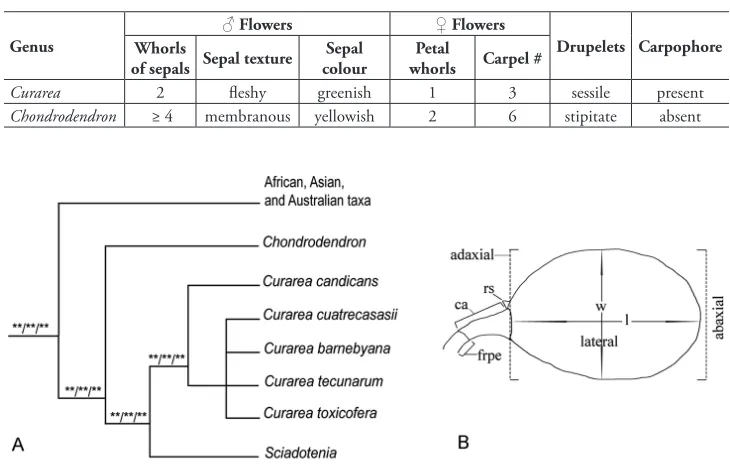
by four or more whorls of three, membranous sepals that are cream coloured and, hence, described as petaloid sepals (Barneby and Krukoff 1971: 7). Staminate flow-ers of both genera have 6 petals that are membranous and much shorter than the
innermost sepals (Table 1). Pistillate flowers of Curarea have only 3 petals and 3
carpels, whilst those of Chondrodendron have 6 petals and 6 carpels. The drupelets
of both genera have narrow supportive structures, but in Curarea, these are elongate
carpophores that bear atop sessile fruits, while in Chondrodendron the fruits are
con-spicuously stipitate (Table 1). The distinct nature of Curarea is also supported in a
family-wide phylogenetic analysis of chloroplast markers (Ortiz et al. 2016), where
it is recovered as monophyletic and sister to Sciadotenia Miers, in a neotropical clade
that also includes Chondrodendron (Fig. 1A; Ortiz et al. 2016). Within this
neotropi-cal clade, Curarea shares with Sciadotenia sessile drupelets borne on narrow elongated
carpophores bearing six carpels in Sciadotenia and only three in Curarea. The two
whorls of sepals in the staminate flowers distinguish Curarea from Chondrodendron
and Sciadotenia, both of which have 3–7 whorls of sepals.
When first described, Curarea included four species: C. candicans, C. cuatrecasasii,
C. tecunarum and C. toxicofera, with C. toxicofera designated as the type species of the
genus (Barneby and Krukoff 1971). While C. cuatrecasasii and C. tecunarum were
newly described, both C. candicans and C. toxicofera were transferred from
Chondro-dendron. Another species was later added to the original four with the recognition of C. crassa, an endemic new species from the Brazilian Atlantic Forest (Barneby 1996).
Although the etymology of the generic epithet was never provided, the name Curarea
doubtlessly refers to curare, the South American arrow-poison for which species of Curarea provide one of the ingredients.
In this first treatment of Curarea (Barneby and Krukoff 1971), which was also
the most comprehensive one at that time, C. toxicofera was broadly interpreted and
included entities formerly described as various taxa, rendering it a large complex with unclear patterns of morphological variation. However, subsequent works generally fol-lowed that of Barneby and Krukoff (1971) and used the five species they recognised in treatment of local, regional and national floras, e.g. Flora of Surinam (Jansen-Jacobs 1976); Flórula de Las Reservas Biológicas de Iquitos, Perú (Ortiz 1997); Flora of Ecua-dor (Ott 1997); Flora de Nicaragua (Ortiz 2001), amongst others. Seven species were later recognised in the most recent, taxonomic account of the genus (Ortiz-Gentry
2000) but Curarea toxicofera remained broadly circumscribed.
On the basis of shared macro- and micromorphology, Ortiz-Gentry (2000)
sug-gested that there were two species groups in Curarea. These were not recovered in a later
– an outlier in the study of Ortiz-Gentry (2000) – was sister to the remaining species of
the genus. Species boundaries in most Curarea are relatively well defined with the
excep-tion of C. toxicofera, which, as mentioned above, has always been broadly defined. For
instance, Barneby and Krukoff (1971) treated the three former Chondrodendron species
[i.e. Chondrodendron iquitanum Diels, C. polyanthum (Diels) Diels and C.
tomentocar-pum (Rusby) Moldenke] as conspecific with Curarea toxicofera. Moreover, the type of
Cocculus toxicoferus Wedd. is a sterile specimen and, hence, lacks diagnostic features to readily distinguish the species, further complicating the application of this name and circumscription of the taxon, which like most Menispermaceae is also dioecious. To
evaluate patterns of morphological variation across the entire range of Curarea
toxi-cofera, 200 collections of the taxon were sorted into five groups based on selected fea-tures such as relative size of petioles and leaves, lamina shape and indumentum type on
its abaxial surface and general features of staminate inflorescence (i.e. slender vs. coarser,
pedicels and staminate flowers conspicuously larger). These groups of specimens were further evaluated using selected quantitative morphological variables. Based on the
out-come of the analyses, three entities are recognised within C. toxicoferas.l., namely C.
toxicoferas.s., C. iquitana and C. tomentocarpa. Two of the five initial groups within C. toxicofera, although distinguished by qualitative features, were however not recovered in the multivariate analyses. Future studies that include other lines of evidence, in addition
Table 1. Main features of Curarea and Chondrodendron.
Genus
♂ Flowers ♀ Flowers
Drupelets Carpophore Whorls
of sepals Sepal texture colourSepal whorlsPetal Carpel #
Curarea 2 fleshy greenish 1 3 sessile present
Chondrodendron ≥ 4 membranous yellowish 2 6 stipitate absent
Figure 1. Schematic representation of affinities and drupelet: A phylogenetic affinities of Curarea and related taxa, modified from Ortiz et al. 2016, three asterisks (***) indicate 100% support in all analyses
in the referred study B schematic illustration of a Curarea drupelet showing the length and width planes
to morphology, might provide insights about their status and specimens associated with these groups are here tentatively placed under the species to which they are
morphologi-cally most similar, preceded by the “aff.” qualifier.
The present revision furthers that of Ortiz-Gentry (2000) which sought to
evalu-ate the circumscription of species within the genus Curarea, using morphological and
anatomical characters. In this study, I provide the taxonomic revision of the species recognised in that work and formally describe the new species treated by Ortiz-Gentry (2000), but were not effectively published there (viz. Melbourne Code Article 30.8).
Additionally, in this study, I evaluate the taxonomic boundaries of the C. toxicofera
complex based on multivariate analyses of the morphological variation across its
dis-tribution. Nine species are recognised in Curarea, of which two are newly described
and two new combinations are proposed. Populations, tentatively identified here as C.
aff. iquitana or C. aff. Tomentocarpa, exhibit complex variations that require additional
field work in combination with molecular studies to better clarify their taxonomic
boundaries. Of the newly described taxa, C. barnebyana occurs in Ecuador and Peru,
while C. gentryana is endemic to western Ecuador and, in a preliminary assessment, is
evaluated as endangered.
Materials and methods
The taxonomic treatment is based upon the examination of 429 herbarium collections from: A, B, BM, BR, ECON, F, G, GH, IAN, INB, K, MG, MO, NY, P, QCNE, R, RB, U, US and USM (acronyms follow Thiers continuously updated). The virtual herbaria of MG (http://marte.museu-goeldi.br/herbario), NY (http://ssciweb.nybg. org/VirtualHerbarium.asp), US (http://collections.nmnh.si.edu/search/botany) and JSTOR Global Plants (http://plants.jstor.org) were also consulted. Additional speci-mens were collected during field trips to Ecuador and Peru. Label information of all specimens studied are available via TROPICOS, the Missouri Botanical Garden (MO) database, as are the images of all specimens housed at MO. Distribution maps were generated using ArcGIS Desktop Release 10 (ESRI Inc., Redlands, CA), a few speci-mens whose labels did not indicate coordinates, but had detailed locality information
were georeferenced post facto using gazetteers, these being found within brackets in the
selected specimens examined section under their respective species. A complete list of all specimens examined is presented in the Supplementary material that accompanies this article.
Species boundaries in Curarea were inferred based on qualitative and
quantita-tive morphological data (available from the author upon request). Measurements were
made from dried herbarium material for leaves, inflorescences and fruits. In Curarea,
dis-tance between the apex and base of the fruit, the actual apex of the fruit is near the base (Fig. 1B) because of the extreme curvature of the fruit in the Menispermoideae. Similar criteria are followed when measuring endocarps; however, the hippocrepiform embryos are measured from one end to the other, along the outer curvature.
The flowers were rehydrated before measurement. A ruler was used to measure leaves and inflorescences, a digital caliper (Digimatic CD-6” CX, Mitutoyo, Japan) was used to measure fruits and endocarps and a dissecting stereoscope (Nikon, Japan) with a micrometric ocular was used to measure flowers. Inflorescence length includes the short peduncle. The two whorls of sepals in both the staminate and pistillate flowers are always conspicuously different in size and sometimes also in shape, hence measure-ments of both whorls are reported. However, a single measurement is reported for the two whorls of petals and stamens in the staminate flowers, except when noticeable vari-ation in size and shape is present. For each character, two to three measurements per specimen were taken, the ranges of the averages being used when describing the species.
Most Curarea species are morphologically distinct, except for the geographically
and ecologically widespread C. toxicoferas.l. For the latter, I carried out multivariate
analyses to evaluate patterns of morphological variation across its entire range. A total of 200 collections were examined and placed in five groups based mostly on variation in general features such as leaf shape and relative size, indumentum type on abaxial leaf surface, the general structure of the staminate inflorescence (i.e. lax or compact), relative staminate flower size and staminate flowers conspicuously pedicellate or
sub-sessile. These five groups, called: al = allpahuayo, iq = iquitana, to = toxicofera, tm =
tomentocarpa and uc = ucayali, below, were further tested by means of a linear
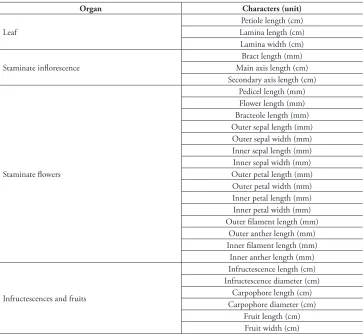
dis-criminant analyses (lda) of selected quantitative data (Table 2) in order to assess the
relative importance of the morphological traits in separating the groups (cf. Henderson
2005). Of the 200 collections, 73 specimens were staminate, 100 were pistillate and 29 specimens were sterile. To include most of the specimens, only leaves were scored for 197 specimens (Dataset 1), a total of 53 specimens were scored for all characters of leaves + staminate inflorescences + flowers (Dataset 2), 55 for staminate inflorescences + flowers (Dataset 3) and 21 specimens for leaves + fruit characters (Dataset 4). Fur-ther, a subset from Dataset 2 was extracted and analysed after removing the toxicofera group, this subset consisted of 27 specimens. All morphological measurements were recorded on an Excel 2010 spreadsheet and log-transformed prior to the analyses. Data analyses were carried out using the package MASS in R ver. 3.1.0 (The R Foundation for Statistical Computing; <http://www.R-project.org>).
A preliminary conservation status assessment for all taxa was carried out according to the IUCN (2012) criteria. Data were analysed using the Geospatial Conservation Assessment Tool, GeoCat (http://geocat.kew.org/) with the default 2 km grid cell.
Features such as wood anatomy, foliar anatomy and leaf venation patterns were also examined. While the few samples per species available for the examination of the characters precluded their inclusion in quantitative analyses, these observations further document interspecific variation in the genus and may provide another line of evidence
Table 2. Morphological characters included in multivariate analyses of Curarea toxicofera complex.
Organ Characters (unit)
Leaf
Petiole length (cm) Lamina length (cm) Lamina width (cm)
Staminate inflorescence
Bract length (mm) Main axis length (cm) Secondary axis length (cm)
Staminate flowers
Pedicel length (mm) Flower length (mm) Bracteole length (mm) Outer sepal length (mm) Outer sepal width (mm) Inner sepal length (mm) Inner sepal width (mm) Outer petal length (mm) Outer petal width (mm) Inner petal length (mm) Inner petal width (mm) Outer filament length (mm)
Outer anther length (mm) Inner filament length (mm)
Inner anther length (mm)
Infructescences and fruits
Infructescence length (cm) Infructescence diameter (cm)
Carpophore length (cm) Carpophore diameter (cm)
Fruit length (cm) Fruit width (cm)
For wood anatomy studies, stem samples ca. 1.5 cm diameter were available for Curarea aff. iquitana (Diels) R. Ortiz [Ortiz 181 & 186 (MO)], C.aff.tomentocarpa
(Rusby) R. Ortiz [Ortiz & Vargas 197 & 199 (MO)] and of about 5–15 cm wide for
C. tecunarum [Ortiz & Vásquez 214, Ortiz et al. 220 (MO), van der Werff & Vásquez 13909 (MO)], whereas only small twigs of about 1 cm in diameter were available for C. candicans [Lanjouw & Lindeman 2779 (U)], C. cuatrecasasii [Aguilar 682, Gentry & Hamilton 41126 (MO)] and for C. barnebyana R.Ortiz [Ortiz & Vargas 200 (MO)]. Permanent slides were prepared following standard techniques in wood anatomy stud-ies. Terms are defined and features are described in accordance with the IAWA commit-tee (1989) guidelines. Table 3 show averages based on 10 measurements of randomly selected cells of the individuals examined.
Table 3. Wood anatomy, general features in Curarea. * = cambium production unit, sensu Jacques &
de Franceschi (2007); diam = diameter; rc = ray cells; crassa, gentryana, toxicofera – not studied for wood
anatomy.
barnebyana candicans tecunarum cuatrecasasii iquitana tomentocarpa
Average (range) Average (range) Average (range) Average (range) Average (range) Average (range)
Number of samples 1 1 3 2 2 2
pith diameter (mm) 3.2 3 3.4 2.4 2.2 1.2
fiber cap in pith strong moderate strong weak weak weak
Features of xylem bundles & rays in the first CPU*
# of xylem bundles 39 51 37 25 28 16
xylem bundle shape nearly terete nearly terete nearly terete nearly terete terete to wedged terete to wedged
xylem bundle width
adaxial 220(125–275) 160(75–200) 228(150–325) 242(175–350) 194(100–300) 202(125-275)
xylem bundle width
abaxial 323(275–400) 233(175–350) 349(275–450) 442(300–575) 259(150–400) 374(175–525)
ray width adaxial 85(50–100) 105(75–125) 81(50–100) 125(75–175) 114(50–125) 12(50–250)
ray width abaxial 150(100–200) 275(225–325) 136(75–250) 210(100–275) 263(150–400) 619(425–1200)
Vessels
# of vessels in xylem
bundles in first CPU* 13(9–15) 17(11–25) 21(12–34) 31(22–48) 17(10–30) 32(20-49)
tangential diam. of vessel
(µm) 118(50–200) 45(25–75) 107(50–200) 99(50–150) 45(25–75) 68(25-125)
element length (µm) 411(330-410) 359(310-400) 373(300-470) 357(260-470) 277(200–380) 301(100-410)
Rays
height >1 mm >1 mm >1 mm >1 mm >1 mm >1 mm
cellular composition procumbent& square procumbent & square procumbent procumbent& square procumbent & square procumbent& square
Mineral inclusions
prismatic crystals in pith abundant moderate absent sparse abundant abundant
prismatic crystals in
ray cells abundant abundant absent abundant abundant moderate to abundant
druses in pith sparse sparse absent sparse absent moderate to abundant
druses in ray cells absent absent absent absent absent absent
stone cells in pith sparse sparse abundant sparse absent absent
stone cells in ray sparse absent absent sparse absent absent
Other cell inclusions
tannins abundant in rc sparse in pith & rc moderate in pith & rc abundant in pith & rc absent sparse in pith cells
tyloses abundant in pith & rc abundant in pith & rc abundant in pith & rc abundant in pith & rc abundant in pith & rc abundant in pith & rc
mid-region of the petiole were sectioned. Both fresh and dried leaf samples were used. Fresh field collections were stored in 70% ethanol; dried leaves were first rehydrated in an aqueous solution of Kodak Photo-Flo 200 and stored in 70% ethanol before pre-paring samples. Observations were made through an Olympus BX40 light microscope at different magnifications. Table 4 summarises the leaf anatomical features and
Tab
le 4.
Leaf anatomy general featur
es in
C
ur
ar
ea
. av = av
erage; diam = diameter;
T
S = transv
erse section; vb = v
ascular bundles. bar nebyana candicans cr assa tecunar um cuatr ecasasii gentr yana iquitana tomentocarpa to xicofer a N
umber of samples
2 2 1 2 3 1 3 2 2 av
erage diam. of apical pulvinus (mm)
2 2.5 ca. 1 2.8 1.8 1.6 3 1.9 2.3
number of vb
. in apical pulvinus
11–12 10 9 11–12 8–9 12 10–13 9–11 11–12 av
. diam. in petiole mid-r
egion (mm) 1.5 1.3 0.9 1.8 1.2 1.1 2.1 1.4 1.6 av
. blade thickness (µm)
94 116 ca. 110 86 82 ca. 79 74 80 85 av
. cuticle + adaxial periclinal
23 24 ca. 21.5 19 14 ca. 16 17 17 19
cell wall siz
e (µm)
adaxial epidermis cell shape
squarish,
rectangular or irr
egular
squarish or rectangular squarish or irr
egular
squarish or irr
egular
squarish,
rectangular or irr
egular
squarish,
rectangular or irr
egular
squarish,
rectangular or irr
egular
squarish,
rectangular or irr
egular
squarish or rectangular
tannins abundant moderate moderate moderate scar ce or absent scar
ce or absent
scar
ce or absent
scar
ce or absent
absent to moderate
range of stomata number/cr
ypt 17–102 15–32 15–46 36–34 16–27 10–17 12–34 7–30 27–37
mean stomata guar
d cell siz
e (µm)
ca. 26 × 23
36 × 35
30 × 30
27 × 31
ca. 27 × 27
33 × 31
31 × 33
31 × 31
28 × 28
mesophyll palisade cell arrangement
rather compact
rather compact
rather compact
rather compact
loose
loose
rather compact
rather compact
rather compact
outer mesophyll palisade cell siz
e (µm)
26 × 4
23 × 5
24 × 2.8
23 × 5
17 × 5
18 × 7
16 × 6
14 × 5
19 × 5
shape of mid-v
ein in TS: adaxially concav e flattened or w eakly concav e w eakly concav e concav e
flattened or weakly conv
ex
flattened or weakly conv
ex
w
eakly conv
ex
flattened
flattened or weakly conv
ex
abaxially
triangular or trape
zoid
triangular or trape
zoid
triangular or trape
zoid triangular , trape zoid or suborbicular transv ersally ellipsoid triangular
triangular or trape
zoid
triangular or trape
zoid
rectangular or transv
ersally
ellipsoid
trichomes on mid-v
ein abaxially
abundant
a fe
w basal cells or glabrate sparse to abundant
abundant
sparse to absent sparse basal cells to glabrate sparse basal cells to glabrate sparse basal cells to glabrate sparse basal cells to glabrate
number of vb
. in mid-v
ein 3–6 3 6 3–5 3–5 3 3–7 4–6 5–9
number of vb
. in petiole main axis
10–12 8–10 10–12 11–12 8–9 12 10–14 9–11 11–12
venation type of acr
Cuticle preparations were obtained following methods cited in Christophel et al.
(1996). Pieces of leaf of 1 cm2 were taken from near the base of the lamina, placed in test
tubes and soaked in 70-95% ethanol for about 24 hours. The ethanol was then decanted and 10 drops of 40% hydrogen peroxide and 5 drops of 90% ethanol were added to the tube and then gently boiled in a water bath until the sample turned light yellow. At this point, cuticles were peeled off and cellular material brushed away. Cleaned cuticles were
then stained in 0.1% Crystal Violet, wet mounted in CaCl2 and observed under the light
microscope. Vouchers for leaf anatomy including cuticle and stomata are as follow: C.
barnebyana [Ortiz & Vargas 194 & 200 (MO)], C. candicans [Jansen-Jacobs et al. 1995
(U)], Pipoly & Boyan 8982 (NY), C. crassa [Jardim et al. 609 (NY)], C. cuatrecasasii [
Ker-nan & Phillips 1147 (F), Callejas 1183 (NY)], C. gentryana R.Ortiz [Rubio & Quelal 1503
(MO)], C. iquitana [Vásquez et al. 18715 (MO)], C. aff. iquitana [Ortiz 185 (MO)], C.
tecunarum [van der Werff & Vásquez 13909 (MO), Ortiz et al. 143 (MO)], C. tomento-carpa [Reynel & Menezes 5025 (MO)], C.aff.tomentocarpa [Ortiz & Vargas 199 (MO)], C. toxicofera [Encarnación 1094 (MO) and van der Werff & Vásquez 13990 (MO)].
Scanning electron microscope (SEM) observations of leaf trichomes and stomata
were made on the adaxial surface of the samples. Samples of 5 mm2 were removed from
mid-lamina of apparently adult leaves of herbarium specimens and mounted on SEM stubs with double-sided carbon conductive tabs and coated with gold using a SEM coat-ing unit E5000. Stomatal classification followed Wilkinson (1979) and trichome descrip-tion and classificadescrip-tion followed Theobald et al. (1979). Observadescrip-tions and photographs were made with a Hitachi S-450 SEM @ 20KV using Polaroid panchromatic film.
The difficulty in matching collections of male and female individuals in Menisper-maceae has frequently been stressed in the past (Sandwith 1930, Barneby and Kru-koff 1971) and the latter authors’ observations regarding the few pistillate flowers in herbarium collections is still relevant at present. In addition to being dioecious, Men-ispermaceae are also, for the most part, canopy lianas and so difficult to reach, hence they are usually overlooked in biological inventories. It is noteworthy that, although in herbarium collections, there are frequently more pistillate than staminate plants, these pistillate plants are mostly in fruit of different degrees of maturity and therefore are not
always readily comparable across species. This is also true for Curarea, therefore species
are distinguished mostly by characters of the staminate inflorescences and staminate flowers. These latter features are supplemented by characters of the fruits, when available.
In this study, species are regarded as segments of separately evolving lineages of populations, as in the general lineage species concept (de Queiroz 1998, 2007). The criterion used to infer species boundaries is morphological discontinuity, species being diagnosed by unique combinations of qualitative and quantitative morphological fea-tures. These morphological features are, as indicated above, mostly based on characters of staminate plants and, for the most part, collections of pistillate plants are assigned to the recognised species if they occur in the same localities where staminate plants have been collected. This approach is rather arbitrary and could be viewed as questionable,
especially when the species co-occur as is the case of C. toxicoferas.s. and the newly
General morphology
Habit and stem
Species of Curarea are all canopy or understory lianas, the canopy species attaining a
height of ca. 30 m, the understory species usually only reaching about 10 m high. In
understory species, stems are more or less terete (flattened in C. toxicofera and ca. 3
cm wide, Grassl 10076), with rings or partial rings centric to weakly eccentric, rarely
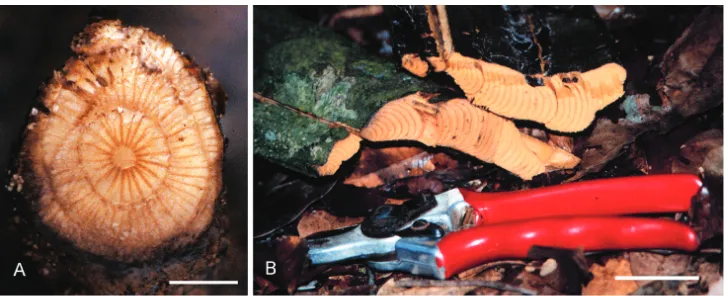
strongly eccentric, in transverse section and 1.5–4 cm in diameter/width (Fig. 2A), while in canopy species, stems are consistently strongly flattened, the partial rings strongly eccentric in transverse section and up to ca. 40 cm in width (Fig. 2B). In both, bark of older stems is usually relatively thin, brittle and smooth, but it can be rugose with irregular shallow lengthwise fissures. Conspicuous tuberculate lenticels
are frequent in C. cuatrecasasii and in C. gentryana and, to some extent, in C. iquitana.
Wood anatomy
Wood anatomy of C. crassa, C. gentryana and C. toxicoferas.s. was not investigated.
For the remaining species, mostly one sample per species was examined. Transverse
sections of the stem of Curarea, as of several other Menispermaceae, show an
ir-regular pattern of secondary growth consisting of successive, complete or partial rings of vascular bundles, which are separated radially by wide interfascicular rays and tangentially by pericyclic fibres and tangential cortical parenchyma. This type of growth is typical of Menispermaceae and has been termed “anomalous secondary growth” (Solereder 1908); “included (interxylary) phloem” (Chalk and Chataway 1937; Metcalfe and Chalk 1950), “xylem and phloem concentrically alternating” (Metcalfe and Chalk 1983) or “successive cambia” (Carlquist 1988, 1996; Jacques and de Franceschi 2007).
Within Curarea, species differ moderately in their pith diameter, distribution
pat-terns of vascular bundles and rays, occurrence of medullary sclerenchyma (e.g. fibre caps) and number and mean tangential diameter of vessels. Variation in these and other features are summarised in Table 3.
Successive and centric to weakly eccentric patterns of few (3–7) complete or
par-tial rings are found in C.aff.tomentocarpa (Fig. 2A) and C. cuatrecasasii and several
(ca. 45) strongly eccentric arches are observed in C. tecunarum (Fig. 2B), C.
can-dicans and C. barnebyana. Wide rays (275–340 µm) in combination with more or less straight tangential margins and vascular bundles with smaller vessel diameter are
observed in C. aff.tomentocarpa (Fig. 3A), C. candicans and, to some extent, in C.
medul-Figure 2. Transversal sections of stem of Curarea: A relatively round stem of C.aff.tomentocarpa (Ortiz
197), showing wide rays B flattened stem of C. tecunarum (Ortiz & Vásquez 214) showing successive
partial rings. Scale bar: 0.5 cm (A); 1.7 cm (B).
lary sclerenchyma in the pith are characteristic of C. tecunarum (Fig. 3B) – this alone
lacks crystalline inclusions– and C. barnebyana.
Relatively narrow rays with conspicuous irregularly angulate radial margins in combination with vascular bundles with large tangential diameters are also observed in C. cuatrecasasii. No representative of C. toxicoferas.s. was available in this study and
sterile specimens provisionally identified as C. toxicofera show moderate to strongly
ec-centric arches of successive growth, although the width reaches only up to 3 cm.
Leaves
Within an individual, the shape and size of the lamina varies with age, position along the stem and exposure to sunlight. Thus, large blades with caudate apices are usually either juvenile and/or found in parts of the plant that are in shaded areas, while smaller blades with acute or acuminate apices are found in mature leaves that are usually exposed to di-rect sunlight. The latter are more conspicuous in species that reach the canopy. The type
collection of C. tecunarum –i.e., Krukoff 8713 and a sterile specimen of Curarea (Cerón
2717), which remains as Curarea sp., show a few leaves with cleft apices. The margins
of blades are entire, but on rare occasions, they are scarcely lobed to apically trilobed
in sterile specimens of C. tecunarum (Vásquez et al. 15101, Lewis et al. 11759) and the
sterile specimen L.C. Richards.n., the type of C. candicans, also has an apically trilobed
Figure 3. LM photographs of transverse sections of wood of Curarea: A small vessels, and broad rays
(double arrow), C.aff.tomentocarpa (Ortiz & Vargas 197) B moderately large vessels, sclerotic pericyclic
fibres (black arrow), strongly developed medullary sclerenchyma (white arrow) and sclerenchyma strongly
intruding into the rays (two white asterisks), C. tecunarum (van der Werff & Vásquez 13909). Scale bar:
0.8 mm (A, B).
Indumentum
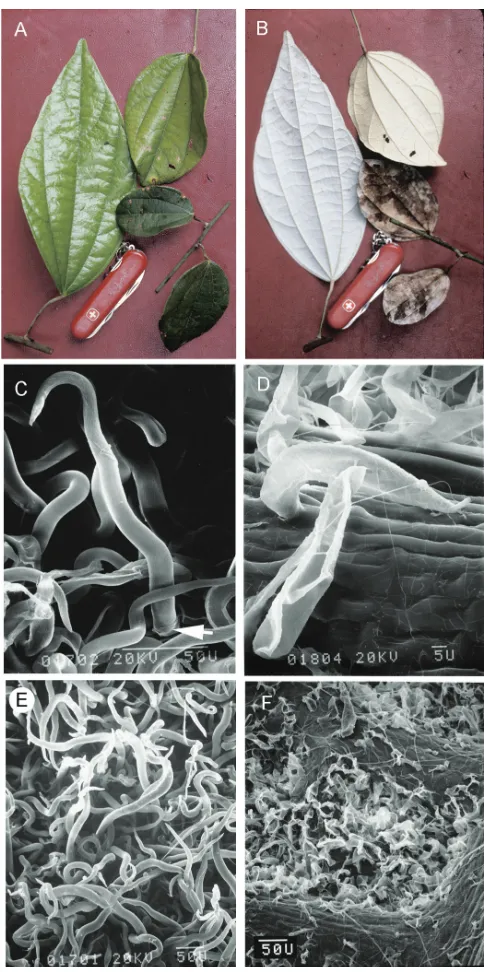
The indumentum in Curarea consists of two-celled unbranched trichomes with a short
basal cell and an elongate terminal cell (Fig. 4C–D). Trichomes occur singly or in pairs.
Several-lobed trichomes have been reported for C. toxicofera by Wilkinson (1989),
but could not be confirmed here. It is likely that the tendency for the terminal cells to collapse in an irregular fashion in dried and/or aged samples gives the impression of tri-chomes being lobed. Indumentum density varies with age in some species, frequently
disappearing along the stems. This variation is of taxonomic use in Curarea. Thus,
uni-formly dense indumentum concealing the lower leaf surface is common in C. crassa,
C. barnebyana and C. tecunarum (Fig. 4E), whereas the indumentum mainly
local-ised in the areole spaces, is common in C. candicans (Fig. 4F), C. cuatrecasasii and less
frequently also in C. toxicoferas.s.
Venation pattern
The venation in Curarea conforms to the acrodromous type (sensu Hickey 1973, 1979)
as observed in mature leaves. Primary veins vary from 3–5(–7), (Fig. 5A–B), however
in one group of species (i.e. C. candicans, C. crassa, C. barnebyana and C. tecunarum,
Fig. 5B), the innermost pair runs almost the whole length of the lamina and arches towards the apex, with only one pair of loosely brochidodromous secondary veins (this pair sometimes absent) and thick and coarse veinlets (higher-order veins), (Fig. 5C).
In the other group of species which includes C. cuatrecasasii, C. gentryana, C. iquitana,
Figure 4. Leaf blade surfaces and SEM micrographs of trichomes of Curarea: A glabrous adaxial leaf
blade surface of juvenile and adult leaves, C. barnebyana (Ortiz & Vargas 194) B densely pubescent adaxial
leaf blade surface of juvenile and adult leaves showing whitish covering more conspicuously in juvenile
leaves, C. barnebyana (Ortiz & Vargas 194) C elongate trichome with a short basal cell (white arrow) and a
cylindrical terminal cell, C. crassa (Jardim et al. 609) D trichome with a moderately short terminal cell, C.
cuatrecasasii (Kernan & Phillips 1147) E matted, elongate trichomes, C. gentryana (Rubio & Quelal 1503)
Leaf anatomy: adaxial cuticle, transverse sections of petiole, lamina and mid-vein
Most of these features were studied by Wilkinson (1989) for C. candicans and C.
toxi-coferas.l. when describing characters common to Tiliacoreae as a whole.
Here, I add observations of the remaining species, the main variations being sum-marised in Table 4. Adaxial epidermal cells in all species are squarish, rectangular or
irregularly shaped. In C. candicans (Fig. 6A), C. crassa, C. barnebyana and C. tecunarum
these have abundant tanniferous cells, but there is little or no tanniferous cells in C.
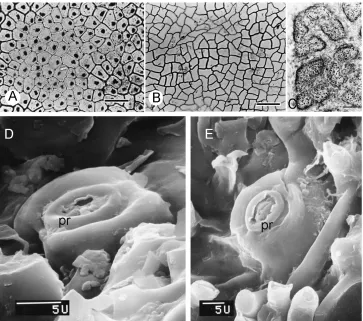
cuatrecasasii (Fig. 6B), C. gentryana, C. iquitana, C. tomentocarpa and C. toxicofera. Curarea species are exclusively hypostomatic, as noted by Wilkinson (1989). The stomata, between the strongly projecting veins (Fig. 6C), are concealed by a dense indu-mentum. They occur typically in groups of 7–102 per areole, with the lowest number
observed in C. tomentocarpa and the highest in C. barnebyana (Table 4). Stomata are
elliptic in outline and immediately surrounding the aperture is a distinct peristomatal rim (Fig. 6D–E), the cell guards range in size from 26–36 × 23–35 µm. In all species,
stomata are raised on a short column of ca. 4 cells (5–6 cells fide Wilkinson 1989).
Wilkinson (1989) described this arrangement of the epidermal cells under the guard cells as cyclocytic. Such projecting stomata with thick peristomatal rims are frequently associated with ecological factors such as high humidity and poor soils (Solereder 1908; Wilkinson 1979), conditions typical of the habitats occupied by
spe-cies of Curarea.
The apical pulvinus of the petiole is more or less circular to weakly triangular in
transverse section and weakly adaxially flattened in C. candicans, C. crassa and C.
te-cunarum. There are no trichomes or only a few persistent basal cells in C. candicans, C. cuatrecasasii, C. gentryana, C. iquitana, C. tomentocarpa and C. toxicofera; usually there are abundant trichomes in the remaining three species. The vascular tissue is a ring of 8–13 vascular bundles. Sclerenchyma cells surround the vascular tissue, exter-nally forming an interrupted or continuous ring of several layers. There are a few small groupings of sclereids (stone cells) in the inner parenchyma of the cortex and, in the pith, a starch sheath (i.e. endodermis) is found around the vascular tissue in all spe-cies. A pulvinus at both ends of the petiole is a common feature in Menispermaceae and they are thought to bring the lamina into the optimum position to receive light (Wilkinson 1989). Pulvini have a large volume of parenchyma; therefore, they are always swollen compared to the rest of the petiole (Esau 1967). The mid-region of
the petiole is circular, from about 1 mm diameter in C. crassa and C. cuatrecasasii, to
about 2.1 mm in diameter in C. iquitana. Trichomes are few to rather abundant,
fre-quently only the basal cells are present. There are 8–14 vascular bundles surrounded by a continuous ring of thick-walled sclerenchyma cells, the layers of parenchyma cells are much reduced and frequently thick-celled parenchyma is found in the pith (Fig. 7A).
Transverse section of the lamina shows mesophyll palisade cells that are somewhat
short and loosely arranged especially the inner layer in C. cuatrecasasii, C. iquitana, C.
gentryana, C. tomentocarpa and C. toxicofera. Palisade cells are moderately long and more
Figure 5. Venation types of Curarea: A innermost pair of main veins acrodromous perfect, 7 main veins
from the base, the basal-most pair weakest, C. tecunarum (van de Werff & Vásquez 13909) B innermost
pair acrodromous imperfect, 3 conspicuous main veins from the base, C. toxicofera (van der Werff &
Vásquez 13990) C well-developed areolae and ultimate veinlets often thin, free vein endings uncommon, C. candicans (Jansen-Jacobs et al. 1995) D well-developed areolae and ultimate veinlets thin, once or twice
branched, endings often free C. cuatrecasasii (Morales et al. 3243). Scale bar: 3.1 cm (A); 0.7 mm (B);
3.0 cm (C); 1.1 mm (D).
The midrib is adaxially concave and abaxially strongly raised and trapezoid or sub
orbicular but always with abundant trichomes in C. barnebyana, C. crassa and C.
tecu-narum (Fig. 7B). In C. cuatrecasasii, C. gentryana, C. iquitana, C. tomentocarpa and C. toxicofera, the midrib is adaxially flat to weakly convex and abaxially strongly raised,
Figure 6. LM photograph and SEM micrographs of leaf adaxial, abaxial surface and stomata in Curarea:
A isodiametric epidermal cells, C. candicans (Jansen-Jacobs et al. nr-1995) B triangular to hexagonal
epi-dermal cells, C. cuatrecasasii (Kernan & Phillips 1147) C abaxial surface showing areoles (black dotted) in
C. toxicofera (van der Werff & Vásquez 13990) D, E SEM micrographs of projecting stomata with distinct
peristomatal rim DC. tecunarum (Ortiz et al. 143) EC. tomentocarpa (Reynel & Meneses 5025). Scale bar:
50 µm (A); 100 µm (B), 0.4 mm (C), pr = peristomatal rim.
adaxially is somewhat flat to weakly concave while abaxially, it is strongly raised and somewhat trapeziform with sparse trichomes or glabrate. As noted by
Wilkinson (1989), the vascular system in Curarea is frequently collateral. There
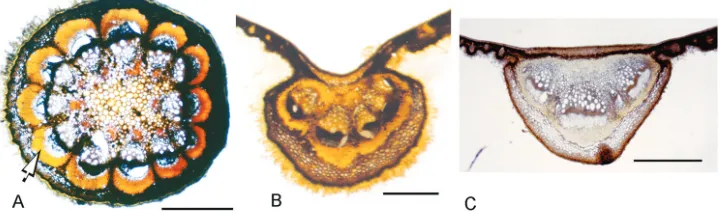
are 3–9 vascular bundles distributed in an arc (Fig. 7B–C), the three central ones be-ing largest. The vascular bundles are surrounded by several layers of sclerenchymatous
cells. Adaxial to the vascular bundles there is a continuous (e.g. C. barnebyana, C.
can-dicans, C. crassa and C. tecunarum) or sometimes interrupted (e.g. C. cuatrecasasii, C. gentryana, C. iquitana, C. tomentocarpa and C. toxicofera) layer of chlorenchyma cells and one or several layers of sclerenchymatous cells immediately below the epidermis.
Figure 7. LM photographs of transverse sections of petiole and mid-veins of Curarea: A petiole
mid-section of C. tecunarum, note the vascular bundles surrounded by sclerotic fibres on the outer part (arrow)
B adaxially concave, abaxially strongly raised, rounded and tomentose mid-vein, C. tecunarum (A, B from
Ortiz et al. 143); C adaxially flat, abaxially strongly raised, triangular and glabrescent mid-vein, C. toxi-cofera (van der Werff & Vásquez 13990). Scale bar: 0.6 mm (A, C), 1 mm (B).
Inflorescences
As all Menispermaceae, Curarea is also dioecious, with staminate and pistillate
inflo-rescences in different plants. Staminate and pistillate infloinflo-rescences are solitary or more frequently fascicled, cauliflorous and arising from old leafless stems, axillary, supra
axil-lary or terminal on young shoots. Inflorescences are basically thyrsi (sensu Weberling
1992), however, in pistillate inflorescences, the primary branches are sometimes re-duced to solitary flowers, thus appearing racemiform; inflorescence axes are slender or moderately stout, sometimes conspicuously ridged, variously densely pubescent, with trichomes adpressed or ascending. The inflorescence bracts subtending the primary branches are ovate to lanceolate, markedly concave and usually fleshy, the adaxial side glabrous, the abaxial side variously pubescent, the indumentum appressed or spreading.
Staminate inflorescences usually multiflorous (Fig. 8A); lax primary branches with
(2–)4–6 branching orders are characteristic of C. cuatrecasasii, C. gentryana, C.
iqui-tana, C. tomentocarpa, C. toxicofera (Fig. 8A) and C. tecunarum. Rather condensed/ compacted primary branches with 0–2 branching orders appearing umbelliform or
irregularly cymose occur in C. crassa, C. barnebyana and C. candicans; occasionally, C.
candicans may have 3 orders of branching. In C. tecunarum, higher branching orders frequently are reduced (i.e. they are not fully dichotomous and flowers are sessile or
subsessile), occasionally in C. gentryana and C.aff.iquitana, reduced branching
occur-ing on alternatoccur-ing sides along the length of the primary branches, appearoccur-ing racemi-form. In most species, the primary branches are moderately thick, but they are rather
thin and filiform in C. cuatrecasasii and C. gentryana.
Figure 8. General morphology in Curarea: A. staminate inflorescence of C. toxicofera (Ortiz et al. 157)
B pistillate inflorescence of C.aff.iquitana (Ortiz 184) C stamens of C. toxicofera (Encarnación 1094)
D anther of C. iquitana showing the horn-like (arrow) adaxial protrusion of the connective (Vásquez et al.
18994) E ripe fruits of C.aff.iquitana showing the fruiting pedicel (frpe) and three elongate carpophores
(white arrow) (Ortiz & Ruiz 191) F ripe fruit of C.aff.iquitana, exocarp of drupelet on right pulled away
showing whitish mesocarp (Ortiz & Pezo 208) G–H immature fruits of C. barnebyanaG lateral view
H view from the top (G–H from Ortiz & Vargas 194) I weakly ornamented endocarp of C. toxicofera
(Lewis & Vásquez 4017) J hippocrepiform embryo of C. barnebyana (Ortiz & Vargas 194). Scale bars:
Flowers
Flowers are unisexual, actinomorphic and trimerous; usually pedicellate, less frequently sessile. The pedicels are usually terete, moderately slender and sometimes ridged. At the apex of the pedicels there are 1–3(4) minute, more or less deciduous structures, usu-ally alternating with the outer whorl of sepals. Although their morphological nature is often unclear, to facilitate description, here I am referring to them as bracteoles. These structures are most commonly ovate-lanceolate, narrowly ovate to ovate or oblong, fleshy, glabrous adaxially, variously pubescent abaxially. They are most often absent in staminate flowers and, hence, frequently not mentioned in earlier descriptions (i.e. Barneby and Krukoff 1971).
Staminate flowers are usually light coloured, frequently described as cream, whit-ish, greenwhit-ish, yellowwhit-ish, orangwhit-ish, greyish or brownish; although flowers are usually
pedicellate, they can be occasionally sessile in C. toxicofera and C. barnebyana and more
often so in C. tecunarum. Sepals are commonly 6(–9), free, in 2(–3) unequal whorls
(sometimes spirally arranged in C. candicans), mostly ovate, narrowly ovate to obovate,
oblong, rhombic, elliptic or suborbicular, usually weakly concave and scarcely fleshy, glabrous adaxially, variously pubescent abaxially, the outermost whorl being smaller than the innermost whorl. The inner sepals have valvate aestivation and, after anthesis,
their tips are usually reflexed (rarely erect). Petals are (5–)6(–9 in C. tomentocarpa), free,
arranged in 2(–3) usually similar whorls, they are conspicuously smaller than the in-ner sepals, usually obovate-trilobed to rhombic or spatulate members, weakly concave, membranous, glabrous adaxially, glabrous or tomentellous abaxially, the lateral mar-gins strongly inflexed and clasping the filaments of the stamens immediately opposite
to them. In C. gentryana, the lateral margins of the inner whorl are adaxially connate
or coherent. The stamens are (3–5)6, (Fig. 8C), arranged in two, more or less similar
whorls (often one in C. gentryana); the filaments are free or variously connate
(con-nate half their length in C.aff.iquitana to fully connate in C. gentryana) and clavate,
clavate-sigmoid to almost terete, glabrous (abaxially tomentellous in C. toxicofera). The
anthers are tetrasporangiate and dithecous, basifixed, ellipsoid or subglobose in shape, erect or slightly incurved and dehiscing by latrorse longitudinal slits. They are yellow in colour when fresh and light brown or cream when dried. Frequently, the sporangia appear half-immersed in the dilated connective. In all species, the connective is con-spicuous on both sides, however, it is frequently thicker adaxially and variously pro-truding and it sometimes grows beyond the thecae to form a horn-like structure, as in C. iquitana (Fig. 8D). The connective is sometimes thinner abaxially and, at the apex in C. tomentocarpa and here, each theca may separate at the apex. Pistillode absent.
Pistillate flowers are greenish, yellowish or brownish coloured; pubescent abaxi-ally. Sepals 6–9, free, in two, or more commonly three unequal whorls, mostly ovate-lanceolate to obovate, oblong, elliptic to rhombic or spatulate, usually weakly concave and scarcely fleshy to fleshy, glabrous adaxially, variously pubescent abaxially, the out-ermost whorl being smaller than the innout-ermost whorl. The inner sepals have valvate aestivation and, after anthesis, their tips are usually reflexed (erect). Petals are usually
C. tecunarum and C. tomentocarpa, they are spatulate and weakly concave, membra-nous, glabrous adaxially, glabrous to scarcely pubescent abaxially. The petals are always smaller than the innermost whorl of sepals and are usually opposite the carpels. There
are three (seldom four in C. tomentocarpa), free carpels, the ovaries are usually coherent
when young, strongly gibbous and densely tomentose; the styles are glabrous and usu-ally terete, weakly tapering distusu-ally, often reflexed, weakly grooved adaxiusu-ally in trans-verse section and commonly subpersistent and located near the base of the fruit; the stigma is inconspicuous. Frequently only one carpel reaches maturity.
Infructescences and drupelets
Infructescences are similar to inflorescences, but are sometimes lenticellate or have exfo-liating bark. Fruiting pedicels are clavate or terete, at times inconspicuous, slender or
rather thick. As the carpel develops in C. iquitana, C. tomentocarpa, C. toxicofera, C.
cuatrecasasii and C. gentryana (i.e. all understory species in which the fruits are close to the ground), the trilobed gynophore enlarges into three relatively short to moderately long stalks (Fig. 8E). This enlargement of the gynophore produces structures known as carpophores, which support the drupelets of each carpel (Forman 1975, 1986). They are weakly terete or clavate, straight or distally weakly incurved and reach 2.7–11.3
mm in length, the longest being observed in C. toxicofera. Carpophores are also found
in other genera in the tribe Tiliacoreae (i.e. the neotropical Sciadotenia and some
Af-rican and Indomalesian species of Tiliacora; Forman 1975), as well as other genera
outside Tiliacoreae (viz. Elephantomene of Anomospermeae, see Krukoff and Barneby
1974; and Anamirta of Coscinieae, see Forman 1975). However, in C. barnebyana,
C. crassa and C. tecunarum, this enlargement does not occur and only a subglobose,
weakly trilobed structure is observed at the distal end of the peduncle and, in C.
candi-cans, this is somewhat drum-like; these four species bear fruits in the canopy.
Drupelets are oblongoid, ellipsoid, obovate or subglobose (Fig. 8E–H) and are weakly laterally compressed when dried. They are obliquely attached to the summit of the carpophore, sessile or less frequently gradually attenuate toward the base, forming
a short stipe ca. 3 mm long in some specimens of C. cuatrecasasii. The exocarp may
be thin or thick, mealy-coriaceous in C. toxicofera (sensu Barneby and Krukoff 1971),
the surface is smooth, rugulose or muriculate, pilosulous or velutinous-hispidulous, the trichomes being erect. The fruits are pale orange to yellow when ripe and fre-quently leathery outside and granular inside when dried. Although, in a strict sense, the single-layered outer epidermis of the pericarp is referred to as the exocarp, here I
am following earlier characterisations of Curarea fruit by Barneby and Krukoff (1971),
who described the several-layered outermost zone of the pericarp (including the epi-dermis) as the exocarp. It is worth noting, however, that it appears that Barneby (1996) interpreted the exocarp as the epidermis only and the remaining layers following the
epidermis as the mesocarp when describing the fruit in C. crassa from dried herbarium
the endocarp (Barneby and Krukoff 1971). Due to the eccentric development of the carpel, the scar of the style is found near the base of the developed fruit. The endo-carp is oblong-ellipsoid or obovoid, hippocrepiform (i.e. horseshoe-shaped) (Fig. 8I), a shape produced by the unequal development of the abaxial side compared to the adaxial side (Botha 1980; Forman 1986); although the hippocrepiform shape is more notice-able from within rather than from the external surface. The texture is typically
papyra-ceous (crustapapyra-ceous in some specimens of C. toxicofera). Commonly the surface is fairly
smooth, but muriculate or weakly reticulate in C. toxicofera (Fig. 8I). Seeds, like the
endocarps, are hippocrepiform (Fig. 8J), semicircular in transverse section and
brown-ish when dried. Seeds in Curarea, as in most members in the tribe Tiliacoreae, lack
endosperm, the cotyledons are thick, fleshy and accumbent, both are usually of equal
size, but in C. barnebyana one of them may be smaller and somewhat J-shaped. The
seed (embryo) is hippocrepiform (i.e. curved around the condyle). The latter has not
been studied in developing carpels in Curarea, however, features of the mature endocarp
suggest that it conforms to a bilaterally compressed septiform condyle as described by Ortiz (2012); the condyle corresponds with a shallow groove on the lateral sides of the external surface of the endocarp.
Pollen morphology
Pollen morphology of Curarea represented by C. toxicoferas.l. was examined by
Thani-kaimoni (1968), Ferguson (1975) and ThaniThani-kaimoni et al. (1984); the latter authors
included also C. tecunarum. Pollen is described as spheroidal, tricolporate, with
circu-lar equatorial outline, muri distinctly papillose, papillae in one or two rows.
Phytochemistry
Several members of Menispermaceae are known to contain toxic compounds and bisbenzyltetrahydroisoquinoline alkaloids are very common in the family (Bruneton 1995, Barbosa-Filho et al. 2000). Amongst the best known is (+)–tubocurarine, a
muscle relaxant produced by Chondrodendron tomentosum, a close relative of Curarea
and the basis for subsequently developed synthetic forms (Bruneton 1995, Tuba et al.
2002). Curarea toxicofera produce alkaloids with curare-like activities such as (-)-curine
and (+)-chondrocurine, (+)-isochondrodendrine; the latter has also been reported in C.
tecunarum (Barbosa-Filho et al. 2000).
Ethnobotany
products is curare, the South American arrow and dart poison of which an overall introduction is given by Krukoff and Moldenke (1938). Curare is a general name for a large group of poisons with muscle paralysis activities (Neuvinger 1998) and several
species of Curarea are a source of this type of poison. Curarea candicans [=
Chondroden-dron candicans (Rich. ex DC.) Sandwith)] was reported by Sandwith (1930), based on
the label information of Jenman 5199 to be used by the Warrou Indians of Guyana as
a source of the “other kind of poison”, a statement that was interpreted by Krukoff and Moldenke (1938) to refer to a different substance from the curare used by the Macusi Indians, also from Guyana.
Curarea tecunarum, variously identified as Chondrodendron polyanthum (Diels)
Diels or as Chondrodendron limaciifolium (Diels) Moldenke, was reported as one of the
main sources of curare for the Tecuna Indians from Brazil (Krukoff and Smith 1937; Krukoff and Moldenke 1938; Krukoff and Barneby 1970). The early report of Krukoff and Smith (1937) was later mentioned by Macbride (1938) in the Flora of Peru, under
the name of Chondrodendron polyanthum. An extract from C. tecunarum is used as a
long-term oral contraceptive for both men and women of the Denís tribe of Brazil (Barneby and Krukoff 1971; Prance 1972).
Curarea toxicofera (as Cocculus toxicoferus Wedd.) has long been known as an important source of curare for the Yaguas and Orijones of Amazonian Peru (de Castelnau 1851). Similar uses in this region have since been reported (Krukoff and Barneby 1970, Ayala Flores 1984), also for Brazil (Prance 1972), Colombia
(García-Barriga 1992) and Ecuador (Cerón 1995). Chondrodendron bioccai G.Lusina (at
pre-sent provisionally included in the synonym of Curarea toxicofera), was stated to be
used as a principal source in the preparation of curare by the Maku Indians from
Alto Rio Negro (Lusina 1954). Similarly, the sterile specimen (Mexia 6321a),
previ-ously identified as Chondrodendron iquitanum (Krukoff and Moldenke 1938) and
later as Curarea toxicofera (Barneby and Krukoff 1971), was reported to be used as a
source of dart poison by Indians in the Rio Santiago area. However, as the specimen in question was not available in this study, it is unclear to which of the two species it belongs.
Geographical distribution and habitat
Curarea is relatively widespread within tropical America, ranging from Costa Rica through Panama, to Bolivia, French Guiana, western Brazil and the Atlantic Forest of South-eastern Brazil (Figs 9, 21 and 25).
Species of Curarea are typically found in lowland tropical moist forests and lower
montane forest (up to 1300 m elevation). They grow in periodically flooded forest
(ei-ther varzea or igapó) to upland non-flooded forest, typically in primary forest, but are
also occasionally present in secondary growth. The species are apparently locally rare
and mainly allopatric, however, Curarea aff.iquitana, C. toxicofera and C. tecunarum
Phylogenetic affinities
In phylogenetic analyses of the family using plastid markers, Curarea was recovered as
sister to Sciadotenia, in a clade that also includes Chondrodendron (Ortiz et al. 2016).
These affinities are congruent with earlier suggestions (Barneby and Krukoff 1971:
Triclisieae sensu Diels 1910; Tiliacoreae sensu Forman 1982, Ortiz et al. 2016). With
Sciadotenia, Curarea shares palmatinerved or plinerved venation and more or less
ses-sile drupelets borne on elongate carpophores. With Chondrodendron, Curarea shares
stomata aggregated in areolar depressions and raised above the epidermal cells on a short column of cells and a thyrsoid staminate inflorescence. In the study of Ortiz et
al. (2016), C. candicans is recovered as sister to a clade in which C. cuatrecasasii, C.
barnebyana, C. tecunarum and C. toxicoferas.l. are all unresolved (Fig. 1B).
Morphological characters suggest two species groups within Curarea (Table 5),
al-though these are not congruent with the results from analysis of molecular data. In the
group including C. barnebyana, C. candicans, C. crassa and C. tecunarum, the innermost
pair of primary veins of mature leaves, which are in the canopy, conforms to an
acrodro-mous perfect venation, with all but C. tecunarum also sharing staminate inflorescences
with compact primary branches that have few branching orders. All the above listed
spe-cies, except for C. candicans, share villous indumentum on their abaxial leaf surface and
short subglobose carpophores. Wood and leaf anatomy features shared amongst these
spe-cies are summarised in Table 5. Curarea candicans differs from the other species in the first
group by its web-like indumentum and its unique drum-like carpophores, its narrow ves-sel elements being more similar to species of the second group. In the latter group, which
includes C. cuatrecasasii, C. gentryana, C. iquitana, C. tomentocarpa and C. toxicofera
(Ta-ble 5), the innermost pair of primary veins on mature leaves are acrodromous imperfect, the species have a strigillose-tomentellous indumentum on their abaxial leaf surface
(web-like/tomentellous in C. gentryana), staminate inflorescences with lax primary branches,
these with 4–6 branch orders, elongate carpophores and a few other anatomical features
(Table 5). However, C. cuatrecasasii shares wide vessels with species in the first group.
Multivariate analyses of Curarea toxicoferas.l.
The principal component analyses (PCA) of the datasets indicates no clear pattern
in the morphological variation of the C. toxicofera complex (not shown). Of the
five datasets, the linear discriminant analyses (lda) of dataset 2, is presented here. The analysis of this latter dataset, which corresponds to a combination of leaves + staminate inflorescences + staminate flowers, was significant (Wilk’s lambda = 0.0043335, P < 0.001) and correctly assigned all individuals to their previously de-fined groups. The first two canonical discriminant functions recovered three clusters,
namely groups to, tm + uc and al + iq (Fig. 10A). Moreover, the toxicofera (to)
group is recovered as an independent cluster by the first canonical discriminant
Tab
le 5.
M
orphological featur
es of the two species gr
oups within
C
ur
ar
ea
. * = species not studied for wood anatomy
. G roup I G roup II M acr
o- and micr
o-morphological Characters bar nebyana candicans cr assa * tecunar um cuatr ecasasii G entr yana* iquitana tomentocarpa to xicofer a * W ood
rays in stem
relativ ely narr ow relativ ely narr ow n/a relativ ely narr ow relativ ely narr ow n/a wide wide n/a av
erage # of v
ascular bundles ar ound pith 39 51 n/a 37 25 n/a 28 16 n/a medullar y scler
enchyma in pith
str ong str ong n/a str ong w eak n/a w eak w eak n/a
Leaf indumentum type on abaxial leaf blade sur
face villous w eb-like to tomentellous villous villous strigillose- tomentellous w eb-liketomentellous tomentellous tomentellous strigillose- tomentellous
type of acr
odr omous v enation per fect per fect per fect per fect imper fect imper fect imper fect imper fect imper fect veinlets thick thick thick thick thin thin thin thin thin
mesophyll palisade cell arrangement
compact compact compact compact loose loose compact loose loose
mesophyll palisade siz
e (mm)
23 × 5
24 × 6
28 × 3
23 × 6
14 × 7
14 × 7
15 × 6
14 × 5
19 × 5
R
epr
oductiv
e
staminate inflor
escence type of
higher branching or
Figure 9. Geographic distribution of Curarea barnebyana, C. candicans, C. crassa, C. cuatrecasasii and C. gentryana.
two discriminant functions explained 68% and 16% of the variation respectively. Traits strongly correlated with the first discriminant function are inner whorl anther length, outer whorl anther length and inner whorl petal length. On the other hand, leaf width, leaf length and bract length are only weakly correlated with the second function. A cross validation (leave-one-out) classification showed that, overall, 70%
of the specimens were correctly classified and individuals of the tm and to groups
were 79% and 92% correctly classified, respectively.
Analysis of the subset of dataset 2, which excluded the toxicofera group, recovered
three clusters, al, iq and tm + uc, however the Wilk’s test was not significant (Wilk’s
lambda = 0.000022, p = 0.2368). Similarly, a cross validation analysis indicated that, overall, only 37% of the specimens were correctly classified (not shown).
Hence based on the results of the lda analysis of the quantitative traits in
dataset 2, a conservative approach is to recognise: the toxicofera (to) group, the
tomentocarpa (tm) group (including the ucayali [uc] group) and the iquitana (iq)
group (including the allpahuayo [al] group) as separate entities (i.e. as three
The groups, here evaluated, appear to vary across an ecological gradient and the
al and uc groups may represent separate entities that could be recognised when more
material becomes available. Of the groups here recognised, one corresponds to C.
toxi-coferas.s., the other two (iq and tm) were also previously described and two new com-binations are here proposed.
Taxonomic treatment
Curarea Barneby & Krukoff
Curarea Barneby & Krukoff, Mem. New York Bot. Gard. 22(2): 7. 1971.
Type.Curarea toxicofera (Wedd.) Barneby & Krukoff.
Description.Lianas, dioecious, growing in canopies or understory; branchlets
vil-lous, strigose or strigillose-tomentellous to glabrate, conspicuously ridged. Leaves simple,
spirally arranged; blade narrowly to broadly ovate or elliptic, oblong, broadly elliptic,
Figure 10. Linear discriminant analysis of characters from leaves, staminate inflorescences and staminate
flowers of the five a priori groups of the Curarea toxicofera complex: A plot of scores of function 1 and
func-tion 2 B histograms of the first discriminant function values showing the positions of the five a priori defined
suborbicular, less frequently obovate; attached to the petiole at the base or scarcely sub-peltate, chartaceous to coriaceous, base truncate or obtuse to rounded or slightly cordate,
margin entire (or very rarely minutely undulate, weakly lobed or apically bilobed in C.
candicans), apex retuse (cleft), acute or acuminate, rarely mucronulate, often cuspidate in young shoots, surfaces usually discolorous, especially when juvenile, lustrous and gla-brous adaxially, but midrib sometimes sparsely tomentose, abaxially with finely silvery tomentellous, strigillose-tomentellous or web-like indumentum or the latter coarse and cream or dark brown villous, sometimes restricted to the areolae with age; palmati- to plinerved, (3–)5–7 main veins, the innermost pair perfect or imperfect acrodromous, secondary veins 0–2(–3) pairs or rarely absent, departing from midrib above the middle of the blade; petiole terete, tomentose to glabrate, pulvinate at both ends, apical pulvinus usually more conspicuous, the surface weakly rugulose, sometimes adaxially flattened. Inflorescences are solitary or fascicled, cauliflorous, axillary, supra-axillary or terminal on young shoots, basically thyrsi or simple dichasia; bracts subtending the primary branches lanceolate, narrowly ovate or ovate, markedly concave, fleshy, glabrous adaxially,
various-ly pubescent abaxialvarious-ly, indument appressed or spreading. Staminate inflorescence with the
axes sometimes conspicuously ridged; primary branches either lax, with several branch-ing orders or compact and with few branchbranch-ing orders, pauci or multiflowered, variously
pubescent. Pistillate inflorescences, with primary branches consisting of simple dichasia or
these reduced to single flowers, mostly pauciflorous. Flowers are unisexual,
actinomor-phic and trimerous; pedicels conspicuous (absent in staminate flowers), terete, moder-ately slender, sometimes ridged, pubescent; bracteoles 1–2(4), usually early caducous,
especially in staminate flowers. Staminate flowers are cream, whitish, greenish, yellowish,
orangish, greyish or brownish; sepals 6(–9), in 2(–3) unequal whorls (spirally arranged), free, mostly ovate, narrowly ovate to obovate, oblong, rhombic, elliptic or suborbicular, inner whorl larger than outer one, both whorls weakly concave, scarce fleshy, glabrous adaxially and variously densely pubescent abaxially, tip of inner sepals erect or reflexed past anthesis; petals (5–)6 in 2, more or less similar whorls, smaller than the inner sepals, free narrow or broadly obovate-trilobed, obovate-rhombic or spatulate, weakly concave, membranous, glabrous adaxially, glabrous to densely tomentellous abaxially, base cuneate to distinctly clawed, lateral margins weakly to strongly inflexed and partially clasping the filaments, rarely those of the inner whorl adaxially connate, apex acute, obtuse, truncate or retuse; stamens (3–)6 in (1–)2 similar whorls, filaments free or variously connate, clavate, clavate-sigmoid or weakly terete, glabrous adaxially, glabrous or tomentellous abaxially, anthers basifixed, erect or weakly incurved, the connective is frequently thicker adaxially and forms a keel or a hump at the base or at the apex of the anther, less fre-quently forming a horn-like structure beyond the anthers; thecae latrorsely opening by longitudinal slits, sometimes anthers splitting into two halves (i.e. abaxial and adaxial)
due to the reduction of the connective; pistillode 0. Pistillate flowers are green, yellowish