R E S E A R C H
Open Access
Determinants of the competitiveness of
smallholder African indigenous vegetable
farmers in high-value agro-food chains
in Kenya: A multivariate probit
regression analysis
Evans Ngenoh
1,3*, Barnabas K. Kurgat
2, Hillary K. Bett
3, Sindu W. Kebede
1and Wolfgang Bokelmann
1* Correspondence:ken.ngenoh@ gmail.com
1Department of Agricultural
Economics, Humboldt University of Berlin, Invalidenstr. 42, 10115 Berlin, Germany
3Department of Agricultural
Economics and Agribusiness Management, Egerton University, P.O. Box 536, Egerton 20115, Kenya Full list of author information is available at the end of the article
Abstract
Smallholder farmers are excluded from efficient and effective participation in high-value agro-food market chains due to major competitiveness constraints and several market failures along these chains. The purpose of this study is to contribute to the
competitiveness of smallholder farmers in a more coordinated and sustainable way that promote their effective and efficient participation in high-value agro-food market chains. In particular, the study aims at determining the main role of households’capitals, institutional, and access-related factors in conditioning the decision of smallholder farmers of African indigenous vegetables (AIVs) to access pillars of competitiveness in high-value market chains (HVMCs). For this purpose, a unique household-level data from a total of 1232 rural and peri-urban AIV-producing households were surveyed, and the data obtained were analysed by using a multivariate probit model.
The results suggest that about two thirds of smallholder AIV farmers had access to at least one pillar of competitiveness in HVMCs. The model results show the presence of inter-dependency of household level decisions to access multiple pillars of competitiveness in HVMCs. Furthermore, the results also reveal that coping with shocks, coupled with access to information on market prices and warnings of unexpected events, contract farming, certification and modern irrigation technologies are the main conditioning factors to the access of the pillars of competitiveness by smallholder farmers.
The promotion and implementation of a well-founded mobile phone-based information access platforms, as well as effective and efficient livelihood strategies that support smallholder farmers to access pillars of competitiveness, is of critical importance towards overcoming the major competitiveness constraints along high-value agro-food chains.
Introduction
The agriculture sector is vital to the economy of many developing countries because it provides raw materials, food and employment to the rising and urbanising population, thus improving the welfare of producers who are poor smallholder farmers (Rios et al.
2008; Zuwarimwe and Mbaai2015; von Grebmer et al. 2016). Furthermore, its role in
improving the livelihoods of smallholder farmers has remained the major strategy towards sustainable rural development through effective and efficient forward and
backward linkages (Olwande et al. 2015). Currently, most developing countries are struggling to secure an adequate and nutritious food supply to match rising demand through various strategies of increasing agricultural production capacity and enhancing
the commercialisation of farm produce (Muhanji et al. 2011; FAO 2014; Zuwarimwe
and Mbaai 2015). This is due to the strong link between the strategic direction taken
by smallholder farmers when organising their scarce resources and the market condi-tions for the produce, along with other investments and innovacondi-tions.
Market-oriented production in Sub-Saharan Africa (SSA) can play a significant role in the households of smallholder farmers if sustainable market integration is embraced
(Xinshen et al. 2007). Many African countries have therefore introduced policies and
programmes to support the integration of smallholder farmers in input and output markets through agricultural intensification and commercialisation (Barrett 2008) since the competitiveness1of smallholder farmers in most markets in SSA is still low, despite agriculture’s significant contribution to household food security and poverty alleviation (Barrett2008; Omiti et al.2009; Olwande et al.2015). Furthermore, linking smallholder farmers to markets reduces the cost of agricultural products and strengthens the eco-nomic linkages between farm and non-farm production systems (Fischer and Qaim
2012; Rao et al.2012).
As a developing country, Kenya is currently facing both social and environmental
challenges, with the main problem being poverty (FAO2014). This has led to the
coun-try suffering from transitory and chronic food insecurity, which has been associated with a numbers of factors such as agricultural production and marketing shocks (PMS), a growing population, low market-oriented production, poor institutional and infra-structural development, and a heavy reliance on rain-fed agriculture (Ngugi et al. 2007;
Omiti 2012). Recently, the emergence of high-value market chains2(HVMCs) has
trig-gered the commercialisation of African indigenous vegetables (AIVs) and other farm
products (Reardon et al. 2009; Chelang’a et al. 2013). This has made policymakers
aware of the importance of AIVs in terms of their role in improving the food situation, nutritional status, income and health of rural and urban households alike in Kenya (Ngugi et al.2007). The enactment of the Kenyan food security and nutrition policy in the development blue print entitled Vision 2030 was solely informed by these develop-ments, with the main aim of ensuring food and nutritional security in all parts of the country at all times (Omiti2012; Ngenoh et al.2016). This is due to the fact that these vegetables have medicinal properties (Kimiywe et al.2007; Chege et al.2014), are highly
nutritious (Mampholo et al.2016) and have great potential to attract a premium of up
them earn a living as producers and traders without substantial capital investment be-ing required. Additionally, the area under AIV cultivation in Kenya increased from 27,102 ha in 2009 to 35,503 ha in 2014, while their yields and value rose by 6% and 10%
respectively between 2012 and 2014 (HCDA2014). Currently, the demand for AIVs has
been increasing in major marketing outlets (formal and informal markets) in urban centres in Kenya (Ngugi et al. 2007; Fischer and Qaim 2012; Chelang’a et al. 2013; Ngenoh et al.2016). Despite this great potential, there is inconsistency in the supply of these vegetables to the majority of HVMCs across urban areas of the country (Ngugi et al. 2007; Chelang’a et al. 2013). Therefore, for smallholder AIV farmers to meet and benefit from this rising demand, they should be integrated into HVMCs so as to sus-tainably produce and supply vegetables all year round (Ngugi et al.2007). However, re-cent studies have indicated that the majority of smallholder farmers are being excluded from the significant growth opportunities offered by HVMCs (Fernandez-Stark et al.
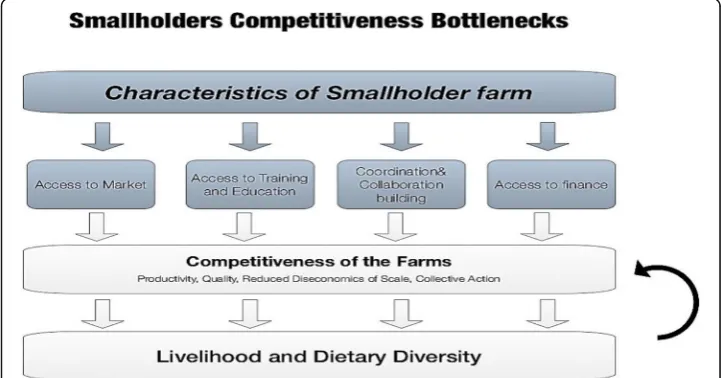
2012; Omiti2012; Chelang’a et al.2013) since they face numerous competitiveness bot-tlenecks (Fig. 1) and market failures along these chains such as low productivity, poor product quality, lack of standards compliance, high transaction costs and a lack of net-works among others (Narrod et al. 2009; Rao et al. 2012; Boström et al. 2015). These challenges have further reduced their sustainable entry into HVMCs, and hence, there is a need for a holistic approach to address these constraints in a more coordinated and sustainable way that promotes their effective participation in such lucrative high-value
agro-food market chains (Fernandez-Stark et al. 2012). This has been aggravated by
stringent regulations in terms of consumer demands from HVMCs, coupled with their sophistication and consolidation, which have made it more difficult for smallholder farmers to participate in these chains (Fernandez-Stark et al.2012; Rao et al.2012).
To overcome these challenges, Fernandez-Stark et al. (2012) have proposed a
four-pillar3model for holistically enhancing the competitiveness of smallholder farmers in HVMCs. The inclusion of smallholder farmers in HVMCs involves significant changes that require them to holistically overcome the major competitiveness con-straints and numerous market failures that limit their competitiveness and thus their sustainable entry into these chains. The authors argue that access to these four pillars
by smallholder farmers will lead to several complementary and integrated investments that will ultimately translate competitiveness constraints into income opportunities and serve as a means of reducing poverty. Against this backdrop, this study sought to con-tribute to the understanding of how smallholder AIV farmers can be supported effect-ively and efficiently to ensure that they are included in HVMCs in a sustainable way. This will only be possible if they receive assistance with overcoming the significant competitiveness challenges and bottlenecks that prevent them from accessing HVMCs. Therefore, identifying the drivers and incentives for accessing high-value markets,
training/extension, finance/credit and farmers’groups may improve smallholder AIV
farmers’chances of competing successfully and sustainably in HVMCs. Finally, it will
also provide a clear framework that could be used by policymakers when making deci-sions about how to support this vulnerable group of farmers so that vibrant agro-food HVMCs can be developed which, in turn, will improve rural household food security and reduce poverty.
The reviews conducted for this paper show that previous studies (Markelova et al.
2009; Narrod et al.2009; Gruère et al.2009; Fischer and Qaim2012; Trebbin2014; Ma and Abdulai 2016) have only used collective action/farmers’groups to link farmers to the markets on the assumption that these are the best model for farmers to access other pre-conditioning factors, without considering the heterogeneity of smallholder farmers in terms of their household characteristics and resources. Additionally, Ferris et al. (2014) used the involvement of extension services and advisory services in linking smallholder farmers with niche markets. Therefore, this paper’s contribution is twofold. First, using a “holistic”model with four key pillars or intervention instruments (access to HVMCs, credit services, extension services and farmers’groups), it was possible to identify the main drivers and incentives for overcoming the major constraints limiting the competitiveness of smallholder AIV farmers in HVMCs. Second, using a multivari-ate probit model, it was possible to estimmultivari-ate the influence of exogenous factors on sim-ultaneous decisions about accessing the four key pillars of competitiveness, while allowing for the error terms of each of these pillars to be freely correlated. Further-more, the model allowed the complementarities and substitutabilities of these pillars of competitiveness to be captured and hence their promotion to be facilitated in order to achieve the maximum welfare benefit for smallholder AIV farmers.
Data and descriptive statistics
The comprehensive cross-sectional data used in this analysis were derived from the Horticultural Innovation and Learning for Improved Nutrition and Livelihood in East Africa (HORTINLEA) project survey conducted in 2014. The project focused on five types of AIVs: African nightshade (Solanum scabrum), spider plant (Cleome gynandra), amaranth (Amaranthus spp), cowpea (Vigna unguiculata) and Ethiopian kale (Brassica
carinata). The survey used a multistage sampling technique to collect data from a total
sample of 1232 AIV-producing households, comprising 806 from rural counties and 426 from peri-urban counties. Smallholder farmers from Kisii and Kakamega counties represented rural areas, while those from Nakuru, Kiambu and Kajiado counties repre-sented peri-urban areas. These counties were selected based on statistics from the Min-istry of Agriculture on the relevance and intensity of the production and marketing of
households were randomly selected, including those that had accessed HVMC pillars4 of competitiveness and those that had not. The information on household and farm-level characteristics, production and marketing activities, and institutional and access-related variables were collected from respondents using a structured and pre-tested questionnaire. The independent variables included in the estimation were
chosen based on a review of previous studies (Man et al. 2002; Ajitabh and Momaya
2004; Markelova et al.2009; Narrod et al.2009; Gruère et al.2009; Fernandez-Stark et al.2012; Fischer and Qaim2012; Trebbin2014; Ma and Abdulai2016).
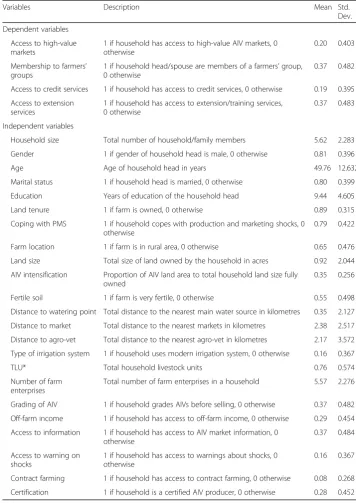
The description and summary statistics of the variables used in this study are
pre-sented in Table 1. Respondents were asked whether they had access to any of the four
key pillars of competitiveness in HVMC during the 2013/2014 production and market-ing season. Since different modes of access to market channels, chains or outlets were observed, a differentiation was made between conventional (normal) market channels and HVMCs. It was specifically noted that 72.1% of farmers were selling their vegeta-bles to different channels. Furthermore, 51.7% and 20.4% of these farmers sold their vegetables to conventional market chains and HVMCs respectively. Therefore, a com-parison was made between farmers who had access to HVMCs and those who did not (those who sold to conventional channels and those who did not sell at all).
Furthermore, with regards to other competitiveness pillars, 36.8% of smallholder AIV
farmers were found to have access to farmers’groups, 37.1% had access to extension
services, while 19.3% accessed credit services (Table 1). Moreover, the findings indi-cated that the majority (65%) of AIV farmers were from rural areas and were predom-inantly (81%) headed by males with an average age of 49.8 years and an education level of 9.4 years. The average household size was between five and six members, with the majority of their household heads (80%) being married. The average land size was 0.92 acres, with 89% of households owning their parcels of land. About 16% of AIV house-holds used modern irrigation systems, indicating a low level of production technology.
Theoretical framework
This study was based on a theoretical framework (a four-pillar or holistic model) for the inclusion of smallholder farmers in high-value agro-food chains, which was pro-posed by Fernandez-Stark et al. (2012). It draws on the concept of competitiveness at farm level. They argue that smallholder farmers should become competitive in order to participate in HVMCs. However, the potential involvement of smallholder farmers in HVMCs presents a challenge because they usually face competitiveness bottlenecks such as low productivity, poor product quality, lack of compliance with standards, high transaction costs and a lack of networks. These competitiveness bottlenecks are diffi-cult for smallholders to overcome because they face numerous constraints. These con-straints include a lack of access to markets, training (technical, interpersonal and entrepreneurial skills), collaborative networks (among small producers and with chain stakeholders) and finance. Consequently, the authors of this model highlight that if smallholders’farmers were relieved of these constraints, they would have the opportun-ity to become competitive and effectively participate in HVMCs in a sustainable man-ner. In particular, the holistic model considers four key “pillars”—access to markets,
access to training, collaboration and cooperation building, and access to finance—as
improving smallholder farmers’competitiveness and sustaining their inclusion in HVMCs. For instance, access to these intervention instruments by smallholder farmers can enable them to overcome productivity-related challenges such as a lack of exposure to buyers (HVMCs) and their requirements, a lack of technical and entrepreneurial skills, a lack of information flow with other producers and also other actors in the chain, and a lack of ac-cess to finance to buy equipment, infrastructure or neac-cessary inputs.5
There are many theoretical frameworks for competitiveness at farm level that in-cludes, for instance, those developed by Buckley et al. (1992), Man et al. (2002) and Table 1Description and summary statistics of selected variables
Variables Description Mean Std.
Dev.
Dependent variables
Access to high-value markets
1 if household has access to high-value AIV markets, 0 otherwise
0.20 0.403
Membership to farmers’ groups
1 if household head/spouse are members of a farmers’group, 0 otherwise
0.37 0.482
Access to credit services 1 if household has access to credit services, 0 otherwise 0.19 0.395
Access to extension services
1 if household has access to extension/training services, 0 otherwise
0.37 0.483
Independent variables
Household size Total number of household/family members 5.62 2.283
Gender 1 if gender of household head is male, 0 otherwise 0.81 0.396
Age Age of household head in years 49.76 12.632
Marital status 1 if household head is married, 0 otherwise 0.80 0.399
Education Years of education of the household head 9.44 4.605
Land tenure 1 if farm is owned, 0 otherwise 0.89 0.315
Coping with PMS 1 if household copes with production and marketing shocks, 0 otherwise
0.79 0.422
Farm location 1 if farm is in rural area, 0 otherwise 0.65 0.476
Land size Total size of land owned by the household in acres 0.92 2.044
AIV intensification Proportion of AIV land area to total household land size fully owned
0.35 0.256
Fertile soil 1 if farm is very fertile, 0 otherwise 0.55 0.498
Distance to watering point Total distance to the nearest main water source in kilometres 0.35 2.127
Distance to market Total distance to the nearest markets in kilometres 2.38 2.517
Distance to agro-vet Total distance to the nearest agro-vet in kilometres 2.17 3.572
Type of irrigation system 1 if household uses modern irrigation system, 0 otherwise 0.16 0.367
TLU* Total household livestock units 0.76 0.574
Number of farm enterprises
Total number of farm enterprises in a household 5.57 2.276
Grading of AIV 1 if household grades AIVs before selling, 0 otherwise 0.37 0.482
Off-farm income 1 if household has access to off-farm income, 0 otherwise 0.29 0.454
Access to information 1 if household has access to AIV market information, 0 otherwise
0.37 0.484
Access to warning on shocks
1 if household has access to warnings about shocks, 0 otherwise
0.16 0.367
Contract farming 1 if household has access to contract farming, 0 otherwise 0.08 0.268
Certification 1 if household is a certified AIV producer, 0 otherwise 0.28 0.452
Ajitabh and Momaya (2004) among others. Buckley et al. (1992) conceptualised a
model for a farm’s competitiveness that contains three interrelated dimensions
(performance, potential and process). Ajitabh and Momaya (2004) meanwhile focused
on the main competitiveness sources at a company level using an
asset-processes-performance (APP) framework. Man et al. (2002) developed a theoretical framework
for the competitiveness of small and medium-sized enterprises (SME) by drawing on the concept of competitiveness at farm level. However, they focused mainly on the key determinants of competitiveness and considered the dimensions (assets, potential, process, performance) of a farm’s competitiveness alongside four attributes (long-term orientation, controllability, relativity and dynamism). However, the holistic model is su-perior when compared to other competitiveness models because it focuses specifically on potential pathways for the inclusion of smallholder farmers in HVMCs. They suggest that in order for smallholder farmers to achieve long-term competitiveness, there is a need to effectively exploit the available opportunities for improving competitiveness-enhancing factors, such as building up their household capitals/assets and resources, as well as efficient and effective utilisation of their institutional connec-tions. Therefore, the holistic model of Fernandez-Stark et al. (2012) was used in this study to assess the determinants of competitiveness of smallholder African indigenous vegetable farmers in high-value agro-food chains in Kenya. The reason for this is that access to markets and critical services such as training and finance, as well as strong and effective collaboration and cooperation, will provide opportunities for smallholder AIV farmers to become competitive on a lasting basis.
Empirical specifications
Conceptual framework
The conceptual framework employed in this study was based on the assumption that AIV farmers choose to access pillars of competitiveness or not because they are as-sumed to be risk neutral. Furthermore, smallholder AIV farmers take into account the expected net returns (PNRA) derived from AIV production by accessing pillars of com-petitiveness and the expected net returns (PNR) derived by not accessing these pillars. Smallholder AIV farming households will decide to access to pillars of competitiveness if the perceived utility or net returns from access (PNRA) is significantly greater than is the case without it (PNR). Although utility is not directly observed, the actions of small-holder AIV farmers are observed through the choices they make, for instance, they would choose to access pillars of competitiveness if Pi >0 . Therefore, Pi can be expressed as a function of observable elements in the following latent variable model:
Pi ¼βXiþμi;Pi¼1if Pi >0 ð1Þ
where Pi is a binary indicator variable that equals 1 for household i that has accessed
pillars of competitiveness, and 0 otherwise;Xiis a set of explanatory variables;β
repre-sents the parameters to be estimated; and μiis an error term assumed to be normally
distributed with zero mean. The probability of smallholder AIV farmers adopting SIPs can be expressed as:
PrðPi¼1Þ ¼ Pr Pi >0
¼ Prðμi>−βXiÞ ¼1−Fð−βXiÞ ð2Þ
Multivariate probit model
In this study, smallholder AIV farmers’decisions to select pillars of competitiveness in-volved multiple choices and they would therefore be expected to choose a combination of pillars rather than just selecting one. It was therefore necessary to use a model that estimates the influence of exogenous variables on simultaneous decisions of accessing various pillars of competitiveness, while allowing for the error terms of each of these pillars to be freely correlated. Therefore, in this study, a multivariate probit (MVP) model was used, which is appropriate for estimating the influence of exogenous factors
on smallholder AIV farmers’ decisions to access pillars of competitiveness in HVMCs,
while allowing the correlation of error terms of different decisions equations (Maddala
1986; Wooldridge 2010). Furthermore, the model enables the complementarities and
substitutabilities of these pillars of competitiveness to be captured and hence enhances the strategies used in the promotion of their access among smallholder farmers for
maximum welfare benefit. Therefore, following the recommendation of Maddala (1986)
and Wooldridge (2010), a typical empirical specification for the MVP model is charac-terised by a set of binary dependent variables (Pin) such that:
Pin¼β0nXiþuin;n¼1;…::;4 ð3Þ
and
Pin¼ 1if P
in >0
0otherwise
ð4Þ
whereβ0nis the corresponding vector of parameters to be estimated andPinis the latent variable. Each of the equations was considered using the same set of independent vari-ables (Xipn) described in Table1.
Results and discussion
Pairwise correlations
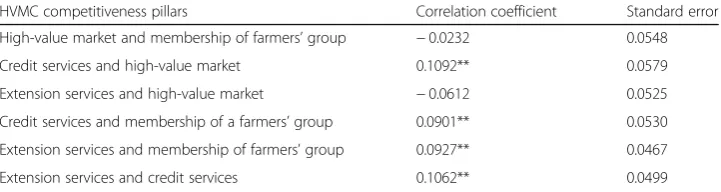
The multivariate probit regression model was estimated at household level. The results from the pairwise correlation are presented in Table2.
These results show a likelihood ratio test ofχ2(6) = 13.416 (p< 0.013), which suggests the presence of interdependence between multiple pillars of competitiveness in HVMC. These results supported the use of the multivariate probit model to analyse the deter-minants of access to pillars of competitiveness in HVMC among smallholder AIV farmers. Furthermore, the findings suggested that some of the pillars of competitiveness in HVMC were complements, with four out of six correlation coefficients being
Table 2Correlation coefficients of pillars of competitiveness in HVMC from MVP estimation
HVMC competitiveness pillars Correlation coefficient Standard error
High-value market and membership of farmers’group −0.0232 0.0548
Credit services and high-value market 0.1092** 0.0579
Extension services and high-value market −0.0612 0.0525
Credit services and membership of a farmers’group 0.0901** 0.0530
Extension services and membership of farmers’group 0.0927** 0.0467
Extension services and credit services 0.1062** 0.0499
Likelihood ratio test of rho21 = rho31 = rho41 = rho32 = rho42 = rho43 = 0;χ2
(6) = 13.416 Prob>χ2
statistically significant, indicating that access to the pillars of competitiveness in HVMC among smallholder AIV farmers was not mutually independent.
Determinants of the choice of pillars of competitiveness in HVMCs
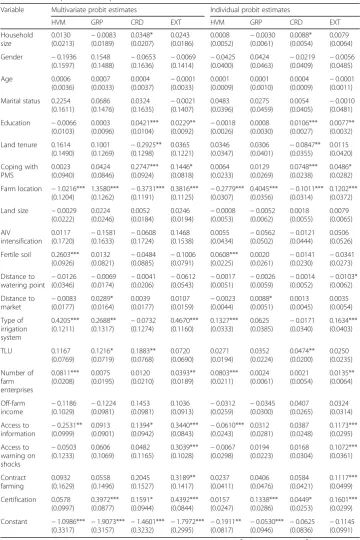
The results of the parameter estimates from the multivariate probit model suggest that capital endowments and entitlements, institutions and access-related variables at house-hold level were significant in informing decisions to access pillars of competitiveness in
HVMCs (Table 3). Social capital variables were the main determinants of smallholder
farmers’access to pillars of competitiveness in HVMCs. Coping with PMS was used as a
dummy variable representing households that responded to productions shocks (drought, floods, pest and diseases, crop failure, among other production-related shocks) and those that responded to marketing shocks (food, input and output prices). The results of this study were consistent with other studies (Frankenberger et al. 2013; Franken et al.2014) in that smallholder AIV farmers who managed to respond to PMS were found to be more likely to access the EXT and CRD competitiveness pillars. Depending on the type of shock and the household’s ability/capacity, as well as the opportunity cost, to not respond to shocks, smallholder AIV farmers who are risk-averse were more likely to avoid spot mar-kets and engage in forward contracts due to their ability to enhance the transformative capacity of reducing market transaction costs. This is only possible if smallholder farmers have access to relevant and appropriate information, as well as the necessary resources that can enhance their adaptive capacity.
Access to HVMC for risk reduction through market-oriented production is a power-ful risk mitigation strategy that can enable smallholder farmers to diversify away from spot markets with high price volatilities (Barrett 2008; Torero 2011). Therefore, for smallholder farmers to participate in HVMC effectively and efficiently, there is a need for them to explore appropriate opportunities for enhancing their asset base and over-coming market constraints and poverty. In general, HVMC activities demand greater assets, liquidity and credit from smallholder farmers and require greater risk mitigation, all of which requires them to access pillars of competitiveness in HVMCs in order to bear the effects of production and marketing shocks and alleviate transaction costs. In
line with Barrett et al. (2001), smallholder households who own their land were also
found to have a negative relationship with access to the CRD competitiveness pillar. This implies that smallholder AIV farmers who fully own their farmland are less likely to access credit services, which is largely attributed to the fact that most of them, espe-cially in rural areas, have limited access to formal credit providers who can help them gain access to unexploitative credit, despite them having the necessary collateral to ac-cess formal credit services. This is due to there being a limited number or even total absence of formal credit providers in most rural areas in Kenya (Kiplimo et al.2015).
products, and only sell these products at the right time without loss of quality. Further-more, this group of farmers would also seek credit financial services in order to acquire the necessary equipment and/or technologies, such as irrigation systems for high-quality Table 3Parameter estimates from multivariate probit and individual probit models for estimating determinants of pillars of competitiveness in HVMC
Variable Multivariate probit estimates Individual probit estimates
HVM GRP CRD EXT HVM GRP CRD EXT
Household size 0.0130 (0.0213) − 0.0083 (0.0189) 0.0348* (0.0207) 0.0243 (0.0186) 0.0008 (0.0052) − 0.0030 (0.0061) 0.0088* (0.0054) 0.0079 (0.0064)
Gender −0.1936
(0.1597) 0.1548 (0.1488) − 0.0653 (0.1636) − 0.0069 (0.1414) − 0.0425 (0.0400) 0.0424 (0.0463) − 0.0219 (0.0409) − 0.0056 (0.0485) Age 0.0006 (0.0036) 0.0007 (0.0033) 0.0004 (0.0037) − 0.0001 (0.0033) 0.0001 (0.0009) 0.0001 (0.0010) 0.0004 (0.0009) − 0.0001 (0.0011)
Marital status 0.2254 (0.1611) 0.0686 (0.1476) 0.0324 (0.1635) − 0.0021 (0.1407) 0.0483 (0.0396) 0.0275 (0.0459) 0.0054 (0.0405) − 0.0010 (0.0481)
Education −0.0066 (0.0103) 0.0003 (0.0096) 0.0421*** (0.0104) 0.0229** (0.0092) − 0.0018 (0.0026) 0.0008 (0.0030) 0.0106*** (0.0027) 0.0077** (0.0032)
Land tenure 0.1614 (0.1490) 0.1001 (0.1269) − 0.2925** (0.1298) 0.0365 (0.1221) 0.0346 (0.0347) 0.0306 (0.0401) − 0.0847** (0.0355) 0.0115 (0.0420) Coping with PMS 0.0023 (0.0940) 0.0424 (0.0846) 0.2747*** (0.0924) 0.1446* (0.0818) 0.0064 (0.0233) 0.0129 (0.0269) 0.0748*** (0.0238) 0.0486* (0.0282)
Farm location −1.0216*** (0.1204) 1.3580*** (0.1262) −0.3731*** (0.1191) 0.3816*** (0.1125) −0.2779*** (0.0307) 0.4045*** (0.0356) −0.1011*** (0.0314) 0.1202*** (0.0372)
Land size −0.0029 (0.0222) 0.0224 (0.0246) 0.0052 (0.0184) 0.0246 (0.0194) −0.0008 (0.0053) −0.0052 (0.0062) 0.0018 (0.0055) 0.0079 (0.0065) AIV intensification 0.0117 (0.1720) −0.1581 (0.1633) −0.0608 (0.1724) 0.1468 (0.1538) 0.0055 (0.0434) −0.0562 (0.0502) −0.0121 (0.0444) 0.0506 (0.0526)
Fertile soil 0.2603*** (0.0926) 0.0132 (0.0821) −0.0484 (0.0885) −0.1006 (0.0791) 0.0608*** (0.0225) 0.0020 (0.0261) −0.0141 (0.0230) −0.0341 (0.0273) Distance to watering point −0.0126 (0.0346) −0.0069 (0.0174) −0.0041 (0.0206) −0.0612 (0.0543) −0.0017 (0.0051) −0.0026 (0.0059) −0.0014 (0.0052) −0.0103* (0.0062) Distance to market −0.0083 (0.0177) 0.0289* (0.0164) 0.0039 (0.0177) 0.0107 (0.0159) −0.0023 (0.0044) 0.0088* (0.0051) 0.0013 (0.0045) 0.0035 (0.0054) Type of irrigation system 0.4205*** (0.1211) 0.2688** (0.1317) −0.0732 (0.1274) 0.4670*** (0.1160) 0.1327*** (0.0333) 0.0625 (0.0385) −0.0171 (0.0340) 0.1634*** (0.0403) TLU 0.1167 (0.0769) 0.1216* (0.0719) 0.1883** (0.0768) 0.0720 (0.0690) 0.0271 (0.0194) 0.0352 (0.0224) 0.0474** (0.0200) 0.0250 (0.0235) Number of farm enterprises 0.0811*** (0.0208) 0.0075 (0.0195) 0.0120 (0.0210) 0.0393** (0.0189) 0.0803*** (0.0211) 0.0024 (0.0061) 0.0021 (0.0054) 0.0135** (0.0064) Off-farm income − 0.1186 (0.1029) − 0.1224 (0.0981) 0.1453 (0.0981) 0.1036 (0.0913) − 0.0312 (0.0259) − 0.0345 (0.0300) 0.0407 (0.0265) 0.0324 (0.0314) Access to information − 0.2531** (0.0999) 0.0913 (0.0901) 0.1394* (0.0942) 0.3440*** (0.0843) − 0.0610*** (0.0243) 0.0312 (0.0281) 0.0387 (0.0248) 0.1173*** (0.0295) Access to warning on shocks −0.0503 (0.1233) 0.0606 (0.1069) 0.0482 (0.1165) 0.3039*** (0.1028) − 0.0067 (0.0298) 0.0194 (0.0223) 0.0168 (0.0304) 0.1072*** (0.0361) Contract farming 0.0932 (0.1629) 0.0558 (0.1496) 0.2045 (0.1527) 0.3189** (0.1417) 0.0237 (0.0411) 0.0406 (0.0476) 0.0584 (0.0421) 0.1117*** (0.0499) Certification 0.0578 (0.0997) 0.3972*** (0.0877) 0.1591* (0.0944) 0.4392*** (0.0844) 0.0157 (0.0247) 0.1338*** (0.0286) 0.0449* (0.0253) 0.1601*** (0.0299)
Constant −1.0986*** (0.3317) − 1.9073*** (0.3157) − 1.4601*** (0.3232) − 1.7972*** (0.2995) − 0.1911** (0.0817) − 0.0530*** (0.0946) − 0.0625 (0.0836) − 0.1145 (0.0991)
Likelihood ratio test of: rho21 = rho31 = rho41 = rho32 = rho42 = rho43 = 0;χ2(6) = 14.931 Prob>χ2= 0.020 Figures in parentheses are robust standard errors
and sustainable production, and hence, it offers an integral solution for overcoming the main constraints faced when accessing HVMCs. In contrast, access to market information (prices) was found to have negative effects on access to HVM competitiveness pillars. This is surprising and is largely attributed to the price of required standards, equipment, trans-portation facilities and other requirements from HVMCs which could carry a high initial cost that the majority of poor smallholder farmers are unable to pay before supplying the HVMCs. Moreover, this could also be attributed to the source of such information, which is consistent with the findings of Ouma et al. (2010) who point out that market price in-formation acquired through neighbours reduces the probability of market participation among smallholder banana farmers in Central Africa.
Furthermore, Bellemare (2012) indicated that households who have access to market
price information may end up creating strong linkages with buyers along agricultural commodity chains through contract farming and thus improve their access to HVMCs. In this regard, access to contract farming was also found to be an important determinant in accessing the EXT competitiveness pillar. This implies that smallholder AIV farmers who are contracted by suppliers are more likely to have access to the EXT competitiveness pil-lar. Depending on the contractual arrangements and the type of market that the produce is supplied to, as well as the nature of the products, smallholder AIV farmers who are in any form of contract farming have better pricing terms with good quality products that can be accepted in HVMCs. HVMCs require formal contracts and are predominantly found in accessible areas, resulting in higher welfare gains for smallholder farmers under contract (Barrett et al.2012; Ma and Abdulai2016).
Access to information related to warnings of future unexpected events/shocks is posi-tively related to access to the EXT competitiveness pillar. This implies that smallholder farmers who receive warnings are more likely to access the EXT competitiveness pillar. Therefore, access to a considerable amount of information on future events enables smallholder farmers to effectively learn about the use of ex ante coping strategies on their farmland, while maintaining food safety standards, and build up their household assets for future consumption as well as supply HVMCs during adverse
periods/occur-rence of shocks (Narrod et al. 2009; Tran 2015). The reason is that when households
are aware of incipient unfavourable events, they tend to take necessary mitigation mea-sures, for instance building up household assets (as an ex-ante coping strategy), which will lessen the impacts of such events. These results also suggest that certification is an important factor in informing the decision taken by smallholder AIV farmers to access three pillars of competitiveness in HVMCs. Households who have access and are certi-fied farmers are more likely to gain access to the GRP, CRD and EXT competitiveness pillars. This is largely attributed to the fact that certification comes at a cost of around 30% of a Kenyan smallholder’s annual vegetable income (Asfaw et al.2010). Providers also always prefer to work with farmers who are in groups because of ease in terms of the required quantities levels, efficiency and effectiveness in the manage-ment of the operation, as well as access to other relevant services such as credit (Chiputwa et al. 2015).
determining their decision to seek access to pillars of competitiveness in HVMCs. With regard to total livestock units (TLU), smallholder AIV farmers with a higher TLU were found to be more likely to seek the GRP and CRD competitiveness pillars. This implies that the higher the TLU, the greater the probability of a smallholder AIV farmer be-coming a member of a farmers’group as well as accessing credit services. Furthermore,
smallholder AIV farmers may be borrowing from informal sources (farmers’groups)
against the assets (livestock) they own or sometimes against future expected incomes, using livestock assets as collateral, especially when options are limited. These findings
are consistent with those of Bahta and Malope (2014), who argue that smallholder
households with higher TLU have higher gross margins and are competitive in HVMCs because they are more likely to use secured loans and divestment strategies. The num-ber of farm enterprises that households operate is an important factor in informing the decision to access the HVM and EXT competitiveness pillars. Consistent with McCord
et al. (2015), smallholder AIV farmers who have a greater number of farm enterprises
were found to be more likely to access extension services. Having more farm enter-prises requires technical knowledge of farming techniques in terms of assets and re-source allocations, cultural practices, management and response to shocks such as pests and diseases, as well as entrepreneurial skills, all of which are acquired from ex-tension agents, especially when supplying HVMCs.
Physical capital variables are important factors influencing access to pillars of com-petitiveness in HVMCs. The results indicated that the type of irrigation system used by smallholder AIV farmers was an important determinant of the choice of pillars of com-petitiveness in HVMC such as EXT, GRP and HVM. This suggests that farmers who use modern irrigation systems are more likely to have access to EXT, GRP and HVM.
These results are consistent with the findings of Burney and Naylor (2012), who
con-cluded that modern irrigation systems are capital-intensive infrastructures that are im-portant in determining smallholders’decisions to switch to high-value crops and hence access HVMs. In addition, the positive relationship between the use of modern
irriga-tion systems and HVM access is consistent with the findings of Ngenoh et al. (2015),
who found that the use of modern production systems are expected to increase the yields of most irrigated products. Use of modern irrigation systems enables smallholder farmers to become competitive in rapidly changing environments and hence require ef-ficient information flows. This is only possible if smallholder farmers use social
net-works through their membership of farmers’ groups and have access to extension
services in order to understand the technical and entrepreneurial skills required. Distance to the nearest market was found to be positively related to access to the GRP competitiveness pillar. These results are consistent with those of Narrod et al.
(2009) and Trebbin (2014), who noted that smallholder farmers who are located at a
of accessing HVMCs. This is because the distance either to input or output markets plays a vital role in determining the farmers’decision-making process in various ways.
Moreover, Wollni and Zeller (2007) noted that smallholder farmers with better access
to farmer groups, coupled with the availability of information and support services as well as the opportunity costs of labour, stand a better chance of minimising high input price volatilities by procuring inputs in bulk.
Natural capitals are important factors that influence the decision to access pillars of competitiveness in HVMCs. The location of smallholder farms is a major determinant in accessing HVMC pillars of competitiveness. Smallholder farmers from rural areas are more likely to access GRP and EXT, while their counterparts in peri-urban areas are more likely to access HVM and CRD. This implies that rural farmers are faced with credit and high-value market access constraints because they lack the necessary institu-tions and infrastructure more than their peri-urban counterparts do. This result is
con-sistent with the findings of Markelova and Mwangi (2010) and Fischer and Qaim
(2012), who noted that poor infrastructure, a lack of supporting institutions, high trans-action costs and limited market opportunities in rural and remote areas lead to highly inefficient and long supply chains that are dominated by non-value-adding intermediar-ies. In addition, farmers who collectively market their farm products are more likely to benefit from high-value supply chains than from local markets. Furthermore, the results indicated that peri-urban farmers are disadvantaged in terms of accessing EXT and GRP because there is a wide variation in what they are doing on their farms, and hence, they find it difficult to come together in groups. In turn, this also makes it difficult for the extension agents to arrange dissemination strategies such as field days, field demon-strations and workshops.
Access to agricultural land with fertile soil6is an important factor when smallholder farmers are accessing the HVM competitiveness pillar. Consistent with Ferris et al. (2014) and Schindler et al. (2016), smallholder AIV farmers who have land with fertile soil were found to be more likely to have access to HVM because they use fewer production inputs to produce significant quantities of high-quality products that are accepted in HVMCs. In addition, these farmers may utilise the resources that would have been used to purchase fertility-enhancing inputs such as fertilisers to meet other relevant requirements, which specifically improve their access to the HVM competitiveness pillar.
since they participate in better off-farm activities that can be used as collateral while accessing these services. With regard to household size, and in agreement with
Jaimo-vich (2015), smallholder households with more members were found to be more likely
to access the CRD competitiveness pillar. This suggests that the larger the household, the greater the demand for food and other resources, and hence, the greater the need for external links to several networks that can provide the necessary services, such as credit. The reason for this is that such households are endowed with labour and only constrained by the resources needed to utilise the available family labour.
Conclusions
This paper determined the main factors influencing the decisions of smallholder AIV farmers to access pillars of competitiveness in HVMCs in Kenya. The pillars of com-petitiveness (HVM, CRD, GRP and EXT) are the necessary pre-conditioning factors that enable smallholder AIV farmers to overcome the major constraints limiting their competitiveness in HVMCs. Using a detailed household-level data and a multivariate probit model, more than two thirds of the interviewed farmers were found to have ac-cess to at least one pillar of competitiveness in HVMCs. Furthermore, the majority of these farmers were from rural areas and had access to EXT and GRP, while their peri-urban counterparts had mainly accessed the CRD and HVM pillars of competitive-ness. This implies that smallholder AIV farmers face numerous constraints in accessing competitiveness pillars, and therefore, efforts need to be made to improve their level of access to these pillars of competitiveness so that they can participate effectively and ef-ficiently in HVMCs. The results of the model estimations identified that smallholders’ decisions to cope with both production and marketing shocks (PMS) were a major fac-tor informing their decision to access the CRD and EXT competitiveness pillars. Coping with PMS enables farmers to access HVMCs and thus build on their assets and invest in capital-intensive production and marketing technologies, which also help them de-velop their ability to withstand shocks and stresses. Furthermore, this study identified that access to information on market prices and warnings and to critical services such as contract farming, certification, grading and irrigation technologies was the most
im-portant factor in smallholder AIV farmers’decisions to access HVMC competitiveness
pillars. Future studies should evaluate whether smallholder farmers’access to quality in-formation, as well as its source, plays a critical role in conditioning access to pillars of competiveness.
production of high-quality products, and thus enable smallholder farmers to supply HVMCs successfully and consistently. Finally, the importance of accessing contract farming and certification in smallholder farmers’decisions to access pillars of competi-tiveness suggests that there is a need for policies that support farmers securing direct supply contracts from HVMCs. This will allow them to directly shift to a market-oriented type of production and furthermore encourage them to diversify into farm enterprises offering high returns that will enable them to reduce the opportunity costs of on-farm labour and resource allocation, and thus reduce production costs in the long run.
Endnotes 1
Competitiveness refers to the ability of smallholder farmers to sell products that meet market requirements in terms of price, quality and quantity while ensuring profit-ability over time, which enables them to prosper (Latruffe2010).
2
The term “high-value market chains” is used in this paper and in the literature to refer to non-traditional agricultural markets such as supermarkets, hospitals, schools, large hotels and restaurants that have higher product prices because of their particular requirements, including high quality standards, handling, packaging and other regula-tions (Fernandez-Stark et al.2012).
3
The four pillars are access to HVMCs, training/extension, finance/credit and farmers’groups/horizontal and vertical coordination and collaboration.
4
These pillars are access to high-value markets (HVM), farmers’groups (GRP), credit services (CRD) and extension services (EXT).
5
For more information on the “four key pillars” of the holistic model, see
Fernandez-Stark et al. (2012).
6
Soil fertility was measured using farmers’ perception of their soil fertility of their land parcels on which AIVs have been grown in the past 12 months, with the options of unfertile, somewhat fertile, moderately fertile and very fertile. In this study, unfertile and somewhat fertile were used to represent unfertile lands, while moderately fertile and very fertile represent fertile land.
Abbreviations
AIV:African indigenous vegetables; APP: Asset-processes-performance; CRD: Credit services; EXT: Extension services; FAO: Food and Agriculture Organization; GRP: Farmers’groups; HCDA: Horticultural Crops Development Authority; HORTINLEA: Horticultural Innovation and Learning for Improved Nutrition and Livelihood in East Africa; HVM: High-value markets; HVMC: High-High-value market chains; MVP: Multivariate probit; PMS: Production and marketing shocks; SME: Small and medium-sized enterprises; SSA: Sub-Saharan Africa; TLU: Total livestock units
Acknowledgements
The authors are very grateful for all the support given to the study by the Horticultural Innovation and Learning for Improved Nutrition and Livelihood in East Africa (HORTINLEA) project, whose data was used in the analysis. We would also like to thank the team who played a role in the project design, survey, data entry and analysis for their efforts.
Funding
Not applicable
Availability of data and materials
The data for this study was drawn from the larger HORTINLEA project survey data, and the authors do not have the permission to share the data.
Authors’contributions
survey, data entry, data cleaning, data analysis, and write-up of the first draft. All the authors oversaw the interpretation and discussion of the results. Finally, all the authors have read and approved the final manuscript for submission.
Competing interests
The authors have declared that they have no competing interests and thus, on behave of all the authors, I would like to state categorically that we have no conflict of interest whatsoever concerning this article. Finally, we wish to state that we are entirely responsible for any errors of omission or commission.
Publisher’s Note
Springer Nature remains neutral with regard to jurisdictional claims in published maps and institutional affiliations.
Author details
1Department of Agricultural Economics, Humboldt University of Berlin, Invalidenstr. 42, 10115 Berlin, Germany. 2
Institute of Arid Lands Management, Laikipia University, P.O. Box 1100, Nyahururu 20300, Kenya.3Department of Agricultural Economics and Agribusiness Management, Egerton University, P.O. Box 536, Egerton 20115, Kenya.
Received: 23 January 2018 Accepted: 10 January 2019
References
Ajitabh A, Momaya KS (2004) Competitiveness of firms: review of theory, frameworks and models. Singap Manag Rev 26(1): 45–61
Asfaw S, Mithöfer D, Waibel H (2010) What impact are EU supermarket standards having on developing countries' export of high-value horticultural products? Evidence from Kenya. J Int Food Agribusiness Mark 22(3–4):252–276
Bahta S, Malope P (2014) Measurement of competitiveness in smallholder livestock systems and emerging policy advocacy: an application to Botswana. Food Policy 49:408–417.https://doi.org/10.1016/j.foodpol.2014.10.006
Barrett CB (2008) Smallholder market participation: concepts and evidence from Eastern and Southern Africa. Food Policy 33(4):299–317
Barrett CB, Bachke ME, Bellemare MF, Michelson HC, Narayanan S, Walker TF (2012) Smallholder participation in contract farming: comparative evidence from five countries. World Dev 40(4):715–730.https://doi.org/10.1016/j. worlddev.2011.09.006
Barrett CB, Reardon T, Webb P (2001) Nonfarm income diversification and household livelihood strategies in rural Africa: concepts, dynamics, and policy implications. Food Policy 26(4):315–331
Bellemare MF (2012) As you sow, so shall you reap: the welfare impacts of contract farming. World Dev 40(7):1418–1434. https://doi.org/10.1016/j.worlddev.2011.12.008
Boström M, Jönsson AM, Lockie S, Mol APJ, Oosterveer P (2015) Sustainable and responsible supply chain governance: challenges and opportunities. J Clean Prod 107:1–7.https://doi.org/10.1016/j.jclepro.2014.11.050
Buckley PJ, Pass CL, Prescott K (1992) The meaning of competitiveness. Servicing International Markets: Competitive Strategy of Firms
Burney JA, Naylor RL (2012) Smallholder irrigation as a poverty alleviation tool in sub-Saharan Africa. World Dev 40(1):110– 123.https://doi.org/10.1016/j.worlddev.2011.05.007
Chadha ML (2006) AVRDC’s experiences within marketing of indigenous vegetables–a case study on commercialization of African Eggplant
Chege PM, Kuria EN, Kimiywe JO, Nyambaka HN (2014) Changes in nutrient content forβ-carotene, iron and zinc in solar dried and stored Amaranthus cruentus vegetables. Int J Agric Innov Res 3(3):880–882
Chelang’a P, Obare G, Kimenju S (2013) Analysis of urban consumers’willingness to pay a premium for African Leafy Vegetables (AIVs) in Kenya: a case of Eldoret Town. Food Sec 5(4):591–595
Chiputwa B, Spielman DJ, Qaim M (2015) Food standards, certification, and poverty among coffee farmers in Uganda. World Dev 66:400–412.https://doi.org/10.1016/j.worlddev.2014.09.006
FAO (2014) The state of food insecurity in the world 2014: strengthening the enabling environment for food security and nutrition. Food and Agriculture Organization of the United Nations, Rome. Available at:http://www.fao.org/publications/ sofi/2014/en/
Fernandez-Stark K, Bamber P, Gereffi G (2012) Inclusion of Small-And Medium-Sized Producers in High-Value Agro-Food Value Chains. Center on Globalization, Governance and Competitiveness, Duke University, 38
Ferris S, Robbins P, Best R, Seville D, Buxton A, Shriver J, Wei E (2014) Linking smallholder farmers to markets and the implications for extension and advisory services. MEAS Brief 4(10):13–14
Fischer E, Qaim M (2012) Linking smallholders to markets: determinants and impacts of farmer collective action in Kenya. World Dev 40(6):1255–1268.https://doi.org/10.1016/j.worlddev.2011.11.018
Franken JRV, Pennings JME, Garcia P (2014) Measuring the effect of risk attitude on marketing behaviour. Agric Econ 45(5): 525–535.https://doi.org/10.1111/agec.12104
Frankenberger D, Swallow K, Mueller M, Spangler T, Downen J, Alexander S (2013) Feed the future learning agenda literature review: improving resilience of vulnerable populations. USAID, Washington DC
Government of Kenya (GoK) (2012) Kenya National Bureau of Statistics (KNBS). Economic survey report 2012. Government printers. Nairobi
von Grebmer K, Bernstein J, Nabarro D, Prasai N, Amin S, Yohannes Y, Sonntag A, Patterson F (2016) The concept of the global hunger index. IFPRI book chapters, 6–9
HCDA. (2014). National horticulture validated report. Kenya, Ministry of Agriculture, Department of Horticultural Crops Development Authority. Kenyan Government printer. Retrieved fromhttp://www.agricultureauthority.go.ke/wp-content/ uploads/2016/05/Horticulture-Validated-Report-2014-Final-copy.pdf
Jahnke HE (1982) Livestock production systems and livestock development in tropical Africa (253p). Kieler Wissenschaftsverlag, Kiel Jaimovich D (2015) Missing links, missing markets: evidence of the transformation process in the economic networks of
Gambian villages. World Dev 66:645–664.https://doi.org/10.1016/j.worlddev.2014.09.019
Kimiywe J, Waudo J, Mbithe D, Maundu P (2007) Utilization and medicinal value of indigenous leafy vegetables consumed in urban and peri-urban Nairobi. Afr J Food Agric Nutr Dev 7(4):1–15
Kiplimo JC, Ngenoh E, Koech W, Bett JK (2015) Determinants of access to credit financial services by smallholder farmers in Kenya. J Dev Agric Econ 7(9):303–313.https://doi.org/10.5897/JDAE2014.0591
Latruffe L (2010) Competitiveness, productivity and efficiency in the agricultural and agri-food sectors. OECD Food, Agriculture and Fisheries Papers, No. 30, OECD Publishing, Paris.https://doi.org/10.1787/5km91nkdt6d6-en
Ma W, Abdulai A (2016) Linking apple farmers to markets: determinants and impacts of marketing contracts in China. China Agric Econ Review 8(1):2–21
Maddala GS (1986) Limited-dependent and qualitative variables in econometrics (No. 3). Cambridge University Press Mampholo BM, Sivakumar D, Thompson AK (2016) Maintaining overall quality of fresh traditional leafy vegetables of
Southern Africa during the postharvest chain. Food Rev Intl 32(4):400–416
Man TW, Lau T, Chan KF (2002) The competitiveness of small and medium enterprises: a conceptualization with focus on entrepreneurial competencies. J Bus Ventur 17(2):123–142
Markelova H, Meinzen-Dick R, Hellin J, Dohrn S (2009) Collective action for smallholder market access. Food Policy 34(1):1–7. https://doi.org/10.1016/j.foodpol.2008.10.001
Markelova H, Mwangi E (2010) Collective action for smallholder market access: evidence and implications for Africa. Rev Policy Res 27(5):621–640
McCord PF, Cox M, Schmitt-Harsh M, Evans T (2015) Crop diversification as a smallholder livelihood strategy within semi-arid agricultural systems near Mount Kenya. Land Use Policy 42:738–750.https://doi.org/10.1016/j.landusepol.2014.10.012 Muhanji G, Roothaer RL, Webo C, Stanley M (2011) African indigenous vegetable enterprises and market access for
small-scale farmers in East Africa. Int J Agric Sustain 9(1):194–202
Narrod C, Roy D, Okello J, Avendaño B, Rich K, Thorat A (2009) Public–private partnerships and collective action in high value fruit and vegetable supply chains. Food Policy 34(1):8–15.https://doi.org/10.1016/j.foodpol.2008.10.005
Ngenoh E, Kebede SW, Bett HK, Bokelmann W (2016) Role of high-value market participation on poverty reduction among African leafy vegetable farmers in Kenya. Afr J Hortic Sci 10:14–20
Ngenoh E, Kirui LK, Mutai BK, Maina MC, Koech W (2015) Economic determinants of the performance of public irrigation schemes in Kenya. J Dev Agric Econ 7(10):344–352
Ngugi IK, Gitau R, Nyoro J (2007) Access to high value markets by smallholder farmers of African indigenous vegetables in Kenya. Regoverning Markets Innovative Practice Series,IIED,London
Olwande J, Smale M, Mathenge MK, Place F, Mithöfer D (2015) Agricultural marketing by smallholders in Kenya: a comparison of maize, kale and dairy. Food Policy 52:22–32
Omiti J, Otieno D, Nyanamba T, McCullough E (2009) Factors influencing the intensity of market participation by smallholder farmers: a case study of rural and peri-urban areas of Kenya. Afr J Agric Resour Econ 3(1):57–82
Omiti JM (2012) Research challenges in agriculture and rural development in Kenya. Afr J Food Agric Nutr Dev 12(6):1–5 Ouma E, Jagwe J, Obare GA, Abele S (2010) Determinants of smallholder farmers' participation in banana markets in Central
Africa: the role of transaction costs. Agric Econ 41(2):111–122.https://doi.org/10.1111/j.1574-0862.2009.00429.x Rao EJ, Brümmer B, Qaim M (2012) Farmer participation in supermarket channels, production technology, and efficiency: the
case of vegetables in Kenya. Am J Agric Econ 94(4):891–912
Reardon T, Barrett CB, Berdegué JA, Swinnen JF (2009) Agrifood industry transformation and small farmers in developing countries. World Dev 37(11):1717–1727
Rios AR, Masters WA, Shively GF (2008) Linkages between market participation and productivity: results from a multi-country farm household sample. Paper presented at the American Agricultural Economics Association Annual Meeting, Orlando, Florida, USA, July 27–19, 2008
Schindler J, Graef F, König H, McHau D, Saidia P, Sieber S (2016) Sustainability impact assessment to improve food security of smallholders in Tanzania. Environ Impact Assess Rev 60:52–63.https://doi.org/10.1016/j.eiar.2016.04.006
Torero M (2011) A framework for linking small farmers to markets. In: IFAD Conference on New Directions for Smallholder Agriculture, vol 24, p 25
Tran VQ (2015) Household's coping strategies and recoveries from shocks in Vietnam. Q Rev Econ Finance 56:15–29.https:// doi.org/10.1016/j.qref.2014.06.006
Trebbin A (2014) Linking small farmers to modern retail through producer organizations–experiences with producer companies in India. Food Policy 45:35–44.https://doi.org/10.1016/j.foodpol.2013.12.007
Wollni M, Zeller M (2007) Do farmers benefit from participating in specialty markets and cooperatives? The case of coffee marketing in Costa Rica1. Agric Econ 37(2–3):243–248
Wooldridge JM, (2010) Econometric analysis of cross section and panel data: MIT press
Xinshen D, Hazell P, Resnick D, Thurlow J (2007) The role of agriculture in pro-poor growth in Sub-Saharan Africa. IFPRI, Washington DC