VIRTUALLY THERE: SOCIAL STRUCTURE OVER TIME AND SPACE
by
Wayne Erik Rysavy
A thesis
submitted in partial fulfillment of the requirements for the degree of
Master of Arts in Communication Boise State University
BOISE STATE UNIVERSITY GRADUATE COLLEGE
DEFENSE COMMITTEE APPROVAL
of the thesis submitted by
Wayne Erik Rysavy
We have read and discussed the thesis submitted by Wayne Erik Rysavy, and we have also evaluated his presentation and response to questions during the final oral examination. We find that the student has passed the final oral examination, and that the thesis is satisfactory for a master’s degree and ready for any final modifications that we may explicitly require.
______________________ __________________________________________
Date Natalie Nelson-Marsh, Ph.D.
Chair, Supervisory Committee
______________________ __________________________________________
Date Donald Winiecki, Ed.D, Ph.D.
Member, Supervisory Committee
______________________ __________________________________________
Date Heidi Reeder, Ph.D.
BOISE STATE UNIVERSITY GRADUATE COLLEGE
FINAL READING APPROVAL
of the thesis submitted by
Wayne Erik Rysavy
To the Graduate College of Boise State University:
I have read the thesis of Wayne Erik Rysavy in its final form and have found that (1) the modifications required by the defense committee are complete; (2) the format, citations, and bibliographic style are consistent and acceptable; (3) the illustrative materials including figures, tables, and charts are in place; and (4) the final manuscript is ready for submission to the Graduate College.
______________________ __________________________________________
Date Natalie Nelson-Marsh, Ph.D.
Chair, Supervisory Committee
Approved for the Graduate College:
______________________ __________________________________________
Date John R. Pelton, Ph.D.
To my loving family:
For giving me the time and space to immerse myself in my passions while also providing unwavering support when I got too deep.
ACKNOWLEDGEMENTS
This thesis could not have happened without the support of many people. I would like to acknowledge my participants in this study of Second Life. Although we have always been distanced, I feel connected to you through our shared experiences and interactions. Thank you for giving me a chance to be a part of your “second” life. My goal has always been to represent your voices and perspective.
To Dr. Natalie for upsetting my commonplace notions of “the way things are” by challenging me to question my assumptions yet supporting my development throughout the process. I am in awe of all you do and all the guidance and compassion you have provided to me over the years. You have vivified my adamant belief in the power of education and solidified my desire to be a professor who, when my time as a student is over, inspires the same personal and intellectual growth in my students.
To Dr. Don for being available at a moment’s notice and meeting with me during my moments of confusion. You always supported me by providing resources I had not yet considered and you challenged me to articulate my assumptions in an environment that fostered my development as a scholar. I am particularly thankful for your qualitative methods course, which inspired me to study Second Life and helped me grow as a scholar.
To Dr. Heidi for challenging me to clarify my points and helping me to
To Marty for being so tough and helping me realize my potential as a student (and a debater) by pushing me beyond what I thought I was capable of and instilling a firm belief of purpose and professionalism within me.
To Laurel for the engaging research courses that encouraged novel research and for fighting for me when I thought the battle was lost.
Christy Bowman, Michelle Bennett, and Dennis Waller for supporting me with words of encouragement and advice when I had my doubts.
My fellow graduate students and friends for supporting me throughout the years, especially during this “crazy-making” process. I am gratefully bound to each of you through our mutual struggles in the trenches.
TABLE OF CONTENTS
DEDICATION ...v
ACKNOWLEDGEMENTS ... vi
CHAPTER ONE: INTRODUCTION ...1
Communication: Historic Evolution and Revolution ...2
The Distant Other: Absent Presence, Self, and Virtual Communication ...8
Communication Technology: Text and Context ...13
Understanding Second Life...16
The “Big Six” of Second Life ...18
Breaking the Rules and Remaking the Rules ...21
(Re)Producing Structure: Self and Other in Interaction ...23
Utilizing a Blended Approach for Understanding ...28
CHAPTER TWO: METHODS ...33
Overview ...33
Second Life in Context ...34
Qualitative Methods: Ethnography of Communication ...35
Data Collection and Procedures ...37
Gaining Access ...37
Participant Observation ...38
Qualitative Interviews ...40
CHAPTER THREE: FINDINGS ...47
An Overview of Themes ...48
Virtual Incarnation ...49
Entering the Grid...50
Getting By and Feeling A Part of the Place ...54
Personified Incarnation ...61
More than just Meat and Bone and Coursing Hormones ...65
Becoming “Soulful” ...65
Coming Together and Coming Apart ...71
Summary ...78
CHAPTER FOUR: DISCUSSION ...80
Rendered Presence ...80
Negotiating Boundaries ...86
A Nuanced Approach ...89
The Spaces Between ...91
REFERENCES ...97
CHAPTER ONE: INTRODUCTION
Communication is both process and art. It is the vehicle through which we share our thoughts and feelings as much as it is a creative activity resulting in the production of new meanings and ways of knowing. While we commonly understand communication as a continual process of reception and interpretation, new electronic media continue to extend our knowledge of what constitutes communication and how we characterize communication. Challenging the longstanding assumptions of fixed and positioned ways of knowing, studies with new electronic media accentuate the burgeoning contrast between the authority and stability of the written word and the mutability of the electronic word (Craig & Muller, 2007). These studies also increasingly highlight the need to problematize virtual communication in its own terms, examining it as a “technologizing” of message dissemination and reception and construction of the self over time and space (Gozzi & Haynes, 1992; Ong, 2002).
This thesis questions the constitutive role communication plays in virtual settings. By problematizing knowledge about virtual communication in Second Life (SL), an online virtual world created by Linden Labs and continually constructed by its residents, I attempt to expand our understanding of communication through technology as mediated communication becomes increasingly prominent in the world and in our daily lives. In particular, I develop a historical foundation for virtual communication that: (a)
another over time and space. I then extend this analysis by clarifying how individual interactions with technology lead to new interpretations how presence is ‘ontologized’ in virtual settings. Ultimately, the argument is made here that new media technologies increase the ubiquity of virtual communication in our lives, and, in turn, engender new ways of understanding identity, communication, and metatheory.
Communication: Historic Evolution and Revolution
Communication is foundational to the creation of our reality. At the most basic level, it is the process through which we make sense of our thoughts and feelings and share our interpretations with others. Yet, as we explore communication, it becomes clear that communication also allows us to make sense of the world through our
interpretations. Understood this way, communication allows us to interpret the world around us through our personal experiences and interactions with others, as well as shape the world through our interpretations. As we are socialized into the world, then, we come to understand not only ourselves, but also the other through communication.
one another, both parties interpret (and misinterpret) one another inextricably tied to the given subjectivity between them. It is during this exchange of both verbal and nonverbal elements that Berger and Luckmann (1966), in particular, argue that the individual and the other are considered “close.” This closeness is not, however, emotionally or
psychological bound, at least not at this point. Instead, Berger and Luckmann (1966) argue that the F2F situation “emphatically bonds” the individual to the other in the immediate moment through direct presence (p. 29). Thus, “closeness” according to Berger and Luckmann is foundationally physical—both self and other are made discernable only through the immediacy of the direct physical apprehension of one another.
interaction that took place and the individual interpretations of what those associations might also entail (Berger & Luckmann, 1966).
For example, initial contact in F2F situation may have allowed an individual to discern the other as “a woman,” “a salesperson” “a jocular person” and so on. Yet, now that this woman, let’s call her Jane, is no longer in the immediate presence of the
individual, let’s call him Henry, she is discerned through the associations said individual can attribute to her based off of the previous interaction and any others associations that reasonably apply. In Jane’s physical absence, Henry may discern her as “duplicitous” in her role as “salesperson” based off of prior experiences with others in that role. Henry may also apprehend Jane as “a mother” or “a single woman” and reasonably attach any other attributes typically ascribed to both of those roles to Jane. Similarly, Jane will discern Henry based off of this initial interaction and make sense of him contextually, drawing upon the prior F2F interaction and any other reasonably acceptable associations that apprehend Henry to her.
The same conceptualization holds true for interpretations of others via a text, albeit somewhat differently. If the other is distanced from the individual (herein the originator, and therefore distanced from the onset), whether physically or metaphysically, then the interpretation of the other is based on both the continual interaction with the originator through the text and the “intersecting typificiations [sic]” that apprehend the originator to the other (Berger & Luckmann, 1966, p. 32). Instead of relying on
“closeness,” the other relies on the resources available to him or her in their remoteness that allow the originator to be reasonably apprehended (see Giddens, 1984). This
of the text and the originator, and interactions with others who have interacted with the text and composed their own interpretations of it.
In particular, the Roman Catholic Church’s exportation of Catholicism to new regions during the seventeenth century can be conceived in this way (King & Frost, 2002). As new indigenous peoples came into contact with the Bible, naïve to its doctrine, they apprehended it through the resources available to them. This, as I’ll explain later, occurred through individual and collective negotiations of both the text and the originator (herein the Roman Catholic Church at large) that allowed indigenous peoples to connect with the prevailing tenets through adaptation and, ultimately, feel psychologically and emotionally close to the Roman Catholic Church and those who shared its belief system. Therefore, interpretations can and do occur beyond the F2F situation and, although remote, are anything but inauthentic.
social exchange over time and distance (Chesebro & Bertelsen, 1996; Gozzi & Haynes, 1992; King & Frost, 2002; Nelson Marsh, 2006; Yakhlef, 2009; see also Boellstorff, 2008). Therefore, while these interpretations may not be perceived as authentically—as “fully real”—as those in F2F interaction, such interpretations of an individual or group via a text can be as real as the interpretation gained from the direct presence of someone. Thus, I argue that communication at a distance is continually re-presenting one another through continued interaction.
Furthermore, when conceptualized this way, it becomes clear that “virtual communication” has, in fact, existed ever since humankind disseminated a presence to others in new locations (King & Frost, 2002; Nelson Marsh, 2006; see also DeSanctis & Monge, 1999; Gozzi & Haynes, 1992; Yakhlef, 2009). With the tenets of a group
packaged into a text, the beliefs and values of the group became increasingly virtual, able to span space and time when distributed. Mediated through some physical representation, or a technical artifact, texts were introduced to new locations, all the while maintaining the distant presence of the other (Gergen, 2002: Gozzi & Haynes, 1992; King & Frost, 2002). As a result, texts became the communicative medium through which individuals came to interpret and effectively ‘create’ the other at a distance.
For example, texts like money and writing, which were fixed across time and space and contextual (King & Frost, 2002, Yakhlef, 2009; see also Chesebro & Bertelsen, 1996; Ong, 2002), became introductory objects through which indigenous peoples
making the other present, in some form, to the indigenous peoples. Although the rules behind these particular texts were largely unclear to these populations who, in turn, maintained their own ways of knowing and living, the dissemination of these texts shaped both parties involved by eventually allowing them to make use of them over prolonged exposure and increased understanding of their usage.
Similarly, abstract concepts also became vehicles through which the presence of the other could be conceived and interpreted, albeit in a more engaging fashion. Unlike the texts of money and writing that required an understanding of their application and value, abstract concepts like those detailed within religious practice and governance became texts that allowed the indigenous peoples to appropriate aspects within their immediate zone of reference (Chesebro & Bertelsen, 1996; King & Frost, 2002). The ritualistic practices of the Roman Catholic Church, as mentioned earlier, serve as a great example of how the doctrine was adapted in new locations. Disseminated around the world, the multivalent doctrine appealed to indigenous locales as a belief system that fit local settings through adapted practice (King & Frost, 2002; see also Nelson Marsh, 2006).
often select) practices of the indigenous world, ontologically amalgamating both the distant other and the indigenous world. As a result, the distant other became increasingly relatable and metaphysically tangible to the indigenous population that began to
understand it through its own interpretations and conceptions.
Historically, whether contextual (read: disambiguous) or abstract (read:
ambiguous) (King & Frost, 2002), texts have allowed for more than the dissemination of information. While they have undoubtedly allowed people to communicate with one another and transmit messages over vast distances, texts have also performed a far greater function: they have connected one presence to another over time and space (Gozzi & Haynes, 1992). By rendering the other as relatable and present through a mediating device, texts have effectively allowed the distant other to be present in physical absence. Concurrently, distributed texts have opened a world of interpretation and negotiation of individual and other over distance.
The Distant Other: Absent Presence, Self, and Virtual Communication Although the individual and the other are not physically present to one another when communicating over vast spans of time and space, they are represented to one another through the mediating text and each other’s interpretations of the other in interaction. Kenneth Gergen’s (2002) treatment of “absent presence” was chiefly concerned with such representation over distance, exploring the implications of
new communication technologies including print and electronic media, people began communicating virtually with one another (Chesebro & Bertelsen, 1996; Gergen, 2002). Mediated by a text, whether a book or computer, for example, the communication between one party and another increasingly spanned time and space. As part of the distribution of texts to new locations, the immediate physical presence of the other—the F2F situation—became less prominent, instead replaced by the interpretations of a presence vicariously internalized and externalized through continued interaction.
Therefore, if communication via a text allows for a rendered presence of the distant other to another in a new location, then communication via a text is always
distanced creating an “absent presence” (Gergen, 2002; see also Gozzi & Haynes, 1992). Or, more simply, any communication beyond the immediate physical presence of the other—the F2F situation—always occurs through a text that renders both communicative agents absent over distance. Thus, distributed texts afford a virtual presence that is highly subject to interpretation and negotiation over time and space within a new location or a localized population.
Moreover, unlike a presence experienced F2F, the virtual presence becomes constituted in language. Where the physical presence can be accounted for, or “apprehended,” directly and through perceptions of one another, the virtual presence cannot. Instead, the virtual presence takes form in the world of words and the
allows for the dissemination of beliefs, values, and cultural norms and expectations. However, unlike oral communication, these thoughts and ideas can be easily ignored or contested upon dissemination into a new location. Stripped of its situational context, the meaning behind the print text becomes subject to individual interpretation, as the writer and reader are not able to interact directly or exchange feedback (Chesebro & Bertelesn, 1996; King & Frost, 2002; see also Berger & Luckmann, 1966; Jackson, 1996).
Consequently, the reader of the text constitutes the distant other within his or her own interpretations of the language, thereby representing the other vicariously.
Similarly, electronic communication texts allow the distant other to become represented in language, but rendered through rapidly streaming electronic transmissions that combine spoken and written word over time and space (Chesebro & Bertelesen, 1996; Gergen, 2002; Gozzi & Haynes, 1992; see also Jackson, 1996). While electronic communication allows people to communicate vocally through telecommunication technologies like the telephone, cellular phone, and, more recently, Voice over Internet Protocol (VoIP), it has, in recent years, also started to integrate visual representation through icons, avatars, and video via webcam.
electronic texts, they actively choose how they represent themselves by constructing a personalized presence facilitated by the technology and how it is understood through managing its material elements and concurrently mediating its social elements (Hine, 2000; Jackson, 1996; see also Boellstorff, 2008; Tracy & Tretheway, 2005), of which I will elucidate more in the following section.
For now, though, it is important to focus on the fact that each individual creates a presence by which he or she is re-presented through the mediating technologies in use over time and space. This re-presentation is not only considered an absent presence of the individual, but it is also a fragmented presentation of the individual (Kuhn & Nelson, 2002; see also Gergen 2002; Tracy & Tretheway, 2005). Composed of mediating elements in the technology as understood by the individual and negotiated by others in interactions, the individual as re-presented is a fragmented presentation of their physical presentation (Hine, 2000, Kuhn & Nelson, 2002; Tracy & Tretheway, 2005; see also Gergen, 2002). Due to the fragmented (i.e. multifaceted) nature of this presence, it must be managed and recognized if it is to fully exist (Tracy & Tretheway, 2005). In other words, communicators using different electronic texts cannot simply have a presence without managing it and negotiating it in the presence of others (Boellstorff, 2008; Hine, 2000; Turkle, 1995). Thus, electronic communication continues to blend elements of oral communication and written communication, all the while maintaining its presence as a distinct form of communication over time and space.
increasingly so online, become physically invisible from one another. Stripped of a definitive presence, an individual must participate in the ongoing construction of his or her identity and world, tailoring elements of the available devices to establish a presence. However, since this presence re-presents the individual in a tailor-made form through the medium, it requires a community of persons to recognize, affirm, and negotiate this mediated representation of self (Gergen, 2002; Turkle, 1995). Consequently, an individual also becomes the subject of perpetual collective interpretation.
Thus, communicators conceptualize of the other within their lives by interpreting their presence in conversation through the technology that allows them to communicate while simultaneously distanced. Consequently, each individual becomes represented in language that is highly arbitrary, the thoughts and reality of which exist in the moment and continued shared experiences between one and another. Over time, these
interpretations constitute the presence of the other in absence, established yet continually negotiated over time and space.
the depth of the world, allowing each individual and his or her collective, yet diverse contributions to shape and reshape the self and his or her reality.
Communication Technology: Text and Context
With history established, both text and context must be elucidated to further understand the depth of virtual communication and absent presence in conjunction with emerging communication technologies like SL. While historic texts have been explored as an element of virtual communication, this section clarifies texts as synonymous with technology. In particular, the argument is made here that emerging communication technologies act as texts because they are composed of both material elements and social elements that are interpreted and reinterpreted through continual usage.
In particular, when an individual encounters a technical artifact (i.e. a technology), whether it is a cup, a book, a computer, or a software program on a
the artifact. At this point the individual perceives what the artifact can do through the social elements—he or she sees the artifact as capable of accomplishing a certain task and seeks to perform that task (Jackson, 1996). In the case of SL, for example, the individual may perceive the artifact as capable of connecting him or her to others at a distance. If, during interaction, the artifact performs the task it was perceived to be capable of doing, then it is a technology and it is said to be “functional” and, therefore, can be read as a text through which interpretations may be drawn through the technology and its context (Jackson, 1996). If, on the other hand, the artifact fails to perform the task it was thought to be capable of, then it is not recognized as a technology and does not warrant attention (Jackson, 1996).
Clearly, then, a technology can be read as a text when it functions through both the material and social elements that compose it. Existing in a context, a technology is understood as individuals come into contact with the material elements that constitute the artifact and collectively interpret its purpose (i.e. the social elements) (Houston &
Jackson, 2002; Jackson, 1996). While any artifact can be understood from its material elements, though, the social elements also work in concert to allow users to realize the potential of the text. In particular, physical features of an artifact become constituted, not through their figure, form, or shape, but rather through how they are socially derived and interpreted (Jackson, 1996). At this point, artifacts are no longer confined by their
However, material elements cannot be wholly discounted. After all, the opposing argument that a text must be perceived prior to its interpretation grounds the presence of the artifact as materially foundational (Jackson, 1996). Therefore, the materiality of an artifact must still be taken into account. Yet, the materiality of an artifact need not
necessarily supersede the social elements, lest we assume the technology as deterministic. Rather, as postulated by Jackson (1996), an artifact can, in fact, be constituted through both elements when it “functions.” This not only allows the artifact to become a technology, but it also allows the artifact to be read as a text that is continually
constructed in a context. In other words, technology and context become “integrated as one entity” where neither exists prior to the other (Jackson, 1996, p. 248). Instead, both technology and context are constructed continually, allowing the researcher to explore how the technology is constituted in action and how it appears to remain stable across news contexts.
Moving now to SL, the site of the research, we can begin to understand how emerging communication technologies are continually constructed in multiple contexts over time and space. An ever-expanding virtual world, SL not only allows individuals to participate in a virtual world, but it also allows them to create the world and the objects around them. In this sense, SL acts as a material technology through which users interact. Users encounter the software through their computers via the Internet. Once the software is downloaded, users instantly begin interacting with it as they construct their identity and, later, the world they take part in. At the same time, users come to understand themselves and the world around them through the social elements of the technology. In encountering SL, users perceive the potential tasks it can accomplish. For the purposes of this research project, the social elements can be said to be communicating with others through a mediated presence at a distance. Ultimately by interacting with the technology and with others, users come to create new meanings for this world, their place within it, and themselves.
Understanding Second Life
Created by Philip Rosedale, former chief technology officer of RealNetworks, Second Life (SL) is a technology of simulation (Markoff, 2002). Unlike other online worlds of fantasy games and massively multiplayer online role-playing games
2008). Therefore, SL users are not gamers, at least not in the classical sense. Instead, SL users are considered “residents,” free agents who can live, work, and create aspects of the world at their will.
As residents come to understand how to operate the technology of SL, residents also learn to negotiate their presence through interacting with others (i.e. becoming socialized). Although Linden Labs, the parent company of SL headed by Mr. Rosedale, outlines formally defined standards of interaction via “The Big Six” (to be discussed further), residents ultimately learn what is customary and acceptable through socializing with others within this world (Boellstorff, 2008). For example, users that enter the world and stay eventually change their avatar’s appearance and adjust their language usage, conforming to the user-created norms of the world (Boellstorff, 2008; see also Deetz, Tracy, & Simpson, 2000). In this sense, residents begin to re-interpret the formally defined rules through personalized conceptualizations of what is and is not acceptable. Ultimately, residents make sense of the world through their interacting with it and with others, thereby changing the constitution of the virtual world of SL.
Additionally, SL differs from other online worlds in that it is has no
predetermined settings and no gameplay-related rules for winning and losing (Boellstorff, 2008; Grossman, 2003). Unlike game worlds of Uru: Ages of Myst and World of
At the same time, however, Linden Labs maintains the clearly defined standards of “The Big Six.” This standards for interaction act as laws and all residents are expected to follow them (Boellstorff, 2008). Yet, since the world of SL is also highly social and interpreted by its users, these rules are often bent or broken in interaction.
The “Big Six” order the world of SL, obligating residents to six specific guidelines in order to maintain their presence in The Grid. In particular, residents are obligated not to assault or harass other residents. This includes acting in a civil manner by avoiding intimidating and sexually provocative gestures and language, as well as not pushing, shoving, or hitting other residents (Linden Research Inc., 2008a). As a
divergence from the realm of the real, though, residents are not allowed to create or use scripts, whether in the form of objects or viruses, which are targeted at another resident. In essence, users should not target others with the direct intention of hurting them either physically or through technological disease.
The “Big Six” of Second Life
Similarly, under the standard of intolerance, residents are compelled to eschew derogatory or demeaning language that discriminates on the basis of race, gender, ethnicity, religion or sexual orientation. However, it is somewhat difficult to define what exactly constitutes “intolerance” in The Grid for two reasons. First, individual users are constituted in-world via an avatar that, for all intents and purposes, has no intrinsic connection to their physical presence. Since users actively construct themselves from the available mediated physical representations (e.g. male, female, furry [feline-like
absent presence. As a result, intolerance is subjective and almost paradoxical since the interpretation can be taken to affect the avatar, the physically distanced individual, or both at the same time. Secondly, and perhaps more difficult to contend with, each particular plot of land carries its own rules and standards for interaction. These rules and standards are practices that are collectively negotiated by the landowners and the users over time, making certain actions acceptable and others unacceptable. Therefore, Linden Labs combats intolerance on a case-by-case basis where the belittling of others and the inhibition of thoughtful exchange counts as “intolerance” as determined in context (Linden Research Inc., 2008a).
Linden Labs also compels its residents to avoid indecency and disturbing the peace. Similar to the socially accepted and mandated laws of the physical world, residents are required to avoid screaming expletives and running around naked (except where explicity made acceptable), as this upsets the experience of others. In the most extreme sense, this also includes following the rules that are established by the event organizer(s) or content owner(s).
experience in The Grid. Although not aberrant from typical methodological concerns, describing scenes and gaining access to certain information becomes somewhat difficult because of this standard.
Ultimately, SL simulates the physical world, attempting to mirror it by
reproducing “standards” that each resident must follow. In so doing, SL begins to appear somewhat less unique than the utopian ideal it espouses on its main webpage
and their interpretation of these structures, alternative meanings are ultimately developed in practice as new cultures are negotiated in these practices in contexts (Nelson Marsh, 2006). Thus, through negotiating the standards and re-interpreting the patterns of practice that make the rules meaningful, new standards are constantly (re)constructed over time.
While Second Life maintains certain standards and guidelines for how residents should behave, there are many residents who passively and actively resist the
“established” order. Although typically pejorative by nature, these residents engage in The Grid through a different set of interpretations. Operating under differing assumptions by culture or experience, some residents of SL bend the rules by constructing their own ethical and behavioral standards, thereby blurring the boundaries established by Linden Labs. In the most extreme case, these deviant interpretations result in direct negation to the “Big Six” of SL. For example, the “griefers,” a coterie of malicious-minded
individuals, actively abuse the guidelines of the “Big Six” by physically and emotionally harming others in SL (Linden Research Inc., 2008b). In some instances they have even attacked others in the virtual world with malicious code that corrupts avatars, deletes inventory items, or ruins account information.
Breaking the Rules and Remaking the Rules
that residents encounter not only restrict certain actions, such as flying, they also restrict the usage and creation of new items (Boellstroff, 2008). In imposing a new order these groups of residents have not only re-interpreted and thus re-created the standards of SL, but they have also reproduced existing structures from the physical world. Ultimately, they prevent those who seek to harm others from being able to do so easily or readily. Similarly, residents also have the power to report other SL residents for abuse by
accessing their profile information and reporting them to Linden Labs. Depending on the severity of the offensive act, Linden Labs will temporarily ban, permanently ban and/or delete the offensive resident’s account, disabling them from harming others from that specific account.
By enacting conventionally agreed upon standards, residents of SL increasingly draw socialization standards from the physical world to limit abuse in their online world. As these conventional standards “re-make” the rules, however, they also produce more restrictions in the world of SL. In particular, the negotiation practices conducted by groups of people begin to reshape the social setting of the virtual world through the new standards they produce. This is what Nelson Marsh (2006) calls “virtual order” because temporally and spatially distanced users collectively negotiate order through shared experiences combined with a reproduction of structures (p. 13; see also Giddens, 1984). Ultimately, these restrictions go beyond limiting abuse because they begin to limit the creative and egalitarian practices upon which SL was founded.
informal standard production. As a result, SL is constantly interpreted by the multitudes of residents who ultimately shape the way in which the technology is understood and, through direct consequence, the ways in which the world of SL is understood.
If users construct the online world through adapted practices that allow them to make sense of their surroundings, then the performances that they engage in online shape the understanding of the technology (i.e. the material element). Here, users rely on practices and performances adapted from the world, but understood in the terms of the online world. As users engage in the online world, then, they inevitably recreate elements of the real world while also producing new practices and ways of understanding.
(Re)Producing Structure: Self and Other in Interaction
We must first acknowledge that structures come to fruition as individuals interact with one another. Therefore, the argument is made here, once again, that organizations are fundamentally communicative. SL, a diverse but highly organized community distributed across time and space, operates as a virtual organization since users collectively negotiate the structure in interaction (see Giddens, 1984). Thus, as
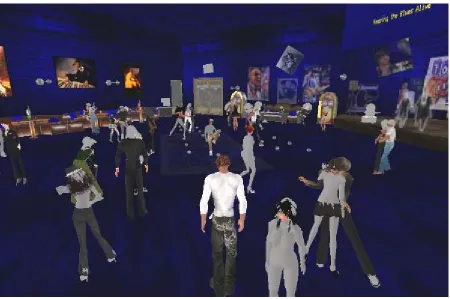
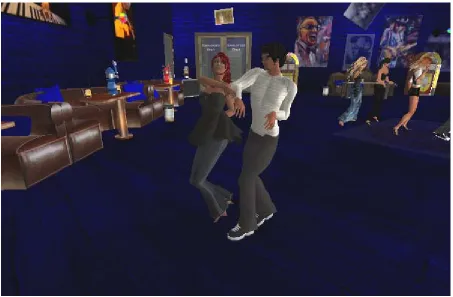
individuals come to SL and interact with one another, they negotiate each other and the virtual world through “taking on the role of the other” (Mead, 1934). Although Mead (1934) did not emphasize the role of a text (especially a virtual technological text) in experiencing one another, his theorizing of “taking on the role of the other” is pertinent, especially with regard to virtual communication (p. 254). Since users of SL and other online worlds identify with one another and form communities, “taking on the role of the other” allows the individual to develop a sense of self, context, and others by anticipating other’s responses and cooperating in social activity. In particular, as an individual comes to the online world of SL, he or she learns, through interaction and reaction, how to function as a member of the community. In the dance setting, for example, this would resemble making sense of the space and the various practices such as dancing, browsing, and lounging that occur within. As the individual interacts with the other in the online world, he or she learns the social activities and, through continued involvement, becomes a member of the community. Thus, interacting with others and cooperating in social activities online, allows structure to be produced and reproduced.
Furthermore, ST aids in understanding “taking on the role of the other” as humans interact with one another and generate social reality through an essential duality of
individuals, Giddens (1984) emphasizes human agency (i.e. action) in coordinating structure for daily life. As competent social agents, people actively interact with one another in order to make sense of their world. In particular, agents actively select and enact practices that make sense in working toward a shared purpose in their daily interactions through the use of rules and resources (Giddens, 1984; see also Nelson Marsh, 2006; Poole & McPhee, 2005; Weick, 1995).
Rules, according to Giddens (1984), are the formulas for action invoked in the course of day-to-day activities that structure the happenings of everyday life. Rules can be informal (i.e. rules of turn-taking in conversation) and formalized (i.e. codified laws), as well as tacit (i.e. letting the other person speak before you interrupt) and discursive (i.e. intricately established with a clear threshold for what is and is not acceptable, such as laws). Rules, are not, however, formalized prescriptions for routines in action, like those of a game (Giddens, 1984). Rather, the more a person acts according to these socially constructed rules, the more socially accepted the rules become. As these rules become increasingly accepted and generalized, we become less aware of them. Eventually rules become so deeply embedded in everyday interaction that we no longer recognize how to interpret the rules that guide our practices (Nelson Marsh, 2006). Ultimately, rules become part of our practical knowledge of how to perform in various situations through this process. Thus, rules imply “methodical procedures” of social interaction whereby agents collectively constitute shared meaning and sanction modes of social conduct (Giddens, 1984, p. 18).
are, therefore, “allocative” or tangible (e.g. physical objects and possessions) and “authoritative” or intangible (e.g. talents, abilities, and knowledge) elements that are incorporated into the production and reproduction of social practices such that structures become realized in action (Giddens, 1984). Take, for example, a typical classroom setting with students and an instructor. The students “know how” to enlist the capabilities of the classroom by sitting down at their desks facing the instructor with a pen and notebook, ready to take notes from the whiteboard (allocative resources and rules). The students and instructor also “know how” to interact with one another to perform the mundane routines of the class based on the constructed meaning of a class/seminar/lecture (authoritative resources and rules). Thus, the socially constructed and deeply understood rules guide how to enact the resources available to actors in such a way that patterns of interaction become manifest as participants coordinate and work toward a common purpose. Once established, understood, accepted, and generalized, the patterns become structured in such a way so as to be discernibly similar across time and space, allowing structure to be produced and reproduced in action (Giddens, 1984; Nelson Marsh, 2006; Poole & McPhee, 2005; Weick, 1995).
Over time, the “routinization” or “standardization” of these practices allows for rules that both clarify and establish the functional elements of the structure, thereby affording “virtual order” in new locations (Nelson Marsh, 2006, p. 13; see also Giddens, 1984; Poole & McPhee, 2005). As human agents in new locales engage in these
practices, they interpret and perform them in their daily lives, making manifest the “virtual order” (Nelson Marsh, 2006). It is in this process of interpretation and
across time and space (Giddens, 1984; Nelson Marsh, 2006; Poole & McPhee, 2005). This is the duality of structure and action as detailed by Giddens and it is the “main grounding of continuities in social reproduction across time-space” (1984, pp. 26-27).
Similarly, “taking the role of the other” and cultural performances also play an important role in the sensemaking and routinization of human action. Drawn primarily from the work of American anthropologist Clifford Geertz, cultural performances are said to play a pivotal role in how individuals come to make sense of their surroundings and, ultimately, how they become socialized into the world. In line with Giddens, Geertz states that, “man [sic] is an animal suspended in webs of significance he himself has spun” (1973, p. 5). Or, more simply, humans produce the structure of significance through which they comprehend the world. This, of course, details the depth of human interaction in culture and systems of knowledge as a symbolic process, but, like Giddens’ work, falls short of conceptualizing communication as the symbolic process through which interaction occurs and by which knowledge is produced and reproduced.
Therefore, in combining the work of Giddens and Geertz, I, like other scholars (Jackson, 1996; Nelson Marsh, 2006), argue that communication is the generative process through which structure emerges in practice and is re-constructed.
Giddens, individuals act as the agents through which a structure is created, understood, and reproduced. Yet, expanding beyond Geertz, Pacanowsky and O’Donnell-Trujillo (1983) conceptualize culture as a communicative process through the actions and
practices that members constitute. These actions, however, are not simply understood in a vacuum; rather, these communicative actions are revealed to the people who use them and those around them. Ultimately, this continual process illuminates the structure of the system and allows it to function within conventionally accepted practices.
Understood this way, communication is both a process of creation and
sensemaking. While ST details the organizational elements of a structure, the cultural approach explicates the depth of communication behind the structure. Therefore, a
blended approach that unites these two theoretical frames focuses attention to the ongoing process of structure through communication, especially at a distance.
Utilizing a Blended Approach for Understanding
Although these theories are typically used to detail communication as directly observed, applying them to virtual communication deepens our understanding of the dynamic and intersubjective processes afforded in absent presence. Instead of assuming that a definitive presence exists that shapes the structure and culture of a group, absent presence through a text demonstrates new avenues for ontologizing what virtual communication is and is not. It is here that we can begin to understand how virtual organizations remain stable across new contexts.
manner of engagement with it can be expounded to include multiple interpretations brought to bear in a diverse site. Moreover, because interpretation via a text acts as a central focus of virtual communication, ontologizing moves beyond a materialist realm of effectiveness and cause and effect (Anderson, 1996). Emerging communication
technologies, like Second Life (SL), instead refocus our attention to the perpetual absent presence of others and how interpretations shape virtual structures.
When problematized through knowledge about virtual communication, any site can be seen through its various extensions that allow it to function, especially virtually. For example, virtual organizations that have no physical location, like SL, still allow structure and, often, afford members increased elements of an organization that facilitate its processes (DeSanctis & Monge, 1999). The lack of a physical location, then, allows the individual to be an active agent in the construction and shaping of the world around him or her, thereby altering our notions about the nature of the individual through human action and communicative processes (Poster, 2007).
Additionally, the vested power placed in the individual under this
conceptualization also contests the authoritative meanings and power structures at play. Since each individual brings his or her own cultural performances to the site and mediates his or her actions through the text, he or she shapes the structure. Therefore, knowledge about the site and its functionality exists through “cultural memberships” that extend beyond what is seen and enacted in-world1
1
“In-world” is the term used by residents of Second Life to describe the online context of interaction. It can
through interpretation in action (Anderson, 1996; see also Giddens, 1984). Therefore, the meaning behind structure is localized, but abstracted beyond the particular collective site. As a result of these abstractions, how we come to know virtual communication is further problematized. If virtual communication exists only in absent presence, then it can only be understood through a technical artifact or a text by which interpretations can be derived. Yet, virtual communication is increasingly ubiquitous, and, to some extent, understood in the everyday life. For example, when one person converses with another on the phone or through an instant messenger, they are “presently absent” to one another (Gergen, 2002). What is not understood, however, is how this presence is understood to be an authentic re-presentation of the individual. Therefore, further research like that presented in this thesis, intends to explore how individuals are constituted in absence and how their actions and performances demonstrate their presence to others.
Furthermore, as an extension to the epistemology of virtual communication, the way we study virtual communication must also be problematized. While virtual
communication is not entirely new, as argued in this paper, the ways in which we study it require a nuanced approach. Instead of examining it from a purely standard ethnographic approach, this study endorses the redefining of ethnography as a methodology to include absent presence, mediating performances, and the fragmented self (Gergen, 2002;
Goffman, 1989; Pacanowsky & O’Donnell-Trujillo, 1983; Tracy & Tretheway, 2005). By including these rich elements, the relationship between theory and method and the
justified argument can be deeply rooted in communication and human action.
performances that create structure can be explored, contrasting the notion that structure exists solely through materiality. Ultimately, then, scholars can broaden their
understanding of both culture and structure to include how texts reproduce existing structures while producing new forms of order.
Similarly, through an understanding of communication in the virtual realm, the practice of virtual communication can be further theorized and modeled. As we come to understand the nature of virtual communication through practice, we can engage in meta-discourse about it. Eventually this will allow us to theorize, more clearly, what virtual communication is and how it occurs. By mapping the field, we can ultimately derive a deeper understanding of structure and ourselves. Therefore, I propose the following research questions in an attempt to further understand not only Second Life and virtual ethnography, but also virtual communication:
RQ1: In what ways do users of Second Life negotiate a virtual presence? RQ2: What does the practice of ethnography look like in virtual settings?
In examining what constitutes knowledge about communication above, I not only explored how communication occurs in the virtual context, I also explained the practices and performances that make it realized across time and space. To help develop
CHAPTER TWO: METHODS
Overview
In the previous section I provided a context for virtual communication,
particularly detailing how virtual communication is inherent in all communication that occurs over time and space. Furthermore, I explained how virtual communication
functions with technology by conceptualizing technology as a text of communication that is dispersed, interpreted, and understood in a context (Jackson, 1996). In discussing technology as a text of communication, I then described how all communication is “virtual” by virtue of a negotiated presence and socially accepted interactions that allow us to communicate and operate over time and space. Filtered through Mead’s (1934) “taking on the role of the other” and Structuration Theory, the previous section explained virtual communication with sensitivity to the technology of Second Life as an
organization full of cultural performances that are realized in interaction.
Based on the developments established in the previous section, I propose the following research questions to guide the analysis of this thesis:
RQ1: In what ways do users of Second Life negotiate a virtual presence? RQ2: What does the practice of ethnography look like in virtual settings?
in identity construction and management. At the same time, RQ1 led to findings that illuminated boundary negotiation between both online and offline contexts. In using ethnography in virtual space, RQ2, like RQ1, explicated how the methodology is nuanced as it is employed on online. This included, similar to RQ1, examining virtual
representation to detail how communication differs in new media and how the methods of data collection and analysis require a nuanced approach that emphasizes reflexivity and increased sensitivity toward those researched. Guided by these research questions, this chapter goes on to explain the context of the study, the methods for collection, and the methods of analysis performed during this study.
Second Life in Context
Second Life (SL) poses new possibilities for enhancing our understanding of virtual communication and emerging communication technologies. In particular, SL expands the realm of communication research by not only detailing the changing nature of communication technologies, but also explicating how such technologies function over time and space. Using the technology-context scheme proposed by Jackson (1996), this research in SL primarily explored how technology (as text) functions through its material components and through the social elements that drive interpretation. Shaped by these interpretations in diverse contexts, this study of SL also details how individual
Qualitative Methods: Ethnography of Communication
Ethnography has long been employed as a method of study for understanding diverse cultures in new or previously unknown locations. Derived primarily from anthropological studies, ethnography typically involved an outside entity observing a distant location and foreign culture (Goffman, 1989; Hine, 2000; LeCompte & Schensul, 1999). In its most historic from, ethnography was used to classify cultures through empirical investigations that occurred in the F2F setting (Deegan, 2001; Sanders, 1999; see also Lindlof & Taylor, 2002). Employing participant-observation, ethnographers interacted with their informants by conducting interviews, compiling statistics, and, at times, engaging in the activities of the culture being observed.
Contemporary studies that employ ethnography, however, have adapted the method by eschewing the “scientistic objectivity” of its previous incarnation for a more subjective voice (Sanders, 1999). Thus, contemporary ethnographic studies, while still employing participant observation, attempt to deepen understanding of cultural
When employed by communication scholars, ethnography is used to deepen our understanding of “other humans qua members of communication communities” (Mumby, 1997, p. 7). Thus, ethnography of communication (EOC) employs participant observation with the ultimate goal of enriching our understandings of the communicative practices that inform cultural members and shape their culture (Lindlof & Taylor, 2002). Emphasis is placed on the reception of messages and the resulting interpretations as activated in the continuous flow of communication of the culture (Lindlof & Taylor, 2002; Redding, 1972). Thus, while message exchange is important in understanding a culture, EOC emphasizes interpretation that constitutes social structure. This emphasis illuminates the relationship between symbolic practices and social structure by detailing how
communication allows the culture to function from moment-to-moment in varying contexts (Lindloff & Taylor, 2002; Mumby 1997).
Data Collection and Procedures
This section discusses how data was collected for this study. It includes gaining access into Second Life (SL), collecting both online and offline fieldnotes of human and nonhuman texts, collecting both online (virtual) and offline documents, and the
justification for conducting participant interviews.
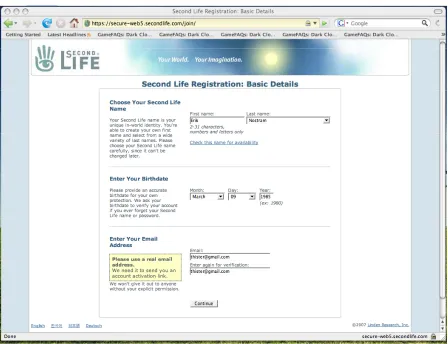
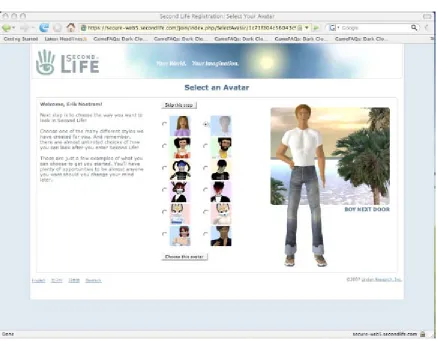
Linden Labs, the producer of SL, espouses an open policy for people who wish to take part in the virtual world of SL. Although some of the programs available to users are proprietary to Linden Labs, becoming a resident in SL is simply a matter of filling out electronic forms of personal identification, selecting a name and avatar as your presence in SL, and downloading and installing the necessary software. However, because SL is open to anyone of age who is interested in participating in the virtual world, it is a large research site to study. To manage this, I observed and took fieldnotes of the online interactions of one culture of people that I became a member of while within Second Life: “clubbers.” In particular, “clubbers” are users that attend dance clubs in SL to meet new people and listen to live music. These users typically engage in the dance club by animating their avatars through a dance sphere or personal animations that enlist their avatar to dance to the music or to quietly sit in a booth and observe others. Additionally, these users actively participate in local events within the space and, in some instances, actively welcome newcomers to the space.
Gaining Access
practices that allow individuals to communicate with one another virtually. While entering SL through signing up for a membership granted me access to these
performances and practices, becoming a part of this virtual world through engaging in communities and coming to know others afforded me the experience to learn, understand, and contextualize them. Although a neophyte to this virtual world, I engaged in the process of personal engagement, exploration, negotiation with others and
experimentation that all users do to become residents. As I became a part of this virtual world, understanding my presence within it and finding others with whom I could share in these experiences, I developed a sense for the social performances and practices that allow individuals to communicate with others at a distance.
Moreover, because I participated in SL before the beginning of this research project, I was able to negotiate access into some groups, like the “clubbing” scene, through residents with whom I had developed a rapport. This access afforded me insight into members’ interactions and both the formal and informal practices that allow people to operate within these groups and spaces. Additionally, through both snowball and convenience sampling, I developed rapport with other informants of the groups and spaces I attended, helping me further contextualize the rich practices in SL.
site. I observed and fieldnoted online interactions as they occurred within individual and group settings. Individual settings included virtually co-located discussions and
interviews in settings that participants felt most comfortable in such as virtual cafes, clubs, and my virtual apartment. Group settings included spaces where others freely interacted with others by their own volition while also discussing their experiences with me. For example, group settings included dance clubs and bars specifically when participants informed me about how to use objects within the space.
As part of the ongoing participant observation process, I primarily adopted the role of researcher, but as I developed a rapport with my participants, I also participated within the research with my participants. This included performances that were both appropriate and befitting of the group and/or space such as dancing, socializing at the bar, avatar modification, and, to a lesser extent, role-playing. Thus, I developed an evolving persona that: (1) achieved deep insight into identity management and organizational and relational processes through involvement and interaction, and (2) recognized the diverse voices and perspectives of the groups and/or spaces I was a part of as they ultimately spoke for the rich practices at work in this virtual world.
Other online data collected during the participant observation process included organizational documents, such as websites, and visual media such as digital
electronically saved and printed copies that were then kept in a secured file in the event that a dispute about authenticity arose.
Visual media including digital photographs were taken and documented with the consent of those being researched. Through the collection of digital photographs,
interactions and online practices were frequently detailed and contextualized alongside observations and fieldnotes, as noted in chapter three. Moreover, visual media allowed me verify my presence in the virtual world—my “being there”—by providing a visual artifact of my performances online.
Ultimately, through observing and participating in this virtual world, I was able to collect interviews, visual media, and fieldnotes that allowed me to make sense of the cultural performances and practices operating virtually. Although minimal due in part the time constraints for this study, I learned a great deal about these virtually (re)produced performances and practices. In-world involvement and interaction facilitated rich insights that allowed me to develop an understanding for the relational dynamics and social performances and practices of identity, identification, presence/representation, and agency that allowed me to contextualize and answer RQ1.
interviewed all of my informants in SL as if we were meeting F2F. Moreover, instead of questioning the representation before me, I accepted it as a distinct identity performance from which rich description and insights could be derived. Since I had come to know these people or met them through informants that I came to know well, I felt that they could speak for the social performances and practices that occurred in this virtual world. This not only allowed me to develop a rapport with my informants, which inevitably led to other informants, but also it allowed me to answer RQ2 by illustrating how many of the practices of ethnography can, in fact, be carried into virtual settings.
Again, although the dataset was limited by the number of interviews and by the time-constraints of finishing a thesis in a timely fashion, I believe the data derived from the current study was substantive as key elements of analysis were repeated and clarified in interaction. Of course, some elements of the practices in SL were not fully illuminated due to the time-constraints and data collection period. In such cases, the data was not used or only mentioned briefly in excerpts within chapter three with respect to my participants’ experiences. Furthermore, I contextualized the data that was analyzed and repeated in interviews through my personal observations and through visual media collection. Although not fully triangulated, the comparison of data in this cross-section proved substantive in that rich elements of analysis emerged across all three aspects of collection.
world of SL in an attempt to explore socialization in virtual settings; (b) identity
construction and negotiated presence; (c) similarity and difference in online and offline identification; and (d) personal histories, experiences, and perspectives of each
participant. Example questions included: “Explain how you became part of Second Life?”; “How long have you been a resident in Second Life?”; “Would you mind walking me through your arrival story?”; “How did you become familiar with the world after you arrived?”; “How did you construct your presence in this world?”; “Could you explain to me why you chose particular elements for your presence in this world?”; “In what ways have you altered your presence in this world?”; “How has your presence changed in light of the interactions and/or encounters you have had with others?”; “Could you explain to me the ways you let others get to know you?”; “In what ways is your presence in this world different from your offline presence?”; “How is your presence in this world similar to your offline presence?”; “Could you explain any elements of your offline presence that overlap with your presence in this world?”; “In what ways is Second Life liberating to you?”; “What are your thoughts on “The Big Six” guidelines that govern interaction in this world?”; and “In what ways do these guidelines affect you?”
Due to the setting of the research site and in conjunction with virtual ethnographic methods (See Boelstorff, 2008; Hine, 2000; Lindlof & Taylor, 2002), all interviews were digitally transcribed during interaction. These interviews were then downloaded into raw text documents that will be stored in password secured files on my laptop and my
external hard drive. To further verify the authenticity of each interview, a photograph and/or screenshot of the researcher and the participant was taken during the interview and complied with the transcribed interview. Participants were at liberty to answer any
questions they wanted. Also participants that wished to remain anonymous were coded with an additional pseudonym and concealed identity at their own discretion.
Data Analysis Methods
understanding of virtual worlds as spaces of negotiation between real-life and virtual-life. In particular, the intent behind these virtual ethnographic methods was to examine the ways in which users treat Second Life as both a virtual space and a real space, and also how they manage this tension through interaction and negotiation.
With substantial data collected and formed into an extensive set, I used a qualitative analysis program created by Dr. Sharlene Hesse-Biber, T. Scott Kinder, and Paul Dupuis, titled “HyperRESEARCH” to code the data with sensitivity to grounded theory. In particular, grounded theory that emphasizes discovery of emergent elements and theoretical development (Glaser & Strauss, 1967; Strauss & Corbin, 1990; see also Lindlof & Taylor, 2002). Therefore, analyzed data was first examined and coded for repetitions, metaphors and analogies, and theory-related material using word lists and key words in context (KWIC) in the attempt to develop categories that clarify the findings (Ryan & Bernard, 2003; Hsieh & Shannon, 2005). In particular, data was openly coded as “each incident compares to other incidents” (Lindlof & Taylor, 2002, p. 219), thereby developing clear categories while attempting to establish relationships among codes and categories. During this stage of the data analysis, categories were established and ascribed attributes that allowed them to be clarified and easily understood. Also during this process some categories were collapsed into other categories due to similar attributes noticed in incident comparison and frequency. Concurrently, data was also coded through
themes, categorizing them into more definitive categories. All coded data was filtered through a codebook, facilitated by HyperRESEARCH, that listed all categories, codes, annotations and examples of each category, and the a short description of the “decision rule” used to classify a code into a category (LeCompte & Schensul, 1999; Lindlof & Taylor, 2002).
Once emergent categories were developed, classified, and sorted in order of prevalence and prominence, I attempted to make connections between the categories through the processes of integration and dimensionalization (Strauss & Corbin, 1990; see also Lindlof & Taylor, 2002). This process emphasizes reshaping categories in an attempt to develop greater meanings for each category, as well as produce new categories or themes that span multiple categories. To accomplish this task, axial coding was used to explicate causal conditions, context, action and consequences (Strauss & Corbin, 1990; see also Lindlof & Taylor, 2002). Ultimately, axial coding was used in an attempt to unite previously separate categories in order to explicate the data in theoretically sound ways of knowing.
developed with sensitivity to the participants’ experiences and perspectives and then filtered through the theoretical framework previously discussed in chapter one.
Ultimately the data was reasonably developed to a point where overarching themes were developed in such a way that substantive claims, backed in the findings, were made with regard to communication research.
CHAPTER THREE: FINDINGS
How is it possible for individuals to come to know one another and organize when virtually distributed across vast spans of time and space? Research on virtual spaces tends to focus on communication technology (the Second Life software in this case) in one of two ways: virtual spaces are technologically determined (i.e. that is determined by the inherent material properties of the technology) (Fulk & Collins-Jarvis, 2001; Rice, Collins-Jarvis & Zydney-Walker, 1999) or socially determined (i.e. that technology use and the creation of virtual space is a social construction process) (DeSanctis & Monge, 1999; Walther, 1992). Recently, research has refocused the empirical lens upon the balance of both of these research perspectives in that both the material properties and the social construction process influence both the material and social elements in technology use (Crider & Ganesh, 2004; Jackson, 1996; Leonardi, Jackson & Nelson Marsh, 2004). In the case of Second Life (SL), this empirical balance contributes to an understanding of the construction of virtual organizational spaces by illuminating the active processes through which individuals experience the virtual setting and shape its organizational practices.
findings illustrate the claims made herein and urge for an empirically balanced approach that examines both the material and social elements in technology use.
An Overview of Themes
Entering and becoming a part of Second Life (SL), two disparate processes, engender intriguing results that helped contextualize both the social performances and practices and the manipulation of the technical artifact that allow individuals to operate within a shared virtual space. Through participant observations, fieldnotes and
interviews, a substantive dataset was formed. Through the lens of grounded theory, this dataset was soon analyzed using both open and in vivo coding. By focusing on keywords in context and then cross-referencing them to other components of the dataset, codes and categories became apparent. As the codes and categories became solidified,
contextualized across the dataset, themes emerged that illuminate the active processes at work within SL.
Two major themes developed during the analysis of data in this study. The first theme, “Virtual Incarnation,” became apparent through participant-observation
documented in fieldnotes and residents’ descriptions about the active process of identity negotiation in this virtual world. Beginning with an initial interest in SL, residents
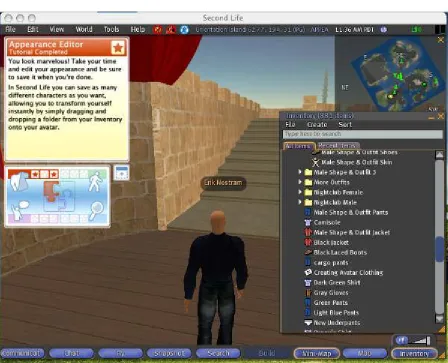
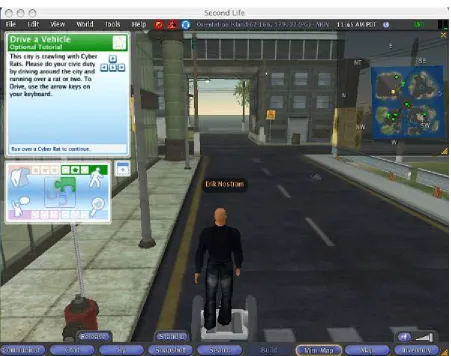
explained the process of visiting the official website (www.secondlife.com), downloading the software, entering the Grid for the first time, learning how to “get by” through
unique experiences, all of the residents described similar events affiliated with entering and becoming a part of the virtual world.
The second theme, “More than Meat and Bone and Coursing Hormones,” developed less transparently. Coupled with but separate from “Virtual Incarnation,” residents’ descriptions about in-world relationships revealed deeper elements of the organizational processes at work in SL, as well as intricate aspects behind the active process of identity negotiation. As residents shared experiences and mutually
self-disclosed to one another, they became closer in the form of community members, friends, family members and intimate couples. Residents’ descriptions of these increasingly intricate and involved aspects of identity negotiation further illuminated the emotional and intellectual connections that developed as residents began to renegotiate the
boundaries of their in-world relationships between one another and the repercussions they faced both in-world and in real life. Since each resident’s experiences occurred
differently with those they developed intimate relationships, each was considered in context and compared only through the intensity of emotion and connection forged in becoming intimate.
Virtual Incarnation
Unlike the F2F situation where an individual’s presence is immediately discerned in the “here and now” of his or her physical presence and taken for granted as an