Timon of Ashes (1-‐20)
Timon of Ashes
Joanna Grossman (Harvard University) 1
Abstract
In his Religio Medici, Sir Thomas Browne writes, “to call our selves a Microcosme, or little world, I thought it onely a pleasant trope of Rhetorick, till my neare judgment…told me there was a reall truth therein. For first we are a rude mass…next we live the life of plants, the life of animals, the life of men, and at last the life of spirits.” This blurring of the boundaries between life forms, coupled with a disavowal of the notion that humans exist apart from other life forms, is what I wish to explore in Shakespeare’s oft-‐overlooked tragedy, Timon of Athens. More specifically, this paper argues that, in terms of how Timon describes himself (or is described by others), we see a clear progression from man to beast to plant to dirt. One can also think of the protagonist as evolving from Homo sapiens to Homo ferus (or Homo sylvestris) and finally to Homo humus. I use the genus designation in jest but also somewhat ironically since the play abjures an anthropocentric view of the world and decenters the notion of the human. But if the play essentially reverses the type of sequence proposed by Browne, the reason behind this reversal is straightforward enough: Timon explicitly aims to position himself as “Misanthropos” (IV.iii.52). Yet hating mankind proves insufficient for Timon and his anger eventually leads to a rejection of the mammalian system as a whole.
Introduction
In his Religio Medici, Sir Thomas Browne writes, “to call our selves a Microcosme, or little world, I thought it onely a pleasant trope of Rhetorick, till my neare judgment…told me there was a reall truth therein. For first we are a rude mass…next we live the life of plants, the life of animals, the life of men, and at last the life of spirits” (Browne 66-‐7). This blurring of the
1 Joanna Grossman is a doctoral candidate in the Department of English at Harvard University
boundaries between life forms, coupled with a disavowal of the notion that humans exist apart from other life forms, is what I wish to explore in Shakespeare’s oft-‐overlooked tragedy, Timon of Athens.1 More specifically, this paper argues that, in terms of how Timon describes himself
(or is described by others), we see a clear progression from man to beast to plant to dirt. One can also think of the protagonist as evolving from Homo sapiens to Homo ferus (or Homo sylvestris) and finally to Homo humus. I use the genus designation in jest but also somewhat ironically since the play abjures an anthropocentric view of the world and decenters the notion of the human.2 But if the play essentially reverses the type of sequence proposed by Browne,
the reason behind this reversal is straightforward enough: Timon explicitly aims to position himself as “Misanthropos” (IV.iii.52).3 Yet hating mankind proves insufficient for Timon and his anger eventually leads to a rejection of the mammalian system as a whole.
Given the play’s intensely misanthropic outlook and the contempt for authority that pervades the text, Timon may well be Shakespeare’s most radical work. Indeed, this essay posits that the events that unfold largely stem from a relatively simple premise: humans are wretched creatures, and as a consequence, should be toppled from their seemingly comfortable and secure place at the top of the existential hierarchy. In order to illustrate the mechanisms behind this premise, I examine the startling ways in which Timon inverts hierarchical orderings of creation – namely the scala naturae or the Great Chain of Being, which was integral to the Elizabethan understanding of the world.4 Initially, animals and plants appear as life forms possibly worth emulating in order to achieve a kind of utopian ideal. However, as the action progresses, the soil and rocks themselves become the logical extension of a desire to remove man from the pinnacle of earthly creation.
Put differently, Timon vehemently champions the argument that if one accepts that humans are flawed by nature (a pessimistic outlook to be sure, but one that is difficult to dispute), then the scala naturae should be turned upside down. Moreover, this very inversion sheds light on the significance behind the play’s curious emphasis on “roots” throughout the discourse. Citing Plato’s claim in the Timaeus that humans “are a plant not of an earthly but of a heavenly growth” with roots suspended above in the “place where the generation of the soul first began”, Michael Marder persuasively argues that Western metaphysics commences “with the inversion of the earthly perspective of the plant, [and] a deracination of human beings from their material foundations” (Jowett 777; Marder 471). For Plato, Aristotle, and many who followed, it mattered not that dirt is a nourishing substance; the idea that the further our distance from the ground, the better, became firmly entrenched. Timon renounces this view not merely through Shakespeare’s careful and deliberate portrayal of the title character’s evolution, but by creating a world where sensation is downplayed in favor of achieving an eternal form of existence, in this case by entering into the “life cycle” of geologic strata.
organisms. As I hope to establish, a modern vision of materiality comes to the forefront, presenting a stark contrast to the deeply held religious views of the day (e.g., Timon offers a reverse biblical allegory). In flipping the ladder upside down, Shakespeare entices his reader to confront inherent weaknesses in human and animal biology, and ultimately to question why man cannot seek a better model from the lowly ground upon which he treads.
Before delving into the text, I would be remiss not to mention Frederick Waage’s “Shakespeare Unearth’d” considering how few scholarly works have explicitly scrutinized Timon’s relationship to the earth and dirt. Waage rightly notes that Timon is “the Shakespearean protagonist who gets closest to the earth” (Waage 158). However, his broader claim regarding the character’s development does not go far enough: “His flight from Athens could be experienced in one sense as an anti-‐pastoral return…to the land…[and] inside the earth – in a cave lacking the amenities of Belarius’ cave in Cymbeline or Friar Lawrence’s cell in Romeo and Juliet. Living there, Timon has put himself on the lowest rung of the economic ladder” (Waage 158). These are fair points, but Waage unknowingly arrives at the heart of the matter in the phrase “inside the earth.” After all, the cave in question is not the stopping point; rather, as I hope to illustrate, the play is driving towards Timon’s return to the earth in the form of the dust or ashes that compose the earth’s strata. Moreover, Timon does not “put himself” merely on the “lowest rung of the economic ladder”; his actions are more ambitious in scope (i.e., not limited to the Athenian socio-‐political realm) as he shifts his existence onto the lowest rung of the entire ladder of being.
Omnis ars imitatio est naturae
: What
Timon’s
art says about man
Timon opens with a conversation between a poet and a painter, both of whom are eager to secure Timon’s patronage by creating works of art that highlight his positive attributes. But their obvious tendency towards flattery is perhaps not as problematic as their view of the relationship between art and nature. Of the painter’s portrait, the poet remarks that “it tutors nature” and is “livelier than life” (I.i.37-‐8).5 To be sure, paintings can certainly be realistic and
splendid works of art, but it seems doubtful that a two-‐dimensional depiction could appear truer or “livelier to life” than the actual three-‐dimensional object or person. And yet – as Nietzsche and Wittgenstein famously suggest – we know that what exists in reality (e.g., a brown decaying leaf hanging on a branch) might not appear as genuine and expressive to the human mind as the abstract symbols and imagined mental pictures we regularly create (and which arguably help to construct and impart meaning).
is likened to a fire that grows from a flint’s spark (I.i.22). In a sense, such comparisons make the “tutors nature”/“livelier than life” remarks appear all the more ironic considering that early modern depictions of plants and geological formations were usually little more than “stylized representations” and formal “decorative motifs” rather than naturalistic representations of the thing itself (Shirley 162-‐4; Capra 177).6
But once Timon arrives on the scene, he provides a curious assessment of the painting that aptly solves the paradox of how a flat image can truly capture the essence of man: “The painting is almost the natural man / for since dishonor traffics with man’s nature, / he is but outside; these penciled figures are / even such as they give out” (I.i.161-‐4). Timon’s remark that humans are inherently superficial seems wholly out-‐of-‐place since he ostensibly believes in the inherent goodness of man and assumes everyone is as generous as he is (I.ii.95). But here we have an early indication that, on some level, Timon realizes that man is hollow at the core with no real substance to be grasped. At a minimum, Timon’s observation offers one possible solution to the dilemma that artists, critics, and philosophers have grappled with for millennia – sometimes the artifice is what is most real.7
Nature’s Bounty
On the most fundamental level, Timon is a play centered on the problem of being too bountiful (i.e., bounty as in a rich harvest) and, more specifically, what happens when the bounty runs dry. That “bounty” and variants of the word (e.g., “bounteous”, “bountiful”, “bountifully”, and “bounties”) are repeated ad nauseam throughout the play should come as no surprise since the title character is a bottomless well of resources. The precise nature of these resources is worth noting since they fall into a handful of categories: minerals/gemstones, rocks, food, drink, metals (e.g., “jewels”, “stones”, “meat”, “wine”, “gold”, money/coins, respectively). One might wish to add water to the list since, as Apemantus points out, Timon “weep[s] to make [men] drink” (I.ii.101). Evidently, there is no part of Timon that the flatterers around him will not eagerly devour.
The Athenian Lord’s comment captures the exploitative mentality that pervades the play. But the intense interest in Timon’s resources hardly seems far removed from the common or default attitude towards all that the natural world supposedly has to offer. Though the exploitation of natural resources (as a condition of human existence) is not unique to any one society or age, it is worth noting that Elizabethan and Jacobean era writings on the flora, fauna, and geology of a given locale (e.g., the wildly popular herbals or tracts about the New World) emphasized the value of plants, minerals, and animals as commodities and/or as objects meant to abet mankind (Armstrong 85; Shirley 134). Although I do not mean to suggest that Timon’s attitude is radically different than that of the other characters (he too enjoys hunting and gemstones), even at an early stage, he believes that society operates according to a sustainable model – a closed-‐circuit economy where goods and resources are continuously transferred among all parties (and where resources never run out).
Man’s Best Friend(s): A Cynical View of Social Bonds
The infamous dinner party where Timon serves boiling water with rocks marks Timon’s descent into a rage-‐filled madness that is brought on by the loss of his fortune and the fact that his friends abandon him in his hour of need. Once Timon realizes that his creditors are not going to stop demanding that he repay the money that he borrowed, he implores them to “cut my heart in sums…tell out my blood…five thousand drops pays that” (III.iv.90-‐4).8 This seemingly
hyperbolic image of blood being counted drop by drop and a body torn apart is perhaps not so far removed (and indeed foreshadows) the fragmentation and degeneration that will occur in terms of how Timon regards his own body. Of course, Timon’s statement also underscores the unfortunate reality that Apemantus discerns from the very beginning: The flatterers are nothing more than scavengers and parasites (“what a number of men eats Timon” (I.ii.37)). Indeed, in Apemantus’ eyes, the relationship between Timon and the men who flatter him is perhaps best characterized as an outright predator/prey dynamic: “It grieves me to see so many dip their meat in one man’s blood” (I.ii.39)
broader perspective, dogs, like humans, are intensely social creatures who prefer to live in groups and (like humans again) possess a keen awareness of hierarchical structures. But hierarchy need not be limited to the level of the canine’s pack; Thomas explains that dogs also “differed in status [as] their owners did” (Thomas 106).10
Given that canines represent hierarchy, the dog imagery (and the specific use of “dog” as an insult) fits extremely well in a play where the protagonist eventually rails against the social aspects of mankind. When Timon says, “henceforth hated be / of Timon man and all humanity!” (III.vii.96-‐7), the distinction between “man” and “humanity” might seem unnecessary. However, one way to interpret Timon’s proclamation would be that the former stands for what we now would term the biological classification (Homo sapiens), while “humanity” encompasses a broader notion involving civilization and society. After all, unlike “man”, humanity can signify all of the graces that supposedly compose our better nature. But it is precisely those positive qualities and customs (which allow society to function) that Timon wholeheartedly rejects. Francois Laroque notes that Timon “renounces festivity” when faced with the “harsh truth”, but his antipathy towards society extends far beyond social gatherings (Laroque 261): “Piety and fear, / religion to the gods, peace, justice, truth, / domestic awe, night rest, and neighborhood, / instruction, manners, mysteries, and trades, / degrees, observances, customs, and laws / decline to your confounding contraries, / and let confusion live!” (IV.i.15-‐21).
Sexual Reproduction vs. Spontaneous Generation
Aside from social customs, the other major aspect of human life that Timon comes to despise is sexuality. Timon, of course, does not deal with the realm of romance and love, but rather focuses on the seedy underbelly of human sexuality. To say that the protagonist seems fixated on sex would be quite the understatement. One of the most interesting examples is the ostensibly unnecessary exchange between Timon and two prostitutes. The scene serves no clear purpose other than to allow Timon to attack individuals who, on account of their profession, function as symbols of sex and lust. Accordingly, Timon is, at times, shockingly frank with his insults. He refers disparagingly to ejaculation (IV.iii.272), and tells the prostitutes to “hold up, you sluts, your aprons mountant” (IV.iii.134) (with an obvious pun on sexual mounting). When Timon wishes that the prostitutes’ “activity may defeat and quell / the source of all erection” (IV.iii.162-‐3), he is referring not just to sexual erection, but to advancement in the social hierarchy.
For a self-‐proclaimed misanthrope, ridiculing the very act (i.e., sexual intercourse) that is central to human biology and fuels the propagation of the species makes perfect sense. Once Timon adopts his new persona – announcing, “I am Misanthropos, and hate mankind” (IV.iii.52) – there is no ambiguity about his position. The only uncertainty is whether he can find a viable alternative to mankind. Initially, Timon looks to the animal kingdom for comfort: “For thy part, I do wish thou wert a dog / that I might love thee something” (IV.iii.53-‐4). He firmly believes that in the woods, “he shall find / the unkindest beast more kinder than mankind”, thus allowing “his hate [to] grow” (IV.i.35-‐40). And yet the language of human sexuality proves difficult to relinquish entirely. After Timon escapes to the forest, he speaks of the earth as our “common mother” whose “womb unmeasurable and infinite breast teems…all” (IV.iii.178-‐9). Timon further asks: “from forth thy plenteous bosom, one poor root. / Ensear thy fertile and conceptious womb; / let it no more bring out ingrateful man. / Go great with tigers, dragons, wolves, and bears; / teem with new monsters” (IV.iii.186-‐90). On the one hand, Timon adheres to the “early modern topos of earth as sentient and nurturing mother” (McColley 51). His focus on wombs and breasts arguably indicates that, at least at this early stage of the transition from aristocratic society to a world of isolation in the woods, Timon cannot avoid thinking in terms of mammalian reproduction. And yet – as the image of a dried up womb suggests – his statements reveal that a new mindset is, in fact, taking “root” (as evidenced in part by his simple request that the earth grant him “one poor root”).
the hierarchy. This desire for creatures to emerge or sprout from the soil is a reference to spontaneous generation – the idea that life can “arise within inanimate material by a completely natural process, one that recurs whenever conditions are right” (Harris 2). With a certain reverence Timon says, “O blessed breeding sun, draw from the earth / rotten humidity” (IV.iii.1-‐2). Indeed, Timon seems quite taken with this form of reproduction/genesis precisely because it conveniently omits human interference. What is more, spontaneous reproduction ensures that animals will lack kinship ties. In his History of Animals, Aristotle explains that some creatures “spring from parent animals according to their kind, whilst others grow spontaneously and not from kindred stock” (Book V). Centuries later, William Harvey in his De generatione animalium revisits the same theme, writing “even the creatures that arise spontaneously are called automatic, not because they spring from putrefaction, but because they have their origin from accident, the spontaneous act of nature…proceeding from parents unlike themselves” (Harvey 170).11 Later in the text, Harvey provides a more in-‐depth account of what it means for life to arise spontaneously (while citing Aristotle):
Another class of animals has a generative fluid fortuitously, as it were, and
without any distinction of sex; the origin of such animals is spontaneous…and as
the more excellent and varied and curious works of art require a greater variety in the form and size of the tools to bring them to perfection, inasmuch as a greater number of motions and a larger amount of subordinate means are
required to bring more worthy labours to a successful issue – art imitating nature here as everywhere else, so also does nature make use of a larger number and variety of forced and instruments as necessary to the procreation of the more perfect animals. For the sun, or Heaven, or whatever name is used to designate that which is understood as the common generator or parent of all animated things, engenders some of themselves, by accident, without an instrument, as it were. [emphasis added] (Harvey 308)
The Great Chain of Being
In his opening soliloquy upon emerging naked from his cave (clothes would naturally serve as a reminder of the civilized world), Timon repeats the word “nature” several times before apostrophizing the planet, stating “Earth, yield me roots” (IV.iii.23). Essentially, from the moment Timon steps foot in his new milieu, Shakespeare emphasizes the power of the sun and soil as the driving forces behind life. If the rhetoric pertaining to the sun’s power seems reminiscent of photosynthesis to modern readers, it is likely because Timon proceeds to repeat the word “root” numerous times. The stage directions routinely indicate that Timon is digging in the dirt and, not surprisingly, he keeps turning up roots (“O, a root!” (IV.iii.193)). As the word “root” appears with greater frequency in the discourse, the focus on animals dissipates. I would suggest that Timon keeps dwelling on roots precisely because this is the part of the plant that is found in the dirt. In other words, it is as if Timon were trying to reach into the soil – not necessarily because of a death drive towards self-‐destruction, but because Timon’s character is moving towards a recognition of that which he always was: the medium that yields resources to humans. Thus, the initially well-‐off Timon comes to represent metaphorically the earth that is rich in natural reserves (and once again becomes “full of gold” (V.i.iv)).
Timon’s newfound obsession with roots coincides with the arrival of his old acquaintance, Apemantus. As with other ambiguous characters in Shakespeare’s plays (e.g., Autolycus in The Winter’s Tale), Apemantus’ role is never entirely clear. Is he Timon’s foil or possibly even his foe? Is he his friend? Or is Apemantus best understood as a kind of teacher? Certainly not all of these categories are mutually exclusive, but there is something to be said for the notion that Apemantus is guiding Timon towards a new sense of his place in the world and serves as a catalyst for a kind of metamorphosis or progression. Early in the play, Apemantus makes a curious remark that links reproduction with degeneration: “the strain of man’s bred out into baboon and monkey” (I.i.251). The idea that man can devolve into lower life forms – or at a minimum that man’s place in the hierarchy is not static – sheds light on Apemantus’ commentary once he meets Timon in the forest.12 When Apemantus first appears, he asks
Timon pointedly, “will these mossed trees / that have outlived the eagle page thy heels / and skip when thou point’st out? Will the cold brook / candied with ice, caudle thy morning taste / to cure thy overnight’s surfeit?” (IV.iii.223-‐7). In essence, Apemantus informs Timon – in no uncertain terms – that the natural world does not exist to do his bidding.
newfound recognition of himself as a tree engenders a complete rejection of the mammalian class:
What wouldst thou do with the world, Apemantus, if it lay in thy
power?...Wouldst thou have thyself fall in the confusion of men and remain a beast with the beasts?...A beastly ambition…if thou wert the lion, the fox would beguile thee. If thou wert the lamb, the fox would eat thee. If thou wert the fox, the lion would suspect thee when peradventure thou wert accused by the ass. If thou wert the ass, thy dullness would torment thee and still though lived’st but as a breakfast to the wolf…wert thou the unicorn, pride and wrath would found thee…wert thou a bear, thou wouldst be killed by the horse. Wert thou a horse, thou wouldst be seized by the leopard. Wert thou a leopard, thou were german to the lion, and the posts of thy kindred were jurors on thy life…what beast couldst thou be that were not subject to a beast? (IV.iii.319-‐38)
Timon effectively underscores the inherent aggression and hostility that seems to plague many of the creatures with which we are most familiar. Moreover, Timon’s rant encourages his audience to conceive of these various mammals not as distinct creatures, but rather as organisms that are ultimately all related (“german”) to one another. Timon essentially lumps them all into one group, deciding that beasts are also worthy of being despised. Amusingly enough, not even the legendary unicorn – which symbolized chastity and was frequently depicted in medieval and Renaissance art laying its head on the Virgin Mary’s lap – is good enough for Timon (Grössinger 82). In this epiphanic moment, Timon realizes that the animal kingdom – replete with violence and treachery – is not so different from the world to which he used to belong. Roberts writes that this denunciation of the animals “ties the tone of
Coriolanus to that of Timon” because both rely on conventional metaphors to attack mobs (Shakespearean Wild 93). Although Timon certainly despises “throngs of men” (IV.iii.21), his diatribe is not truly against a mob mentality; Timon’s hatred is so profound that it operates at the individual level: Any one person or beast – acting completely alone and independently – is worthy of hate.
The View from the Ground
When Apemantus says to Timon, “the middle of humanity thou never knewest, but the extremity of both ends” (IV.iii.300), he seems to be urging Timon to speed along towards his eventual destination – whatever this “extremity” may be. Indeed, Timon thinks of himself only briefly as a stately tall tree for he is far more interested in casting his eyes downward, telling the thieves he encounters in the forest, “behold, the earth hath roots / within this mile breaks forth a hundred springs…each bush lays her full mess before you” (IV.iii.410-‐4). To the poet and painter he asks, “how shall I requite you / can you eat roots and drink cold water?” (V.i.71-‐2). It is not entirely clear that Timon is being ironic when he tries to chase away Apemantus by throwing rocks at him, saying, “I am sorry I shall lose a stone by thee” (IV.iii.363). At this point, Timon’s chief (if not only) comfort undoubtedly lies in the caves, forest, and ground – in short, the space apart from civilization.14 He misses no opportunity to insult the visitors who come to
disturb his peace of mind. When the thieves tell Timon they “cannot live on grass, on berries, [and] water”, Timon sarcastically replies, “you must eat men” (IV.iii.410).15
Timon is certainly not the first time Shakespeare has shown a curious fondness for these particular mineral substances – perhaps “fondness” is too strong a word, but there is precedent for characters finding comfort in the unlikeliest of places (granting new meaning to the idiom “between a rock and a hard place”):
Titus: Therefore I tell my sorrows to the stones; Who, though they cannot answer my distress, Yet in some sort they are better than the tribunes, For that they will not intercept my tale:
Receive my tears and seem to weep with me; And, were they but attired in grave weeds, Rome could afford no tribune like to these.
A stone is soft as wax, tribunes more hard than stones; A stone is silent, and offendeth not,
And tribunes with their tongues doom men to death. (III.i.36-‐46)
From a thematic perspective, Titus’ lines – which he utters after two of his sons have been captured and accused of murdering Bassianus – reveal at least one crucial similarity between the two tragedies: the treatment that one can expect to receive at the hands of his fellow man is harsh and unforgiving. In that sense, the literal hardness of stones cannot compare to the metaphorical hardness in a man’s heart and to those “hard fate[s]” (as Alcibiades complains) that men inflict on their own kind (III.vi.73).
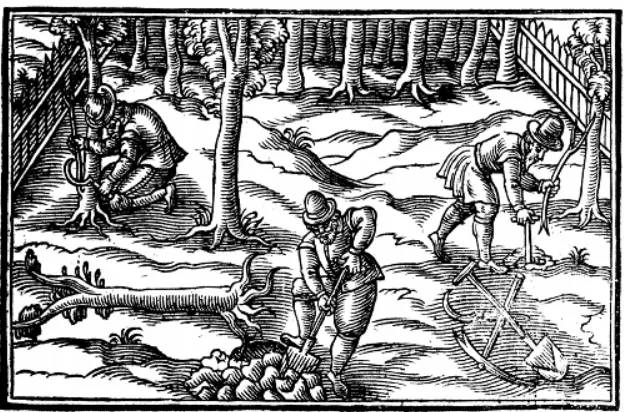
If anthropocentrism is understood to involve the exploitation of resources (as Bruce Boehrer contends), then I would argue that Timon’s concern over losing a stone corresponds to his attitude about the gold that he discovers in the forest (Boehrer 6).16 For Timon’s transformation to be complete, it is essential that he should refuse this “gift” from the earth. The precious metal presents a golden opportunity for Timon to return to his former life in glory. Importantly, however, Timon can no longer comprehend gold as a resource to be used.17 Indeed, he appears unable to conceive of virtually anything as an exploitable resource and has no desire to mold the surrounding environment to suit his whims (Fig. 3).
As the lines about grass, berries, water, roots, bushes, etc. indicate, Timon does not consider his life in the forest to be somehow lacking. In this sense, and despite being a deeply pessimistic tragedy, Timon creates a “green world” that is distinct from the nightmarish landscapes of Titus Andronicus and King Lear. If Lear’s heath, for example, constitutes a place of “fear and trembling”, can the same truly be said of Timon’s cave in the woods (Borlik 1)? As with Shakespeare’s green world comedies, visitors keep popping in and out (e.g., Alcibiades enters with two prostitutes by his side), often simply to converse with Timon. Although it may be true, as Richard Marienstras claims, that the woods in Timon are “topographically ill-‐ defined” (and a sense of disorientation can induce fear), this does not automatically imply that the forest is by nature “abstract” (Marienstras 15).18 The perceived lack of detail concerning
Timon’s physical surroundings is largely a product of the play’s fascination with the ground itself. Shakespeare constantly directs our eyes downward and it is at this lower level or plane where his protagonist chooses to stay.
Figure 3. A depiction of men using natural resources from the frontispiece to A New Orchard
and Garden (1623). (Note that the fence is a product of the woods being contained/tamed.)
Death, Decay, and Becoming One with the Earth
The final stage of Timon’s (or indeed anyone’s) existence is death. Timon ends somewhat mysteriously since, unlike other tragedies where the audience beholds the corpse of the slain title character, we never see Timon’s body. His “demise” raises more questions than it answers: is Timon dead? If so, who buried him? Did he procure his gravestone beforehand? Or did Timon escape? Even the title – “The Life of Timon” – suggests something uplifting, as though the tears that Neptune sheds on the plot of dirt that marks his grave could in fact reanimate Timon so he could rise from the soil (V.v.87). But even if one accepts that Timon is in fact buried underground, his decision to pass into oblivion does not, I would argue, support Jonathan Bate’s estimation of the play as being about “the freedom to choose pain, to choose death, [and] to seek another world of whose existence we have no sure knowledge” (Bate 177). If anything, Timon’s actions (post-‐financial ruin) are motivated by the desire to escape the pain that he feels most acutely when dealing with other human beings (who, incidentally, regard him like prey or a piece of meat).
As for the issue of entering into another existence of which he has no knowledge, Timon’s unsentimental view of death and decay suggests a certain expectation or sense of what lies on the other side of life. One of the more noteworthy aspects of Timon’s death is that the audience is explicitly informed on several occasions that Timon is entombed by the edge of the sea:
Thy gravestone daily. (IV.iii.370-‐2)
Soldier: My noble general, Timon is dead;
Entombed upon the very hem o’th’ sea. (V.i.66-‐7)
Timon: Timon hath made his everlasting mansion Upon the beached verge of the salt flood;
Who once a day with his embossed froth The turbulent surge shall cover. (V.ii.100-‐3)
This detail may seem trivial, but its curious inclusion (especially since Timon has heretofore been associated with the woods and caves) calls attention to the fact that Timon’s resting place ensures that his body will be subjected to constant erosion. Ultimately, retreating into a cave was not enough; in Timon’s ideal vision, he becomes part of the geologic strata as his body enters into the “life cycle” of dirt and rocks. Interestingly enough, Timon’s various references to salt (“salt hours” (IV.iii.85), “salt tears” (IV.iii.433), “salt flood” (V.ii.101)) take on an added significance at this point given that salt is the ash-‐like precipitate that remains after water evaporates – a more extreme version of the rocks in water that Timon served at his banquet. Salt, of course, can extend the shelf life of something – in essence, keeping an object frozen in a state immune to decay, but this mineral also kills vitality as we know it. A worm or slug will instantly shrivel up and die if subjected to an onslaught of this compound; and while salt, as a seasoning, is a welcome addition at the dinner table, human (or indeed animal) wounds and sores become infinitely more painful upon exposure to this crystalline deposit.
When Timon announces that he is writing his epitaph (and is presumably preparing to depart from the world), he admits “but yet I love my country” (V.ii.76). Considering Timon’s hatred for civilization (which has in no way abated), the most straightforward meaning would seem to be that Timon is simply espousing his love for the very land and countryside that has become his true home and refuge. It seems logical, then, that his epitaph should specifically indicate that Timon does not want feet trampling over the dirt (V.v.78). After all, if his body does in fact lie in that plot of ground, then his decaying corpse literally becomes part of the soil – an idea that Shakespeare uses to great effect in Hamlet. The “extremity”, then, that Apemantus spoke of is arguably the extreme materiality of the self. In other words, Timon is not thinking of a potential afterlife in terms of his soul leaving his earthly body behind; instead, he remains focused on the earth as the site of himself (i.e., his “self”) even in death.
Timon and Christianity
dozen or so words. Timon of Athens, however, expands the idea that Hamlet touches upon into a full-‐length play, thereby allowing the reader to perceive this implied metamorphosis at every step of the way. Andreas Höfele notes that “Hamlet’s investment in human dust is a far cry from the lofty Christian disdain for the vanity of earthly excellence” (Höfele 165).19 Without
question, Timon reveals a similar position, but Shakespeare seems intent on taking this idea to its logical extreme. Though Hamlet ultimately cannot shake off his “nauseated vision of universal cannibalism”, such anxieties are noticeably absent from Timon (Höfele 165).20 The
reason for this fundamental difference seems to be that Timon’s existence becomes entirely defined by place; he is rooted to the earth in a way that characters like Hamlet are not. The result is that Timon puts forth what we might consider a more modern view of death insofar as the play presents a stark departure from “medieval Christian thinkers [who] considered human beings as merely visitors here on earth, as essentially spirits without place” (Hiltner 4).
Regarding the play’s relationship to Christianity, numerous scholars have noted that Timon’s infamous banquet – where Apemantus laments that “so many dip their meat in one man’s blood” (I.ii.39) – is meant to evoke the Last Supper, and Matthew 26:23 in particular: “He that dippeth his hand with me in the dish, he shal betraye me” (Holdsworth 190). But the implication, as some have argued, that Timon is therefore a Christ-‐like figure who is similarly betrayed by his followers is, in my view, a bit heavy-‐handed. According to Julia Reinhard Lupton, “like Jesus, Timon finds himself abandoned by those he would redeem” (Lupton 144). Alison Scott compares Jesus’ “feeding of the multitude” to Timon’s gift giving, while G. Wilson Knight offers the most glowing praise of all: “Timon is the totality of all, his love more rich and oceanic than all of theirs, all lift their lonely voices in his universal curse. Christ-‐like, he suffers that their pain may cease, and leaves the Shakespearean universe redeemed” (Scott 238; Knight 236).
The flatterers who reject Timon, however, are just that – flatterers and gadflies, not apostles or adherents. Moreover, the play as a whole makes it clear that these people are not guilty of some grave and singular transgression, but that ingratitude and selfishness are typical of human (if not animal) behavior.21 But perhaps most importantly, a Timon/Jesus equivalence does
I would argue that, on a macro level, Timon functions like a reverse biblical allegory. We begin with a protagonist who is astonishingly charitable; indeed, one might say almost godlike in his compassion and willingness to help others (in the immortal words of Alexander Pope, “to err is human, to forgive divine”). To be sure, deities across cultures have often been portrayed as vengeful or even petty at times, but my point is that the degree of Timon’s initial compassion and generosity well exceeds the bounds of what is normally seen in human society. After he is completely ruined (not unlike the titular figure in the Book of Job), the story naturally shifts dramatically, but it does so in a way that seems to fly in the face of certain aspects of Christian orthodoxy – namely the fixation on a strict and immobile ordering of creation. The Christian angelic hierarchy (e.g., archangels, seraphim, cherubim) is one well-‐known example, having been explicated and developed by numerous theologians, e.g., Pseudo-‐Dionysius and Thomas Aquinas. The Ladder of Divine Ascent (scala paradisi) written by John Climacus in the seventh century, served as an important treatise for monasticism and explained how religious perfection could be attained after passing through thirty steps or rungs on the metaphorical ladder to paradise. Of course, the scala naturae (ladder of nature/Great Chain of Being) is perhaps the example par excellence of hierarchy in Christian theology.
In Timon, not only is the Great Chain of Being model flipped on its head, but the highest rungs (God and the angels directly below) are essentially taken out of the equation. This is not to say that Timon is an atheistic tragedy (clearly, references to the “gods” abound), but the reason that critics refer to Timon as a deeply pessimistic tragedy is, at least in part, due to the gods above being largely immune to any prayers or cries for help. To the extent that they do intervene in human affairs, it is mostly to toy with our emotions, hence why Timon – after finding the gold – begins wailing, “Ha, you gods! Why this? What this, you gods?” (IV.iii.31). The fact that we are dealing with ancient Greek gods somewhat complicates matters given that references to the “gods” continue throughout (albeit taking on darker tones as the action unfolds), but in terms of biblical allusions, Timon’s language appears to be influenced less and less by scriptural passages as the play progresses. In his article on Timon’s use of explicit biblical allusions, R.V. Holdsworth cites examples that appear almost exclusively in the first half of the play (the latest quotation coming from Act III, scene ii). My point is that this particular Shakespearean tragedy seems to be driving towards a conclusion that does not conform to Christian doctrine – i.e., there is no heaven/afterlife, only the expectation that your body will decay and remain on earth.
Conclusion
important part of Timon’s revenge fantasies (e.g., prostitutes spreading venereal disease). Yet Timon also displays a keen interest (obsession rather) with injuries to the neck and throat area. He warns visitors in menacing fashion that if they should “speak”, they will be hanged” (V.ii.16) and tells the thieves that only a boiling fever will permit them to “scape hanging” (IV.iii.424). To be sure, such references to hanging borrow from proverbial phrases, but Timon’s statements belong to a larger pattern that permeates the play from start to finish. Shakespeare fixates on the throat/neck as a site of weakness in the human body that can be exploited by ensuring that a person cannot breathe. In Act I, Apemantus states that he fears those who would “spy [his] windpipe’s dangerous notes” and that “men should drink with harness on their throats” (I.ii.48-‐ 50). When Timon is confronted with the men who have come to procure the debts that he owes, he is overcome with a feeling of suffocation, saying “give me breath” (II.ii.33).
The juxtaposition between humans suffering injury near the top of their body and the constant references to roots that are firmly entrenched below the soil should not go unnoticed. As living organisms, we lack the kind of safeguard that roots provide against injuries or trauma (i.e., hewn branches, pruned buds, and cut stems need not kill or even harm a plant).23 Eager to exploit man’s vulnerability, Timon fantasizes about asphyxiation. He tells the prostitutes that they should “burn...up” whoever tries to “convert” them with “pious breath” and use “fire [to] predominate [their] smoke” (IV.iii.140-‐2). The phrase “burn him up” means to inflame, but also suggests choking (which is further corroborated by the use of “smoke”). Timon later tells the senators that they “have throats to answer” (V.ii.56-‐64). And yet, Timon offers the Athenians “some kindness”, explaining that they can “stop affliction” by hanging themselves on the “tree which grows...in [his] close” (V.ii.90). Timon is not interested in beasts or other men ripping his enemies apart for he aligns himself with the bottom rungs of the scala naturae. Naturally, he will not be swayed by the senators’ appeals that the “public body…play[s] the recanter, feeling in itself / a lack of Timon’s aid” and “hath sense...of its own fail” (V.ii.29-‐33). Though such analogies are persuasive in Coriolanus (e.g., Menenius’ speech about the “body’s members rebell[ing] against the belly” (I.i.85)), rhetoric that draws an analogy between the state and human anatomy proves futile in Timon. Indeed, words that call attention to any form of nervous system (e.g., “feeling”, “sense”) only undermine the senators’ cause.
elucidates why Shakespeare chooses to depict a man who yearns to become part of the earth’s soil.
Endnotes
1 Timon has received comparatively little attention in ecocritical scholarship. There are a few (mostly passing)
references to the play in some of the book-‐length studies that have thus far utilized an ecocritical methodology to
examine the Shakespearean canon and/or early modern literature (e.g., Green Shakespeare, Ecocriticism and
Shakespeare, Ecocritical Shakespeare, Ecocriticism and Early Modern English Literature, and The Indistinct Human).
2 In making this claim, I use Bruce Boehrer’s thoughtful definition of absolute anthropocentrism – namely the belief
that “human beings are radically...different from all other life[forms]; that this difference renders humankind superior to the rest of earthly creation; and that this superiority, in turn, designates the natural world as an exploitable resource” (Boehrer 6). Boehrer also defines what he terms “relative anthropocentrism”, but since this deals with discrimination against different groups within the human race, the theory is not pertinent to this investigation.
3 Browne’s sentence foreshadows Ernst Haeckel’s now discredited biogenetic law/recapitulation theory (often
referred to as “ontogeny recapitulates phylogeny”), which posited that, as an embryo develops, it passes through “stages represented by adult organisms of more primitive species” (Kampis 14).
4 The scala naturae derives in large part from Aristotle’s History of Animals where he is concerned with studying
creatures, classification, and hierarchical orderings. However, the now common phrase “the Great Chain of Being” (made even more popular and ubiquitous in no small part thanks to Arthur Lovejoy’s seminal work on the history of the idea) was “largely an invention of eighteenth century writers” (Bucholz 393).
5 This estimation offers a stark departure from the platonic theory of forms. In Book X of the The Republic,
Socrates famously explains how artwork is an imitation of a copy and is thus several times removed from the true form: “The reason [the art of imitation] can make everything is that it grasps just a little of each thing – and only an image at that.” (Book X, Bychkov 56). Also worth noting in this conversation are the compliments (again, using language that seems to evoke Plato) regarding their ability to create “good form[s]” that offer a “pretty mocking of the life” (I.i.35).
6 A notable exception in Renaissance art is Leonardo da Vinci’s work. For a discussion on the high degree of
scientific accuracy in his rendering of natural details see Ann Pizzorusso’s “Leonardo’s Geology: The Authenticity of the ‘Virgin of the Rocks.’”
7 See, for example, John Ruskin’s lengthy commentary on representing an olive tree in The Stones of Venice.
Ruskin offers a similar but more nuanced view of the problem that Plato identifies – namely the difficulties that artists inevitably face when depicting organisms accurately and in a manner that would make them instantly recognizable to a viewer (Ruskin 177-‐78). Yet unlike Plato, Ruskin is understandably interested in how artists can create a symbolic likeness far more replete in “olive tree-‐ness” than the actual entity itself – an idea that
Nietzsche, in his famous leaf example, engages with in discussing how “primal forms” arise from the “perception of similarities” and “masking the dissimilarities” (Sluga 81; Hass 110).
8 Those familiar with The Merchant of Venice will likely perceive eerie parallels between Timon’s reproach and so