Issues
ISSN: 2146-4138
available at http: www.econjournals.com
International Journal of Economics and Financial Issues, 2018, 8(5), 11-20.
Negative List in Services Liberalization for ASEAN Developing
Countries
Sigit Setiawan*
Senior Researcher at Fiscal Policy Agency, Ministry of Finance Indonesia, Indonesia. *Email: [email protected]
ABSTRACT
Recently, several new FTAs/RTAs involving ASEAN developing countries have emerged with different services negotiation modalities, one of them is to adopt or migrate to negative list for scheduled commitments. The change surely brings concerns among ASEAN developing countries. This study is intended to first, analyse the pros and cons for ASEAN developing countries in migrating to negative list; secondly, to analyze various potential issues that ASEAN countries may encounter in migrating to negative list and how to address such issues. To reach the objectives, descriptive analysis method is adopted, relevant literature and FTA agreements are analyzed, and two series of focus group discussions were held. Several potential issues are identified and probable solutions are provided in this study, with regard to protection for new services and new financial services, the transposition of GATS style positive list to negative list, template headnotes, consistency, safeguard, and foreign control.
Keywords: FTAs/RTAs, Services Liberalization, Negative List, ASEAN
JEL Classifications: F13, H87, K33, O24
1. INTRODUCTION
International trade negotiations commonly negotiated in the Free Trade Areas (FTAs) forum cover three major sectors i.e. goods,
services and investments. The first sector iniatiated and negotiated
in international trade negotiations forum is the goods sector, resulting in the agreement prominently known as GATT (General Agreement on Trade and Tariff) 1948. Thereafter the service sector was born with its GATS, followed by the investment sector with TRIPS in the Uruguay round, which was concluded
on January 1, 1995. It altogether marked the establishment of
a popular international trade negotiation body called the WTO
(World Trade Organization).
In the service sector negotiations, the agreed results are formulated in the text of agreement and its attachments of
liberalization commitments. In the commitments, some regulatory
obstacles are relaxed or removed and some others are maintained. The method of arranging the relaxed and removed barriers and the constraints that are maintained in a service trade agreement is called scheduling method. The formulation result is called scheduled commitment.
WTO GATS (General Agreement on Trade in Services) has iniatiated the use of positive list or so-called GATS hybrid list scheduling method. Out of positive list is another approach, the so-called negative list, whose use was initiated by NAFTA (North American Free Trade Area) agreement. The latter agreement was
concluded in 1994, close to the conclusion of GATS in 1995.
Most ASEAN developing countries have only been familiar with and comprehended GATS style positive list thus far. In the past trade negotiations of services attended by ASEAN countries such as the WTO for multilateral forums, ASEAN Economic Community (AEC) for internal ASEAN, and various regional and bilateral forums i.e., ASEAN-China FTA, ASEAN-Korea FTA, ASEAN-Australia New Zealand FTA, ASEAN-India FTA, Malaysia-Japan EPA, and Indonesia-Japan EPA - the method that
ASEAN countries have adopted in services trade liberalization is
only positive list with GATS-style. It is not surprising if negotiators or stakeholders in ASEAN have preferred to stay away from negative list during service sector negotiations.
all ASEAN countries and some traditional and non-traditional ASEAN partner countries has brought wind of change towards the use of negative list. RCEP involving all ASEAN countries and their traditional partner countries, and TPP composing only a few ASEAN countries and several non-traditional ASEAN partner countries have contributed to the transformation. The transformation has occured gradually in RCEP, while we see drastic transformation in TPP.
Various concerns overshadow ASEAN developing countries in migrating to the negative list. The use of negative lists in the
scheduling method is generally associated with wider liberalization (Adlung and Mamdouh, 2013). Before it comes into effect, a more expansive liberalization generally has to get parliamentary approval first for ratification. But given that such liberalization is
closely linked to foreign ownership issue - a sensitive issue amid the facts of existing inequalities commonly found in ASEAN developing countries - this polemic is not easy to be resolved by the country administrations.
There are some concerns that using negative list will cause government lacking policy space in treating foreign business players legally. Other concerns are using negative list will not tolerate developing countries policy failures, including the policy
measures toward foreign business (Kalsey, 2017). Those policy
failures relating to the changes of treatment toward foreign investors could trigger some lawsuits from foreign investors and
partner country against developing ASEAN countries. Based on experiences, the financial impact that developing countries have
to incur is more harmful than developed countries do.
In comparison, due to losing the dispute case in ICSID, the developing countries have to pay in average awarded claim of damage amounted 99 cents USD per capita. Meanwhile the rich developed countries have ironically to pay only 12 cents USD
per capita (Gallagher and Shrestha, 2011). Therefore, good
comprehension in the negative list as an alternative scheduling method employed in service sector negotiations is important for ASEAN developing countries.
This study has several objectives. The first objective is to analyse
the pros and cons for ASEAN developing countries in migrating to negative list as the scheduling method used in their service sector agreements. To provide clearer initial background, in the beginning
the author will present briefly the characteristics of negative list
compared to positive list, as well as the countries and the FTAs that
make use of both scheduling methods. The second one is to analyze
various potential issues that ASEAN countries may encounter in migrating to negative list and how to address such issues. Several
potential issues are identified in this study i.e. protection for new services and new financial services, the transposition of GATS
style positive list to negative list, template headnotes, and the last one: Consistency, safeguard, and foreign control.
This study applies descriptive analysis method. The research method is conducted by reviewing the relevant literature and FTA agreements, as well as holding two series of focus group discussions (FGD) to discuss the issues with several legal experts and trade service practitioners. The FGD was conducted in two
series, the first was held on February 17, 2017 in Jakarta, and the second was held on November 6, 2017 in Tangerang, West Java.
2. TWO POLES OF SCHEDULING
METHODS
There are two mainstreams in scheduling the commitments of
service sector liberalization: The positive list which is used in the
WTO GATS commitments, and the negative list which is used by North American NAFTA member states. The main characteristics
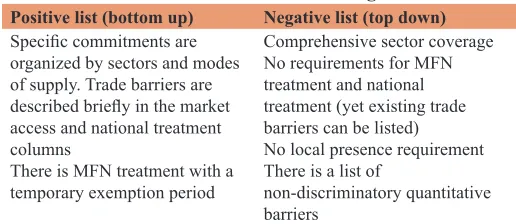
of both scheduling methods are summarized by Stephenson and Robert (2011) in Table 1.
The dimensions generally described in the scheduling list consist of two things, i.e., (i) a list of business activities subject to the
service sector liberalization commitments, and (ii) the degree of
openness to foreign ownership.
In the positive list method, the services sectors and the matters
covered by liberalization or open to partner countries are included
in the scheduling list. Whereas in the negative list method, it applies the opposite: The service sectors and the matters not covered by
liberalization or closed to the partner countries are included in the list.
The currently applicable scheduling method for GATS style
positive list has been adopting S/L/92 since early 2000s, replacing
the old MTN.GNS/W/164. Some FTAs with GATS style positive list involving ASEAN countries and non-ASEAN countries are
summarized in Table 2.
Some characters can be identified from the GATS-style list (World Bank, 2007). First, the commitment of liberalization in each sector
is described in four modes of supply, namely mode 1 (cross-border trade), mode 2 (consumption abroad), mode 3 (commercial presence), and mode 4 (movements of natural persons).
The commitment structure of ASEAN countries in the most of FTAs follows the above modes. Only a few other FTAs involving individual ASEAN countries such as Thailand-Australia FTA is found a
different and more simple structure. The purpose of simplification
is to make it easier for businesspeople to read and understand it.
On the other hand, the negative list scheduling method does not
have any specific guidelines. The only possible reference is the
UN VCLT (United Nations Vienna Convention on the Law of
Table 1: Main characteristics of scheduling methods Positive list (bottom up) Negative list (top down) Specific commitments are
organized by sectors and modes of supply. Trade barriers are described briefly in the market access and national treatment columns
There is MFN treatment with a temporary exemption period
Comprehensive sector coverage No requirements for MFN treatment and national treatment (yet existing trade barriers can be listed) No local presence requirement There is a list of
non-discriminatory quantitative barriers
Treaties), which is actually a general guideline for all countries in making international treaties. The main principle of VCLT is that international treaties are binding only for the contracting parties.
As a matter of fact, developed countries do not always prefer the adoption of negative list. European countries in the EU prefer applying the positive list in their negotiation when negotiating with the US in transatlantic trade and investment partnership (T-TIP). The US itself is surely accustomed to negative lists, so which approach
being adopted should be negotiated by US and EU first (Fefer, 2018).
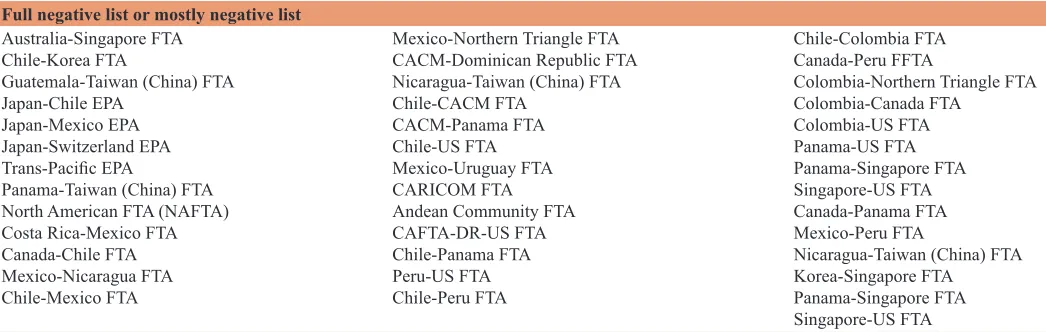
The use of negative list originated from the North American Free Trade Agreement (NAFTA) which became effective since 1994 and involved three countries in American continent: Canada, Mexico and the United States. This preference is then widespread to other countries including those in Asia and Australia, and a few European countries which were accustomed to positive list, especially the GATS-style hybrid list. In their FTAs/RTAs expansion, the American countries encourage their partner countries to also adopt negative list. Here is a summary of various FTAs/RTAs that adopt negative list (Table 3).
The agreement model with negative list approach then was introduced to East Asia and ASEAN through the FTAs/RTAs agreement between Singapore and the United States which came
into effect in 2003. Singapore also adopted negative list in
Australia-Singapore FTA. After Australia-Singapore, other East Asian countries such
as Japan, Korea, including Australia then followed (World Bank, 2007). Since then several ASEAN partner countries have adopted
negative list. For example Japan, Japan has adopted negative list
with Chile in Chile FTA, Mexico EPA, and
Japan-Switzerland EPA. Korea has also used negative list in Chile-Korea.
Those ASEAN partner countries in the previous FTAs/RTAs, have become agents that bring and encourage gradual migration to negative list in RCEP. Meanwhile, the non-traditional ASEAN partner countries bring and encourage full migration to negative list
in TPP. Several ASEAN countries i.e., Singapore, Malaysia, Brunei,
even Vietnam (one of the LDCs with Laos and Cambodia), have assumed the consequence of having to use a negative list approach.
The main agreement adopting the negative list have certain disciplines which are not found in the main agreement with positive
list (World Bank, 2007). Some disciplines can be mentioned
such as local presence requirements, quantitative restrictions, performance requirements, limitations on senior managers and board of directors, and limitations on cross-border purchases
of financial services. Local presence discipline requirements
especially are used for commitments in mode 1 cross-border trade.
FTA trade in services agreements with negative list generally make use of two other main disciplines (i.e., standstill and ratcheting), which are in line with freedom of access to investments promoted by the scheduling method. Standstill means the level of market access (MA) for foreign players is guaranteed similar with the applicable regulatory regime at the signing date of an FTA agreement. Ratcheting means ‘automatic binding’, that is when the restrictive status quo policy is removed by issuing a new policy, the policy regime is then automatically bound to the level of openness which is set by that new and more liberal policy.
Table 2: FTAs/RTAs ASEAN and non-ASEAN with positive list for services sectors Full positive list or mostly positive list
Lao PDR-US BTA Mainland-Hongkong CEPA Mainland-Macao CEPA AFAS
ASEAN-China FTA ASEAN-Korea FTA
ASEAN-Australia New Zealand FTA
Australia-Thailand FTA Indonesia-Japan EPA Japan-Brunei EPA Japan-Malaysia EPA Japan-Philippines EPA Japan-Singapore EPA Japan-Thailand EPA India-Singapore ECA
EFTA-Korea FTA EFTA-Singapore FTA Jordan-Singapore FTA New Zealand-Singapore FTA Vietnam- US BTA
MERCOSUR
Source: Author’s compilation, World Bank (2007), METI Japan (2010). “Services Report in WTO,” and Stephenson and Robert (2011)
Table 3: FTAs/RTAs with negative list for services sectors Full negative list or mostly negative list
Australia-Singapore FTA Chile-Korea FTA
Guatemala-Taiwan (China) FTA Japan-Chile EPA
Japan-Mexico EPA Japan-Switzerland EPA Trans-Pacific EPA
Panama-Taiwan (China) FTA North American FTA (NAFTA) Costa Rica-Mexico FTA Canada-Chile FTA Mexico-Nicaragua FTA Chile-Mexico FTA
Mexico-Northern Triangle FTA CACM-Dominican Republic FTA Nicaragua-Taiwan (China) FTA Chile-CACM FTA
CACM-Panama FTA Chile-US FTA Mexico-Uruguay FTA CARICOM FTA Andean Community FTA CAFTA-DR-US FTA Chile-Panama FTA Peru-US FTA Chile-Peru FTA
Chile-Colombia FTA Canada-Peru FFTA
Colombia-Northern Triangle FTA Colombia-Canada FTA
Colombia-US FTA Panama-US FTA Panama-Singapore FTA Singapore-US FTA Canada-Panama FTA Mexico-Peru FTA
Nicaragua-Taiwan (China) FTA Korea-Singapore FTA
The positive side of implementing the above two disciplines in
negative list is that liberalization policy is considered having more
credible and clear direction. Meanwhile ratcheting discipline itself is considered having a lack of transparency, seeing that the new and more liberal policy is not updated and included in the detailed
FTA commitments (Adlung and Mamdouh, 2013).
The pressure from partner developing countries having experienced in negative lists has successfully changed ASEAN developing countries to migrate from GATS style positive list to negative list, gradually or drastically. RCEP still can accept GATS style positive list provided that ASEAN countries apply standstill and ratchet to their limitations for a minimum number of those sub-sectors on which they have made commitments with limitations. The other gradual step is they must also opt one of the choices. Option one is to identify sectors in their schedules to which they will apply the most-favoured-nation (MFN) rule to
future FTAs (“MFN forward”), while the other option is to draw up a “transparency list” that modifies the current measures that
they maintain in their schedules, intended to be converted into a
negative list annex in the future (Kelsey, 2017).
But negative list has a drawback compared to positive list. ASEAN
member countries (both as one community and a single country) are more comfortable using positive lists in FTAs/RTAs. The use of supply modes in the GATS style positive list allows governments
to flexibly adjust the competitiveness between local and foreign
business players in the domestic services market (Hoekman and
Sauve, 1994:71; OECD, 2002. p. 15).OECD (2002) argues that
with positive list, the state is enabled to make commitments under the current regulatory regime, which provides the state with the
so-called policy flexibility and policy space.
For developing countries in general and ASEAN developing
countries in particular, policy flexibility and policy space become
important. Foreign ownership related investment regimes needs some adaption suitable with national interests and current conditions. The policy is intended to keep balance between the access provision for foreign investors and the achievement of national development objectives. In identifying such a balance, the government conducts trial and error process to identify the most appropriate policy options for the country’s level of development
at a given time (UNCTAD, 2004). Thus, in undertaking trial and
error process, developing countries may not risk themselves by
binding their policy so firmly to IIAs or FTA agreement.
In addition, we should not also fully associate market liberalization
exactly similar with market opening. The concept of market
liberalization is not really similar with the market opening,
since the market opening should not always necessarily be associated with policy relaxation for foreign business players in the competition with local business players commonly found in
the liberalization policy. In undertaking market liberalization, a
particular country must carefully calculate when the timing is
appropriate. Before liberalizing its market, the government should
launch domestic measures aimed to support the development of
its domestic industry. Such support can be in the form of fiscal incentive policies and specific privilege to local entrepreneurs.
Subsidies, waivers and tax exemptions, imposing import duty for imported goods and granting monopoly rights for a given
period are some examples of fiscal incentives and privilege (Setiawan, 2015). The most important factor for developing
countries to develop their national economy is not trade
liberalization (Stiglitz and Charlton, 2005).
The timing strategy for trade liberalization or free trade
implemented by the developed countries in the past was compiled by a German economic and economic historian named
Friedrich List (Reinert, 2007). List wrote the recipe for successful
transformation of England into a developed country, which was then followed by other developed countries. The successful
transformation comprises four periods. The first period is changing
consumption patterns and then creating demand for industrial products. The second is protecting and building their own local industries. The third is integrating an economically broader geographical area. The fourth period, when all countries have their respective competitive industrial sectors, on the basis of common interest then the world free trade is opened. Meanwhile,
in modern era there should be a modification for the above theory.
Developing countries do not have to follow similar way, and they can accelerate the transformation process in the second period, involving their domestic industries in the supply chain industrial network of developed countries.
In comparison with developed countries, developing countries have more limited abilities to develop regulations. In that regard, the structure of agreements with negative lists is not necessarily conducive to encouraging market opening, particularly in sensitive sectors. In negative list, government has no room to address policy, regulatory, social, or political failures, unless it has the foresight and negotiation ability to preserve the adequate policy space or can succeed declaring one of the agreement's exceptions. The negative list option is risky in legal and political terms, even
for well-experienced government in liberalization, privatization,
and free market adoption, supported with solid bureaucracies and
negotiators (Kelsey, 2017). With the use of positive list in WTO GATS, developing countries have a higher sense of confidence when taking initial liberalization policy steps. Government can
ensure providing better commitments while also accommodating concerns or complaints from domestic stakeholders at the same
time (World Bank, 2017).
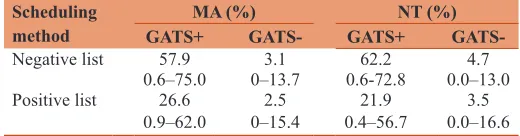
Adlung and Mamdouh (2013) also argues that positive list is safer and more conservative than negative list in gradual liberalization. This finding is based on some evidence that the deviation value
from positive list is smaller than the one from negative list. When
Table 4: Conversion risks of FTA negative list and FTA positive list
Scheduling
method GATS+MA (%)GATS- GATS+NT (%)
GATS-Negative list 57.9 3.1 62.2 4.7
0.6–75.0 0–13.7 0.6-72.8 0.0–13.0
Positive list 26.6 2.5 21.9 3.5
GATS commitments are expanded to be more liberal (GATS +), deviations for both MA and NT for the positive list (26.6% and
21.9%) are smaller than the negative list (57.9% and 62.2%). It
is shown in Table 4.
Adlung and Mamdouh (2013) study is contradictory to some views in World Bank (2007) which state that positive list and
negative list are only methods of scheduling, while the outcome of
liberalization from those two methods will be the same. Moreover,
they view that each negative list schedule can be replicated into a positive list schedule.
3. RESERVATIONS STRATEGIES FOR NS,
NFS, AND FINANCIAL SERVICES
The interpretation of NS (New Services) and NFS (New Financial
Services) in a trade liberalization services agreement or an
investment agreement may vary, depending on the agreement among negotiating parties. The first interpretation of NS or
NFS is a “newly born” financial services or service sector in the
services market, that means the sector is not listed in the services
sector classification yet. The second interpretation is an existing services sector or financial services sector in the services sector classification, but since the sector has not developed then it is not
regulated yet.
NS or NFS in the first interpretation - newly born sector - is created
by rapid development in telecommunications sector and positive
results from significant efficiency in logistics costs (WTO, 2014). Adlung (2009) illustrates one example of NS, i.e., the emissions certification trading sector in the service sector classification. In
the past this sector was not known. Another NS sector is energy
services. This sector needs a new classification in order to integrate
with the energy sector, which is an integrated one. Discussions on
this issue are discussed in the Committee on Specific Commitment WTO negotiations (Cottier, et al., 2010). In this WTO committee, the classification of new sectors in the services sector is negotiated.
NFS sectors is also continuing to emerge along with the development of culture and technology. It can be seen from the
emergence of various supply and demand of new financial services
such as sharia bank and factoring (leasing). In addition, new
financial transaction services are also emerging using financial technology; where this type of service will shape the structure of future financial industry (Lee and Teo, 2015).
As mentioned above, the NS or NFS sector may also be sourced from
existing sectors in the classification but not regulated yet, for example
is processing information and data collection (data processing). The sector was not regulated in the beginning, but it has now been regulated by the government in many countries, in line with the recent
development of commercial sectors for data processing (Roy, 2017).
In securing NS dan NFS, we need drafting several reservation clauses. However, in general, the agreement drafters from ASEAN developing countries - especially compared with those from
developed countries – have lacked of experience in formulating the
agreement text with negative list. In this context, the smart strategy adopted in resolving the above issue is not formulating the text
of agreement with negative list from scratch, but by “transferring knowledge,” learning the techniques
The first source taken as a technical reference in securing NS and
NFS is the Swiss-Japan FTA agreement. In this agreement text, it appears that reservations on NS and NFS can be linked to several issues. Reservations are included in the text by closing open loopholes on the sectors which are automatically open since they are not listed in the negative list. In this case the purpose of the NS and NFS reservations in international investment treaties is to maintain the foreign entry access from sensitive sectors, not in the purpose of sorting out which sectors require investors.
Cultural issues are one of the most sensitive. The audiovisual services sector is a sensitive sector considering the fact that this sector is the gateway for foreign cultures and propaganda (campaigns) that potentially disrupt the resilience and stability of political economy and socio-culture.
European countries, including Switzerland expect that the audiovisual entertainment for their citizens is truly in line with
their identity of personality and European entity. Similarly, the
distribution of sensitive goods or products – which is related to
distribution services - should be monitored.
In addition to sensitive sectors, Switzerland also include the
unknown sub-sectors into NS. The sectors are generally not included in the UN Central Product Classification list. The reservations on NS for the above sectors are intended for MA and
national treatment (NT) disciplines, as seen in Box 1.
Box 1. Subsectors classified as NS by Switzerland Various services new services
CPC 7524 Programme transmission services (limited to new audiovisual services)
CPC 75300 Radio and television cable services (limited to new audiovisual services)
CPC 752 Telecommunication services (limited to new telecommunication services)
CPC 8499 Other computer services n.e.c. (limited to new computer services)
CPC 8719 Other advertising services n.e.c. (limited to new advertising services)
CPC 87909 Other business services n.e.c. (limited to new auctioneering services)
CPC 9611 Motion picture and video production and distribution services (limited to new audiovisual services)
CPC 9612 Motion picture projection services (limited to new audiovisual services)
CPC 9613 Radio and television services (limited to new audiovisual services)
CPC 96199 Other entertainment services n.e.c. (limited to new entertainment services)
CPC 96499 Other recreational services n.e.c. (limited to new recreational services)
In addition, a services sector that is not currently served in Swiss
commercial market is also classified as NS. It covers services
associated with existing or new products or the manner in which
a procuct or service is supplied. The NS coverage of Switzerland is inspired by NFS definition in the WTO Understanding on
Commitments in Financial Services document.
In Swiss-Japan FTA, for a general understanding about NS, Japan
made a substantial scope similar to Switzerland but with a different text. Japan classifies unrecognized and unknown sub-sectors in the international product classification for services sectors/CPC and
Japaneses Industrial Standard Committee (JISC) as NS. Japan then reinforces it by reserving any provisions related with NS outside
the sectors listed in JISC or CPC classification system, taking into
account the circumstances under which the agreement enters into force.
In the agreement text, Japan acknowledges any new classification
of sectors which have been explicitly acknowledged in the CPC and JISC at the time of entry into force of the agreement. However, if the new sector is not feasible to be served technically in the mode of supply of services available in the Japanese market, then Japan maintains its policy for the sector. This Japanese clause applies to MFN, MA, and NT disciplines.
NS restrictions are not known in the ASEAN service agreements yet, but it is not the case in the ASEAN ACIA (ASEAN Chapter on Investment Agreement) which has imposed NS restrictions. In ACIA, unregulated sectors can fall into NS category, so that it can be closed. The following illustration from ACIA may apply to ASEAN developing countries services agreements with a negative
list: “For unregulated sectors, ASEAN Member States can reserve
new and emerging sectors, sub-sectors, industries, products, or activities and also existing sectors, subsectors, industries, products, or activities which are unregulated at the time of submission of
the reservation lists.”
Wording techniques including sectors or subsectors (which are not
in the classification of JISC and CPC) into NS can also be learned
from EU-Canada CETA (Comprehensive Economic and Trade
Agreement): “EU and Canada reserve new services that cannot be classified in the CPC 1991. The parties also reserve existing services that could be classified in the CPC 1991, but that could
not previously be supplied on a cross-border basis due to lack of
technical feasibility.”
For other FTA cases such as Japan-Australia EPA, we can also see the similarities with Japan-Swiss FTA in grouping particular sectors into NS. The phrase ‘reserving the services sector that is not available yet in the commercial market’ in the Japan-Swiss FTA and the phrase
“preserving technically unfeasible service sector” within the
Japan-Australia EPA are actually alike. The reservations are applied into some disciplines: MA, NT, most-favoured-nation (MFN) treatment, and local presence. In the agreement, Japan states that it reserves
the services other than those recognized or those should have been recognized. Japan also reserves services which were not technically
feasible at the effective application date of agreement.
NFS subsectors are exclusively outside the NS grouping, because NFS has been solely described and has special arrangements in the WTO Understanding on Commitments in Financial Services documents. Since NFS and Financial Services have
special arrangements in the WTO, then they also have specific arrangements in FTAs in the form of specific articles in specifc annexes. In the Japan-Swiss FTA, NFS is specifically arranged in
Article II of Annex VI Chapter on Financial Services.
Special arrangements for NFS in the WTO mention that member
states shall permit financial service suppliers of any other Member established in its territory to offer in its territory any new financial service. In this regard, NFS is defined as “a service of a financial
nature, including services related to existing and new products or the manner in which a product is delivered. The product or the
manner is not supplied by any financial service supplier in the
territory of a particular WTO member, but it is supplied in the
territory of another member.”
After learning the relevant WTO documents and the above FTA agreements, we can say that the special arrangements in the WTO for NFS has obviously inspired the adoption of similar provisions in several FTA agreements for NS and NFS. NS and NFS may apply if a particular sector is regulated only in a certain country and if it is commercially available or technically feasible only in a
certain country. This notion is also used in the Japan-Switzerland FTA, specifically in Switzerland agreement text relating to NFS.
In this regard, a sector can be committed open if the sector has
been regulated and there is already any financial sector provider operating both in the Switzerland and Japan markets.
The provisions in WTO documents which mention NFS do not
specify certain limitations or barriers to secure NFS. The first option of NFS restriction is through authorization and licensing.
The existence of articles related with NFS in the agreement does not nullify the authority of government institutions or appointed
institutions to regulate financial services and grant the license. NFS
restrictions are applied on MA and NT related articles, which are combined with licensing related articles.
Reservations on NFS are also adopted by a few countries for the
reasons of prudential objectives and maintaining authorization.
The illustrations for these reservations can be noticed in Japan-Australia EPA and EC-Chile FTA. In Japan-Japan-Australia EPA,
Australia declares to reserve “… non-discriminatory limitations concerning admission to the market of new financial services
where such measures are required to achieve prudential
objectives.” Australia also confirms its authority to “………
determine the institutional and juridical form through which a new
financial service may be supplied and may require authorisation for the supply of the service.” The other party Japan, with different wording also reserves “…… non-discriminatory limitations concerning admission to the market of new financial services … aimed at achieving such prudential objectives.”
In article 121 of EC-Chile FTA agreement, it is stated that “… shall permit ……… any new financial service …… provided that the introduction of this new financial service does not require a new law or the modification of an existing law.”
With regard to licensing, the authorization of local financial service authority in granting limited licenses in FTAs to foreign financial services may also be specified in the agreement. In another FTAs involving ASEAN country – i.e., Australia-Singapore
FTA - Singapore includes a wide range of coverage in its future measures, containing Singapore’s domestic rights to maintain the
restrictions on the provision of financial services by Australian banks: “[…] to adopt or maintain any measure affecting the supply
of services by foreign full banks or in relation to Qualifying Full
Bank licences.” With this future measure, granting licensing is
strictly limited to limited licenses to Australian banks.
The existence of NS or NFS and the strategy of reserving a sector or subsector in Free Trade Agreements especially services sector
with negative list have been described above. Based on these
real examples and illustrations, ASEAN countries can explore their own innovative and unique strategies and techniques by modifying the illustrated strategies explained above considering their respective needs and interests.
4. GATS STYLE POSITIVE LIST TO
NEGATIVE LIST TRANSPOSITION
This section will explain several strategies and considerations in migrating the ASEAN scheduled commitment in GATS style positive list to negative list.
One of the most secure way to convert respective ASEAN country scheduled commitment of GATS style positive list to negative list is to fully reserve sectors and business activities and declare it in
Annex II - future measures, then open it again in the annex. By
placing it in Annex II, there is no obligation for ASEAN countries
to include specific regulations or provisions that support or explain
the closure of a particular sector or business activity. In this
regard, it is sufficiently stated that “(a particular ASEAN country)
reserves the right to adopt or maintain any measures with respect
to a particular sector or subsector in. services.” The liberalization
disciplines shall not apply to such sectors or sub-sectors. This strategy is inspired by Australia-Chile agreement (Chile does) and the TPP (Vietnam does).
In the Annex I-non conforming measures of negative list scheduled commitment, ASEAN developing countries are allowed to amend the previous regulation that has been included in the annex, as long as it honors previous commitments. Suppose that in Annex I, it is stated some NT-related measures or regulations which distinguish the treatment between foreign service providers and local service providers. Such condition is allowed and NT discipline remains invalid for the regulation.
With regard to GATS, all measures issued by both central and local
government should observe its liberalization disciplines. Central
government certainly will ensure its observance to international treaties in making laws and regulations. Although in a regional government act, it is stipulated that local regulations should not
conflict with international treaties, but in reality it possibly takes
place. Thus, safeguarding the potential breach of local regulations is believed to be necessary to avoid lawsuits or claims from partner countries or foreign investors.
Unlike financial services whose regulatory authority is solely in the Financial Service Authority, services sectors other than financial
services may be regulated by local governments. Such a condition makes the local government regulations - for services sectors other
than financial services - are exposed a higher risk in breaking negative list liberalization disciplines. Besides, the work of harmonization on
international treaty, central government and regional regulations by a particular central government agency is not a brief task and will normally take time. Therefore, ASEAN developing countries having local governments should reserve all local regulations in Annex II-Future Measures of negative list commitments.
Privilege accorded internally among country members in ASEAN community is the next issue in transposition. Such a privilege should be included as Non-Conforming Measures Most Favoured Nation (NCM-MFN) in Annex I of negative list. It applies to other privileges that certain ASEAN countries have given to other countries as well. ASEAN countries privilige in
the financial services sector should also be reserved in services trade agreements with negative list. “All treatments, for all sectors
without exceptions, accorded by ASEAN countries under the
internal ASEAN agreement, will be excluded.” The reservation
will include MFN discipline. Thus there is no need that the each existing privilige in the internal ASEAN agreement is reserved one by one for each sector or subsector.
ASEAN partner countries are supposed to tolerate and understand if the reservation action by ASEAN countries is intended for the purpose of closer economic integration. Such an integration can be seen among EU country members, Australia with New Zealand, and also China Mainland with Hong Kong. Closer economic integration excluded from MFN is something common.
5. PREPARING TEMPLATE HEADNOTES
Headnotes or cover notes or sometimes called explanatory notes are the top clauses in annex I and annex II negative list. Headnotes before annex I and annex II in the negative list become guidance or references in writing or reading entries in the stipulated commitments. This condition is different from GATS style positive list which has S/L 92 standard document as a guide. The common practice is that there is one headnote for all parties as found in ACIA. However, different headnote from each party is possible, as long as it is agreed by the negotiating parties and understood by the parties how to read the commitments.
These different headnotes can be found in TPP, where each TPP member country has different versions of headnotes. At the beginning of negotiations, the formulation of headnotes was
was still a sharp contrast between developed and developing country groups negotiating in TPP. Since there would be no agreed concensus at the end, the headnotes formulation was
finally allowed to be different and each headnote was subject to
respective country’s version. In order not to have a dispute from misunderstanding, each country ensured other negotiating parties in TPP understand its headnote.
A challenge that ASEAN developing countries encounters in
preparing headnotes for financial services and services sector
is how to make headnotes safe and comfortable for sector stakeholders. Preparing headnotes together for annexes in a FTA services agreement with negative list can be part of short-term
targets for financial services and services sector stakeholders.
In the case of TPP, since some developing countries have just recently adopted negative list, those developing countries continue to incorporate GATS commitments in their negative list commitments, and mention the improvements or GATS plus committed in TPP. This form of stated commitment actually still tolerate the existence of positive list commitment in TPP negative list agreement.
In the commitments described in annexes, we may find an inconsistency between description and measures at times. To eliminate misunderstandings and inconsistencies, some negotiations formulate the substance of headnotes which stipulate which one is applicable: Description or measure.
In case of the above inconsistency is found, there are several possible approaches to follow: First, description that prevail, or second, measures that prevail. In ACIA, the one declared valid is description, with the understanding there is a possibility in the regulation that the existing measure is unclear, or the committed item is only a fraction of overall measures. The negotiators believe that the reference goes to the description, since the measure is a set of laws and regulations, and inconsistencies between the description and the measures are only a fraction of the contents in a set of regulations mentioned in source of measures section. Whereas in Japan-Swiss FTA, the measures prevail in case of
inconsistency with the description is found. “In the interpretation
of a reservation, all of its elements shall be considered. and the
elements shall prevail over all other elements”.
To learn from the example of headnotes in the FTA services agreement with negative list, ASEAN developing countries may refer to Vietnam in TPP. In the headnote, Vietnam states that the description explains the non-conforming measure for each entry
in annex. The articles of agreement specified do not apply to the non-conforming measures identified in the description element.
Another illustration associated with definition of description can
be seen inAustralia-Chile FTA. In the agreement, Australia and
Chile use different definitions for “Description”. “Description, for Australia, sets out the non-conforming measure for which
the entry is made; and Description, for Chile, provides a general, non-binding, description of the measure.”
In the Australia-Japan FTA, there is a headnote describing
NFS: “Australia reserves the right to adopt or maintain
non-discriminatory limitations concerning admissions to the market
of new financial services.” Such headnote is not found in TPP.
Headnotes can also be adopted to protect some regulations, including regulations at the level below central government (including local government regulations) and unmonitored lower level technical regulations. For example in the Australia-Chile FTA, there is an introductory note on Annex I that protects some additional or unmonitored regulations at the time the agreement is concluded, especially at the local government level.
6. CONSISTENCY, SAFEGUARD, AND
FOREIGN CONTROL
In preparing agreements with negative list, the issue of consistency is essential to manage to circumvent ASEAN developing countries from possible lawsuits and disputes from partner countries or foreign investors. To maintain the consistency of their FTA agreements with local government regulations or policies, ASEAN developing countries may include some exceptions in the annexes of non-conforming measures and future measures. It is the practice carried out by the countries involved in Singapore-US FTA,
Japan-Mexico FTA, and Australia-Singapore FTA (World Bank, 2007).
In Singapore-US FTA, the United States incorporates the following
non-conforming measures: “[A]ll existing non-conforming
measures of all states of the United States, the District of Columbia,
and Puerto Rico.” The implications of this clause are the policy
exception in all states, districts of Columbia and Puerto Rico that are inconsistent or contrary to US obligations under the FTA.
The issue of consistency with the GATS treaty must also be fully considered by ASEAN developing countries. In the same FTA, for consistency with GATS, the United States puts a limitation in
its non-conforming measures schedule as follows: “Reserves the
right to adopt or maintain any measure that is not inconsistent with the United States’ obligations under Article XVI of the General
Agreement on Trade in Services.”
Other issues of consistency that must be scrutinized exist in the
agreement chapters. In FTA services negotiation with negative list, negotiators and drafters of agreement from ASEAN developing countries need to manage and check both Services Chapter and Investment Chapter, so that each substance of the FTA agreement does not run independently for a similar substance issue. Each chapter needs to be mantained consistent by adding an appropriate clause feature to the investment chapter or services chapter.
may be reduced if safeguarding on a host country’s balance of
payment (BOP) must be carried out. The two kinds of provisions
are necessary, thus the two should be adopted in each transfer clause in Investment Chapter and Services Chapter.
In the above case, the legal drafter of ASEAN developing countries should maintain rules consistency, in order that services investment in Services Chapter also applies to all (both services or non-services) investments set forth in Investment Chapter. The argument is because in an economic crisis situation, it is impossible
for the Central Bank to filter only transfers for the service sector, or to filter transfers that are bound or not bound by international treaties. As a solution, the drafter also needs to include BOP
safeguards in Services Chapter into Investment Chapter that regulates the entire sector. For ASEAN developing countries,
BOP Safeguard is a crucial issue in protecting the economy during economic crisis. Thus, BOP Safeguard should be secured in all
their FTA agreements.
In various FTA negotiations, there are different views on the
duration of BOP safeguards applicability between developed and developing countries. For illustrations, Korea demands that BOP
Safeguards are applicable for only one to two years as agreed and adopted in the US-Korea FTA and TPP. Australia desires
BOP safeguards applicable in the short term only, meanwhile, ASEAN developing countries demands BOP safeguards to exist
continuously at all times and apply both to services and non-services sectors until the economic crisis is really over. When there is no common ground for all parties, criteria for safeguard duration may be agreed by all parties to refer to IMF recommendations.
In the above safeguarding clause, it is found that the clause contains
the phrase “keeping in mind the interests of the investor.” This
phrase may potentially diminish the power of safeguarding clause since the investor may interpret it as a freedom to transfer. In negotiations, it is the task of negotiators to balance the interests of government for economic protection and the interests of investors in enjoying the freedom to invest safely. Negotiators need to have similar understanding that a robust safeguard clause is necessary. They also need to understand the consequences if there is no solid safeguard for the sovereignty of respective ASEAN developing countries.
The practice of granting excessive freedom of investment has been perceived by some ASEAN developing countries as well as a few of partner countries. All of them dislike their domestic trade measures disputed by foreign investors in the ISDS (Investor State Dispute Settlement) forum. Indonesia has been sued by foreign investors in at least seven cases in ICSID, while its neighboring countries have experienced less cases: Malaysia (3), Philippines
(4), and New Zealand (1) (ICSID, 2014). Meanwhile, Australia has
been taken into another international arbitration court by foreign investors over Tobacco pack packaging case. Therefore, despite
the freedom that investors benefit, to some extent some safeguards
should be provided to hinder investors’ lawsuits in ISDS. Some exceptions may be included in the agreement text to anticipate and
to hinder potential lawsuits caused by free outflows restriction, in order to bring the settlement resolved at the domestic level first.
With regard to foreign control, one of the most widely known policy is the limitation of the foreign equity participation (FEP), in the form of foreign companies shares ownership limitation in a domestic company. However, FEP is not the only way for foreign control. Other elements outside FEP are the rights or authorities to control the domestic company. Despite majority shares ownership of foreign companies, it can still be regulated that the rights or powers of domestic company control should be retained domestically.
Another government control policy tool for foreign investors is to apply the provisions on prohibition and performance requirements (PPR). An illustration of a PPR is tax incentive or a
government-owned land tenure facility if a foreign investor commits a specific action, e.g., fulfillment of local content. ASEAN developing
countries generally do not commit to PPR in FTA international agreements, so that if all services sectors are reserved from PPR, it should not be considered as a backtracking.
7. CONCLUDING REMARKS AND
RECOMMENDATIONS
Based on its historical background and experience, at the
beginning ASEAN as an entity and individual countries have been comfortable using GATS style positive list in FTAs/RTAs. However, the latest FTA negotiation demands have directed the need for ASEAN to comprehend negative list well.
The adoption of service trade agreements with negative lists are
perceived to indicate the liberalization policies taken with more
credibility and clearer direction. On the other hand, positive list is safer and more conservative than negative list in the gradual
liberalization for ASEAN developing countries. The use of negative lists has the potential to reduce policy space and reduce the flexibility of ASEAN developing countries to fine-tune competitiveness
conditions suitable with current national interest between local players and foreign players in the domestic services market.
Several key issues behind the application of negative list in
services liberalization for ASEAN developing countries and the solutions can be summarized below. First is the issue of reserving or protecting NS (new services) and NFS (new financial services).
The solution is reservations on NS and NFS should be provided for
unrecognized, unregulated, not technically feasible, and sensitive sectors or subsectors. The authorization and licensing requirements
and the limitation due to prudential objectives reason can also be adopted to protect NS dan NFS.
The second issue is related to the transposition of GATS style positive list commitments to negative list commitments. The solution for ASEAN developing countries is to take a gradual
and safe migration. It is conducted by first closing all sectors and
The third issue is the preparation of headnotes templates. The solution
for this problem is first, every ASEAN country should prepare
a headnote template which is the most convenient to submit in negotiations for domestic service stakeholders. Each negotiating party may have uniform headnotes or different ones depending on their agreement. The second, with regard to solution of the second issue above, ASEAN developing countries should state in their headnote that they still incorporate their GATS commitments in the negative list and mention that the improvement (GATS plus) is delivered in the list. The third, it should be included in the headnote which one applies - the description or the measure - if there is an inconsistency between the description and measures in the negative list commitment.
The fourth issue is consistency of the services trade agreement
with other agreements. The solution is first, ASEAN developing
countries can include the exclusion of local government measures on non-conforming measures and future measures. The second is to adopt GATS consistency reservation in the Annex I - NCM schedule. The third is monitoring and checking consistency between chapters of agreement and incorporating the appropriate clause feature for coherence.
The fifth issue is regarding with safeguard on crisis and dispute. The solution is first incorporating the provision on Transfer and Payment and the provision on Safeguarding BOP among relevant chapters. The second is to prioritize resolving trade measure
dispute in domestic level, not in international arbitration.
The sixth issue is concerning foreign control. The solution is first,
limiting FEP. The second is restricting controlling authority of a domestic company remains on domestic shareholder. The third is the application of PPR.
In drafting and formulating service trade agreements with negative lists, negotiators and agreement drafters must be observant and thorough in learning various modifications and innovations from various FTAs in the world. Intelligent and smart team of negotiators and agreement with blended deep comprehension of national interests, knowledge and skills is required to produce solid and robust agreements, including FTA services agreements with negative list.
Coordination is a luxury item, especially in developing countries. Negotiators and drafters are generally focused only on sectoral issues, which issues are administered exclusively in respective institutions. They are potentially fragmented in sectoral issues and trapped in exclusivity. At times they are not really aware of the existence of overlapping issues, those which need relevant and coordinated measures. Therefore, the measures should be incorporated in the provisions under the agreement in an integrated and comprehensive approach. In so doing, in preparing FTA agreements we can not neglect the negotiating team structure. In the sctructure, there should be a party who is competent and able to see from the helicopter view, then coordinate all stakeholders and their related agreement chapters.
8. ACKNOWLEDGEMENT
Sincere gratitude for Irfa Ampri, PhD., Eladirman, Martin, and
Nurhafia for supports and contributions.
REFERENCES
Adlung, R. (2009), Services Liberalization from a WTO/GATS Perspective: In Search of Volunteers. World Trade Organization, Economic Research and Statistics Division.
Adlung, R., Mamdouh, H. (2013), How to Design Trade Agreements in Services: Top Down or Bottom Up?”. Staff Working Paper ERSD-2013-08 WTO. Economic Research and Statistics Division. Cottier, T., Malumfashi, G., Matteotti-Berkutova, S., Nartova, O.,
De Sépibus, J., Bigdeli, S.Z. (2010), Energy in WTO Law and Policy. WTO Individual Project No. 6.
Fefer, R.F. (2018), U.S. Trade in Services: Trends and Policy Issues. Washington, D.C: Congressional Research Service.
Gallagher, K., Shrestha, E. (2011), Investment Treaty Arbitration and Developing Countries: A Re-appraisal. Global Development and Environment Institute Working Paper No. 11-1.
Hoekman, B., Sauve, P. (1994), Liberalizing Trade in Services. World Bank Discussion Papers No. 243, June 1994.
ICSID. (2014), The ICSID Caseload–Statistics (Special Focus: South & East Asia & The Pacific).
Kelsey, J. (2017), The Risks for ASEAN of New Mega-Agreements that Promote the Wrong Model of e-Commerce. ERIA Discussion Paper Series. New Zealand: The University of Auckland.
Lee, D., Teo, E. (2015), Emergence of FinTech and the LASIC principles. The Journal of Financial Perspectives, EY Global FS Institute, 3(3), 24-36.
METI Japan. (2010), 2010 Report on Compliance by Major Trading Partners with Trade Agreements-WTO, FTA/EPA, BIT.
OECD. (2002), The Relationship Between Regional Trade Agreements and the Multilateral Trading System Services”. OECD. Trade Directorate. Working Party of the Trade Committee.
Reinert, E.S. (2007), How Rich Countries Got Ric and Why Poor Countries Stay Poor. London: Constable & Robinson Ltd.
Roy, M. (2017), The Contribution of Services Trade Policies to Connectivity in the Context of Aid for Trade. Staff Working Paper ERSD-2017-12 13 September 2017. World Trade Organization. Economic Research and Statistics Division.
Setiawan, S. (2015), In: Parjiono, P., Setiawan, G., Eladirman, E. IJEPA (Indonesia-Japan Economic Partnership Agreement): Dukungan terhadap Produksi, Ekspor, dan Impor Manufaktur Indonesia. Jakarta: BKF Kemenkeu. Penerbit Nagamedia
Stephenson, S., Robert, M. (2011), Innovations of Regionalism in Services in the Americas. Working Paper No. 2011/34/May 2011 NCRR Trade Regulation. Swiss National Centre of Competence in Research. Stiglitz, J., Charlton, A. (2005), Fair Trade for All: How Trade can Promote
Development. USA: Oxford University Press.
UNCTAD. (2004), World Investment Report 2004: The Shift Towards Services. New York and Geneva: United Nations: UNCTAD. World Bank. (2007), Trade Issues in East Asia: Liberalization of Trade in