Issues
ISSN: 2146-4138
available at http: www.econjournals.com
International Journal of Economics and Financial Issues, 2016, 6(S1) 41-45.
Special Issue for “Theory and Practice of Organizational and Economic Problems of Territorial Development and the Effectiveness of Social and Economic Systems”
The Methodology of Functioning Engineering Mechanisms in the
System of Auditing Controls
Evgenij Ju. Moskvitin
1*, Oksana A. Sherbakova
2, Ol’ga F. Sverchkova
3, Svetlana A. Marjanova
4,
Viktor V. Bykadorov
51Institute of Entrepreneurship and Service Sector (Branch), Don State Technical University, Shakhty, Russian Federation, 2Institute
of Entrepreneurship and Service Sector (Branch), Don State Technical University, Shakhty, Russian Federation, 3Institute of
Entrepreneurship and Service Sector (Branch), Don State Technical University, Shakhty, Russian Federation, 4Institute of
Entrepreneurship and Service Sector (Branch), Don State Technical University, Shakhty, Russian Federation, 5Institute of
Entrepreneurship and Service Sector (Branch), Don State Technical University, Shakhty, Russian Federation. *Email: [email protected]
ABSTRACT
In connection with the crisis increases the relevance of audit control in the Russian economy. Great influence on the modern accounting in Russia have been successfully carried out reforms and existing engineering mechanisms in the system of auditing controls. The article shows the different interpretations of the concept of “engineering”, and discusses the methodology, methods and mechanisms of functioning of engineering mechanisms in the system audit trail, as well as the main directions of the use of accounting and auditing engineering and basic engineering of accounting tools of various kinds. Model instruments and statutory audit of engineering are used in a variety of processes, not only at the micro level, but also at the meso and macro levels. The article identified and grouped the main problems of further development of Russian accounting and reporting. Showing difficulties that do not allow to apply international auditing standards in full, as well as proposed solutions to these problems. As one of these solutions to the identified problems proposed accounting model for using engineering mechanisms in the audit.
Keywords: Audit, Accounting, Engineering
JEL Classifications: A20, L11
1. INTRODUCTION
The audit is one of the two directions of activities of the International Federation of Accountants, including: International Accounting Standards Committee; Public Sector Committee; The International Council on standards of auditing; the system of subcommittees. Problems of financial accounting, reporting and auditing are discussed at international congresses, forums, companies, regional and national congresses of accountants and auditors. On them are considered the main problems of accounting, reporting and auditing. The main problems: The development of the accounting profession; promoting the transition of accountants and auditors to use of common standards; improving the quality of services; the public interest; organization and methodology
of the virtual (network) of accounting and reporting; Use engineering mechanisms in accounting and auditing; development and publication of international auditing standards; supervision of compliance with international auditing corporations, global quality standards; development and adoption of international financial reporting standards; regulation of accounting and auditing practices in the public sector and others. Many of these problems are considered in the works of Russian scientists (Cherkesova, 2012; Arens and Lobbek, 1995; Jekklz and Dipiaza, 2003).
2. THE MAIN PART
These rating journals for the past 40 years, discussed the problem of financial engineering and engineering, financial engineering, and engineering, auditing engineering, and engineering, computer technology and capabilities, zero balance, control and legal engineering, engineering and iterative methods of forecasting and control, specialized tools accounting and control engineering.
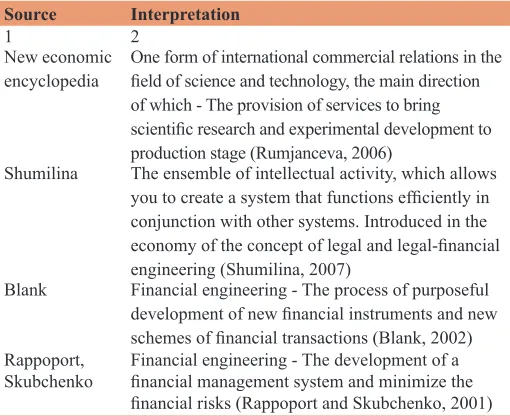
In various literature uses a wide variety of concepts of accounting and auditing engineering tools, some of which are presented in Table 1.
The main uses of accounting and auditing engineering are presented on Figure 1.
The main types of accounting engineering instruments of diverse kinds of data are presented in Figure 2.
Model of instruments and statutory audit of engineering are used in a variety of processes: In operational activities; in the overall
management of the organization; to manage and control the use of property; management and backup system control, risk, etc.
In the Russian auditing standards (International Standards on Auditing [ISAs]) and ISAs engineering character instruments, primarily on the basis of computer information systems (CISs) data presented in Table 2.
Part of the international standards, which have no analogues in the Russian audit to some extent focused, according to the most diverse comments on the use of information technology, information systems, accounting, audit, legal and other engineering mechanisms: ISA 110 “Glossary of Terms,” ISA 240 “Fraud and Error”; ISA 500 “Audit Evidence”; ISA 530 “Audit Sampling and Other Selective Testing Procedures”; ISA 700 “The Auditor’s Report on Financial Statements”; ISA 800 “The Auditor’s Report on Special Purpose Audit Engagements”; ISA 920 “Engagements to perform agreed-upon procedures regarding financial information.”
Most of the provisions of the International Auditing Practices (IAPS), which has no analogues in the Russian economy, focused on the operation in a computing environment: IAPS
Table 1: Basic interpretation of “engineering” concepts
Source Interpretation
1 2
New economic
encyclopedia One form of international commercial relations in the field of science and technology, the main direction of which - The provision of services to bring scientific research and experimental development to production stage (Rumjanceva, 2006)
Shumilina The ensemble of intellectual activity, which allows you to create a system that functions efficiently in conjunction with other systems. Introduced in the economy of the concept of legal and legal-financial engineering (Shumilina, 2007)
Blank Financial engineering - The process of purposeful development of new financial instruments and new schemes of financial transactions (Blank, 2002) Rappoport,
Skubchenko Financial engineering - The development of a financial management system and minimize the financial risks (Rappoport and Skubchenko, 2001)
Figure 1: Areas of use of the accounting and audit engineering
Figure 2: Instruments accounting and auditing engineering Table 2: International and Russian standards, focused on
the use of engineering machinery
International auditing
standards Russian auditing standards
ISA 220 “Quality
Control for Audit Work” “Intercompany control of audit quality” ISA 400 “Risk
Assessments and Internal Control”
“The study and evaluation of accounting and internal control systems during the audit” ISA 401 “Auditing in a
CISs Environment” “Audit in terms of computer processing” ISA 520 “Analytical
Procedures” “Analytical procedures” ISA 540 “Audit of
1000, “Inter-bank Confirmation Procedures”; IAPS 1001 “CIS Environments - Stand-Alone Microcomputers”; IAPS 1002 “IT Environments – On-line Computer Systems”; IAPS 1003 “CIS Environments - Database Systems”; IAPS 1004, “The Relationship Between Banking Supervisors and Banks’ External Auditors”; IAPS 1006 “Audits of the financial statements of banks”; IAPS 1010, “The Consideration of Environmental Matters in the Audit of Financial Statements.”
However, there is no standard in the international and Russian practice, which considers the model of functioning of engineering machinery in the audit, which would solve the problems of accounting audit software engineering, engineering technology audit, the results obtained, the solution. Availability and use of such a standard would help, at least, if not prevent the global financial crisis, at least weakening it, as his main reason was the issue of unsecured derivatives. It is possible that the case in the absence of engineering mechanisms controlling the ratio between the real and monetary resources derived from them (i.e., the bank) financial instruments, the normal relationship between which is defined as 1-9, but it was never proved.
All these provisions have led to the need to develop and test engineering mechanisms of the model with the following guidelines.
Firstly, when developing the model took into account the definition of audit in accordance with international standards as a systemic process of obtaining and evaluating objective data on economic activities and events, establishing the level of compliance with the criteria of the state standards, norms and guarantees, which represents the results to interested users, in which must take into account two defining positions:
• The objectivity findings, is impossible without the use of computer programs and engineering, primarily semantic, allowing to determine the cash flow analysis for unauthorized streams;
• Compliance the findings with the system of standards and norms. It is very difficult if there is mass indices, acting in different directions, without the use of the system aggregates obtained according to engineering mechanisms (for example, the net assets in the market valuation, net liabilities at fair valuation).
Secondly, it is necessary to take into account the methods control: • Audit planning;
• Legal and regulatory framework in line with the theme of testing, including regulations on accounting, taxes, guarantees and partnership;
• Inspection program that includes specific targets to verify the account and the performance of functions;
• Control procedures to check operation of the scanning object; • Procedure of documentary and factual verification of required
materials specific activity;
• Approaches to the systematization of the materials of the audit; • Activities for the compilation of the auditor’s findings,
coordination of plans and discussion of audit results and suggestions on it;
• Organization of monitoring the implementation of the proposals based on audit control;
• Test data are based on the use of engineering mechanisms (auditing, monitoring, accounting, financial, legal, special).
Third, the operating model should focus on a number of conceptual provisions that increase the conclusiveness of the audit:
• Generalization of the results of the audit should focus on the objective of the use of aggregated and disaggregated indicators of ownership in the appropriate prices (market, fair); • Use of modern computer programs;
• Financial reporting is the main source of information for external users;
• The notion of an audit of financial statements and related services are differentiated;
• Audit opinion in respect of the reliability of allegations submitted by one party and intended for use by the other party shall be regarded as confidence;
• During the audit absolute confidence in the reliability of the financial statements is unattainable because of the existence of the following factors: The need for statements of our judgment; testing applications; the presence of the limitations inherent in any system of accounting and internal control; • The auditor forms an opinion on the reliability of financial
information in the report.
Fourth, the model of functioning of engineering mechanisms should ensure effective protection of the rights of all participants of market relations:
• The correct definition of a market and fair value; • Control of ownership indicators in the reform process; • The relevance of accounting information;
• Enforcement of property rights (ownership, use, management, the right to income, enterprise security, perpetuity ownership); • Assessment of the positive and negative aspects of the
company on the basis of the SWOT-analysis;
• Definition of the status of the enterprise backup system by co-measuring net assets according to the balance sheet derivative (state reserve system) and a derivative of the balance of integrated risk reporting (cost of risk assets); • Accounting software engineering process management
relevant objects;
• Organic development of adequate technology credentials engineering processes (Simonovich, 2006);
• Reliable control of the financial condition based on the dynamics of the aggregated and disaggregated indicators of ownership;
• Assessment of the solvency of an institutional unit, taking into account the size, timing, risks and interest rates; • Widespread use in the evaluation of audit activity the
Instruments of accounting engineering, which increases transparency in audit and the reality of the assets, liabilities, equity, net assets, net of liabilities.
clear idea of how and on what basis accounting statements taken as a source for analytical conclusions were formed. Thus, it is not only and not so much the information, but rather, the gap in the methodology and technique of these compared with each other sciences (Kol’vah, 1999), and the gap between the accounting, analysis, audits may be reduced based on the use of engineering tools and instruments.
Fifth, the process of internal and external audit should be based on compliance with direct and feedback ties controlled process (management audit, strategic audit, performance audit, audit accounting systems).
Sixth, in the formation of the accounting software (audit sampling, recording and control points, dimension, analytic, the use of algorithms, drivers, etc.) and system engineering, engineering technology audit must be audited to determine the features and limitations of the system objects (norms, standards, focus on the best of the company, etc.).
From this perspective, the authors have developed and tested a model of functioning of engineering machinery in the audit. The model was tested on the organization and methodology of the audit for next objects:
I. General audit:
• Confirmation of statements;
• The organization of internal control; • The preservation of ownership. II. Management audit
III. Strategic audit IV. Efficiency audit V. Special audit
VI. Audit accounting status VII. Audit of financial accounting.
Such a classification audit of objects allows you to emphasize certain areas and overall management control processes, management audit and strategic audit:
I. Organization of control of the overall management: • A strategic, forecast derivativing balance reports; • Semantic derivative balance report (management
economic situation).
II. Manage and control to use of ownership:
• The organic, the substantial, trust, actuarial, discounted, remedial derivatives balance reports.
III. Management and control system backup and risks:
• Hedged, integrated risk and derivatives balance reports. IV. Management and control of innovation processes:
• Innovation, venture derivatives balance reports. V. Management of the financial results:
• Proficit, client derivatives balance reports. VI. Managing the reorganization and liquidation process:
• Reorganization, separation, consolidation, liquidation derivatives balance reports.
VII. Managing the financial situation and solvency:
• Monitoring, immunizing derivatives balance reports. VIII. Human resource management:
• Behavioristic, intellectual derivatives balance reports.
IX. Management of warranty, taxes and subsidies:
• Warranty, pledge, subsidiary derivatives balance reports. X. The organization of control:
• Zero and non-zero specialized derivatives balance reports.
Model engineering operation mechanisms in the audit is formed by the following blocks:
• The stages of the audit in accordance with international standards;
• A structured chart of accounts; • Aggregated units used to summarize; • Aggregated accounting entries; • Audit approach;
• An accounting audit software engineering; • The organization of engineering processes; • Methodology;
• technology engineering audit; • The result;
• Decision.
First unit of engineering mechanisms of the model presented in the audit of the audit phases:
• Selection of audit object;
• Organizational and methodological training; • The choice of engineering machinery; • During the research process;
• The research process: a. The accounting software;
b. Used the audit of engineering technology; • Monitoring results;
• Decision.
Second unit of the engineering mechanisms model presented in the audit concept of a structured chart of accounts. Accounting audit software engineering - is a means of collecting, grouping and reporting in order to ensure its relevance, that is the appropriate response of the request.
First sub-block by the accounting software is represented audit sampling, selection of all the elements, the selection of specific articles.
Audit sampling involves the application of audit in respect of <100% of the control object.
Standards and recommendations to the auditor in the construction of the sample are shown in ISA 530 “Audit Sampling and Other Selective Testing Procedures”.
When audit sampling can used statistical and non-statistical approach. Statistical sampling is characterized by a random selection of items and the use of probability theory to evaluate the results; sampling not having these characteristics are non-statistical.
In addition to the sampling, the auditor can use:
systems are high. The use of 100% verification is also possible when using the auditor of CISs;
• Selection of specific articles - According to the preliminary assessment of inherent risk and risk control system, characteristic of the general totality and the representation of the client’s business can be selected articles:
• Continuous control of primary documentation;
• Continuous analysis of the general ledger, which allows to find major errors, but requires a very high qualification of the auditor.
When using selective methods the auditor verification should extend the identified errors (excluding atypical) in the general totality. Then they estimated the cumulative impact (taking into account the errors detected atypical) on the financial statements. To do this, the results are compared with the allowable error of less than or equal to the preliminary assessment of materiality, certain auditor to study together and draw conclusions.
Accounting and control points - this account, sub-account 1, 2, 3, etc. order, analytical accounts, the article and the cost elements which may conduct reconciliation with any restrictions.
The dimension of time is determined by the accounting, evaluation, economic situation and the fractals of time and space (Kastel’s, 2000).
Analyticity accounting software audit (structural units, activities, company codes, responsibility centers), which carried out the audit control and summarizing verification results.
Algorithms and drivers are widely used in accounting and auditing and represent a coherent system for processing, organizing and analyzing information in order to obtain final data.
Architectonics structured chart of accounts based on the organic combination of structured, adaptive, information, integrated architecture, which operate on the basis of accounting engineering tools in order to create an effective information management system for the adoption of the operational, tactical and strategic
decisions in terms of integration of the financial systems, management and strategic audit.
3. CONCLUSIONS
Develop and test a model of functioning engineering mechanisms Audit focused on the control of the organization in the public system, management, strategic audit, performance audit, accounting systems and its optics are meant to do the blocks: Stages of an audit in accordance with international standards; structured chart of accounts; aggregated units (net assets and net liabilities in the market and a fair assessment) used to summarize; aggregated accounting entries; audit approaches; providing an accounting audit process; organization of engineering processes; audit of engineering technology (the start and end operator, corrective, regulatory, audit and hypothetical wiring); results and decisions.
REFERENCES
Arens, A., Lobbek, J. (1995), Audit. Moscow: Finance and Statistics. p560.
Blank, I.A. (2002), Asset Management. Kiev: Centr. p720.
Cherkesova, J.J. (2012), The human factor in the knowledge of economy. Bulletin of the South-Russian State Technical University, (4), 124-128.
Jekklz, R., Dipiaza, S. (2003), The Future of Corporate Reporting. How to Restore Public Confidence. Moscow: Alpina Publisher. p212. Kastel’s, M. (2002), The Information Age: Economy, Society and Culture.
Moscow: High School of Economics. p608.
Kol’vah, O.I. (1999), Situation-Matrix Accounting: Conceptual Models and Solutions. Rostov-on-Don: Izdatel’stvo SKNC VSh. p243. Rappoport, B., Skubchenko, A. (2001), Engineering and Business
Modeling. Moscow: Tandem. p286.
Rumjanceva, E.E. (2006), New Economic Encyclopedia. Moscow: INFRA-M. p810.
Shumilina, V.E. (2007), International Financial Accounting Model: Especially Applications in Russia: Monograph. Rostov-on-Don: Rostov State Economic University “RSEU”. p162.