Vol. 3, No. 4; July 2015 ISSN 2324-805X E-ISSN 2324-8068 Published by Redfame Publishing URL: http://jets.redfame.com
Higher-Order Thinking Development through Adaptive Problem-based
Learning
Jamal Raiyn1, Oleg Tilchin1
1Computer Science Department Al-Qasemi Academic College of Education, Baqa El-Gharbieh, Israel
Correspondence: Oleg Tilchin, Academic College of Education P.O. Box 124, Baqa El-Gharbieh 30100, Israel
Received: April 16, 2015 Accepted: April 30, 2015 Online Published: May 20, 2015
doi:10.11114/jets.v3i4.769 URL: http://dx.doi.org/10.11114/jets.v3i4.769
Abstract
In this paper we propose an approach to organizing Adaptive Problem-Based Learning (PBL) leading to the development of Higher-Order Thinking (HOT) skills and collaborative skills in students. Adaptability of PBL is expressed by changes in fixed instructor assessments caused by the dynamics of developing HOT skills needed for problem solving, flexible choice of control tests and problems for students, and adaptive formation of HOT skills within heterogeneous collaborative groups. It induces the students to develop HOT skills and collaborative skills through a combination of personalized and collaborative PBL. Adaptability of PBL is realized by taking into account values of the proposed coefficient of HOT skills development. The two-stage process of adaptive PBL allows guided development of HOT skills in students during study of a subject. Attention in the first stage is devoted to development of analytical HOT skills in students through personalized PBL. The main attention on the second stage is devoted to the development of creative HOT skills and collaborative skills in students through collaborative PBL. The proposed approach provides effective development of HOT skills and collaborative skills in students owing to: availability of a two-stage adaptive PBL process, complex and adaptive assessment of HOT skills, dynamic choice of control tests and problems for students, adaptive formation of HOT skills heterogeneous collaborative groups, and management of HOT skills development of students.
Keywords: higher-order thinking, adaptive learning, problem-based collaborative learning
1. Introduction
Development of Higher-order Thinking (HOT) skills of students is a complicated multidimensional challenge of education. The most significant HOT skills of students are the skills needed for problem solving. The favorable environment for development of such skills can be created through the use of the Problem-based Learning (PBL) model (Duch, Groh, Allen, 2001; Amador, Miles, Peters, 2006; Barell, 2006; Barret & Moore, 2010). Such an environment should be: HOT skills-centered (an instructor must focus on HOT skills development of students); student-centered (an instructor should encourage student interest in critical thinking and problem solving); assessment centered (an instructor should monitor student performance, and provide a high quantity and quality of assessment while stimulating students for HOT skills development); computer-supported to promote students’ HOT skills development and decrease an extra-heavy workload for an instructor (Hannafin & Land, 1997; Jonassen, 1998; Bransford, Brown, and Cocking, 1999; Baden & Major, 2004; Pettigrew & Scholter, 2010).
There are two distinct types of HOT skills needed for problem solving: analytical and creative thinking skills. Analytical or logical thinking skills allow critical thinking and help select the best alternative. The analytical thinking skills are: ordering, comparing, contrasting, evaluating, and selecting. Creative thinking skills are also needed for problem solving. The creative thinking skills are problem finding (identifying the problem), efficiency (producing many ideas), flexibility (producing a broad range of ideas that characterizes flexible understanding), originality (producing uncommon ideas), and elaboration (developing ideas) (Hmelo-Silver, 2004; Bednarz, 2011; Cottrell, 2011; Cottrell, 2013).
According to the proposed approach, development of HOT skills in students during study of a subject by the class is realized through a two-stage process of adaptive PBL. The course knowledge is acquired during the first stage, and is devoted to the development of analytical HOT skills in students. Fixed initial assessments of analytical HOT skills are set. After this stage, analytical HOT skills of every student are examined by the personal control questions based on course material. It allows assessment of development of the analytical skills. Next, adaptive collaborative group formation takes into account the assessment results of individual students.
The second stage of adaptive PBL is fulfilled by the collaborative groups through a problem- solving process based on course material. The main attention on this stage is devoted to development of creative HOT skills and collaborative skills of students. After the second stage, developing HOT skills and collaborative skills of individual students are examined. The choice of control questions for examination of analytical HOT skills development is triggered by the assessments of the skills after the first stage. Development of creative HOT skills of a particular student is examined by control problems.
2. Related Research
The proposed approach is directed towards developing HOT skills and collaborative skills of students through the realization of adaptive PBL. The approaches, methods, and tools reviewed here are examined relative to various aspects of this process.
Savery (2006) affirms that the goals of PBL are knowledge building and adoption of a problem-solving process. Barrows & Kelson (1995) and Hmelo-Silver (2004) determine the goals of PBL, including flexible knowledge; effective problem-solving skills; self-directed, lifelong learning skills; effective collaboration skills; and intrinsic motivation. According to Hmelo-Silver (2004), “Intrinsic motivation occurs when learners work on a task motivated by their own interests, challenges, or sense of satisfaction.” Students are induced to collaborate through their reflection and through the interdependence of learning within the group. Zimmerman (2002) specifies self-directed, lifelong learning skills enabling autonomous learning.
Schmidt & Moust (2000) emphasize the particular importance of collaboration because it affects intrinsic motivation and learning outcomes. Mennin (2007) explores a PBL group as a complex adaptive system (CAS). CAS is characterized by diverse agents interacting with each other capable of changing by self-organizing. A small student group is complex. It is adaptive in that the participants individually and in a group are altered. Burgos, Tattersall & Koper (2006) propose different types of adaptive learning support including problem-solving support, information filtering, collaborative grouping of students, adaptive testing, and real-time course modifications by the instructor to meet the specific needs of learners. Brusilovsky & Peylo (2003) consider adaptive group formation using knowledge about collaborating peers, and adaptive collaboration support providing an interactive support of a collaboration process assisting an individual student in solving a problem.
Knight (2000) pointed to the need for a systematic approach in the assessment of students’ learning that provides reliability, validity, and usability. Moallem (2007) considers the process of evaluation relative to the following stages: initial assessment, progress assessment, and product assessment. Lovie-Kitchin (2001) rightly claims assessment methods should be congruent with the PBL process. Macdonald and Savin-Baden (2004) stressed the need for specific assessment methods for PBL. The authors note assessment should reflect the practical orientation of PBL. Brookhart (2010) asserts that holding students accountable for HOT through assessment increases student motivation and improves the results of learning. Student assessment is realized through reflection on built knowledge.
Papanastasiou (2014) defined adaptive assessment as a type of assessment that is set for each student taking into account an assessment of his (her) previous performance. This allows an assessment to be more accurate in terms of individual ability. Tilchin & Raiyn (2015) introduce an innovative approach to complex, adaptive, and computer-mediated assessment of HOT skills development of students. The complexity of assessment is expressed by forming the combined assessments of HOT skills of different types. Adaptation of assessment to the process of HOT skills development is expressed by changes in an instructor‘s fixed assessments by crossing from one phase of PBL to another. Assessment adaptation is provided for individual students as for a study group. Computer mediation of assessment is provided by a Computer Assessment Tool which promotes students’ HOT skills development and facilitates the assessment process for an instructor.
3. Organizing Adaptive Problem-Based Learning for Thinking Development
Organizing adaptive PBL leading to development of HOT skills and collaborative skills of students is realized by the following steps:
A. Preparation of the needed instructional materials for a course
B. Assessment of developing analytical skills of the students after the first stage of PBL C. Building HOT skills heterogeneous collaborative groups of students
D. Formation of fixed assessments of HOT skills for the second stage of PBL
E. Assessment of HOT skills development of students after the second stage of PBL
F. Assessment of collaborative skills of students
A.
Preparation of the needed instructional materials for a coursePreparation of the needed instructional materials for a course includes: The forming of a list of course topics
Formulation of course requirements from a student with regard to development of HOT skills. After studying a course, a student should have developed HOT skills and collaborative skills. Thereby, he (she) should be able to apply effectively acquired knowledge through taking creative solutions during solving of the proposed instructional problems, and explain cause-and-effect relationships.
The forming of a list instructional problems covering all learning outcomes and HOT skills
Setting fixed initial assessments of analytical HOT skills. The difference of the fixed initial assessments of the skills expresses the preference of an instructor in the development of certain skills during the first phase of
Adaptive PBL. An example of setting the fixed initial assessments is represented by Table 1. The “Evaluating” skill has the greatest need for development since it provides critical thinking. Consequently, the maximum fixed initial assessment is set for this skill.
The forming of control questions and instructional problems for the examination of HOT skills of students. The instructor composes: a list of control questions which should examine analytical HOT skills of students after the first phase of Adaptive PBL; a list of control questions and problems for examination of analytical and creative HOT skills of students after the second phase.
Table 1. Fixed assessments of analytical HOT skills
The type of thinking skills Skills name The fixed initial assessments (%)
Analytical (40%)
Evaluating 14
Selecting 10
Contrasting 7
Comparing 5
Ordering 4
B.
Assessment of developing analytical skills of students after the first stage of PBLA student’s analytical HOT skills are assessed (by an instructor) through the answers given by a student to control questions from the individual list. An instructor assessment of a student answer to a question varies from zero to the fixed initial assessment of an analytical skill corresponding to a question. If a student cannot answer a question, or an answer is incorrect, then an instructor assessment is equal to zero. If a student answers a question corresponding to a certain skill correctly, an instructor assessment is equal to a fixed initial assessment of the corresponding skill. It means he or she has developed this skill. If a student answer is not full, an instructor sets a suitable assessment. As a result, an assessment of a student is made. Assessments of other students from a study group are set analogously. An example of assessment of the analytical skills of students is represented by Table 2. Formative assessments of analytical skills in student s1, s3, and s5 are 34, 19, and 14, accordingly.
Table 2. Assessment of analytical skills after the first stage of PBL
The questions Skills names S1 S2 S3 S4 S5 S6
qa11 Evaluating 7% 7 2 3 5 2 4
qa12 Evaluating 7% 7 2 2 4 0 3
qa21 Selecting 5% 4 3 5 3 0 5
qa22 Selecting 5% 4 2 5 4 0 5
qa31 Contrasting 7% 7 4 2 7 3 4
qa41 Comparing 5% 3 5 2 4 5 2
qa51 Ordering 4% 2 0 0 0 4 0
Formative assessment of analytical skills 34 18 19 27 14 23
δ (ki) = (g f
(ki) – g(ki)) / g(ki), -1< δ(ki) ≤ 0 (1)
where
δ(ki)is a coefficient of development of skill ki in students of the study group;
gf(ki) is a total formative assessment of skill ki for the study group. It is the equal sum of formative assessments of skill
ki of study group students;
g (ki) is a total fixed assessment of skill ki. It is determined by multiplication of the fixed assessment of the skill ki on
the number of students in the study group.
Example1: There are six students s1, s2,…, s6 in the study group. The formative assessments of the “Evaluating” skill for these
students are 14, 4, 5, 9, 2, 7, accordingly (Table 2). Hence, a total formative assessment of this skill for the study group is equal to 41. Fixed assessment of this skill is equal to14 (Table 1). Consequently, a total fixed assessment of the skill for the study group comprising six students equals 84. Then, the value of the coefficient of development of the “Evaluating” skill in the study group, according to formula (1) is δ (ki) = - 0.51. Analogously, the values of the
coefficient of development of “Selecting”, “Contrasting”, “Comparing”, and “Ordering” skills are – 0.33, - 0.36, - 0.3, and – 0.75, accordingly.
C.
Building HOT skill heterogeneous collaborative groups of studentsEffective PBL is created by the following conditions for building a collaborative group:
All the students studying a course should have all analytical HOT skills. Students develop needed HOT skills as a result of collaboration with other students in a study group.
Maximum mutual supplementation of skills of students inside a collaborative group. This condition provides facilitation of developing skills of the students of the collaborative group through interactions compensating for the lack of personal skills.
Taking into account individual characteristics of students during the formation of collaborative groups. This condition allows removal of limitations of collaboration.
The students will get an opportunity to develop HOT skills through collaboration owing to: intra-group interactions among students if cumulative skills of students in a collaborative group equal the required analytical HOT skills; inter-group interactions among students if cumulative skills of students in a collaborative group are less then the required analytical HOT skills.
Example2: Guided by the stated conditions of building collaborative group and based on the assessments of analytical skills of
students (Table 2), two collaborative groups are formed. The first collaborative group g1 includes the students s1, s3, and
s5. The second collaborative group g2 includes the students s2, s4, and s6. Further development of analytical HOT skills
of the students in the group g1 can be provided by intra-group interactions among students because the group has all
needed skills. All students of the group g2 received assessment of the skill “Ordering” equal to zero. It means that the
students of the group did not develop this skill. Hence, development of this skill in the students of the group g2 can be
provided through inter-group interactions with the students from the group g1.
D.
Formation of fixed assessments of HOT skills for the second stage of PBLAnalytical skills development occurs during the first phase of PBL. Consequently, fixed assessment of this skill type is decreased for the second stage of PBL. Furthermore, analysis of assessments of analytical HOT skills reveals a lack or inadequate development of certain skills in a study group. It stipulates the need for adaptation of a study group’s analytical skills assessments in the process of developing these skills. Adaptation of assessments is realized by changing fixed analytical HOT skills assessments, and if examination results reveal a lack of a certain skill development for the study group, then fixed assessment of this skill is modified by an instructor.
Example 3:
Fixed assessment of the analytical skill type is set equal to 20% for the second stage of PBL. Analysis of the determined values of the coefficient of analytical skills development (Example1) reveals inadequate development of some analytical skills in the study group. Owing to that, fixed assessments of “Comparing”, “Selecting”, “Contrasting”, “Evaluating”, and “Ordering” are set equal to 2, 3, 4, 5, and 6, accordingly. The fixed assessment is set for the skill “Ordering” because this skill has the weakest assessment for the study group after the first phase of PBL.
basis of preferences of an instructor. Adaptive assessments should provide stimulation and facilitation of acquisition of HOT skills and collaborative skills.
An example of setting fixed assessments of HOT skills for the second stage of PBL is represented by Table 3.
Table 3. Fixed assessments of HOT skills for second stage of PBL
The type of thinking skills Skills name The fixed assessments
Analytical (20%)
Evaluating 5 Selecting 3 Contrasting 4 Comparing 2
Ordering 6
Creative (60%)
Originality 15 Efficiency 12 Flexibility 11 Problem finding 9 Elaboration 13
E.
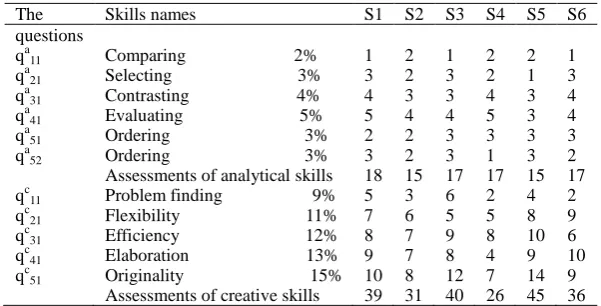
Assessment of HOT skills development of students after the second stage of PBLThe instructor composes individual lists of control questions on the basis of the complete list for examination of analytical skills development. An individual list can contain some questions for examination of a certain analytical skill. The individual questions are formed on the basis of skill assessments of a student after the first stage of PBL. It provides adaptive personalized learning. Next, the instructor composes individual lists of control problems based on the complete list. Development of the creative skills of a student is assessed by the instructor as a result of solving the problems from the individual list. The aggregate of control questions and problems from the individual lists should provide examination of all analytical and creative skills. An example of assessment of HOT skills of students after the second stage of PBL is represented by Table 4.
Table 4. Assessments of HOT skills after second stage of PBL
The Skills names S1 S2 S3 S4 S5 S6
questions
qa11 Comparing 2% 1 2 1 2 2 1
qa21 Selecting 3% 3 2 3 2 1 3
qa31 Contrasting 4% 4 3 3 4 3 4
qa41 Evaluating 5% 5 4 4 5 3 4
qa51 Ordering 3% 2 2 3 3 3 3
qa52 Ordering 3% 3 2 3 1 3 2
Assessments of analytical skills 18 15 17 17 15 17 qc11 Problem finding 9% 5 3 6 2 4 2
qc21 Flexibility 11% 7 6 5 5 8 9
qc31 Efficiency 12% 8 7 9 8 10 6
qc41 Elaboration 13% 9 7 8 4 9 10
qc51 Originality 15% 10 8 12 7 14 9
Assessments of creative skills 39 31 40 26 45 36
Assessment of HOT skills development is realized by comparison of the values of the coefficient of skill development after the second stage of PBL with the corresponding values of the coefficient of skill development after the first phase of PBL. The values of the coefficient of developing skills in the study group are determined by formula (1).
Example 4:
The values of the coefficient of skill development δ(ki) after the first phase of PBL(Example 1) are
“Comparing” - 0.3; “Selecting” – 0.33; “Contrasting” - 0.36; “Evaluating” - 0.51; and “Ordering” – 0.75 .
The values of the development coefficient δ(ki) of these skills based on assessments of HOT skills after the second
phase of PBL(Table 4) are:
“Comparing” - 0.25; “Selecting” – 0.22; “Contrasting” - 0.13; “Evaluating” - 0.17; and “Ordering” – 0.16.
Comparison of the specified values of the coefficient of skill development in the study group shows significant development of analytical HOT skills due to the second stage of PBL. Particular development of “Evaluating” and “Ordering” skills confirms effectiveness of adaptive formation of fixed assessments of HOT skills and collaborative PBL.
Table 5. Combined assessments of the student HOT skills
S1 S2 S3 S4 S5 S6
The assessments of analytical skills 18 15 17 17 15 17 The assessments of creative skills 39 31 40 26 45 36 The combined assessments of HOT skills 57 46 57 43 60 53 F. Assessment of collaborative skills of students
An assessment of collaborative skills of a student is done by taking into account assessments of his (her) HOT skills acquired as a result of collaborative PBL. The collaborative group is skill heterogeneous with realization of a condition of maximal mutual supplementation of skills of the collaborative group of students. It fosters and facilitates skill-sharing among students.
Assessment of collaborative skills is based on analysis of assessments of HOT skills of students after collaborative problem solving. The objective of the analysis is to determine the student (or students) who obtained a maximal assessment. Such assessment is a result of the acquisition of HOT skills by students due to collaborative problem solving. It can serve as a measure of success of collaboration of a student with other students of the collaborative group and also with students of other collaborative groups. Hence, a student with a maximal assessment of HOT skills possesses the best collaborative skills. The assessments of collaborative skills of students in a study group are calculated proportionally to the assessments of HOT skills on the basis of fixed assessment of collaborative skills.
The combined summative assessments characterize outcomes of PBL. These assessments are determined by the summation of combined assessments of HOT skills and assessments of collaborative skills.
Example 5:
A student s5 has the best collaborative skills since the combined assessment of HOT skills of this student is maximal
(Table 5). A student s4 has the worst collaborative skills since the combined assessment of HOT skills of this student is
minimal (Table 5).
The fixed assessment of collaborative skills is 20%. This assessment is obtained by the student s5 since the assessment
of the student is maximal and equals 60. Hence, the assessment of collaborative skills obtained by the student s4 equals
14%.
Assessments of collaborative skills of remaining students are calculated analogously. The results of calculations are shown in the second row of Table 6. The results of calculating the combined summative assessments of students are represented by the last row of Table 6.
Table 6. Assessment of collaborative skills
S1 S2 S3 S4 S5 S6
The combined assessments of HOT skills 57 46 57 43 60 53 Assessment of collaborative skills 19 15 19 14 20 17 The combined summativeassessments 76 61 76 57 80 70 4. Conclusion and Future Work
This paper has introduced an approach to organizing adaptive PBL leading to the development of HOT skills and collaborative skills of students. HOT skills development of students during study of a subject is realized through a two-stage process of adaptive PBL. Adaptability of PBL is expressed by changes in fixed instructor assessments caused by the dynamics of HOT skills development, dynamic choice of control tests and problems for students, and adaptive formation of HOT skills heterogeneous collaborative groups.
The approach stimulates active, personalized, and collaborative learning, induces the students to develop HOT skills and collaborative skills needed for problem solving, and facilitates realizing PBL. Adaptability of PBL is realized by taking into account the values of the proposed coefficient of HOT skills development. HOT skills development of individual students confirms the effectiveness of adaptive formation of fixed assessments of the skills. Assessments of collaborative skills of students are caused by assessments of their HOT skills after collaborative problem solving.
Further research will be directed towards developing an approach to organizing adaptive PBL, and enhancement of efficiency in its practical use.
References
Amador, J. A., Miles, L., & Peters, C. B. (2006). The practice of problem-based learning: A Guide to Implementing
PBL in the College Classroom, Jossey-Bass, 1 edition
Baden, M. S., & Major, C. H. (2004). Foundations of problem- based learning (Society for Research into Higher
Barell, J. F. (2006). Problem-based learning: an inquiry approach, Corwin, 2nd edition
Barrows, H., & Kelson, A. C. (1995). Problem-based learning in secondary education, Problem-Based Learning Institute, Springfield, IL
Barret, T., & Moore, S. (2010). New approaches to problem-based learning: revitalizing your practice in higher
education, Routledge, 1 edition
Bednarz, T. F. (2011). Developing critical thinking skills: pinpoint leadership skill development, Majorium Business Press
Bransford, J. D., Brown, A. L., & Cocking, R. R. (1999). How people lLearn: brain, mind, experience and school, The National Academies Press
Brookhart, S. M. (2010). How to assess higher-order thinking skills in your classroom, Association for Supervision & Curriculum Development, 1 edition
Brusilovsky, P., & Peylo, C. (2003). Adaptive and intelligent web-based educational systems. International Journal of
Artificial Intelligence in Education, 13(2), IOS Press, 159–172,
http://www2.sis.pitt.edu/~peterb/papers/AIWBES.pdf
Burgos, D., Tattersall, C., & Koper, R. (2006). Representing adaptive learning strategies in IMS learning design, http://hdl.handle.net/1820/601
Cottrell, S. (2011). Critical thinking skills: developing effective analysis and argument, Palgrave Macmillan, 2nd edition
Cottrell, S. (2013). The Study skills handbook, Palgrave Macmillan, 4th edition
Duch, B., Groh, S., & Allen, D. (2001). The power of problem-based learning, Falmer/KP, 1 edition
Hannafin, M. J., & Land, S. M. (1997). The foundations and assumptions of technology-enhanced student-centered learning environments, Instructional Science, 25, Kluwer Academic Publishers, 167–202.
Hmelo, S., & Cindy, E. (2004) Problem-based learning: what and how do students learn?, Educational Psychology
Review, 16(3), 235-266. http://dx.doi.org/10.1023/B:EDPR.0000034022.16470.f3
Jonassen, D. (1998). Designing constructivist learning environment. Reigeluth, C. M (Ed.), Instructional theories and
models, Mahwah, NJ, 2 edition
Knight, P. T. (2000). The value of a programme - wide approach to assessment. Assessment and Evaluation in Higher
Education, 25(3), 237-251. http://dx.doi.org/10.1080/713611434
Lovie, K. J. (2001). Reflecting on assessment, Schwartz, P. et al. (Eds). Problem-Based Learning: Case Studies,
Experience and Practice. London: Kogan Page
Macdonald, R., & Savin, B. M. (2004). A briefing on assessment in problem-based learning. Learning and Teaching
Support Network. ftp://www.bioscience.heacademy.ac.uk/Resources/gc/assess13.pdf
Mennin, S. (2007). Small-group problem-based learning as a complex adaptive system. Teaching and Teacher Education, 23, 303–313. http://dx.doi.org/10.1016/j.tate.2006.12.016
Moallem, M. (2007). Assessment of complex learning tasks: A design model IADIS. In Proceedings of International
Conference on Cognition and Exploratory Learning in Digital Age (CELDA.)
http://www.coe.missouri.edu/~jonassen/courses/CLE/
Papanastasiou, E. (2014). Adaptive assessment. Encyclopedia of Science Education, Springer, 1-2. http://dx.doi.org/10.1007/978-94-007-6165-0
Pettigrew, C., & Scholter, I. (2010). Using assessment to promote student capabilities. Barrett, Terry & Moore, Sarah (Eds), New Approaches to Problem-based Learning: Revitalising Your Practice in Higher Education, Routledge, 1 edition
Savery, J. R .(2006). Overview of problem-based learning: definitions and distinctions. The Interdisciplinary Journal of
Problem-based Learning. Spring, 1(1), 9-20. http://dx.doi.org/10.7771/1541-5015.1002
Schmidt, H. G., & Moust, J. H. (2000). Factors affecting small-group tutorial learning: A review of research. Evensen, D.& Hmelo, C. E. (eds.), Problem-Based Learning: A Research Perspective on Learning Interactions, Erlbaum, Mahwah, NJ, pp. 19–51.
Zimmerman, B. (2002). Becoming a self-regulated learner: an overview. Theory into Practice. 41(2), 64–71. http://dx.doi.org/10.1207/s15430421tip4102_2