Equine Veterinary Journal
1
Final Revision – NOT EDITED by the journal
2 3
4
5
6
7
8
9
10
11
12 13
14 15
16 17
18 19 20
21 22
Validity of indicators of dehydration in working
horses: a longitudinal study of changes in skin tent
duration, mucous membrane dryness and drinking
behaviour
J.C. PRITCHARD
†*, C.C. BURN
†, A.R.S. BARR
†and H.R. WHAY
††
Department of Clinical Veterinary Science, University of Bristol, Langford, Bristol BS40 5DU;
*Brooke Hospital for Animals, Broadmead House, 21 Panton Street, London SW1Y 4DR.
Keywords: behaviour; dehydration; drinking; horse; skin tent; working
Summary
Reasons for performing study: Dehydration is a serious welfare concern in horses working in developing countries. Identification of a valid and practical indicator of dehydration would enable more rapid treatment and prevention.
dehydration and use this to validate a standardised skin tent test, drinking behaviour
and mucous membrane dryness as potential field indicators. 23
24 25 26
27 28
29 30 31
32 33
34 35 36
37 38
39 40 41
42 43
Methods: Fifty horses with a positive skin tent test, working in environmental temperatures of 30 to 44°C in Pakistan, were rested and offered water to drink ad
libitum. Body weight, clinical and blood parameters, mucous membrane dryness, drinking behaviour and skin tent duration at six anatomical locations were measured
at 0, 30, 60, 120, 180, 240 and 300 minutes.
Results: Skin tent duration was affected by side of animal (p=0.008), anatomical location and coat moisture (both p<0.001). Younger animals had shorter skin tents at
all time points (p=0.007). There was no significant association between plasma osmolality (Posm) or water intake and skin tent duration. Horses with a higher Posm
drank significantly more water (p<0.001), and had longer (p<0.001) and more frequent (p=0.001) drinking bouts. Neither Posm nor water intake affected qualitative
and semi-quantitative measurements of mucous membrane dryness significantly.
Conclusions and potential relevance:
The standardised skin tent test and measures of mucous membrane dryness
investigated in this study were not valid or repeatable indicators of dehydration when compared with Posm as a ‘gold standard’ criterion. The volume of water consumed and
the number and duration of drinking bouts are the most reliable guide to hydration
status currently available for adult working horses. Offering palatable water to drink ad libitum provides both the diagnosis and the remedy for dehydration in working
horses. 44
45 46
Introduction
47
48 49 50
51 52
53 54 55
56 57
58 59 60
61 62
63 64 65
66 67
68 69 70
71
Recognition, prevention and rational management of dehydration would constitute a major contribution to the welfare of equids working in developing countries (Pritchard et al. 2006). Many horses work for a median 8.1 (inter-quartile range: 4.25 – 12.5)
hours per day, pulling carts or carrying loads at moderate speeds in environmental temperatures of up to 44°C (Pritchard 2007a), so could be considered equivalent to
non-elite endurance athletes. In endurance horses, dehydration is a contributing factor to reduction in work capacity (Sosa León et al. 1995), exhaustion (Carlson et al. 1976) and conditions such as heat stroke and synchronous diaphragmatic flutter (Sosa
León 1998).
Dehydration in equids has been evaluated by assessment of clinical signs such
as pulse rate and quality, heart rate, capillary refill time, mucous membrane dryness and skin turgor (Rose and Hodgson 2000); measurement of blood parameters including packed cell volume (PCV), serum total protein (TP), electrolytes and
osmolality (Posm) (Brownlow and Hutchins 1982) and estimation from known fluid
losses (Kingston et al. 1997). Changes in body weight (BWT) are considered to be a
reliable guide to fluid balance during exercise (Carlson 1987), so dehydration is commonly described in terms of percentage loss of BWT. Guidelines for subjective clinical assessment of dehydration vary considerably both between and within current
equine veterinary textbooks (Barton and Moore 1999; Robinson 2003; Rose and Hodgson 2000). Butudom et al. (2003) noted that sweat losses following exercise in
the horse may be isotonic or hypertonic to plasma (potentially leading to isotonic or hypotonic dehydration) and that dehydration results partly from a mismatch between thirst and water deficit. A primary stimulus for thirst is plasma hypertonicity (Johnson
useful indicator of hydration status. Pritchard et al. (2006) found a positive correlation
between P 72
73 74 75
76 77
78 79 80
81 82
83 84 85
86 87
88 89 90
91 92
93 94 95
osm and volume of water drunk by working donkeys but not horses.
The skin tent test examines the delay in return of a fold of pinched skin to its normal position (Dorrington 1981). Application of this test on the neck, point of
shoulder or eyelid has been used for the clinical assessment of dehydration in sick animals and equine athletes (Harris et al. 1995, Rose and Hodgson 2000, Robinson
2003). Rose and Hodgson (2000) specified that the skin over the point of the shoulder provides more reliable results than that over the neck and described the duration of skin tent as proportional to the degree of dehydration (percentage loss of BWT) it
represents. Some investigators have questioned the validity and repeatability of this test in sport horses (Harris et al. 1995) and in working horses and donkeys (Pritchard
et al. 2006, 2007b). In particular, the 3-tier graded skin tent test used by Harris et al. (1995) was not a reliable indicator of environmental conditions or performance and individual horses showed marked differences in resting results between the left and
right sides of the neck. Pritchard et al. (2006) found that for working horses and donkeys, an anatomically standardised skin tent test on the neck using a two-tier
grading system (normal/ abnormal) could not be validated using PCV, TP and Posm
sampled at a single point in time, due to the potentially confounding effects of anaemia, hypoproteinaemia and electrolyte depletion in the sample population.
The aims of this investigation were:
1) to measure longitudinal changes in PCV, TP, Posm, electrolytes, clinical signs and
2) to establish the criterion validity of a standardised skin tent test at three anatomical
locations on each side of the animal, an assessment of oral mucous membrane dryness using a novel adaptation of the Schirmer test, and thirst as evidenced by drinking behaviour, as potential field indicators of dehydration.
96
97 98 99
100 101
102 103 104
105 106
107 108 109
110 111
112 113 114
115 116
117 118 119
120
Materials and methods
This study was carried out in Lahore during May/June 2006, under ethical approval from the University of Bristol (Investigation number UB/04/075) and was compliant
with Pakistan law regarding ethical use of animals in science. All clinical observations were made at a field clinic run by the working equine welfare charity, the Brooke
Hospital for Animals, using a standard test protocol carried out by a single observer (JCP). Data relating to drinking behaviour were collected by a second observer (RE). Preliminary testing of the method was carried out during a 2-week pilot study in July
2005 and for the first 2 days of the current study period.
Animals
The longitudinal study of 50 horses examined each animal at 7 time points over 5 hours, during which drinking water was offered ad libitum. Animals recruited to the
study were working in high ambient temperatures (30 to 44°C and 17% to 56% relative humidity) in the vicinity of the clinic, transporting people or goods by cart.
Preliminary assessment 121
122 123 124
125 126
127 128 129
130 131
132 133 134
135 136
137 138 139
140 141
142 143 144
145
On admission the following were recorded: body weight (BWT), using an electronic weighbridge (Eziweigh)1 previously calibrated with known volumes of water; heart rate (HR); BCS; respiratory rate (RR); and rectal temperature (RT) using a digital
thermometer. A jugular catheter was placed anterograde under local anaesthesia and the horse was then rested in the shade for at least 15 minutes prior to the first test.
Test protocol
A 20ml jugular venous blood sample was drawn at time point 0 and at 30, 60, 120,
180, 240 and 300 minutes. Ten minutes prior to each time point, the horse was removed from the pen, weighed three times and the average BWT recorded. A clinical
examination was carried out, as described for the preliminary assessment. A vertical fold of skin was pinched and released using the standardised method described by Pritchard et al. (2006). This was repeated at 10 second intervals 3 times each over the
centre of m. serratus ventralis (‘injection triangle’), m. brachiocephalicus and the point of the shoulder, repeated on each side of the animal (a total of 18 skin tents).
Time taken for the released skin to return to its normal contour was measured in 1/100ths of a second using a hand-held stopwatch. Ten seconds before the first skin tent test in each anatomical position, and then immediately after each one (10 seconds
prior to the next one), the skin was smoothed once using the back of the hand: (a) to ensure that it had returned to its normal contour ready for the next pinch, and (b) to
Mucous membrane dryness 146
147 148 149
150 151
152 153 154
155 156
157 158 159
160 161
162 163 164
165 166
167 168 169
170
Preliminary testing had indicated that neither ocular tear test strips (Schirmer Tear Test2), nor phenol red test threads (Zone-Quick3) were suitable for assessing gingival mucous membrane tackiness in the horse, due to practical difficulties with retaining
them in a standardised position, so a novel method was devised for this study. During each clinical examination, gingival moisture was assessed immediately dorsal to the
upper corner incisor, using a 2cm x 2cm square of fast filter paper (Filpap F4/KA24) placed on the mucosa for 10s and alternating sides of the mouth at each time point. Preliminary testing had also shown that in the high ambient temperatures, rapid
evaporation from the filter paper precluded the use of advanced weighing techniques to calculate amount of moisture absorbed, so a quantitative assessment of gum
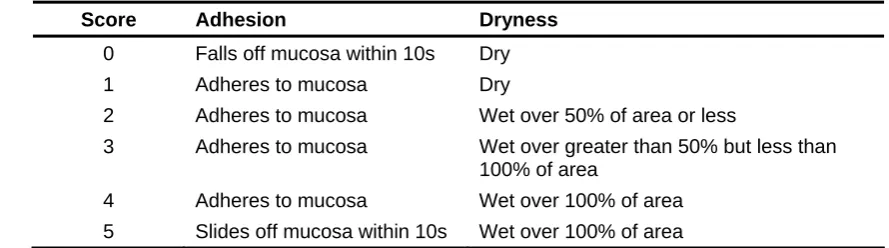
moisture was made by delineating the wet area immediately. This was later transferred to graph paper and the area of wet paper was calculated. Qualitative assessment of dryness and adhesion to the mucosa was scored as shown in Table 2.
Drinking behaviour
The horse was returned to the pen and offered water at ambient temperature from a 30L plastic container, standing in a spill tray. The following components of drinking behaviour were observed for the first 10 minutes after returning to the pen: latency to
first drink, number of broken (by raising the head above the bucket rim) and unbroken drinking bouts and average length of drinking bout. While the clinical examination
was taking place, volume of water drunk (to the nearest 0.5L) since the previous time point was measured. Water was fully replaced each time in order to minimise effects of water temperature change on drinking behaviour. Water spilled during drinking and
each time point and these volumes were subtracted from the apparent volume drunk.
Water temperature and environmental temperature and relative humidity (Vaisala HM34)
171
172 173 174
175 176
177 178 179
180 181
182 183 184
185 186
187 188 189
190 191
192 193 194
195
5
were measured at each time point. Food was withheld during the 5 hour observation period.
Blood sample
An aliquot was centrifuged and analysed immediately for PCV (Haematokrit 20)6. The remaining sample was divided between EDTA and SST II Plus vacutainers7. Serum was separated (EBA-20)6 on site and all samples were submitted to the
national reference laboratory (Aga Khan University Hospital Laboratories, Karachi) for determination of TP (Cobas Mira)8, sodium (Na+), potassium (K+) and chloride
(Cl-) concentrations (Nova 16)9 and Posm (Advance Osmometer 3D3)10.
Data analysis
Exploratory analysis showed most residuals to be Normally distributed; some parameters were log10-transformed to achieve this. First, repeatability of the skin tent
test was evaluated using a general linear model (GLM) for repeated measures, to examine the effects of anatomical position, side of animal (left/ right), repetition number and coat moisture on skin tent duration. The Tukey post hoc test was used to
test for differences between means. Based on these results, the most clinically relevant (first) skin tent was included in further repeated measures GLM taking into account
anatomical location and side of animal as blocking variables. This examined its relationship to changes in clinical parameters (HR, BCS, mucous membrane tackiness), blood parameters (PCV, TP, Posm, electrolytes), BWT and water intake
of age were also controlled for as blocking factors. Statistical analysis was performed
using Minitab 196
197 198 199
200 201
202 203 204
205 206
207 208 209
210 211
212 213 214
215 216
217 218 219
11
(v.15) and the level of statistical significance was set at p<0.05 for all analyses.
Results
Animals recruited to the study are summarised in Table 3.
Repeatability of the skin tent test within and between animals
Skin tent duration was affected significantly by age of animal, with older horses
having a more prolonged skin tent at all time points than those aged two to five years. Anatomical position, side of animal and coat moisture also had an effect on the
duration of skin tenting: the magnitude and direction of these effects are described in Table 4. There was no significant difference in duration between three repetitions of the skin tent test carried out 10 seconds apart at any anatomical location.
Drinking behaviour
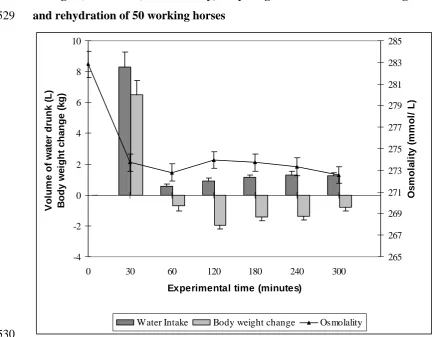
Forty-nine of the 50 horses drank water immediately on entering the pen at time 0. Water intake varied significantly over time: horses drank 8.3 (+/- 1.0) L between 0 and 30 minutes, compared with a maximum of 1.3 (+/- 0.2) L between other time
points (F (5, 245) = 48.58, p<0.001). The maximum water intake between 0 and 30
minutes was 28L and the minimum was 0 L. There were no significant effects of
environmental heat and humidity or water temperature on water intake.
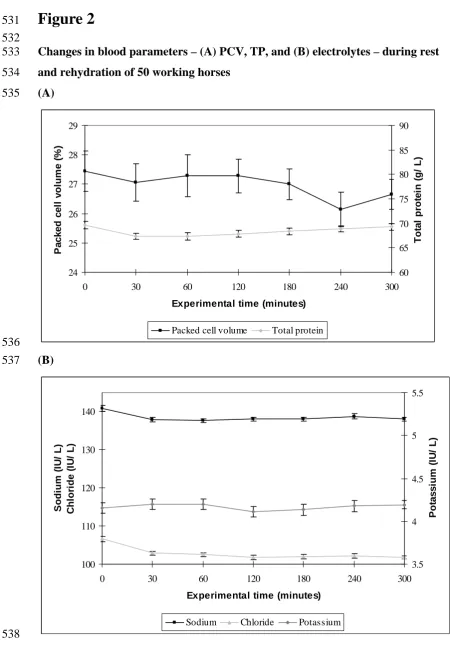
Figures 1 and 2 illustrate changes in blood parameters, body weight and water intake
over time. Mean PCV and TP values for the group of 50 horses fell between 0 and 30 minutes then rose gradually to initial levels by 300 minutes (F
220
221 222 223
224 225
226 227 228
229 230
231 232 233
234 235
236 237 238
239 240
241 242 243
(1, 295) = 9.37, p = 0.002
and F(1, 295) = 38.70, p < 0.001, respectively). Four individuals exhibited a temporary 8
to 10% fall in PCV between 30 and 120 minutes. Posm fell significantly from 283 +/-
1.2 mOsm/L to 274 +/- 0.8 mOsm/L between 0 and 30 minutes (F (6, 294) = 10.69,
p<0.001), remaining at this level until 300 minutes. There were no significant relationships between changes in PCV or TP and changes in Posm. Horses with a
higher Posm drank significantly more water (F(1,200) = 945.47, p<0.001), and had longer
(F(1,200) = 15.75, p<0.001) and more frequent (F(1,200) = 10.64, p=0.001) drinking bouts
during each subsequent observation period. However, Posm did not seem to influence
the proportion of broken to unbroken drinking bouts.Serum Na+ and Cl- followed the same pattern of changes as Posm, while K+ did not change significantly over the course
of the study. There were no significant effects of sex, age or BCS on blood
parameters.
Body weight and clinical parameters
Figure 1 illustrates the significant initial increase followed by decrease in BWT (F (6,
294) = 45.36, p<0.001) recorded over the 5-hour period. The magnitude of BWT
change was positively associated with water intake (F (1, 247) = 945.47, p <0.001) and
negatively associated with Posm (F (1, 247) = 6.24, p = 0.013). Animals with higher heart
rates drank larger volumes of water (F (1,129) = 8.01, p = 0.005). There were no other
significant relationships between Posm or water intake and any other clinical
The study found no significant relationship between Posm, PCV or TP and skin
tent duration at any anatomical location. There was no significant relationship between P
244
245 246 247
248 249 250 251
252 253
254 255 256
257 258 259
260 261
262 263 264
265 266
267 268
osm, water intake or environmental temperature and humidity and qualitative
or quantitative assessments of mucous membrane dryness.
Discussion
Body weight and blood parameters as a ‘gold standard’
Evaluation of skin tent duration and other field measures of dehydration requires a ‘gold standard’ criterion against which to compare their validity (Bland and Altman
1999). In working equids identifying this criterion has been an elusive goal for two reasons: firstly, the confounding effects of sub-clinical disease, excessive sweat electrolyte losses and poor nutrition on standard blood measures such as PCV, TP and
Posm (Pritchard et al. 2006), and secondly the lack of controlled conditions for
accurate measurement of fluid losses. Carlson (1987) recommended measurement of body weight change as an indicator of dehydration. However, Marlin et al. (1995)
described estimation of fluid losses from measurements of body weight in field situations as being subject to several errors; in particular, the inability to measure
faecal and urinary losses. In the current study it was not possible to provide food measured accurately, or calculate fluid and faecal losses, so changes in BWT were not suitable criteria against which to validate other measures. After the predicted rise at
30 minutes, BWT fell by 60 minutes to below its value at time 0 and initial BWT was not regained by 300 minutes. This suggests that the weight of ongoing faecal, urinary
Longitudinal measurement of PCV, TP, Posm and electrolytes resulted in a
clearer understanding of their relationship with water intake and skin tent duration than was provided by the previous cross-sectional study (Pritchard et al. 2006). Figure 2 shows that P
269
270 271 272
273 274
275 276 277
278 279
280 281 282
283 284
285 286 287
288 289
290 291 292
osm (with Na+ and Cl-) fell by 8 +/- 1.2 mOsm/L after the first drinking
bout and maintained a steady state until 300 minutes. This agreed with findings by Butudom et al. (2003) who observed Posm and Na+ returning to normal within 30
minutes of rehydration of horses by offering water to drink. For the current investigation, Posm was selected as the criterion against which to test the validity of
other parameters, although as discussed by Bland and Altman (1999), this does not
imply that it was a perfect measure. It is notable that only 3 out of 50 values for Posm
at time point 0 lay above the reference range established for working horses in
Pakistan (272 – 297 mOsm/L; JCP, unpublished data); therefore a single blood sample taken at a this point would not have identified dehydration. However, longitudinal assessment of falling Posm over the course of the study enabled
comparison with changes in other variables of interest.
PCV did not demonstrate a relationship with either water intake or Posm. The
significant fall in TP seen between 30 and 120 minutes was presumably caused by haemodilution, after which values returned to initial levels. This demonstrates the potential weakness of relying on PCV and TP to assess dehydration: the longitudinal
changes in these parameters seen in the present study suggested that animals were euhydrated at time 0. The 8-10% drop in PCV occurring in 4 horses after ingestion of
anaemia and tissue oxygen deprivation with sudden haemodilution to this extent
(Freitag et al. 2002). 293
294 295
296 297 298
299 300 301
302 303
304 305 306
307 308
309 310 311
312 313
314 315 316
317
Repeatability and validity of the standardised skin tent test
The major findings of this study were that the skin tent test, even when standardised in method and timed accurately using a stopwatch, was not repeatable between the
right and left sides of the animal or between the three anatomical locations tested. Changes in skin tent duration over time can not be attributed to changes in Posm or to
volume of water drunk, as no significant associations between skin tent and measures
of hydration status were found in this sample population. These results suggest that changes in skin tent may be attributable to changes in coat moisture, or to other
factors such as the apparent effect of small differences in neck position and muscle (including panniculus) movement observed in the preliminary testing periods.
Coat moisture had a highly significant effect on skin tent duration.
Investigation of this factor was prompted by an observation, made during the preliminary testing period, that a normal (rapid) skin tent in dry horses became very
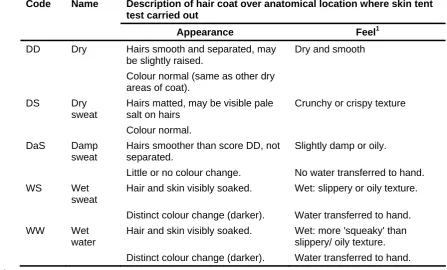
prolonged (> 15 s) when the animals were suddenly soaked with rain. In the study, the absence of rain or water on the coat meant that no animals were scored WW; however, the order of skin tent duration of DS< DD< DaS< WS suggested that coat
moisture may affect skin tent in a graded manner. This could be due to an internal or external effect of sweat production on the elastic recoil of the dermis. A recent review
of sweating in horses (Jenkinson et al. 2006) found that the myoepithelial cells of the equine subdermis appear contracted during sweating, and described the extrusion of cell vesicles and dead secretory cells, as well as large quantities of electrolytes, from
secretion from dermal sweat glands, or its gain on the skin surface, could potentially
affect skin recoil. However, this would not explain the effect of rain water seen in the pilot study.
318
319 320 321
322 323
324 325 326
327 328
329 330 331
332 333
334 335 336
337 338
339 340 341
342
Skin tents on the left side of the animal were longer than on the right. The
assessor’s right hand was used to pinch the skin at all three locations on the left side of the horse (and vice versa) so, despite practice, right-handedness may have had an
unintentional effect on the strength of the pinch and hence the duration of tenting. Harris et al. (2005) found skin tents to be longer on the right side of the neck than the left, but the laterality of the assessor was not described. There may be an additional
effect of laterality on reaction times to operate the stopwatch which was held in the opposite hand to that used for pinching. Alternatively, where carts are driven on the
left side of the road, as in Pakistan, a difference in muscle size and/or tension on the horse’s left side could cause the asymmetry of skin tent duration seen in this study.
Rose and Hodgson (2000) recommended the skin over the point of the
shoulder as more reliable than the neck for detection of dehydration; however during rehydration of the horses in the current study, no change in skin tent duration occurred
at this location. The finding that skin tent was longest over m. serratus ventralis, followed by m. brachiocephalicus and shortest, with least variability, over the point of the shoulder may be due to differences in skin tension between these locations.
Age-related differences in skin elasticity between animals may explain, at least in part, the significant effect of age on skin tent duration seen in the current investigation and
previously (Pritchard et al. 2006). Both found that younger horses had shorter skin tent times than older ones, although the age brackets varied slightly between studies.
The novel quantitative and qualitative assessments of mucous membrane dryness
made in the present study were not found to be valid measures of dehydration. Despite subjective assessment of gum dryness or tackiness being recommended in equine clinical publications as part of an assessment of dehydration (Hollis and Corley 2007,
Robinson 2003, Rose and Hodgson 2000), evidence from the current study did not support its reliability for this purpose. These findings may be due to other factors
over-riding the effect of dehydration; for example, oral mucous membrane dryness could be decreased by drinking or increased by sympathetic stimulation during mouth handling. Alternative sites, such as vaginal and ocular mucous membranes, were
investigated during preliminary testing and judged unsuitable for practical reasons, such as the high prevalence of ocular discharge in the working animal population
(Pritchard et al. 2005). 343
344 345 346
347 348
349 350 351
352 353
354 355 356
357 358
359 360 361
362 363
364 365 366
367
The pattern of drinking behaviour illustrated in Figure 1 shows that animals appeared to quench their thirst immediately on being offered water and their intake
remained low for the rest of the study period. This agrees with Butudom et al. (2003) who observed that following a 45-km endurance exercise test, horses drank as soon as
water was offered and consumed the majority of their intake within 1 to 2 minutes. Houpt et al. (1989) found that resting ponies deprived of water for 24 hours also drank to satiety within 90 seconds of gaining access to water, often in a single long
draught, and their fluid deficits were corrected precisely within 15 minutes. In the present study, the number and average duration of drinking bouts reflected Posm but
thirst did not reduce the number of times a horse raised its head while drinking, indicating that the need for vigilance or respite during bouts of drinking appears to interrupt the thirst drive for short periods. Therefore, although not ideal, water
being simple to administer and simultaneously alleviating the fluid deficit, although
there are also potential limitations where water is unavailable, or drinking is inhibited by human proximity (such as an animal in this study that would not drink in the presence of the observer) or negative alliesthesia for water. Although water intake in
this study did not appear to be affected by water temperature, voluntary replacement of fluid losses in working horses may be further improved by offering water at
optimal temperature, flavour and salinity; this is a potential area for further research. 368
369 370 371
372 373
374 375
376 377 378
379 380 381
382 383
384 385 386
387 388
389 390 391
Conclusions and potential relevance
The dual aims of this study were to define a ‘gold standard’ criterion for identifying dehydration in adult working horses and to validate simple indicators, including a
standardised skin tent test, for field use. The gold standard was defined as Posm,
subject to the limitation that in dehydrated working horses it frequently may fall within the reference range so longitudinal changes should be examined. Substantial
variability in test methodology, anatomical location and position of the animal’s head, neck and limbs when the test is carried out has made skin tent duration subjective and
difficult to interpret. The results demonstrated a lack of validity of both a highly standardised skin tent test and measures of gingival mucous membrane dryness when compared to Posm and water intake, with implications for both clinical practice and the
assessment of horses during work or competition. Use of drinking behaviour as a field assessment of hydration status constitutes diagnosis by response to treatment. This has
drink ad libitum provides both a simple diagnosis and a remedy for dehydration which
can be implemented by any person in the field. 392
393 394
395 396 397
398 399 400
401 402
403 404 405
406 407
408 409 410
411 412
413 414 415
416
Acknowledgements
This study was supported and funded by the Brooke Hospital for Animals. The
authors would like to thank Major Anwar Asim, Dr Ikram Ullah Khan, Nabi Bakhsh, Muhammad Haneef, Naseer Ahmad, and all the management and staff of Brooke Field Clinic 2 at Shahdara Fodder Market, Lahore. Thanks to Rebecca Edwards for
data collection relating to drinking behaviour. We would also like to thank all the owners who kindly permitted their animals to be used in this study.
Manufacturers’ addresses
1
Tru-test Ltd., Auckland, New Zealand.
2
Schering-Plough Animal Health, New Jersey, USA.
3
Menicon Pharma, Illkirch-Graffenstaden, France.
4
Smith Filters, Tunbridge Wells, UK.
5
Vaisala Group, Vantaa, Finland.
6
Hettich Zentrifugen, Tuttlingen, Germany.
7
BD Vacutainer, Pre-analytical Solutions, New Jersey, USA.
8
Roche Instrument Centre, Rotkreuz, Switzerland.
9
Nova Biomedical, Massachusetts, USA.
10
Advance Instruments, Philadelphia, USA.
11
417
418 419 420
421 422
423 424 425
426 427
428 429 430
431 432
433 434 435
436 437
438 439 440
References
Barton, M.H. and Moore, J.N. (1999) Fluid and electrolyte therapy. In: Equine
Medicine and Surgery, Volume 1. 5th Edition. Eds: P.T. Colahan., I.G. Mayhew, A.M. Merritt and J.N. Moore, Mosby Inc., Missouri, pp 146 - 148
Bland, J.M. and Altman, D.G. (1999) Measuring agreement in method comparison studies. Stat. Methods med. Res. 8, 135 – 160
Brownlow, M.A. and Hutchins, D.R. (1982) The concept of osmolality: Its use in the
evaluation of “dehydration” in the horse. Equine vet. J. 14 (2), 106-110
Butudom, P., Axiak, S.M., Nielsen, B.D., Eberhart, S.W. and Schott II, H.C. (2003)
Effect of varying initial drink volume on rehydration of horses. Physiol. Behav. 79, 135 – 142
Carlson, G.P. (1987) Haematology and body fluids in the equine athlete: A review. In: Equine Exercise Physiology. Eds. J.R. Gillespie and N.E. Robinson, ICEEP
Publications, Davis, California. pp 393 – 425
Dorrington, K.L. (1981) Skin turgor: do we understand the clinical sign? Lancet317
(8214), 264-266 441
442 443 444
445 446
447 448 449
450 451
452 453 454
455 456
457 458 459
460 461
462 463 464
465
Freitag, M., Standl, T., Horn, E.P., Wilhelm, S. and Esch, J.S.A. (2002) Acute
normovolaemic haemodilution beyond a haematocrit of 25%: ratio of skeletal muscle tissue oxygen tension and cardiac index is not maintained in the healthy dog. Eur. J.
Anaesth.19 (7), 487 – 494
Harris, P.A., Marlin, D.J., Mills, P.C., Roberts, C.A., Scott, C.M., Harris, R.C., Orme,
C.E., Schroter, R.C., Marr, C.M. and Barrelet, F. (1995) Clinical observations made in nonheat acclimated horse performing treadmill exercise in cool (20°C/ 40%RH), hot,
dry (30°C/ 40%RH) or hot, humid (30°C/ 80%RH) conditions. Equine vet. J. Suppl. 20, 78 - 84
Hollis, A. and Corley, K.T.T. (2007) Practical guide to fluid therapy in neonatal foals. In Practice29 (3), 130 – 137
Houpt, K.A., Thornton, S.N. and Allen, W.R. (1989) Vasopressin in dehydrated and rehydrated ponies. Physiol. Behav.45 (3), 659 – 661
Jenkinson, D.M., Elder, H.Y. and Bovell, D.L. (2006) Equine sweating and
anhydrosis: Part 1 – equine sweating. Vet. Dermatol.17, 361 – 392
Johnson, P.J. (1998) Physiology of body fluids in the horse. Vet. Clin. N. Am. -
466
467 468 469
470 471
472 473 474
475 476
477 478 479
480 481
482 483 484
485 486
487 488 489
490
Kingston, J.K., Geor, R.J. and McCutcheon, L.J. (1997) Rate and composition of sweat fluid losses are unaltered by hypohydration during prolonged exercise in horses. J. Appl. Physiol.83 (4), 1133-1143
Marlin, D.J., Harris, P.A., Schroter, R.C., Harris, R.C., Roberts, C.A., Scott, C.M.,
Orme, C.E., Dunnett, M., Dyson, S.J., Barrelet, F., Williams, B., Marr, C.M. and Casas, I. (1995) Physiological, metabolic and biochemical responses of horses competing in the speed and endurance phase of a CCI**** 3-day-event. Equine vet. J.
Suppl.20, 37 – 46
Pritchard, J.C., Lindberg, A.C., Main, D.C.J. and Whay, H.R. (2005) Assessment of the welfare of working horses, mules and donkeys, using health and behaviour parameters. Prev. vet. Med.69, 265-283
Pritchard, J.C., Barr, A.R.S. and Whay, H.R. (2006). Validity of a behavioural
measure of heat stress and a skin tent test for dehydration in working horses and donkeys. Equine vet. J. 38 (5), 433 – 438
Pritchard (2007a). Development and evaluation of welfare improvement strategies for working equids. PhD Thesis (University of Bristol), pp 87, 110
Robinson, N.E. (2003) Management of pain and dehydration in horses with colic. In:
Current Therapy in Equine Medicine, 5th Edition. Saunders, Missouri, pp 117-118 491
492 493 494
495 496
497 498 499
500 501
502 503
Rose, R.J. and Hodgson, D.R. (2000) Fluid and electrolyte therapy: Assessment of
fluid and electrolyte balance. In: Manual of Equine Practice, 2nd Edition, Eds. R.J. Rose and D.R. Hodgson, Saunders, Philadelphia, P.A., 757 – 758.
Sosa León, L.A., Davie, A.J., Hodgson, D.R., Evans, D.L. and Rose, R.J. (1995) Effects of oral fluid on cardiorespiratory and metabolic responses to prolonged
exercise. Equine vet. J. Suppl. 18, 274 – 278
Table 1
504 505 506 507
508
Qualitative assessment of coat moisture in 50 working horses. 1 'Feel' assessed by smoothing the hair once with the back of the hand immediately prior to skin tent test
Code Name Description of hair coat over anatomical location where skin tent test carried out
Appearance Feel1
DD Dry Hairs smooth and separated, may be slightly raised.
Dry and smooth Colour normal (same as other dry
areas of coat). DS Dry
sweat
Hairs matted, may be visible pale salt on hairs
Crunchy or crispy texture Colour normal.
DaS Damp sweat
Hairs smoother than score DD, not separated.
Slightly damp or oily.
Little or no colour change. No water transferred to hand. WS Wet
sweat
Hair and skin visibly soaked. Wet: slippery or oily texture. Distinct colour change (darker). Water transferred to hand. WW Wet
water
Hair and skin visibly soaked. Wet: more 'squeaky' than slippery/ oily texture. Distinct colour change (darker). Water transferred to hand.
Table 2
510 511 512 513 514
Qualitative assessment of mucous membrane dryness in 50 working horses, using
a 400mm2 square of filter paper placed on the gingival mucosa, dorsal to the
upper lateral incisor, for 10 seconds.
Score Adhesion Dryness
0 Falls off mucosa within 10s Dry 1 Adheres to mucosa Dry
2 Adheres to mucosa Wet over 50% of area or less
3 Adheres to mucosa Wet over greater than 50% but less than 100% of area
4 Adheres to mucosa Wet over 100% of area 5 Slides off mucosa within 10s Wet over 100% of area
Table 3
516 517 518
Description of 50 working horses recruited to study with a positive skin tent test
Parameter Mares (n = 43)
Stallions (n = 7)
Age
2 - 5 years 6 1
6 - 10 years 14 1
11 - 15 years 23 5
Body condition score (BCS)
2 37 7
2.5 5 0
3 1 0
Table 4
520 521 522 523 524 525
Effects of age, anatomical location, side of animal, coat moisture and repetition
on skin tent duration in 50 working horses.
1
n/s = not significant
2
not an exact F test
Variable F (df,error) Significance 1
Description/ direction of effect on skin tent duration
Age of horse F(2, 2024) =
5.442
p = 0.007 older age groups > 2 - 5 years Anatomical
location
F(2, 2024) =
899.61
p < 0.001 M. serratus ventralis > m.
brachiocephalicus > point of shoulder Side of animal F(1, 2024) =
6.98
p = 0.008 Left side > right side at all anatomical locations
Coat moisture F(3, 2024) =
37.74
p <0.001 Wet sweat > damp sweat > dry coat > dried sweat
Repetition F(2, 6241) =
1.10
n/s No difference between 3 repetitions 10 seconds apart
Figure 1
527 528 529
Changes (mean + s.e.) in osmolality, body weight and water intake during rest
and rehydration of 50 working horses
-4 -2 0 2 4 6 8 10
0 30 60 120 180 240 300 330
Experimental time (minutes)
V
o
lum
e
of
w
a
te
r dr
unk
(
L)
B
o
dy
w
e
ight
c
ha
nge
(
k
g)
265 267 269 271 273 275 277 279 281 283 285
O
s
mo
la
lit
y
(
mmo
l/ L
)
Water Intake Body weight change Osmolality
Figure 2
531 532 533 534 535Changes in blood parameters – (A) PCV, TP, and (B) electrolytes – during rest
and rehydration of 50 working horses
(A) 24 25 26 27 28 29
0 30 60 120 180 240 300
Experimental time (minutes)
P a c k e d c e ll v o lu me ( % ) 60 65 70 75 80 85 90 Tot a l pr ot e in ( g/ L)
Packed cell volume Total protein
536
537 (B)
100 110 120 130 140
0 30 60 120 180 240 300
Experimental time (minutes)
S odi um ( IU / L) C h lo rid e ( IU / L ) 3.5 4 4.5 5 5.5 P o ta ss iu m (I U / L )
Sodium Chloride Potassium