Vol. 3, No. 1 (2009)
http:/www.eludamos.org
Passionate Digital Play-Based Learning
(Re)Learning in computer games like Shadow of the Colossus
Konstantin Mitgutsch
Eludamos Vol. 3, No. 1 (2009) pp. 9-22
Copyright © by Konstantin Mitgutsch
(Re)Learning in computer games like Shadow of the
Colossus
KONSTANTIN MITGUTSCH
The power of failures and irritations for learning and experiencing is known since ancient times. Like Ulysses, the hero of Homer's epic poem the Odyssey, the protagonist learns through experiencing obstacles and suffering through unexpected actions. In this sense the ancient Greek playwright Aeschylus writes in his play "The Suppliants", how suffering is salutary:
Let Him look down on mortal wantonness! (...) Urged on by passion's shunless stress. (...) And, cheated, learns too late the prey has 'scaped their hold! (...) Zeus, who leads onward mortals to be wise. Appoints that suffering masterfully teach. (Aeschylus 525–456 B.C.)1
The ancient idea that "suffering masterfully" teaches, also known in English as "no pain, no gain", implicates one of the oldest existing concepts of learning called "matheín – patheín" learning through suffering. But the ancient understanding of
pathos is ambiguous; it implicated not just misery and suffering, but also enthusiasm and passion (cf. Meyer-Drawe 2009, Mitgutsch 2009). By experiencing antagonisms and resistance the hero is forced to change his perspectives, his prejudgements and illusions – he needs to learn anew, driven by passion. Until today this kind of learning has been related to myths, epic poetry and ancient dramas and appears old-fashioned. Compared to contemporary understanding of learning as a neuronal activity in the premotor cortex (cf. Gazzaniga 2004) or a "process of adaption by which a set of adjustable parameters is automatically modified so that some objective is more readily achieved" (Flake 2000)2, it even seems antiquated. As I will examine in this paper, quite the contrary is happening in 21st Century computer games - passionate learning becomes vivid again. As a statement about being passionately driven by playing a game - by Peter Purgathofer exemplifies, digital games provide experiences that reach back to the ancient idea of learning through suffering:
In 2004 Steven Spielberg (...) said: "I think the real indicator will be when somebody confesses that they cried at level 17" (Breznican, 2004). I wasn't prepared for this: I cried after I killed my first giant in Shadow of the Colossus. (Purgathofer 2007)
learning and playing (cf. Mitgutsch 2008). Therefore, learning based on play does not only engage the learner through entertainment and challenge, but also through confrontation and passion. On this account my contribution aims to give insights into a novel understanding of the passionate dimension of learning and combines this phenomenological concept with the general aspect of “play” in computer games, as the dimension of inordinate, creative, innovative and free playing (cf. Gee 2003) within the strict structures of games (cf. Frasca 2003, Caillois 1982). Therefore, it will show what a philosophical-educational perspective can offer a theory of learning anew or relearning, founded on the so-called negative dimension of learning (cf. Gadamer 1975, Buck 1989, Waldenfels 2002, Benner & English 2005) within the new educational game studies. Furthermore the possibilities and limits of "passionate Digital Play-Based Learning" will be reconsidered and practically examined by an analysis of the action-adventure game, exemplified through the digital game “Shadow of the Colossus” (Sony 2006). To sum up, my research questions are: What can we learn by suffering in digital games like “Shadow of the Colossus” (Sony 2006). And what kind of learning opens up the passionate dimension of playing?
Shadow of the Colossus – The Game
The same team from Sony computer entertainment that created the 2001 fantasy title ICO, created another epic style action-adventure video game called “Shadow of the Colossus” (Sony 2006). The plot of the story appears unspectacular: A young warrior - named Wander (in a first draft NICO...) rides with his horse called Agro to an ancient temple in a forbidden and remote area called Dormin, to revive his beloved girlfriend (Sherman 2006).3 The introduction to the Game shows a conversation between the hero and a godlike voice, in which he begs for the girl’s life:
Wander: Please, I need you to bring back her soul... / Dormin: That maiden's soul? Souls that are once lost cannot be reclaimed... Is that not the law of mortals? With that sword, however... it may not be impossible. / (...)/ Wander: Then what am I to do? / Dormin: In this land there exist colossi that are the incarnations of those idols. If thou defeat those colossi—the idols shall fall4
Given this task, the protagonist Wander searches for 16 colossi on the back of his horse Agro and tries to defeat them. To find each colossus Wander raises his magic sword in the sunshine to reflect beams of light, which show him the right direction of the next colossus (cf. Dunham 2005)5. The journey from one colossus to the next is without any enemies and sees the player in a varied terrain, in which one easily gets lost. Once the journey has reached its goal and a colossus is found, the player must explore its weaknesses and invent a way to defeat his opponent. The equipment to fight the colossi are only a sword and a bow, but the monsters can only be injured at specific points on their bodies, that are hard to reach and well hidden. The vague mission of defeating all 16 Colossi, that represent the fight between David and Goliath, appears to be the only possibility to revive the girl (cf. Purgathofer 2007).
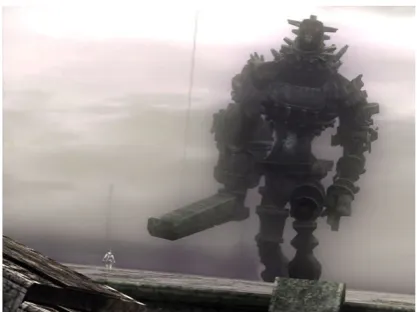
Figure 1: Cover of Shadow of the Colossus (Sony 2006)
Without focussing only on the ludological aspects, the narratives, the game design or the gameplay, I will stress a theoretical learning perspective on the process of experience within this game. Therefore I will introduce a linear and a circular understanding of learning within digital games exemplified by the action adventure “Shadow of the Colossus” (Sony 2006)
Learning based on playing games
The question as to whether playing games provides or prevents learning is as old as our habit to learn. In our daily routine but also in most theories, learning and playing are counterparts. In this common view learning is understood as a rational and reasonable act of achieving knowledge and experiences, while playing appears as an irrational and affective activity that remains pointless. The debate on whether games are a valuable tool to enrich learning is controversial. Almost 2300 years ago even Aristotle disclaimed how learning and playing fit together: »It is clear then that we are not to educate the young with a view to their amusement. Learning brings pain, and while children are learning they are not playing.« (Aristotle: The Politics, 1339 a26). Aristotle's statement in his book "The Politics" (1984) adverts to a special form of playing. He questions whether children should learn to play music, which in his understanding should be limited to gifted adults. Without challenging this curious argument I want to focus on a specific topic that he introduces: How could the phenomenon of learning in relation to playing games be understood? Because the question as to whether learning by playing is possible or not, relates to the question of how learning is understood in general.
know how learning proceeds. The reason for this circumstance is simple: If we focus on the results and the outcome of learning, the process of learning is being disguised, and contrariwise, the results are hidden, if we focus on the question of how learning proceeds. We are familiar with this problem from our own experience: We know that we have learnt something, when we have already achieved an intended knowledge. But in that moment we forget how our learning proceeded. What Günther Buck – in reference to Aristotle’s theory of epagoge (English: induction) states – is the fact that every process of learning proceeds as a path of experience (Buck 1989). And this path of experience differs from its outcome.
Every theory of learning implicates an (implicit and explicit) concept of how the movement of experience within learning proceeds, a fact that is more or less unconsidered in the field of educational game studies and educational science. To introduce the different understandings of experience paths in learning, I will – very shortly – sketch two models of learning paths. The following models are reduced to the basic theoretical assumptions in these theories of learning and provide a basis on which our model of passionate learning can be discussed:
Linear understanding of learning by games
In traditional educational institutions the enhancement of motivation for learning
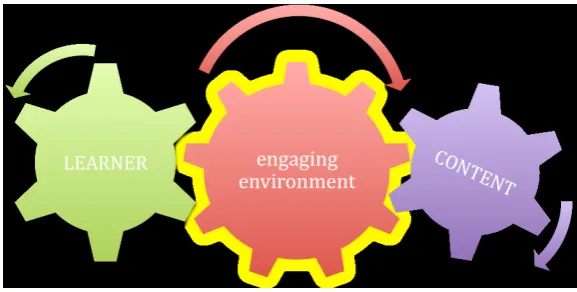
something was often reduced to a pressure to perform for someone. As Mark Prensky states: “More generally, students’ motives for learning are a mixture of intrinsic goals and extrinsic rewards, combined with psychological factors such as fear and need to please.” (Prensky 2002, p. 1) Although academic learning implies a high quality of meaningful content, the engagement of learners seems difficult to enhance. Computer games, however, engage the player in a highly significant way, but – until now – with a less substantive content. Thus, it may be concluded that learning based on games facilitates a reasonable symbiosis of meaningful content (learning) and an engaging environment (games), transformed through digital media (cf. Prensky 2001, p. 146). A typical example of a theory of learning based on games can be found within the Concept of Digital Game-Based Learning. Therefore I will shortly introduce Marc Prenskys concept of learning based on games, to give an insight, into how a typical linear understanding of learning can be outlined:
Marc Prensky states that Digital Game-Based Learning in the twenty-first century (cf. Prensky 2002) postulates a specific perspective on the process of human learning. While traditional theories of learning concentrate on the content of learning, and fathom learning under the condition of teaching, today’s typical theories focus on cognitive processes and try to locate acts of learning in the human brain. Contrary to this, an understanding of learning based on games focuses on how one learns what. Furthermore, Prensky recommends a learner-centred perspective, which focuses on the learner’s motivation to engage with a particular content. He defines learning as follows: “Human Learning is the set of processes people employ, both consciously and unconsciously, to effect changes to their knowledge, capacities and/or beliefs”
‘knowledge’ (facts, groups of facts, relationships between facts), and ‘doing’ (capacities, tasks, skills and behaviours) but also ‘beliefs’ (theories, understanding of how and why things work or happen)” (ibid.). Furthermore, Prensky stresses that the success of learning relates to the “type of material to be learned” (ibid.) and to the knowledge the learner has already achieved. The theory of Digital Game-Based Learning argues that gaming holds the ability to be completely learner-centred and to engage the learner’s attention. On the whole, Digital Game-Based Learning focuses on learning based on the condition of the learner’s motivation to engage with a certain type of content. However, it remains questionable as to whether this reduction of the human process of learning to the learner’s motivation is reasonable. To sum up, learning is understood as a set of linear processes that affect changes in the learner’s knowledge, capacities and/or beliefs (cf. Prensky 2001). So how does learning in this understanding proceed as a path of experience (Buck 1989). It can be reduced and illustrated as follows (figure 2):
Figure 2: Linear Learning in Games
The concept of Digital Game-Based Learning (DGBL) appears to be a reasonable tool in designing learning games and in explaining linear learning paths. It focuses on the intended content to be learned and uses games to open up an engaging learning environment. Therefore DGBL is useful to design and evaluate learning games that involve a linear learning structure. But is this concept capable of explaining the path of learning in a game such as “Shadow of the Colossus” (Sony 2006)?
Linear Learning in Shadow of the Colossus
• The game implies a very learner and player centred perspective.
• There is no multiplayer-modus and no online interaction.
• The learner’s motivation to engage with the "content" Colossi is extremely high.
• The “type of material to be learned”, however, is simple and unemployable:
o 16 tasks, with the same structure of challenges.
o Riddle-like challenge how to defeat the colossi.
o hardly any communication.
o no substantial knowledge involved!
o cognitive abilities are reduced to the handling of the controller
o No adaption to the knowledge the learner has already achieved in "real" life.
• The environment is barely engaging, very lonesome and uneventful.
• The gameplay is (besides killing the colossi) not fun at all, but rather long-winded
To sum up: In the sense of Digital Game-Based Learning (e.g. Prensky) “Shadow of the Colossus” (Sony 2006) lacks meaningful content and an engaging environment does not cause a change to the players knowledge, capacities and/or beliefs. In the words of an unsatisfied gamer: "Find 16 monsters, climb each one all the way to the top and stab them to death".6 The game appears to be more brutal and a boring ‘jump & run’ game, than a fruitful learning challenge. Or as another displeased gamer states: »This game's lovely graphics are the only thing that kept me from giving it a zero. The story is extraordinarily dull, the controls are too difficult, and the world of SOTC is a lonely, depressing place« (Tom C. gave it a2)7.
Players like Tom C. seem to be irritated and disgusted by this game, but they are in a minority. Most players are fascinated and engaged especially by the simplicity, the loneliness and the painful experience within the game:
On the other hand Shadow of the Colossus is hard to define because the experience is so absolutely pure that it almost defies categorization. It's you, your horse and 16 giants whom you must vanquish to save a girl who lies motionless on an altar. That's it. But it's those elements and only those elements that make Shadow so incredible captivating. (...) The proverb "Each journey begins with a single step" exemplifies the magnitude of your quest in SotC. (Vaughn8)
this perspective can be described and what kind of learning it makes visible within the game “Shadow of the Colossus” (Sony 2006) will be examined in the following chapter.
Circular and passionate understanding of learning by play
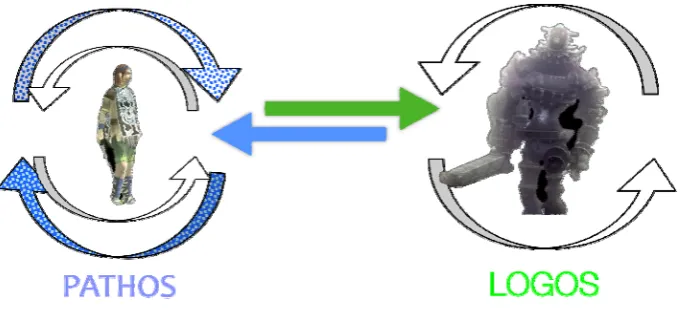
To introduce a different understanding of learning, it seems necessary to take a closer look at the word passion. As mentioned before, passion refers to the Greek phrase pathos (Greek for 'suffering' or 'experience'). Pathos implies three meanings: (1) something that happens to us, that touches us, that af-fects us. (2) something adverse, that is connected with suffering but also opens up for learning from mistakes; and (3) pathos as passion which shakes us out of our usual habits (cf. Waldenfels 2004, Mitgutsch & Sattler 2008). The counterpart of pathos is logos. Logos (Greek for 'word') refers to the internal consistency, the clarity of a claim and the logic of reasons. If something is logos-driven it focuses the rational and logical aspect of something. In our modern understanding of learning (as it may be exemplified by DGBL) the rational aspect of learning appears important, while the passionate dimension appears valueless. By contrast it will be shown that learning in its process should not only be understood as exclusively and purely logos-driven, but as driven by passion as well. Passion is a force to set experience and learning in motion. The idea of learning by suffering reaches back to the roots of our thinking about learning in general. But it sank into oblivion within our modern understanding of education. So let me reintroduce the passionate dimension of learning to you:
In the so-called negative dimension of learning, (cf. Buck 1989, Burgos 2004, Meyer-Drawe 2005, Mitgutsch 2009) learning is conceived as a "process in which one’s experience of one’s own knowledge and ignorance, ability and inability plays a central role" (Benner & English 2004, p. 412). An insight into the meaning of the negativity of experience for learning can only be given by focussing on the execution of learning as a process of achieving experience. Learning in this respect indicates that expectations and prejudgements are confronted with unexpected resistance in the process of gaining experience.
The historical roots of theories of learning and negativity reach back to Aristotle’s theories of epagoge (often translated as induction), to Franics Bacons concept of negative instances within induction and to the idea of transcendental experiences referring to Edmund Husserl. Hans-Georg Gadamer states in his book Truth and Method (1998) that the refutation of wrong generalisations through new experience is constitutional to every process of experience. He argues that the negativity of experience has a certain productive meaning to the process of gaining experience (Gadamer 1975, 353). Without explicating the theoretical background, I will focus on the path of experience that can be deduced, from these theories. This concept that I call "passionate dimension of learning", subsumes the central aspects of these theories, combined with actual phenomenological studies from Bernhard Waldenfels. So how does learning proceed in this understanding?
somewhere else in foreign parts. Before the learner becomes aware of the phenomenon – we call 'experience', – something adverse happens to him. His experience transforms into an answer to something adverse that befalls him. While the learner concentrates his attention on something that attracts him, he transforms a passionate impetus in his horizon of experience. His horizon implies several existing pre-experiences and unconscious anticipations that allow him to arrange and label any experienced impulse into a specific experience. As Bernhard Waldenfels quotes, he experiences something as something. In a circular movement, stroked by passion, his process of experience is set in motion. Now the learner starts to 'experience' the object and risks his pre-experience with an certain anticipation, thought or action. He receives new inputs, if his anticipations and preconceptions are adequate with his new experience. If the new experience is resident and heterogenic to his horizon of experiences, the horizon transforms, and he relearns, unlearns or learns anew. Within this negative dimension of the process of learning we learn:
• something new about an object
• something new about ourselves
• something new about our ways of experiencing and learning
• something new about our limits and the relativity of our experience
One who relearns moved by the passionate dimension of experiences is maybe not 'better' than he was before, but he becomes - as Gadamer say - "radically undogmatic" (Gadamer, 1975, p. 319) towards his preconceptions and unreflected pre-judgements. This aspect appears to be essential to learning in general and therefore fruitful if being enhanced by someone or something. Even by playing a game...
Learning in the Shadow of a Colossus?
Figure 3: Circular learning by playing games
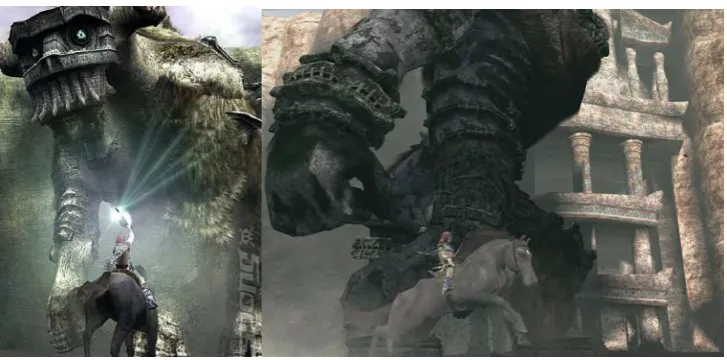
Figure 4: Invincible Enemy
The player learns how to climb onto the Colossus, how to hold onto him, while his enormous body shakes. Each step confronts the player with new unexpected movement - he tries to balance and search for ideas. He learns that he can not beat the giant, but search for his 'Achilles tendon' and after a miserable and ugly fight, he stabs his magic sword in the weak point of the Colossus. But, the victory is not at all glorious, it is rather tragic and breathtaking. It is like defeating someone innocent, who did not even offend you. Peterp states: "Killing the Colossus leads to another emotion: disappointment. There is the sight of grandeur destroyed, a feeling of being a barbarian, a sense of palpable loss that comes with each victory. Once the killing is done, there is nothing joyous about it." (Peterp, 2005)9
This statement shows that winning against an enemy, also implies a loss. A strange and hurtful experience, that explains the players’ intention to cry (cf. Purgathofer 2007). After your unglamorous victory you faint and awake next to your girlfriend’s dead body. No commendation, no points, no encouragement - just one of sixteen broken status - and the next task, to find and beat another Colossus. It is not the fun factor that gains movement in this game, not the engaging environment. It is the passion and the painful hope for something unknown. A new (but very old form) of playing and experiencing becomes vivid! Playing, Learning, Suffering... Within which the player travels from one giant to the next, never knowing what to expect or how the beat his invincible enemy. Just as in Homers Ulysses, Wander becomes involved in a never ending journey full of losses and pain. And it even becomes worse (readers, who have not played the game yet, should skip the next passage!):
an evil task, like selling your soul to the devil, to bring your beloved wife back to life. After all the victories and long travels, the player realises, that his goals were wrong. Now the Wander has lost everything - his pride, his soul, his friends and himself - his life! At least he gets killed by his own people!
Experiences like that were not related to digital games until today, they were related to myths! In Shadow of the Colossus the player learns how fallen heroes suffer, how winning in the end means losing. How clear goals might turn into unconsidered prejudgments. How inescapable experiences strike us and lead to relearning and learning anew. While playing the game, while travelling trough the lonely scenery and after realising the evil task, the players are confronted with unknown, resistant experiences, that force them to invent new ways of acting and new forms of gameplay. The players relearn and (un)learn, they suffer and are driven by passion - they learn that things might be different on a second view. It is not only through insights into the process of experience that many aspects of the passionate dimension of playing can be understood, but also by statements of the players them self:
One of the greatest traits of good literature is its ability to tell us something about ourselves as we experience it. (...) It begs us to examine the world the hero lives in and leaves us unsure of whether we made the correct choice in our interactions with nature. (...) The game should leave you wondering if you did the right thing. (Danny Webb; November 9, 2005)10
5. Potentials and Limits – a Conclusion
So what impacts can be concluded from this concept of passionate digital play-based Learning? Let us learn from a game that involves killing giants? No, not at all – let us make games and work with games that shake our believes, that open up new unexpected experiences, that use the creativity of the player and provoke unlearning, relearning and learning anew. But how?
1. Educational theories and concept of DGBL shall not only focus on the logical, rational and linear learning processes, but also on passionate circular learning paths.
2. Learning in general, but also in, by and based on playing games, involves more than achieving enriched content. It involves a process of experiencing and about learning about yourself, your anticipations and prejudgments.
3. Therefore the educational approach to 'use' games for teaching, should give the players the chance to experience something new and unexpected that might not seem fruitful at a first glance.
5. If games have the power to involve and irritate us like “Shadow of the Colossus” (Sony 2006), new forms of learning and literacy will be developed, that challenge our experiences to their limits.
To prove that not only highly sophisticated games like "Shadow of the Colossus"
(Sony 2006), but also games such as “The New Adventures of the Time Machine”
(Cryo Interactive Entertainment 2000) have the ability to provoke relearning, unlearning and learning anew:
»This game – and this turned out to be true of video games more generally – requires the player to learn and think in ways in which I am not adept. […] Oddly enough, then, confronting what was, for me, a new form of learning and thinking was both frustrating and life enhancing.« (Gee 2003, p. 5)
Learning based on playing 21st century games is possible, not just on a rational level, but also in its circular movement of experience driven by passion. Players are not just playing games they are experiencing games, and themselves. They are learning anew, relearning and unlearning by the passionate dimension of playing games. A phenomenon of great interest for education, for game design and for game studies...
References
Aeschylus: The Suppliants. Available at:
http://www.whitekit.com/playwrighter/playwrights/Ancient_Greek_Roman/
[Accessed: 15 February 2009].
Aristotle (1984) The Politics. In: Benjamin J. (ed.) The Complete Works of Aristotle, vol. 2, Princeton, 1984.
Benner, D. & English, A. (2004) “Critique and Negativity: Toward the Pluralisation of Critique in Educational Practice, Theory and Research.” Journal of Philosophy of Education (38), p. 410–428.
Buck, G. (1989) Lernen und Erfahrung – Epagogik. Zum Begriff der didaktischen Induktion [Learning and Experience – Epagogik; 3rd ed.]. Darmstadt: Wissenschaftliche Buchgesellschaft.
Burgos, R. (2004) Negativity: A Disturbing Constitutive Matter in Education. Journal of Philosophy of Education 38: 429–440.
Caillois, R. (2001) [1958] Man, Play ,Game. Chicago: University of Illinois Press. Flake, G.W. (2000) The Computational Beauty of Nature: Computer explorations of
fractals, chaos, complex systems, and adaptation. MIT Press.
Gadamer, H.-G. 1975 [1960]. Truth and Method. Trans. G. Barden and J. Cumming. New York: Continuum Press.
Gagné, R. M. (1985) The Conditions of Learning. New York: Holt, Rinehart and Winston.
Gazzaniga, M.S. (ed.) (2004) The Cognitive Neurosciences III. Cambridge, MA: MIT Press
Gee, J. P. (2003) What Video Games Have to Teach Us About Learning and Literacy. New York: Palgrave/ Macmillan.
Meyer-Drawe, K. (2005) Anfänge des Lernens. Zeitschrift für Pädagogik, 49. Beiheft, p. 24-37.
Meyer-Drawe, K. (2009) Diskurse des Lernens. Paderborn: Fink, Wilhelm. Mitgutsch, K. (2008) Digital Play-Based Learning. A philosophical-pedagogical
perspective on learning and playing in computer games. In: Special issue of the Journal for Information Technology Studies as Human Science. Human IT (9.3), p.18–36. Available at: http://etjanst.hb.se/bhs/ith//3-9/km.pdf [Accessed: 15 February 2009].
Mitgutsch, K. (2009) Lernen durch Enttäuschung. Eine pädagogische Skizze. Wien: Braumüller Verlag.
Mitgutsch, K. & Sattler, E. (2008) Learning by Passion. Tracing a Passionate Dimension within the Negativity of Learning in Philosophy of Education.
Critique and Humanism, Special Issue "Philosophy of Education and educational practice" (26): Sofia, p. 109-123.
Prensky, M. (2001) Digital Game-Based Learning. New York: McGraw-Hill. Prensky, M. (2002) The motivation of game play. The real twenty-first century
learning revolution. On the Horizon, 10(1). Available at:
http://www.marcprensky.com/writing/ [Accessed: 15 February 2009]
Prensky, M. (2003) “eNough!: Learning’ is a misnomer – it’s mostly just
‘e-Teaching.’ For any teaching to reliably and consistently produce the results we want, we still have a lot to learn about learning.” On The Horizon 11.1.
Available at: http://www.marcprensky.com/writing/ [Accessed: 15 February 2009].
Purgathofer, P. (2007) Emotion and Story in Shadow of the Colossus: A Meta-Review, Eudamos, Journal for Computer Game Culture 1(1). Available at:
http://www.eludamos.org/index.php/eludamos/article/view/10/33 [Accessed: 15 February 2009].
Waldenfels, B. (2004) Phänomenologie der Aufmerksamkeit. Frankfurt am Main: Suhrkamp.
Figures
Figure 1: Cover of Shadow of the Colossus (Sony 2006). Available at:
http://www.thedjlinkdomain.co.uk/pictures/games/shadow_of_the_colossus2b.j pg [Accessed: 15 February 2009]
Figure 4: Invincible Enemy. Available at:
http://shadowofthecolossusfans.com/files/2008/12/shadow-of-the-colossus-bso-photo1.jpg & http://www.tleaves.com/weblog/images/articles/colossus.jpg
[Accessed: 15 February 2009]
Notes
1
http://www.whitekit.com/playwrighter/playwrights/Ancient_Greek_Roman/
[Accessed: 15 February 2009].
2
http://mitpress.mit.edu/books/FLAOH/cbnhtml/glossary-L.html - learning
[Accessed: 15 February 2009].
3
http://gamasutra.com/features/20060328/sherman_01.shtml [Accessed: 15 February 2009].
4
Sony Computer Entertainment. Shadow of the Colossus. PlayStation 2
5
http://www.computerandvideogames.com/article.php?id=130289&site=psw
[Accessed: 15 February 2009].
6
http://www.computerandvideogames.com/article.php?id=130289&site=psw
[Accessed: 15 February 2009].
7
http://apps.metacritic.com/games/usercomments.jsp?id_string=5159: WREeN2hMofPZrOW8EtdlZA** [Accessed: 15 February 2009].
8
http://cheatcc.com/psx2/rev/shadowofthecolossusreview.html [Accessed: 15 February 2009].
9
http://tleaves.com/weblog/archives/000496.html [Accessed: 15 February 2009].
10