R E S E A R C H
Open Access
Characterization of a biogas-producing microbial
community by short-read next generation DNA
sequencing
Roland Wirth
1, Etelka Kovács
1, Gergely Maróti
2,3, Zoltán Bagi
1, Gábor Rákhely
1,4and Kornél L Kovács
1,4*Abstract
Background:Renewable energy production is currently a major issue worldwide. Biogas is a promising renewable energy carrier as the technology of its production combines the elimination of organic waste with the formation of a versatile energy carrier, methane. In consequence of the complexity of the microbial communities and metabolic pathways involved the biotechnology of the microbiological process leading to biogas production is poorly understood. Metagenomic approaches are suitable means of addressing related questions. In the present work a novel high-throughput technique was tested for its benefits in resolving the functional and taxonomical complexity of such microbial consortia.
Results:It was demonstrated that the extremely parallel SOLiD™short-read DNA sequencing platform is capable of providing sufficient useful information to decipher the systematic and functional contexts within a
biogas-producing community. Although this technology has not been employed to address such problems previously, the data obtained compare well with those from similar high-throughput approaches such as 454-pyrosequencing GS FLX or Titanium. The predominant microbes contributing to the decomposition of organic matter include members of the Eubacteria, class Clostridia, order Clostridiales, family Clostridiaceae. Bacteria belonging in other systematic groups contribute to the diversity of the microbial consortium. Archaea comprise a remarkably small minority in this community, given their crucial role in biogas production. Among the Archaea, the predominant order is the Methanomicrobiales and the most abundant species isMethanoculleus marisnigri. The Methanomicrobiales are hydrogenotrophic methanogens. Besides corroborating earlier findings on the significance of the contribution of the Clostridia to organic substrate decomposition, the results demonstrate the importance of the metabolism of hydrogen within the biogas producing microbial community.
Conclusions:Both microbiological diversity and the regulatory role of the hydrogen metabolism appear to be the driving forces optimizing biogas-producing microbial communities. The findings may allow a rational design of these communities to promote greater efficacy in large-scale practical systems. The composition of an optimal biogas-producing consortium can be determined through the use of this approach, and this systematic methodology allows the design of the optimal microbial community structure for any biogas plant. In this way, metagenomic studies can contribute to significant progress in the efficacy and economic improvement of biogas production.
Keywords:Biogas, Next-generation sequencing, DNA, Microbial community structure, Bacteria, Methanogens, SOLiD™, Metagenomics, Hydrogen metabolism
* Correspondence:[email protected] 1
Department of Biotechnology, University of Szeged, Középfasor 52 Szeged H-6726, Hungary
4
Institute of Biophysics, Biological Research Center, Hungarian Academy of Sciences, Temesvári krt. 62, Szeged H-6726, Hungary
Full list of author information is available at the end of the article
Background
The utilization of fossil fuels on a global scale is limited by the availability of these resources and by the environ-mental effects of their excessive exploitation. The produc-tion of renewable energy carriers is therefore currently receiving increasing attention worldwide. Biogas is a promising candidate as the technology of its production may combine the treatment of various organic wastes with the generation of an energy carrier for the most versatile applications [1-4]. Biogas can be converted to heat and/or electricity, and its purified derivative, biomethane, is suit-able for every function for which fossil natural gas is used today. The decomposition of organic materials by a micro-bial community is carried out under anaerobic conditions [5]. The great variety of diverse microbes that participate in the microbial food chain gradually degrade the complex molecules essentially to a mixture of CH4and CO2[6-9]. The actions of the various microbes, involving members of the Eubacteria and Archaea, are coordinated by envi-ronmental and internal factors. The composition of this microbial consortium depends on various factors, such as substrate ingredients, temperature, pH, mixing, or the geometry of the anaerobic digester. A clear understanding of the organization and behavior of this multifarious com-munity is crucial for optimization of their performance and attainment of the stable operation of the process. Classical microbiological methods are principally based on studies of isolated pure strains of microbes, and hence are of little help when the goal is elucidation of the relation-ships among members of a complex microbial consortium in order to improve the overall performance.
The developent of high-throughput sequencing tech-nologies has opened up new avenues for such investiga-tions. Methods with which to reveal the compositions of microbial communities, based on the generation of 16 S rRNA gene clone libraries and Sanger sequencing of the 16 S rDNA amplicons, have recently been devised [10-13]. Archaeal community members have been iden-tified and semi-quantitatively enumerated through the use of the mcrA gene, which codes for one of the key enzymes in methanogenesis, the α-subunit of methyl-coenzyme M reductase occurring uniquely in methano-gens [14]. Alterations in the organization of methanogenic communities under various conditions have been reported on the basis of this phylogenetic marker [15-19].
The automated Sanger sequencing approach is fre-quently referred to as “first generation sequencing”. The past few years have brought important technical break-throughs and the“next-generation sequencing”techniques have been developed. A common feature of these meth-ods, which employ various chemical reactions for the rapid determination of DNA sequences [20,21], is the pro-duction of huge databases prepared from relatively short sequence fragments and the use of sophisticated
bioinformatics to analyze the results [22]. This metage-nomic approach allows the real-time study of live consor-tia in various environments through identification of the members of these communities [23-25] and/or determin-ation of the relative abundances of particular physiological functions, reflected in the occurrence of specific enzymes [26-28]. Currently the most widespread next-generation se-quencing method employs 454-pyrosese-quencing procedures for metagenomic purposes (Roche). This technique has been used for the characterization of biogas-producing communities [29-33], among numerous other applications. A fundamentally different methodology is offered by the SOLiD™(sequencing by oligo ligation and detection) tech-nology (Applied Biosystems). As indicated by its name, SOLiD™is based on a ligation reaction and each nucleotide is interrogated twice, which significantly reduces the poten-tial errors arising from misreading and thereby improves the reliability of the data [34,35]. Since its introduction onto the market in 2007, a number of systems have been investigated with the SOLiD™method [36-39], but as far as we are aware biogas-producing microbial communities have not been analyzed by SOLiD™ so far. Besides its ex-ceptional accuracy, the fundamental differences as com-pared with the 454-pyrosequencing approach are the extremely high throughput of the SOLiD system (200 Gb/ run) and the short-read technology (50–75 nucleotides/ read).
The aim of the present study was to determine the possi-bility of applying this short-read next-generation sequen-cing technology to characterize the composite microbial consortium developing in a biogas fermenter and to test whether the results validate those obtained by using the pyrosequencing approach. Samples were taken from an an-aerobic fermenter fed primarily with plant biomass and pig manure slurry so that the conclusions could be compared with those drawn from other data sets relating to distinct anaerobic degradation processes with similar substrates.
Results and discussion
Distribution of metabolic functions in the microbial community
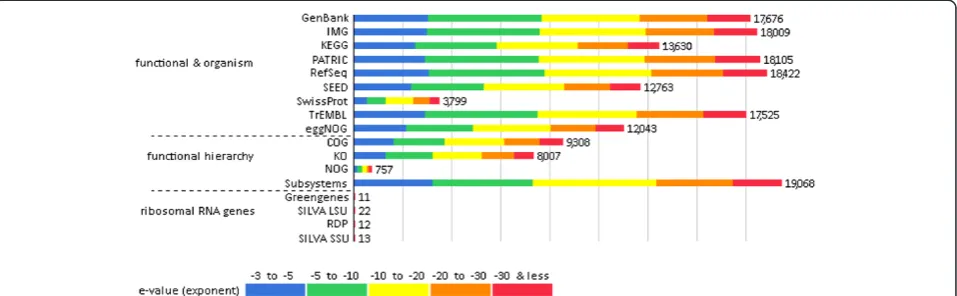
In order to gain an insight into the diverse biochemistry of the biogas-producing community, the short DNA sequences generated by parallel sequencing were used to create environmental gene tags (EGTs) and clusters of orthologous groups of proteins (COGs). The raw sequence reads of about 50 bp were assembled into contigs by using the CLC Bio Genomics Work Bench software [40]. The generated contigs were uploaded to the MG-RAST server, where the data were automatically normalized, processed and evaluated. Those that passed the quality control (see Materials and Methods) were aligned to sequences stored in a number of public databases [41]. This permits
reflects the reliability of the results. 26,895 contigs passed the quality control. The contigs were trans-lated into proteins, yielding 13,545 (52%) predicted protein sequences. 12,441 (91%) of the annotated fea-tures could be placed in the functional hierarchy. In this way, the DNA sequences from the SOLiD™ reads could be linked to metabolic functions. The results are depicted in Figure 2.
Most of the COGs are linked to information storage and the basic metabolisms of the organic macromolecules (proteins, nucleic acids, lipids, and carbohydrates). Simi-larly, a large number of COGs related to the biosynthesis of basic cell components, such as cell wall material, vita-mins, protective mechanisms and stress responses. These functions are required for the appropriate performance of the community, and therefore are expected to manifest Figure 1Source hit distribution. Legend: The graph displays the number of features in our examined dataset that were annotated by the different databases: GenBank- National Institutes of Health Genetic Sequence Database, IMG- Integrated Microbial Genomes at the Joint Genome Institute, KEGG- Kyoto Encyclopedia of Genes and Genomes, PATRIC- Pathosystems Resource Integration Center, RefSec- National Center for Biotechnology Information Reference Sequences Database, SEED- The SEED Project, SwissProt- Swiss-Prot Uniport Knowledgebase, TrEMBL-TrEMBL Uniport Knowledgebase, eggNOG- evolutionary genealogy of genes: Non-supervised Orthologous Groups, COG- eggNOG: Clusters of Orthologous Groups, KO- KEGG Orthology, NOG- eggNOG: Non-supervised Orthologous Groups, Subsystems- SEDD Subsystem Annotation, Greengenes- 16 S rRNA Gene Database, SILVA LSU- SILVA Large Subunit rRNA Database, RDP- Ribosomal Database Project, SILVA SSU- SILVA Small Subunit rRNA Database. The bars represent annotated reads, which are colored according to their e-value range.
themselves. The high numbers of protein and DNA me-tabolism COGs suggest that the cells are mostly active. Energy generation and storage are further representations of important functional groups of COGs. These findings are in line with previous studies which indicated that the housekeeping mechanisms and carbohydrate metabolism are predominant. Among the genes involved in the carbo-hydrate metabolism, those that degrade cellulose are par-ticularly important for the efficient breakdown of the cellulosic biomass substrate. The 16 S rDNA hits and COGs demonstrated that the Firmicutes phylum is of out-standing importance in cellulose degradation by the biogas microbial community, corroborating earlier findings [29-31,42].
Taxonomic profile of the biogas microbial community The assembled contigs were subjected to taxonomic ana-lysis through use of the MG-RAST server [43]. The results
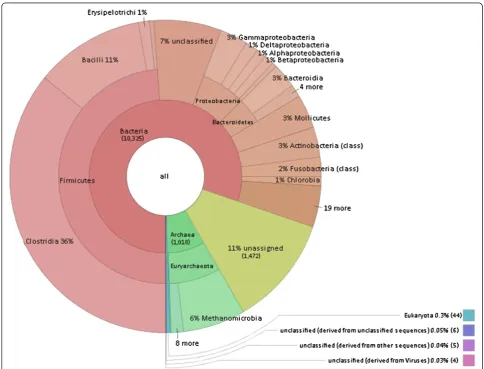
were filtered for e-values, percentages of homology and lengths of homology. The ensuing identification and abun-dance list clearly showed that prokaryotes comprised the most abundant domain; the predominant systematic groups were the Bacteria and Archaea (Figure 3). Within the Bac-teria domain, the Firmicutes phylum proved most abun-dant. The classes Clostridia and Bacilli belonging in this phylum accounted for the majority of the Bacteria in the biogas fermenter. In the Archaea domain, the Methanomi-crobiales family provided a preponderance of the identified species. Members of the above-mentioned systematic groups have been identified previously in the anaerobic digestion of maize silage and silage supplemented with ani-mal manure [29-31,42]. It should be noted that a number of sequence reads did not exhibit homology to any of the known and sequenced microbial species, which implies the presence of numerous so far unidentified microbes in bio-gas fermenters.
The bacteria domain
More than 1,000 representatives of the Bacteria domain were identified in the metagenomic database.
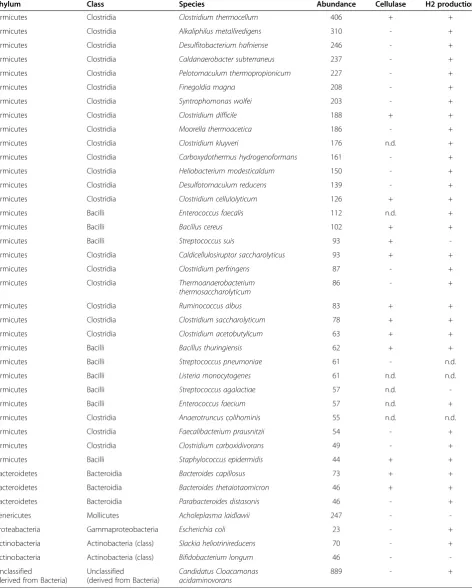
The first step in the anaerobic degradation of complex organic substrates involves the breakdown of large mole-cules by hydrolysis [45,46]. Certain communities of bac-teria are capable of the efficient hydrolysis of plant biomass rich in lignocellulose. Most of these bacteria belong in the classes of the Clostridia and Bacilli. As expected, the over-whelming majority of the identified abundant species in our biogas fermenter were members of the Clostridia (36%) and Bacilli (11%) classes, together with members of the Bacteroidia (3%), Mollicutes (3%), Gammaproteobac-teria (3%) and ActinobacGammaproteobac-teria (3%) classes (Figure 3). Un-assigned and unidentified sequences were ignored in this analysis. The most abundant identified species are listed in Table 1. and the presence or absence of cellulose degrading activity and hydrogenase enzymes is indicated.
Among the Clostridia, Clostridium thermocellum oc-curred most frequently. This species can hydrolyze cellu-lose efficiently by means of its extracellular cellulases, which are organized into cellulosomes [47,48]. An out-standing member of this class is C. kluyveri, which is unique among the Clostridia, because it uses ethanol and acetate as sole energy sources and converts these substrates to butyrate and H2 [49]. A prominent and well-characterized species is C. acetobutylicum, which exerts cellulolytic, saccharolytic and H2-producing activ-ities. The fermentation pathways may yield organic acids such as acetate and butyrate (acetogenesis), or acetone, bu-tanol and ethanol (solventogenesis) [50,51]. C. perfingens generates lactate, acetate and butyrate from sugars, and through its [FeFe]-hydrogenase, it can also produce H2 [52]. Similarly to C. thermocellum, C. cellulolyticum is a well-known strain that degrades cellulose to acetate and evolves CO2and H2[53].C. saccharolyticumadditionally possesses cellulolytic activity. The fermentation products include acetate, ethanol, H2 and CO2 [54]. C. difficile is one of the rare pathogens [55] found in a biogas commu-nity. Thermoanaerobacterium thermosaccharolyticumis a H2-producing bacterium that has been reported to live in co-culture with C. thermocellum, the mixed culture producing more H2than the pure cultures [56,57].
Rumi-nococcus albus has been noted for its efficient
cellulose-degrading activity by cellulosomes; the major fermentation product is ethanol [58]. Both Anaerotruncus colihominis
and Faecalibacterium prausnitzki colonize the intestine
and produce various volatile organic acids from glucose and acetate, respectively [59,60].
Besides being capable of reductive dechlorination,
Desulfitobacterium hafniense can produce sulfide from
thiosulfate or sulfite, but cannot reduce sulfate. As car-bon source it prefers to ferment pyruvate and lactate. This species is also known to contain Hup
(hydrogen-uptake) type of [NiFe]-hydrogenases [61]. Heliobacterium
modesticalum can grow in either photoheterotrophic or
chemotrophic mode. Under chemotrophic conditions it ferments acetate to H2and CO2. It also contains a number of hydrogenases, including [NiFe]- and [FeFe]-hydrogenases [62]. H2 and acetate are generated by Caldanaerobacter
subterraneusfrom lactose, glucose or cellobiose as substrate
[63]. Syntrophomonas wolferi ferments long-chain fatty acids and lives in co-culture with methanogenic Archaea [64]. Pelotomaculum thermopropionicumtoo forms a syn-trophic relationship with methanogens, and its abundance in the anaerobic digester community is therefore reason-able. The syntrophic associations play important roles in efficient biogas formation [65]. The unique members of the Clostridia class,Alkaliphilus metalliredigensand
Desulfoto-maculum reducens, were detected in unexpectedly high
amounts. These bacteria are known to use lactate and acetate as electron sources for the reduction of iron and co-balt in anaerobic respiration [66]. Although it may not be trivial to explain the occurrence of metal-reducing bacteria in an anaerobic biogas-producing community, it should be noted that these bacteria also possess highly active [FeFe]-hydrogenases [67]. Caldicellulosiruptor saccharolyticusis a cellulose-degrading and H2-producing bacterium. Addition of a pure culture of C. saccharolyticus to sewage sludge, plant biomass, animal manure or a mixture of these sig-nificantly increased the extent of biogas production [68].
Finegoldia magnahas noteworthy substrate specificity, as it
can utilize only fructose from among a range of sugars, and produces acetate [69].F. magnaalso carries the genes for a putative hydrogenase [70]. The large number and propor-tion of members of the Clostridiales order are indicative of the important role of these bacteria in the proper function-ing of the microbial community in an anaerobic digester fed with complex substrates. Their contribution to the breakdown of polysaccharide molecules may be explained by the high cellulolytic activity of numerous members of the Clostridiales order, and members of the Clostridiaceae family are capable of performing diverse fermentation path-ways. They primarily ferment sugars to organic acids [71]. The Wood-Ljungdahl pathway, also known as the reductive acetyl-CoA pathway, plays an important role in this process, which is typical in acetogenic bacteria and in some Archaea [72]. In this process, CO2is reduced to CO and then con-verted to acetyl-CoA, H2serving as electron donor [73]. In the anaerobic digester, the aceticlastic Archaea split acetate to CH4and CO2in an energy gaining process [74]. Besides the acetogenic Clostridia discussed above,Moorella
thermo-acetica and Carboxidothermus hydrogenoformans also
ob-tain energy via the Wood-Ljungdahl pathway. It should additionally be noted that a large number of Clostridia actively produce H2, an important substrate for the hydro-genotrophic methanogens. It is noteworthy thatCr.
Table 1 The 40 most frequently found microbial species in the Bacteria domain
Phylum Class Species Abundance Cellulase H2 production
Firmicutes Clostridia Clostridium thermocellum 406 + +
Firmicutes Clostridia Alkaliphilus metalliredigens 310 - +
Firmicutes Clostridia Desulfitobacterium hafniense 246 - +
Firmicutes Clostridia Caldanaerobacter subterraneus 237 - +
Firmicutes Clostridia Pelotomaculum thermopropionicum 227 - +
Firmicutes Clostridia Finegoldia magna 208 - +
Firmicutes Clostridia Syntrophomonas wolfei 203 - +
Firmicutes Clostridia Clostridium difficile 188 + +
Firmicutes Clostridia Moorella thermoacetica 186 - +
Firmicutes Clostridia Clostridium kluyveri 176 n.d. +
Firmicutes Clostridia Carboxydothermus hydrogenoformans 161 - +
Firmicutes Clostridia Heliobacterium modesticaldum 150 - +
Firmicutes Clostridia Desulfotomaculum reducens 139 - +
Firmicutes Clostridia Clostridium cellulolyticum 126 + +
Firmicutes Bacilli Enterococcus faecalis 112 n.d. +
Firmicutes Bacilli Bacillus cereus 102 + +
Firmicutes Bacilli Streptococcus suis 93 +
-Firmicutes Clostridia Caldicellulosiruptor saccharolyticus 93 + +
Firmicutes Clostridia Clostridium perfringens 87 - +
Firmicutes Clostridia Thermoanaerobacterium
thermosaccharolyticum
86 - +
Firmicutes Clostridia Ruminococcus albus 83 + +
Firmicutes Clostridia Clostridium saccharolyticum 78 + +
Firmicutes Clostridia Clostridium acetobutylicum 63 + +
Firmicutes Bacilli Bacillus thuringiensis 62 + +
Firmicutes Bacilli Streptococcus pneumoniae 61 - n.d.
Firmicutes Bacilli Listeria monocytogenes 61 n.d. n.d.
Firmicutes Bacilli Streptococcus agalactiae 57 n.d.
-Firmicutes Bacilli Enterococcus faecium 57 n.d. +
Firmicutes Clostridia Anaerotruncus colihominis 55 n.d. n.d.
Firmicutes Clostridia Faecalibacterium prausnitzii 54 - +
Firmicutes Clostridia Clostridium carboxidivorans 49 - +
Firmicutes Bacilli Staphylococcus epidermidis 44 + +
Bacteroidetes Bacteroidia Bacteroides capillosus 73 + +
Bacteroidetes Bacteroidia Bacteroides thetaiotaomicron 46 + +
Bacteroidetes Bacteroidia Parabacteroides distasonis 46 - +
Tenericutes Mollicutes Acholeplasma laidlawii 247 -
-Proteabacteria Gammaproteobacteria Escherichia coli 23 - +
Actinobacteria Actinobacteria (class) Slackia heliotrinireducens 70 - +
Actinobacteria Actinobacteria (class) Bifidobacterium longum 46 -
-Unclassified
(derived from Bacteria)
Unclassified
(derived from Bacteria)
Candidatus Cloacamonas acidaminovorans
889 - +
donor and water as an electron acceptor, to produce acetate and H2[75,76]. BothCr. hydrogenoformansandM.
thermo-acetica are capable of H2production [77]. The
predomi-nance of the Clostridia in the anaerobic digester community triggers the activity of the hydrogenotrophic methanogens, which must keep the H2partial pressure in the system low in order to ensure system stability [78]. The delicate balance between the Clostridia and hydrogeno-trophic methanogens must be a determining factor within the biogas-producing microbial consortium (Figure 3).
The second largest group of bacteria in the anaerobic degradation community is the class of Bacilli in the Bac-teria domain. The most abundant species from this class in our fermenters was Enterococcus faecalis. This strain, an anaerobic Gram-positive bacterium found in the di-gestive system, is able to hydrolyze plant polysaccharides and possesses hydrogenase activity in its formate de-hydrogenase complex [79].E. faeciumis also common in the gastrointestinal system. These microbes convert car-bohydrates such as fructose, maltose, lactose and galac-tose to acetate and ethanol [80,81]. Bacillus cereus and
B. thuringiensiscan carry out both aerobic and anaerobic
metabolism. Under anaerobic conditions, B. cereus fer-ments glucose to a mixture of acetate, lactate and ethanol, while B. thuringiensis produces mostly lactate [82,83].
Streptococcus pneumoniais a pathogen that converts
glu-cose to lactate [84]. Its relativeS. suiscan ferment glucose, lactose, maltose and trehalose to a mixture of volatile fatty acids [85], whileS. agalactiae also generates ethanol be-side the volatile acids [86,87]. Additional pathogenic Ba-cilli detected in the anaerobic digester community, though in low abundance, include Staphylococcus epidermis and
Listeria monocytogenes[88].
Over and above the members of the Clostridia and Ba-cilli classes discussed above, the study revealed add-itional members of the microbial systematic groups in the biogas-producing community, though their contribu-tion to the microbiological food chain is probably lim-ited relative to that of the Clostridia and Bacilli. Bacteroidia species were identified in meaningful quan-tities. Members of the Bacteriodia are common in nature at sites where degradable organic material is to be found, such as plants and other forms of biomass. Bacteroides
capillosusis an intestinal bacterium that ferments lactate
and produces H2, and also displays cellulolytic activity [89]. As an outstanding example of human-bacterium symbiosis, Bacteroides thetaiotamicron is a constituent of the intestinal flora, which specializes in hydrolyzing polysaccharides of plant origin, i.e. cellulose and starch, as carbon sources [90,91]. Parabacteroides distasionisis a Gram-negative, non-spore-forming bacterium that produces volatile organic acids [92].
The members of the Mollicutes are facultative anae-robes. Under anaerobic conditions, they produce organic
acids, which may be utilized by the acidoclastic metha-nogens [93]. Acoleplasmatales is the most abundant among the relatively few Mollicutes class members.
Aco-leplasma laidlawii ferments glucose to produce lactic
acid, saturated fatty acids and acetate [94]. All these fer-mentation products are subsequently converted to bio-gas by the acetoclastic Archaea in the methanogenic consortium. Although Gammaproteobacteria are fre-quently found in diverse habitats, they do not appear to dominate in the biogas-producing community.
Escheri-chia coli, one of the most widespread and certainly the
most thoroughly studied bacterium, was present in the anaerobic community.E. coli, a facultative anaerobe, has a highly versatile metabolism. Under anaerobic condi-tions, it produces lactate, succinate, ethanol, acetate, H2 and CO2 in a mixed acid fermentation [95]. Various [NiFe]-hydrogenases are involved in the metabolism of H2 , and a syntrophic relationship often develops with H2 consumers in order to keep the H2partial pressure low in the entire system [96]. Members of the Actino-bacteria class are commonly found in soils and natural waters. Some of them effectively break down complex organic material such as cellulose, and thereby play an important role in the carbon cycle [97]. Furthermore, members of this group are known to produce lignin-degrading enzymes [98]. Two species of Actinobacteria were identified in our biogas fermenter samples:Slackia
heliotrinireducensandBifidobacterium longum. Sl.
helio-trinireducens is a Gram-positive anaerobic bacterium
which can reduce nitrate to ammonia if there are elec-tron donors (H2or formate) in the system. This organ-ism has also been reported to produce acetic acid and lactic acid, and contains a hydrogenase [99,100]. Bf.
longum is a Gram-positive bacterium found as a
sym-biont in the human normal intestinal flora [101]. It metabolizes oligosaccharides and releases lactic acid, which helps control the normal microflora.
In addition to the known phylogenetic categories, 7% of the sequences belong to the Bacteria domain, but lacks detailed classification. In this group candidatus
Cloacamonas acidaminovoranswas found in remarkably
high abundance. This species was also identified in sev-eral anaerobic digester microflora [31,102].c. Cm.
acida-minovorans gains energy from sugars in the
Embden-Meyerhof pathway and from the fermentation of amino acids. It is a fermentative H2 producer, containing a [FeFe]-hydrogenase, which is an indication of syntrophic metabolism [103].
The archaea domain
fermentors [106]. The hydrogenotrophic Archaea are capable of reducing CO2 to CH4, H2 being used as an electron donor. The CO2-reducing pathway starts with the formation ofN-carboxymethanofuran from CO2and the C1-carrier methanofuran, which is subsequently reduced to formyl-methanofuran. The reductant is pro-vided from reduced F420 (8-hydroxy-5-deazaflavin) and hydrogenases. The central electron carrier in hydrogeno-trophic methanogenesis is coenzyme F420 [107]. As the first step in the inverse Wood-Ljungdahl pathway, ace-tate is activated to acetyl-CoA with the participation of phosphotransacetylase and acetate kinase in acetotrophs
[108]. Carbon monoxide dehydrogenase (CODH)
then breaks down acetyl-CoA to CO, a methyl group and CoA [109]. CO is oxidized to CO2, which gener-ates the electrons for reduction of the methyl radical to CH4 [110].
Around 10% of the identified microbes in the biogas-producing community belonged in the Archaea (Figures 3 and 4). This correlated well with findings in previous stud-ies [30,42]. In the domain of the Archaea the Methanomi-crobiales order predominates in the community. Within this order, the most abundant species is Methanoculleus
marisnigri [111]. Interestingly, the same Archeon has
been found in several methanogenic consortia [112,113].
M. marisnigriJR1 is the only member of the
Methanocul-leus genus, which has been sequenced so far [114], and it
cannot be excluded that several members of the same genus produce the high abundance of Methanoculleus -related reads [42]. BesidesMethanoculleus, other represen-tatives of Methanomicrobiales contribute to the plethora of hydrogenotrophic methanogens, e.g. Methanospirillum
hungatei[115],Methanosphaerula palustris[116],
Metha-noregula boonei [117], Methanocorpusculum labreanum
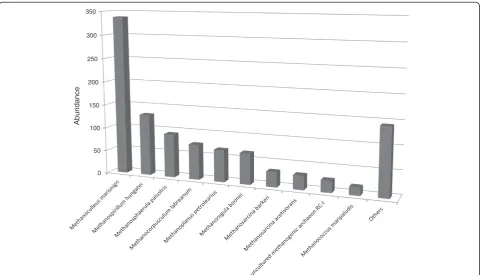
[118] and Methanoplanus petrolearius [119]. From the class of Methanococci, Methanococcus maripalidusis also a hydrogenotrophic methanogen [120] (Figure 5). Among the aceticlastic methanogens,Methanosarcina acetivorans [121] was present in a relative majority. An unidentified archaeon detected among rice rhizophere methanogens was also found in the anaerobic biogas community. This species was described as having a unique aerotolerant H2/ CO2 dependent lifestyle and enzymes for carbohydrate metabolism and assimilatory sulfate reduction [122].
The predominance of the hydrogenotrophic methano-gens strongly suggests that methane is generated mainly by the hydrogenotrophic pathway and aceticlastic methan-ogenesis plays a secondary role in the anaerobic digestion process (Figures 3 and 4.). H2is produced for the hydroge-notrophic methanogens by the acetogens,e.g.Clostridia as shown above, or by syntrophic acetate oxidation [103, 123,124]. At any rate the close proximity of the participat-ing microbes and the very delicately balanced H2 metabol-ism are a must in these communities in order to keep the
0 50 100 150 200 250 300 350
Abundance
H2 concentration low and favor CH4 formation [68,106]. Acetate stimulates the growth ofMethanospirillum hunga-tei [115], Methanosphaerula. palustris [117],
Methanore-gula boonei [118], Methanocorpusculum labreanum[118],
Methanococcus maripalidus[118] andMethanoplanus
pet-rolearius[119]. In contrast,Methanoculleus marisnigrican
only use CO2 as carbon source [110]. Accordingly, ad-equate acetate supply is required for the growth of hydroge-notrophic and aceticlastic methanogenesis and syntrophic acetate oxidizers [103,118,119,121].
All of the identified Methanomicrobiales possess H2 -activating membrane-associated hydrogenases [42,117,119, 125], and the relative wealth of hydrogenase-specific DNA reads corroborates the importance of these enzymes in the anaerobic degradation of organic material (Table 1 and Figure 5). Although the contributions of Eubacteria and Ar-chaea cannot be distinguished in Figure 5, the widespread presence of H2-activating enzymes underlines their import-ance in the physiology of the biogas-producing community. A highly efficient interspecies H2transfer [126] must take place between the H2-forming and consuming partners.
Besides the hydrogenases other genes encoding important redox proteins and likely to be connected to H2metabolism were detected in the biogas fermenter,e.g.coenzyme M het-erodisulfide heptanyl threonine phosphate (CoM-S-S-HTP) oxidoreductase, formate dehydrogenase and coenzyme F420 hydrogenase. CoM-S-S-HTP oxidoreductase catalyzes the conversion of CoM-S-S-HTP to HS-HTP (7-mercapto-heptanyl-L-threonine phosphate), which is a unique meth-anogenic cofactor in all methanogens [127]. Formate dehydrogenase extracts the hydrogen from formate and releases CO2 [128]. Reduced F420 is oxidized by a mem-brane bound electron transport system. When F420is oxi-dized, an equimolar amount of CoM-S-S-HTP is reduced. CoM-S-S-HTP oxidoreductase is common in all methano-gens but formate dehydrogenase and coenzyme F420 are only typical to hydrogenotrophic methanogens [108].
Comparison of the 454-pyrosequencing and SOLiD™ metagenomic results
Previous studies designed to improve the understanding of microbial communities in biogas-producing anaerobic digestors, based on next-generation sequencing methods,
relied exclusively on the pyrosequencing technique [29-31,42]. The substrates fed into the fermentors included ani-mal manure and green plant biomass (maize or green rye silage), commonly employed in German biogas facilities. Our laboratory fermenters were fed with a substrate mix with a similar composition, but our operational parameters, sample handling, DNA extraction protocols and sequence data collection and analysis methods were different.
The SOLiD™sequencing method produces short indi-vidual reads (50 nucleotides) in a significantly higher number than does pyrosequencing. We have generated and analyzed 23,897,590 individual reads representing 1,194,879,500 bases. In previous studies, two versions of 454-pyrosequencing were employed and compared: GS FLX and Titanium [12]. The latter provides somewhat longer reads and increased throughput relative to GS FLX (454 GS FLX resulted in 616,072 sequence reads with an average read length of 230 bases, while Titanium resulted in 1,347,644 reads with an average read length of 368 bases). As a general rule of thumb, the longer the read sequence and the higher the number of indepen-dent reads, the more reliable the data.
displayed a good correlation. Strains noted for their highly efficient polysaccharide degradation capabilities, such as
Clostridium thermocellum,C. cellulolyticumand
Caldicel-lulosiruptor saccharolyticus, are found to be the most
abundant, regardless of the sequencing method used for their identification.
Similarly to the Bacteria, the members of the Archaea domain demonstrate a markedly comparable community structure, which is clearly reflected in any next-generation sequencing dataset. The analysis of the data at the species level revealed a strong correlation between the findings of the 454-pyrosequencing and SOLiD™next-generation se-quencing technology platforms. The Methanomicrobiales were indicated to constitute the majority of the Archaea in this environment by the sequencing with the 454 GS FLX [29-31], 454 Titanium [42] and SOLiD™ platforms alike. Within this taxon, the predominant genus is Methanocul-leus, and the most abundant species according to our SOLiD™results isM. marisnigri. Exactly the same picture was revealed by the 454-pyrosequencing approach [29-31,42]. It is worth noting that the Methanomicrobiales are hydrogenotrophic methanogens, which are capable of re-ducing CO2with H2to produce additional CH4in the bio-gas-producing consortium. The DNA-based community structure analysis of anaerobic degradation samples has already demonstrated the enormous importance of hydro-genotrophic methanogens.
Conclusions
The metagenomic analysis of biogas-producing microbial communities is a novel approach by which to study the
complex interaction among microbes in an environment that is important for both basic research and the practical aspects of improvement of renewable energy production from biomass. In the present study, the Applied Biosys-tems’ SOLiD™ sequencing platform was used to collect relevant data. This next-generation DNA sequencing ap-proach has not been used previously to characterize the microbial consortium of a biogas fermentor. Similar data sets determined with the Roche 454-pyrosequencer have been analyzed and reported [29-31,42]. SOLiD™ differs from the 454 technique in several important technical aspects. SOLiD™sequencing is based on ligation reactions, operates with a short read length and a much higher throughput than that of the 454 technique, and each nu-cleotide is read twice by the system, which makes the data highly accurate. Metagenomics is a special application and poses a real challenge since the complexity of the samples requires both high throughput and long reads. It is there-fore important to compare the results obtained on a simi-lar microbial community by using different analytical approaches; this can validate the various methodologies. It should be emphasized that a contribution is also made by microbes that are unknown or undetermined in the data-bases. These are not available for study by any of the current methods, but the rapid increase in available gen-ome information justifies the exploitation of novel, high-throughput genomic methods in the field of community analysis.
One conclusion drawn from this study is that the sets of metagenomic information deduced from the data-bases via the various methods correlate well with each Clostridium thermocellum, Bifidobacterium longrum, Clostridium
celluloliticum, Bacteroides thetaiotaomicron, Enterococcus faecalis,
Slackia heliotrinireducens, Candidatus Cloacamonas acidaminovorans, Clostridium kluyveri, Clostridium acetibutilicum, Clostridium perfingens, Clostridium saccharolyticum, Caldanaerobactersubterraneus, Finegoldia magna, Enterococcusfaecium, Lactobacillus helveticus, Streptococcus
Carboxydothermus hydrogenoformans, Morella thermoacetica,
Methanogenesis
Ace
to
genesis (W
ood
Ljungdahl
path
w
a
y)
-Hydrogenotrophs:
Methanoculleus marisnigri, Methanoregula boonei, Methanosphaerula palustris, Methanospirillum hungatei, Methanoplanus petrolearius, Methanocorpusculum labreanum Lipids, proteins, carbohydrates, cellulose
Fatty acids, amino acids, sugars
Volatile fatty acids, propionate, butyrate, succinate, alcohols
Acetate, CO2, H2
Methane, CO2 Hydrolysis
Acidogenesis
Acetogenesis
Bacteroides capillosus
pneumoniae
Pelotomaculum thermopropionicum
Acetotrophs:
Methanosarcina barkeri, Methanosarcina acetivorans
Helobiabact
eriummodestic
alum, Clostridium
ac
e
tobotilicum, Clos
tridium
perfingens,
C.
sac
charolyticum, C c
elluloliticum,
Morella
thermoac
e
tic
a, Charbo
xidothermus
hidrogenof
ormas
other. In this way, the databases generated through use of either of the investigated next-generation sequencing approaches have been validated and appear reliable and reproducible.
Although the anaerobic fermentation conditions (fer-menter size, feedstock composition and origin, mixing, inoculum composition, etc.) were somewhat different, the SOLiD™and 454-pyrosequencing data appear to lead to the same fundamental conclusions. Members of the Firmicutes and Bacteroides phyla play the most impor-tant role in the hydrolysis of the plant biomass and in the secondary fermentation. In particular, many Clostrid-ium species were identified which possess cellulolytic and H2-producing activities, both properties probably being essential for the efficient degradation of the bio-mass. In the Archaea domain, Methanomicrobiales is the most abundant order that uses CO2 as a carbon source and H2as an electron donor for methanogenesis. The predominance of the Methanomicrobiales and many hydrogenases suggests that the hydrogenotrophic path-way leading to CH4 formation may be more significant than recognized earlier [131-134]. Methanoculleus
mar-isnigri proved to be the principal species among the
archaeal habitants in the biogas fermenter. Interestingly, the same Archaeon has been identified as the most abundant in an anaerobic digester operated under differ-ent conditions [29-31,42,113,114]. It is therefore con-cluded that an optimized balance between H2producers and consumers is critical for the efficient operation of the biogas microbial community.
Methods
Fermentation conditions
The anaerobic digestion experiments were performed in 6-liter, continuously stirred tank reactors with a working volume of 5 liters. The fermenters were designed and constructed by Biospin Ltd, Hungary and installed at the Department of Biotechnology, University of Szeged [135]. The reactors were fed periodically with maize sil-age (68% oTS) added to pig manure slurry to sustain an average 15% oTS. Mixing of three fermenters operated in parallel was achieved with a single electronic engine through belt transmission in order to maintain identical mixing conditions. Heating was maintained by an elec-tronically heated jacket which surrounded the cylindrical apparatus. Temperature was measured with a bimetallic-type sensor, and was maintained constant at 37 ± 1.0 °C. Electrodes for continuous monitoring of pH and redox potential were inserted into the fermentor in sealed sockets. The evolved gas left the fermentor through flex-ible neoprene tubing connected to the top plate, where ports for gas sampling through silicone rubber septa were also installed. Gas volume was measured with ther-mal mass flow controllers (DMFC, Brooks) attached to
each gas exit port. The hydraulic retention time 60 days. The pH was maintained between 7.9-8.4. Acetate con-centration was 0.1 g/mL, The volatile fatty acid content varied between 1.5 and 1.6 g HAceq/L, the buffering capacity was 9.21-9.28 g CaCO3/L. Data were collected, stored and analyzed with special software developed by Merat Ltd., Hungary. The key parameters (temperature, mixing speed and pH) were controlled continuously by the software. Biogas production was 610 LN/ kg oTS (or-ganic total solids) with 52% methane content.
Purification of total DNA from biogas fermenter
A 2-ml liquid fermentation sample was utilized to pre-pare total community DNA by applying a CTAB based DNA extraction buffer [136-138]. Cell lysis was carried out at 55 °C overnight. Phenol:chloroform (1:1) was used to extract contamination, and the genomic DNA was precipitated with ethanol (90%). The DNA pellet was resuspended in 100 μl of TE buffer [139]. Its quantity was determined in a NanoDrop ND-1000 spectropho-tometer (NanoDrop Technologies, Washington, USA). DNA purity was tested by agarose gelelectrophoresis. This method yielded a pure (A260/A280= 1.8) and suffi-cient amount of total DNA (200–800 ng/μl).
Sequencing the DNA of the biogas fermenting microbial community
Sequencing was performing using an Applied Biosystems SOLiD™ 4 sequencing platform. Primary data analysis was carried out with software provided by the supplier (base-calling). The 50 nucleotide reads were analyzed, quality values for each nucleotide were determined, and the reads were assembled into contigs through use of the CLC Bio Genomics Workbench 4.6 program [40]. The preset parameters were as follows: minimum contig length = 200, similarity = 0.8, length fraction = 0.5, inser-tion cost = 3, deleinser-tion cost = 3, mismatch cost = 2, color space elignment = yes, color error cost = 3.
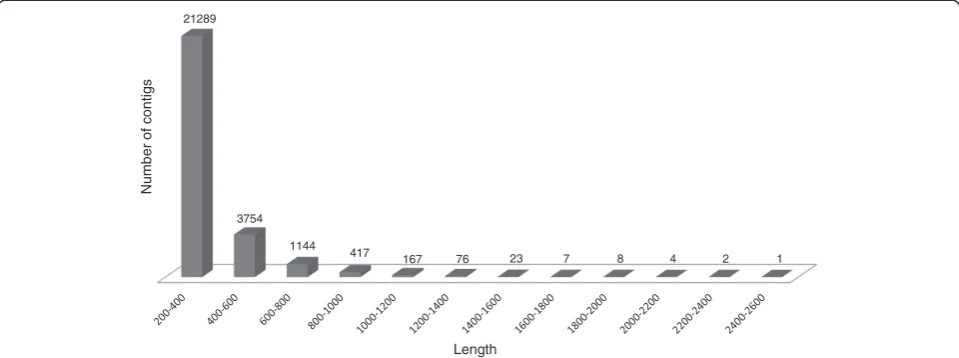
In the contig assembly process, 288 large contigs con-taining more than 1,000 bp were identified. The average length of the assembled contigs was 333 bp. The cumu-lative number of all contigs was 26,892, which amassed 8,978,367 bp. The contig size distribution is presented in Figure 7.
Data normalization and analysis
The assembled contigs were further analyzed by using the MG-RAST software package [140], which is a modi-fied version of RAST (Rapid Annotations based on Sub-system Technology).
SEED comprehensive non-redundant database compiled from various publicly available sequencing centers and other sources [142]. These databases include several rDNA datasets too, e.g. GREENGENES [143], RDP II [144], and European 16 S RNA [145], among other in-formation sources. To identify the gene content of the biogas reactor, all contigs were functionally annotated by means of the clusters of orthologous groups (COGs) of proteins made automatically by the MG-RAST server using the eggnog and COG databases. The generated matches to external databases were used to compute the derived data. The phylogenetic reconstruction of the contig sets was performed by using both the phylogen-etic information contained in the SEED nr database and the similarities to the ribosomal RNA database. Func-tional classifications of the PEGs were computed by pro-jecting against SEED FIGfams [146] and subsystems based on these similarity searches [142]. These func-tional assignments served as the raw input for an auto-matically generated initial metabolic reconstruction. The user interface provided a means of altering some of the parameters employed for the functional and metabolic reconstruction computation [140]. The acceptable per-centage of identity was set to be >70%, the minimum read length was>35 nucleotides and the e-value cut-off was<10-6. The contigs formed from the sequence reads were compared with the M5nr database for phylogenetic analyses [147], which integrated the previously men-tioned databases into a single, searchable database offered by MG-RAST.
Abbreviations
SOLiD™: Sequencing by Oligo Ligation and Detection new generation sequencing platform; CTAB: Cetyltrimethylammonium bromide;
EGT: Environmental gene tags; COG: Orthologous group of proteins;
CoM-S-S-HTP: Coenzyme M heterodisulfide heptanyl threonine phosphate) oxidoreductase; HS-HTP: 7-mercaptoheptanyl-L-threonine phosphate; PEGs: Potential protein encoding genes; TE buffer: Tris-EDTA buffer (10 mM Tris, 1 mM EDTA pH: 8.0).
Competing interest
The authors declare that they have no competing interests.
Acknowledgments
This work was supported by EU projects HUSRB/1002/214/041 IPA and HURO/1001/193/2.2.2. CBC. Domestic funds from GOP-1.1.2.-07/1-2003/8-0007, TÁMOP-4.2.1/B-09/1/KONV-2010-0005, Baross_DA07_DA_TECH-07-2008-0012, Baross_ALGOLABH, OMFB-00356/2010 and TÁMOP-4.2.2/B-10/1-2010-0012 are gratefully acknowledged.
Author details
1Department of Biotechnology, University of Szeged, Középfasor 52, Szeged
H-6726, Hungary.2Institute of Biochemistry, Biological Research Center,
Hungarian Academy of Sciences, Temesvári krt. 62, Szeged H-6726, Hungary.
3Bay Zoltán Nonprofit Research Ltd, Derkovits fasor 2, Szeged H-6726,
Hungary.4Institute of Biophysics, Biological Research Center, Hungarian
Academy of Sciences, Temesvári krt. 62, Szeged H-6726, Hungary.
Authors’contributions
RW developed the DNA extraction protocol and participated in the evaluation of the data. EK carried out the anaerobic digestion experiments and supervised the operation of the fermenters. GM organized and performed the next-generation sequencing and took part in the data analysis. BZ participated in the experimental work and its design. GR contributed to the data interpretation. KLK conceived the study, participated in its design and compiled the manuscript. All the authors have read and approved the final manuscript.
Authors’information
GM is Head of the Metagenomics Laboratory, Bay Zoltán Nonprofit Research Ltd., Szeged, Hungary. RW and EK are PhD students, ZB is a postdoc, RG is an Associate Professor, and KLK is a Full Professor and Department Chairman at the Department of Biotechnology, University of Szeged, Hungary. RG is the Director of the Environmental Research Institute at the University of Szeged. KLK is a Senior Adviser at the Institute of Biophysics, Biological Research Center, Hungarian academy of Sciences and also serves as President of the Hungarian Biogas Association.
Received: 10 April 2012 Accepted: 6 June 2012 Published: 6 June 2012
21289
3754
1144 417
167 76 23 7 8 4 2 1
Numb
e
r of
c
o
ntigs
Length
References
1. Angelidaki I, Ellegaard L:Codigestion of manure and organic wastes in centralized biogas plants: status and future trends.Appl Biochem Biotechnol2003,109:95–105.
2. Daniels L:Biotechnological potential of methanogens.Biochem Soc Symp 1992,58:181–193.
3. Weiland P:Production and energetic use of biogas from energy crops and wastes in Germany.Appl Biochem Biotechnol2003,109:263–274. 4. Santosh Y, Sreekrishnan TR, Kohli S, Rana V:Enhancement of biogas
production from solid substrates using different techniques—a review. Bioresour Technol2004,95:1–10.
5. Eder B, Schulz H:Biogas praxis: Grundlagen. Planung, Anlagenbau, Beispiele, Wirtschaftlichkeit, Freiburg: Ökobuch Verlang GmbH; 2005.
6. Bayer EA, Belaich JP, Shoham Y, Lamed R:The cellulosomes: multienzyme machines for degradation of plant cell wall polysaccharides.Annu Rev Microbiol2004,58:521–554.
7. Cirne DG, Lehtomaki A, Bjornsson L, Blackall LL:Hydrolysis and microbial community analyses in two-stage anaerobic digestion of energy crops. J Appl Microbiol2007,103:516–527.
8. Darke HL, Kusel K, Matthies C:Ecological consequences of the phylogenetic and physiological diversities of acetogens.Antonie Van Leeuwenhook2002,81:203–213.
9. Shin HS, Youn JH:Conversion of food waste into hydrogen by thermophilic acidogenesis.Biodegradation2005,16:33–44.
10. Huang LN, Zhou H, Chen YQ, Luo S, Lan CY, Qu LH:Diversity and structure of the archaeal community in the leachate of a full-scale recirculating landfill as examined by direct 16S rRNA gene sequence retrieval.FEMS Microbiol Lett2002,214:235–240.
11. Klocke M, Mähnert P, Mundt K, Souidi K, Linke B:Microbial community analysis of a biogas-producing completely stirred tank reactor fed continuously with fodder beet silage as mono-substrate.Syst Appl Microbiol2007,30:139–151.
12. McHugh S, Carton M, Mahony T, O’Flaherty V:Methanogenic population structure in a variety of anaerobic bioreactors.FEMS Microbiol Lett2003, 219:294–304.
13. Mladenovska Z, Dabrovski S, Ahring BK:Anaerobic digestion of manure and mixture of manure with lipids: biogas reactor performance and microbial community analysis.Water Sci Technol2003,48:271–278. 14. Ferry JG:Enzymology of one-carbon metabolism in methanogenic
pathways.FEM Microbiol. Rev1999,23:13–38.
15. Juottonen H, Galand PE, Yrjala K:Detection of methanogenic Archaea in peat: comparison of PCR primers targeting themcrAgene.Res Microbiol 2006,157:914–921.
16. Luedeers T, Chin KJ, Concard R, Friedrich M:Molecular analysis of methyl– coenzyme M reductase alpha subunit (mcrA) genes in rice field soil and enrichment cultures reveal the methanogenic phenotype of a novel archaeal lineage.Environ Microbiol2001,3:194–204.
17. Luton PE, Wayne JM, Sharp RJ, Riley PW:ThemcrAgene as an alternative to 16S rRNA in the phylogenetic analysis of methanogen populations in landfill.Microbiology2002,148:3521–3530.
18. Nunoura T, Oida H, Miyazaki J, Miyashita A, Imachi H, Takai K:Quantification ofmcrAby fluorescent PCR in methanogenic and methanotropic microbial communities.FEMS Microbiol Echol2008,64:240–247. 19. Zou C, Zhang J, Tang Y, Zhengkai X, Song R:Diversity of methanogenic
archaea in biogas reactor fed with swine feces as the mono-substrate by mcrAanalysis.Microbiol Res2010,1:27–35.
20. MacLean D, Jonathan DG, Studhole JD:Application of„next- generation” sequencing technologies to microbial genetics.Nature Rev2009,7:287–295. 21. Metzker ML:Sequencing technologies–the next generation.Nature Rev
2009,11:31–44.
22. Raes J, Foerstner KU, Bork P:Get the most out of your metagenome: computational analysis of environmental sequence data.Curr Opin Microbiol2007,10:490–498.
23. Tyson GW, Chapman J, Hugenholtz P, Allen EE, Ram RJ, Richardson PM, Solovyev VV, Rubin EM, Rokhsar DS, Banfield JF:Community structure and metabolism through reconstruction of microbial genomes from the environment.Nature2004,428:37–43.
24. Venter JC, Adams MD, Myers EW, Li WP, Mural RJ, Sutton GG, Smith HO, Yandell M, Evans CA, Holt RA, Gocayne JD, Amanatides P, Ballew RM, Huson DH, Wortman JR, Zhang Q, Codira CD, Zheng XH, Chen L, Skupski M, Subramanian G, Thomas PD, Zhang J, Gabor Miklos GL, Nelson C, Broder S,
Clark AG, Nadeau J, McKusick VA, Zinder N, Levine AJ,et al:The sequence of the human genome.Science2001,291:1304–1351.
25. Venter JC, Remington K, Heidelberg JF, Halpern AL, Rusch D, Eisen JA, Wu D, Paulsen I, Nelson KE, Nelson W, Fouts DE, Levy S, Knap AH, Lomas MW, Nelson K, White O, Peterson J, Hoffman J, Persons R, Baden-Tillson H, Pfannkoch C, Rogers Y-H, Smith HO:Environmental genome shotgun sequencing of the Sargasso Sea.Science2004,304:67–74.
26. Angly FE, Felts B, Breitbart M, Salamon P, Edwards RA, Carlson C, Chan AM, Haynes M, Kelley S, Liu H, Mahaffy JM, Mueller JE, Nulton J, Olson R, Parsons R, Rayhawk S, Suttle CA, Fohwer F:The marine viromes of four oceanic regions.PloS Biol2006,4:e368.
27. Edwards RA, Rodrigez-Brito B, Wegley L, Haynes M, Breitbart M, Peterson DM, Saar MO, Alexander S, Rohwer F:Using pyrosequencing to shed light on deep mine microbial ecology.BMC Genomics2006,7:57.
28. Gill SR, Pop M, Deboy RT, Eckburg PB, Turnbaugh PJ, Samuel BS, Gordon JI, Relman DA, Fraser-Liggett CM, Nelson KE:Metagenomic analysis of the human distal gut microbiome.Science2006,312:1355–1359. 29. Schlüter A, Bekel T, Diaz NN, Dondrup M, Eichenlaub R, Gartemann KH,
Krahn I, Krause L, Krömeke H, Kruse O, Mussgnug JH, Neuweger H, Niehaus K, Pühler A, Runte KJ, Szczepanpwski R, Tauch A, Tilker A, Viehöver P, Goessmann A:The metagenome of a biogas-producing microbial community of a production-scale biogas plant fermenter analyzed by the 454-pyrosequencing technology.J Biotech2008,136:77–90. 30. Krause L, Diaz NN, Edwards RA, Gartemann K-H, Krömeke H, Neuwger H,
Pühler A, Runte KJ, Schlüter A, Stoye J, Szczepanowski R, Tauch A, Goesmann A:Taxonomic composition and gene content of a methane-producing microbial community isolated from a biogas reactor.J Biotech 2008,136:91–101.
31. Kröber M, Bekel T, Diaz NN, Goesmann A, Sebastian J:Phylogenetic characterization of a biogas plant microbial community integrating clone library 16S-rDNA sequences and metagenome sequence data obtained by 454-pyrosequencing.J Biotech2009,142:38–49.
32. Sundberg C, Abu Al-Soud W, Larsson M, Svennson B, Sörensson S, Karlsson A:454-pyrosequencing analyses of bacterial and metagenomic Archaea DNA and RNA diversity in 20 full-scale biogas digesters. InProceedings of the First International Conference on Biogas Microbiology: 14–16 September 2011; Leipzig. Edited by Kleinsteuber S, Nikolausz M. Leipzig: UFZ Press; 2011:47. 33. Hanreich A, Schimpf U, Zakrzewski M, Schlüter A, Bendorf D, Klocke M:
Monitoring of changes within a microbial, biogas producing community. InProceedings of the First International Conference on Biogas Microbiology: 14–16 September 2011; Leipzig. Edited by Kleinsteuber S, Nikolausz M. Leipzig: UFZ Press; 2011:49.
34. Mardis ER:The impact of next-generation sequencing technology on genetics.Trends in Gen2008,24:133–141.
35. Overview of SOLiD™sequencing chemistry. http://www.appliedbiosystems. com/absite/us/en/home/applications-technologies/solid-next-generation-sequencing/next-generation-systems/solid-sequencing-chemistry.html. 36. Liu Z, Klatt CG, Wood JM, Rusch DB, Ludwig M, Wittekindt N, Tomsho LP,
Schuster SC, Ward DM, Bryant DA:Metatranscriptomic analyses of chlorophototrophs of a hot-spring microbial mat.IJSEM2011,5:1279–1290. 37. Tyler HL, Roesch LFW, Gowda S, Dawson WO, Triplett EW:Confirmation of
the sequence of‘Candidatus liberibacter asiaticus’and assessment of microbial diversity in Huanglongbing-infected Citrus phloem using a metagenomic approach.Mol Plant-Microbe Interactions2009,22:1624–1634. 38. Johansen SD, Karlsen BO, Furmanek T, Andreassen M, Jørgensen TE,
Bizuayehu TT, Breines R, Emblem A, Kettunen P, Luukko K, Edwardsen RB, Nordeide JT, Coucheron DH, Moum T:RNA deep sequencing of the Atlantic cod transcriptome.Comp Biochem Physiol Part D: Genomics and Proteomics2011,6:18–22.
39. McKernan KJ, Peckham HE, Costa G, McLaughlin S, Tsung E, Fu Y, Clouser YC, Dunkan C, Ichikawa J, Lee C, Zhang Z, Sherdian A, Fu H, Ranade S, Dimilanta E, Sokolsky T, Zhang L, Hendrickson C, Li B, Kotler L, Stuart J, Malek J, Manning J, Antipova A, Perez D, Moore M, Hayashibara K, Lynos M, Beaudoin R, Coleman B,et al:Sequence and structural variation in a human genome uncovered by short-read, massively parallel ligation sequencing using two base encoding.Genome Res2009,19:1527–1541. 40. CLC Genomics Workbench. http://www.clcbio.com/index.php?id = 1297. 41. Tools and data used in MG-RAST.
http://blog.metagenomics.anl.gov/tools-and-data-used-in-mg-rast/.
Comparative and joint analysis of two metagenomic datasets from a biogas fermenter obtained by 454-pyrosequencing.PLoS One2011,6: e14519.
43. About MG-RAST. http://blog.metagenomics.anl.gov/about/. 44. Ondov BD, Bergman NH, Phillippy AM:Interactive metagenomic
visualization in a Web browser.BMC Bioinformatics2011,12:385. 45. Lynd L, Weimer P, van Zyl W, Pretorius I:Microbial cellulose utilization:
fundamentals and biotechnology.Microbiol Mol Biol Rev2002,66:506–577. 46. Drake H, Küsel K, Matthies C:Ecological consequences of the phylogenetic
and physiological diversities of acetogens.Antonie Van Leeuwenhoek2002, 81:203–213.
47. Zverlov VV, Kellermann J, Schwarz WH:Functional subgenomics of Clostridium thermocellum cellulosomal genes: identification of the major catalytic components in the extracellular complex and detection of three new enzymes.Proteomics2005,5:3646–3653.
48. Gold DN, Martin JJV:Global view of the Clostridium thermocellum cellulosome revealed by quantitative proteomic analysis.J Bacteriol2007, 189:6787–6795.
49. Seedorf H, Fricke WF, Veith B, Brüggemann H, Liesegang H, Strittmatter A, Miethke M, Buckel W, Hinderberger J, Li F, Hagemeier C, Thauer RK, Gottschalk G:The genome ofClostridium kluyveri, a strict anaerobe with unique metabolic features.Proc Natl Acad Sci USA2008,105:2128–2133. 50. Jones DT, Woods DR:Acetone-butanol fermentation revisited.Microbiol
Mol Biol Rev1986,50:484–524.
51. Sabathé F, Bélaїch A, Soucaille P:Characterization of the cellulolytic complex (cellulosome) ofClostridium acetobutylicum.FEMS Microbiol Lett 2002,217:15–22.
52. Kaji M, Taniguchi Y, Matsushita O, Katayama S, Miyata S, Morita S, Okabe A: ThehydAgene encoding the H2evolving hydrogenase ofClostridium
perfingens: molecular characterization and expression of the gene.FEMS Microbiol Lett1999,181:329–336.
53. Guedon E, Desvaux M, Petitdemange H:Improvement of cellulolytic properties ofClostridium cellulolyticumby metabolic engineering.Appl Environ Microbiol2002,68:53–58.
54. Murray DW, Khan WA, van den Berg L:Clostridium saccharolyticurnsp. nov., a saccharolytic species from sewage sludge.IJSEM1982,32:132–135. 55. Larson H, Price A, Honour P, Boriello S:Clostridium difficileand the etology
of pseudomembranous colitis.The Lancet1978,311:1063–1066. 56. Shin H-S, Yaun J-H, Kim S-H:Hydrogen production from food waste in
anaerobic mesophilic and thermophilic acidogenesis.Int. J. Hydrogen Energy2004,29:1355–1363.
57. Liu Y, Yu P, Song X, Qu J:Hydrogen production from cellulose by co-culture ofClostridium thermocellumJN4 andThermoanaerobacterium thermosaccharolyticumGD17.Int J Hydrogen Energy2008,33:2927–2933. 58. Mutolik S, Vinodkumar CS, Swamy S, Manjappa S:Depolymerization of
bagasse byRuminococcus albusin the production of eco-friendly fuel. Res Biotechnol2011,2:1–6.
59. Lawson PA, Song Y, Chengxu L, Denise RM, Vaisanen ML, Collins MD, Finegold SM:Anaerotruncus colihominisgen. nov. sp. nov. from human feces.IJSEM2004,54:413–417.
60. Duncan SH, Hold GL, Harmsen HJM, Stewart CS, Flimt HJ:Growth requirements and fermentation products ofFusobacterium prausnitzii and a proposal to reclassify it asFaecalibacterium prausnitziigen. nov. comb. nov.IJSEM2002,52:2141–2146.
61. Nokaga H, Keresztes G, Shinoda Y, Ikenaga Y, Abe M, Naito K, Inatomi K, Kensuke F, Inui M, Yukawa H:Complete genome sequence of the dehalorespiring bacteriumDesulfitobacterium hafnienseY51 and comparison withDehalococcoides ethenogenes195 J.Bacteriol2006, 188:2262–2274.
62. Tang K-H, Yue H, Blankenship RE:Energy metabolism ofHeliobacterium modesticaldumduring phototrophic and chemotrophic growth.BMC Microbio2010,10:150–164.
63. Yokoyama H, Moriya M, Ohmori H, Waki M, Ogimo A, Tanaka Y:Community analysis of hydrogen producing extreme thermophilic anaerobic microflora enriched from cow manure with five substrates.Appl Microbiol Biotechnol2007,77:213–222.
64. McInerney MJ, Briant MP, Hespell RB, Casterton JW:Syntrophomonas wolfei gen. nov. sp. nov., an anaerobic, syntrophic, fatty acid-oxidizing bacterium.Appl Environ Microbiol1981,41:1029–1039.
65. Schink B:Energetics of syntrophic cooperation in methanogenic degradation.Microbiol Mol Biol Rev1997,61:262–280.
66. Ye Q, Roh Y, Caroll SL, Blair B, Zhou J, Zhang CL, Fields MW:Alkaline anaerobic respiration: isolation and characterization of a novel alkaliphilic and metal-reducing bacterium.Appl Environ Microbiol2004, 70:5595–5602.
67. Hydrogenases of Desulfotomaculum reducens. http://www.ncbi.nlm.nih. gov/gene?term = Desulfotomaculum%20reducens%20fe%20fe% 20hydrogenase.
68. Bagi Z, Ács N, Bálint B, Horváth L, Dobó K, Perei RK, Rákhely G, Kovács KL: Biotechnological intensification of biogas production.Appl Microbiol Biotechnol2007,76:473–482.
69. Goto T, Yamashita A, Hirakava H, Matsutani M, Todo K, Ohsima K, Toh H, Miyamato K, Kuhara S, Hattori M, Shimizu T, Akimoto S:Complete genome sequence ofFinegoldia magna, an opportunitic pathogen.DNA Res2008, 15:39–47.
70. Finegoldia magna putative hydrogenase. http://www.uniprot.org/uniprot/B0S2U0. 71. Demian AL, Newcomb M, David Wu JH:Cellulase, clostridia, and ethanol.
Microbiol Mol Biol Rev2005,69:124–154.
72. Müller V:Energy conservation in acetogenic bacteria.App Environ Microbiol2003,69:6345–6353.
73. Rother M, Oelgeschläger E:Carbon monoxide-dependent energy metabolism in anaerobic bacteria.Arch Microbiol2008,190:257–269. 74. Ragsdale SW, Pierce E:Acetogenesis and the Wood- Ljungdahl pathway
of CO2fixation.Rev Biochim Biophys Acta2008,1784:1873–1898. 75. Wu M, Ren Q, Durkin AS, Daugherty SC, Brinkac LM, Dobson RJ, Madupu R,
Sullivan SA, Kolonay JF, Nelson WC, Tallon LJ, Jones KM, Ulrich LE, Gonzalez JM, Zhullin IB, Robb FT, Eissen JA:Life in hot carbon monoxide: The complete genome sequence ofCarboxydothermus hydrogenoformans. PloS Genet2005,1:563–574.
76. Debarati P, Frank WA, Arick T, Bridges SM, Burgess SC, Yoginder SD, Lawrence ML:Genome sequence of the solvent-producing bacterium Clostridium carboxidivoransstrain P7.J Bacteriol2010,192:5554–5555. 77. Pierche E, Xie G, Baradote RD, Saunders E, Hann SC, Detter JC, Richardson P,
Brettin TS, Das A, Ljungdahl LG, Ragsdale SW:The complete genome sequence ofMoorella thermoacetica(f.Clostridium thermoaceticum). Environ Microbiol2008,10:2550–2573.
78. Boone DR, Whitman WB, Rouviere P:Diversity and taxonomy of methanogens. InMethanogenesis ecology, physiology, biochemistry and genetics, Boone DR, Whitman WB, Rouviere P. Edited by Ferry JG. New York: Chapman and Hall; 1993:35–80.
79. Enterococcus faecalis hydrogenase 3. http://biocyc.org/EFAE749511-HMP/ NEWIMAGE?object = Hydrogenase-3.
80. Wei C, Kunio O, Shoichi S:Intergeneric protoplast fusion between Fusobacterium variumandEnterococcus faeciumfor enhancing dehydrodivanillin degradation.Appl Environ Microbiol1987,53:542–548. 81. Guerra NP, Fajardo P, Fuciños C, Amado RI, Alonso E, Torrado A, Pastrana L:
Modelling the biphasic growth and product formation byEnterococcus faeciumCECT 410 in realkalized fed-batch fermentations in whey. J Biomed Biotechnol2010, 290286. Epub.: 2010. 06. 10.
82. Duport C, Zigha A, Ronsenfeld E, Schmitt P:Control of enterotoxin gene expression inBacillus cereusF4430/73 involves the redox sensitive ResDE signal transduction system.J Bacteriol2006,188:6640–6651.
83. Ohara H, Yahata M:α-lactic acid production by Bacillus sp. in anaerobic and aerobic culture.J Ferm Bioeng1996,81:272–274.
84. Hoskins J, Alborn JrWE, Arnold J, Blaszczak LC, Burgett S, DeHoff SB, Strem ST, Fritz L, Fu DJ, Fuller W, Geringer C, Gilmour R, Glass JS, Khoja H, Kraft AR, Lagace RE, LeBlanc DJ, Lee LN, Lefkowitz EJ, Lu J, Matshushima P, McAhren SM, McHenney M, McLeaster K, Mundy CW, Nicas TI, Norris FH, O’Gara M, Peery RB, Robertson GT,et al:Genome of the bacteriumStreptococcus pneumoniaestrain R6.J Bacteriol2001,183:5709–5717.
85. Klipper-Balz R, Schleifer HK:Streptococcus suissp. nov., nom. rev.IJSEM 1987,37:160–162.
86. Glaser P, Rusniak C, Buchrieser C, Chevalier F, Frangeul L, Msadek T, Zauine M, Couvé E, Lalioui L, Poyort C, Trieu-Cout P, Kunst F:Genome sequence of Streptococcus agalactiae.Mol Microbiol2002,45:1499–1513.
87. Streptococcus agalactiae. http://microbewiki.kenyon.edu/index.php/ Streptococcus_agalactiae.
88. Ramick TL, Fleming HP, McFeeters RF:Anaerobic and aerobic metabolism ofListeria monocytogenesin different glucose media.Appl Environ Microbiol1996,62:304–307.
90. Bjursel MK, Martens EC, Gordon JI:Functional genomic and metabolic studies of the adaptations of a prominent adult human gut symbiont, Bacteroides thetaiotaomicron, to the suckling period.J Biol Chem2006, 281:36269–36279.
91. Bacteroides thetaiotamicron. http://microbewiki.kenyon.edu/index.php/ Bacteroides_thetaiotaomicron.
92. Sakamato M, Benno Y:Reclassification ofBacteroides distasionis Bacteroides goldsteiniiandBacteroides merdaeasParabacteroides distasionisgen. nov. comb. nov.Parabacteroides goldsteiniicomb. nov. andParabacteroides mardaecomb. nov.IJSEM2006,56:1599–1605. 93. Maniloff J:McElhaney RN, Finch LR, Baseman JB: Mycoplasmas: molecular
biology and pathogenesis. Washington DC: American Society for Microbiology; 1992.
94. Lazarev VN, Levitskii SA, Basovskii YI, Chukin MM, Akopian TA, Vereshchagin VV, Kostrjukova ES, Kovaleva GY, Kazanov MD, Malko DB, Vitreschak AG, Sernova NV, Gelfand MS, Demina IA, Serebryakova MA, Galyamina MA, Vtyurin NN, Rogov SI, Alexeev DG, Ladygina VG, Govorun VN:Complete genome and proteome ofAcoleplasma laidlawii.J Bacteriol2011, 193:4943–4953.
95. Han K, Lim HC, Hong:Acetic acid formation inEscherichia coli fermentation.Biotechnol Bioeng1992,15:663–671.
96. Menon NK, Chatelus CY, Dervartanian M, Wendt JC, Shanmugam KT, Peck HD, Przybyla AE:Cloning and mutational analysis of thehuboperon encodingEscherichia colihydrogenase 2.J Bacteriol1994,176:4416–4423. 97. Ventura M, Canchaya C, Tauch A, Chandra G, Fitzgerald FG, Chater FK, van
Sinderen D:Genomics of Actinobacteria: Tracing the evolutionary history of an ancient phylum.Microbiol Mol Biol Rev2007,71:495–548.
98. Kirby B, Le Roes M, Meyers P:Kribella karoonensissp. nov. andKribella swartbargensissp. nov., isolated from soil from the Western Cape, South Africa.IJSEM2006,56:1097–1101.
99. Pukal R, Lapidus A, Nolan M, Copeland A, Glavina Del Rio T, Lucas S, Chen F, Tice H, Cheng J-F, Chertov O, Bruce D, Goodwin L, Kuske C, Brettin T, Detter JC, Han C, Pitluck S, Pati A, Mavrommatis K, Ivanova N, Ovchinnikova G, Chen A, Palaniappan K, Schneider S, Rohde M, Chain P, D’haeseleer P, Göker M, Bristow J,et al:Complete genome sequence ofSlackia
heliotrinireducenstype strain (RHS 1).SIGS2009,1. doi:10.4056. 100. Slackia heliotrinireducens Fe-S-cluster-containing hydrogenase subunit.
http://www.uniprot.org/uniprot/C7N224.
101. Schell MA, Karmrabűntzon M, Snel B, Vilanova D, Berger B, Pessi G, Zwahlen M-C, Desiere F, Bork P, Delley M, Pridmore RD, Arigoni F:The genome sequence ofBifidobacterium longumreflects its adaptation to the human gastrointestinal tract.Proc Natl Acad Sci USA2002,99. doi:10.1073. 102. Pelletier E, Kreimeyer A, Bocs S, Rouy Z, Gyapay G, Chouari R, Rivière D,
Ganesan A, Daegelen P, Sghir A, Cohen GN, Médigue C, Weissenbach J, La Paslier D:Candidatus Cloacamonas acidaminovorans”: genome sequence reconstruction provides a first glimpse of a new bacterial division. J Bacteriol2008,190:2572–2579.
103. Chouari R, Le Paslier D, Dauga C, Daegelen P, Weissenbach J, Sghir A:Novel major bacterial candidate division within a municipal anaerobic sludge digester.Environ Microbiol2005,7:1104–1115.
104. Deppenmeier U, Müller V:Life close to the thermodynamic limit: how methanogenic Archaea conserve energy.Results and problems in cell differentiation2008,45:123–152.
105. Thauer R, Kaster A, Seedorf H, Buckel W, Hedderich R:Methanogenic Archaea: ecological relevant differences in energy conservation.Nature Rev Microbiol2008,6:579–589.
106. Oelgeschläger E, Rother M:Carbon monoxide-dependent energy metabolism in anaerobic bacteria and archaea.Arch Microbiol2008, 190:257–269.
107. Deppenmeier U, Müller V, Gottschalk G:Pathways of energy conservation in methanogenic archaea.Arch Microbiol1996,165:149–163.
108. Ferry JG:Enzymology of the fermentation of acatate to methane by Methanosarcina thermophila.Biofactors1997,6:25–35.
109. Grahame DA:Catalysis of acetyl-CoA cleavage and tetrahydrosarcinapterin methylation by a carbon monoxide dehydrogenase-corrinoid enzyme complex.J Biol Chem1991,266:22227–22233.
110. Fischer R, Thauer RK:Ferredoxin-dependent methane formation from acetate in cell extracts ofMethanosarcina barkeri(strain MS).FEBS Lett 1990,269:368–372.
111. Anderson IJ, Sieprawska-Lupa M, Lapidus A, Nolan M, Copeland M, Del- Rio TG, Tice H, Dalin E, Barry K, Saunders E, Han C, Brettin T, Detter JC, Bruce D,
Mikhailova N, Pitluck S, Hauser L, Land M, Lucas S, Richardson P, Whitman WB, Kyrpides NC:Complete genome sequence ofMethanoculleus marisnigriRomesser et al. 1981 type strain JR1.Standards in Genomic Sciences2009,189.
112. Nettmann E, Bergmann I, Pramschüfer S, Mundt K, Plagsties V, Hermann C, Klocke M:Polyphasic analysis of methanogenic archaeal communities in agricultural biogas plants.Appl Environ Microbiol2010,76:2540–2548. 113. Ziganshin AM, Schmidt T, Scholwin F, II’inskaja ON, Harms H, Kleinsteuber S:
Bacteria and archaea involved in anaerobic digestion of distillers grains with solubles.Appl Microbiol Biotechnol2011,89:2039–2052.
114. Anderson I, Ulrich LE, Lupa B, Susanti D, Porat I, Hooper SD, Lykidis A, Sieprawska-Lupa M, Dharmarajan L, Goltsman E, Lapidus A, Saunders E, Han C, Land M, Lucas S, Mukhopadhyay B, Whitman WB, Woese C, Bristow J, Kyrpides N:Genomic characterization of methanomicrobiales reveals three classes of methanogens.PLoS One2009,4:5797.
115. Southam G, Kalmakoff ML, Jamell KF, Koval SF, Beveridge TJ:Isolation, characterization and cellular insertion of the flagella from two strains of the archaebacteriumMethanospirillum hungatei.J Bacteriol1990,172:3221–3228. 116. Cabillo-Quiroz H, Yavitt JB, Zinder SH:Methanosphaerula palustris gen nov
sp nov., a hydrogenotrophic methanogen isolated from a minerotrophic fen peatland.IJSEM2009,59:928–935.
117. Bräuer SL, Cabillo-Quiroz H, Ward RJ, Yavitt JB, Zinder SH:Methanoregula booneigen. nov. sp., an acidophilic methanogen isolated from an acidic peat bog.IJSEM2010,61:45–52.
118. Zhao Y, Boone DR, Mah RA, Boone JE, Xun L:Isolation and characterization ofMethanocorpusculum labreanumsp. Nov. from LaBrea tar pits.IJSEM 1989,39:10–13.
119. Brambilla E, Djao ODN, Daligault H, Lapidus A, Lucas S, Hammon N, Nolan M, Tice H, Cheng J-F, Han C, Tapia R, Goodvin L, Putluck S, Liolios K, Ivanova N, Mavromatis K, Mikhailova M, Pati A, Chen A, Palaniappan K, Land M, Hauser L, Chang Y-J, Jeffries CD, Rohde M, Spring S, Sikorski J, Göker M, Woyke T,et al:Complete genome sequence ofMethanoplanus petroleariustype strain (SEBR 4847T).SIGS2010,3:203–211.
120. Kessler PS, Blank C, Leigh JA:Thenifgene operon of the methanogenic archaeonMethanococcus maripaludis.J Bacteriol1998,180:1504–1511. 121. Galagan JE, Nusbaum C, Roy A, Endrizzi MG, McDolnald P, FritzHugh W,
Calvo S, Engels R, Smirnov S, Atnoor D, Brown A, Allen N, Naylor J, Sthange-Thomann N, DeArrellano K, Johnson R, Linton L, McEwan P, McKernan K, Talamas J, Tirrel A, Ye W, Zimmer A, Barber RD, Cann I, Graham DE, Grahame DA, Guss AM, Hedderich R, Ingram-Smith C,et al:The genome of M. acetivoransreveals extensive metabolic and physiological diversity. Genome Res2002,12:532–542.
122. Ercel C, Kube M, Reinhardt R, Liesack W:Genome of Rice Cluster I archaea
–the key methane producers in the rice rhizosphere.Science2006, 313:370–372.
123. Schnürer A, Houwen FH, Svensson BH:Mesophilic syntrophic acetate oxidation during methane formation by a triculture at high ammonium concentration.Arch Microbiol1994,162:70–74.
124. Schnürer A, Schink B, Svensson BH:Clostridium ultunensesp. nov., a mesophilic bacterium oxidizing acetate in syntrophic association with a hydrogenotrophic methanogenic bacterium.IJSEM1996,46:1145–1152. 125. Chouquet CG, Sprott GD:Metal chelate affinity chromatography for the
purification of the F420-reducing (Ni, Fe) hydrogenase of Methanospirillum hungatei.J Microbiol Methods1991,13:161–169. 126. Löffler FE, Sanford RA:Analysis of trace hydrogen metabolism.Environ
Microbiol2005,397:22–237.
127. Thauer RK, Hedderich R, Fischer R:Reactions and enzymes involved in methanogenesis from CO2and H2. In Edited by Ferry JG. New York, London: Chapman and Hall; 1993:209–252. Methanogenesis.
128. Ferry JG:Formate dehydrogenase.FEMS Microbiol Rev1990,87:377–382. 129. Jaenicke S, Zakrzewski M, Jünemann S, Pühler A, Groesmann A, Schlüter A:
Analysis of the metagenome from biogas-producing microbial community by means of bioinformatics methods. InHandbook of Molecular Microbial Ecology, vol. II. Metagenomics in Different Habitats. 1st edition. Edited by de Bruijn FJ. Hoboken: Wiley-Blackwell; 2011:403–414. 130. Herbel Zs, Rákhely G, Bagi Z, Ivanova G, Ács N, Kovács E, Kovács KL:
Exploitation of the extremely thermophilicCaldicellulosiruptor saccharolyticusin hydrogen and biogas production from biomasses. Environ Technol2010,31:1017–1024.