Copyright © 2008 Pearson Education, Inc., publishing as Pearson Benjamin Cummings
PowerPoint® Lecture Presentations for
Biology
Eighth Edition
Neil Campbell and Jane Reece
Lectures by Chris Romero, updated by Erin Barley with contributions from Joan Sharp
Chapter 47
Chapter 47
Overview: A Body-Building Plan
• It is difficult to imagine that each of us began
life as a single cell called a zygote
• A human embryo at about 6–8 weeks after
Copyright © 2008 Pearson Education, Inc., publishing as Pearson Benjamin Cummings
• The question of how a zygote becomes an
animal has been asked for centuries
• As recently as the 18th century, the prevailing
theory was called preformation
• Preformation is the idea that the egg or sperm
• Development is determined by the zygote’s genome and molecules in the egg called
cytoplasmic determinants
• Cell differentiation is the specialization of
cells in structure and function
Copyright © 2008 Pearson Education, Inc., publishing as Pearson Benjamin Cummings
• Model organisms are species that are
representative of a larger group and easily
studied, for example, Drosophila and
Caenorhabditis elegans
• Classic embryological studies have focused on
the sea urchin, frog, chick, and the nematode
Concept 47.1: After fertilization, embryonic development proceeds through cleavage,
gastrulation, and organogenesis
• Important events regulating development occur
during fertilization and the three stages that build the animal’s body
– Cleavage: cell division creates a hollow ball of cells called a blastula
Copyright © 2008 Pearson Education, Inc., publishing as Pearson Benjamin Cummings
Fertilization
• Fertilization brings the haploid nuclei of sperm
and egg together, forming a diploid zygote
• The sperm’s contact with the egg’s surface
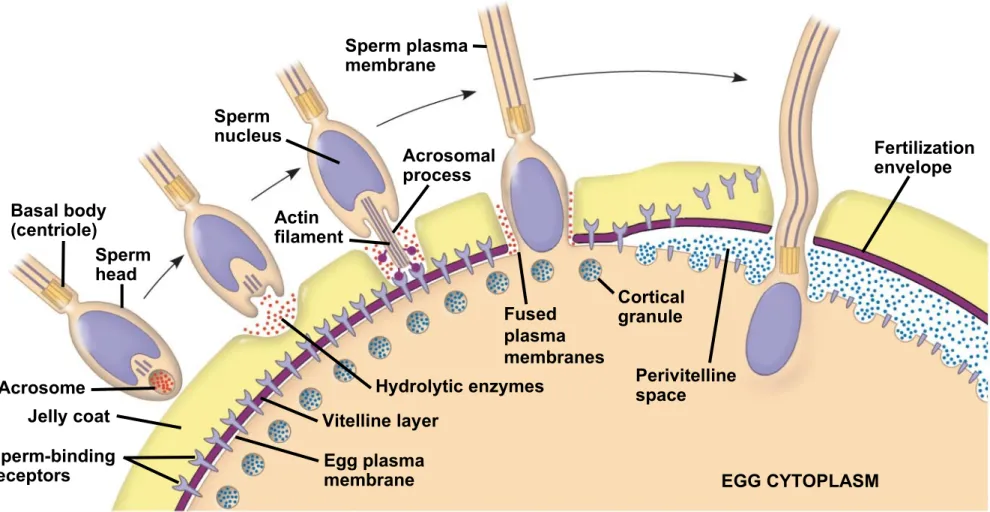
The Acrosomal Reaction
• The acrosomal reaction is triggered when the
sperm meets the egg
• The acrosome at the tip of the sperm releases hydrolytic enzymes that digest material
Fig. 47-3-5 Basal body (centriole) Sperm head Sperm-binding receptors Acrosome
Jelly coat Vitelline layer
• Gamete contact and/or fusion depolarizes the
egg cell membrane and sets up a fast block to
Copyright © 2008 Pearson Education, Inc., publishing as Pearson Benjamin Cummings
The Cortical Reaction
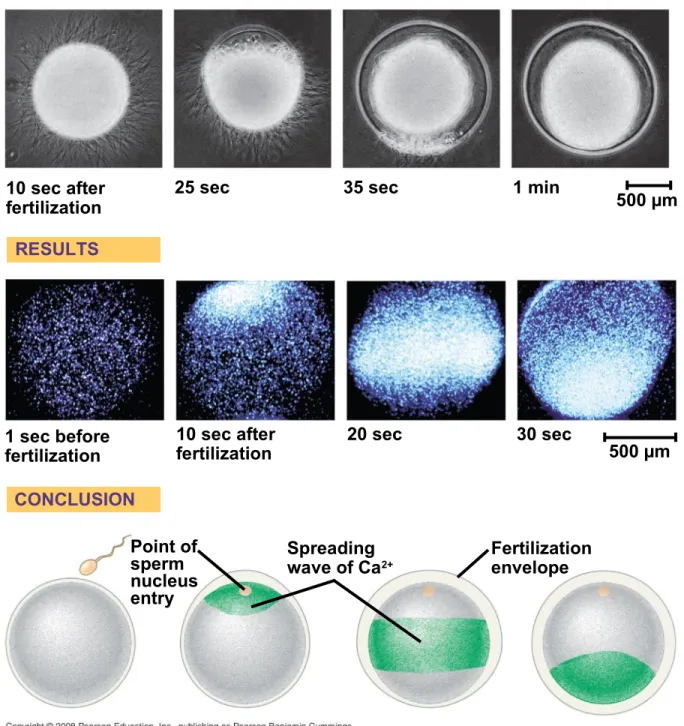
• Fusion of egg and sperm also initiates the
cortical reaction
• This reaction induces a rise in Ca2+ that
stimulates cortical granules to release their
contents outside the egg
• These changes cause formation of a
Fig. 47-4
EXPERIMENT
10 sec after fertilization
1 sec before fertilization
RESULTS
CONCLUSION
25 sec 35 sec 1 min
500 µm
10 sec after
fertilization 20 sec 30 sec 500 µm
Point of
sperm Spreadingwave of Ca2+
Copyright © 2008 Pearson Education, Inc., publishing as Pearson Benjamin Cummings
Activation of the Egg
• The sharp rise in Ca2+ in the egg’s cytosol
increases the rates of cellular respiration and protein synthesis by the egg cell
• With these rapid changes in metabolism, the
egg is said to be activated
• The sperm nucleus merges with the egg
Fertilization in Mammals
• Fertilization in mammals and other terrestrial
animals is internal
• In mammalian fertilization, the cortical reaction
modifies the zona pellucida, the extracellular
matrix of the egg, as a slow block to
Fig. 47-5
Follicle cell
Zona pellucida
Cortical granules Sperm
nucleus Sperm
• In mammals the first cell division occurs 12–36
hours after sperm binding
• The diploid nucleus forms after this first division
Copyright © 2008 Pearson Education, Inc., publishing as Pearson Benjamin Cummings
Cleavage
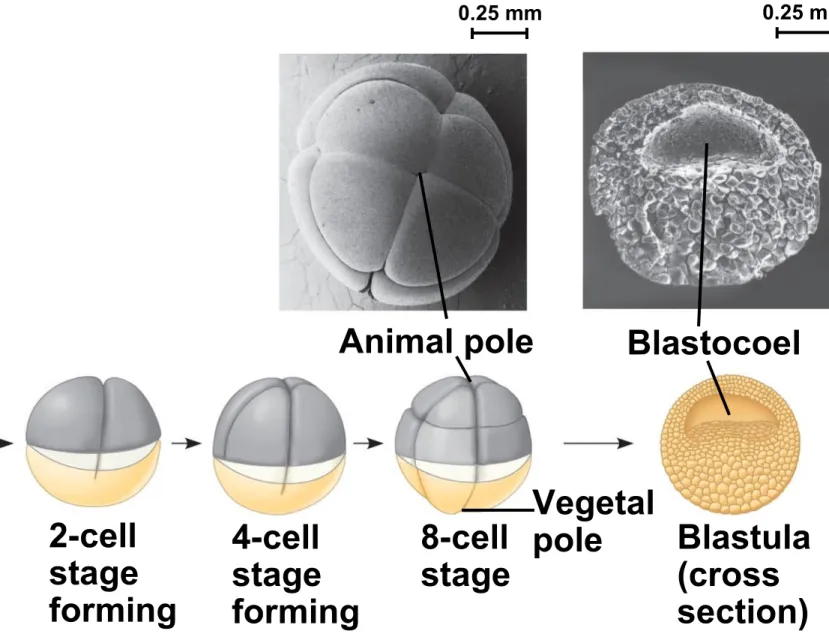
• Fertilization is followed by cleavage, a period
of rapid cell division without growth
• Cleavage partitions the cytoplasm of one large
cell into many smaller cells called blastomeres
• The blastula is a ball of cells with a fluid-filled
Fig. 47-6
Copyright © 2008 Pearson Education, Inc., publishing as Pearson Benjamin Cummings
• The eggs and zygotes of many animals, except
mammals, have a definite polarity
• The polarity is defined by distribution of yolk
(stored nutrients)
• The three body axes are established by the
egg’s polarity and by a cortical rotation following binding of the sperm
• Cortical rotation exposes a gray crescent
Fig. 47-7
(a) The three axes of the fully developed embryo
(b) Establishing the axes
• Cleavage planes usually follow a pattern that is
Fig. 47-8-6 Blastula (cross section) Blastocoel Animal pole 4-cell stage forming 2-cell stage forming Zygote 8-cell stage Vegetal pole
• Cell division is slowed by yolk
• Holoblastic cleavage, complete division of the egg, occurs in species whose eggs have little or moderate amounts of yolk, such as sea
Copyright © 2008 Pearson Education, Inc., publishing as Pearson Benjamin Cummings
• Meroblastic cleavage, incomplete division of
Gastrulation
• Gastrulation rearranges the cells of a blastula
into a three-layered embryo, called a gastrula,
Copyright © 2008 Pearson Education, Inc., publishing as Pearson Benjamin Cummings
• The three layers produced by gastrulation are
called embryonic germ layers
– The ectoderm forms the outer layer
– The endoderm lines the digestive tract
– The mesoderm partly fills the space between the endoderm and ectoderm
Video: Sea Urchin Embryonic Development
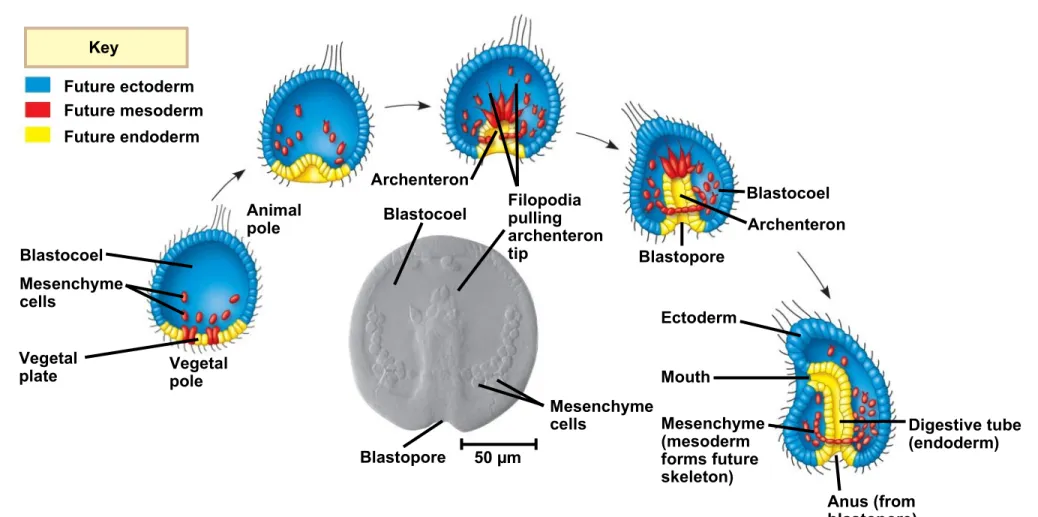
• Gastrulation in the sea urchin embryo
– The blastula consists of a single layer of cells surrounding the blastocoel
– Mesenchyme cells migrate from the vegetal pole into the blastocoel
Copyright © 2008 Pearson Education, Inc., publishing as Pearson Benjamin Cummings
• Gastrulation in the sea urchin embryo
– The newly formed cavity is called the
archenteron
Fig. 47-9-6 Future ectoderm Key Future endoderm Digestive tube (endoderm) Mouth Ectoderm Mesenchyme (mesoderm forms future skeleton) Anus (from Future mesoderm Blastocoel Archenteron Blastopore Blastopore Mesenchyme cells Blastocoel Blastocoel Mesenchyme cells Archenteron Vegetal
plate Vegetalpole
Copyright © 2008 Pearson Education, Inc., publishing as Pearson Benjamin Cummings
• Gastrulation in the frog
– The frog blastula is many cell layers thick
– Cells of the dorsal lip originate in the gray crescent and invaginate to create the
archenteron
– Cells continue to move from the embryo surface into the embryo by involution
– These cells become the endoderm and
• Gastrulation in the frog
– The blastopore encircles a yolk plug when
gastrulation is completed
– The surface of the embryo is now ectoderm, the innermost layer is endoderm, and the
Fig. 47-10-4 Future ectoderm Key Future endoderm Future mesoderm SURFACE VIEW Animal pole Vegetal pole Early gastrula Blastopore Blastocoel Dorsal lip of blasto-pore CROSS SECTION Dorsal lip of blastopore Late gastrula Blastocoel shrinking Archenteron Blastocoel remnant Archenteron Blastopore
Blastopore Yolk plug
Ectoderm Mesoderm
• Gastrulation in the chick
– The embryo forms from a blastoderm and sits on top of a large yolk mass
– During gastrulation, the upper layer of the blastoderm (epiblast) moves toward the
Copyright © 2008 Pearson Education, Inc., publishing as Pearson Benjamin Cummings
– The midline thickens and is called the
primitive streak
– The movement of different epiblast cells gives rise to the endoderm, mesoderm, and
Fig. 47-11
Future ectoderm
Dorsal Fertilized egg
Copyright © 2008 Pearson Education, Inc., publishing as Pearson Benjamin Cummings
Organogenesis
• During organogenesis, various regions of the
germ layers develop into rudimentary organs
• Early in vertebrate organogenesis, the
Fig. 47-12
Neural folds Tail bud
Neural tube
(b) Neural tube formation Neural
fold
Neural plate
Neural
fold Neural plate
Neural crest cells Neural crest cells Outer layer of ectoderm Mesoderm Notochord Archenteron Ectoderm Endoderm
(a) Neural plate formation
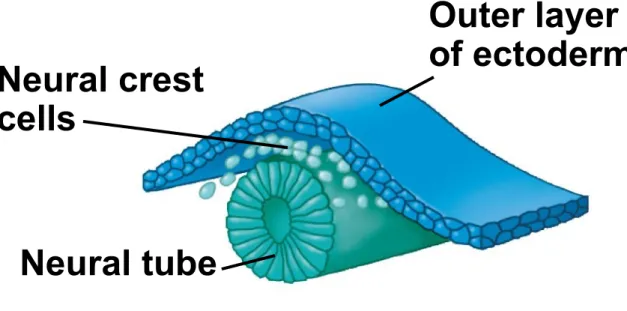
• The neural plate soon curves inward, forming
the neural tube
• The neural tube will become the central
Fig. 47-12b-4
Neural tube Neural crest cells
Outer layer of ectoderm
• Neural crest cells develop along the neural
tube of vertebrates and form various parts of
the embryo (nerves, parts of teeth, skull bones, and so on)
• Mesoderm lateral to the notochord forms
blocks called somites
• Lateral to the somites, the mesoderm splits to
• Organogenesis in the chick is quite similar to
Fig. 47-13
Endoderm
(a) Early organogenesis Neural tube Coelom Notochord These layers form extraembryonic membranes YOLK Heart Eye Neural tube Somite Archenteron Mesoderm Ectoderm Lateral fold Yolk stalk Yolk sac
(b) Late organogenesis
Somites Forebrain
• The mechanisms of organogenesis in
Fig. 47-14
ECTODERM MESODERM ENDODERM
Epidermis of skin and its derivatives (including sweat glands, hair follicles)
Epithelial lining of mouth and anus
Cornea and lens of eye Nervous system
Sensory receptors in epidermis
Adrenal medulla Tooth enamel
Epithelium of pineal and pituitary glands
Notochord
Skeletal system Muscular system Muscular layer of
stomach and intestine Excretory system
Circulatory and lymphatic systems
Reproductive system (except germ cells) Dermis of skin
Lining of body cavity Adrenal cortex
Epithelial lining of digestive tract Epithelial lining of respiratory system
Lining of urethra, urinary bladder, and reproductive system
Liver Pancreas Thymus
Developmental Adaptations of Amniotes
• Embryos of birds, other reptiles, and mammals
develop in a fluid-filled sac in a shell or the uterus
• Organisms with these adaptations are called
Copyright © 2008 Pearson Education, Inc., publishing as Pearson Benjamin Cummings
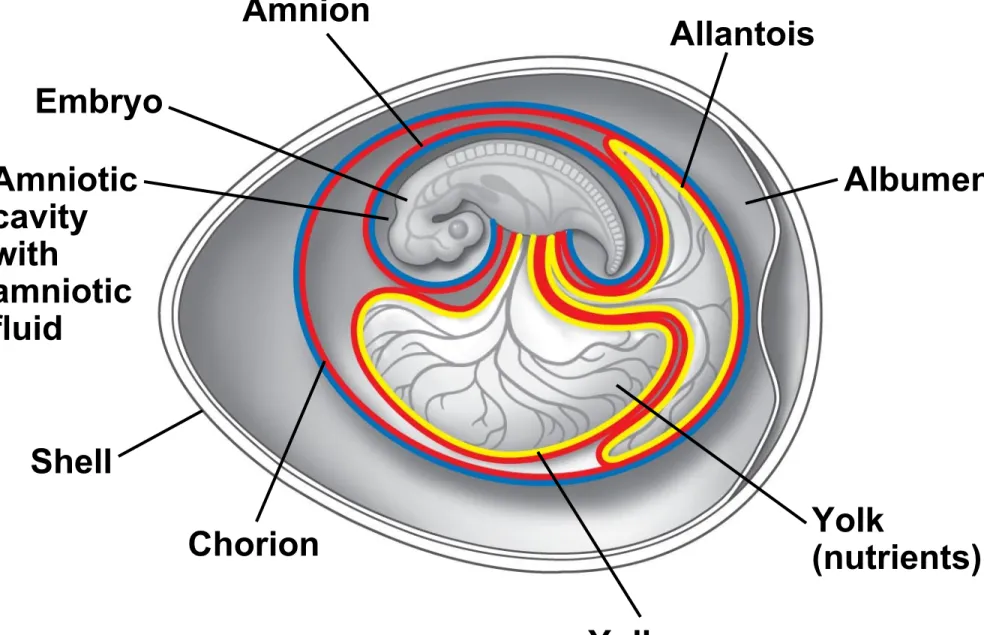
• During amniote development, four
extraembryonic membranes form around the embryo:
– The chorion functions in gas exchange
– The amnion encloses the amniotic fluid
– The yolk sac encloses the yolk
Fig. 47-15
Embryo
Amnion
Amniotic cavity with
amniotic fluid
Shell
Chorion Yolk (nutrients)
Allantois
Copyright © 2008 Pearson Education, Inc., publishing as Pearson Benjamin Cummings
Mammalian Development
• The eggs of placental mammals
– Are small and store few nutrients
– Exhibit holoblastic cleavage
– Show no obvious polarity
• Gastrulation and organogenesis resemble the
processes in birds and other reptiles
• Early cleavage is relatively slow in humans and
• At completion of cleavage, the blastocyst
forms
• A group of cells called the inner cell mass
develops into the embryo and forms the extraembryonic membranes
Copyright © 2008 Pearson Education, Inc., publishing as Pearson Benjamin Cummings
• The epiblast cells invaginate through a
primitive streak to form mesoderm and endoderm
• The placenta is formed from the trophoblast,
mesodermal cells from the epiblast, and adjacent endometrial tissue
• The placenta allows for the exchange of
materials between the mother and embryo
• By the end of gastrulation, the embryonic germ
Fig. 47-16-5 Yolk sac Mesoderm Amnion Chorion Ectoderm Trophoblast Endoderm Hypoblast Expanding region of trophoblast Epiblast Maternal blood vessel Trophoblast Hypoblast Endometrial epithelium (uterine lining)
Inner cell mass
Blastocoel Uterus Epiblast Amniotic cavity Expanding region of trophoblast
Copyright © 2008 Pearson Education, Inc., publishing as Pearson Benjamin Cummings
• The extraembryonic membranes in mammals
Concept 47.2: Morphogenesis in animals involves specific changes in cell shape, position, and
adhesion
• Morphogenesis is a major aspect of
development in plants and animals
• Only in animals does it involve the movement
Copyright © 2008 Pearson Education, Inc., publishing as Pearson Benjamin Cummings
The Cytoskeleton, Cell Motility, and Convergent Extension
• Changes in cell shape usually involve
reorganization of the cytoskeleton
• Microtubules and microfilaments affect
Fig. 47-17-6
Actin filaments Microtubules Ectoderm
Copyright © 2008 Pearson Education, Inc., publishing as Pearson Benjamin Cummings
• The cytoskeleton also drives cell migration, or
cell crawling, the active movement of cells
• In gastrulation, tissue invagination is caused by
changes in cell shape and migration
• Cell crawling is involved in convergent
Fig. 47-18
Conv
ergen ce
Copyright © 2008 Pearson Education, Inc., publishing as Pearson Benjamin Cummings
Role of Cell Adhesion Molecules and the Extracellular Matrix
• Cell adhesion molecules located on cell
surfaces contribute to cell migration and stable tissue structure
• One class of cell-to-cell adhesion molecule is
Fig. 47-19
0.25 mm 0.25 mm
Copyright © 2008 Pearson Education, Inc., publishing as Pearson Benjamin Cummings
• Fibers of the extracellular matrix may function
as tracks, directing migrating cells along routes
• Several kinds of glycoproteins, including
Fig. 47-20
Experiment 1
Matrix blocked
RESULTS
Copyright © 2008 Pearson Education, Inc., publishing as Pearson Benjamin Cummings
Concept 47.3: The developmental fate of cells
depends on their history and on inductive signals
• Cells in a multicellular organism share the
same genome
• Differences in cell types is the result of
• Two general principles underlie differentiation:
1. During early cleavage divisions, embryonic
cells must become different from one another
– If the egg’s cytoplasm is heterogenous, dividing cells vary in the cytoplasmic
Copyright © 2008 Pearson Education, Inc., publishing as Pearson Benjamin Cummings
2. After cell asymmetries are set up, interactions
among embryonic cells influence their fate, usually causing changes in gene expression
Fate Mapping
• Fate maps are general territorial diagrams of
embryonic development
• Classic studies using frogs indicated that cell
Fig. 47-21
Epidermis
(b) Cell lineage analysis in a tunicate (a) Fate map of a frog embryo
Epidermis
• Techniques in later studies marked an
Fig. 47-22 Mouth Zygote Intestine Nervous system, outer skin, muscula-ture Intestine Hatching Eggs Vulva Anus 1.2 mm ANTERIOR POSTERIOR Muscula-ture, gonads 10 0
First cell division
Establishing Cellular Asymmetries
• To understand how embryonic cells acquire
Copyright © 2008 Pearson Education, Inc., publishing as Pearson Benjamin Cummings
The Axes of the Basic Body Plan
• In nonamniotic vertebrates, basic instructions
for establishing the body axes are set down early during oogenesis, or fertilization
• In amniotes, local environmental differences
play the major role in establishing initial
Restriction of the Developmental Potential of Cells
• In many species that have cytoplasmic
determinants, only the zygote is totipotent
• That is, only the zygote can develop into all the
Copyright © 2008 Pearson Education, Inc., publishing as Pearson Benjamin Cummings
• Unevenly distributed cytoplasmic determinants
in the egg cell help establish the body axes
• These determinants set up differences in
Fig. 47-23b
Thread Gray
crescent
Experimental egg (side view)
Gray crescent Control egg
(dorsal view)
EXPERIMENT
Copyright © 2008 Pearson Education, Inc., publishing as Pearson Benjamin Cummings
• As embryonic development proceeds, potency
Cell Fate Determination and Pattern Formation by Inductive Signals
• After embryonic cell division creates cells that
Copyright © 2008 Pearson Education, Inc., publishing as Pearson Benjamin Cummings
The “Organizer” of Spemann and Mangold
• Based on their famous experiment, Hans
Spemann and Hilde Mangold concluded that
the blastopore’s dorsal lip is an organizer of the embryo
• The Spemann organizer initiates inductions
Fig. 47-24
Primary structures: Neural tube
Dorsal lip of blastopore Secondary (induced) embryo Notochord Pigmented gastrula (donor embryo) EXPERIMENT Primary embryo RESULTS Nonpigmented gastrula (recipient embryo) Secondary structures:
Notochord (pigmented cells)
Copyright © 2008 Pearson Education, Inc., publishing as Pearson Benjamin Cummings
Formation of the Vertebrate Limb
• Inductive signals play a major role in pattern
formation, development of spatial organization
• The molecular cues that control pattern
formation are called positional information
• This information tells a cell where it is with
respect to the body axes
• It determines how the cell and its descendents
• The wings and legs of chicks, like all vertebrate
Fig. 47-25
(a) Organizer regions Apical ectodermal ridge (AER)
Digits Limb buds
(b) Wing of chick embryo
• The embryonic cells in a limb bud respond to
positional information indicating location along three axes
– Proximal-distal axis
– Anterior-posterior axis
Copyright © 2008 Pearson Education, Inc., publishing as Pearson Benjamin Cummings
• One limb-bud organizer region is the apical
ectodermal ridge (AER)
• The AER is thickened ectoderm at the bud’s tip
• The second region is the zone of polarizing
activity (ZPA)
• The ZPA is mesodermal tissue under the
• Tissue transplantation experiments support the
hypothesis that the ZPA produces an inductive signal that conveys positional information
• Signal molecules produced by inducing cells
influence gene expression in cells receiving them
• Signal molecules lead to differentiation and the
development of particular structures
• Hox genes also play roles during limb pattern
Fig. 47-UN1
Sperm-egg fusion and depolarization of egg membrane (fast block to
polyspermy)
Cortical granule release (cortical reaction)
Fig. 47-UN2
Blastocoel Animal pole 2-cell
stage forming
8-cell stage
Copyright © 2008 Pearson Education, Inc., publishing as Pearson Benjamin Cummings
You should now be able to:
1. Describe the acrosomal reaction
2. Describe the cortical reaction
3. Distinguish among meroblastic cleavage and
holoblastic cleavage
4. Compare the formation of a blastula and
gastrulation in a sea urchin, a frog, and a chick
5. List and explain the functions of the
6. Describe the process of convergent extension
7. Describe the role of the extracellular matrix in
embryonic development
8. Describe two general principles that integrate
our knowledge of the genetic and cellular mechanisms underlying differentiation
Copyright © 2008 Pearson Education, Inc., publishing as Pearson Benjamin Cummings
10.Explain pattern formation in a developing